‘Okryu’ North Korean online shopping website gaining popularity

April 10th, 2015

Institute for Far Eastern studies (IFES)

According to the Japanese newspaper Choson Sinbo, a new online shopping mall in North Korea is enjoying popularity. “In Choson [North Korea] an e-commerce service system is being operated that handles food and all kinds of light industry goods,” the newspaper’s Pyongyang correspondent reported on April 2, 2015.

The newspaper explained that at the end of 2014, North Korea did a test-run of the system, and since the beginning of this year it has been in full operation. Since February of this year, they also started an e-commerce service that uses smart phones with communication functions.

Users access a computer network, and after joining the ‘Okryu’ e-commerce system, they can browse and purchase products.

In the Okryu e-commerce system, there are products of various name-brand commercial stores, restaurants and shops, including Changjon Haemaji Restaurant, Haedanghwa Restaurant, and Kumsong Foodstuff Factory.

On the homepage users are able to search for the products and when they decide to purchase a product they pay for it with an electronic card.

Currently, a variety of North Korean products are sold through Okryu, including various culinary dishes and food items, cosmetics and medical supplies, and footwear and bags. The Choson Sinbo said that “through Okryu [North Koreans] can even order naengmyon (cold buckwheat noodles) from the famous Okryukwan Restaurant.”

The newspaper went on to say, “This system has been a sensation among working-housewives, who can conveniently buy the products they need without going to the store […] There are also many users who choose products from Okryu’s homepage to send to friends or family during holidays and on birthdays.”

According to officials from the General People’s Service Bureau, “If the same types of products produced at several stores or factories are posted on the computer network, people will choose to purchase goods that are higher quality and cheaper in price. As a result, production units will begin competing in the areas of cost-saving and quality improvement.”

The newspaper added, “In the future the ‘Okryu’ homepage will not just contain the pictures of products, but it will also contain audio and video and become a fully multimedia website.” The e-commerce system is “also exploring a service that would make it possible for travelers to make reservations and search for information about accommodations at their respective destinations.”

Here is what KCNA had to say (2015-4-2):

Online Commercial Service Begins in DPRK
Pyongyang, April 2 (KCNA) — Online commercial service system, called “Okryu”, is run by the General Bureau of Public Service in the DPRK.

Citizens can make a search for their necessities like consumer goods and medicines even with mobile phone after joining in the system and ask for delivery.

Jong Sol Hwa, an official of the general bureau, told that the system helps consumers easily purchase their necessities at a lower cost.

Here is a translation of a longer April 2 article in the Choson Sinbo about the Okryu service:

E-commerce Service Okryu (옥류): Delivery also Possible
Search for Goods Online and Pay with Card.

North Korea has launched an e-commerce site mostly for food items or various light industry goods.

Order Okryu-gwan’s Noodle via Mobile Phones

People’s Service General Bureau(인민봉사총국) operates an e-commerce site called 《Okryu》. It started test operation at the end of 2014 and has run the service since the beginning of this year. 《Okryu》 is based on nationwide intranet and electronic payments systems and its operating principles are 《Put People’s Convenience First》 and 《Serve the Best Domestic Goods》.

It has also started since February the e-commerce service via mobile phones.

After customers access the internet and join the site 《Okryu》, they search for the products and order them.

People’s Service General Bureau(인민봉사총국) connects with nationwide commerce service units and make people purchase various goods without inconvenience at low prices.

On the website, popular products from well-known stores, restaurants, and commerce service units of each region including Changjeon Haemaji Restaurant(창전해맞이식당), Haedanghwa Service Complex(해당화관), and Keumsong Food Industry(금성식료공장).

Customers can search for and browse the goods they want on the website and pay when they order with electronic cards.

They can also ask corresponding commerce service units via phone call the features of their products before purchasing.

Diverse domestic goods including food and groceries, cosmetics and medicine, and shoes and bags are sold through 《Okryu》. Even cold-noodles from the Okryu Restaurant can be ordered.

There is also a delivery system ensuring the speed and the accuracy. Many different affiliated transportation companies under the People’s Service General Bureau(인민봉사총국) undertakes the delivery tasks.

The e-commerce service has gained popularity due to its convenience, especially for housewives who go to work as they can purchase without going directly to stores.

There are also consumers purchasing through 《Okryu》 to buy presents for their family and friends around holyday or birthday.

Opportunity for Low Price・Quality Competition

The persons from the People’s Service General Bureau emphasize the purpose of this service; to secure people’s convenience as much as possible through 《our products》, the best quality domestic goods.

According to their explanation, as many but the same types of products from different stores or factories are listed on the site, people find the products with lower price but higher quality. In consequence, there must be the competition for cost saving and quality improvement among production units.

“The e-commerce is only in its beginning stages, we will keep trying to collect people’s opinions actively and to secure their convenience, they said.

《Okryu》 is planning to include multimedia such as audio and video as well as the images of the products. Also, it will launch the service that tourists can search for accommodations of each region and make a reservation for them.

Additional Information:

1. Here is the original report in the Choson Sinbo.

2. Here is coverage in North Korea Tech.

3. Here is coverage in UPI.

4. Here is coverage in NK News.

Share

Third session of 13th SPA held

April 9th, 2015

According to KCNA (2015-4-9):

The Third Session of the 13th Supreme People’s Assembly (SPA) of the DPRK took place at the Mansudae Assembly Hall Thursday.

Present there were deputies to the SPA.

Present there as observers were officials of the party, armed forces and power organs, social organizations, ministries and national institutions and those in the fields of science, education, literature and art, public health and media.

The participants observed a moment’s silence in memory of President Kim Il Sung and leader Kim Jong Il, founder and builder and eternal leaders of the DPRK.

Discussed at the session were “1. On the work of the DPRK Cabinet for Juche 103 (2014) and its tasks for Juche 104 (2015)”, “2. On summing up the fulfillment of the state budget of the DPRK for Juche 103 (2014) and its state budget for Juche 104 (2015)” and “3. Organizational matters”.

Deputy Pak Pong Ju, premier of the Cabinet, made a report on the first agenda item.

He said that last year the DPRK registered great successes in grain production, provided a guarantee for completing the stock-breeding base in Sepho area as a gift to the 70th anniversary of the founding of the Workers’ Party of Korea and built many monumental structures, icons of Juche architecture, through army-people coordinated operations.

It opened up a bright prospect for implementing the behests of Kim Jong Il on turning the Chongchon River into one of treasure and patriotism, made progress in developing economy and improving the people’s living standard by dint of science and technology and made great achievements in the fields of sports, education and public health, he noted.

It is the main tasks for this year to settle the food problem of the people with the farming, stock-breeding and fishery as the three thrusts, boost electricity production and put the metal industry on a Juche basis while taking it as the lifeline and key point to carry out the behests of Kim Jong Il and pushing forward them consistently, he said, referring to the concrete tasks.

Deputy Ki Kwang Ho made a report on the second agenda item.

The plan of state budgetary revenue for last year was over-fulfilled 1.6 percent, 6 percent increase over the previous year, the plan for state budgetary expenditure was carried out at 99.9 percent, and 46.7 percent of the total state budgetary expenditure was spent for the development of the national economy, 37.2 percent for the cultural field and 15.9 percent for national defence, he said.

The state budgetary revenue for this year will grow 3.7 percent over last year.

The state budgetary expenditure for this year will grow 5.5 percent over last year, 15.9 percent of total budgetary expenditure will be spent for national defence and bigger investment will be made to shore up the national economy and to improve the people’s living standard, he said.

Speakers said that the work of the Cabinet and the fulfillment of the state budget for last year have been reviewed correctly, clear-cut tasks for this year for improving the standard of people’s living and building an economic power have been advanced and the state budget was properly shaped to fully display the advantages of the socialist system. They expressed full support and approval of them.

They evinced the pledge to consolidate the political and military might of the country in every way, bring about fresh progress in all spheres of socialist construction and thus mark the 70th anniversaries of the WPK founding and the liberation of Korea as grand festivals of victors.

The session adopted a decision of the SPA of the DPRK “On approving the report on the work of the DPRK Cabinet and the summing up of the fulfillment of the state budget for Juche 103 (2014)” and an ordinance of the SPA of the DPRK “On the state budget of the DPRK for Juche 104 (2015)”.

Deputy Pak To Chun was recalled from member of the DPRK National Defence Commission due to his transfer to other post.

Deputy Kim Chun Sop was elected member of the DPRK NDC to fill a vacancy upon the authorization of Marshal Kim Jong Un.

KCNA also reports “SPA Session Reviews Cabinet Work Last Year and Advances Its Tasks for This Year“:

Deputy Pak Pong Ju, premier of the Cabinet, delivered a report on the work done by the Cabinet last year and tasks facing it this year at the Third Session of the 13th Supreme People’s Assembly (SPA) of the DPRK Thursday.

According to the report, last year was a year of shining victories as the foundation for winning a final victory in all fields of building a thriving nation was consolidated and invincible might of Juche Korea was strikingly demonstrated under the wise leadership of Marshal Kim Jong Un.

Farming materials including chemical fertilizers, rice-seedling transplanting machines, mobile threshing machines, farm machine parts and oil were provided as planned last year, true to the intention of the party which set the agricultural field as a key field in the drive of pushing forward economic construction and improving the standard of people’s living and an outpost of defending socialism.

Pasture covering 50 000 hectares was created in the Sepho area and the work of securing livestock was pushed ahead simultaneously with the construction of structures and preparations for their operation to provide a guarantee for completing the stock-breeding base in Sepho area as a gift to the 70th anniversary of the Workers’ Party of Korea.

The Wisong residential district for scientists, Yonphung Rest Home for Scientists, Pyongyang Orphanage and Baby Home and lots of other monumental structures were built as icons of Juche-based architecture.

More than 1 000 valuable scientific and technological development projects were carried out.

The coal industry showed 28 percent increase in production over last year.

The production of cement jumped 12 percent over last year and that of various industrial indices including nitrogen fertilizer, salt and timber also went up.

Players of the DPRK bagged many gold medals at the 17th Asian Games and other international sports events, demonstrating the honor of the country. The popular policies of the party were implemented at a higher level in the fields of education and public health.

Referring to the tasks for this year, he stressed the need to consistently hold fast to the implementation of the behests of leader Kim Jong Il as a lifeline and the most important work. The main thrusts for this year are to organize the economic work with a main emphasis on solving the food problem of the people with agriculture, stock-breeding and fisheries as the three pivots, drastically increasing power production and putting metal industry on Juche basis, the reporter said.

He called for improving the production environment of the units associated with the leadership feats of President Kim Il Sung and Kim Jong Il and steadily raising their modernization level so as to continue glorifying their undying feats.

It is important to thoroughly carry out the party’s strategic line on simultaneously developing economic construction and the building of a nuclear force and provide equipment, raw materials and funds necessary for the combat readiness of the People’s Army and the defence industry in a responsible manner and thus actively contribute to bolstering up the defence capabilities.

Investment in the field of science and technology should be increased and efforts be concentrated on solving scientific and technological problems urgently required by reality including key state projects for the development of science and technology.

Scientific farming methods should be actively introduced into the agricultural field and drive of securing and saving water should be conducted and such farming materials as chemical fertilizers, rice seedling transplanting machines, rolled steel, farm machine parts and oil be satisfactorily provided.

Ministries, national institutions and provincial people’s committees should complete flawlessly and qualitatively the construction of dwelling houses, pens of domestic animals, public buildings, pavement of roads and creation of windbreaks by the 70th anniversary of the WPK. The management of modern stock-breeding bases, fish breeding bases, greenhouses and mushroom production bases in different parts of the country should be put on normal footing and production be boosted there.

In the fisheries field fishing boats and fishing tackle should be modernized and scientific fishing methods be actively introduced to haul fishes all the year round.

In the field of light industry, local supply of raw and other materials should be actively pushed forward and their production be markedly boosted to provide the people with more consumer goods.

A decisive measure should be taken to provide equipment and materials needed for thermal power plants and coal mines on a top priority basis.

The power stations in tiers on the River Chongchon, Paektusan Songun Youth Power Station, Ryesonggang Power Station, Orangchon Power Station and other hydroelectric power stations that were planned by Kim Jong Il should be completed in a short span of time.

Efforts should be focused on further rounding off the work of putting metal industry on a Juche basis.

In the chemical industrial field, production should be put on a normal footing at Juche fertilizer and Juche fiber production bases.

High temperature air combustion technology and other technologies that do not require the use of heavy oil should be introduced into various fields of the national economy.

Sustained great efforts should be directed to reenergizing the production in the vanguard sectors and key industries of the national economy such as railway transport, mining, forestry and machine-building industry.

All the fields and units should turn out in the drive of restoring forests and work hard to turn the mountains of the country into those in thick verdure full of nuts and fruits. Substantial work should be conducted to turn Pyongyang into the hub and model of Songun culture and a world class city and to spruce up provincial, city and county seats so that they may preserve their local characteristics.

The work to drastically improve education in the new century should be actively pushed forward, enthusiasm for sports should be raised higher and lots of fine literary pieces be created to encourage all people in the general offensive for glorifying the grand October festivals.

The reporter called on all the officials in the field of economic guidance to thoroughly carry out the important tasks set forth by Kim Jong Un in the New Year Address and at the enlarged meeting of the Political Bureau of the Central Committee of the Workers’ Party of Korea and fulfill their responsibilities and duties in the general offensive this year marking the 70th anniversaries of the WPK and the liberation of Korea.

Finally, KCNA reports “SPA Session Reviews Implementation of State Budget for 2014 and Sets forth State Budget for 2015“:

Deputy Ki Kwang Ho, minister of Finance, made a report on the review of the fulfillment of the state budget of the DPRK for Juche 103 (2014) and the state budget for Juche 104 (2015) at the Third Session of the 13th Supreme People’s Assembly on Thursday.

According to the report, the plan of state budgetary revenue for last year was over-fulfilled 1.6 percent, 6 percent increase over the previous year.

The local plan for budgetary revenue was carried out at 122.2 percent and the plan for state budgetary expenditure at 99.9 percent.

46.7 percent of the total budget was spent for the development of the national economy.

37.2 percent of the total state budgetary expenditure was spent for the cultural field including education, public health, sports and literature and art.

15.9 percent of total expenditure was directed to national defence.

The state budgetary revenue and expenditure for this year have been shaped in such a way as to bolster up the capabilities for self-defence and effect a turn in building a socialist economic power and a highly civilized nation by giving definite precedence to science and technology.

The state budgetary revenue will grow 3.7 percent over last year; transaction revenue is expected to swell 2. 6 percent, revenue from the profits of state enterprises 4.3 percent, revenue from the profits of cooperative organizations 3. 2 percent, real estate rent 0.7 percent, social insurance fee 2.8 percent, revenue from sale of properties and price differential 1.4 percent, revenue from other sources 0.8 percent and revenue from economic trade zones 3.6 percent.

The national budgetary revenue will account for 79 percent and the local budgetary revenue 21 percent of the state budgetary revenue. Provinces, cities and counties are expected to ensure expenditure with the revenue from local sources and provide profits to the national budget.

The national budgetary expenditure is expected to grow 5.5 percent over last year for focusing investment in augmenting the national power, developing science and technology and undertaking the projects for fulfilling the grandiose plan of the party so as to financially guarantee the general advance for greeting the grand October festival with labor achievements.

15.9 percent of total expenditure will be spent for national defence.

The allocation of funds for the field of science and technology is expected to go up 5 percent.

4.2 percent more financial disbursement will be made for the agricultural field, 6.8 percent more for the fisheries field, 5.1 percent more for the industrial field including light industry and vanguard fields of the national economy, 8.7 percent more for capital construction and 9.6 percent for the forestry field to shore up the national economy as a whole, bring about a turn in improving the people’s living standard and wage a dynamic drive for the building of monumental edifices and reforestation.

Expenditure for education goes up 6.3 percent, that for public health 4.1 percent, that for sports 6.9 percent and that for culture 6.2 percent so as to provide a financial guarantee for the drive for bringing about a turn in building a highly civilized socialist state.

A large amount of funds will be sent as educational aid fund and stipends for the children of Koreans in Japan this year, too.

The reporter stressed that the Korean people faced with huge tasks this year but the DPRK is sure to emerge victorious as there are the tested and seasoned leadership of the Workers’ Party of Korea, invincible revolutionary spirit and fighting spirit and the army and people full of revolutionary and patriotic enthusiasm.

Here is a summary in Yonhap:


Additional information:

1. 38 North offers analysis by Ruediger Frank and Alexandre Mansourov.

2. The Institute for Far Eastern Studies (IFES) offered two reports.

3. Here is coverage in the Daily NK.

4. Here is coverage in Yonhap.

Share

Sci-Tech Complex on Ssuk Islet, Pyongyang

April 4th, 2015

UPDATE 9 (2015-10-28): KCNA reveals new photos of the completed Sci-Tech Complex:

 Sci-Tech-2015-10-28-KCNA

Click image to see larger version.

You can read more here.

UPDATE 8 (2015-8-12): KCNA reports a few more details on the functions/information of the complex:

Preparations for Running Sci-Tech Complex in DPRK
Pyongyang, August 12, 2015 17:23 KST (KCNA) — The Central Information Agency for Science and Technology in the DPRK has pushed ahead with the preparations for running the Sci-Tech Complex, which is now under construction in Pyongyang.

The Agency concentrated its efforts on developing various kinds of service programs on a higher level. The programs include information retrieval system, database management system, print system and translation system.

It is also conducting at the final stage the work to synthesize and systematize a large amount of data.

Meanwhile, more than 1 000 multimedia pieces and scores of diagrams were produced.

UPDATE 7 (2015-7-10): New Google Earth imagery of the construction site reveals additional details of the project:

 Sci-Tec-Instutite-2015-5-20

UPDATE 6 (2015-6-25): Google has uploaded a new image of the Sci-Tech Complex. The image is dated 2015-4-28. You can now see the distinctive “atom” shape the building will achieve:

 Sci-tech-complex-2015-4-28

UPDATE 5 (2015-4-4): The Pyongyang Times has published a new article on the Sci-Tech Complex:

Sci-tech complex construction goes full steam ahead

A sci-tech complex is being built on Ssuk Islet in the Taedong River meandering through the middle of Pyongyang.

The complex is almost equal to the Grand People’s Study House in both total area and height.

The Grand People’s Study House is a Korean-style building with an area of 100 000 square metres. It was completed in 1982 in a year and nine months after its groundbreaking.

It contributed greatly to making the whole society intellectual and developing the country’s science and technology.

The new centre is a palace of learning for all people as well as scientists and technicians. It is intended for making all people well-versed in science and technology. It will also serve as a centre for disseminating cutting-edge science and tech-nology across the country.

Latest architectural technologies are employed intensively to the construction.

A green building, the exterior is designed in the form of a large atomic structure symbolic of the world of science to make viewers feel at a glance that it is an information centre of science and technology.

Several flower-patterned outdoor exhibition grounds, study places, a fountain park and a science and technology tower will be built around the main building.

In the central hall that reaches up to the fourth floor will be installed a model of a carrier rocket of artificial earth satellite.

On every floor will be arranged e-reading rooms for professionals, where they can have access to any information in various fields, as befits a general e-library.

The layout includes sectoral sci-tech exhibition halls, online lecture room, room for the show of science film, local and foreign technological information exchange room for joint research and exchange and hall for presentations of scientific and technological achievements and workshops.

Also arranged in the complex will be children’s dream hall for helping them acquire scientific principles and cultivate a web of fantasy, basic knowledge application hall for schoolchildren and halls showing the history of the development of science and technology in the country.

It will be furnished with facilities to transmit information needed for sci-tech information rooms throughout the country.

A several-kilometre-long embankment will be built around the island to prevent flood water. Road extending more than four kilometres will be laid in the compound and the bridge linking the island to Chungsong Bridge will be rebuilt into a new three-way bridge branching into the island.

A trolley bus line is to be built, forming a loop line from Yokjon Street, via Mirae Scientists Street and Chungsong Bridge, to the island.

Tens of thousands of tall trees and flowering shrubs are planned to be planted on the island to landscape the surroundings of the complex and new species of turf over a large area will add to the beautiful scenery of the island.

It is a gigantic construction project with a huge workload.

Soldier builders engaged in the construction are now stepping up the project as scheduled to create a new Pyongyang spirit and Pyongyang speed in the “all-at-once” spirit of the Korean People’s Army of transforming mountains and rivers not in a decade but in a year.

After finishing the excavation for the foundations, the most difficult task, in the biting cold of midwinter they are pushing ahead with the concrete work for the foundations underground and the first floor.

The construction of a modern 500-capacity tower hotel, bridge leading to the island and the trolley bus line is being pushed in a three-dimensional way.

The builders in charge of the bridge are pushing forward with the project as planned by applying advanced construction methods to the building of cofferdam and excavation for the foundations of piers.

Civil servants cleared the site over several thousand square metres and planted over 3 000 trees and flowering shrubs in 15 species.

UPDATE 4 (2015-3-20): According to Radio Free Asia:

North Korea is building a science and technology facility on an unpopulated island in the capital Pyongyang to store digital information obtained in part by hacking foreign websites to help scientists and other professionals access outside know-how, sources from the country said.

“North Korea is building Science and Technology Hall, a massive information and communication service center for scientists, technicians and teachers who can’t access the internet,” someone who works for an educational institution told RFA’s Korean Service.

“If Science and Technology Hall is completed, they can see digital materials from all parts of the world such as international technical development trends and [information about] military, telecommunications and satellites,” the source said.

The facility, which is being built on Pyongyang’s Ssuk Island, will disseminate information to scientists and technicians via the country’s intranet, he said.

It will be connected to major universities in Pyongyang as well as research centers and laboratories in leading companies through a dedicated line, he said.

Construction has already started on the facility, which will collect and organize both domestic and global data, on Ssuk Island,” the Chosun Shinbo, the journal of the Chongryon (General Association of North Korean Residents in Japan), which represents the position of the North Korean regime, reported in January.

UPDATE 3 (2015-2-27):  Kim Jong-un has made a second visit to Ssuk Islet to guide construction of the “Sci-Tech Complex”.

sci-tech-overview

According to Rodong Sinmun:

The complex should serve as a seat of learning where not only scientists and technicians but also people from all walks of life can have an ample opportunity of learning and a center for disseminating latest science and technology throughout the country, he said, calling for constructing it to be impeccable in terms of architectural beauty and practical use.

He gave an instruction to build a hotel capable of accommodating 500 people which can match well its surrounding environment so that it may provide best convenience to visitors.

He called for pushing ahead with the construction of the complex and preparations for its operation simultaneously.He underscored the need to meticulously organize the work for building a strong latest science and technology database, supplying equipment and apparatuses necessary for e-library service at the highest level, establishing a network between the complex and scientific and technological knowledge dissemination rooms across the country and assigning scientists, experts and service workers.

He underlined the need to successfully undertake the embankment project on Ssuk Islet where the complex is located and effectively arrange environment around it including afforestation and greening.

He praised commanding officers and soldiers of KPA Unit 963 for contriving and introducing an innovative construction method and pushing ahead with the project in a bold way.

He said every sector and unit should render sincere material and moral assistance to the construction of the complex so that it may be pushed forward as a project involving the entire Party, the whole country and all people.

He was so kind as to solve all problems arising in the construction on the spot.

That last sentence I found particularly humorous.

UPDATE 2 (2015-2-1): The “scientific and technological study center” seems to have been re-designed over the last few months. Although construction on the old design had begun, the shape of the facility seems to have changed (was this a consequence of Kim Jong-un’s visit to the facility last year?):

Ssuk-islet-center-2014-7-3

Ssuk-islet-center-2014-9-21

Ssuk-islet-center-2014-10-26

Ssuk-islet-center-2015-1-14

(Image Dates: 2014-7-3, 2014-9-21, 2014-10-26, 2015-1-14)

UPDATE 1 (2015-1-9): According to the Institute for Far Eastern Studies (IFES):

The Choson Sinbo, pro-North Korean newspaper in Japan, reported on January 10, 2015 that a “Science and Technology Hall” is under construction on the Ssuk Islet on Pyongyang’s Taedong River. The hall is reported to serve as a “multi-functional technological service base which will conserve and maintain digitalized data of science and technological achievements made by mankind, and facilitate information sharing and exchanges through a network system.”

The newspaper stated, “The Republic with the national strategy to achieve economic revitalization through science and technology is emphasizing the need for informatization of educational materials in order to foster professionals in science and technological sector.” In also stressed, “In the Kim Jong Un Era, this project is under promotion to advance to the next level.”

Last June, Kim Jong Un visited the Ssuk Islet to provide field guidance for the “Ssuk Islet development project.” During the visit, Kim proclaimed, “The demand for scientific and technological knowledge sharing is increasing day by day,” and added, “Our Party [Workers’ Party of Korea] has decided to develop Science and Technology Hall in the Ssuk Islet to address the demands of the people.” According to the newspaper, the islet, which is situated at the gateway to Pyongyang, will be equipped with indoor and outdoor exhibition space and will “transform the scenery of the Taedong River.”

Last year, the faculty residence for the Kim Chaek University of Technology was completed (two, 46-story apartment buildings) on the riverside of the Taedong River. This high-rise, which looks afloat on the Taedong River, will be at the center of the currently-under-construction “Mirae [Future] Scientists Street.” This street will house various residential and public service buildings.

In particular, the newspaper claimed, “The economic trials suffered from the end of the 20th century with the blockade and sanctions from our adversaries has impeded the advancement of the information sector. Hence, the informatization of educational resources is one of the fastest measures to ensure the best conditions and environment for education.” It conveyed the Science and Technology Hall development in the Ssuk Islet will contribute to the efforts toward the “informatization of educational resources.”

It further elaborated, “The most pragmatic approach to meet the demand for knowledge dissemination is not to distribute compulsory literatures, teaching materials, and experimental equipment for every field and units which will require tremendous effort in terms of funds, materials and time.” Instead, the article stipulated that the more rational choice would be to “create a state-level system that can provide necessary information in digitalized data and share that information to the people.”

This can be interpreted as one of North Korea’s efforts to revitalize the economy through science and technology.

ORIGINAL POST (2014-6-3):

Sci-tech-complex-2014-1-27

Sci-tech-complex-2014-4-13

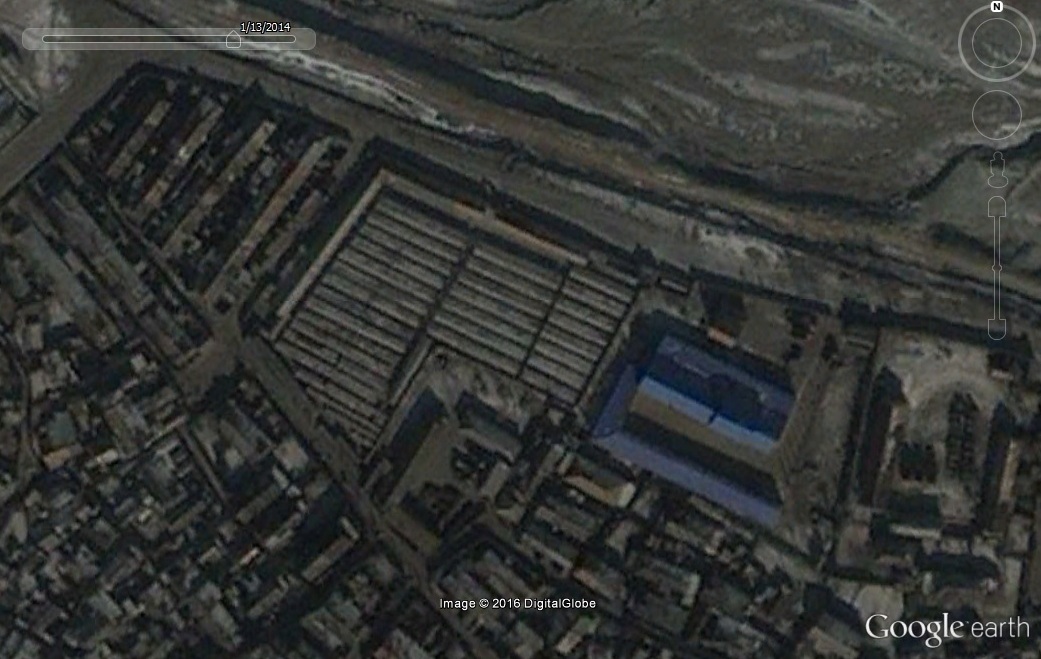
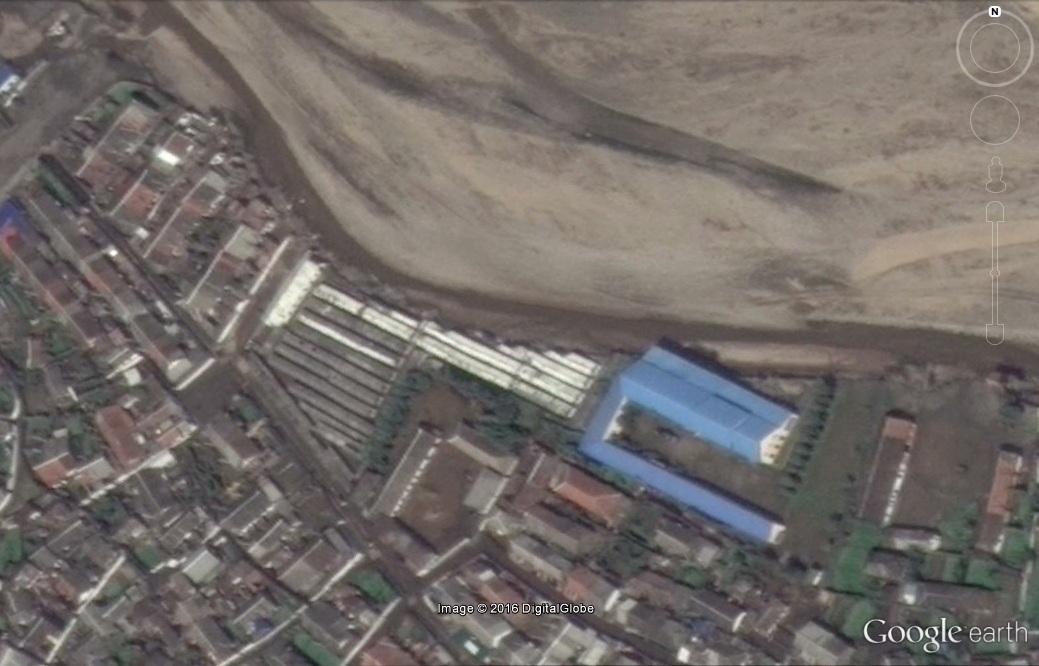
Imagery on Google Earth indicates the construction work on Ssuk Islet in Pyongyang began between 2014-1-27 (Top) and 2014-4-13 (Bottom)

On June 2, 2014, Rodong Sinmun/KCNA announced that Kim Jong-un visited Ssuk Islet in Pyongyang and “called for turning the islet associated with the feats of President Kim Il Sung into the one for scientific and technological study center.”

As shown in the satellite images above, construction on the new center had begun before Kim Jong-un made his visit.

KCNA goes on to describe aspects of the new center:

Saying that demand for the dissemination of science and technology is increasing as the day goes by, Kim Jong Un noted that the Party determined to build a modern scientific and technological study center on the islet to meet the requirements of the people.

The center to be built on the islet will function not only as a comprehensive data base for scientific and technological achievements made by mankind but also as a multi-purpose scientific and technological service center, which makes it possible to use all data and share and exchange information through a network any time, he noted.

He instructed officials to build the center at the highest level in the aspects of architectural beauty, formative art and architectural contents so that it may appear a building of national treasure and fashionable and world-class one.

Feasting his eyes on both banks of the River Taedong, he said the site was a very good place and the center to be built on the islet would serve as another springboard from which the country would surpass the world’s level. He added he felt pleased to foresee the center.

Noting that the scientific and technological study center to be built on the islet is another gift of the WPK for the people, he specified measures for designing, construction and the supply of building materials, etc.

Share

China rejects DPRK coal shipment (Again)

April 4th, 2015

UPDATE 1 (2015-4-4): For the second time this year, the Chinese have rejected a shipment of North Korean coal. According to the Korea Herald (Yonhap):

China has returned a shipment of anthracite coal to North Korea because it failed to meet standards for mercury emissions, according to a local report on Saturday.

This appears to be the second rejection by China of the North Korean mineral this year.

The shipment arrived at the Longkou port of China’s northern coastal province of Shandong late last month, but was returned as its quality did not satisfy China’s environmental regulations, iQiru.com, a local Shandong Internet news site, reported, citing an unnamed Longkou port official.

The report did not elaborate further or include the volume of the rejected North Korean coal.

In September last year, China announced strict regulations against the sale and import of coal with high toxic pollutants, including mercury and sulfur, to improve the country’s air and water quality.

Anthracite coal accounted for 39.8 percent of North Korea’s total exports to China last year.

China’s imports of North Korean coal plunged 53.2 percent from a year earlier to 16.78 million tons in January this year, according to Chinese customs data.

ORIGINAL POST (2015-3-9): Back in October of 2014, Kevin Stahler was the first person to point out (as far as I am aware) that the DPRK’s coal exports to China were in decline. Quoting Kevin:

However, this year North Korea’s anthracite exports to China are on course for a hard landing. The total value of imported anthracite is down 23 percent in the first half of 2014 compared to a year earlier. That’s an annualized $340 million hit to North Korea’s balance of payments. But North Korea is not alone: China has seen a double-digit decline in both the value and volume of its total world coal imports from January – August 2014.

On March 4, 2015, Yonhap reported that China returned a shipment of coal to the DPRK for reasons related to domestic environmental protection regulations:

China has rejected imports of some North Korean anthracite coal because the coal failed to meet domestic standards for mercury emissions, a local newspaper reported Wednesday, in what appeared to be China’s first rejection of North Korean minerals over environmental concerns.

The shipment was returned to North Korea on Feb. 27 from the Rizhao port of China’s northern coastal province of Shandong, the National Business Daily newspaper reported, citing an unnamed port official.

The report did not elaborate further, or include the volume of the rejected North Korean coal.

After three decades of rapid industrialization, China regularly sees hazardous air pollution with levels of particulate matter rising to nearly 40 times the limits set by the World Health Organization during the winter months.

In September, China announced strict regulations against the sale and import of coal with high toxic pollutants, including mercury and sulfur, to improve the country’s air and water quality.

Anthracite coal accounted for 39.8 percent of North Korea’s total exports to China last year.

In January, China’s imports of North Korean coal plunged 53.2 percent from a year earlier to 16.78 million tons, according to Chinese customs data.

On March 9, UPI reported on one of the key aspects of China’s new environmental policies and how it will affect the DPRK:

China’s crackdown on coal-related pollution will take a heavy toll on the North Korean economy, South Korean newspaper Donga Ilbo reported Monday.

China’s plan is to drastically reduce coal consumption by 160 million tons in the next five years. The plan, presented at the National People’s Congress in Beijing, aims to reduce the fossil energy use that is contributing to severe pollution in big cities, The Australian reported.

Countries exporting coal to China are all affected, but the plan could create an economic crisis in impoverished North Korea. Coal and iron-ore exports are two of North Korea’s biggest exports to China, its biggest trading partner.

According to the Donga Ilbo, more than 97 percent of North Korean exports are shipped to China*, and coal, iron ore comprise 60 percent of all North Korean exports.

China’s anti-pollution policy is affecting North Korean cargo. A North Korean ship delivering coal to China was turned away at the coastal city of Rizhao on Feb. 27. The Donga Ilbo reported the coal did not satisfy China’s environmental regulations.

The rising ban and other factors are placing the impoverished North Korean economy in a tight squeeze.

Anna Fifield also covered this story for the Washington Post and Guardian.

*The article reports that China accounts for 97% of the DPRK’s international trade. This is only true if one excludes South Korean trade–which South Korea does because they consider North-South trade as “inter-korean” trade.

Share

Increase in sales volume of domestic goods in North Korean stores

April 3rd, 2015

Institute for Far Eastern Studies (IFES)

North Korea’s official news agency, Korean Central News Agency (KCNA) reported on March 25, 2015 that the volume of domestic goods sold at North Korean stores is increasing.

“Every display is filled with all kinds of inexpensive, high-quality domestic goods. Numerous shoppers are purchasing these goods, all of which are produced at domestic light industry factories. This is a sight that is commonly seen today at Choson’s [North Korea’s] department stores,” KCNA reported.

The news agency also quoted the manager of Pyongyang’s Department Store No. 1: “In recent years there have been remarkable improvements in every indicator, from the amount and quality of light industry goods produced domestically to the brands and packaging. As this has occurred, demand for these goods has increased,” he explained.

While he says that stores are mainly selling domestically produced goods like food and cosmetics, he also said, “Because furniture and building materials, shoes and clothing, medicine and other goods are also low-priced and suited to the tastes and health of our people, they are gradually overwhelming imports.”

The manager of Sinuiju Cosmetics Factory commented as well: “Previously, our ‘Pomhyanggi’ (or ‘Spring Scent’) brand was the only product that people could point to as a cosmetics product […] But the popularity of Pyongyang Cosmetics Factory’s ‘Unhasu’ (or ‘Milky Way’) is rising, and when you include the units produced at Myohyang Cosmetics Factory, its units actually surpass ours and are putting up a strong challenge. We had better get ourselves together.”

At light industry factories across the country, production of food products is rapidly increasing, and quality is improving as well. But it has reportedly not been easy to meet the people’s demand. Thus, manufacturers are working to improve product design and manufacturing technology and pledge to actively help improve the lives of the people.

In addition to this, KCNA reported that at places like the Namhung Youth Chemical Complex and the Hamhung Automated Equipment Factory, they are also spurring on production of domestic products through means such as domestically producing raw materials and equipment.

Meanwhile, North Korea is building one modern foodstuff factory after another in Pyongyang. The Rodong Sinmun, mouthpiece of the Workers’ Party of Korea, reported on March 18, 2015 that in the Nakrang district, construction of the ‘corn processing plant’ entered its final stages. There are plans for this factory to produce around 10 different food items out of corn (corn is the most common food ingredient in North Korea), including corn noodles and snacks.

On February 10, 2015, in Pyongyang’s Mangyongdae district, ‘Mangyongdae Kyonghung Foodstuff Factory’ was completed and went into operation. KCNA emphasized that this foodstuff factory is “a modern and comprehensive food manufacturing center” and will supply residents with “tasty and nutritious food.”

Similarly, in June 2014, the Unha Taesong Foodstuff Factory in Pyongyang’s Potonggang district finished construction and began production. North Korea’s official web portal,  ‘Naenara’ explained that the factory produces approximately 100 kinds of food such as bread, snacks, candy, beer, ham and sundae (or Korean sausage).

The fact that in a relatively short period of time modern foodstuff factories are continually being built in Pyongyang is consistent with the most important task of North Korea in the Kim Jong Un era: improving the food situation of the North Korean people. On February 18, 2015, First Chairman Kim Jong Un spoke at the enlarged meeting of the Political Bureau of the Workers’ Party. There, he asserted that the improvement of people’s lives was the nation’s first priority, and he specifically emphasized the importance of solving the food issue. Unlike the past, recent efforts extend beyond solving the food shortage problem and aim to raise the quality of food for the people.

Share

DPRK expels German and American aid workers

April 2nd, 2015

UPDATE 1 (2015-4-8): Less than a week since expelling a German aid worker, the DPRK announces it deporting and American. According to the Wall Street Journal:

North Korea said Wednesday it has deported an American aid worker for “plot-breeding and propaganda” against the isolated state.

A report from Pyongyang’s state media named the aid worker as Sandra Suh. It said Ms. Suh has been a frequent visitor to the country since 1998 for humanitarian work but engaged in anti-North Korean “propaganda abroad with photos and videos … she secretly produced and directed.”

The Korean Central News Agency report said Ms. Suh has been deported.

A spokeswoman for the U.S. Embassy in Seoul said she couldn’t immediately comment on the report. Attempts to locate Ms. Suh weren’t immediately successful.

Foreign aid workers’ access to North Korea is extremely limited and the presence of U.S. citizens is rare. The regime has in the past shown reluctance to let foreign aid agencies work inside the state and has occasionally denied visa renewals when its economic performance made some gains.

The Los Angeles Times follows up (2015-4-8):

Suh is the founder of the Los Angeles-based humanitarian organization Wheat Mission Ministries.

Her daughter-in-law told the Los Angeles Times in a brief phone call that her family was thankful that it appeared Suh would be released, but declined to give details on Suh’s visits to North Korea out of concern about jeopardizing her return.

Eun-sook Suh said Sandra Suh was originally from the Pyongyang area and fled south during the Korean War. She initially returned to North Korea with the hope of finding long-lost family members.

“We’re just thankful that God seems to be helping her return,” she said.

Wheat Mission Ministries did not immediately return a request seeking comment, but its website states it was founded by Sandra Suh in 1989 “in response to the needs of the children and families of North Korea” and was formally established as a 501(c)(3) nonprofit organization in 2005. Suh, however, is not listed as a current staff member.

The Korean Central News Agency did not say when Suh was detained, nor was it clear whether she had already been deported. The agency said Suh had engaged in anti-North Korean “propaganda abroad with photos and videos” that she “secretly produced and directed, out of inveterate repugnancy” toward the secretive nation.

According to the group’s website, Wheat Mission sends medicine, medical equipment, food, building materials, clothes, shoes and blankets to North Korea. The organization is also involved in teaching North Korean healthcare professionals and building schools and orphanages. It says it is inspired “to share the love and humility of Christ.”

North Korea has detained and then released a number of Westerners in recent years who were missionaries or devout Christians, including Korean American missionary Kenneth Bae and Jeffrey Fowle, an Ohio man who traveled to North Korea on a tourist visa and intentionally left a Bible in a hotel room.

The country director of a German aid group, Welthungerhilfe, or World Hunger Aid, was recently expelled. The group said Pyongyang had asked the worker, Regina Feindt, to leave the country in February without saying why. Welthungerhilfe has worked in North Korea since 1997, spending tens of millions of dollars on projects to improve food, sanitation and water supply.

Here is coverage in UPI:

North Korea deported a Korean American aid worker and philanthropist on charges of espionage – after receiving $2 million in annual aid from her organization for 25 years.

Pyongyang’s state-controlled media outlet KCNA had blasted Sandra Suh on Wednesday, for partaking in a plot against the North Korean government, and for disseminating “propaganda” about the reclusive state, reported Yonhap.

Suh left North Korea and arrived in Beijing on Thursday, en route to the United States after the announcement.

Choe Jae-yeong, a pastor and an acquaintance of Suh, said Suh was a “doyenne of North Korea aid organizations in the Los Angeles area,” according to Radio Free Asia.

Choe said even in the darkest days of the Great Famine that killed more than two million North Koreans in the 1990s, Suh was at the forefront of providing aid to the needy. At the time, she operated a noodle factory in North Korea’s Hwanghae province and in Pyongyang, and supplied medical aid.

Suh even arranged a trip to North Korea for U.S.-based pastors in order to raise funds and awareness of the need for a hospital for the disabled in North Korea. At one point, she collected used carpets for North Korean orphanages.

The Korean American aid worker had relatives in North Korea and her philanthropic work enabled her to cultivate a friendship with the North Korean authorities.

North Korea’s KCNA claimed Suh had confessed to her crimes and “earnestly begged for pardon.”

The Guardian reported Suh is registered as a founder of Wheat Mission Ministries, established in 1989 to provide food aid and medical technology to North Korea.

ORIGINAL POST (2015-4-2): James Pearson writes in Reuters (also printed in the Guardian):

North Korea has expelled the country director of one of the few foreign aid groups to operate in its territory.

Welthungerhilfe, whose name translates as World Hunger Aid, is one of Germany’s largest non-governmental aid organisations and has been working in North Korea since 1997, spending more than €60m on projects designed to improve food, sanitation and water supply.

It said North Korea had asked its country director Regina Feindt to leave the country in late February, without warning or saying why.

Feindt’s colleague Karl Fall, who had worked in the country for 12 years, left of his own volition the next month.

“Welthungerhilfe does not see anything in Mrs Feindt’s behaviour that would have justified an expulsion,” the aid group said.

It said Feindt left North Korea on 26 February and Fall left on 19 March. Feindt and Fall were not available to comment, Welthungerhilfe said.

The abrupt departures came as a surprise to members of the small foreign community in Pyongyang, according to a regular visitor to the North Korean capital who wished to remain anonymous, citing the sensitive nature of working there.

Welthungerhilfe would not comment on the events leading up to Feindt’s deportation. “We don’t know why this has happened,” said spokeswoman Simone Pott.

The NGO still has a skeleton presence in North Korea. It said its activities to improve water and sewage systems in cities were unaffected.

“At the moment we are in discussions with the North Korean authorities to secure a basis for continuing our development work in the country for the benefit of the people of North Korea,” the group said.

Read the full story here:
North Korea expels country director of German aid group
Guardian
2015-10-2

Share

How to run a “private” bus company in the DPRK

April 1st, 2015

According to the Daily NK:

More independent transportation companies, run by the donju, or new affluent middle-class, are springing up in North Korea’s main transit hubs and driving up fares.

“There is a growing number of bus and truck companies operating not only in Pyongyang but nationwide,” a source from North Hamkyung Province told Daily NK last Friday. “People are buying buses or trucks and then paying the state a certain fee to open up transportation companies authorized by the central authorities.”

She explained that those members of the donju with significant amounts of money establish contacts with central bodies and win over the right to operate. “The ‘Pyongyang Transit and Trade Company’ and the ‘General Bureau of Transportation,’ which fall under the Cabinet, write up permits for individual donju and are authorizing the operations in exchange for a certain amount of the profits,” she said, adding that each region has bus companies that come from those two Pyongyang-based offices, creating a de facto public-private collaborative operation.

The donju, by importing second-hand buses from China for 3,000 to 4,000 USD, are overtly raking in profits and revolutionizing bus transportation in North Korea; personal bus transportation was only available in two to three cities in the early 2000s, including Pyongyang, but now it has spread nationwide. According to the source, some companies own anywhere from dozens to hundreds of buses.

“The fare between Chongjin and Musan used to be 8,000 KPW [1 USD] until just two years ago, but now it has jumped to 50,000 KPW [6.25 USD]. The bus that runs between Chongjin and Kim Chaek is currently 80,000 KPW [10 USD] – ten times the original price,” she noted. “Donju are raising the fares to whatever they want depending on the oil prices and exchange rate with the Chinese yuan.”

In the North’s main cities, state-run trams, trolleys, and long-distance buses do operate, but the vehicles are old and the companies beset by economic difficulties. The number of donju-run companies, however, is increasing by the day, leaving the state no choice but to accept their money and grant them license to operate.

“People are happy that there are more options for transportation but there are a lot of complaints about the expensive fares,” the source said. “Some say it’s not unusual for such companies to be operating in the way they do considering the dilapidated condition of state companies, but in the end it’s the regular people who bear the brunt of it all.”

Additional posts on the DPRK’s bus networks here.

Read the full story here:
Transportation Options Taking Off
Daily NK
Choi Song Min
2015-04-01

Share

Dandong businesses propose lowering trade duties

March 30th, 2015

According to Yonhap:

Chinese firms have proposed establishing a non-tariff trade market with North Korea where cheap goods can be traded without tariffs between the two nations, according to the Chinese border city of Dandong on Monday.

The proposal was made by representatives of Chinese firms in Dandong on Thursday when they met with a North Korean trade delegation, led by Pak Ung-sik, director of the North’s Korean International Exhibition Corporation, according to a statement posted on the Chinese city’s website.

More than 70 percent of bilateral trade between North Korea and China is conducted through Dandong.

Pak reacted positively to the proposal, saying he would relay it to the relevant North Korean authorities and hopes to hold more discussions over the proposal, according to the statement.

Another Chinese border city, Tumen, in the northeastern Jilin province, opened a non-tariff trade market with North Korea in 2010, but the market was quickly suspended as North Korea banned civilians from participating in it due to concerns over the spread of banned materials that may enrage the North’s leadership.

At that time, Tumen had pledged not to impose tariffs on the trade of goods worth less than 8,000 yuan (US$1,287) per person.

China’s is the economic lifeline of North Korea, but their political ties remain strained over the North’s defiant pursuit of nuclear ambitions.

North Korea’s annual trade with China fell 2.4 percent from a year ago in 2014, marking the first decline since 2009, according to data compiled by the Beijing unit of the South’s Korea Trade and Investment Promotion Agency (KOTRA).

The North’s trade with China totaled US$6.39 billion last year, compared with $6.54 billion in 2013, the data showed.

Read the full story here:
Chinese firms propose non-tariff trade of cheap goods with N. Korea
Yonhap
2015-3-30

Share

Outline for development of Wonsan-Kumgangsan Tourist Region revealed

March 26th, 2015

Institute for Far Eastern Studies (IFES)

North Korea has recently revealed an outline of its plans for the Wonsan-Kumgangsan Tourist Region. In May an information session regarding the development of this project will be held on-site in Kumgangsan.

The Chinese newspaper Liaoning Daily reported on March 21, 2015: “North Korea recently held a briefing session regarding its development plans for the Wonsan-Kumgangsan Region at the Grand Metropark Hotel in Shenyang. The meeting was attended by professionals, scholars and businesspeople from several neighboring Northeast Asian countries.”

According to the newspaper, at the event North Korea revealed development plans for a tourist region of approximately 430 square km in area. It also revealed that there will be six major scenic spots throughout the Wonsan-Kumgangsan Tourist Region, namely, Wonsan, Tongchon, Mount Kumgang, Sogwangsa, Masikryong Ski Resort and Ullim Falls.

North Korean authorities explained, “This year the Wonsan-Kumgangsan Tourist Region development project is considered the most important element of our country’s international economic development efforts. The region is being designed at the government level as a world scenic spot that combines the beauty of the ocean, lake, and city.”

The authorities went on to explain that “Geographically, the Wonsan-Kumgangsan Tourist Region is situated on the eastern part of the Asian continent and the central part of the Choson [Korean] Peninsula. Within a 3-hour flight of that region there are a total of 40 cities with populations exceeding 1 million people […] The region contains a total of approximately 670 tourist sites, 140 historical sites, 10 sand beaches, 4 mineral springs, 10 natural lakes, and 3 million tons of muds that are highly effective in the treatment of neuralgia and enteritis of the small and large intestines.”

While North Korea repairs and expands the existing road network connecting each tourist site (focusing first on Wonsan), North Korean authorities have decided to construct a transportation network by establishing a high-speed railroad between Pyongyang and Wonsan, as well as opening passenger routes between Wonsan Harbor and Rason and Wonsan Harbor and Vladivostok. They will also introduce a series of measures for attracting tourists, including a no-visa system, which is currently being studied.

The authorities also explained that North Korea “guarantees the free economic activity of investors and will offer fixed, regular benefits in areas such as land use, labor employment, and taxes.”

“Tourism, manufacturing, and service businesses will be exempt from corporate income taxes for four years, three years, and one year respectively. Meanwhile, real estate businesses that invest in infrastructure will be exempted from land use taxes for ten years, and those that invest in other areas will be exempt for five years.”

The Liaoning Daily reported that at the information session, O Ung Gil, president of North Korea’s Wonsan District Development General Corporation, said, “I hope that by participating this May at Mount Kumgang in the international seminar regarding the development of the Wonsan-Kumgangsan Tourist Region, everyone will have the opportunity to witness and experience Mount Kumgang first-hand. […] North Korea’s door is always open and investors are welcome any time.”

Various Chinese companies and private organizations hosted the information session. Approximately 50 Chinese professionals and business people, who were invited beforehand, attended the program. Only a few Chinese and Japanese media outlets that were chosen by the organizers were permitted to cover the event.

Share

Japanese police raid home of Chongryun chairman

March 26th, 2015

UPDATE 1 (2015-5-29): Office 39 has been connected to the Japanese investigation. According to the Daily NK:

An investigation launched by Japanese police has revealed that Office 39, a special department charged with raising funds for Kim Jong Un’s use, is involved in illegal operation exporting pine mushrooms to Japan, Yomiuri Shimbun, a Japanese daily, reported on May 27th.

During a police raid on the home Huh Jong Do, the son of the head of the pro-North General Association of Korean Residents in Japan [Chongryon], the authorities uncovered documents revealing correspondence between the group and Office 39, revealing that North Korea has been exporting pine mushrooms to Japan in conjunction with Chosun Specialty Sales, an affiliate of Chongryon.

An official with the investigation said it was the first time documents explicitly stating “Office 39” have come to light, leading police to push ahead with the investigation and assert the shadowy agency’s direct involvement in the illicit operation.

Both Huh and Kim Yong Jak, head of Chosun Specialty Sales, were arrested on May 12th for violating laws administration of foreign currency. Police investigations revealed that these two men had imported approximately 1,800 kg of pine mushrooms from North Korea in September of 2010–a clear violation of Japan’s ban on trading with North Korea, implemented after North Korea’s second nuclear test in 2009.

Meanwhile, Washington D.C.-based Voice of America, quoting Japanese daily Sankei Shimbun, that Office 39, Huh, and Chosun Specialty Sales were all involved in the pine mushroom smuggling ring, dividing the profits among the involved parties.

ORIGINAL POST (2015-3-26): According to the Japan Times:

The head of the pro-Pyongyang General Association of Korean Residents in Japan, or Chongryon, had his home searched by police on Thursday, and two South Korean men were arrested on suspicion of illegally importing matsutake mushrooms from North Korea.

Raids took place at six locations, including the Tokyo home of Ho Jong Man, chairman of Chongryon, a body which has functioned as a de facto North Korean embassy for many decades in the absence of diplomatic ties between Tokyo and Pyongyang.

Observers said the raid on the chairman’s home could affect stalled bilateral talks on Pyongyang’s abductions of Japanese nationals in the 1970s and 1980s.

Police arrested Lee Tong-chol, 61, president of a Tokyo-based trading house, and Yoshihiko Kin, 42, an employee of the company. They are suspected of illegally importing about 1,200 kg of matsutake mushrooms worth around ¥3 million via China in September 2010.

The mushrooms are believed to have been sold in Japan, mislabeled as Chinese-grown produce.

Japan has banned imports from North Korea since October 2006 as part of economic sanctions imposed in response to Pyongyang’s missile and nuclear programs.

Both suspects are residents of Japan, and both denied the allegation. Investigators quoted Lee as saying he does not understand why he should be arrested, while Kin denied all knowledge of the matter.

Police are investigating the relationship between the suspects and Ho, who is a member of North Korea’s top legislature.

After the early morning raid on his home in Tokyo’s Suginami Ward, Ho told reporters angrily he does not even know the name of the trading company.

“The investigation is done unlawfully and this would lead to serious problems in the relationship” between North Korea and Japan, he said.

“This is political suppression against the General Association of Korean Residents in Japan,” he said.

Touching on the ongoing investigation into the fate of Japanese citizens abducted by North Korea, Ho said the Japanese authority is making things worse, interfering with the investigation by deliberately worsening relations with North Korea.

Meanwhile, a senior police investigator said authorities suspect a link between the illegal trade and Chongryon, and that they will do everything they can to investigate.

To that end, police have so far searched more than 10 locations, including the trading house and the homes of Lee and of Ho’s son last May.

The locations searched Thursday include the Tokyo home of the pro-Pyongyang group’s vice chairman.

Read the full story here:
Police search home of Chongryon leader over suspected North Korea mushroom shipment
Japan Times
2015-3-26

Share

An affiliate of 38 North