DPRK Cabinet adopts ‘Border region management provision’

July 22nd, 2008

Institute for Far East Studies (IFES)
NK Brief No. 08-7-22-1
7/22/2008

On July 18, the North Korean Cabinet publication, “Democratic Choson’, revealed that the cabinet had recently adopted the ‘Border Bridge Trade Complex Management Activities Provision’.

According to the newspaper, the provision spells out to whom the rules and regulations must be applied regarding the orders and management activities of the border bridge trade complex. In addition, “by being adopted, the provision firmly creates regulations on foreign economic activities that cross over border bridges and has prepared the legal support for unceasing improvements of the border bridge trade complex’s management activities.”

North Korea relies on border trade with Chinese areas such as the city of Dandong, in Liaoning Province, and the Yanbian Korean Autonomous Prefecture, as cross-border trade shot up to over 200 million USD last year.

Share

Tom and Jerry

July 22nd, 2008

tomandjerry.jpg

I am told that in the 1980s Tom and Jerry was a poplar show on DPRK and USSR state television.  In the DPRK they even kept the names Tom and Jerry.

Share

Mongolia to hire North Korean workers

July 22nd, 2008

From Daily Business News Mongolia:

At the submission of the Government of Mongolia, the Parliament ratified Mongolia-North Korea Inter-governmental Agreement on exchanging work forces on the 20th of July, 2007. According to the Agreement, Ministry of Social Welfare and Labor of Mongolia is to negotiate in the near future with Foreign Trade Ministry on realizing the agreement and exchange of work force, especially number and need of work force, the minimum wage /by USD/, labor conditions /normal and abnormal/, social welfare /social insurance/ and therefore those interested in employing North Korean wok force in 2009 should formulate their TORs accurately as well as submit them to the MSWL within 23 July. Currently orders should be submitted on the basis of position vacancy since number of workers is not specified yet.

Read more here.

Share

DPRK competes in International Mathematical Olympics

July 21st, 2008

UPDATE: I know all of you were wondering how the DPRK fared in the 2008 International Mathematical Olympics!  It is certainly the most under-reported story of the year!

North Korea improved over last year’s performance to capture 7th placeThe team’s individual results can be found hereUn Song Ri led his team to victory scoring a 97.94% and capturing 12th place individually.

Scoring ahead of the DPRK: China (PRC), Russia, USA, Republic of Korea, Iran, Thailand. 

ORIGINAL POST: I was perusing the Korean Friendship Association web site this morning, and noticed this post:

Author: Alejandro Cao De Benos
Subject: International Mathematic Olympics

A Delegation of 6 DPRK students (16 to 19 y.o.) and 2 professors from KIM IL SUNG University and Pyongyang Middle School Number 1, are now in Madrid to participate in the International Mathematic Olympics.

On 15th will be the opening ceremony, 16th and 17th the exams. 21st will be the closing ceremony. (100 countries participate)

After the exams, they are invited by the organizing Committee to tour Madrid city center, Aranjuez, Toledo, Salamanca and enjoy typical Flamenco dance.

I just said goodbye to them after sharing 5 days in the capital. They are studying day and night, eager to get the best marks in the competition.

Ri dongji, best of success for all the team!!

This competition originates in the former USSR and Warsaw Pact countries.  Some quick background info can be found on the competition’s Wikipedia site and official site.

Here are the annual results (grouped by country) since the competition started in 1959.  Of all these years, the DPRK (PRK) only competed in 2007-Hanoi (8th place – see team results here), 1992-Moscow (16th place – team results here), 1991-Sweden (Disqualified – the only team ever disqualified.  Not sure why—anyone out there know?), and 1990-Beijing (19th place – team results here).  Here are the results for all the individuals who have competed on the DPRK team.

Here is where the 2008 team’s results will be posted.  The web page gives a contact name (Ham Yong Chol) and email address.  Some enterprising journalist out there should try to get a story.  

Share

(UPDATE) China asks some North Koreans to leave ahead of Olympics

July 21st, 2008

UPDATE 2: According to the Associated Press:

[A South Korean] NIS official, who asked not be named, citing an internal policy, told The Associated Press that China had no plans to close all bridge links with North Korea “out of concerns of diplomatic friction with North Korea.”

The official also said China would not ask all North Koreans in China to leave, saying that Beijing plans to crackdown on North Koreans who illegally stay in China and Beijing plans to restrict renewing visas for North Koreans. 

UPDATE 1:  According to the Associated Press, China plans to close all the bridges to the DPRK during the Olympics, starting next month.  This will have a devastating impact on trade with Sinuiju, Manpo, Hyesan, Hoeryong, and many other trading hubs along the Chinese border.

ORIGINAL POST: According to an interesting article in Bloomberg (thanks to reader) China is acting to reduce the chances that North Korea issues will interfere with coverage of the Olympic games in Beijing this summer.

According to the article:

China asked some North Korean work units to leave the country or move their business operations during the Olympic Games, according to documentation from the North Korean embassy obtained by Bloomberg News.

Citing security issues, China asked North Koreans, except trade representatives and government-dispatched personnel, to leave by July 31 and not return until the end of September, the Korean-language statement said. The embassy in Beijing gave the order to North Koreans in a July 11 directive, according to a copy of the document obtained by Bloomberg News.

The order took effect from July 13 and those who delay departure would be fined or not allowed to reenter China, according to the document. Workers scheduled for dispatch to China from July 1 should delay their departure until Sept. 25, it said.

and…

It isn’t clear how authoritative the directive is. Five North Korean businessmen contacted by Bloomberg news provided different departure dates, or said they were not affected by the directive. The people refused to be identified in print, citing possible recriminations.

A press attaché at the Chinese embassy in Tokyo who declined to give his name said he wasn’t aware of the directive and that there would be no way to confirm its existence.

Read the articles here:
China asks some North Koreans to leave ahead of Olympics
Bloomberg
Hideko Takayama
7/15/2008

Report: China to shut down all bridges linked to NKorea during Olympics
Associated Press
7/21/2008

China to step up inspections at border with North Korea during Olympics to stop migrants
Associated Press
Kwang-Tae Kim
7/22/2008

Share

(UPDATED) South Korean tourist fatally shot at Kumgang

July 21st, 2008

UPDATE 13-August 28:   Yoon Man-jun stepped down as CEO of Hyundai Asan over the July 11 killing of the 53-year-old South Korean woman by a North Korean soldier at the North’s Diamond Mountain resort, the company said in a statement. The company quoted Yoon as saying that he wanted to take “moral responsibility” for the death. (ETN news)

UPDATE 12-August 8: Despite bringing a halt to tourism in Kumgangsan, South Korea sent arrears to the DPRK.  From the Choson Ilbo:

Despite stalemate over the shooting death of a South Korean tourist at North Korea’s Mt. Kumgang, tour operator Hyundai Asan made its July payment for tours to North Korea.

Asan said Thursday it paid US$675,250 to North Korea to cover costs accrued by 10,380 South Korean tourists who visited the mountain resort on July 1-11, until the tours halted after a South Korean tourist was shot and killed by a North Korean soldier at Mt. Kumgang.

Update 11-August 8: DPRK to expel all remaining ROKs from Kumgnag starting August 10.   

UPDATE 10-Auguts 4: KCNA issues statement. 

UPATE 9-August 3: Though no date was given, North Korea intends to expell most remaining South Koreans from Kumgang (Yonhap):

North Korea’s official media said earlier in the day that Pyongyang will expel all “unnecessary” South Korean personnel from the Mount Geumgang resort, where a South Korean tourist was shot dead by a North Korean soldier last month.

More than 260 South Korean workers are stationed at the scenic resort, according to Hyundai Asan, the South Korean tour organizer. 

UPDATE 8-July 26: North Korea succeeds in preventing shooting concerns from being mentioned in official summary of ASEAN meeting.

UPDATE 7- July 23: South Korean government prevents South Korean civic groups from visiting DPRK until the North’s government agrees to participate in shoting investigation. (Donga Ilbo) 

As of Tuesday, six organizations had been offered invitations to visit the DPRK (Donga Ilbo):

One hundred members of the Korean Teachers and Educational Workers’ Union applied for permits to visit North Korea during August. In addition, 120 South Gyeongsang Province officials including Governor Kim Tae-ho are reportedly planning to visit the regime.

Humanitarian organizations such as Good Neighbors International, Nanum International and the Korean Sharing Movement will reportedly send 40-150 delegates to the North in August (for the former two) and September. In addition, North Korean officials invited around 120 members of Peace Three Thousand, and the representatives of the two will meet in Gaesong on Saturday to discuss the invitation.

These organizations [would] stay two to four days in North Korea and [] attend joint meetings with the North Korean Teachers’ Union, visit North Korean industrial facilities, tour Mount Baekdu, and attend an Arirang performance – a play propagandizing the regime.

UPDATE 6- July 21: Suspension of the Kumgang Tours will cost the DPRK $20 million per year.  If South Korea suspends the Kaesong tours (to the city, not the industrial zone) it will cost the DPRK government $15 million. (Choson Ilbo)

Maybe these numbers are sinking in. According to the Donga Ilbo:

North Korean officials recently followed one after another in expressing their perplexity regarding the incident, and fell over themselves to invite a horde of South Korean civic groups in August. These recent moves by the North have led some to believe that the North Korean authorities have somehow changed its stance towards the South.

An American source who recently met with North Korean officials in China and a working-level official at a South Korean civic group also said, “North Korean authorities told us that the shooter was a ‘very young’ person.”

The source added, “North Korean authorities told us that the incident equally took them aback. They added that especially at a time when the South Korean authorities are anxious to give them 50,000 tons of corn, those who thought the incident was intentional simply do not know anything about their regime.”

Unification Ministry spokesman Kim Ho-nyun also confirmed the Dong-A Ilbo’s report that North Korea invited a large group of South Korean visitors to Mount Baekdu and Pyongyang.

The Choson Ilbo remains skeptical

UPDATE 5 – July 17: The North’s story has changedDPRK rejects South’s inspectors. Seventy percent of officials of the United Front Department who were in charge of foreign affairs with South Korea were expelled from their positions early this year. It seemed to be an initiative step for taming the Lee administration and controlling the South’s policy (Daily NK).

UPDATE 4 – July 15: South Korea ups the ante by threatening to suspend tours of Kaesong unless the DPRK participates in the Kumgang shooting investigation (Bloomberg). 

NKeconWatch analysis: Suspending tours to Kumgang is relatively expensive for both North and South.  Hyundai and the South Korean government spent a lot of money developing the facilities, and by this time, the North Koreans who were earning from the project have grown accustomed to the cash flow.  The tours of Kaesong are different, however.  The South invested relatively little capital in the Kaesong tours, so suspending them idles few of their resources but hits the pocketbooks of the North Koreans who sponsor the program.  Could the Kaesong Industrial Zone be turned into a bargaining chip? 

UPDATE 3 – July 14: South Korea officially casts doubt on North Korea’s portrayal of events leading up to the shooting based on CCTV video and an eyewitness account. (Choson Ilbo) 

UPDATE 2: This story in the Korea Times (h/t ROK Drop) seems to indicate that there was a witness to the shooting and that there were no substantial barriers or warnings that vacationers could wander into a restricted military zone.   

UPDATE 1: The North Koreans expressed regret for the shooting, but says the responsibility lies entirely with Seoul.  They also refuse to cooperate with the South Korean government in an investigation of the incident citing that they have already sorted things out with Hyundai Asan. Although South Korea’s President Lee Myung-Bak ignored the situation in a parliamentary speech he gave shortly after the shooting, the Unification Ministry has now publicly stated that the shooting was “wrong by any measure, unimaginable, and should not have occurred at all.” 

ORIGINAL POST:Tourism numbers at the Kumgnag resort were up this year, despite high political tensions. 

From the AP:

A North Korean soldier fatally shot a South Korean tourist Friday at a mountain resort in the communist North, prompting the South to suspend the high-profile tour program just as South Korean’s new president sought to rekindle strained ties between the divided countries.

The news of the unprecedented shooting of a 53-year-old woman at Diamond Mountain resort emerged just hours after new President Lee Myung-bak delivered a nationwide address calling for restored contacts between the two Koreas, which have been on hold since he took office in February.

Kim said South Korea would suspend future Diamond Mountain tours until it completes an investigation. The other some 1,200 tourists already at the resort are to complete their tours as scheduled by as late as Sunday, said Hyundai Asan, the South Korean company that operates the resort.

Links to full stories below the fold:

Read the rest of this entry »

Share

DPRK bolsters social security laws

July 21st, 2008

Institute for Far Eastern Studies
NK Brief No. 08-7-17-1
7/17/2008

Recent transformations in the North Korean economy and society have led the government to draft policies to link the social welfare matrix to the social security law. The ‘Democratic Chosun’, a publication of the Central Peoples’ Standing Committee and the Cabinet, has on five occasions (April 3 and 4, May 14, 16, and 23, 2008) run articles titled, “Regarding the Social Security Law,” explaining recent changes to the law and its affects on the North’s social welfare.

This law contains six sections and 49 articles, the purpose of which is to strictly establish the structure and methodology of the nation’s social security system, and to protect the health of the people while providing them with secure and happy lives. Details of the law have not yet been made available.

North Korea established the National Social Security Law on August 30, 1951, although it was not actually enforced until after the April 14, 1978 Socialist Labor Law was passed. North Korea’s social security system is a means with which to control the country’s socialist economy, and also acts to restrict the lives of the people, as well. From when the September 8, 1948 Constitution was passed right up until today, North Korea has provided its people with social insurance and social security systems. Society’s sick, feeble, and handicapped receive treatment assistance or material support from the social insurance system.

By looking at past transitioning countries, one can see that transforming systems and quickly changing social and economic structures lead to linking of social security with social welfare in order to protect the society’s weak. In North Korea, the passing of the July 1, 2002 Economic Management Reform Measures and other sudden changes in the social and economic environments raised concerns regarding the issue of protecting the country’s most vulnerable. Combined with the North’s food shortages, the protection of the society’s elderly, children, pregnant, and other vulnerable elements has become a special issue of concern for North Korean authorities.   

NKeconWatch commentary:
This article surprised me.  Aside from this post, IFES updates are pretty well researched.  Does anyone really believe that the dejure intent and defacto incidence of legislation in North Korea are the same?  You would have to be completely ignorant of life in any communist country to actually believe the statement, “From when the September 8, 1948 Constitution was passed right up until today, North Korea has provided its people with social insurance and social security systems. Society’s sick, feeble, and handicapped receive treatment assistance or material support from the social insurance system.”

Not only is health care under-supplied in the DPRK, it is also not provided free-of-charge.  I am told by people who have had to obtain health care in the DPRK that you generally have to pay bribes to get access.  This was the reality of life in most communist countries. Here is a much better analysis of the supply of health care in the DPRK. 

As for the concern of North Korean authorities to maintain a social safety net during a difficult economic transition, this is no doubt true for a number of DPRK policy makers.  But the people who actually make decisions are still siding with security hawks who refuse to give aid workers and NGOs the freedom they need to effectively help people.

Share

N Korea worker killed in Kaesong

July 17th, 2008

From the BBC:

A North Korean worker was killed and four others were injured in an accident in the Kaesong industrial complex in North Korea, Southern officials said.

It happened when a steel frame collapsed at a factory owned by a South Korean company, Pyeongan, on Wednesday.

An investigation into the cause of the accident is reportedly under way.

Two of the four injured are in critical condition, a spokesman for South Korea’s Unification Ministry said, according to Associated Press.

They are all being treated in a hospital in the zone.

Read the full story here:
N Korea worker killed in Kaesong
BBC
7/17/2008

Share

GPI Consultancy: Economic Mission to North-Korea

July 16th, 2008

Netherlands Centrum voor Handelsbevordering
27 September – 4 October 2008  
View the information flyer with more information here: it-tour_dprk.pdf

For the past decades, the Democratic People’s Republic of Korea (DPRK) also known as North-Korea has been one of the most isolated countries in the world. Until recently, foreign companies could hardly enter this country. Inspired by the economic successes of its neighbouring country China, North-Korea has since a few years opened its doors for foreign enterprises. The DPRK established several free trade zones to attract foreign investors. In 2002 North Korea started to experiment with the Kaesong Industrial Region, near the South-Korean border. Moreover, other areas were designated as Special Administrative Regions, such as Sinŭiju near the border with China.
 
Currently, China and South-Korea are the most important trade partners of North-Korea; their mutual trade is growing fast. Also for European companies there are many opportunities to trade with North-Korea. During the recent seminar: ‘Doing Business with North-Korea’ (The Hague, 30 May) the representative from North-Korea highlighted that there are business opportunities in several fields, including Textile Industry, Shipbuilding, Agro Business, Logistics and Information Technology.

DPRK finds itself at the beginning of a new era of openness. In North-Korea there is a need for many foreign products and investments. The Chamber of Commerce Amsterdam, GPI Consultancy and the Netherlands Council for Trade Promotion are organizing an economic mission to investigate the business opportunities for foreign companies in this country. This unique economic mission to North-Korea will take place from 27 September to 4 October 2008. Our partner in North-Korea is the Pyongyang Chamber of Commerce. Mr. Renze Hasper, Member of the Board of the Chamber of Commerce Amsterdam, will be the mission leader of this economic mission. 
 
The program includes individual matchmaking, company visits, network receptions and dinners. Furthermore, a visit is being planned tot the Kaesong Industrial Region.

GPI Consultancy is responsable for the IT-program of the mission. As an example, the program for the IT-delegates has been attached; they will visit firms in Pyongyang in the field of software development, animation, cartoons, computer games and BPO (Business Process Outsourcing). Similar matchmaking visits will be arranged for delegates from other business sectors.
  
The mission is open for participants from other countries as well.
If you are interested in joining this trade mission, please contact:

Paul Tjia
GPI Consultancy
P.O. Box 26151,
3002 ED Rotterdam,
The Netherlands
E-mail: [email protected]
tel: +31-10-4254172 
fax: +31-10-4254317
Website: www.gpic.nl 

Share

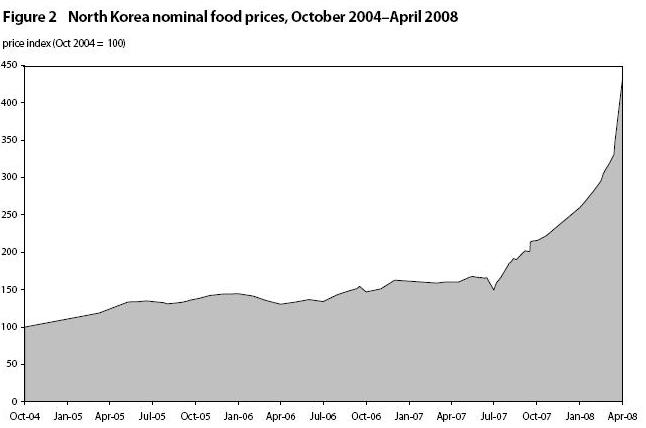
What caused the DPRK’s spring ’08 food price increases?

July 13th, 2008

North Korea’s agricultural and food markets suffer from a number of permanent constraints that prevent their efficient operation.  Rail transport is slow and/or unreliable, internal travel restrictions for “ordinary” merchants, and poor road conditions limit the distance food can travel before it goes bad.  Restrictions on communications and lack of a futures market makes it difficult to know how much food is available in each location, or what is expected to be available in each location.  This leads to hoarding, volatile prices, and a mismatch between local supply and demand.  Compounding these basic problems is a poor business environment characterized by collective farming practices, corruption, bribery, poor property rights protection, poor contract enforcement, and ex-post expropriation of profits.  Given these constraints, it is amazing agricultural and food markets work at all. 

In addition to these factors, the DPRK’s food markets suffered a number of adverse supply shocks this year from flooding, China’s restrictions on food exports, and a decrease in expected food aid from China, South Korea, and the US (See the effects on prices in this chart by Noland/Haggard/Weeks here). The arrival of food aid has since brought some of these prices down.

This week, the Daily NK reports on two other causes of price increases in the DPRK: Anti-corruption campaigns and restrictions on farming private plots.

Anti Corruption campaigns (more here and here)

He reported that “From March to late April, for almost 40 days, inspections were undertaken nationally. In Hwanghae Province, the inspection groups under the Central Court came down and confiscated food which the cadres in farms had embezzled. In some cases, they confiscated 500-1000kg of rice and grains from cadres’ households by searching with metal sticks in their backyard.”

The Director of the Ministry of Administration of the Chosun (North Korea) Workers’ Party Jang Sung Taek and his inspection group went to Shinuiju and inspected persons in charge of trading.

No. 112 Land System

The No. 112 land system operates whereby the authorities offer a certain width of fallow lands, which are different by grade of food distribution amount, to national public servants and clerical workers, given in order to make them solve their food problem by farming instead of relying on distribution. Ishimaru explained that “However, the new Kim Young Il cabinet abrogated this system and banned them from planting seeds on those fields.” 

Read the full story here:
Intensive Inspections in March and April a Direct Reason for Rise in Food Prices
Daily NK 
Kim So Yeol
7/4/2008  

Share