(UPDATED) DPRK signs ASEAN non-agression treaty

July 11th, 2008

UPDATE: From Voice of America:

North Korea’s foreign minister signed the Treaty of Amity and Cooperation – often called the TAC – at the conclusion of the Association of Southeast Asian nations regional security forum, Thursday in Singapore.

The deal was drafted in 1976, and has been signed by all of ASEAN’s ten members, plus 14 other nations including South Korea, with whom North Korea has never formally concluded its 1950s war.

Alan Chong, a political science expert at the National University of Singapore, says the TAC is very general, but sets a framework for peace.

“It has been morally binding in a positive way rather than legally binding. It is a diplomatic device that commits signatories to this notion of a minimal peaceful coexistence, you know, ‘Don’t resort to the use of arms and other physical hostile measures the moment you have international disputes,'” said Chong.

ORIGINAL POST: According to Bloomberg:

North Korea agreed to sign the Association of Southeast Asian Nations’ non-aggression treaty, Kyodo News reported yesterday, citing a letter by the communist state’s Foreign Minister Pak Ui Chun.

North Korea has requested the treaty not be imposed on its relations with countries outside the 10 ASEAN members, the news service said, citing the letter from Pak to Singaporean Foreign Minister George Yeo, ASEAN current chairman.

ASEAN member nations: Brunei Darussalam, Cambodia, Indonesia, Lao PDR, Malaysia, Myanmar, Philippines, Singapore, Thailand, Vietnam.

Read the full stories here:
North Korea Signs On to Southeast Asia ‘Amity’ Pact
Voice of America
Kurt Achin
7/24/2008

North Korea to Sign ASEAN’s Non-Aggression Treaty, Kyodo Says
Bloomberg
Takahiko Hyuga
7/11/2008

Share

Pyongyang wants McDonald’s franchise?!?

July 9th, 2008

Incredible! 

Burger Chain ‘Rebuffed N.Korean Overtures’
Choson Ilbo
7/10/2008
 
Influential North Koreans tried to bring McDonalds into the country, but the fast-food chain declined citing lack of profitability, Radio Free Asia reported Wednesday. RFA quoted Nancy Mazeska at MacDonald’s International Franchise Division as saying the person who contacted the chain probably had “political connections” and a “history of success in North Korea.” But due to the poor infrastructure and distribution network and probable lack of demand, McDonalds decided to take a rain check.

McDonalds at one point thought about letting its franchise in South Korea handle North Korean operations, she said. She did not comment further on who the businessman was and when he contacted the company. According to North Korean press, mass-produced hamburgers were distributed in universities in Pyongyang in September 2000 at the orders of North Korean leader Kim Jong-il.

Many thoughts are running through my head:

1.  Can you imagine?  The “golden arches” right next to the Arch of Triumph in Pyongyang.  Of course the North Koreans would make sure that their “golden arches” were the largest in the world—3 meters taller than the ones in America.

2. Rumor has it that no two countries with a McDonald’s in them have ever attacked each other…with one recent exception: the bombing of Serbia in the 1990s.  Despite the fact that McDonald’s is frequently targeted by anti-American activists, the opening of a franchise in Pyongyang would in fact be a great symbol of hope.

I remember visiting the first McDonald’s in the Soviet Union just after it opened in Moscow.  I stood in line for hours to eat food that tasted exactly like it did in America (of course I was living in England at the time and their food didn’t taste much better than the Soviets’).  The reason I stood in line for so long is because so many Russians wanted to try it as well, and it was finally considered politically acceptable.  The same would probably be true of Pyongyang residents, and the line out the door would be telling.

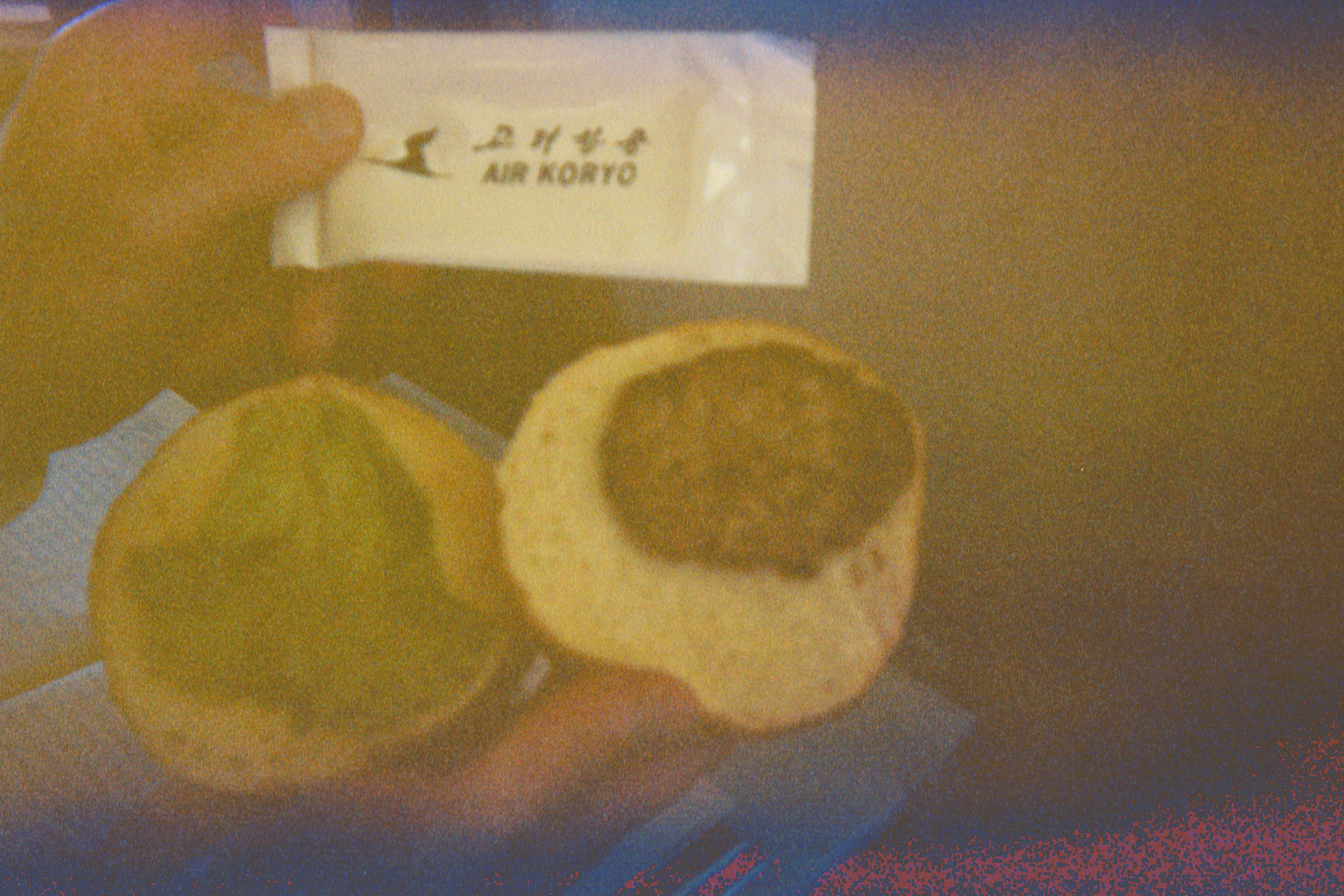
3.  The hamburger is not entirely unknown to North Koreans.  All outbound flights on Air Koryo serve a hamburger (or at least it is some kind of meat patty in a much larger bun with a piece of lettuce).  In business class, you get it on a plate.  I don’t think it is that great, but it is made in the DPRK.  Here is a bad photo I took of the alleged burger.

UPDATE: 4. ROK Drop wonders if they would have used US beef! 

Share

Lankov’s North Korea scenarios…

July 9th, 2008

As Marcus Noland has noted, one of the most difficult aspects of developing scenarios of North Korea’s future is that we do not know Kim Jong il’s vision for the DPRK after he has passed. Is he grooming members of his family to take his place or just to make sure they are wealthy and protected? Is Kim looking at China as a model? Some reports claim he is looking at Thailand’s royal family. What about a military dictatorship?

This week, Andrei Lankov weighs in with several scenarios he has outlined in four Daily NK stories:

Scenario 1:Kim Jong il follows the China/Vietnam model. Agriculture privatized along with a number of small- medium-sized firms. Workers Party remains in control. Lankov believes this scenario politically unobtainable since the inflow of knowledge of the outside world, particularly of the wealth in South Korea, will make incumbent political legitimacy almost impossible to maintain.

Scenario 2: The North Korean regime collapses because it does not have the power or resources to maintain its authority. If this happens, South Korean might not have any choice but to move to take over despite the high economic costs.

Scenario 3:If North Korea does collapse, South Korea does not have to be the only government to assert control in the territory. China has political and economic incentives to be heavily involved in North Korea’s re-composition, or to enter into a protective relationship with incumbent North Korean authorities. Market reforms would follow and opposition would be manageable.

Scenario 4: Weak political power gives various factions (including the military) space to revolt. Neither China nor South Korea want to get involved in an internal clash and North Korea descends into medium-term chaos.

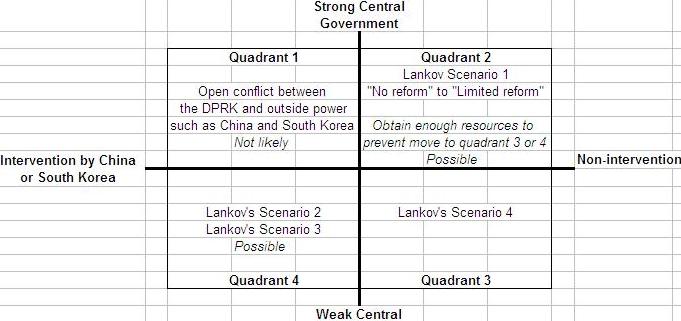
Taking a step back, I use Lankov’s examples to build a broader scenario map using his drivers (regime strength/weakness and foreign intervention/non-intervention):

lankovscenarios.JPG

(Click on image for larger view)

Along the vertical axis is the strength of the DPRK’s central government. It is strong in the top two quadrants and weak in the bottom two quadrants. Along the horizontal axis is intervention or non-intervention by China or South Korea.

Using this framework, we see that Lankov’s first scenario falls into quadrant 2 (upper right), and economic reforms lead to a weakening of the central government, pushing the country into quadrants 3 or 4. This transition is based on the notion that the North Korean central government, or whichever coalition holds it together, can’t survive an economic transition, mainly due to the visible success of South Korea. I think this is an interesting argument, but I am not entirely convinced by it. Hong Kong is not inspiring revolts in China for the same reasons that North Korea does not need to fall prey to political upheaval—mainly, keep people from organizing and dispersing information, and make sure that some fraction of the productive gains from economic reforms are strategically redistributed as political rents. Of course, it would be interesting to see if a communist government could survive in Hong Kong if China was the giant, capitalist neighbor.

Special shout out to Herman Khan here.

Comments welcome.

ReadLinks to Lankov’s articles below the fold:
Read the rest of this entry »

Share

labor constraints at Kaesong

July 9th, 2008

According to the Korea Times, the end of official North-South dialogues has put plans on hold to expand housing for workers in the Kaesong Industrial Zone. 

From the article:

Officials at the complex expressed concerns that South Korean companies intending to set up operations there may be unable to do so as a lack of housing will likely see manpower shortages.

According to the Gaesong Industrial District Management Committee, the number of North Korean workers at 72 companies operating in the site totals 30,084 and the figure could reach 40,000 by late this year.

Besides, approximately 80,000 to 100,000 workers would be needed by 2010 when 450 companies are expected to settle in the industrial park.

However infrastructure projections show that less than 60,000 North Korean workers will likely be able to commute to the industrial site.

Currently, North Korean workers head for their workplaces by 88 commuter buses and bicycles and the authorities promised to provide an additional 100 buses until the year’s end.

South and North Korea agreed last December to build dormitories to accommodate 15,000 North Korean workers.

The two sides were to conduct a geological survey early this year and start construction work in the first half of the year following the agreement but the suspended talks have hindered the plan.

After conservative President Lee Myung-bak vowed a tougher line toward the North, the communist North kicked South Korean officials out of its territory in March and cut off official communication channels.

The Seoul government recognizes the lodging problem as urgent. Yet, it admitted it cannot find a solution at the moment since the North is rejecting any talks.

Read the full story here:
Gaeseong Complex Lacks in Lodgings for N. Korean Workers
Korea Times
Kim Sue-young
7/9/2008

Share

Russia sends fuel to DPRK

July 9th, 2008

According to Yonhap:

Russia will deliver another 100,000 tons of fuel oil to North Korea by October as a reward for the country’s shutdown of its nuclear power facilities, Itar-Tass news agency reported Wednesday, quoting a top Russian envoy to the six-party nuclear talks.

North Korea has been promised energy aid equivalent to a million tons of heavy fuel oil as part of economic and political rewards for declaring all its nuclear programs and disabling its main nuclear plants under a six-party deal on ending the North’s nuclear activities.

“We’ve fulfilled our promises — delivered 100,000 tons of fuel oil in two batches by the middle of the year,” Russian Deputy Foreign Minister Alexei Borodavkin was quoted as telling journalists in Beijing Wednesday. “We are preparing to fulfil our obligations further and send another 100,000 tons by October,” he said.

Read the full article here:
Russia to send more fuel oil to N.K. by October: report
Yonhap
7/9/2008

Share

Noko Jeans

July 8th, 2008

Some enterprising Swedes are attempting to manufacture and export jeans from North Korea.  As far as western countries go, Sweden has been one of the leaders in commercial interaction with the DPRK.  Although, according to Erik Cornell, they were frequently burned. 

The project, Noko Jeans, would be the first jeans manufacturer in North Korea.  Here is some info from their website:

Noko Jeans – jeans from North Korea

Noko Jeans began with an e-mail sent to North Korea, fueled by the enthusiasim of being able to contact the country directly. We thought Noko Jeans would end there, before it even began. It didn’t. Instead, and despite our lack of experience in international trading, it swiftly grew to a much more serious level.

Initiated and managed by three Swedes with a background in advertising and PR, Noko Jeans is our attempt to approach and get closer to North Korea, and it is our attempt to answer the question: is it possible to do what no one has ever done before? Is it possible to design, produce and import jeans from North Korea?

Greetings from North Korea!

After months of research, loads of headache and, lastly, several meetings with North Korean government representatives, we are finally allowed into the country. As official visitors, and by invitation of the state. Take off: 27th of July.

We are just now beginning to sense that this experiment actually might come true. Please stay with us as we tell you the unique process – and story – that is Noko Jeans.

Share

Pyongyang Autumn International Trade Fair announced

July 8th, 2008

From the European Business Association (EBA) web site:

4th Pyongyang Autumn International Trade Fair
September 22nd – 25th, 2008, 9:30am-6:00pm
Further details here

Information flyer here: eba.pdf
Registration flyer here: registration.doc

The European Business Association (EBA) in Pyongyang issues this bulletin in order to inform about special conditions for participation by European businesses in the upcoming international trade fair in Pyongyang.

EBA Pyongyang and Korea International Exhibition Corporation (KIEC) will co-organise a special collective booth to host European businesses for the third time.

European companies interested in taking advantage of this opportunity are invited to visit the EBA website www.eba-pyongyang.org to see reports about the EBA booths in October 2007 and May 2008, which both were very successfull. Please also click through to membership and consider becoming a member of EBA.

The collective EBA booth has proven to be a convenient and cost-effective way to introduce European companies to the North Korean market. The participation fee is 600 or 700 Euro.

Share

(Updated) Inter-Korean trade up this year

July 8th, 2008

According to Yonhap (citing a Ministry of Unification report), trade volume between the two Koreas increased 23% to US$880 million (up from $718.2 million) in the first half of 2008.  This is due to an increase in commercial trade (not official exchanges), which were up 47% to $823.6 million from $558.7 million.  Commercial trade comprises 94% of trade volume, up from 78% last year. The number of firms conducting inter-Korean trade reached 526, up from 324, and and they manufactured 736 items (up from 686).

Goods traded in larger volume than a year ago: plate glass, clams, brackens and textiles from the Kaesong complex.

(UPDATE) Much of this is due to brisk activity in the Kaesong Industrial Zone, which employs 30,084 North Koreans (as of July 4, 2008), up from 225 in 2004.  The zone comprises 72 South Korean firms. 

Total production at the complex has been on a steady rise from US$15 million at the end of 2005 to $373.8 million as of the end of May, up 147 percent from last year, the Kaesong Industrial District Management Committee said.

“Such a rise in production is notable in that 33 of the 72 firms in the complex are start-ups operating there for less than one year,” said Kim Min-kyong, a public relations official of the committee.

To learn more, read the full articles below:
Number of N.K. workers at Kaesong complex tops 30,000
Yonhap
Shim Sun-ah
7/8/2008

 Inter-Korean trade rises sharply in first half despite political chill
Yonhap
Shim Sun-ah
7/7/2008

Share

Korea Business Consultants Bulletin: June 2008

July 7th, 2008

Korea Business Consultants publishes a monthly newsletter.  The June issue has languished in my “inbox,” but I have finally gotten around to posting the PDF.

The articles are on the following subjects:

Bush Responds to DPRK Nuclear Gesture
China Urges ROK to Loosen US Military Ties
“NK Orchestra May Play in US”
Foreign Funds Boosting NK Schools
Russia Donates Flour to DPRK
China Surges Ahead of ROK in DPRK Trade, Aid
DPRK Wants Japanese Funds for Gas Plant
DPRK, ROK, Russia to Build Power Project
“Lack of Fertilizer NK Farmers’ Biggest Headache”
N, S Educators Meet
Low–Key Celebrations of June 15 Summit
ROK Eyeing DPRK Iron Ore
ROK Offers Corn Aid to DPRK
“N-S Trade Surging”
“Solar Energy Park for DMZ”
China’s VP Xi Jinping Visits DPRK
NK Women Defend Boxing Titles
NK Bans Tobacco Ads
Golf Course Opens at Mt Kumgang
Striker Jong Dubbed “NK Wayne Rooney”
NK Women Win Asian Soccer Cup
Kumsusan Memorial Palace

Share

Aid Agencies to Deliver U.S. Food Assistance to DPRK

July 6th, 2008

UPDATE: Below is a list of organizations that are distributing US aid in the DPRK:

Mercy Corps works amid disasters, conflicts, chronic poverty and instability to unleash the potential of people who can win against nearly impossible odds. Since 1979, Mercy Corps has provided more than $1.5 billion in assistance to people in 106 nations.

World Vision is a Christian humanitarian organisation dedicated to working with children, families and their communities worldwide to reach their full potential by tackling the causes of poverty and injustice. We serve all people, regardless of religion, race, ethnicity or gender.

Samaritan’s Purse provides immediate, no-red-tape response to the physical and spiritual needs of individuals in crisis situations, especially in locations where few others are working. The organisation is working in more than 100 countries to provide aid to victims of war, disease, natural disaster, poverty, famine and persecution.

Global Resource Services is dedicated to going beyond charity to find real solutions to complex global crisis where peace and security are in jeopardy. Our mission is driven by an end vision of reconciliation. Relationships, respect and reconciliation are the common threads that empower our cause.

Christian Friends of Korea (CFK) has been working since 1995 to bring hope and healing to the people of North Korea. To date, CFK’s efforts to build trust and relationships and meet real human needs at tuberculosis and healthcare facilities have resulted in the delivery of over $35 million USD in humanitarian assistance to the DPRK.

From the World Vision web page:

Five aid agencies today announced that they have signed an agreement with the Democratic People’s Republic of Korea to deliver U.S. government food assistance to North Koreans suffering from severe food shortages. The partnership will distribute 100,000 metric tons of food to more than a half-million needy people over a twelve-month period.

Mercy Corps is leading the programme, with World Vision as co-lead, pending final agreement. Partner agencies are Samaritan’s Purse, Global Resource Services and Christian Friends of Korea. Daily rations will be provided for approximately 550,000 vulnerable people – mostly children, the elderly and pregnant and nursing women – in two North Korean provinces. The programme, funded by the U.S. Agency for International Development’s (USAID) office of Food for Peace, is the first U.S. food assistance programme for North Korea since 2000.  

ORIGINAL POST:
From the Mercy Corps web site (July 1, 2008):

Mercy Corps is taking the lead in a yearlong distribution of 100,000 metric tons of food to quell rampant hunger in North Korea.

We have been asked by the U.S. government to spearhead a partnership of five non-governmental organizations (NGOs) that will implement a major food assistance program for North Korean families. Distribution of the food aid – provided by the U.S. government and funded by the U.S. Agency for International Development’s (USAID) Food for Peace program – is taking place over the course of twelve months beginning in June 2008. Alongside our partner organizations, we will distribute food such as cereal grains, vegetable oils and beans through schools, hospitals, orphanages and other institutions.

Our food distribution programs are expected to reach more than 550,000 people – primarily children, the elderly and the extremely poor – in two provinces. We will have staff residing in North Korea to visit families, monitor distribution and assess impact.

Since 1996, Mercy Corps has promoted cross-cultural exchange and worked with the country’s vulnerable families and communities to help meet health and nutritional needs, as well as collaborate on long-term agricultural and economic solutions. Our late co-founder, Ells Culver, reached out to the North Korean people in the aftermath of drought, flooding and food shortages. That cooperation was strengthened last year when we hand-delivered $13 million of medicines for flood survivors, and earlier this year when we received a USAID grant to install emergency generators and medical equipment in six county hospitals.

Your gift to our Global Food Crisis fund will help us deliver assistance to even more families in some of the world’s most challenging places.

To learn more, visit their website (link).

To make a donation, click here.

To read the press release, see below:
Aid Agencies to Deliver U.S. Food Assistance to North Koreans
Reuters Alert Net
7/2/2008
Contact: Geraldine Ryerson-Cruz, +1.202.572.6302, [email protected]

Share