Last call at Kaesong…

December 1st, 2008

The end of sunshine?
According to Yonhap (here and here), Friday, November 28, was the last day of the Kaesong day tours (210 tourists made the trip) and the last day the “train to nowhere” made its inter-Korean trip.

As for the Kaesong Industrial Zone (KIZ)…According to (Bloomberg), on December 1 the DPRK cut the number of “windows” available each day for South Korean vehicles to enter and leave the KIZ from 19 to 6 (though the Donga Ilbo claims just 3), and limited the number of South Koreans allowed in the complex to 880—about 20% of the 4,200 previously permitted to enter the complex.

According to the  Donga Ilbo, Pyongyang delivered notice at 11:55pm Sunday saying those allowed to stay in Kaesong are 27 staff of the management committee; four from the (South) Korea Land Corp.; 40 from Hyundai Asan Corp.; five at restaurants and living quarters; two at shops and hospitals; and 800 from South Korean companies. Border crossings are also limited to 250 staff members and 150 vehicles each time.

Jeopardizing more than Kaesong
As previously discussed (here and here), South Korea and Russia are interested in building oil and natural gas pipelines which would cross the DPRK. If these projects went through, the DPRK government would benefit from construction and “rental” fees—in effect taking a cut of all the energy resources that cross their borders.  North Korea, is now telling the Russians that the project is not too palatable at the moment.

Still more red than green it seems.

What now?
So while the DPRK chases away investment from the South, they solicit more from Kuwait and Singapore (where Chris Hill is due to stop by):

North Korean Foreign Trade Minister Ri Ryong Nam, now in Singapore, has urged Singapore companies to invest in the isolated country, the Singapore government said Monday.

The North Korean minister “briefed…on economic developments in North Korea and possible investment opportunities for Singapore companies,” in a meeting with Singapore’s former Prime Minister Goh Chok Tong, now a senior minister in the Cabinet, a government statement said.

Goh said, “Singapore would be glad to explore ways to strengthen bilateral cooperation, including in the areas of trade and investment, once international concerns were assuaged and the environment improved.”

Singapore Foreign Minister George Yeo made a trip to North Korea in May, accompanied by a business delegation, in what was the first official visit to North Korea by a Singapore Cabinet minister.

On that trip, Yeo met North Korea’s No. 2 political leader Kim Yong Nam and Ri.

Yeo said at the end of his visit North Korea might be keen to learn from some aspects of the Singapore development model and that Singapore is ready to offer help and ideas. (Kyodo-Japan Economic Newswire)

Chewing gum manufacturers beware!

Share

Pyongyang changes official narrative on South

December 1st, 2008

In a recent Korea Times article, Andrei Lankov (citing Brian Myers) highlights how the DPRK has changed the narrative of its raison d’être in response to the growing realization among its people that South Korea is not the poor, exploited US colony the propaganda portrays it to be. 

Quoting from the article:

Until some time a decade ago, the North Korean populace was expected and required to believe in a very simple world picture.

The North, led by the glorious dynasty of omniscient and benevolent rulers, was the best society on the face of the Earth, much envied and glorified by the less fortunate peoples of other countries.

The rest of the world was inferior, though people in the socialist countries admittedly fared better than the helpless inhabitants of the capitalist hell.

But worst of all was South Korea, the colony of the U.S. imperialists who exploited it with unparalleled brutality.

However, around 2000 the North Korean watchers (well, actually a handful of them with the time and ability to read the official press systematically) began to notice a new image of the South emerge.

Brian Myers, the ever observant reader of North Korean press and fiction first noticed the signs of this quiet transformation when it was only beginning.

Soon it became clear that he was right. A new propaganda line was being born. Interestingly, this time the new line was introduced not through newspapers, but in a more subtle way, through works of fiction, which also have to be approved by the supreme ideological authorities.

The new South Korea which emerged in these writings wasn’t so poor. Actually, it was not poor at all. The characters in recent North Korean novels, which deal with the imaginary life of the South, enjoy a lifestyle far superior to that of the average North Korean. They drive cars, dine out easily and live in expensive houses.

As Myers pointed out, the North Korean authors have poor ideas of how expensive Seoul real estate has become, so they sometimes overestimate South Korean’s income levels. In one novel, a young South Korean journalist buys a house in a very expensive neighborhood after merely a few years of work.

Does this mean that the new image of the South is positive? Of course not! South Korean society might be rich, the propaganda operators say, but it is still inferior to the North.

The South Koreans had to pay a terrible price for their success: they were deprived of their precious national identity.

The cultural uniqueness and racial purity of the great Korean nation has become endangered. Mixed marriages are mentioned frequently and in a way that makes readers believe they are between the same lusty Americans and young Korean women.

However, the propaganda insists, the South Koreans themselves are not happy about this situation. They dream about liberation and purification, and their hopes are pinned on Pyongyang and, above all, the Dear Leader himself. In recent years, North Korean propaganda has insisted that Kim Jong -il is worshipped in the South. Similar statements were made earlier as well.

According to this new logic, the North is a torchbearer, a proud protector of nationhood and racial purity. South Korean prosperity is tainted and hence should not be envied.

The North must fight for the ultimate salvation of the South, and such salvation can be achieved only through unification under the North Korean auspices, so all South Koreans will be able to enjoy the loving care of the Dear Leader. Only American troops and a handful of national traitors prevent this dream from coming true.

Lankov (and Myers) speculate that the North Korean government changed the narrative in response to unauthorized information permeating the country.  In a related note, the overt propaganda in many North Korean films has also been reduced in recent decades.

Most importantly, Lankov reminds us that nationalism is not a viable long-term political strategy—even in North Korea.  North Korean Juche was supposed to liberate the Korean people and deliver on material progress, but it has not succeeded.  From top to bottom, many North Koreans already know this.

Share

Kuwait funding DPRK water and sanitation projects

November 26th, 2008

UPDATE: According to the Pyongyang Times:

The Kuwait Fund for Arab Economic Development has decided to loan on the updating of sewage treatment facilities in Pyongyang.

The ceremony for signing a loan-giving agreement took place on November 19 at the People’s Palace of Culture, which was attended by a delegation from the Ministry of City Management led by Deputy Minister Ri Kang Hui and a delegation from the Kuwait Fund for Arab Economic Development headed by Deputy General Director Hesham Ebraheem Alwaqayan.

The fund will provide long-term low-interest loan for the technological renovation of sewage facilities in Pyongyang.

The loan will be spent on upgrading dozens of pumping stations.

The agreement was inked by Ri Kang Hui and Hesham Ebraheem Alwaqayan.

The Kuwait fund had loaned on the Pyongyang drinking water service reconstruction in 2003.

The DPRK ministry spent the loan on upgrading water purification plants, increasing water production capacity, updating and expanding drinking water service networks and establishing information system on drinking water service and completed the project in February last year.

ORIGINAL POST (2008-11-26): Although the DPRK is doing its best to chase away South Korean investment, the Kuwaiti government is providing Pyongyang with a USD$21.7 million loan to construct water and sanitation facilities.

The Kuwait Fund for Economic Development (KFAED) stated here on Sunday that it will sign a loan agreement with North Korea in a few days which is valued at KD 6.2 million (USD 21.7 million) to help in financiaing a sanitation system project.

In a statement to the media FKAED added the suggested project contributes in improving a the environment and public health by raising the performance of city sewage systems.

With this second loan, KFAED financing to North Korea is to come to KD 12.4 million (USD 43.4 million), going into development projects in water and sanitation sectors.  This is in addition to technical assistance of KD 153.5 thousand (USD 537,000).

I am unsure what exactly Kuwait’s play is here.  Altruism is well and good, but an unconvincing motive for such a hefty sum of money.  The only other narrative that I can imagine is awfully cynical:  If these sanitation projects are constructed by Kuwaiti contractors and engineers using Kuwaiti parts and supplies, then international development officials should be aware that the DPRK offers many opportunities to channel development funds into the coffers of supporters back home—you just have to make sure Pyongyang gets its cut.

Does anyone else have a theory?

Read the full story here:
Kuwait News Agency
11/16/2008

Share

Little sunshine on this cloudy day

November 24th, 2008

Last week, North Korean Economy Watch reported Pyongyang’s irrational economic policy threats which could end the flow of millions of South Korean dollars into North Korean coffers.  I use the word “irrational” because government policies are typically designed to increase revenues to the treasury (or to coalition / constituent members), not scare them away.  Today, however, North Korea reaffirmed its commitment to closing the border with South Korea on December 1, though with some qualifications:

1. The North Koreans will end “the train to nowhere(c) NKeconWatch. This is puzzling because of all the inter-Korean projects, this one is the least “contaminating.” The South Korean government pays the North Korean government to send an empty train across the border each day.  Why jeopardize this easy money?

2. The North Koreans will end the Kaesong day tours.  This will not be good for Hyundai Asan (HA), which is already suffering losses from the idle Kumgangsan resort.  On the plus side for HA, since this project merely bussed people around Kaesong, they will not be leaving much fixed capital on the northern side of the DMZ.  Still, it is strange that the North Koreans would seek to end this program.  Although it is slightly “contaminating” in that hundreds of South Koreans are shuffled through Kaesong every day, the North’s citizens are generally isolated from their wealthy neighbors. Additionally, I estimate that this program has grossed the North Koreans nearly USD$10 million since it was launched nearly a year ago. This is not an insignificant amount of money to the DPRK.

3. The ultimate fate of the Kaesong Industrial Zone remains uncertain.  Although the North Koreans have threatened to “selectively expel” up to half of the South Koreans in the facility, some managers remain optimistic:

“(The North) never said it would halt production or expel staff related to the production process. So even in the worst case of operating with only half of the staff, we think there won’t be any problem in production,” said Lee Eun-suk, an official at Shinwon Corp, which has clothing factories at Kaesong. (Reuters, via the Washington Post)

Unless North Korea’s policy makers are terminating the flow of economic rents into the country to curb the power of some particular official or interest group, there are not many instances where these actions could be considered shrewd.  Adding to the confusion, most analysts presume that the majority of the South’s construction and wage fees are distributed to the small cohort of high-ranking North Korean policy makers who ostensibly signed off on the projects in the first place.  So why would they now decide to end their own direct funding?

These policy decisions, moreover, will likely affect the North Koreans in ways they do not yet seem to anticipate, particularly when it comes to attracting private foreign direct investment (which is desperately needed).  Private investors will not be attracted to a business environment where the rules of the game are prone to changing every few months.  Investment entrepreneurs will not risk the appropriation of large scale fixed assets.  International aid and official foreign direct investment will probably go on as usual as these tasks have more to do with political decisions than economic.

So what is going on?  That is the million dollar question, and speculation in this case is not worth all that much.  The Daily NK, however, claims to have interviewed an “official” from Pyongyang who discussed recent developments in the Kaesong Industrial Zone.  His claim is that the North Koreans made the decision to close the Kaesong Zone for internal political reasons:

Q. What is the reason that North Korea is trying to suspend the business in the Kaesong Industrial Complex?

A. In fact, the story about the suspension of the Kaesong Complex has emanated from Pyongyang since this fall, but it had been decided as an instruction of the Party in Pyongyang late last year.

It is hard to say conclusively what is happening in Kaesong, because there are so many complicated things at work. People from the Party in Pyongyang say that the Kaesong Complex and tourism should fall into disuse and the Mt. Geumgang tourism site should be left alone. Whether or not the Kaesong Complex is thrown away is only up to our economy condition and also the General (Kim Jong Il)’s decision.

Q. Do you mean that instructions on the Kaesong Complex have already been decided internally by the Party?

A.Yes, you can say that. This was because at the beginning, they started it on in the precondition of switching workers once a year, but now they know that switching workers every year is impossible.

Additionally, rumors on South Chosun have been constantly circulating among workers and their families, so illusion of the South have now become uncontrollable among the people. The authorities cannot overlook this situation.

From the Party’s view, each worker in Mt. Geumgang and Kaesong is like a poster advertising capitalism. Due to them, our socialist system could be cracked.

As I know, at least 20 affiliates with Kaesong Complex came into questioning for advertising South Chosun and capitalism.

There was a thorough reshuffling in the Party last year. There is nobody who talks about Kaesong or Mt. Geumgang.

Q. Can North Korea ignore the abundant dollars from Kaesong in practice?

A. Frankly speaking, we have relied on it due to money. Even right now, if South Korea treats things like the Mt. Geumgang shooting accident flexibly and starts the tours again, everything is okay. The money we want does not need to come only from South Korea. There are Yuan, Rubles and dollars as well. They are all the same.

Although our economy is so terrible, we will not establish the national vision only targeted on making money. You should bear this point in mind.

Thoughts and opinions apprecaited. 

Read more here:
There Is an Internal Reason for the Bluff on Kaesong
Daily NK
Jung Kwon Ho
11/16/2008

Kaesong Staff to Be Expelled
Daily NK
Kim So Yeol
11/24/2008

Kaesong Tour and Trains are Suspended
Daily NK
Jeong Jae Sung
11/24/2008

North Korea to Halt Cross-Border Rail Service, Tours
Bloomberg
Heejin Koo
11/24/2008

North Korea prepares to shut border with South
Reuters (via Washington Post)
Jonathan Thatcher
11/24/2008

N. Korea Stiffens Diplomatic Stance
New York Times
Choe Sang-hun
11/24/2008

Share

Pyongyang University of Science and Technology (PUST) update

November 23rd, 2008

The Pyongyang University of Science and Technology  (PUST) has launched a new web site (click here) featuring pictures of the campus nearing completion in Southern Pyongyang.  The university’s opening, however, is behind schedule—now planned for spring of 2009. 

According to an email from Norma H. Nichols, Director, International Academic Affairs Office, Yanbian University of Science & Technology, sent to the CanKor list:

I have been rather deeply involved in preparing for the new university [PUST] since its beginning stages. We did not open in May and we still cannot announce an opening this fall. We really do think it will happen, although we still do not have the desperately needed EAR from the US Commerce Dept. that would allow us to take in the equipment we think we need. –CanKor report #312

Click here to see the PUST campus (under construction) in Google Maps

Share

IBEW doing charity work in North Korea

November 23rd, 2008

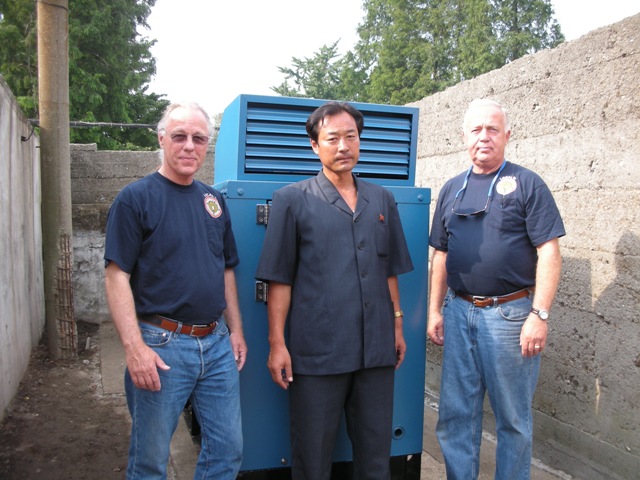
ibew.jpgPutting the “International” into the “International Brotherhood of Electrical Workers,”  Dan and Dennis McCarty, retired from Local 48, traveled with Mercy Corps to Haeju, North Korea, to install electrical systems in three area hospitals:

The men did all pre-planning and preparation work by working from photographs. But that wasn’t the only obstacle the twin brothers had to overcome.

“We experienced low quality electrical power and long hours without electricity,” said Dan McCarty. The language barrier also proved to a challenging, as well as working with a limited number of tools, materials and equipment.

“If you don’t have it with you when you arrive, your only option is to improvise while upholding safe practices,” said Dennis McCarty.

But the brothers didn’t let anything stand in their way. The project was pronounced a resounding success by North Korean’s hospital directors. All three power systems are operational and are currently in service.

Read the full story here:
Twin Brothers Light Up Hospital
IBEW Local 48
11/17/2008

Share

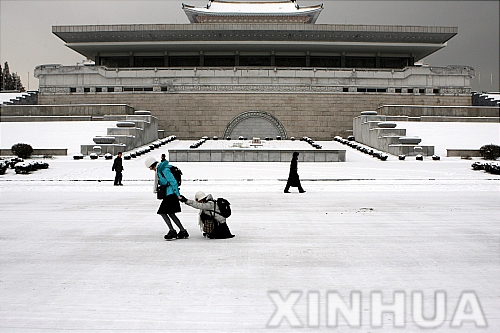
Pyongyang’s first snow of 2008

November 23rd, 2008

Taken by a Xinhua reporter (h/t to Korea Beat).

pyongyangsnow.jpg

This photo is taken in Kim il Sung Square in front of Kim Jong il’s viewing platform and the Grand People’s Study House.

Share

Korea Business Consultants Newsletter 11-2008

November 23rd, 2008

Korea Business Consultants has published their latest newsletter.  You may download it here.

Topics include:
DPRK to Close DMZ Crossing Points
ROK Catholic Priest To Work In DPRK
South’s DLP to Send Team to Pyongyang
Inter-Korean chicken business booms despite chilly ties
”Unofficial DPRK Mission for US”
China Eyes Trade Zone for DPRK Business
Bicycles Becoming More Popular in Pyongyang
“DPRK, China to Up Water Cooperation”
“Kaesong Better that PRC Option”
ROK Business Leaders Visit Kaesong
ROK Charity Sends Flour to DPRK
ROK Eases DPRK-Related Business Rules
“Kaesong goods carried by road”
Kaesong’s Fall Scenery Lures ROK Visitors
DPRK Loses to Thailand 1-0
Names and Titles

Share

North Korean authorities order markets to open every ten days, from 2009

November 21st, 2008

Daily NK
Jeong Jae Sung
11/21/2008

The North Korean authorities have been on the move to strengthen recent market regulation policies.

The 6th edition of “NK In & Out,” a recently released newsletter by the Network for North Korean Democracy and Human Rights (NKnet, Representative Han Gi Hong), relayed an order decreed by the North Korean authorities for the operation of markets every 10 days (on the 1st, 11th, and 21st of the month) starting next year, and introduced as an example some Pyongyang-based markets that only open once a month (on the 10th of every month) starting from last month.

According to the newsletter, an inside source in Yangkang Province reported, “The news of the ‘10-day market system’ starting next year emerged from lectures for government officials.”

A source from Shinuiju also said, “From November, the market maintenance office guards have been relaying the news of the conversion of permanent markets into markets that will operate much less frequently to the civilians.”

A North Hamkyung source said, “At a recent meeting of the People’s Unit, I heard that a new market management policy will come into effect starting next year. However, this is nothing new; all it is saying is that the jangmadang will be eliminated and converted into farmers’ markets, starting next year.”

The sources then pointed out that while the resistance of North Korean citizens will be strong, the possibility of actual policy implementation is deemed low.

The sources unanimously declared, “Similar news of the conversion of markets to the 10-day system or farmers’ markets began to circulate widely at the beginning of the year, but it was not carried out. If the jangmadang are converted into farmers’ markets right now, a riot will result.”

They also retorted, and expressed skepticism regarding the regulation of the market itself, “Most of the products that are circulated in the markets are connected to officials, so they will not actively step forward to regulate the markets and forsake their own gains.”

The “NK In & Out” newsletter relayed that irregular trends have not yet taken place in the markets in North Korea’s major regions. One Chinese trader who visited Dandong, China on the 10th said, “Markets are operating as normal, daily, in Pyongyang, Eunsan, Pyongsung, and Shinuiju.”

He added, “Among the rumors I have heard recently, there was one that private trade itself would be strictly prohibited from November 10th, but this news has been circulating for a while, so people are uncertain whether this will actually happen either.”

The newsletter released a rumor that graffiti and flyers saying “Topple Kim Jong Il” were seen on the morning of the September 9th National Foundation Day among North Korean citizens.

With regard to this, a Shinuiju source stated, “According to stories from merchants who have recently come from Pyongyang, the graffiti could be found near Chungsung Bridge on Unification Street in Pyongyang on September 9th. Flyers were passed out in the markets.”

He added, “The flyers also said, ‘What is socialism?’ ‘How can officials eat well while people starve?’ and ‘Let’s end the Kim Jong Il era’.”

Share

Farewell Gordon Tullock

November 20th, 2008

tullock.jpgGeorge Mason University law and economics professor Gordon Tullock is retiring.  Professor Tullcok is one of the seminal scholars of the Public Choice school of economics and the phenomenon known as “rent seeking.”  Although his CV is over 20 pages long, his most referenced work is The Calculus of Consent, co-authored with Professor James Buchanan who was awarded the Nobel Prize for the book’s contributions to economic science. 

Professor Tullock began his career in the US State Department, where he had a front row seat to Chairman Mao’s defeat of Chiang Kai-shek. He was actually in Beijing the day the communists entered the city, and for several years afterwards, he worked the China and North Korea desks for the State Department.

Since moving to Virginia in 1999, I have been honored to work down the hall from Professor Tullock, and he has always been a great source of wisdom and humor.  I wish to congratulate him for his notable and prolific career(s). 

Share