KWP acsends in September

July 14th, 2010

UPDATE:  The Daily NK also offers some propaganda posters leading up to the event.

ORIGINAL POST: According to the Daily NK:

Hwang Jang Yop, President of the Committee for the Democratization of North Korea, believes the motivation behind the Chosun Workers’ Party (KWP) delegates’ conference, which is to be held for the first time in 44 years this September, is Kim Jong Il’s belief that the power of the Party needs to be increased since too much authority is currently concentrated in the National Defense Commission, and this could represent an obstacle to the establishment of Kim Jong Eun’s succession.

Hwang, who was speaking at a forum in Seoul on July 13th, explained, “Kim Jong Il relies on the military to reign, and the core of that power is the National Defense Commission, but he is trying to solve the succession issue by strengthening the authority of the Party.”

“Kim wants to return the National Defense Commission to its previous role, which was to devote itself to military duty,” he added.

Hwang stated, “Kim Jong Il believes that Kim Jong Eun’s succession cannot be same as his own, which was done through the military. He believes that Kim Jong Eun cannot manage the military as well as he could, and therefore, if Kim Jong Il dies with power concentrated in the National Defense Commission, stabilizing the succession will be difficult.”

“The military is difficult to control if there is a problem, and since Kim Jong Il understands this fact, he is intending to control the military through the Party. Also, Kim will want to announce the succession issue to the North Korean people through the Party rather than the military.”

“The previous Military Commission of the Chosun Worker’s Party served the role of an administrative organization,” Hwang reminded listeners. “Taking the opportunity offered by the Chosun Workers’ Party delegates’ conference, the functions of the Party will be acknowledged and strengthened, while the military will be refocused on military work.”

He also commented, “Kim Jong Il has threatened the international community through the military in difficult political and economic times, and run North Korea by directly mobilizing the army. However, the cultural and ideological unification of North Korean citizens is impossible through the military so, Kim Jong Il will actively use the Party in the establishment of the succession.”

“Kim Jong Il believes that only the Party can unite the North Korean people ideologically during the establishment of the succession, so therefore he is hosting the Chosun Workers’ Party delegates’ conference to begin the process by reinforcing Party authority,” Hwang concluded, returning to the main theme.

Previous posts on September conference here and here.

Read the full story here:
KWP to Take the Power Back in September
Daily NK
Kim Yong Hun
7/14/2010

Share

Russia To Augment Missile Defense Along Border With North Korea

July 14th, 2010

According to RTTN News:

Russia is to deploy its latest surface-to-air missiles along its border with North Korea as part of efforts to strengthen its missile defense system in the region, local media reported on Tuesday.

According to an unnamed Russian defense official, the deployment of S-400 Triumph missiles in the country’s Far East will help avert potential missile threats from Pyongyang.

He added that the North Korean missile programs posed a threat to neighboring territories in Russia as the test site is ‘alarmingly close’ to Russian border.

As part of the move to augment the existing system two modern missile systems will be stationed there.

Meanwhile, Moscow ‘s decision comes even as there has been an escalation in tensions between North Korea and South Korea over the sinking of a South Korean naval vessel in the Yellow Sea.

Even though Seoul blamed Pyongyang for the tragedy, the latter has remained in denial throughout.

Read the full story here:
Russia To Augment Missile Defense Along Border With North Korea
RTTN News
http://news.ino.com/headlines/?newsid=71320101330
7/13/2010

Share

DPRK-PRC trade up 18.1% from January to May 2010

July 13th, 2010

Institute for Far Eastern Studies (IFES)
NK Brief No.10-07-08-2
7-8-2010

As inter-Korean commerce has all but dried up in the wake of the Cheonan incident, trade between North Korea and China appears to have continued to grow. According to Chinese customs statistics released on July 6, trade with North Korea from January to May amounted to 983.63 million USD; 18.1 percent more than the 833.07 million USD reported for the same period last year.

North Korea imported 727.192 million USD-worth of Chinese goods (29 percent increase over the same period last year), but exports dropped by 4.9 percent, amounting to only 256.438 million USD. This indicates a 60 percent increase in North Korea’s trade deficit with China, which was 470.757 million USD in the first part of 2009. With South Korean sanctions against the North halting all inter-Korean trade outside of the Kaesong Industrial Complex following the sinking of the Cheonan, it is expected that Pyongyang will become even more economically dependent on Beijing.

During this period, crude oil accounted for most of North Korea’s imports from China, as Pyongyang bought 254,000 tons (slightly more than the 247,000 tons in early 2009). However, due to rising international fuel prices, this oil cost the North 157.097 million USD, a 76 percent increase over what Pyongyang spent during this period last year.

In addition, rice (24,400 tons), corn (31,400 tons), beans (20,500 tons), flour (34,000 tons) and other necessary food imports totaling 11,300 tons reflected a 41 percent increase over the same period in 2009. The cost of fertilizer imports also jumped sharply, amounting to 81,943 tons, or 115.6 percent more than the 38,004 tons imported from January to May 2009. Increasing imports of food and fertilizer are a result of the growing agricultural difficulties being faced in the North. Based on current prices, aviation fuel imports also grew by 46.8 percent, freight trucks by 98.7 percent, automobile fuel by 47.4 percent, and bituminous coal by 137 percent.

The top ten official imports of Chinese goods by North Korea were as follows: crude oil (21.6 percent); aviation fuel (3.1 percent); freight trucks (2.9 percent); automobile fuel (2 percent); bituminous coal (1.9 percent); fertilizer (1.8 percent); beans (1.6 percent); flour (1.6 percent); rice (1.5 percent); and corn (1.1 percent).

North Korea’s exports to China were mainly underground natural resources. The top ten exported goods were: iron ore (17.1 percent); anthracite (16 percent); pig iron (9.6 percent); zinc (5 percent); Magnesite (3.6 percent); lead (2.4 percent); silicon (2.3 percent); men’s clothing (2.2 percent); frozen squid (2.1 percent); and aluminum (1.9 percent).

Share

DPRK risk ‘biggest drag on Seoul’s credit rating’

July 13th, 2010

According to the Choson Ilbo:

Korean reunification risk is the biggest drag on South Korea’s sovereign rating, according to an expert at ratings agency Standard and Poor’s.

David Beers of S&P on Monday said, “Korea unification, that’s going to be very economically and financially challenging for South Korea, because of the huge gap in income levels of the two countries.”

German reunification cost a lot of money despite the narrower economic gap between East and West Germany. The U.S-based global credit agency has kept South Korea’s sovereign rating unchanged at A since July 2005 — two notches lower than AA-, the rating given before the Asian financial crisis in the late 1990s, because the potential cost of the Korean reunification has been increasing, he said.

Beers also pointed to the war risk between South and North Korea as a hurdle to raising South Korea’s rating, even though the likelihood is slim.

The “stable” outlook means that there is a slim chance of a change in the country’s rating for two years to come, he added.

Beers was positive about the country’s reduction of short-term foreign debts since the global financial crisis in 2008 and predicted it will be ready to avert another global liquidity crisis.

An S&P inspection team led by Beers is in Seoul to attend an annual consultation about the rating from Wednesday to Friday.

Read the full story here:
N.Korean Risk ‘Biggest Drag on Seoul’s Credit Rating’
Choson Ilbo
7/13/2010

Share

Rice Prices on the Rise

July 13th, 2010

According to the Daily NK:

The price of rice in the three northern provinces of North Korea (Yangkang, North and South Hamkyung) has risen above 750 won for the first time in four months.

A source from Yangkang Province told The Daily NK yesterday, “Chosun rice prices have reached a high of 750 won in the Hyesan jangmadang,” and added, “Rice prices in Hyesan, Wiyeon and Chundong in Yangkang Province are at a similar level.”

In Chongjin, North Hamkyung Province, on around the 5th of this month the price of a kilo of rice hit 700 won. If the inflationary trend were to continue, by late July or early in August, it could have surpassed 1,000 won.

That said, the future is hard to predict. Rice immediately after the redenomination could nominally be bought for 20 won per kilo, but by mid-March this year was setting people back more than 1,000 won. However, the next month, prices had dropped back to around 500 won.

The source explained that the reason for the current situation may be the rising exchange rate. One Yuan was 110 won until last month, but is currently worth more than 150 won. North Korean exchange rates tend not to go down without intervention, so without any decisive measures by the authorities to stabilize rice prices, the result will be a rise in prices overall.

Hyesan in Yangkang Province is one of the comparatively free places where traders can visit China once every two weeks or so; therefore, rice prices were quite fluid. However, the reason why rice prices even in this city continue to rise is that there is not enough rice being imported, while exchange rates are rising inexorably.

The North Korean authorities once tried to lower prices by releasing rice from military stores. However, the effect was fleeting.

According to the source, the Hyesan jangmadang currently opens at 3PM and closes at 7PM due to agricultural activities, but trading is unrestricted. No regulations on price or usage of foreign currency are in place, but trade in industrial products remains slow due to the dire economic status of the majority of residents.

The authorities are trying to emphasize economic achievements in order to promote Kim Jong Eun’s succession, but the economic situation people are facing is far from satisfactory.

Read the full story here:
Rice Prices on the Rise
Daily NK
Shin Joo Hyun
7/13/2010

Share

KPA discipline along the Chinese Border

July 13th, 2010

According to the Telegraph:

Previously considered to be among the regime’s most important assets, the North Korean People’s Army has always been well provisioned in order to ensure the troops remain loyal.

But a poor harvest and the disastrous revaluation of the North Korean currency in November of last year has worsened the nation’s already dire economic straits.

Defectors have claimed that they were required to survive on noodles made of ground corn and that meat or fish were a luxury, a journalist for Japan’s Asahi Shimbun reported from the Chinese  city of Shenyang.

On one stretch of the border, Chinese troops apprehended five North Korean soldiers in May alone. Prior to the sinking of the South Korean corvette Cheonan in March, allegedly by a torpedo fired from a North Korean submarine, it was rare for troops to be taken into custody on the Chinese side of the Yalu River.

The defectors have claimed that senior members of the party and the armed forces were stockpiling provisions, another indication that the regime is steeling itself for a military confrontation.

“In the past there have been cases of North Korean troops crossing the border and plundering Chinese farms for their food, which they then took back to their posts in the North,” Kim Sang-hun, a human rights activist in Seoul, told The Daily Telegraph.

However, these soldiers chose to return to the North with the supplies.

Robert Dujarric, a professor of international relations specialising in North-East Asia, said the situation in North Korea was “very bad” at present, due to the poor harvest, but a more dramatic indicator of the scale of the problem would be if military officers or members of elite military units opted to follow in the footsteps of these soldiers.

The defectors apprehended by the Chinese were reportedly returned to North Korea, where they face execution.

Read the full story here:
North Korean soldiers defect to China fuelling fears of imminent military clash
Telegraph
Julian Ryall
7/12/2010

Share

DPRK says upcoming party meeting will be historic

July 13th, 2010

According to Yonhap:

North Korea stressed on Tuesday the historical importance of its upcoming meeting of core ruling party delegates, urging the younger generation of party members to be as loyal to the leadership as their predecessors.

In September, the communist state will hold its first meeting of senior Workers’ Party delegates in 44 years, a move that observers say may be aimed at paving the ground for leader Kim Jong-il to transfer his power to his third son, Jong-un.

Kim, 68, made his first public appearance in a 1980 convention, considered to be more authoritative, and sealed himself as the successor to his father, Kim Il-sung, who founded the North and died in 1994.

In an editorial seen here on Tuesday, the Rodong Sinmun, the party’s daily, heaped praise on party members who died loyal to the founder and called on new members to “follow suit.”

The paper, considered to be Pyongyang’s main mouthpiece, also described the September meeting as one that will “shine as a notable event in the history of the holy Workers’ Party.”

Late last month, the paper said that the party will expand its role and function through the meeting, stressing the importance of the central party organ that had once served as a venue for Kim Jong-il to rise up the power ladder when he was young.

Kim is believed to be quickening his power transfer after suffering a stroke two years ago. Earlier this year, North Korea promoted Kim’s brother-in-law as a vice head of the National Defense Commission, the highest seat of power. Jang Song-thaek is believed to be the central figure behind the succession process.

Read the full story here:
N. Korea says upcoming party meeting will be historic
Yonhap
Sam Kim
7/13/2010

Share

Kaesong output declines

July 13th, 2010

According to Yonhap:

Production at a South Korea-financed factory park in North Korea fell for a second straight month in May, figures showed Tuesday, as manufacturers complained of a decrease in orders amid tension between the divided states.

Production at the joint complex in the North Korean border city of Kaesong stood at US$27.79 million in May, a 1.2 percent decrease from a month earlier, according to the Unification Ministry in Seoul.

The number, however, marked a 56 percent increase from a year earlier, the ministry said, a sign that the complex is expanding on a yearly basis.

Despite the deadly March sinking of a South Korean warship, which was blamed on North Korea and ignited the ensuing tension along the border, the number of North Korean workers in the complex topped 44,000 recently. More than 120 South Korean companies employ the workers to produce labor-intensive goods such as utensils and garments.

The companies have recently called on the Seoul government to ease its restrictions on their operations, including a cap on the number of South Korean workers allowed to travel to Kaesong daily.

South Korea has also banned the companies from new investments in their businesses within the complex, which opened in 2004 and represents the last remaining major symbol of reconciliation between the Koreas.

According to Yonhap:
Output at inter-Korean factory park declines for second month
Yonhap
7/13/2010

Share

Bermudez publishes KPA Journal, Vol. 1, No.6

July 12th, 2010

kpa-journal-vol6.JPGJoseph Bermudez, military analyst for Jane’s Intelligence Review and author of The Armed Forces of North Korea, has published the sixth issue of his very fascinating KPA Journal.

Click here to download the full issue (PDF).

Topics include: DPRK Intelligence Services 1967-1971 (Part 3), P’okpoong Main Battle Tank.

Previous issues of KPA Journal can be downloaded here.

Share

Hamhung’s (future) residential construction

July 12th, 2010

I have previously posted about residential construction in the DPRK in Ryongchon (here) and Pyongyang (here and here).

Apparently Hamhung is on the government’s list of urban areas that need to be rebuilt. KCNA reported on May 2o:

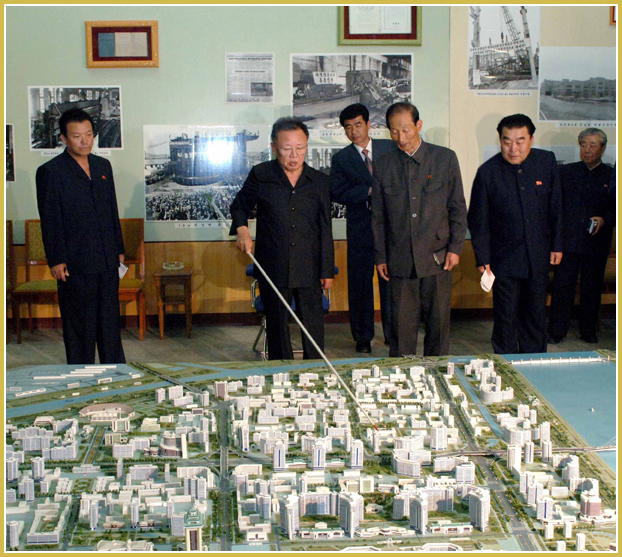
After touring Hamhung City, [Kim Jong-il] examined a miniature of the city construction layout plan and other plans for the development of major economic fields in South Hamgyong Province and guided the work in this domain on the spot.

Underscoring the need to build Hamhung City under a long-term plan by thoroughly applying the socialist principle, the principle of popular character as it is the industrial city with a large number of workers, he specified the orientation and ways to do so.

Here is a photo of Kim Jong-il inspecting that very miniature mentioned in the KCNA piece.

hamhung-future.jpg


Click image for larger version

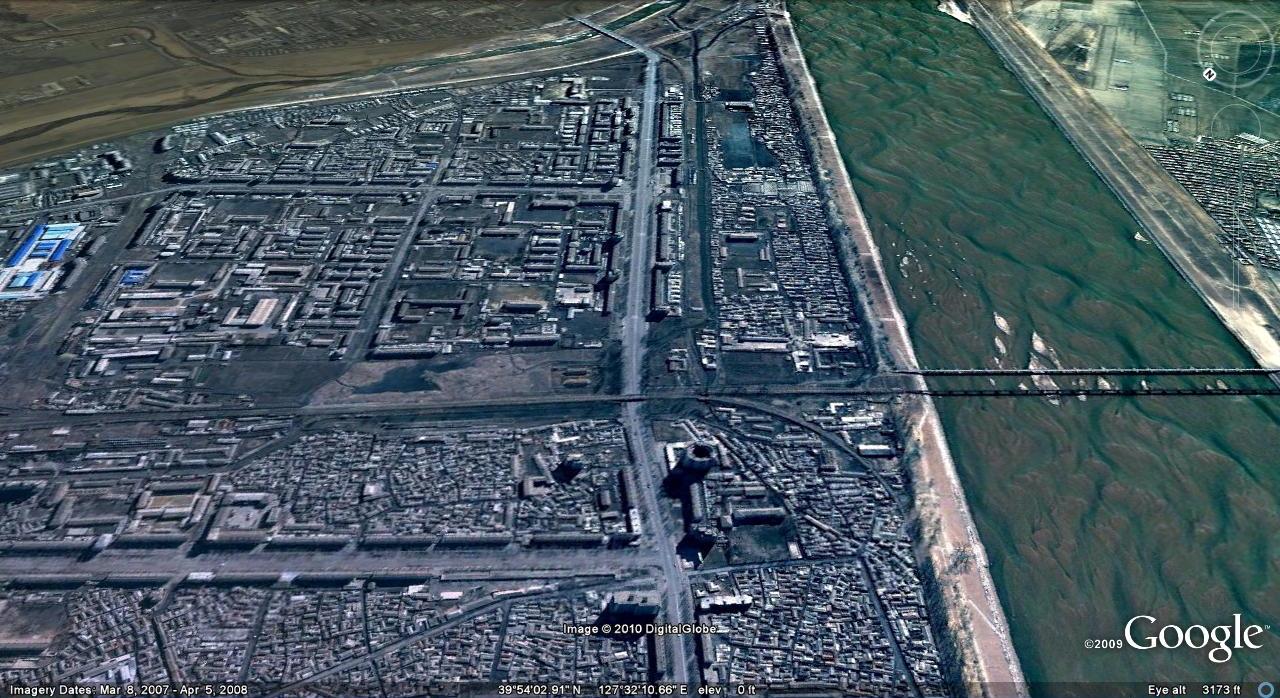
Here is a Google Earth satellite image of this same area as it appears today–taken from the same angle:

hamhung-area-for-development.JPG

The ghost of Ceauşescu is lurking.  Who knows if they will ever get around to completing this task, but it is apparent they intend to remake Hamhung in the image of Kwangbok Street or Rakrang in Pyongyang.

Jane Jacobs is rolling in her grave.

Share