Amnesty International publishes report on DPRK

July 15th, 2010

UPDATE: UN World Health Organization has criticized the Amnesty report.  According to the Associated Press:

The World Health Organization found itself Friday in the strange position of defending North Korea’s health care system from an Amnesty International report, three months after WHO’s director described medicine in the totalitarian state as the envy of the developing world.

WHO spokesman Paul Garwood insisted he wasn’t criticizing Amnesty’s work, but the public relations flap illustrated an essential quandary for aid groups in unfree states: how to help innocent people without playing into the hands of their leaders.

Amnesty’s report on Thursday described North Korea’s health care system in shambles, with doctors sometimes performing amputations without anesthesia and working by candlelight in hospitals lacking essential medicine, heat and power. It also raised questions about whether coverage is universal as it — and WHO — claimed, noting most interviewees said they or a family member had given doctors cigarettes, alcohol or money to receive medical care. And those without any of these reported that they could get no health assistance at all.

Garwood said Thursday’s report by Amnesty was mainly anecdotal, with stories dating back to 2001, and not up to the U.N. agency’s scientific approach to evaluating health care.

“All the facts are from people who aren’t in the country,” Garwood told reporters in Geneva. “There’s no science in the research.”

The issue is sensitive for WHO because its director-general, Margaret Chan, praised the communist country after a visit in April and described its health care as the “envy” of most developing nations.

Major global relief agencies have been quietly fighting for years to save the lives of impoverished and malnourished North Koreans, even as the country’s go-it-alone government joined the exclusive club of nuclear weapons powers and wasted millions on confrontational military programs.

Some groups may fear being expelled from the country if they are openly critical of Pyongyang, which is highly sensitive to outside criticism. Still, Chan’s comments were uncommonly ebullient.

Garwood and WHO spokeswoman Fadela Chaib insisted that Amnesty’s report was complementary to their boss’ observations, and sought to downplay Chan’s praise for North Korea. Instead, they focused on the challenges she outlined for North Korea, from poor infrastructure and equipment to malnutrition and an inadequate supply of medicines.

But whereas Chan had noted that North Korea “has no lack of doctors and nurses,” Amnesty said some people had to walk two hours to get to a hospital for surgery. Chan cited the government’s “notable public health achievements,” while Amnesty said health care remained at a low level or was “progressively getting worse.”

Asked Friday what countries were envious of North Korea’s health, Chaib said she couldn’t name any. But she highlighted the importance of maintaining the health body’s presence in the country, where officials do their best to save lives despite “persisting challenges.”

“We are an organization dealing with member states, and we respect the sovereignty of all countries,” Chaib said. “We need to work there to improve the lives of people.”

Sam Zarifi, head of Amnesty’s Asia-Pacific program, said the human rights group stood by its findings.

“We certainly have a lot of restrictions in terms of working in North Korea, but we did our best in terms of capturing the information we could verify,” Zarifi said. “We don’t take the WHO’s statements as criticizing or rejecting Amnesty’s findings.”

He said Amnesty had spoken to North Koreans as well as to foreign health care and aid workers, and relied heavily on WHO for information — including the assessment that North Korea spends $1 per person per year on health care, the lowest level in the world.

The U.N. estimates that 8.7 million people need food in North Korea. The country has relied on foreign assistance to feed much of its population since the mid-1990s when its economy was hit by natural disasters and the loss of the regime’s Soviet benefactor.

North Korea, ruled by Kim Jong Il, is routinely described by U.N. and other reports as one of the world’s most repressive regimes.

Garwood said Amnesty’s research added a needed element to understanding health conditions in North Korea, but added that it didn’t even mention recent improvements in the country as the result of a program funded by South Korea and aided by WHO.

The U.N. body claims that maternal mortality has declined by over 20 percent since 2005, and diarrhea cases and deaths in operations have also dropped. It says more than 6,000 doctors and nurses have been trained in emergency obstetric care, newborn care and child illnesses, while clinics have received better material for operations, blood transplants and other medical interventions.

As for Chan’s April claim that “people in the country do not have to worry about a lack of financial resources to access care,” Garwood said hundreds of field missions have been conducted in North Korea.

“None have come back reporting the kinds of things in the Amnesty report in terms of payment for services,” he said.

“I’m not saying they’re not credible accounts,” he added. “But it’s not taking into account some of the things that are happening today.”

Zarifi, of Amnesty, said the whole debate would be ended if North Korea’s government provided access to monitors so that everyone had a better understanding of the country’s health care system.

“Every indication we have indicates the state of health care in North Korea is dire,” he said.

ORIGINAL POST: Here is the introduction to the report (which you can download here as a PDF):

In the early 1990s, the Democratic People’s Republic of Korea (DPRK or North Korea) faced a famine that killed up to one million people in a population that at the time hovered around 22 million (the current population stands at 23.9 million). Food shortages and a more general economic crisis have persisted to this day. The government has resolutely maintained that it is committed to, and capable of, providing for the basic needs of its people and satisfying their right to food and a proper standard of health. The testimonies presented in this report suggest otherwise. The people of North Korea suffer significant deprivation in their enjoyment of the right to adequate health care, in large part due to failed or counterproductive government policies. These poor policies include systematic failure to provide sufficient resources for basic health care (North Korea had one of the lowest levels of per capital funding for health care recorded by the World Health Organisation in 2006). After nearly two decades, food insecurity remains a critical concern for millions of North Koreans. This has been compounded by the government’s reluctance to seek international cooperation and assistance, which the government is obligated to do when it would otherwise be unable to ensure minimum essential levels of food for the whole population, and its restrictions on the delivery of humanitarian assistance. This delayed and inadequate response to the food crisis has significantly affected people’s health.

Additionally, a currency revaluation plan in November 2009 caused spiralling inflation that in turn aggravated food shortages and sparked social unrest. In the first few months after the plan went into effect, the North Korean government exacerbated the situation by restricting the use of foreign currency, closing down food markets, and prohibiting small-plot farming. Many people died of starvation and many others lost their entire savings.

Amnesty International has documented how widespread and chronic malnutrition, which suppresses people’s immune system, has triggered epidemics and mass outbreaks of illnesses related to poor diet. Interviews with North Koreans depict a country that professes to have a universal (free) health care system but in reality struggles to provide even the most basic service to the population. Health facilities are rundown and operate with frequent power cuts and no heat. Medical personnel often do not receive salaries, and many hospitals function without medicines and other essentials. As doctors have begun charging for their services, which is illegal under North Korea’s universal health care system, the poor cannot access full medical care, especially medicines and surgery.

The interviews conducted by Amnesty International indicate that the North Korean government has also failed its obligation to provide adequate public health information. As a result, most of the interviewees were unaware of the importance of seeking proper medical diagnoses or completing a course of medication. And, because many hospitals no longer supply free services or medicines (despite government commitments to the contrary), many people normally do not visit doctors even when they are ill.

In a 2004 report, Starved of Rights: Human rights and the food crisis in the Democratic People’s Republic of Korea (North Korea), Amnesty International documented actions of the North Korean government that aggravated the effects of the famine and the subsequent food crisis, including denying the existence of the problem for many years, and imposing ever tighter controls on the population to hide the true extent of the disaster from its own citizens. It also documented the government’s refusal to allow swift and equitable distribution of food and its imposition of restrictions on freedom of information and movement, which exacerbated the population’s ability to search for food.3 Although some progress has been made since 2004, access to food is still a critical issue in North Korea. As this report demonstrates, the inadequate and sometimes counter-productive actions of the North Korean government over the country’s food crisis have had a devastating impact on the health of the population.

Under international law and standards, North Korea is obligated to protect the rights of its population to the highest attainable standard of health. This means that, at the very least, the state must provide for adequate health care and the underlying determinants of health, including food and nutrition, housing, access to safe and potable water and adequate sanitation, safe and healthy working conditions, and a healthy environment. North Korea’s responsibilities under international and domestic law will be addressed in greater detail in section 5.

To improve the situation, Amnesty International presents the following key recommendations to the government of the Democratic People’s Republic of Korea with more detailed recommendations in the conclusion of this report.

Amnesty International calls on the North Korean government to:

1. as a matter of priority, ensure that food shortages are acknowledged and effective steps taken to address these shortages, including acceptance of needed international humanitarian assistance;

2. ensure the need-based and equitable distribution of health facilities, goods and services throughout the country;

3. co-operate with the World Food Programme and donors, allow unrestricted access to independent monitors, and ensure non-discrimination, transparency and openness in the distribution of food aid;

4.ensure that medical personnel are paid adequately and regularly so that they may carry out their duties properly;

5. undertake information and education campaigns to provide accurate and comprehensive information on prevalent infections and diseases; their causes, symptoms and treatment; and the importance of medical diagnosis and effective use of medicines.

Furthermore, Amnesty International recommends to the international community, and in particular, major donors and neighbouring countries such as China, Japan, Russian Federation, South Korea and US to:

1. ensure that the provision of humanitarian assistance in North Korea is based on need and is not subject to political conditions.

This report has received wide coverage in the media.  Here are the links:

Barbara Demick, Los Angeles Times

Choe Sang-hun, New York Times

Yonhap

BBC

Share

Demick’s “Nothing Left”

July 15th, 2010

Barbara Demick wrote an interesting piece in the New Yorker this week which captures first-hand stories about how the DPRK’s currency reform affected local families (not well).

Here is her article in PDF format.

Share

Cato Institute panel on DPRK

July 15th, 2010

This week the Cato Institute hosted a panel on North Korea.  Participants include:

Stephen Linton, Chairman and Founder, Eugene Bell Foundation
Karin J. Lee, Executive Director, The National Committee on North Korea
Doug Bandow, Senior Fellow, Cato Institute
Ted Galen Carpenter (Moderator), Vice President for Defense and Foreign Policy Studies, Cato Institute

You can see a video of the panel discussion here.  It includes an interesting fundraising video by the Eugene Bell Foundation.

UPDATE: Tad at NKnews.org has a write up of the panel here.

Share

DPRK leases squid rights to Chinese

July 15th, 2010

According to the Joong Ang Ilbo:

North Korea is allowing Chinese fishermen into its territorial waters on the East Sea in exchange for cash, according to Seoul government officials.

The North Korean and Chinese governments recently agreed to allow squid boats from China to fish in North Korea’s waters, said a Seoul official who declined to be named.

About 250 Chinese boats are operating near Najin [Rajin/Rason] and Chongjin, two port cities in North Hamgyong Province, a northeast coastal area. It is the first time such a large number of Chinese crafts have been allowed to operate in North Korea’s seas, he said.

North Korea is collecting about 250,000 yuan ($36,913) for each boat for 2010, meaning the impoverished country is expected to earn about 62.5 million yuan in the deal.

“Many of the North’s fishing boats are extremely outdated and are experiencing intense fuel oil shortages, while squid prices in China have gone up due to supply shortages,” the official said. “So each side’s interests have been satisfied.”

North Korea has been hungry for more cash to finance state projects, including a so-called Pyongyang modernization project that involves paving major roads, upgrading railway networks and refurbishing urban streets.

“They are trying to secure more foreign currency through a commercial deal that is not subject to UN Security Council Resolution 1874,” said the official, referring to the UN economic sanctions adopted in June 2009 that involve trade restrictions, cargo inspections and other limits on financial transactions.

The Chinese fishing boats operating in the North’s sea mostly come from Dalian and Dandong, two ports in China’s northeastern coastal region.

“The fishing rights the Chinese boats have secured cover most of the North’s territorial waters on the East Sea,” said another Seoul official. The official expressed concern about possible overfishing by the Chinese, which may affect South Korean fishermen as well.

“Once squid start moving to the south, the Chinese fishing boats will travel farther south, possibly all the way down to Heungnam, Sinpo and Wonsan,” said another South Korean government official, referring to the North’s port cities in South Hamgyong Province.

Read the full article below:
North Korea leases out its squid beds to China
Joong Ang Ilbo
Chung Yong-soo
7/15/2010

Share

Former DPRK railway minister reportedly executed

July 15th, 2010

According to Breitbart (via Breitbart):

Former North Korean Railways Minister Kim Yong Sam was executed in March last year for failing to maintain locomotive trains that had been in store for wartime, Radio Free Asia, a nonprofit radio station, reported Wednesday on its Internet edition.

A source on North Korean affairs said Kim got into trouble during an inspection by the National Defense Commission for scrapping locomotive trains that were in store for wartime.

After the inspection, carried out after celebrations were held to mark the country’s 60th birthday on Sept. 9, 2008, Kim was handed over to the State Security Department, report said.

He had been railways minister for 10 years from September, 1998.

The Choson Ilbo has more:

A nationwide campaign is underway recently in North Korea to get rid of photos and publications of executed former senior officials, Radio Free Asia claimed Tuesday.

This campaign was ordered by leader Kim Jong-il on July 2. The North’s Press Censorship Bureau is reportedly destroying documents and materials collected from across the country.

According to RFA, the campaign’s targets include Pak Nam-gi, the former director of the North Korean Workers Party’s Planning and Finance Department who was executed in March over the disastrous currency reform, and former railways minister Kim Yong-sam.

“Railway workers suffering from the food shortage stole copper and aluminum parts from locomotive trains that were in store for wartime and sold them as scrap metal. As a result, about 100 locomotives were scrapped,” it claimed. “This was revealed in an inspection by the National Defense Commission in 2008.” Kim Yong-sam was then taken to the State Security Department and executed in March the following year, it added.

Kim Yong-sam was appointed railways minister in September 1998 but has not been seen in public since October 2008, when he was replaced by current minister Jon Kil-su.

A Unification Ministry official said rumors about his execution are “rampant.”

Read the full stories here:
Former N. Korean railways minister Kim Yong Sam executed: report
Kyodo (via Breitbart)
7/14/2010

N.Korea’s Ex-Railways Minister Executed
Choson Ilbo
7/15/2010

Share

DPRK soldiers change uniforms

July 15th, 2010

According to the Choson Ilbo:

kpa-uniform-changes-2010-7-14.jpg


Click image for larger version

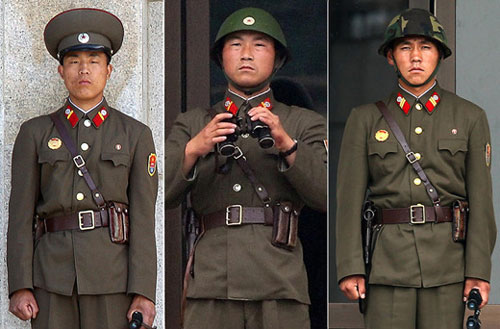
North Korean soldiers stationed at the border truce village of Panmunjom have changed their headgear again.

On Thursday, a day ahead of planned military talks about the sinking of the South Korean Navy corvette Cheonan between the UN Command and the North, they were seen wearing camouflage helmets (right).

They have worn them for 10 days, a South Korean military spokesman said. In late May the guards switched from their usual army caps (left) to steel helmets (center).

Read the full story here:
N.Korean Soldiers’ Changing Millinery Fashions
Choson Ilbo
7/15/2010

Share

Some see Cheonan in new DPRK propaganda poster

July 14th, 2010

dprk-cheonan-poster.JPG

According to the Joong Ang Daily:

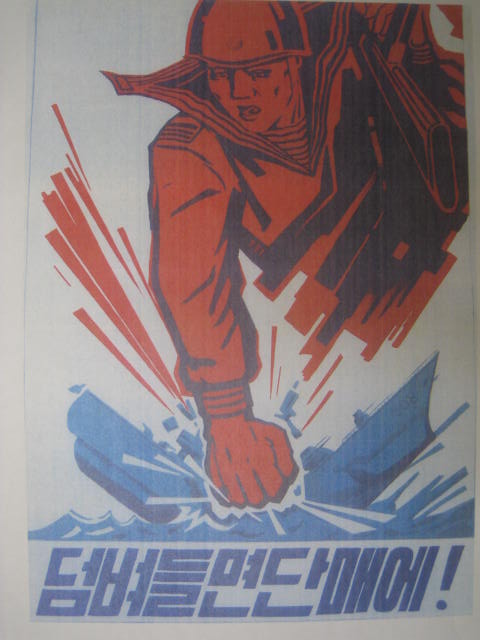
[Radio Free Asia] reported on its Korean Web site that the poster shows a fully armed soldier cutting a corvette similar to the Cheonan in half with his bare fist. Below the image is the phrase “Deom-byeo-deul-myeon Dan-mae-e!” (“Ready to crush any attack with a single blow!”).

Radio Free Asia based its report on an interview with the businessman, who took the photo of the poster on a recent trip to North Korea. The poster is shown on the RFA Korean Web site. The RFA did not specify the date the photo was taken but, citing unnamed sources, said it was likely the poster was made after the Cheonan sinking to encourage military heroism among North Korean soldiers.

The RFA quoted the Chinese businessman as saying, “Officials in North Korea have claimed that the South Korean government’s accusation of North Korea as the culprit in the Cheonan incident is a false charge, but the propaganda poster showing the breaking of a ship in two pieces seems to conflict with their claim.”

The full Joong Ang Daily article can be seen here.

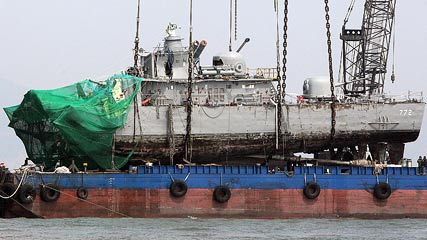
Here is a picture of the Cheonan:

cheonan-surface.JPEG

At first glance the painting seems like it could be the Cheonan or some kind of corvette vessel.  I looked through my books on North Korean propaganda and found several images of soldiers smashing things with their fists (western books and videos, the US capital, imperialist soldiers, etc—but no naval vessels). I also found several posters with naval ships…but they were all of the USS Pueblo.  This is the first North Korean poster I have seen that features a naval vessel that is not the Pueblo.  However, I am more inclined to think it is a generic ship “form” meant to convey a broad idea rather than a specific act.  This is because the painted ship, in addition to bearing some slight differences with the actual Cheonan,  is “stylized”–it lacks a propeller and a flag of origin. A great new addition to the North Korean propaganda collection nonetheless.

Share

Frontline Club discussion of DPRK

July 14th, 2010

Last month the Frontline Club (London) hosted a panel discussion on the DPRK.  Participants included:

Vitit Muntarbhorn, former UN Special Rapporteur on situation of human rights in North Korea;
Lord Alton of Liverpool, chair of the all party parliamentary group for North Korea;
Professor Hazel Smith, professor of security and resilience at Cranfield University
Park Ji-hyun, refugee from Chongjin

The panel took place on June 21 and you can watch it here.

Thanks to a feline friend for the link.

Share

Kumamoto trading firm head indicted over illegal exports to China/DPRK

July 14th, 2010

According to Kyodo (via Japan Today):

Prosecutors indicted the president of a trading company in Kumamoto Prefecture on Tuesday on a charge of illegally exporting to China a power shovel that can be used in the development of weapons of mass destruction and which was later transported to North Korea, investigators said. Hiromitsu Tsutsumi, 63, of Yatsushiro, Kumamoto Prefecture, was arrested last month along with the 37-year-old head of another trading firm in Fukuoka City, but prosecutors have decided not to indict the latter due to insufficient evidence.

Tsutsumi is suspected of exporting to China a used power shovel in April last year under the name of the trading firm in Fukuoka by submitting to customs a false declaration and without obtaining permission from the economy, trade and industry minister, according to the indictment. The Fukuoka prefectural police said they have confirmed that the power shovel has since been transported to North Korea from China’s Dalian.

Tsutsumi has also exported three other power shovels to Hong Kong in February last year and has told investigators that he received orders from North Korea and was given about 10 million yen in advance payment, and that the power shovel he exported in April 2009 was a reward for the ordering party, according to the police. Power shovels are designated as items subject to the export control regulation as they could be diverted for military use, such as for launch pads for ballistic missiles.

Just last week another Japanese firm was busted for illegally exporting luxury goods to the DPRK.

Read the full story here:
Kumamoto trading firm head indicted over illegal exports to China
Kyodo (Japan Today)
7/14/2010

Share

Food price update

July 14th, 2010

According to the Daily NK:

As previously reported, the price of rice in North Korea, which declined in March, has started soaring again. But this rice price fluctuation looks different from those of previous years.

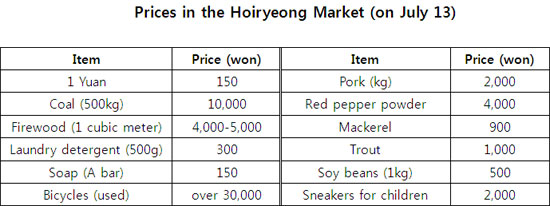
According to a source from North Hamkyung Province, rice in Hoiryeong market was between 450 and 500 won per kilogram until late June, but on July 13th it hit 750 won. Corn rice is also more than 400 won now.

At the same time, one Yuan is now worth 150 won.

Since the mid-2000s when the market economy started to spread, rice prices have risen during the spring poverty season in April and May. And then, in around late June, when potatoes and barley are harvested, prices stabilize, and then, in September, they decline in expectation of the harvest.

Therefore, traders in the jangmadang generally buy rice and other grains in November and December and then sell them in the jangmadang during April. Cadres also use that regular cycle of food price rises and falls to profit by buying rice late in the year and releasing it for a higher prices during the next spring. Therefore, poorer people also try to get rice and grain in winter time.

However, since the currency redenomination, the fluctuations have changed.

Immediately after the redenomination, the authorities released a measure shutting down the markets, so in January rice prices rose by around 60 times compared with before the redenomination. The markets have been open once again since February 5th, but food prices remained unstable through mid-March. That was because people did not buy grains until March, at which time demand promptly far outstripped supply.

In April this year, there was a limited amount of food distribution and some residents in some districts of Pyongyang received corn, which they were supposed to receive in May and June, in advance. Additionally, as a result of Kim Jong Il’s visit to China, rumor had it that a large amount of food would be delivered, so rice prices were relatively flat.

However, when the rumor turned out to be empty, a decree was handed down to lower units in May ordering food self-reliance at the local level. This only intensified anxiety about the food situation.

More serious problems may come in July and August, monsoon season. If the weather affects farming, anxiety about food for the last half of the year will grow. Make things worse, there was cold-weather damage to farming early this year, so a lost harvest is clearly going to be on people’s minds.

On this, one source said, “Food wholesalers predict that prices will go on rising until the harvest in August. And when rising food prices influence general products, big troubles can come, like they did in January of this year.”

dnk-hoeryong-mkt-prices-7-13-2010.jpg


Click image to see Hoeryong market prices.

Read the full story here:
Food Price Cycle Twisting in the Wind
Daily NK
Yoo Gwan Hee
7/13/2010

Share