KCNA hails UNPF cooperation

July 12th, 2010

According to KCNA:

Int’l Cooperation Strengthened in Population Work

Pyongyang, July 10 (KCNA) — Twenty-five years has elapsed since the cooperation between the Democratic People’s Republic of Korea and the United Nations Population Fund (UNPF) was started.

The DPRK government concluded an agreement with the UNPF in Juche 74 (1985) and has conducted various activities to improve the population work.

From 1986 the UNPF has cooperated with the DPRK in the population work such as training of experts, building of material foundations, census of population and improvement of the women’s health.

In cooperation with the UNPF, the DPRK government conducted the first nationwide census in 1993 and the second in 2008 in a scientific way suitable to the international standard.

The government has also successfully finished the survey of the pregnant women’s mortality and health, one of the Millennium Development Goals (MDG).

The results of the survey have served as basic data in working out national economic growth plan and public health plan in a scientific way.

On the occasion of the World Population Day (July 11), Yang Song Il, a section chief of the Population Centre of the DPRK, told KCNA that the 2007-2010 fourth cooperation plan between the UNPF and the DPRK will be finished and the 2011-2013 fifth cooperation plan will be worked out this year.

He said, “We will continue surveys in different fields to make a scientific contribution to the development of national economy and public health and work hard to implement the action programme of the International Conference on Population and Developmentand attain the MDG, further strengthening cooperation with international organizations, including the UNPF”.

Share

Miscellaneous foreign assistance documents

July 12th, 2010

Several reports on various foreign assistance programs in the DPRK have been piling up on my desktop so I thought I would go ahead and post them for you.  They are not particularly timely, but they are full of interesting information.

U.S. Bilateral Food Assistance to North Korea Had Mixed Results (PDF)
US GAO
June 2000

DPRK: Water and sanitation in three counties of Kangwonin three counties of Kangwon Province (Thongchon, Chonnae, Popdong)
Reliefweb Mission Report
March 2002

Rehabilitation of Thongchon, Popdong and Chonnae Water Supply systems (Kangwon Province, DPR of Korea)
Reliefweb Mission Report
June 2002

Democratic People’s Republic of Korea: Operations Report
International Federation of Red Cross and Red Crescent Societies
Appeal no. MDRKP001
November 15, 2007

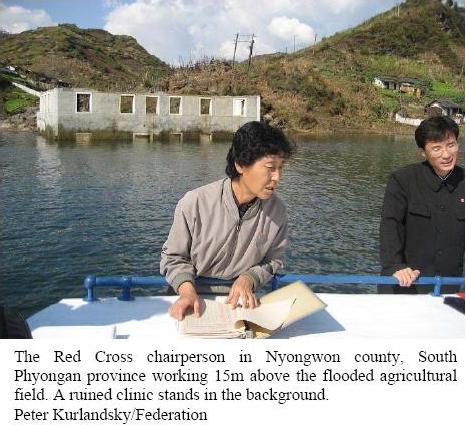
The IFRC contains the below photo of a flooded clinic:

nyongwon-clinic-flooded-ground.JPG

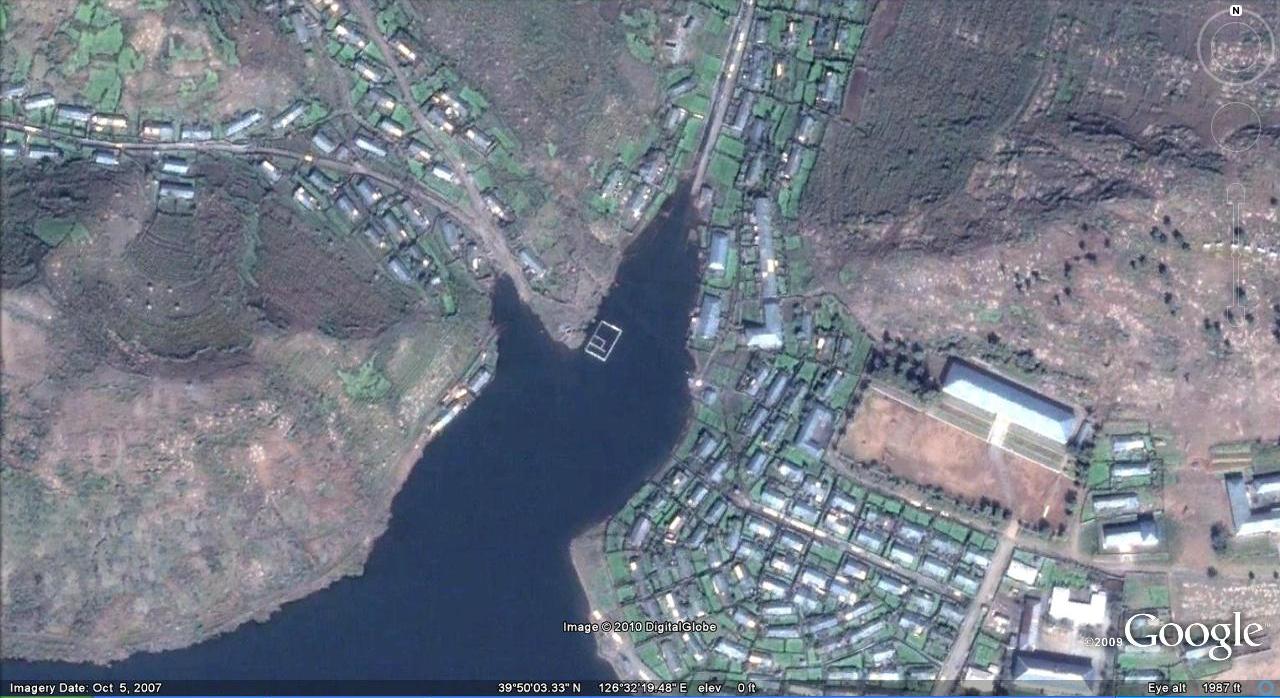
This clinic is in Nyongwon at 39°50’3.51″N, 126°32’18.64″E.  Here is a satellite image:

nyongwon-clinic-flooded-satellite.JPG

The sad part is that the damage caused by flooding is in large part an unintended consequence of agriculture, deforestation, and hydro-power policies.  This clinic lies behind the Taedonggang Dam in Tokchon (satellite image here).

Share

Police arrest 2 for illegal ‘luxury’ exports to N. Korea

July 11th, 2010

According to Kyodo (Via Breitbart):

Police on Thursday arrested the operator and an employee of a trading company in Sakaiminato, Tottori Prefecture, on suspicion of illegally exporting pianos to North Korea in violation of a ban on the export of “luxury” items to the country, investigative sources said.

The company is suspected of having exported several pianos worth some 4 million yen from February to the fall of 2009 to North Korea via Dalian in northeastern China, in violation of the foreign trade control law, according to the sources.

Japan banned the export of luxury items to North Korea in November 2006 in response to the country’s first nuclear test a month earlier and expanded the ban to cover all exports to North Korea in June last year, due to Pyongyang’s second nuclear test and unresolved issues including the abduction of Japanese nationals.

In late May, the Tottori prefectural police raided the company’s office and other related locations and have since analyzed confiscated materials such as account ledgers, the sources said.

According to the corporate registry, the company was established in June 2006, with 10 employees. It sells and exports secondhand goods and also engages in the collection and delivery of industrial waste.

Police arrest 2 for illegal ‘luxury’ exports to N. Korea
Kyodo (via Breitbart)
7/8/2010

Share

DPRK aid update

July 11th, 2010

According to KBS:

Red Cross to Help NK Prepare for Monsoon Season

The International Federation of Red Cross and Red Crescent Societies reportedly plans to allocate around nine million dollars this year for projects to support North Korea ahead of the monsoon season.

Radio Free Asia said Wednesday that the Red Cross plans to select 31 towns that are considered to be the most vulnerable to natural disasters and will provide them with up to nine-and-a-half million dollars for preparedness training and to build dams and reservoirs.

The report said the international organization’s plans aim to help some eight-point-two million North Koreans this year.

The Red Cross also plans to form a committee on preventing natural disasters in the North from this month until mid-September, when the region is affected by monsoon rains.

And according to another KBS story:

WFP to Spend $2.8 Mln on NK Food Aid

The U.N. World Food Program (WFP) has decided to spend nearly two-point-eight million U.S. dollars on food aid for North Korea.

The funding for the aid was provided by the Swedish government.

Radio Free Asia quoted WFP global media coordinator Greg Barrow as saying that his agency will use the Swedish donation to help North Korea, which is in desperate need of emergency food aid.

Barrow said that the North will require even more donations from countries around the world, given that the current amount of food aid for the impoverished nation is expected to run out by September.

Read the full stories here:
WFP to Spend $2.8 Mln on NK Food Aid
KBS
7/7/2010

Red Cross to Help NK Prepare for Monsoon Season
KBS
7/7/2010

Share

China To Recycle Waste From Russia, North Korea

July 11th, 2010

According to Bernama (Malaysia):

China will build a huge centre to recycle wastes from Russia and North Korea, in a city that borders the two countries, local authorities said Wednesday.

The centre is expected to recycle nearly three million tonnes of scrap machines, cables, appliances, vehicles, mobile phones, batteries, plastics and other wastes each year, Xinhua reported.

Northeast China’s Jilin Province has approved the recycling centre in Hunchun City. It will cover 135 hectares of land and the facility’s combined floor space will top 500,000 square meters, an official with the publicity department of Hunchun City Government said.

The project is expected to create nearly 10,000 jobs, and its annual output value will reach 15 billion yuan (US$2.21 billion) after it becomes operational, said the spokesman.

However, the spokesman did not elaborate further on the details regarding construction of the centre.

Read the full story here:
China To Recycle Waste From Russia, North Korea
Bernama
7/7/2010

Share

Neurosurgeon travels to N. Korea on medical mission

July 11th, 2010

According to the Delmar Times:

San Diego neurosurgeon Dr. Kevin Yoo recently spent the first half-day of his medical mission to North Korea assembling a $20,000 surgical operative microscope that his travel partner donated to the Pyongyang University Hospital.

And both he and his fellow neurosurgeon Dr. Kee Park, who retired from private practice in Missouri several years ago to devote himself to humanitarian medical projects, demonstrated the effectiveness of the new scope in a series of operations they performed or assisted in during their three-day teaching visit to the North Korean capital in early June.

Yoo, 45, a Carmel Valley resident and father of three children, who was born in Seoul, South Korea, took time off from his busy practices in La Jolla, Poway and Temecula to join Park in a “special access” mission to the isolated communist state arranged with the help of the United Nations.

Park previously made similar trips to Ethiopia, Nepal and, on four occasions, to North Korea.

Yoo learned of Park’s humanitarian efforts at a meeting of Korean-American Spine Surgeons and volunteered to join Park, who lives in Indiana, on his fifth visit to North Korea last month.

“He didn’t think I would show up, but I did,” Yoo said.

They rendezvoused at the Inchon International Airport in South Korea and traveled together to North Korea via Beijing.

Yoo is a staff physician at Scripps Memorial Hospital in La Jolla specializing in head, neck and spine surgery.

Commenting on his visit to North Korea, Yoo said he was impressed with the knowledge, intelligence and skill of the North Korean surgeons. “But,” he said, “they just didn’t have the tools” that American surgeons often take for granted.

“The microscope was a tremendous addition to what they had,” Yoo said. “Dr. Park told me they had an old microscope that was broken down and he had a terrible headache using it because only one of the eyepieces worked and the visualization was pretty poor.”

Initially, Yoo was scheduled to assist in the operations, but, as it turned out, he did most of the work on two lumbar disc operations that the North Koreans were not used to performing “the way I did it.”

Given the tense political climate between Pyongyang and Washington these days, especially after the alleged North Korean torpedo attack and sinking of a South Korean warship in March, we asked if he and Park, as Americans, had experienced any animosity toward them.

“No,” Yoo said, “we were very well received. The gratitude they showed was always present, and I was told many times to come back.

“They were very grateful, and, obviously, very much in need of our help, very much in need of tools. It can be as simple as sterile gloves. They have them, but they have to recycle them. These guys would take the gloves, wash them, re-powder them, and use them again. And, for us, everything is disposable.

“I would just like to be able to share with them what we have,” he said.

He is hoping he may be able to convince Scripps to allow him to collect unused items from the operating room to donate to the hospital in Pyongyang on a return visit to North Korea being planned for next October.

“The need is great,” he said.

Yoo said he is not a political person. He is, however, interested in helping in “people-to-people” missions “that have a medical bent to them.”

Asked what gives him the greatest satisfaction in his work, he said: “Medicine is really tough these days. There are a lot of disappointments. Just to get paid for our services, we have to fight so much. So satisfaction is sometimes very difficult to obtain.

“But the thing that keeps us going on is good results and good patient outcome. But it’s so overshadowed by all the other things we have to deal with, regulations, not being paid … and fighting with the insurance companies.”

But, he said, he is beginning to enjoy the business aspects of his work.

“I don’t like fighting with insurance companies, but I do like the art of the business side of it, just practicing, surviving and making it work.

“The bottom line is, it really is a business. I put my practice on hold and spent several thousand dollars going to North Korea. I couldn’t do that if I wasn’t running a profitable practice.”

Read the full story here:
Neurosurgeon travels to N. Korea on medical mission
Del Mar Times
Arthur Lightbourn
7/8/2010

Share

DPRK defectors stuck in Japan’s offices in China

July 11th, 2010

According to Asahi:

A 63-year-old ethnic Korean woman in Osaka city has become increasingly frustrated over China’s stance that has created a diplomatic imbroglio involving human rights and prevented a long-awaited reunion with her niece.

The niece in her 20s is one of more than 10 defectors from North Korea seeking passage to Japan who remain holed up under protective custody in Japanese diplomatic offices in China, sources said.

The niece has been stuck in China for about 18 months. Another defector has been under protection at a Japanese diplomatic office in China for about two years, according to the sources.

The defectors are ethnic Koreans who used to live in Japan and moved to North Korea under a repatriation program between 1959 and 1984 as well as their kin.

The problem they face is China’s hard-line approach taken against defectors from North Korea after the 2008 Beijing Summer Olympics.

China refuses to issue exit permits for the defectors unless the Japanese government promises to end its protection for such people.

The Japanese side has flatly rejected the demand.

“Why wouldn’t the Chinese government approve of their leaving China?” the aunt asked.

The Chinese government said tougher action is needed to prevent a spike in the number of defectors from North Korea.

Although China increasingly deported North Korean defectors following a surge in the mid-1990s, it had in principle allowed defectors staying at foreign diplomatic offices to depart to countries of their choosing.

However, under the current policy, the last authorized departure of a North Korean defector to Japan was in July last year involving a pregnant woman in need of surgery, according to the sources. And that case was approved as an exception.

In January, China notified foreign diplomatic missions of its view that defectors from North Korea should not be given protection.

Beijing told the Japanese side, “If defectors under protection continue to be allowed to leave, the influx of defectors will increase.”

Besides demanding a Japanese oath not to offer protection to the defectors, the Chinese side warned that providing protection outside the premises of diplomatic offices would violate Chinese laws.

But Tokyo refuses to abandon its humanitarian stand based on its own laws.

Under the immigration control law, Tokyo has taken into protective custody former Korean residents of Japan who moved to North Korea as well as their relatives within the third degree of kinship.

In addition, a Japanese law that came into force in 2006 concerning human rights violations in North Korea obliges Tokyo to protect and help defectors from the isolated country.

If such defectors faced barriers in entering a Japanese diplomatic office, Japanese diplomats met them outside to offer protection after confirming their identities in advance.

Japan has eight diplomatic offices in China, including the embassy in Beijing and a consulate general in Shenyang.

So far, nearly 200 defectors have been taken into protective custody and transferred to Japan. But it now does not take in defectors because of China’s new stance.

The aunt in Osaka city also defected from North Korea and returned to Japan after receiving protection in a Southeast Asian country in 2001.

According to groups assisting defectors from North Korea, defectors in recent years have increasingly fled China to Laos and then entered Thailand mainly to avoid being trapped at diplomatic offices in China.

More than 50 percent of 2,952 defectors transferred to South Korea in 2009 came via Thailand.

The aunt was born and raised in Japan, but moved to North Korea in the 1960s under the repatriation program at the insistence of her mother. The aunt’s parents, a younger brother and a younger sister also went.

She married in North Korea and had three children.

But after severe food shortages hit North Korea, the aunt crossed the border alone to seek help from her husband’s relatives in China’s northeastern region.

She was later joined by her second son, and the two made it to Japan.

Her husband and her oldest son defected later, but the aunt’s daughter, her younger sister and her younger brother remain in North Korea.

Her niece fled North Korea after leaving her infant son in the care of her mother.

With the extended family now split, the niece remains stuck in the middle in China.

The aunt said she saw her niece only a handful of times in the past.

“But I am determined to take good care of her like a parent,” the aunt said.

Read the full story here:

Share

Creditors cut off Hyundai Asan

July 11th, 2010

According to the Economic Times of India:

Creditors stopped providing new loans Thursday to South Korea’s troubled Hyundai Group, which runs a shipping line and major business projects in North Korea, officials said.

Nine of the group’s 12 units will receive no fresh loans “until the group accepts our demands”, said a spokesman for Korea Exchange Bank, the largest of 13 creditors.

The decision does not affect Hyundai’s better-known operations such as automaking and shipbuilding, which were hived off from the original group into financially separate businesses after the 1997-98 financial crisis.

The Hyundai Group includes the country’s biggest bulk carrier Hyundai Merchant Marine and Hyundai Asan, which operates the troubled projects in the North.

The group was picked by creditors in May as a financially distressed conglomerate. But it has refused to sign a deal to sell non-core assets to reduce debts, insisting its financial health is improving.

Debt piled up last year as Hyundai Merchant Marine suffered heavy losses due to the global business slump. However the shipping line posted 154 billion won (126 million dollars) in operating profit in the second quarter of this year.

“Creditors have ignored our position that such a deal will weaken our competitiveness at a time when the group is improving its financial structure,” a group spokeswoman said, without giving total debt figures.

Hyundai, once South Korea’s largest business empire, has been dowgraded to a second-tier conglomerate since its automaking and shipbuilding arms were hived off in 2000 and 2002.

Hyundai Asan’s projects in North Korea, including the Mount Kumgang tourist resort, have been in trouble since a conservative government took office in Seoul in early 2008.

The Kumgang tours were suspended in July 2008 after North Korean soldiers shot dead a Seoul housewife who strayed into a military zone, causing losses to the South Korean company of tens of millions of dollars.

A day trip from the South to the North’s historic city of Kaesong was later also suspended.

Hyundai Asan also operates a jointly-run industrial estate in the North whose operations have sometimes been hit by political tensions.

Read the full story here:
S Korean banks end new loans to Hyundai Group
Economic Times
7/8/2010

Share

The All-North Korean Pig Farming Sector

July 10th, 2010

Accroding to the Daily NK:

The 8th issue of Rimjingang, the periodical written by North Korean underground journalists, sheds light on North Korea’s private livestock industry.

One article, “Livestock Industry Developing from Private Means of Living into Private Enterprise,” describes how pig farming has developed during and since the famine period. It explains how, under the functioning planned economy, the “livestock industry” amounted to each household unit raising pigs to sell on the side, but now the planned economy is little more than a distant memory and the livestock sector has been specialized and systematized into sectors; breeding, butchery, distribution and sale.

That is why in North Korean markets 90% of goods are Chinese, but 100% of pigs and pork is North Korean.

Under the planned economy, roughly 20% of people in rural areas privately raised pigs and sold them to state meat procurement stores for two kilograms of corn per kilo of meat, the report notes. But from the mid 1980s, procurement stores bought them for cash, so competition grew and eventually the stores had to close due to increasing prices and their own lack of ready cash. Since the 1990s, distribution has stopped and more than 50% of people have started raising pigs in more specialized ways, it adds.

The report goes on to explain that during the March of Tribulation people figured out that their salaries, even when received, represented a mere tiny fraction of the labor value they could realize by trading illegally in the jangmadang. Many were unwilling to put up with it.

“Going through the March of Tribulation, the profit motive through the market has opened the door to new food lives which the Leader cannot open with his slogan, ‘reform food lives with meat,’” the report asserts. “Now, since a powerful supply and demand system has been spontaneously established, anybody can afford to eat meat as long as they can earn money.”

“’Leave us alone!’ is the real voice of the people of Chosun,” the report concludes, adding that the phenomenon of the Chosun pig farming industry implies the clear potential to develop modern industry in North Korea.

The 8th edition of Rimjingang was published in Korean on June 30th.

Read the full story here:
The All-North Korean Pig Farming Sector
Daily NK
Yoo Gwan Hee
7/10/2010

Share

Taegyedo tideland project completed

July 8th, 2010

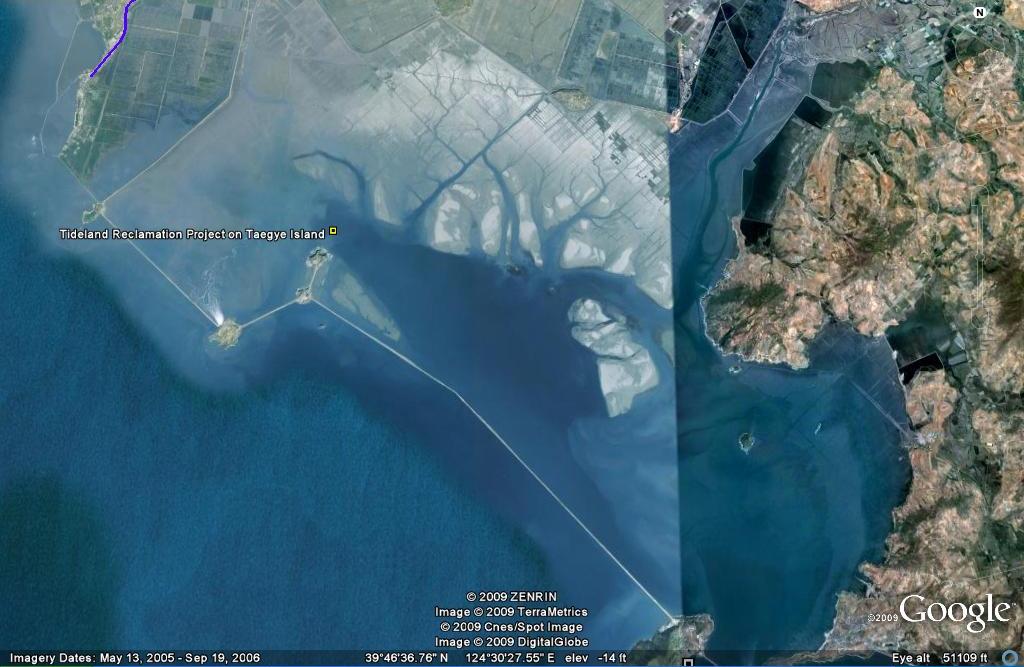
taegyedo.JPG

Click above Google Earth image for larger version

According to KCNA:

Pyongyang, June 30 (KCNA) — A detailed report of the Korean Central News Agency on the completion of the Taegyedo Tideland Reclamation Project was released Wednesday.

According to it, the project for reclaiming 8,800 hectares of land, the largest ever in the history of tideland reclamation in Korea, was completed to connect Taedasa Islet, Kacha Islet, Soyondong Islet and Taegye Islet in the West Sea with dykes extending several kilometers. This sharply reduced the indentation of the shoreline of Yomju County and Cholsan County of North Phyongan Province.

As a result, there appeared salterns and fish breeding farms along with a big socialist farm in the nation’s leading reclaimed tideland. Thanks to tide embankments seashore farms and villages in various counties are completely freed from the damage by tidal waves and salty seawater and a long ring road linking Tasa Workers’ District, Yomju County to Jangsong Workers’ District, Cholsan County was built along the strong dykes.

The project as huge as the West Sea Barrage in terms of size and the volume of work and equivalent to the undertaking to obtain the same arable land as that in a lowland county required the fullest display of mental power as it was Herculean task to create things from nothing, harnessing wild nature at a time when everything was in short supply.

President Kim Il Sung matured a grandiose plan for reclaiming tideland on the West Coast while waging bloody battles against the Japanese imperialists and formed a group for surveying tideland when the war was at its height, exploring the path for great nature-harnessing projects for the eternal prosperity of the country. General Secretary Kim Jong Il possessed of the iron will to accomplish the patriotic cause for eternal prosperity initiated by the President visited tideland reclamation sites two times when the above-said projects were making dynamic progress. He highly appreciated the successes made by officials and workers there and clearly indicated the way to be followed by them.

When the severest tidal waves in hundreds of years hit the whole area along the west coast of Korea on August 21, Juche 86 (1997), the builders there waged a persevering struggle, rebuilding broken sections of Breakwater No.1 between Taedasa Islet and Kacha Islet and Breakwater No. 2 between Kacha Islet and Soyondong Islet and finally relinking Breakwater No. 3 on June 11, Juche 94 (2005) and finishing the first-phase damming up project.

By July Juche 96 (2007) the builders successfully completed Breakwaters Nos. 2 and 4 and completed Breakwater No.1 on the occasion of the 60th anniversary of the DPRK.

They built Breakwater No. 3 covering hundreds of thousands of square meters with feldspar through their patriotic devoted drive.

Thanks to the patriotic enthusiasm and heroic struggle of the builders, such inner network project as installation of draining gates and building of embankment in the middle and lower reaches of a river were simultaneously carried out, turning thousands of hectares of tideland into a fertile land.

The Taegyedo Tideland Reclamation Project was finally completed with the completion of Breakwater No. 3 ahead of schedule.

I have previously posted information on the DPRK’s land reclamation projects in the West Sea.  See the post here.

There is also more information on these projects in the book North Korea: A Strange Socialist Fortress by Lee Hy-sang.  Here is a link to the book in Google Books.  The Tideland reclamation projects are discussed on pp 134-139.

Share