Archive for the ‘Transportation’ Category

Air China finally lands in Pyongyang

Monday, March 31st, 2008

According to Reuters, Air China on Monday launched service to North Korea, making it the world’s only foreign airline to fly regularly to Pyongyang.

The Beijing-Pyongyang flight route was postponed by three months after Air China said preparatory work took longer than expected.

Air China will fly the return trip three times per week, making Pyongyang a Star Alliance destination, the airline grouping led by Singapore Airlines, Lufthansa and United Airlines.

Air China said previously that it saw the financial potential in the route, primarily from the Chinese tourist business.

I predicted that Air China would primarily service Chinese customers, with Westerners sticking with Air Koryo, the North Korean airline. In separate conversations with Koryo Tours and Walter Keats both tour operators expressed a preference for Air Koryo because of its flexibility and unique atmosphere, neither of which Air China can easily match. 

The time-warp effect travelers feel when boarding an Air Koryo flight, however, might be soon diminished.  Largely at the insistence of Beijing, Air Koryo has recently updated its fleet to meet international safety standards.  Although the stewardesses appearance and speaker announcement welcoming arrivals to the land of “juche paradise” will likely remain the same, the 1950’s era deco interior will certainly take on a more conventional feel. 

Source material here:
Air China launches flights to North Korea
Reuters
Simon Rabinovitch
3/31/2008

Share

KFA wraps up business delegation to DPRK…

Monday, March 10th, 2008

In the words of Alejandro himself:

[The] Korean Friendship Association concluded its first busines [sic] delegation, headed by Mr. Alejandro Cao de Benos, Special Delegate and KFA President, in collaboration with the DPRK Committee for Cultural Relations, Ministry of Trade and the DPRK Chamber of Commerce. The group included companies from Australia, France, Spain and Lebanon in different sectors like ship building, foodstuff production, medicine, IT and infrastructure, etc. The visit was a big success and 75% of the investors signed letter of intentions and contracts. All of the participants agreed that DPR Korea has a huge potential and new market with many interesting opportunities with the lowest taxes and wages but with the most skilled, motivated workforce. The companies fullfiled [sic] all their plans and resolved the questions during the visit and they had meetings with their Korean counterparts as well as with the officials of Trade, Chamber of Commerce, Banking authorities and logistics.

They visited a Foodstuff factory,  Heavy Machinery complex, Ostrich farm as well as the ‘Kaesong Industrial Zone’ in the border with South Korea, were they had a briefing by the Director representative of Hyundai-ASAN.

After that, the investors visited a South Korean cable-making factory and a garment manufacturing plant specialized in high quality sport brands.

From KFA we congratulate the companies that concluded agreements and established Joint Ventures in the DPRK and wish them success in their projects.

From a follow up post on the KFA forum, one of the attendees appears to be Mr. Kevin Liu, head of Asian Division of London-based Exclusive Analysis.

Share

Russian auto plant KamAZ in DPRK

Thursday, March 6th, 2008

A couple of days ago, we had an interesting exchange in the comments that I want to make sure readers have an opportiunity to see:
———————–

Werner Koidl Says: 
 
In that Asia Times report Dr. Petrov wrote:
“… Last year the Russian auto plant KamAZ opened its first assembly line in North Korea, specializing in the production of medium-size trucks named “Taebaeksan-96″. …”

I would be interested in more details about that KAMAZ truck assembly line in North Korea ! Where ?, joint venture ?, size ?
———————–

Leonid Petrov Says: 
 
Concerning the “Taebaeksan 96″ truck assembling plant, the KamAZ set it up last year (2007 or Juche 96) in the town of Pyeongseong. The terms of this deal with NK were really “friendly” and last year KamAZ was having no or very little profit. The production volume last year was very limited (45 or 48 trucks). However, it’s just the beginning of such cooperation.

There is one technician-representative from KamAZ who manages the assembling process. He stays in Pot’onggang HTL and commutes to Pyeongseong. Many North Korean drivers and technicians seem to be technically ignorant (i.e. not knowing how to change the engine oil, etc.), so they need a new technological culture to be introduced. Russians train them well and the North Koreans are grateful.
———————–

Gag Halfrunt Says:

Now that explains the brochure for the Taebaeksan 96 I’d noticed on the Korean Friendship Association’s exports page. I was wondering how anyone could be making money from sticking badges on KamAZes and trying to sell them on. In any case, the export potential for the Taebaeksan 96 must be close to zero, since anyone outside the DPRK who wants a KamAZ can buy one assembled by KamAZ itself.

Trying to drum up interest in the DPRK as an investment destination, the KFA say, “All business made directly with the government, state-owned companies. No middle agents.” This is amusing, because, on the Pyeonghwa car brochure on the KFA website, they’ve sneakily deleted Pyeonghwa’s own contact details and replaced them with the KFA’s email and web addresses. I think this qualifies them a “middle agent” standing between Pyeonghwa and any potential export customers…
———————–

Werner Koidl Says:
 
The link “brochure for the Taebaeksan 96″ given by Gag Halfrunt seems to indicate that the KamAZ Taebaeksan-96 is assembled in a joint venture with Ryongwang [Ryongbong] Trading Company of North Korea. Ryongwang Trading is also the joint venture partner of Pyeonghwa Motors (Unification Church) to assemble the “Whiparam” in Nampo. And Ryongwang Trading company is also business partner of “Kohas” company from Switzerland. And because of its connections to Ryongwang this Swiss company got in troubles with the US administration.

Share

Stratgeic alliances in North East Asia: Railways, ports, and energy

Tuesday, March 4th, 2008

Writing in today’s Asia Times, Dr. Leonid Petrov analyses the complexity of Russia, Rok, DPRK, and Chinese relations:

Russia and North Korea:

Territorial claims, in one form or another, involve almost all countries adjacent in this region with the exception of Russia and Korea. The Joint Russian Federation-DPRK Commission for the Demarcation of State Borders has recently completed its work by documenting and marking the 17-kilometer frontier. This strip of uninhabited and swampy land in the mouth of the Tumannaya (Tuman-gang) River plays an exceptionally important geopolitical role. It not only provides the two countries with land access to each other, but also prevents Chinese access to the East Sea (Sea of Japan).

China and North Korea: 

Here, some 50km north of the small port that forms the core of North’s Rajin-Seonbong Special Economic Zone, the interests of Russia and China are now at stake. Russia is rapidly repairing the railroad track, and China (in a similarly speedy manner) is constructing a new automobile highway, both leading from their respective borders to the port of Rajin. Russia, investing at least 1.75 billion rubles (US$72 million) into this project, seeks to strongly connect Rajin (and the rest of northern Korea) to its Trans-Siberian Railroad. China, in turn, hopes to divert the growing cargo traffic to its own territory, offering the efficient network of railroads for delivery of South Korean and Japanese goods to Central Asian and European markets. What position will the government of North Korea take in this clash of ambitions?

Russia and South Korea (energy and trade):

In 2007, the volume of the export of “black gold” from Russia to South Korea reached 38.13 million barrels (2.7 times more than in the previous year). The relative proximity of the Russian oil and gas fields is an attractive factor for Korean companies who actively search for alternatives to Middle East oil suppliers. This year South Korea will for the first time start importing natural gas from Russia. The expected volume of delivery during 2008 is 1.5 million tons (or 5.1% of South Korea’s annual demand).

and

Trade relations between Russia and Korea are steadily growing. According to customs statistics, last year Russia recorded the sharpest increase of South Korean imports (56.2% more than in 2006). Due to the inflow of “petro-dollars” the new class of nouveaux riches in Russia began actively buying Korean automobiles, cell phones, television sets and LCD monitors. South Korea exported to Russia goods worth US$8.1 billion (including $3.296 billion of automobiles, $859 million of mobile phone equipment, motor vehicles and spare parts worth $659 million). As for trade with North Korea, in 2006 Russia occupied third place after China and South Korea and absorbed 9% of the total $3.18 billion spent by the North on imports.

More on Russia/South Korea energy talk here. 

The whole article deserves reading here:
Russia lays new tracks in Korean ties
Asia Times
Leonid Petrov
3/5/2008

Share

DPRK holds first extended cabinet meeting of the year

Monday, March 3rd, 2008

Institute for Far Eastern Studies (IFES)
NK Brief No. 08-3-3-1
3/3/2008

In the latest issue (February 3rd) of the DPRK Cabinet bulletin, “Democratic Chosun”, it was reported that the first extended cabinet meeting of the year opened in the beginning of February, with Premier Kim Young-il presiding. The bulletin stated that the issue of accomplishing this year’s economic plans was discussed.

At the meeting, Vice Premier Kwak Bum-ki stressed that accomplishing this year’s economic goals was “essential for opening the doors to a breakthrough for building an economically strong nation,” and that it was the “fundamental task laid out before the Cabinet.” He went on to reveal the tasks and directives needed to revitalize all realms of socialist construction, which he stated was necessary to create a powerful and prosperous nation by 2012, the centennial anniversary of the birth of the late Kim Il Sung.

In particular, he called for the production of the “lifeline of socialist construction”, and specifically, electricity, coal, metal, and railways, which he referred to as the “four lines for the advance of the people’s economy.”

Accordingly, the goal of carrying out overwhelming repairs to power generation facilities, and at the same time constructing new power plants in order to increase electrical production capabilities by several hundred thousand kilowatts, was proposed.

The meeting also stressed the need for concentrating efforts on geological exploration and exploitation industries in order to reasonably development and use natural resources, for a change in production of goods necessary for daily life, and for a resolution to the people’s ‘eating problem’ alluded to in the recent New Year’s Joint Editorial.

The bulletin also reported that there was discussion on creating a new five-year plan for the development of science and technology, going as far as to say, ”the role of science and technology in the building of an economically powerful nation is decidedly large, and in order to answer the very real calls for development, [the issue of] strengthening international economic projects” was brought up.

Premier Kim Young-il, Vice-Premier Kwak Bum-ki, Chairman Kim Kwang-rin, of the Committee on National Planning, Park Nam-jil, of the Power Supply Industry Bureau, and Kim Yong-sam, from the Railways Bureau, were among cabinet ministers present.

Share

Russian ship makes it home

Thursday, February 28th, 2008

UPDATE: Dr. Petrov made some interesting comments that deserve highlighting:

The BBC report is full of mistakes. The name of the ship was “Lidia Demesh”. On board were 23 members of crew and 1 passenger. After being arrested the ship was escorted to the port of Kimchaek.

The situation was resolved quickly thanks to the Russian Consular General, E.Val’kovich, who personally went to Kimchaek and sorted things out. Most Russian diplomats posted to DPRK are fluent in Korean and exempt from travel restrictions. So, no traditional Hawaiian symbol of respect is needed. 

ORIGINAL POST: The BBC reported last week that the North Koreans pulled a surprise ‘Pueblo’ on the Russians.

The Lida Demesh, carrying a consignment of cars from Japan, was heading for the Russian port of Vladivostok when it was stopped by patrol near Cape Musudan.

An armed group boarded the ship and ordered the captain to change course and go to a North Korean port [Chongjin],” he told the Russian NTV network.

Mr Yeroshkin said the centre had been told the ship’s 25 crew-members were fine and that there had been no threat to their lives. (BBC)

Strangely, this was not the first time this has happened… 

A similar incident in 2005 took 15 days to resolve through diplomatic channels. (BBC)

Fortunately for the crew, the situation did not last that long.

A Russian cargo ship released by North Korean authorities on Wednesday has arrived in the Far East port of Vladivostok.

Captain Yury Buzanov said on returning to Russia that he was forced to enter North Korean waters to avoid a shipwreck due to a heavy storm.

“To save the crew I decided to enter North Korean waters because the waves in the Sea of Japan were three to four meters high with winds of 25 meters per second. In such stormy conditions, the cargo could have shifted in an instant causing the ship to lurch and sink,” the captain said. (Novosti)

No word if they ever used the traditional Hawaiian symbol of respect.

The full stories can be found here:
North Korea Detains Russian Ships
BBC
2/23/2008

Russian ship arrives home after seizure by North Korea
Novosti
2/28/2008

Share

DPRK tries to increase “taxes” on bus (coach) market

Monday, February 18th, 2008

bus.jpgDuring the late 1990s, North Korea suffered a terrible economic collapse which resulted in famine and massive social dislocation.  During this time, most ministries and state-owned companies  were cash-strapped and unable to maintain their operations.  Out of desperation they turned to private investment for much needed revenues by outsourcing many basic services. (Individuals who were capable of taking up such opportunities were probably small in number at the time, but apparently now compose a healthy sub-section of the population.)

Outsourcing has benefited both the government and private entrepreneurs.  Outsourcing allows state-owned companies to receive capital financing from private individuals as well as a share of joint-venture revenues (tax revenues).  Private entrepreneurs need a legal business environment where they know they will not be subject to ex-post expropriation of profits.  Leasing the name of a government body gives them some of this legal cover.  This system is no doubt tolerated because it allows the government create space for entrepreneurship (and tax revenue) within the existing state structure while still maintaining de jure control of the means of production.   

According to the story in the Daily NK, the regulations for establishing a legitimate passenger bus company under this system (or “coach” company for readers in Her Majesty’s Commonwealth) are fairly strict.  Once an individual acquires a bus (appx US$6,000-10,000), he has to register it with the government body for whom he is working.  Revenues are then split 70/30 (the government taking 30%) for three years, after which the individual is required to “donate” the privately acquired bus to the state-owned enterprise.  This policy literally gives North Korean entrepreneurs just three years to recoup their investments!

The response of the North Korean business community was predictable:  investors sell the buses before the three years are up or they forge registration papers.  This is not hard to do in the DPRK.  In fact if you have just one other associate who owns a bus in similar condition, all you need to do is trade with him every three years and re-register the new vehicle. 

Word of this game has finally reached the top and they have responded by increasing their share to 70% of passenger bus revenues–leaving just 30% for the purchaser of the vehicle.  It is unclear from the story if investors are still required to “donate” their busses after three years, but realizing that the confiscation of buses was not enforceable, the North Korean government probably just opted for a larger share of the revenue over time.

The good news is that it is not likely that many people pay 70% of revenues either.  After-all, someone has to collect these taxes and he has needs too.  Sounds like some kind of arrangement could be reached…

You can read the full story here:
North Korea Regulates Operation of “Service Car”
Daily NK
2/18/2008

Share

David Kang on North Korean trade potential

Tuesday, February 12th, 2008

Kang: North Korean Trade Potential
Council on Foreign Relations
12/17/2007

Last December, David C. Kang, a professor of government at Dartmouth College and an adjunct professor at Tuck Business School, discussed the North Korean economy for the Council on Foreign Relations. I have excerpted some of his comments below.

His view on the new North-South cargo train service:

It doesn’t have huge economic significance in the overall GDP of North Korea. But it does have major economic significance in the fact that what North Korea had to do in order to let a train go through was an awful lot of adjustment[…]in terms of linking up the railroad, all the ministries had to prepare.  The old [Korean Energy Development Organization] had this problem as well. [W]hen they wanted Americans and South Koreans working in North Korea to build this light-water reactor, [they] had to set up protocols [Post offices, phone calls, where they were going to stay, etc]. It is pretty significant in terms of how much they had to adjust.

He quoted the following figures on North – South trade:

From $200 million in 1998, to now exceeding $1.7 billion in 2007.   South Korea’s total trade volume is $250 billion.

His opinion on the direction of the North Korean economy:

At this point what we’re seeing is very initial steps on the part of North Korea as they try to open up reform and yet maintain control. At the same time, they are being forced into a number of institutional changes and mind-set changes that are the first step forward in this process.

His view of North Korea’s comparative advantage:

Most of the companies that have gone in—the South Korean companies that have gone in—are assembly and light manufactures, such as or textiles and light consumer goods. This is the sort of obvious point of departure. It’s not hugely capital intensive in terms of building factories, and can take advantage of North Korean cheap labor and South Korean technological advantages.

There are a lot of potential mineral resources in North Korea, which would require a whole infrastructure of legal reforms to happen before anyone would take care of them. But at this point the safest bets are the ones that are on the order of assembly and light manufactures in the North and then exporting them out.

His view of South Korea’s long term goals:

If there’s unification, or even better relations, and South Korean companies can use cheap North Korean labor, instead of having to send those factories to China or Vietnam—not only do they speak Korean, they’re culturally similar, and the labor would be cheaper.

[I]f you could reconnect the railroads, from Japan, through Pusan [South Korea], up through North Korea, then out to China and Russia, you would be linking up all these economies in a much more efficient way than they are now. So everybody wants that. But obviously there’s the political problem. And even on the infrastructure side, the North Korean rail system is so old and so decrepit, that basically it would have to be rebuilt from zero. But the potential upsides are massive, in the long run.

His view of China’s engagement:

China has been essentially as deeply involved in economic engagement with North Korea as has South Korea—and by some measures, actually more so. Whereas South Koreans just do this assembling, some Chinese companies are moving in and building full factories in the North. There’s a lot of interest in Chinese-North Korean economic relations on both sides.

Share

Pyongyang to start using buses with air conditioning

Tuesday, February 12th, 2008

Yonhap
2/12/2008

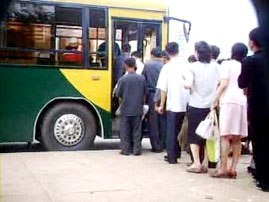
North Korea will begin using more than a hundred new buses with air conditioning for the convenience of a growing number of foreigners visiting Pyongyang, a U.S. government-funded radio station reported Tuesday.

Pyongyang’s municipal people’s committee recently requested a Chinese bus manufacturer to install air conditioning in 110 new buses to be used in the capital city, Radio Free Asia said.

The North already paid the cost in cash and 52 of the buses were already sent to Pyongyang, it said.

The communist state depends heavily on foreign aid to overcome its chronic energy shortage.

“North Korea is introducing buses with air conditioning to make Pyongyang look more advanced and urban in the eyes of foreign tourists whose number is on the rise,” the radio report said, quoting an unidentified source in China. “North Korean people have realized by watching TV dramas and other programs from South Korea that their living standards are not good enough.”

Share

ROK business optomistic about inter-Korean cooperation after nuke resolution

Tuesday, February 12th, 2008

Institute for Far Eastern Studies (IFES)
NK Brief No. 08-2-12-1

2/12/2008

South Korean businesses currently involved in inter-Korean economic cooperation are facing many difficulties, both due to and in spite of the system in place, so that at the moment, investment in North Korea does not look much more appealing than in Vietnam or China.

The Korea Chamber of Commerce carried out a survey, titled “Business Perspective on the Direction of South-North Economic Cooperation Policy”, targeting 300 successful businesses (170 companies responded) and 200 companies currently involved in inter-Korean economic cooperation (132 companies responded). According to the results of the survey, 79.4 percent of companies involved in inter-Korean cooperation responded that they are “currently facing systemic and procedural difficulties.”

More specifically, 44.7 percent pointed to the “3-C” (commute, communication, and customs) issues, 22.4 percent pointed to “claim resolution procedures,” 14.3 percent highlighted “difficulties with financial transactions,” 11.8 percent chose the “ban on the import of strategic materials,” and 5 percent indicated that “limited markets” were the main issue.

In addition, 58 percent of responding companies noted issues not related to the system set up for inter-Korean cooperation. 36.6 percent pointed to difficulties resulting from the “lack of understanding of market economics,” 28.7 percent noted a “lack of supervision by managers,” 24.8 percent chose “uncooperative, highly tense attitudes,” and 8.9 percent pointed out “demands for quick production.”

When asked about the relative attractiveness of investment in North Korea if the current situation were maintained, as compared to Vietnam and China, only 27 percent responded, “more attractive”, while 53.7 percent, or twice as many companies, responded that investment was “impossible.”

However, 58 percent responded that, in the event the North’s nuclear issues were resolved, investment in North Korea would be “more attractive than China and Vietnam”, while only 21.7 percent responded that investment in the North would still be “impossible.”

The overall impression of these companies regarding inter-Korean cooperation is that “improvement of inter-Korean relations offers opportunities for new enterprises and is a positive influence on the South Korean economy” (65.3 percent), and 19 percent felt that cooperation would “in the future, serve as a springboard for the relaunch of the South Korean economy.” 15.7 percent of responding companies felt, however, that “there would be no substantial positive influence on the economy.”

Currently, a resolution to the North Korean nuclear issues is the most important factor, but it is imperative that pledges of the incoming ROK administration such as strengthening investment security, preparing claim resolution measures and other issues to placate business interests, and nurturing North Korean exporters, are institutionalized.

Share
