Archive for the ‘Transportation’ Category

Koreas to send joint cheering squad to Olympics

Monday, February 4th, 2008

Yonhap
2/4/2008

South and North Korea agreed Monday to send a 300-strong joint cheering squad to the Beijing Olympic Games in early August, the Unification Ministry said.

One hundred and fifty people from each side will travel across the heavily armed border by train to Beijing, it said.

The agreement was made by working-level officials at a one-day meeting in Kaesong, a North Korean border city.

The two sides agreed to hold another round of talks to discuss the details of sending the joint cheering squad, the ministry said in a news release.

Hailed as a symbol of inter-Korean peace and reconciliation, the cross-border railway was reconnected in May last year for the first time in 56 years. It was severed in the early stage of the 1950-53 Korean War.

The two Koreas agreed during the second summit of their leaders in October to transport the joint cheering contingent to the Aug. 8-24 Olympics using the Gyeongui railway, which is linked to the Chinese railway system.

South Korea also hopes to connect the railway to the Trans Siberian and Trans Chinese railways so products from the world’s 13th biggest economy can be transported to Europe at lower costs and in less time.

Yoo Sang-il, a member of the Korean Olympic Committee, led the three-member South Korean delegation to the talks. Yoo’s North Korean counterpart was Hwang Chol, a department director of the North’s Council for National Reconciliation.

Share

One eye on the fish, the other on North Korea

Friday, February 1st, 2008

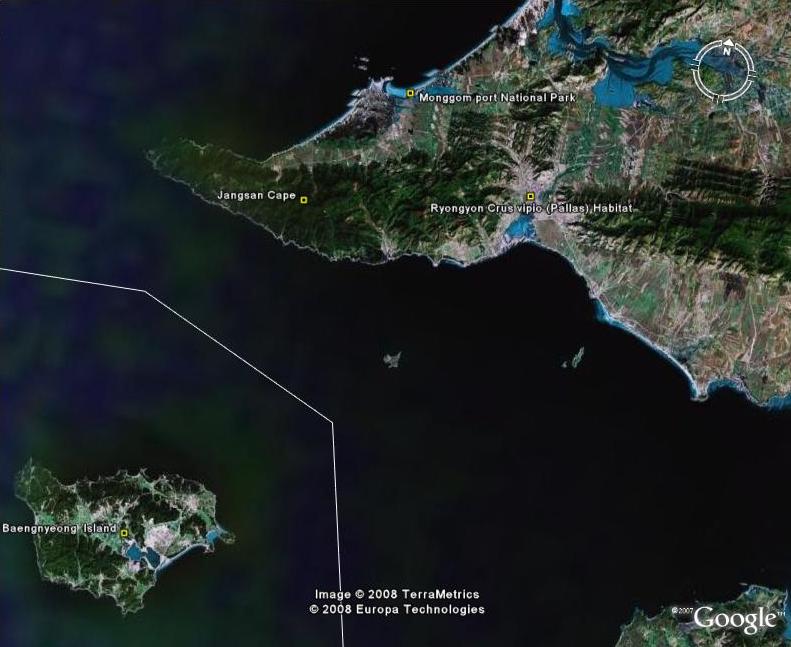
island.JPGThe New York Times (free registration required) ran an article today on Baengnyeong Island, South Korea’s northern most island which is below the NLL (the de jure, though disputed, sea border between the DPRK and the ROK), but only 10 miles from the coast of North Korea.

Fishermen have gone missing from this island for years, and occasionally, naval clashes erupt between the DPRK and ROK.  The latter problem, though not the former, was an agenda item on the most recent Inter-Korea talks between Kim Jong Il and the former South Korean President Roh Moo-hyun.

The island is now a sad reminder of the costs of division and isolation:

[F]or Chang Hyung-soo, a 64-year-old retired diver here, this narrow strip of water is what separates him from his hometown [in the PDRK]. It also separates him from three of his friends who were lost in fog while fishing and taken to North Korea three decades ago.

and… 

“A few weeks ago, a 93-year-old man came here to take a last look at his hometown across the channel before he died,” Mr. Chang, the retired diver, said from the hilltop. “But he could see nothing because of the fog. I still remember the old man’s tears of disappointment.”

Complicating the matter, however, is the competition from Chinese fishersmen granted territorial access by the DPRK:

To make matters worse, hundreds of Chinese fishing boats, after paying fees to the North Korean Navy, have sailed into waters between their islands and North Korea in recent years while the South Korean fishermen have been restricted to waters close to their own shores.

“The Chinese trawlers catch anything, everything, and deplete our seas,” said Kim Myong-san, 78, who first came to the island as a marine and settled here with his wife.

Notes:
One Eye on the Fish, the Other on North Korea
New York Times

Choe Sang-Hun
1/31/2008

Top image from Google Earth. Download “North Korea Uncovered” to see this location on your own Google Earth.

Share

Koreas discuss improving cross-border train service

Tuesday, January 29th, 2008

Yonhap
Shim Sun-ah
1/29/2008

On the first day of working-level talks in North Korea on Tuesday, the two Koreas discussed scaling back their first regular inter-Korean railway service to run in more than a half century, as the trains are often empty, South Korean officials said.

The two Koreas began the regular train service in December as a symbol of peace and rapprochement following the October summit between their leaders.

A 12-car train runs once a day on a 20-kilometer railway connecting South Korea with a North Korean train station near a joint industrial complex in Kaesong.

(more…)

Share

Air Koryo fleet expanding

Sunday, January 27th, 2008

TU-204-300 touches down at a North Korean airport
(Hat tip to Mateusz)
12/28/2007

A TU-204-300 has touched down at a North Korean airport in what became Russia’s first successful deal to supply its most advanced long-range jet abroad. With its 500-8500 flying range, the plane is capable of swiftly transforming its fuselage on the ground. The plane has already been making shuttle non-stop flights inside and outside Russia. North Korean flag Carrier Air Koryo has ordered the TU-204-300.

TU-204-300 with PS-90A engines is a mid-range passenger a/c is intended to carry passengers, luggage and cargo on domestic and international trunk routes of 500 to 8500 km distance . The airliner was built on the basis of TU-204-100 a/c and represents the continuation of TU-204/214 a/c family. TU-204-300 a/c performed its maiden flight 18 August, 2003. The aircraft is produced in series at “:Aviastar-SP” Closed Stock Company in Ulianovsk. Opposite to TU-204-100 the TU-204-300 a/c has a shortened fuselage (by 6 m) and increased fuel reserve. Set of equipment was updated. Improved comfort level of the cabin helps the passengers to withstand long flights. Maximal payload is cut down to 18000 kg at increased flight range.

Click here to get specs on all the planes in Air Koryo’s fleet (h/t DPRK Studies)

Share

Hoiryeong Trains for War

Tuesday, January 22nd, 2008

Daily NK
Lee Sung Jin
1/22/2008

The citizens of Hoiryeong are worried about ongoing evacuation training they must undergo as part of a joint winter military drill with the army that began on January 17, said a source.

The winter military drill used to be held in December each year but this year it was delayed.

“People feel uneasy because of the sudden beginning of the drill and the strict regulations on the jangmadang in the cold winter,” one source reported on the 21st.

At 3 am on January 17th, in Hoiryeong, North Hamkyung Province, the North Korean army announced an emergency summons, modified the Worker and Peasant Red Guards, Local Reserve Forces and Youth Red Guard, declared a state of national preparation for war and started inspection of emergency supplies. The Local Reserve Forces rushed to occupy strategic positions and the Worker and Peasant Red Guard started a scouting drill.

During the winter military drill, ordinary citizens must leave their residential districts, taking one day’s worth of food with them, and live in an encampment for Local Reserve Forces around 8-12 km away from their homes.

The average temperature in Hoiryeong drops to around minus 10 degree Celsius in January. As defectors in Seoul testified, it is terribly hard to put up with the lack of heat at the encampments.

This drill is limited only to Hoiryeong. The source said: “It is actually a type of civil defense training. It was ordered by the People’s Safety Agency, but the army participated as well.”

This year’s drill was more intense than previous year’s. Vehicles without camouflage netting were prohibited from the streets and all citizens were forced to wear camouflage while outdoors.

The source said the drill was so similar to actual warfare that Local Reserve Forces and Worker and Peasant Red Guards wore their real rank badges.

When the drill started, factories and People’s Units in Hoiryeong began holding lectures entitled, “Let’s complete preparation for war against the American imperialists’ constant war maneuvers!”

Share

Forced Construction of Kim Jong Il Road in Bitter Cold

Monday, January 21st, 2008

Daily NK
Moon Sung Hwee
1/21/2008

Tens of thousands of a Shock Brigade (state construction workers) of North Korea are forced to build roads under minus 20 degree Celsius weather to prepare for Kim Jong Il’s unforeseen visit to the area, an inside source told the Daily NK.

The informer said, on the 3rd of January, “Since mid December, thirty thousands of Shock Brigade for the Propaganda of the Party Ideology (shortly June 18 Shock Brigade) had been poured into building road in Samsoo, Yangkang Province.”

He added that the Shock Brigade was connecting road between Wangduk Station in Hyesan (exclusively for Kim Jong Il) and Samsoo Power Plant. Kim Jong-Il was rumored for planning on surprise visit to the power plant. The road would be 22 km in length.

There was actually a road built in 2003 between Wangduk and Samsoo Power Plant. However, the road was ordered to be renovated due to Kim Jong Il’s dissatisfactory remark on it in his March 2006 visit to the area.

During the 2003 road construction, the Hyesan city government mobilized tens of thousands of residents plus June 18 Shock Brigade to finish it on time. Nevertheless, as Kim Jong Il showed discontent, Yangkang Provincial party officials and June 18 Shock Brigade officers were criticized harshly.

The problem was that the road was through downtown Hyesan, and a section of it was to meandering, thus dangerous to protect “the Comrade General.”

“After that, June 18 Shock Brigade, who just finished constructing Hyesan-Dancheon road, were reinforced and put to refurbish the Kim Jong Il’s private road,” the informant added.

The road currently under construction is to connect Wangduk and Samsoo Power Plant while circumventing populated area of Hyesan. And, of course, since the road is built as a “Number 1 Road,” it is solely for Kim Jong Il’s use, not even for party officials let alone ordinary people.

According to the informant, condition of road construction is harsh. Workers of the Shock Brigade are forced to work in bitter cold. When asked about disgruntlement of the workers, the informant replied, “This sort of hardship happens every time the General visits a certain area. Who can argue with the General’s order?”

Share

KINU “Business Conglomerates Appearing in North Korea”

Thursday, January 3rd, 2008

Daily NK
Yang Jung A
1/3/2008

Through its publication “North Korea is Changing” the Korea Institute for National Unification (KINU) highlighted numerous changes and reforms that have occurred in North Korea due to the 2002 “July 1st Economic Maintenance Reform Policy” (Hereon referred to as the “July 1 Policy”). This publication deals with the changes the North Korean economy is undergoing following the economic crisis of the 1990s, and expounds on the country’s prospects for future economic reform.

The following is a summary of the main points introduced in the publication.

The “Invisible Hand” at Work in North Korean Markets

Following the enactment of the July 1 Policy in 2002, agricultural markets transformed into general markets. Soon, industrial products were being sold alongside agricultural products as the free market spirit spread to the country’s distribution system.
Along with the rise of general markets, street markets, and individualized commercial activities, a new merchant class is emerging. People who are able to put to use business acumen and an understanding of market principles are able to accumulate personal wealth. This demonstrates that aspects of Western-style rationalist thinking, including the pursuit of profit-seeking are being instilled in the minds of the North Korean people.

It is difficult to say if this experiment in free market economics will be successful in the long run. More than anything, due to the rigidity of the North Korean regime, the realm in which the “Invisible Hand” can operate is greatly restricted. This is the fundamental paradox facing North Korea’s prospects for reform and opening.

“Hardworking Heroes” Become “People with Two Jobs”

As the economic difficulties became severe, work opportunities evaporated. Living off of the wages provided by the state became impossible. North Korean laborers responded to this by taking on side jobs or engaging in independent sales.

According to defectors living in South Korea, after the July 1 Policy, there has been an increase “People with Two Jobs.” These are people who are engaging in economic activities additional to their primary occupations. People are beginning to accept the notion that it is better to work for personal benefits than to receive the title of “Hardworking Hero.”

Such phenomena have also changed people’s perceptions about occupations in general. For example, the elite classes now prefer diplomatic positions and jobs where they can make international connections, rather than working in party or government positions. The common people prefer agricultural jobs with the benefits of access to the food distribution system and the ability to earn side profits by being a merchant. In addition, common people also prefer being personal drivers, photographers, workers at the Food Distribution Office, servicepersons, or fishermen.

Business Conglomerates Are Emerging in North Korea

With the implementation of the July 1 Policy, North Korea has witnesses the creation of its first business conglomerates. A case in point is the Korea Pugang Corporation, which has expanded to include 9 subsidiaries and 15 foreign offices engaging in various lines of work. The website of the “Korea Pugang Corporation” reveals that the company has around $20 million in capital and does an average of $150 million of business each year.

The executives in charge of the company’s growth are brothers Jon Sung Hun and Young Hun. President Jon Sung Hun is in his early 50s and studied abroad in Tanzania before returning home to teach English at Kim Il Sung University. He later became a businessperson. His English skills are among the top 10 in North Korea. Young Hun is in his 40s and is the president of a company affiliated with the Finance and Accounting Department of the Workers’ Party. His company dominates North Korean diesel imports.

If the Jon brothers are the representative examples of conglomerate-based new capital, Cha Chul Ma ranks high among those who earned capital due to their power in North Korean society. With his focus on doing business with China, Cha is known for his ability to earn foreign currency and dominates the foreign currency earning businesses belonging to the Standing Committee of the Supreme People’s Assembly. His personal wealth is said to be over $10 million.

As the son-in-law of Lee Jeh Gang, the First Vice Director of the Guidance Department of the Workers’ Party, Cha gets some support from his father-in-law. Cha, who is known to live so freely that he was seen wearing Bermuda shorts on the streets of Pyongyang, is said to be a “Representative Case of a North Korean who succeeded in business on his merits, regardless of assistance from surrounding figures”.

The Number One Worry is Sustenance

North Koreans are said to live three different lives: their family lives, their working or school lives, and their political lives. Their lives are organized by politics from “cradle to grave,” and they must attend various political meetings, organizations, and study sessions. However, there are many people who are unable to participate in regular meetings of their political units due to economic difficulties. As they do not receive sufficient food distributions and their wages are too low, they must seek their food independently through individual economic activities.

Because the transportation infrastructure in the country is not advanced, it takes at least half a month to one month to go into the countryside to search for food and then they must return and sell the food or daily-use items they acquired, leaving little time for any other activities. Ninety percent of North Koreans engage in some form of business, and as a result, only an estimated 30% to 60% participate in required political activities.

Marriage Culture

These days, in North Korea, the ideal spouse is the one who makes the most money. Previously, when North Korean women chose their spouses, they considered the social status of their potential suitor. However, after the economic crisis, they started to prefer businesspersons and people who earn foreign currency, instead of discharged soldiers and cadres. For men as well, they now prefer money to looks as society increasingly revolves around the economy. As a result, an overwhelmingly higher proportion of men marry older woman than before.

Marriage customs are simplifying as well. Before the economic crisis, women usually provided the domestic items for the household and men provided the estate. However, after the economic crisis, dowries have downgraded into simple things like clothes. Because the allocation of estates has been delayed, more and more people are living at their parents’ homes.

Especially for women, there have been some phenomenal changes. Many women consider marrying late or not marrying at all. Reasons for this include the fact that woman cannot marry men just because the men can’t work and needs a woman to bring home money. Even in such a patriarchal culture, such complaints are becoming increasingly common.

Share

Air China to (eventually) Fly to Pyongyang

Wednesday, January 2nd, 2008

UPDATE: Surprise–it has been delayed:

Air China delays Pyongyang route for three months
Reuters

1/2/08

Air China has postponed Wednesday’s opening of a new route to the North Korean capital, Pyongyang, until March, citing operational reasons, but denied the decision was linked to politics.

Hat tip Michael Rank

Original Story:

Air China to Fly to Pyongyang
CARNOC.com
(hat tip to Werner in Vienna, Aus.)
Simon Li   
11/06/2007

On Nov. 5, Air China announced that the airline will launch Beijing-Pyongyang route on Jan. 2, 2008. This new service means that the airline’s international operations (including Hong Kong SAR and Macau SAR) will be increased to 72 routes.

Full flight schedule of Beijing-Pyongyang service as below:

Flight No.:  CA121
Route:  Beijing – Pyongyang
Days of Operation: Wed, Fri, Sun
Aircraft Type:  B737
Dep. Time: 14:00
Arr. Time:  17:00

Flight No.: CA122
Route:   Pyongyang – Beijing
Days of Operation: Wed, Fri, Sun
Aircraft Type:  B737
Dep. Time:  18:00
Arr. Time:   19:00

(NKeconwatch: Notice how this does not conflict with air Koryo’s Tuesday/Saturday schedule.  I predict that if this goes through, we will see greater volumes of Chinese tourists take the Air China flights, and western tourists will still demand the “unique atmosphere” of air Koryo–they might even pay more for it!)

Share

The Dreams of North Korea’s Youth Is to Succeed as Merchants

Friday, December 28th, 2007

Daily NK
Park Hyun Min
12/28/2007

The future dream of North Korea’s teenagers is no longer to become party leaders or soldiers, or even join the Party, but to become “merchants.”

Good Friends,” an aid organization for North Korea, said through “Today’s News on North Korea” No. 104 on the 27th, “Most of the elementary and senior middle school students nowadays, upon being asked what they would like to do post-graduation, say they would like to be merchants.”

The source relayed, “Many of their peers have stopped going to school and have started doing business. It is too burdensome for some students to attend school, so they sell noodles or vegetables by sticking around the jangmadang (markets) and contribute to their families’ livelihoods.”

(more…)

Share

S. Korea to develop two resource rich areas in N. Korea

Thursday, December 27th, 2007

Yonhap
12/27/2007

South Korea plans to develop two resource rich regions in North Korea that can benefit both countries and fuel cross-border economic cooperation, the government said Thursday.

The blueprint calls for more funds to be funneled into North Korea so prospective developers can conduct geological surveys and compile detailed data for future reference, the Ministry of Commerce, Industry and Energy said.

Resource-poor South Korea imports most raw materials to operate its heavy industry-centered economy. Lack of social infrastructure and mining knowhow have prevented North Korea from fully developing resources.

(more…)

Share
