Archive for the ‘Transportation’ Category

Russia donates food to DPRK

Thursday, June 19th, 2008

After China and the USA made high-profile food donations to North Korea, the Russians finally joined the game.  Russia’s Foreign Minister claims that by the end of June his country will have sent 3,000 tons of flour to UN World Food Program distributors in North Korea. The first aid deliveries arrived in North Korea by train on June 11.

I am surprised Russia waited so long to get into the game.  Russia has been prodding North Korea to link its Trans-Siberian rail traffic to South Korea, and they want to make sure the Chinese don’t squeeze them out of North Korea’s Raijin Port (which does not freeze in the winter).  Food aid might not have helped these processes along, but waiting so long to jump on the bandwagon can’t have helped. 

In March of this year, the Russians inked a deal to renovate the railway lines between their border and Raijin (the tracks are different gagues).

Read about the aid here: 
Russia to deliver 3,000 tons of flour to North Korea
Novosti
6/9/2008

Russia sends food aid to North Korea
Associated Press
6/19/2008

Share

DPRK economy shrinks for second year: Bank of Korea

Tuesday, June 17th, 2008

North Korea does not publish economic data.  The size of North Korea’s economy is estimated by South Korea’s Central Bank (Bank of Korea), the US Central Intelligence Agency (CIA), and other think tanks such as the Sejong Institute (Lee Jong Seok)

According to a recent report by the Bank of Korea, North Korea sufferd its second full year of economic contraction (as defined by GDP), 1.1% in 2006 and 2.3% in 2007.  The bank estimates North Korea’s 2007 gross national income (GNI/GNP) at $26.7 billion, per capita GNP at $1,152 (assuming population of 23 million).  If you are interested in knowing the difference between GNP and GDP, click here.

Here are some highlights from the report:

Agriculture, forestry & fisheries marked a 9.4% decrease following a 2.6% decrease in 2006

Mining increased 0.4% in 2007, down from 1.9% increase in 2006

Manufacturing increased 0.8%, higher than 0.4% 2006 increase. -1.7% growth in light industry, due to the decrease in food products and beverages. +2.3% growth in heavy industries led by expansion of metal and machinery products.

Electricity, gas & water production increased 4.8%, (+2.7% in 2006), from hydroelectric and steam power generation.

Construction production -1.5%, (-11.5% in 2006), from reduced non-housing construction and civil engineering.

Services +1.7%, (+1.1% in 2006). Hotel, restaurant, transport, post & telecom industry expanded.

Trade volume (goods) fell 1.8% to $2.941 billion, 1/248 South Korea’s. Exports fell 3.0%, imports fell 1.3%.

These estimates are based on trade figures obtained from the Korea International Trade Association, Korea Trade and Investment Promotion Agency, fuel and food aid figures from aid groups such as the International Red Cross and the World Food Program, as well as information provided by frequent visitors.

More information here:
Full report by Bank of Korea  and data (recomended)

North Korea’s Economy Shrank in 2007, Second Annual Contraction
Bloomberg
Heejin Koo
6/17/2008

Share

More Czech tram cars headed to Pyongyang

Saturday, May 31st, 2008

UPDATE: Photos here (h/t Mateusz)

From Radio Prague (hat tip to David):

The Prague Transport Authority announced on Tuesday that the first of twenty reconditioned trams would be shipped to North Korea this week. The North Korean government are paying about 13 million crowns – that’s just over 800,000 U.S. dollars – for the second-hand trams, one of Prague’s most instantly recognisable symbols. But as Rob Cameron reports, they’re not the first Czech trams to be sent abroad, and not even the first to be sent to North Korea.

In the unlikely event you were to find yourself waiting for a tram at Pyongyang’s Mangyongdae station, you might well be surprised to see a Czech tram trundling along the rails towards you. But Czechs trams have long been a feature of life in the North Korean capital. The first – a fleet of new T4 trams – arrived in 1991, in time for Kim Il Sung’s 79th birthday. (The T4 is the chunky, rather boxlike model from the 1990s that runs on the number 3 line in Prague, for example.)

But the latest consignment heading for Pyongyang this week are reconditioned T3s, the older, iconic red and cream trams that date from the 1960s. The T3s were first produced by the CKD Tatra Smíchov factory in Prague (the T stands for Tatra). In all, a staggering 14,000 T3s were produced in Smichov and exported all over the Soviet bloc, as part of the Comecon system of allocating entire industries to individual communist countries.

Read the full article here:
Iconic red and cream Prague trams get new lease of life in Pyongyang
Radio Prague
Rob Cameron
5/6/2008

Share

Air Koryo’s new Tupolev

Monday, April 21st, 2008

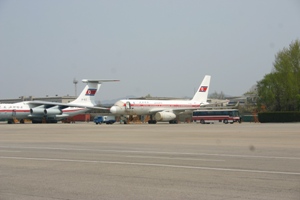
A recent traveler with Koryo Tours sent this photo of Air Koryo’s new Tupolev parked at Pyongyang’s Sunan Airport.  According to a woman at the airport, it starts flying May 1, 2008 (May Day).

airkoryothumb.JPG

Click on the image for larger view

Share

Air Koryo and DPRK tourism update

Friday, April 18th, 2008

This morning the International Herald Tribune published an interesting AP story on Air Koryo, North Korea’s state airline.

As has been mentioned before, Air Koryo recently began upgrading its fleet–but guess who will seemingly be on the first flight? 

The airline also has taken delivery of its first new jet in years. South Korea’s Yonhap news agency, quoting diplomatic sources in China, reported Thursday that North Korea’s reclusive leader Kim Jong Il was likely to fly to Vietnam and China on the new plane next week.

Kim is widely believed to shun air travel. His previous trips abroad by luxurious special train were shrouded in secrecy and reports speculating on his destinations beforehand were not always accurate.

And although the economy at large is not doing so well, Air Koryo business is brisk. 

“The golden days are now[.]  They’re busier than ever,” says Nick Bonner of Koryo Tours. (paragraph edited)

In 1998, his Koryo Tours — which despite being similarly named for an ancient Korean dynasty is unrelated to the airline — escorted just 98 tourists to North Korea. The number doubled to 200 in 2006 and last year jumped to a still minuscule 1,100. Some of his customers also get into the country by train, a much longer trip.

Bonner said a roundtrip ticket on Air Koryo between Beijing and Pyongyang costs 2,550 Chinese yuan (US$365; €230) for economy and 4,340 yuan (US$621; €390) for business class.

What are Air Koryo’s most recent routes:

Air Koryo now has just three regularly scheduled international routes. Domestic service is said to be virtually nonexistent.

It flies roundtrip three times a week between Pyongyang and Beijing and twice a week to the northeastern Chinese city of Shenyang, an important source of trade for North Korea.

The other is return service once a week to Vladivostok. A flight to Khabarovsk, another city in the Russian Far East, stopped in 2005. The airline also had flew to Bangkok and Macau in recent years.

About the fleet upgrade: 

Perhaps illustrative of Air Koryo’s improving fortunes, in December it acquired a twin-engine Tu-204-300 jet manufactured by Russia’s OAO Tupolev, adding to its fleet of other Tupolev, Antonov and Ilyushin jets and turboprops.

Tupolev mentions the deal on its Web site, though did not disclose financial terms when asked.

A non-North Korean with intimate knowledge of the airline, who refused to be identified, confirmed the deal, adding North Korean pilots were receiving training in Russia with the craft set to begin operations at the end of April.

Although the article insinuates that economics are largely behind the fleet upgrade, a little nudging by China certainly did not hurt.  China gave Air Koryo a deadline to meet Beijing safety standards.  But despite China’s concern for air safety, Air Koryo still has one of the best records in the business:

Though concerns about safety have been raised — Air Koryo is banned from flying in the European Union — the carrier has apparently had just one major accident, a crash in West Africa in 1983 when the airline was known under a different name.

The plane, an Ilyushin 62 carrying 23 people, was en route to Conakry, the capital of Guinea, on an “international non-scheduled passenger” flight, when it went down in the Fouta Djall mountains, according to the Aviation Safety Network Web site. All aboard perished.

Air Koryo made its first flight to South Korea in August of 2000 to ferry 100 separated family members for temporary reunions with long-lost relatives in the South. The airline has made occasional flights to South Korea for special purposes as relations have warmed in recent years.

The article does not mention the other (minor) mishap in 2006:

On August 15, 2006 aircraft from Air Koryo (Tupolev 154B-2) on an international scheduled passenger flight from Beijing, China (Beijing Capital Airport) to Pyongyang, North Korea (Sunan International Airport) experienced a runway mishap (exited runway) during landing rollout after landing in bad weather at Sunan International Airport. No injuries were reported and damage to plane was minor. (Wikipedia)

Read the full article here:
North Korea’s quirky Air Koryo survives and, increasingly, appears to thrive
International Herald Tribune (AP)
4/18/2008

Share

DPRK budget expenditures grow 2.5% this year

Wednesday, April 16th, 2008

UPDATE: Yonhap reports that the food shortage was also discussed at the cabinet meeting:

North Korea has recently convened a Cabinet meeting to discuss food shortages, China’s Xinhua News Agency said Sunday, as international concerns grow over the North’s economic woes.

The North’s Cabinet recently held an enlarged session and decided to address the chronic shortages of food and consumer goods, the news agency said, citing a recent edition of the cabinet daily Minju Joson.

DPRK budget expenditures grow 2.5% this year
Institute for Far Eastern Studies (IFES)
NK Brief No. 08-4-16-1
4/16/2008

On May 9, the sixth round of North Korea’s 11th Supreme People’s Assembly opened, at which this year’s budget expenditures were announced to be 2.5% greater than last year. It was also reported at the assembly that the Cabinet would pursue a new 5-year plan to develop the nation’s science and technology sector by 2012.

Despite officially holding a seat on the Assembly, General Secretary Kim Jong Il did not attend this year’s assembly meeting. In addition, there was no mention during the assembly of inter-Korean, U.S.-DPRK or other foreign relations.

Cabinet Deputy Prime Minister Roh Doo-chul announced this year’s budget, stating that “this year, in order to strengthen national defense, and while building strength, to decisively advance the people’s economy and existing industry as well as improve the lives of the people, the national budget expenditure plan will be expanded to 102.5% of last year.”

According to this statement, this year’s budget is estimated to be 451.5 trillion won (3.2 billion USD). An estimated 15.8%, or 71.3 billion won (510 million USD), is slated for national defense. Last year’s national defense budget was 15.7%, or 69.2 billion won (490 million USD), of the national budget.

North Korea has also decided to increase budget allocations for energy, coal, and metal industries as well as the railway sector by 49.8% as compared to 2007, and will focus investments on staple industries. In the past, the North had stressed the importance of the ‘four main sectors’ of improvement in the people’s economy, including energy, but this year the government will actually focus investment on these sectors.

Cabinet Prime Minister Kim Young-il stated, “From this year until 2012, we will proceed forward with a new 5-year plan for the development of national science and technology…As we systematically increase national investment in this sector, we will raise the sense of responsibility and the role of technicians and raise the level of science and technology development as quickly as possible.”

In 2012, North Korea will celebrate the 100th anniversary of the birth of national founder Kim Il-sung, and has set a goal of constructing an economically powerful nation by that year.

Read the Yonhap story here:
N.K. discusses food shortage in Cabinet meeting
Yonhap
4/20/2008

Share

Japanese Red Army Hijackers Willing to Return to Tokyo to Face Trial

Tuesday, April 15th, 2008

(UPDATE 2: 1/12/2009) Last of the children of the Japanese Red Army will return to Japan:

The 14-year-old son of one of the Japanese men who hijacked a Japan Airlines airplane and defected to North Korea in 1970 will travel to Japan next week, the last of the children of the hijackers to move to Japan from the country. A supporter of the hijackers’ family members left for Pyongyang on Saturday, where he will meet with the boy and accompany him to Japan via Beijing on Tuesday.

The boy is the son of Moriaki Wakabayashi, 61, who is on the international wanted list for hijacking the plane. The supporter left the Chinese capital after obtaining a special traveling permit from the Japanese Embassy for the boy, who was born in North Korea and does not have a Japanese passport. Family members of the nine hijackers began returning to Japan in 2001. Those remaining in North Korea will be the four of the nine hijackers still living in the country and two wives who are on the international wanted list for their alleged involvement in the kidnapping of Japanese nationals for North Korea. (Japan Today, 1/10/2009)

(UPDATE: 5 days after NKeconWatch posts the press release)

From the Japan Times (h/t OneFreeKorea)

Asked in a telephone conversation whether the hijackers called for help from the European Parliament, Ford said, “The only help they seemed to want was to publicize their offer.”

Ford said the meeting was set up by his North Korean hosts when discussing barriers to the removal of North Korea from the U.S. list of state sponsors of terrorism.

He said he has informed the Japanese government of his meeting with the hijackers.

“This is an opportunity that I hope the Japanese government will take to move closer to normalize relations between Tokyo and Pyongyang,” Ford said.

Of the nine hijackers who sought asylum in the North, three have died and two who later returned to Japan were convicted.

Read the full article here:
EU lawmaker meets North fugitives
Japan Times
4/15/2008

Press Release:

redarmy2.JPG


Monday 7 April 2008

Glyn Ford (Labour MEP for South West England), met in Pyongyang with Moriaki Wakabayashi and Takahiro Konishi two of the four remaining Japanese hijackers in North Korea. Moriaki Wakabayashi and Takahiro Konishi, who hijacked Japan Airlines Yodo Flight 351 from Tokyo to Fukuoka in 1970 declared that they are willing to return to Japan to face trial. 

Following the meeting with the hijackers, Glyn Ford MEP, said: “All four hijackers are now willing to return to Japan.  This offer is only conditional on the dropping of arrest warrants against three of them for possible complicity in the abductions of Japanese citizens to North Korea in the 1980s. Their return would mean that the last remaining obstacle to the US removing its terrorist state designation of North Korea would have been removed consequently allowing progress to be made towards a final settlement of the current nuclear crisis on the Korean Peninsula.”

He continued “This is an opportunity that I hope the Japanese government will take to move closer to normalise relations between Tokyo and Pyongyang. If US Army deserter and defector Robert Jenkins can return to Japan after only serving a token 30 days in jail I see no reason why the Japanese government should refuse to accept an offer that might well lead to the four remaining hijackers, all now in their late 50s and 60s, facing up to 12 years in prison.”

In January Glyn’s book North Korea on the Brink: Struggle for Survival was published by Pluto Press. It will be published in Tokyo in June by Daiichihoki and in Korea by Humanitas.

Share

An In-depth Look at North Korea’s Postal Service

Tuesday, April 8th, 2008

Daily NK
Moon Sung Hwee
4/8/2008

April 8th is Postal Service Day in North Korea. Each province has a branch office of the Ministry of Posts and Telecommunications and Communication Maintenance Bureau. The postal system manages the distribution of letters, telegrams, telephone calls, TV broadcasts, newspapers and magazines. Additionally, they mint stamps and also operate an insurance agency in name only.

In the late 1990s, the national postal system was completely ruined

In North Korea, postal service offices are set up in each “ri”—a small village unit–, of each county to deliver letters, parcel posts and telegrams. Following the March of Tribulation in the late 1990s, the delivery system was completely destroyed and its formal structure was left in tatters. Even in the 1980s when the North Korean economy and people’s lives were relatively stable, it took around 15 days to two months on average to deliver a letter from Pyongyang to a rural village.

In the case of a telegram, it took generally 3 or 4 days to reach a postal office in a rural area. In the late 1980s, to guarantee efficiency within the telegram delivery system, the authorities supplied the offices with second-hand bicycles from Japan.

After the March of Tribulation, letters disappeared due to train delays and frequent blackouts, and the telegram service was virtually incapacitated due to the lack of electricity.

Telephones were restricted to control the outflow of national secrets

North Korea uses a separate electricity supply for its telephone system. Even if there is a power blackout in a village, villagers can still use the telephone network. In 1993, fiber-optic cables were installed and the use of mail and telegram services began to decline. North Korean people call fiber optic cable a “light telephone.”

North Korea built an automatic telecommunicates system by developing multi-communication technology with imports of machinery and by inviting engineers from China in 1998.

In 2003, authorities allowed cadres to use telephones in their houses and in 2005, they also allowed people to use the telephone at home as long as they paid 2,000 North Korean won (approx. USD0.6) a month (a monthly salary is 1,500 won per laborer).

In August, 2007, the government tightened regulations regarding the telephone system. People could make calls only within their province. Authorities said the reason was to prevent the outflow of national secrets.

The Ministry of Posts and Telecommunications controls TV and other broadcasting. There is no cable TV in North Korea. Authorities set up an ultra-short wave relay station in each county to relay television broadcasts.

North Korea signed a contract with Thailand for satellite broadcasting and installed U.S.-made transmission and relay facilities in 2000.

People can now listen to “Chosun Central Broadcasting,” but in rural areas, it is difficult to recieve signals because the broadcasting facilities and cables have already begun to deteriorate.

People sarcastically say a “newspaper is not about news but about “olds.” The authorities pay special attention to the successful delivery of the Workers Party Rodong Shinmun bulletin. To deliver Rodong Shinmun from Pyongyang to each province or even to each city and county by train, it normally takes 4-5 days. Sometimes, it takes more than a week.

People also say they use an “oral-paper” to get information because rumors are faster than the Rodong Shinmun.

Postal service workers were dragged to prison camps

In 1992, the Minister and all related officials of Posts and Telecommunications were fired, and the Minister, the Vice Minister and their families were sent to political prison camps for having wasted national finances for the import of factory machinery to produce fiber-optic cables from the U.K.

They submitted a proposal to Kim Jong Il to buy factory machines in order to earn foreign currency through the production and export of fiber optic cables. However, in the end they eventually bought worn-out machines from the U.K. and failed to earn profits. In addition, they embezzled some of the funds.

In 2001, in Lee Myung Soo Workers-District of Samjiyeon, Yangkang Province, two office workers and a manager of a relay station broadcasted Chinese TV programs that they were watching to residents by mistake, so they were sent to a political prison camp and their families were expelled to a collective farm.

Agents of the National Security Agency are stationed at the Ministry of Posts and Telecommunications in order to scrutinize mail, parcels, to tap telephone wires and to supervise residents.

The Ministry regularly dispatches professional engineers to the 27th Bureau, to the airwaves-monitoring station, and to the 12th Bureau, which was newly established to censor mobile phones.

On Postal Service Day, Chosun Central Agency often delivers praise for the development of North Korea’s postal system and facilities under the General’s direction.

However, most ordinary citizens will not be able to watch or read about it in time, for the lack of paper, electricity, infrastructure, and delivery systems.

Share

Several Hundred Casualties in Train Incidents

Monday, April 7th, 2008

UPDATE: It looks like the  DPRK’s market for scrap metal has a human cost.

From the Daily NK:

Train wrecks which occurred in Yangkang Province last month were found to be caused by stolen railroad spikes, a source from the province said.

“The train derailed because somebody had stolen railroad spikes. Four passenger coaches fell into ravine, claiming hundreds of casualties,” said the source in a phone interview with DailyNK on April 9.

[T]he source said that the March 24 accident took place in Youngha-ri, Woonheung of Yangkang Province, not in Yanghwa-ri, Shinpo of South Hamkyung Province as reported by Daily NK on April 4.

The full update can be read here:
North Korean Train Wreck Caused by Missing Railroad Spikes
Daily NK
Lee Sung Jin
4/14/2008

ORIGINAL ARTICLE: 

Several Hundred Casualties in Train Incidents
Daily NK
Lee Sung Jin
4/7/2008

On the 24th and 27th of March, there were two cases of trains overturning, killing or seriously wounding hundreds of people in the workers’ area of Goeup, Kim Hyung Jik (a county), Yangkang Province and in Shinpo, South Hamkyung Province.

A source from North Korea, during a telephone conversation with Daily NK on the 4th, revealed that “At the end of last month, on the Hyesan-Manpo Line and Hyesan-Pyongyang Line, the two trains overturned after leaving Hyesan, causing a few hundreds casualties.”

The source said that “On the 27th of March, the No. 2 train on the Hyesan-Pyongyang was overturned around Yanghwa-ri in Shinpo and a few days earlier than that, on the 24th, the train on the Hyesan-Manpo – bringing people visiting the revolutionary memorial site – was also overturned in Kim Hyung Jik (formerly Hoochang).”

However, the cause, the whole story of the incidents, the exact spots and total casualties were not reported. The instruction to immediately produce coffins was conveyed to each city and county, according to the source.

The source explained the incident in Kim Hyung Jik on the 24th. In Goeup in Kim Hyung Jik, a carriage of trains fell off the tracks and 4 passengers and crew were killed, with dozens of passengers wounded.

The incident site in Yanghwa-ri in Shinpo is located near the light water reactor being supposed to be supported by KEDO in Kangsang-ri. Both Yanghwa and Kangsang-ri are located in Geumho Special Zone.

The source was concerned that “Due to these continuous incidents, people worry that the authorities might end up pressing espionage charges against innocent residents.”

Share

South Korean firm gets exclusive rights in Nampo

Tuesday, April 1st, 2008

Acheon Global Corp.  has obtained the exclusive right to use the Ryongnam Ship Repair Factory in the western port city of Nampo

The right to enable the firm to gain domestic and overseas investment in its ship repair and steel-structure manufacturing businesses in North Korea, Acheon officials said.

According to KCNA (12/29/2006), the site has been recently refurbished:

The Ryongnam Ship Repair Factory of the Democratic People’s Republic of Korea has been reconstructed on an expansion basis. The factory successfully constructed a large dock, three wharves to repair big cargo ships, a combined repair workshop, an acetylene generating workshop, oxygen generating workshop, a heavy oil power plant, a wind and solar power station over the last four years.

The newly built Dock No. 2 can repair several ships of tens of thousands of tons simultaneously.

The repair processes are automatized and controlled by computer. There are in the dock a horizontal jib crane, gantry crane and general control room. It is divided into the main sluice, operated by computer, and the middle one.

The combined repair workshop which covers the floor space of over 17,000 square meters specializes in making ship-body pipes while repairing propellers and power system.

The acetylene generating workshop does not produce any industrial spent water.

The wind and solar power station turns out stabilized electricity for the general control room, dwelling houses and cultural welfare facilities. Its expansion on a modern basis has consolidated the material and technical foundation for developing water transport.

Read the full article here:
Local firm to use N.K. ship repair yard
Yonhap
3/23/2008

Share