Archive for the ‘Automobiles’ Category

Russian blog debuts DPRK PDA device

Wednesday, November 3rd, 2010

UPDATE: Martyn Williams writes in PC World (11/5/2010):

A new PDA (personal digital assistant) has hit stores in North Korea, according to a student who writes a blog from the secretive state.

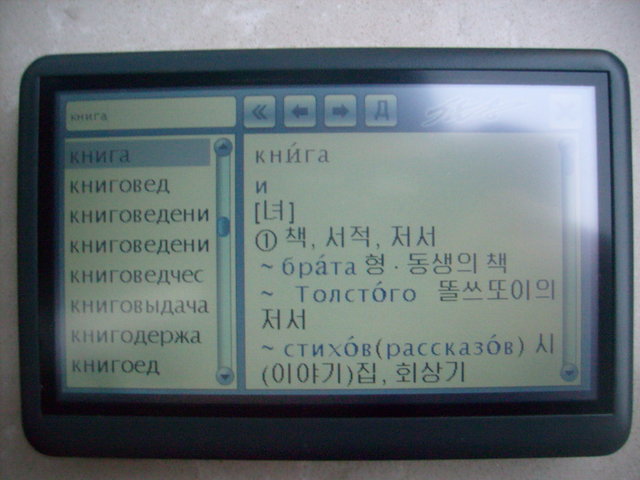
The device, which doesn’t appear to carry any branding, has a color touchscreen display that occupies its entire front, according to photos published on the “Pyongyang Show and Tell” blog. The Russian-language blog is maintained by a Russian student who is studying in the country.

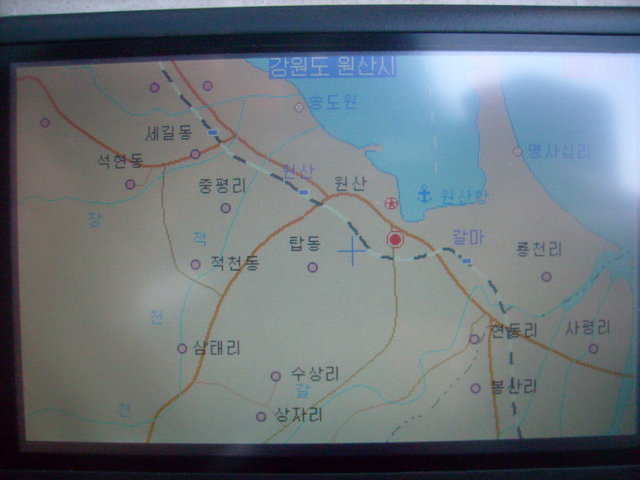
Installed software includes a Korean dictionary and translation dictionaries pairing Korean to and from Russian, English, Chinese and German, the blog report said. There are several basic utility programs and an electronic map of the country although the PDA does not feature GPS (global positioning system).

There is also no wireless networking so data transfer has to take place via a USB connection to a Windows or Linux computer. Data can also be transferred via MicroSD card, which is the same as used in domestic cell phones.

“Comparing it to modern things like, let’s say, the iPad, it’s nothing,” the blog’s author, who didn’t wish his name to be used, told IDG News Service via email. “It’s still good as a dictionary, except I don’t see any other advantages.”

It’s not the first PDA in North Korea.

In 2003 the country’s media said “Hana 21,” a PDA developed by the Samilpo Information Center, had been put on sale. The device included English-Korean and Korean-English dictionaries as its main function and also had several games and a basic word processor. Input was by pen and touchscreen.

According to published images of the Hana 21, the two devices are different.

At the time the Hana 21 was said to cost around 200 euros (US$182 at the exchange rate of the time).

The new PDA that hit stores recently costs around US$140.

“It’s still hard to buy for a Korean, but there are many people who keep their money for years and can afford it,” the student said via email.

PDAs have long been out of fashion in many countries after their features and functions were duplicated by smartphones. North Korea has a 3G cellular network, but most cell phones have only basic features.

ORIGINAL POST: Show and Tell Pyongyang introduced the world to the DPRK’s version of Linux: Red Star.  Now he has introduced us to the DPRK’s new Personal Digital Assistant (PDA).

Here are pictures from the Russian web page:
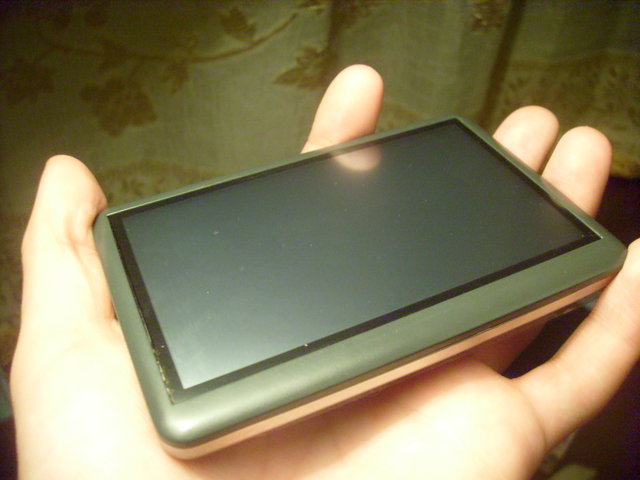
According to the Russian-language web page (via Google Translate):

A few weeks ago in North Korea has started selling the first PDA. In all the computer shops you can see the advertising of the new items. [I] offer a small review of this device.

On sale are a few options. The difference between them – is the amount of internal memory and a built-in slot for the stylus. The most feature-rich [costs] $ 140 and has 8 gigs of internal memory and a slot for the stylus, so you do not accidentally lose it.

In addition, there is a slot for MicroSD memory cards – the same as in the local mobile phones.

The main function of which is worth noting (and more generally for which there is a fly sabzh), an electronic dictionary Samhyn (삼흥) with the Russian language. It is no secret that South Korea produced electronic translators, but, according to eyewitnesses, the Russian language is absent in them as fact. And in this case, Russian-Korean and Korean-Russian dictionaries most voluminous in the number of vocabulary words. Besides, there are English, Chinese and German. Also has a large Korean Wiki Grand Korean Dictionary.

So for me personally, the main value of the PDA – is an electronic dictionary, which can carry with them always and everywhere. And the rest is not so important.

So what else is there? There is a map of Korea’s system of teaching foreign languages (English, Chinese). By the way, about a month ago there was an opportunity to put maps on your mobile phone. Application free of charge and requires activation. Put it on a large computer center of the city. []

Device has access to TV, headphones and a USB-slot. Possible to connect devices to both Windows, and Linux (in this case, Red Star)

On the whole – everything is simple and works quite well. At the moment, the firmware needs some work, not all features fully implemented, but the Korean comrades promise to update and refine.

If anyone else has more information, please let me know.

Share

DPRK restricts private car use, rattles markets

Monday, November 1st, 2010

Institute for Far Eastern Studies (IFES)
NK Brief No. 10-11-01-1
11/1/2010

The North Korean Ministry of People’s Security (MPS) recently issued an order restricting the use of automobiles and warning that any car or truck used to earn private income would be confiscated by the State. There were a few cases of authorities cracking down on the use of private buses in the mid-2000s, but this is the first time there has been a widespread crackdown on the private use of all vehicles.

According to a report from the Daily NK, a source from North Hamgyeong Province has revealed that “on an order from the MPS, a crackdown on privately-owned cars, buses, and 1.5-2 ton small trucks began last month,” and, “all traffic police were mobilized and are checking all registrations, car-use permits, and driving licenses.” According to the source, each regional transportation authority is filing comprehensive situation reports, which show that with the exception of cars used by the elite, all illegally-used cars are being confiscated. Even cars used by military-run foreign capital organizations are subject to inspection by police.

In North Korea, the lack of electricity has led, since the mid~2000s, to the sharp drop in the use of trains and a rise in reliance on the so-called ‘service car’ as the primary method of moving people and goods around the country. This crackdown on service cars will be carried out in two phases: Phase 1 will run until the end of the year, then Phase 2 will be carried out until April 2011. The ownership and use of cars by organizations and businesses will also be investigated, while other cars will be inspected one at a time as they travel the roads. If any illegal use is discovered, the car will be impounded.

This kind of measure appears to be one aspect of North Korean authorities’ on-going battle against “anti-socialism.” Cars and other government property being put to private use is problematic, but a crackdown of this size indicates that organizations and government workers are abusing the rules on such a scale that the government can no longer tolerate their corruption. In order for these service cars to exist, authorities must break laws, forge documents, and pay bribes to get a car registered, purchase gas, and handle profits.

However, a crackdown on these cars is expected to have many side-effects. Service cars began replacing trains in 2004, but the people’s reliance on them grew so quickly that they are now the primary means of transportation throughout North Korea.

Ultimately, the North can not avoid significant aftershocks of the measure; without service cars, not only will businesses suffer production problems, those people who make their living through wholesale and retail markets will suffer, and the standard of living for people across the country will take a hit.

Previous posts on this topic cna be found here and here.

Share

Information on the DPRK’s informal transport market

Thursday, October 28th, 2010

According to the Daily NK:

With North Korea’s domestic security forces having been engaged in inspecting and confiscating vehicles being used for private gain since October 18th, the question of whether the so-called “servi-cha” industry will stay the course has become a central issue for many. This is because the presence or absence of the “servi-cha” can make or break the North Korean domestic economy, much like last year’s currency reform.

What is a “servi-cha”?

There are two types of “servi-cha”. The first are vehicles, mainly buses and trucks, owned by state organs and enterprises, which transport people and supplies in exchange for money. Enterprises use the money earned from the service to provide rations for the workers, cover transportation costs or obtain further raw materials for production.

The second type of “servi-cha” is those owned by individuals but registered as being owned by an enterprise; they are used for private gain. Collusion among three parties; the owner of the vehicle, the driver and the enterprise under whose name the vehicle is registered, is necessary in such cases. The owner of the vehicle acquires a car from, predominantly, China or Japan, whereupon cadres of a certain enterprise or local unit register the vehicle under the name of the enterprise or unit. A driver is hired thereafter, who then gets a drivers’ license from the cadre and sets about earn a profit by providing public transportation to residents or moving supplies. A portion of the money earned is given to the cadre, who will usually take a fraction for personal gain and register the remainder as company profit.

In general, two people man a “servi-cha”; the driver and his assistant. Alongside them, the owner of the freight being transported is present, and thereafter empty seats are taken by other passengers. If the car meets an inspection on the way to its destination, there is no problem; on paper, the vehicle is legitimate; it belongs to a unit, and the owner of the freight carries a transportation permit that he/she has received from the car owner. With a bit of alcohol and tobacco on hand to bribe the inspector, even the people occupying the empty seats are free to pass.

A North Korean license plate contains information on the institution the vehicle belongs to. As most people do not have a travel permit, they tend to prefer “servi-cha” that display the license number of a powerful institution. Transportation fees differ according to the type of license plate on the “servi-cha”. “Servi-cha” with plates from powerful groups charge higher fees than those with plates from food factories and agricultural offices, for example.

Vehicles are assigned numbers based on certain rules; license plates that reflect an auspicious date are deemed best; either 216 (February 16th; Kim Jong Il’s birthday) or 727 (July 27th; Victory Day). The license plate of a car given as a gift by Kim Jong Il to someone on the Central Committee might be assigned a number such as 216-11-101.

Furthermore, each department of the Party uses its own license plate number in order to distinguish ownership of vehicles. For example, the Party’s Finance and Accounting Department uses the number 02; 11 and 12 is reserved for Party offices; 12 to 14 for administrative units; 15 to 17 for the People’s Safety Agency; 18 to 20 for the National Security Agency; 21 for judicial branches; 22 for a unit under Party Department No. 39, 90 for the Central Party liaison office, and 46 for passenger transport services.

Inspections are stricter for those “servi-cha” with less impressive license plates. Travel permit checks become more thorough, and the inspectors ask more questions about the cargo. Thus, vehicle owners with “weaker” plates tend to have to give more bribes.

Origins of the “Servi-cha”

Public transportation virtually stopped in North Korea during the economic collapse which began in 1995, bringing about shortages of fuel and electricity. The country was incapacitated to the point that the government issued a decree calling on cadres to walk.

The first people to break the logjam were from foreign-currency earning units. They were able to use imported fuel to transport freight for other companies, at a price. Many enterprises quickly spotted the rising demand for freight logistics services, and started earning considerable profits by importing Chinese Dongfeng or Japanese second-hand trucks.

Demand for this was not limited to institutions and enterprises. Vendors also wanted to move their supplies around the country. The importing of Chinese products to the Rajin-Sonbong Special Economic Zone beginning in 1997 was followed by a rise in long distance cargo transportation to cities as far as away as Pyongyang, Hyesan, Sinuiju, Kaesong and Haeju.

The Different Types of “Servi-cha”

In general, trucks are a popular choice. This is because they can transport cargo and people at the same time. Buses, which are more readily owned by institutions and enterprises than trucks, are also often utilized for long-distance trips. A regular 45-person bus will often be full to capacity, with the central aisle lined with makeshift seats.

Party and military cadres also use their vehicles as “servi-cha”. It is commonplace for them to order drivers to look out for long-distance travelers as a means of earning extra money when the car is not in use. This also applies to the case of military cadres.

Sometimes, the seats of Japanese second-hand vehicles or Chinese second-hand jeeps are removed in order to take a maximum of eleven passengers.

Earning Money through “Servi-cha”

Use of “servi-cha” has vastly increased the quantity of goods and number of people crossing provinces, with goods smuggled in across the Tumen and Yalu Rivers in the north spotted in locations as far away as South Hwanghae and Kangwon Province, both of which border South Korea. Therefore, it can be said that production and trade between enterprises and vendors owes a great deal to the “servi-cha”.

For example, in 2001 the price of sweet potatoes peaked in the Rajin-Sonbong Zone. Demand for sweet potatoes was high in places north of Hamheung because climate conditions in that northern region are not favorable for cultivating the crop. While sweet potatoes were priced at 7 won per kilogram in South Hwanghae Province, in the Rajin-Songbong Zone the price exceeded 45 won per kilogram.

Vendors from Rajin-Sonbong were therefore able to increase profits 50% by selling Chinese everyday goods in Hwanghae province, and then make seven times more money selling southern sweet potatoes in the north.

It goes without saying that initial expenditure is required to pull this off. The cost of changing tires, of filling up the vehicle with gas, of bribing officials for travel permits and drivers’ permits, all added up to about 70,000 won. However, a round-trip could earn the “servi-cha” crew a net profit of 60,000 to 70,000 won. At the time, it was very good money.

Kim Kyung Hee’s “Servi-cha” Experiment

On her way to Kangkye in Jagang Province, Kim noticed a throng on the street, and approached, concealing her identity. They were people waiting for a “servi-cha”. Leaving her assistant and vehicle behind, Kim quietly stood in line with the other people.

Eventually, a 10-ton “servi-cha” arrived and people began scrambling for seats on the platform normally reserved for cargo. Paying her fare, 50 won, Kim also tried to board, but the driver noted her less than ordinary appearance and gave her the passenger seat.

After a few minutes of travel, a strange voice could be heard;

“Comrade, our time is up.”

The source of the sound was Kim’s watch. It was a message from her assistant, who was following the “servi-cha”. The driver, concerned for any number of reasons, immediately stopped and asked Kim to descend from the cab. In the end, the “servi-cha” left her behind on the road. It has been said that Kim went back to her vehicle and told her assistant that the “servi-cha’s are rather fun”.

Read the full story here:
Servi-Cha: the Lifeblood of the People’s Economy
Daily NK
Im Jeong Jin
10/28/2010

Share

DPRK cracks down on informal transportation market

Monday, October 25th, 2010

According to the Daily NK:

The People’s Safety Ministry has declared war on the use of vehicles for private gain, according to a source, raising fears that another period of social upheaval is on the cards.

Vans, buses and trucks have been in use as so-called “servi-cha” (service cars) in North Korea since the late 1990s, after the authorities became unable to provide regular electricity to the railroads. Since then, this alternative transportation system has become a core means of distribution and domestic movement.

However, a source from North Hamkyung Province reported on Sunday, “A crackdown on sedans, vans, and 1.5 to 2-ton trucks belonging to individuals has begun under a decree handed down by the People’s Safety Ministry on the 18th. Now, all traffic safety agents are checking car registration documents, vehicle licenses, car permits and driver’s licenses on the streets.”

The source explained, “The PSM intends to confiscate all kinds of vehicles apart from those registered for cadres and businesses in the Traffic Office database in each province. Even those vehicles belonging to military-owned foreign currency-making enterprises have been targeted for inspection, but the military police will deal with them.”

According to the source, the North Korean authorities have divided the crackdown on the servi-cha system into two steps: the first is to be carried out until the end of this year, and the second by late April, 2011. First, for the next six months, the PSM will investigate vehicle ownership in government organs, companies and factories, inspecting all vehicles on the streets and confiscating those found guilty of illegality. In the second phase, the PSM will move on owners of private vehicles.

Vehicle management in North Korea is the work of the Traffic Department of the People’s Safety Ministry. The Traffic Department has a Traffic Office under each municipal or provincial People’s Safety Ministry which is in charge of monitoring vehicles within that region. Vehicles belonging to the military are managed and monitored by the rear guard unit of each corps, division or regiment; punishment, monitoring and crackdowns are military police duties.

The operation of a “servi-cha” requires the collusion of three parties; the car’s real owner, a driver and a cadre from an organ or enterprise.

A used car arrives from China or Japan, whereupon the cadre, who has close relations with the smuggler of the car, registers it in the name of his organ or enterprise, since all vehicles must belong to a group, not an individual.

Then, the car owner hires a driver and operates the vehicle as a bus or delivery truck.

Gains are divided between the cadre and the owner, who also pays the driver’s salary. The cadre extracts some of the profits for himself and records the rest as company income.

Under this mechanism, almost every organ, company, factory and even collective farm has at least one “servi-cha” in its name; profits are used to cover other losses, since there is no support coming from Pyongyang anymore.

This system is probably the most decisive influence on the growth of the jangmadang in North Korea. Thanks to the “servi-cha”, volumes of commercial traffic and personnel migration have increased and products smuggled in across the Tumen and Yalu Rivers from China are able to reach remote southern provinces such as Kangwon and Hwanghae.

Since the late 1990s, when the operating ratio of the railroad dropped to as low as 40%, the servi-cha system spread as an alternative to the collapsing public transit network. As permanent markets emerged in 2004, demand from people for migration and the distribution of goods increased drastically, and thereafter the system became the core transportation tool.

Considering the dominant influence of the “servi-cha” in the daily lives of the North Korean people today, if the crackdown is long and/or successful over a long period, other serious effects may be felt in North Korean society, where the aftershocks of the currency redenomination have only just dispersed.

This measure is being interpreted as part of a series of struggles for the eradication of what the North Korean authorities see as “anti-socialist elements”. Additionally, it seems to be an attempt not to ignore the abuse of loopholes in the system by cadres.

From the authorities’ perspective, the wide-spread usage of the servi-cha represents a loss of control over the society, because the movement of goods and people naturally incorporates the circulation of information.

The obvious problem is that any crackdown on the servi-cha industry will cause instability in the markets.

The source said, “Getting rid of ‘servi-cha’ is the same as letting us starve to death,” adding, “If they eliminate ‘servi-cha’, it won’t just be a problem for companies; any life tied up in markets including wholesaling and retailing will hit a brick wall.”

He explained further, “The measure will be a blow to cadres in the middle and lower levels, who are in collusion with traders. Therefore, lower cadres are likely to resist the measure first.”

Therefore, it is very much open to question whether the measure will be a success or a failure, just like previous crackdowns over markets and the currency redenomination.

Read the full story here:
War Declared on the Servi-Cha
Daily NK
Im Jeong Jin
10/25/2010

Share

Friday Grab Bag

Thursday, October 21st, 2010

1. The Boston Globe puts together a great photo album of the celebrations attended by Kim Jong-un.

2. Pyonghwa Motors did a car show in Vietnam where several of their vehicle models are sold. Who would have thought that both the North Koreans and the Unification Church would approve of a showcase model! See the Pyonghwa Motors Wikipedia page here.

3. See the KPA’s “Funky get down Juche party” (Youtube).  It only works with audio!

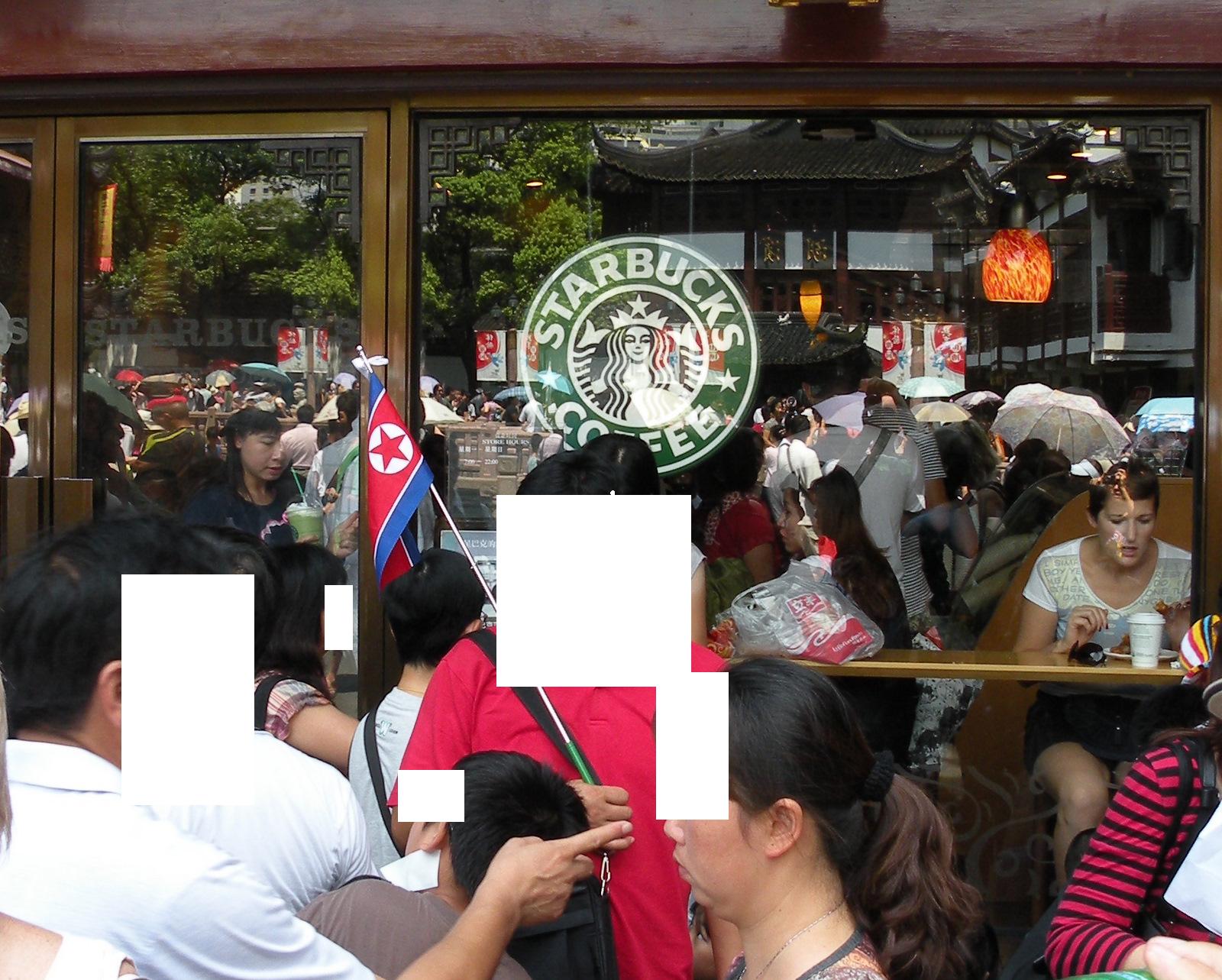
4. Here is a group of North Koreans in China visiting Starbucks! (They were only seen outside the Starbucks, I cannot confirm they went in)

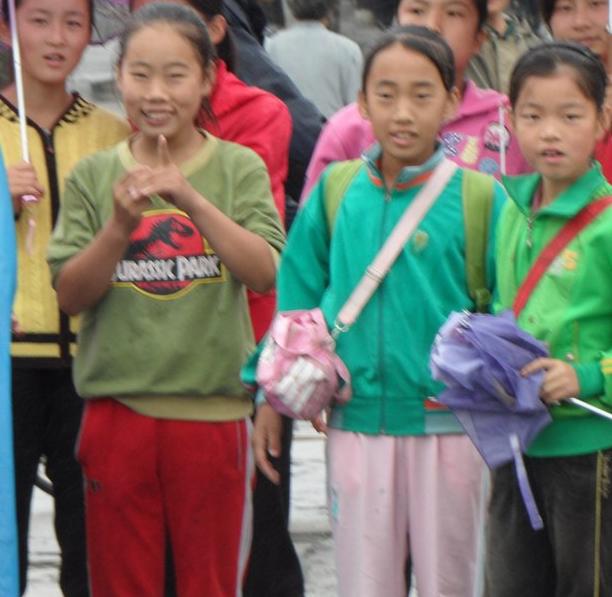
5. Recently I have posted a lot of pictures of North Koreans wearing Western brands (Jesus, Mickey Mouse, South Park, etc).  Today we see Jurassic Park (h/t to an anonymous colleague):

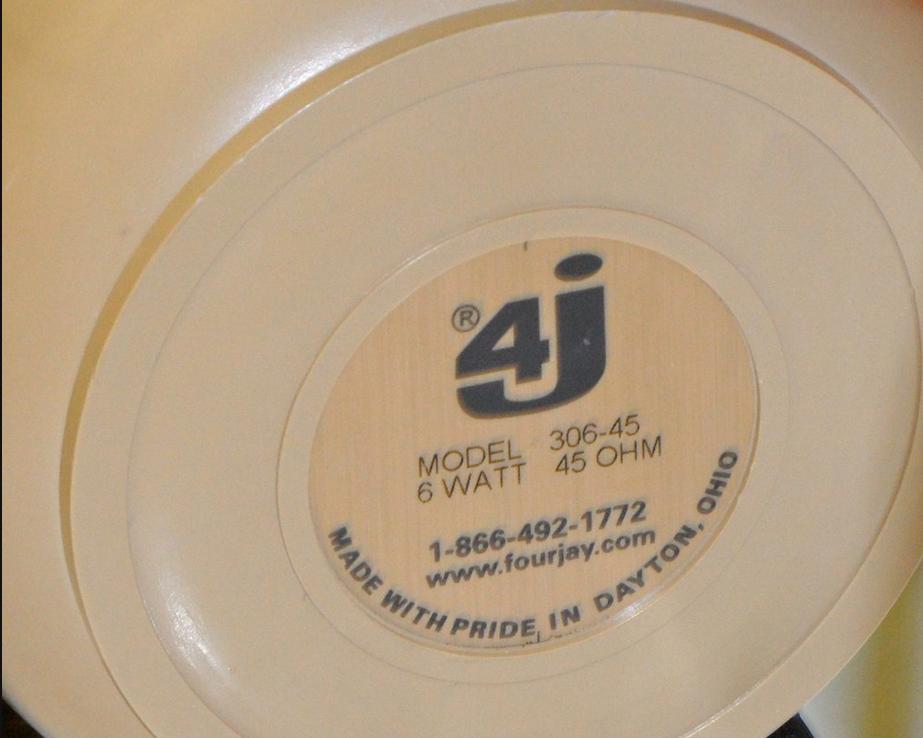
6. Fourjay Industries of Dayton, OH, might like to know that their products are helping to motivate swimmers at the Kim Il-sung University swimming pool (satellite image here).  I am willing to bet that the DPRK’s order (probably made through one or more intermediaries) did more good for the state than the stimulus package (zinger)!  I realize this picture proves nothing.  You just have to trust me that it came from Kim Il-sung University (Gag located the product web page here):

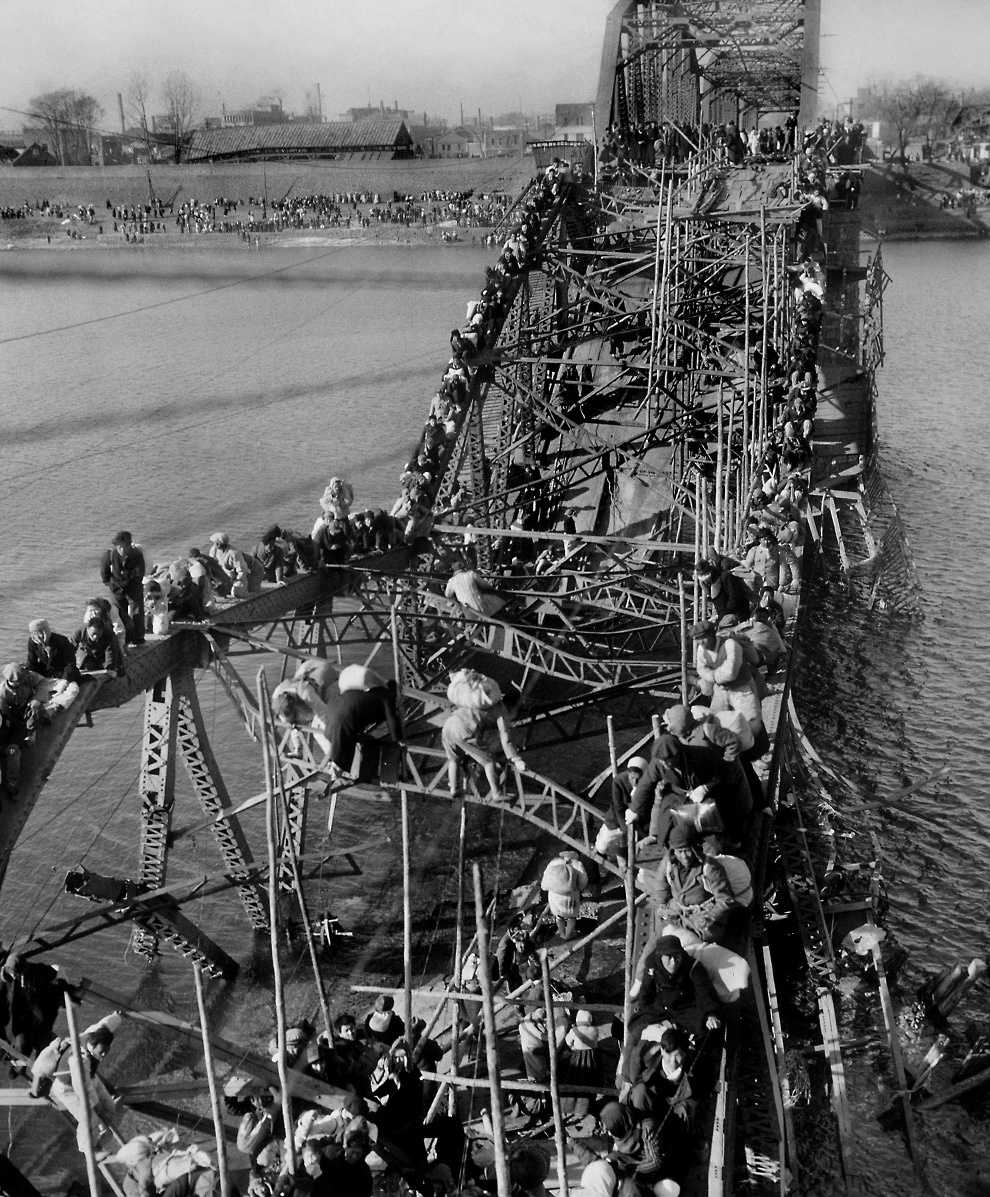
7. Finally, here is a good copy of a very famous picture:

Share

Friday Fun: South Park in Pyongyang, mass games tours, and missing traffic girls

Thursday, September 30th, 2010

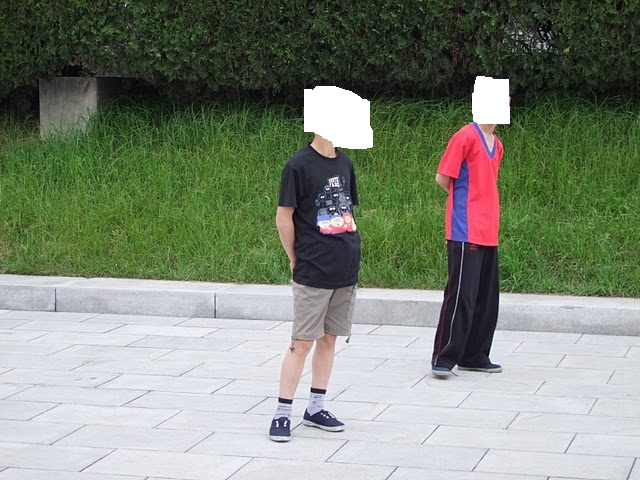
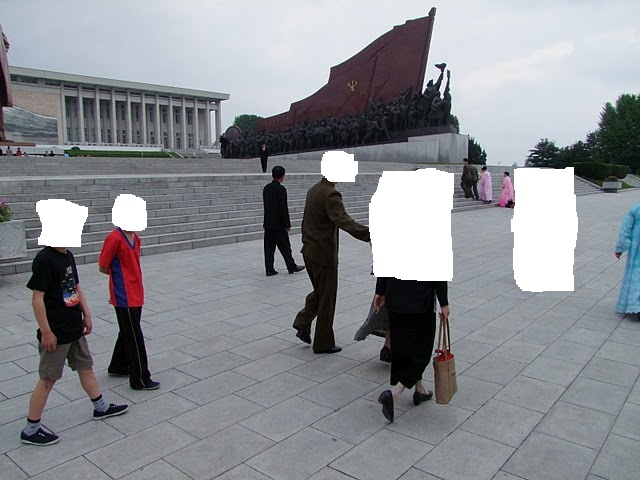
FIRST: A visitor to Pyongyang sent me these photos of a North Korean boy wearing a South Park shirt on Mansu Hill:

I trust that I do not need to explain why this is interesting.

SECOND: From Koryo Tours: The latest news from Pyongyang is that Arirang, the spectacular 100,000-strong mass gymnastic event has been extended until October 25th, marking the final performance of the 2010 season. If you haven’t yet seen tens of thousands of people moving in unison, 20,000 students forming a giant mosaic or the dancing eggs that makes Arirang unique, don’t miss our Last Chance Tour. Visitors can also see the massive monuments of Pyongyang, eat food “fit for royalty” in the ancient city of Kaesong and watch the North and South stare each other down at the DMZ. There’s no word yet on whether 2011 will have mass games at all – this just might be Arirang’s last dance. Don’t miss it!

If you are not able to see the Mass Games this year you should still see Centre Forward!

THIRD: NKNews.org has a couple of interesting recent updates from the DPRK.  The first claims that all of Pyongyang’s traffic ladies have been replaced by traffic lights.  Read the report here.  The second report covers a whole list of interesting observations.  Check out the report here.

Share

Security tightened leading up to party conference

Friday, August 27th, 2010

According to the Daily NK:

It has been reported that the North Korean authorities have declared a “Special Vigilance Period” and begun regulating civilian access to Pyongyang. The move looks like the start of preparations for the Delegates’ Conference of the Chosun Workers’ Party, which could begin as early as the end of next week.

An inside source reported the news in a telephone conversation with The Daily NK today, saying, “Since the 26th, they have been regulating access to Pyongyang for provincial residents at all the ‘No. 10 Checkpoints.’”

The General Security Bureau of the National Security Agency sets checkpoints at every major entry point into Pyongyang, and these are called “No. 10 Checkpoints.” They are used to regulate the floating population; at all checkpoints, vehicles and civilians have their documents checked.

There are approximately ten checkpoints, with Junghwa No.10 (Hwangju, North Hwanghae Province to Pyongyang), Seopo No.10 (Pyongsung, South Pyongan Province to Pyongyang), and Majang No.10 (Sariwon, North Hwanghae Province to Pyongyang) seeing the highest traffic flows.

The source added, “There is also a decree whereby all local cadres on business trips and others visiting Pyongyang on family business or for other reasons must leave Pyongyang by the end of this month.”

Special Vigilance Periods are a customary move when important events are held in Pyongyang on national holidays.

On Kim Il Sung’s and Kim Jong Il’s birthdays (April 15 and February 16), the founding day of the Chosun People’s Army (April 25) and the Chosun Worker’s Party (October 10), the four major national holidays, the Special Vigilance Period conventionally lasts for seven to ten days, while there is customarily a three or four day Special Vigilance Period when the Supreme People’s Assembly is sitting. Additionally, when international VIPs visit Pyongyang, access to the city is generally restricted for four to six days.

The only specific public evidence of the start date of the Delegates’ Conference came in the form of a June 26th Chosun Central News Agency dispatch, according to which, “The Politburo of the Central Party summons a delegates conference of the Chosun Workers’ Party at the beginning of September, 2010 to elect the leading apparatus of the Workers’ Party and reflect new demands for the revolutionary development of the Party, which is facing critical changes in bringing about the strong and prosperous socialist state and Juche revolutionary achievements.”

While the statement could mean any time between September 1st and 10th, considering September 9th is the founding day of the North Korean regime, the conference looks likely to be held between September 6th and 8th.

The Chosun Central News Agency (KCNA) also reported today that county delegates’ conferences have been held and provincial delegates’ conferences will be held soon. The latter will elect provincial delegates who will go forward to the main conference.

In another report, Chosun (North Korea) Central Broadcast (the state radio station) reported that Kim Jong Il had been voted in as a delegate for the North Korean People’s Army in a military party delegates’ conference held in the April 25 House of Culture on the 25th.

Read the full story here:
Pyongyang Getting Set for Delegates’ Conference
Daily NK
Yoo Gwan Hee
8/27/2010

Share

Roads to Sinuiju

Monday, August 16th, 2010

Last week I wrote about new satellite imagery on Google Earth which showed highway construction in Sinuiju.

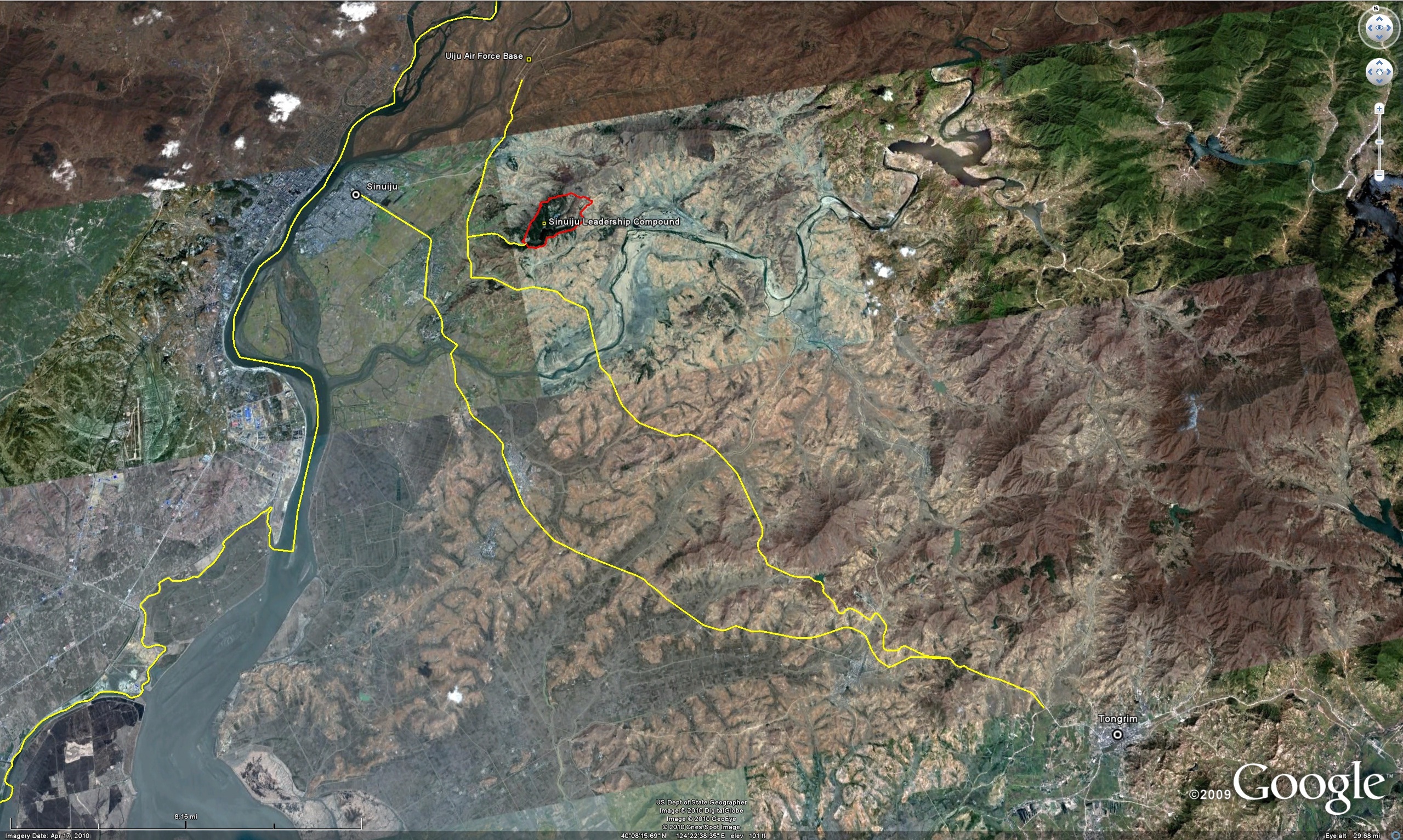
The story is more interesting than I initially suspected, however.  It appears that the DPRK is building two highways between Tongrim and Sinuiju.  One highway will probably be for public, commercial, and international traffic.  The other road is likely reserved for “you-know-who” and other senior policy makers.  Below is a map of both these highways between Tongrim and Sinuiju.  The “elite road” is the road to the right that connects Tongrim to Kim Jong-il’s compound in Sinuiju and the Uiju Airforce Base.  You can see the map below:

It is not clear where these roads go south of Tongrim because the satellite imagery predates the highway construction.

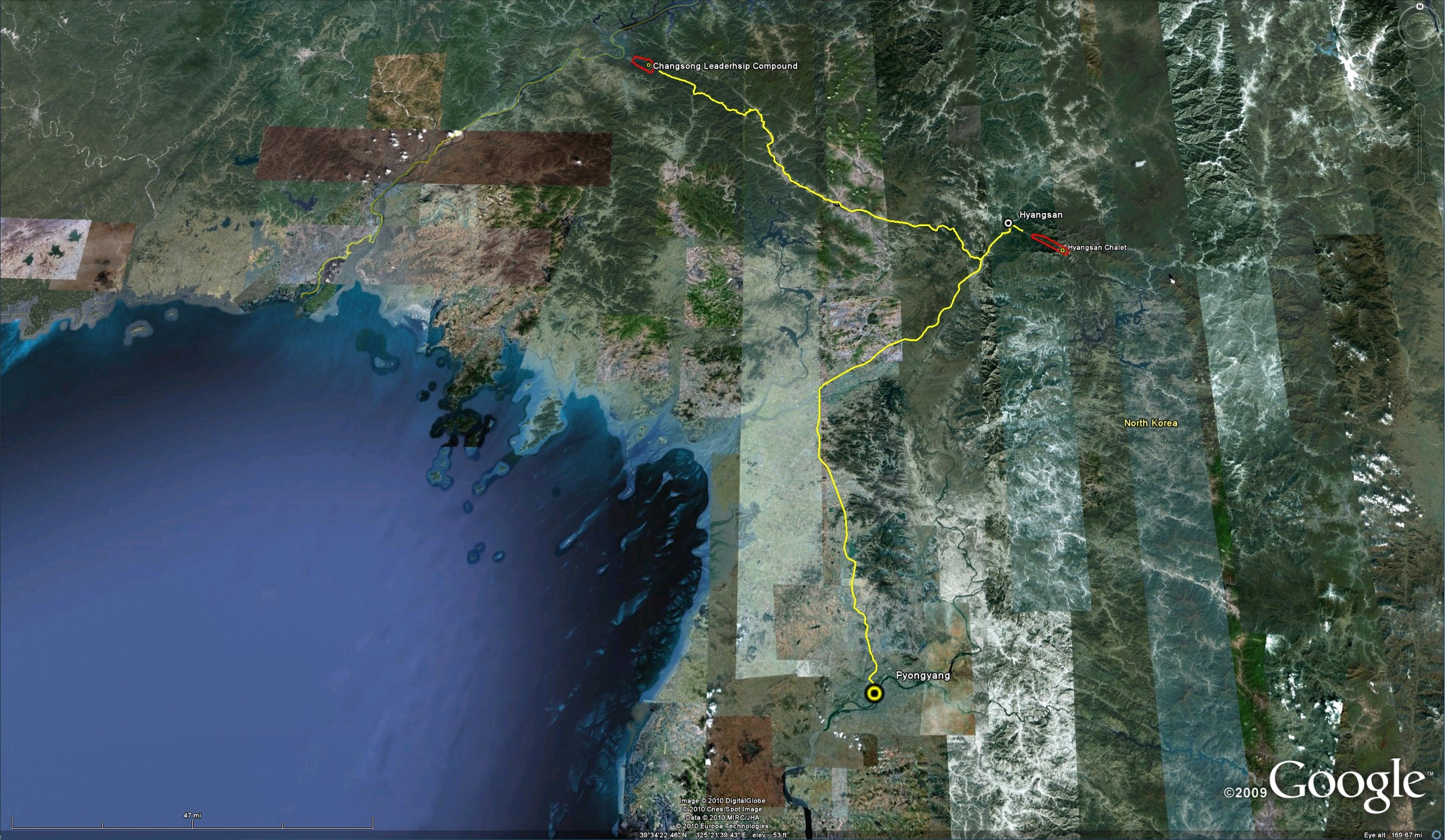
There are several highways in the DPRK that are reserved for Kim Jong il and other senior policymakers.  Below is the highway that connects Pyongyang to leadership compounds in Hyangsan and Changsong (on the Chinese border).

Share

What’s new in Sinuiju?

Sunday, August 8th, 2010

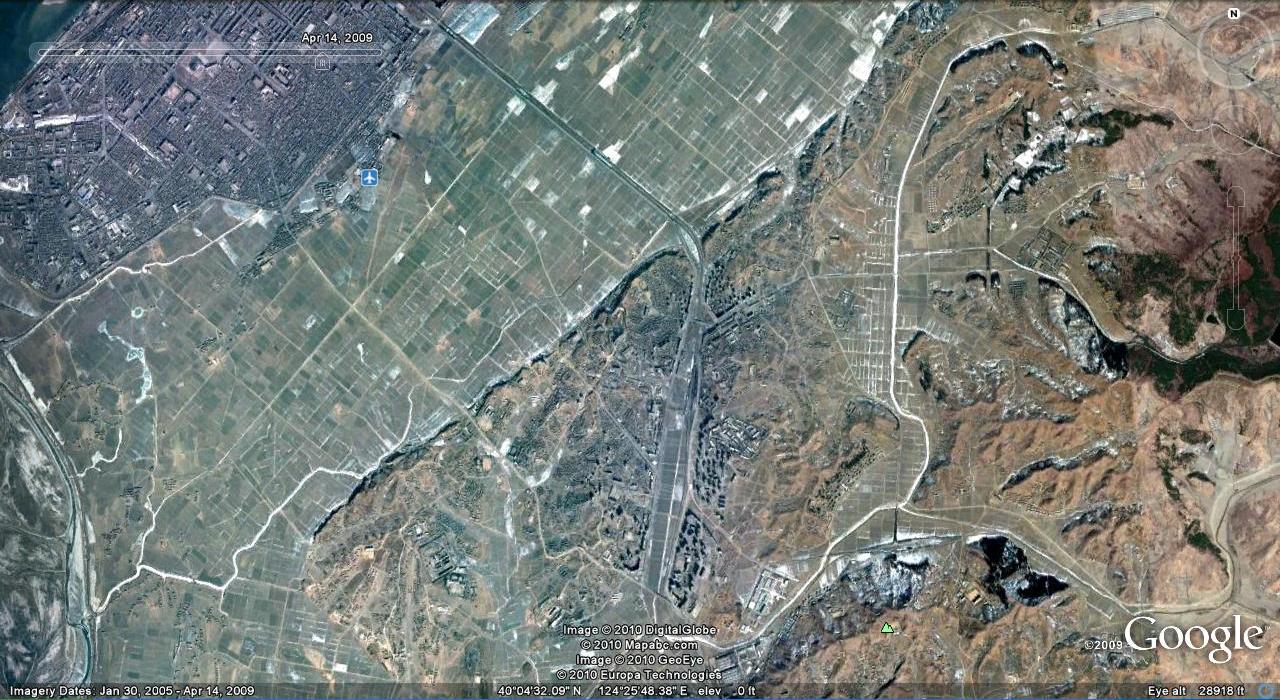
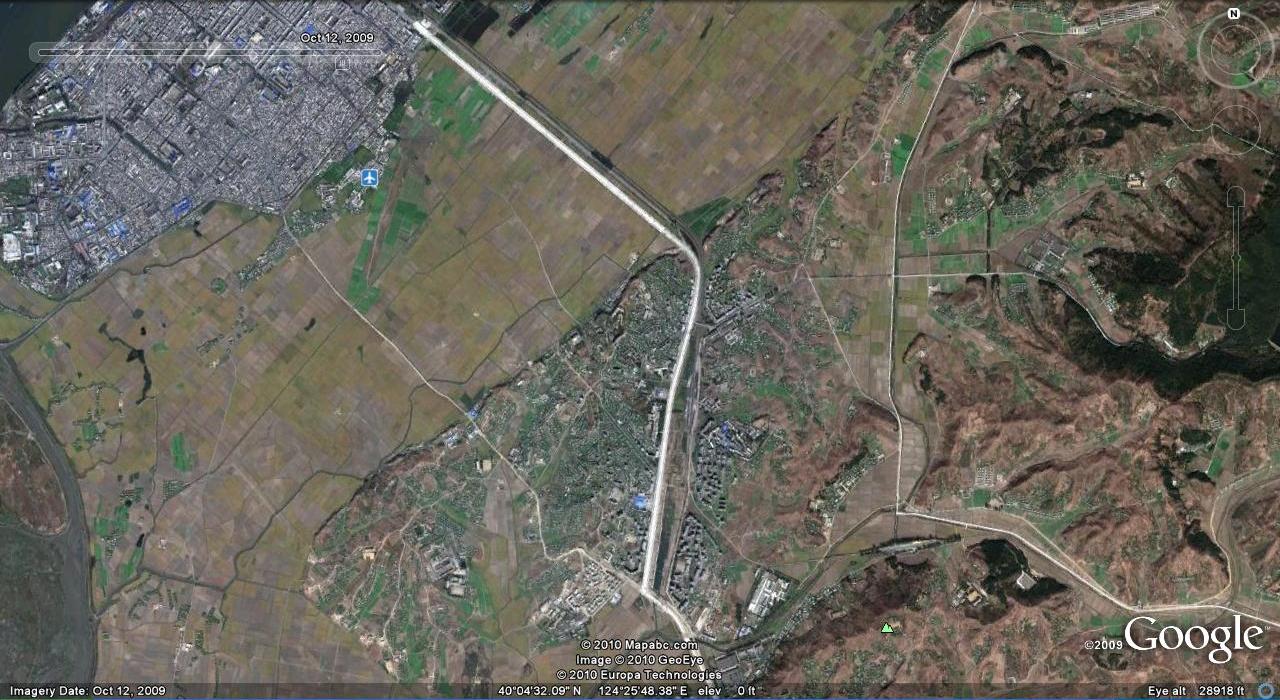
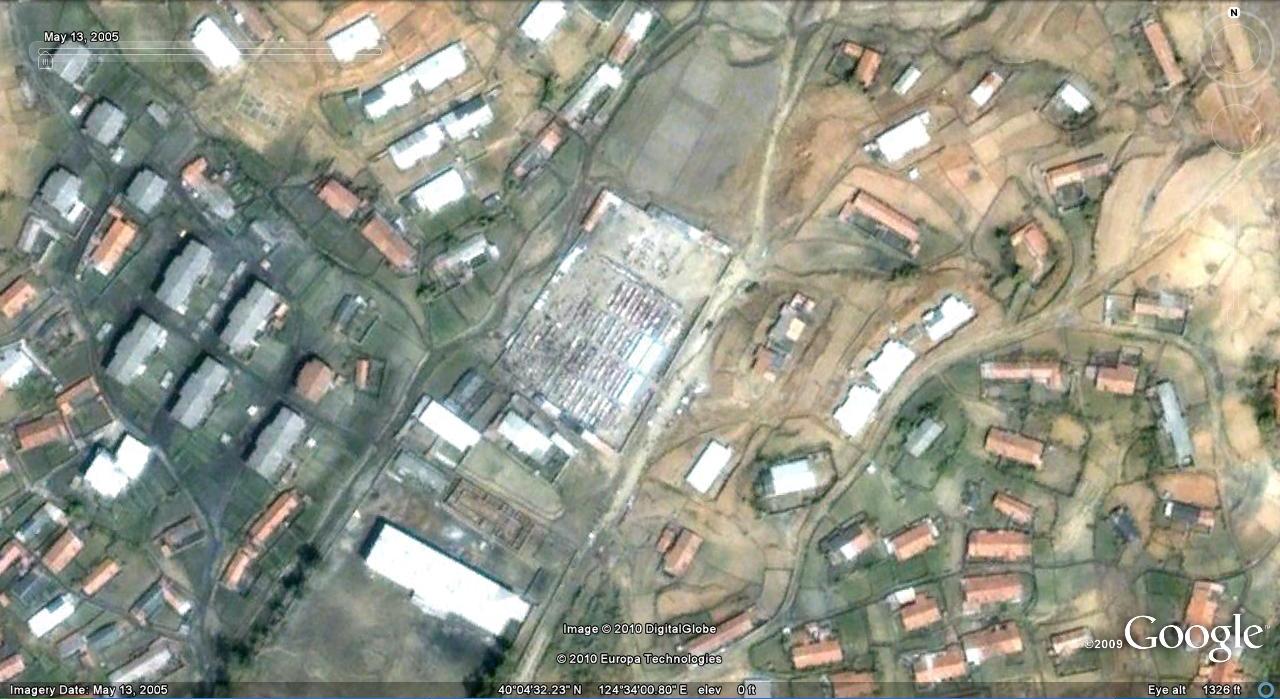
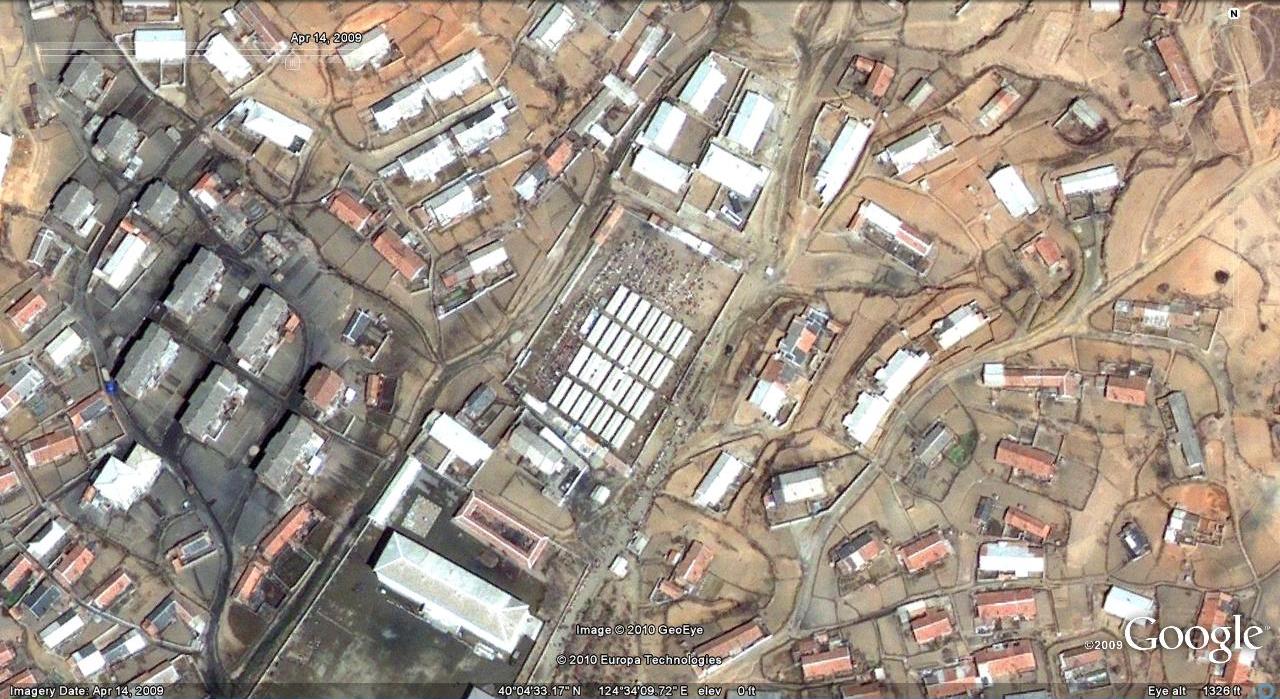
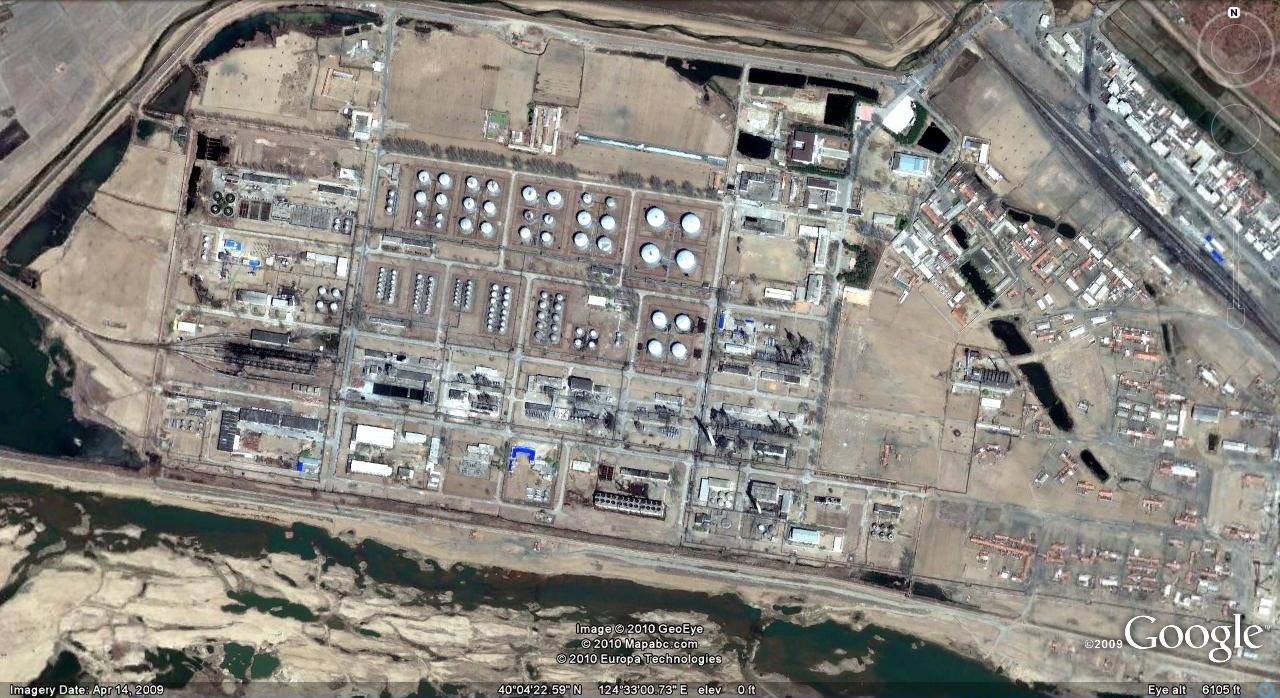
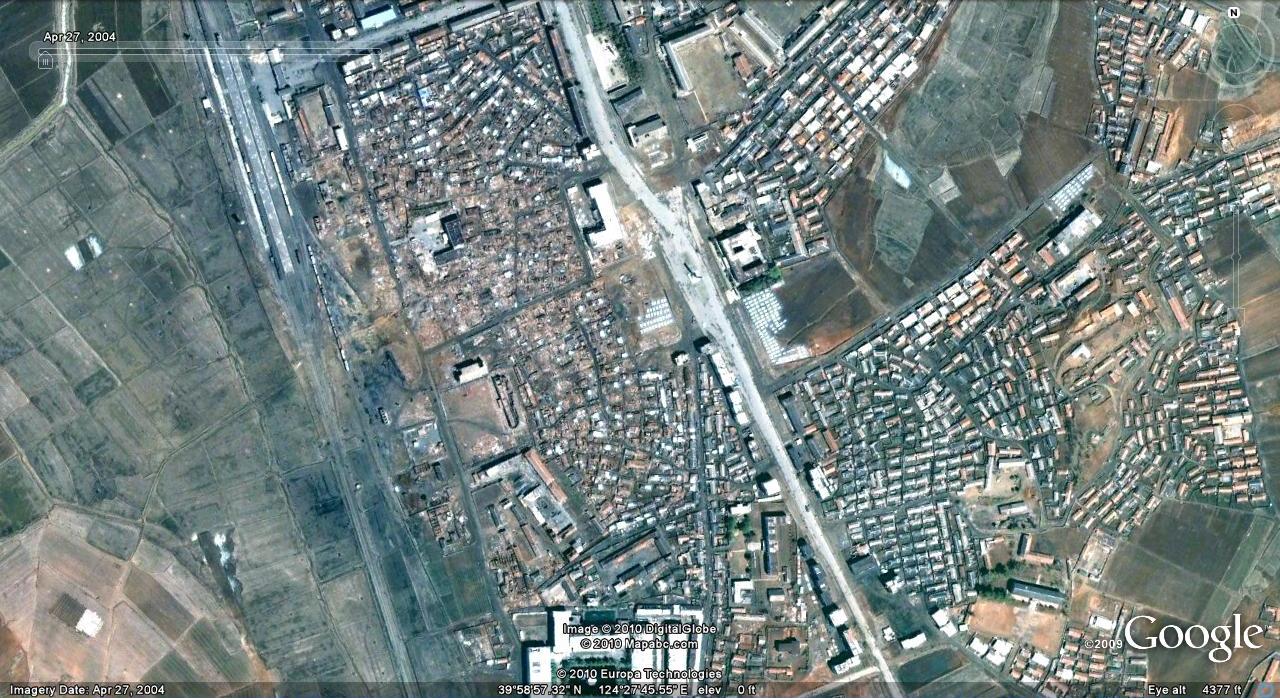
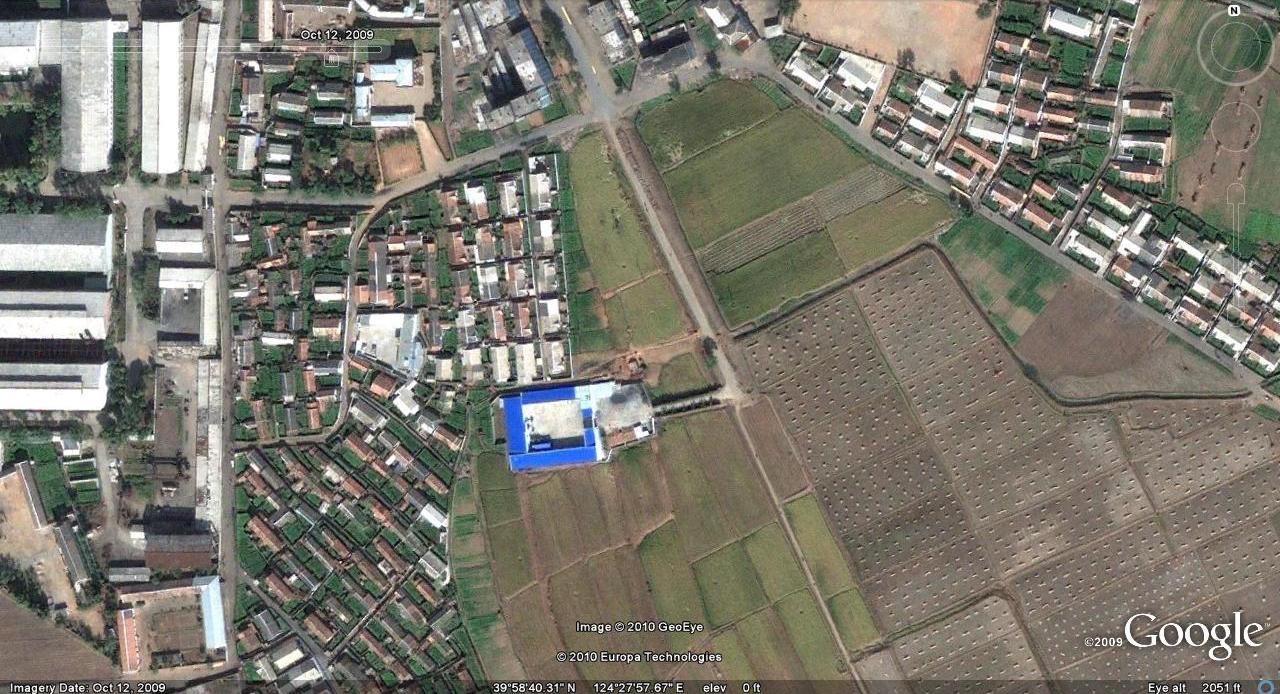
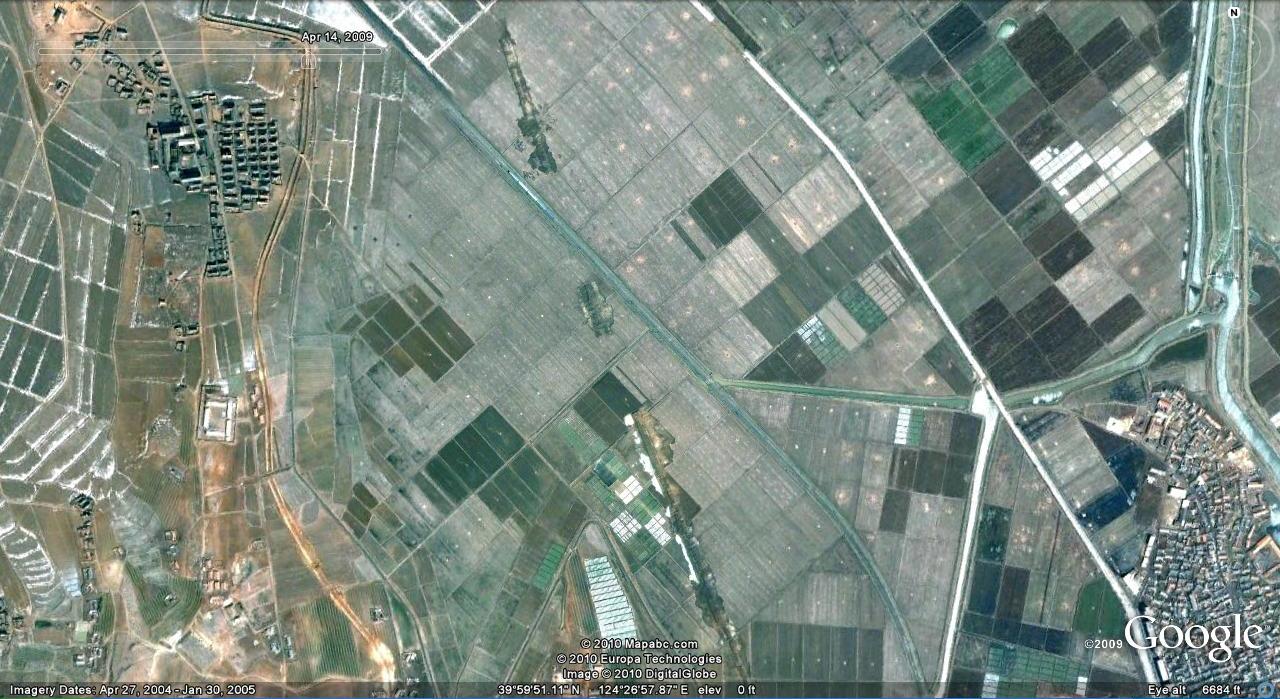
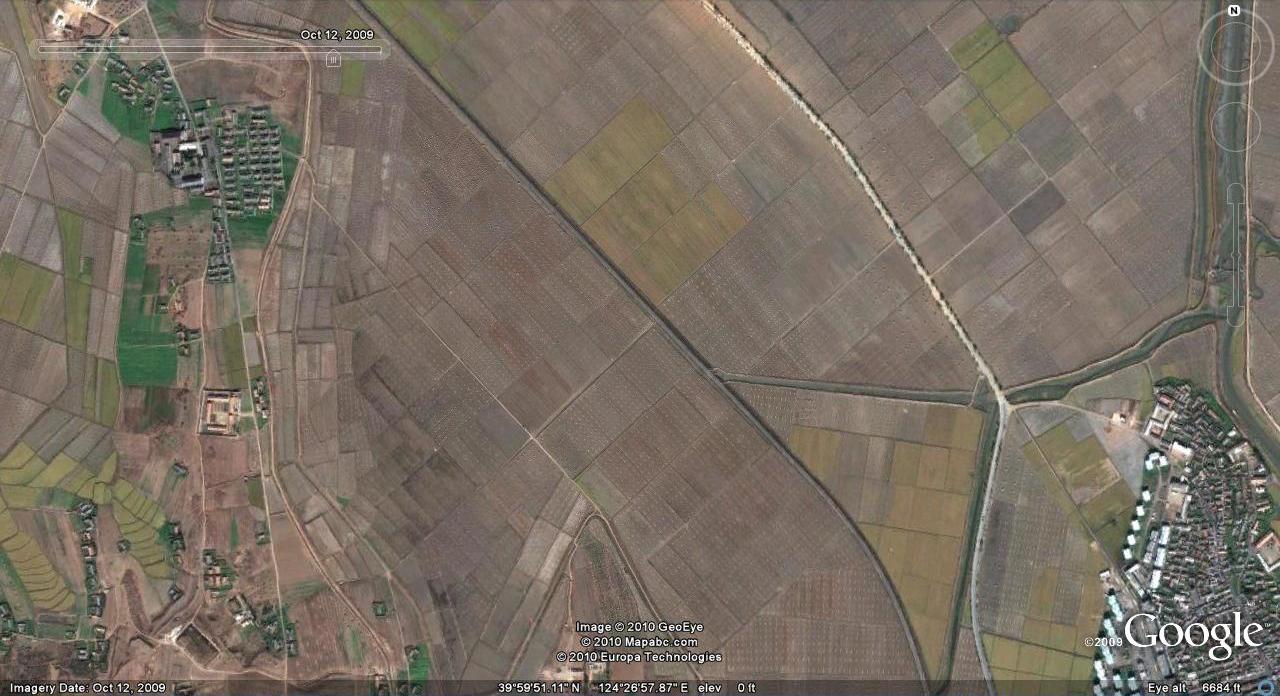
Google Earth has added some new GeoEye imagery for Sinuiju, Ryongchon, and Phihyon counties. The imagery dates are Oct 12, 2009 and April 14th, 2009.  So what is new in this area?

Pyongyang–Sinuiju highway under construction
It can be most easily seen between the Sinuiju Train Station and Rakwon-dong.

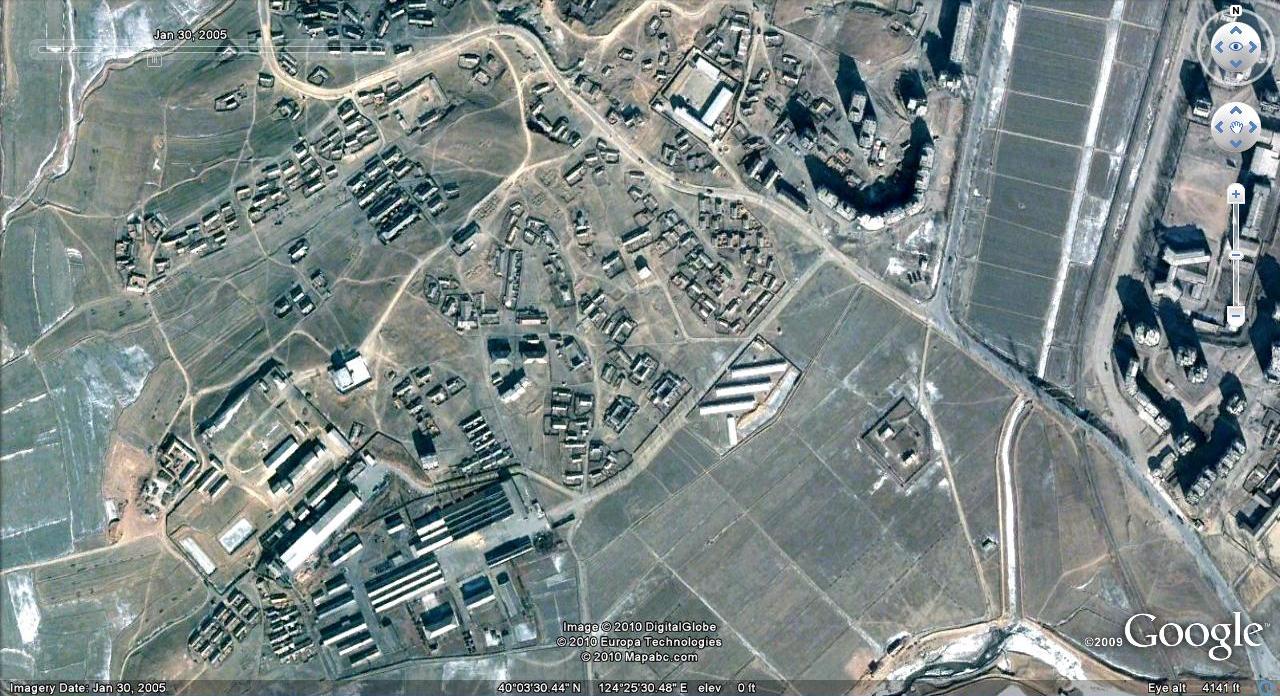
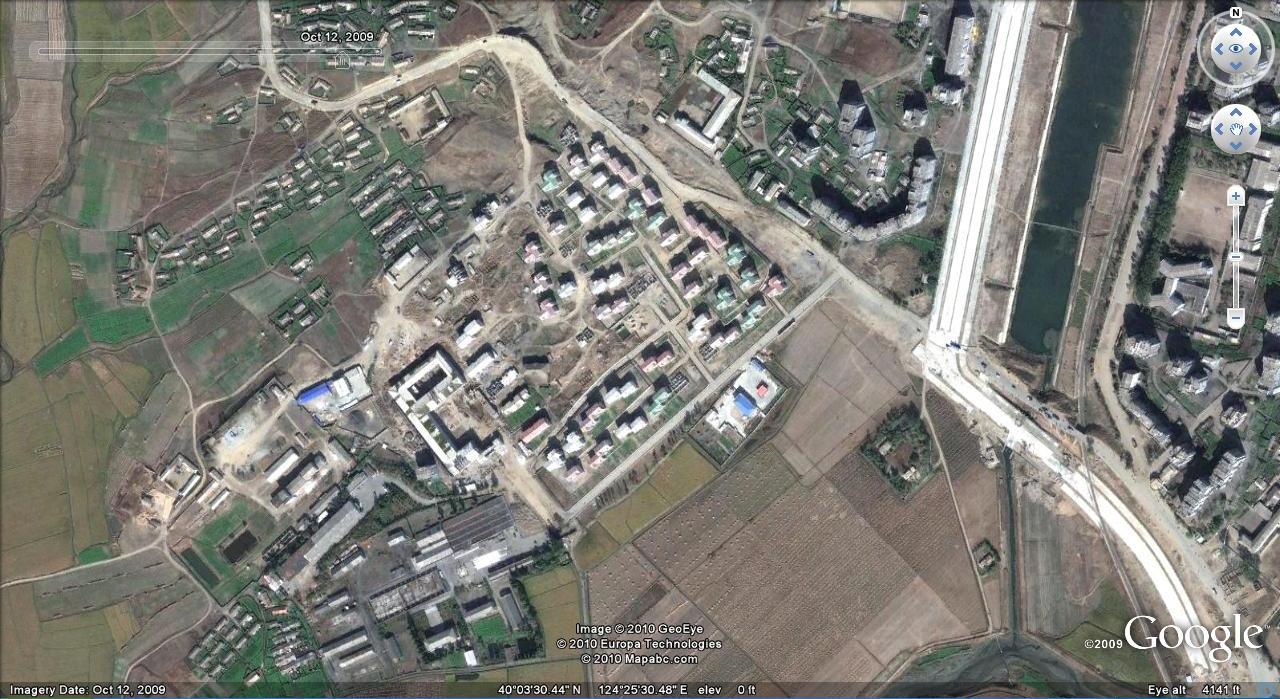
Villages along the highway are being spruced up in anticipation of car traffic:

The highway construction can be seen as far south as half-way between Ryongchon and Yomju.  I suspect that it is intended to continue south to Anju where it will meet up with the Pyongyang-Hyangsan highway.

Market construction in Sinuiju and Phihyon County
I blogged about the new Sinuiju market here. Below is imagery of the new Phihyon County Market (피현군):

Ponghwa Chemical Factory (Refinery)
It was partially visible before, but now we can see the whole thing. It is one of two refineries in the DPRK.  The other is in Rason (satellite image here).


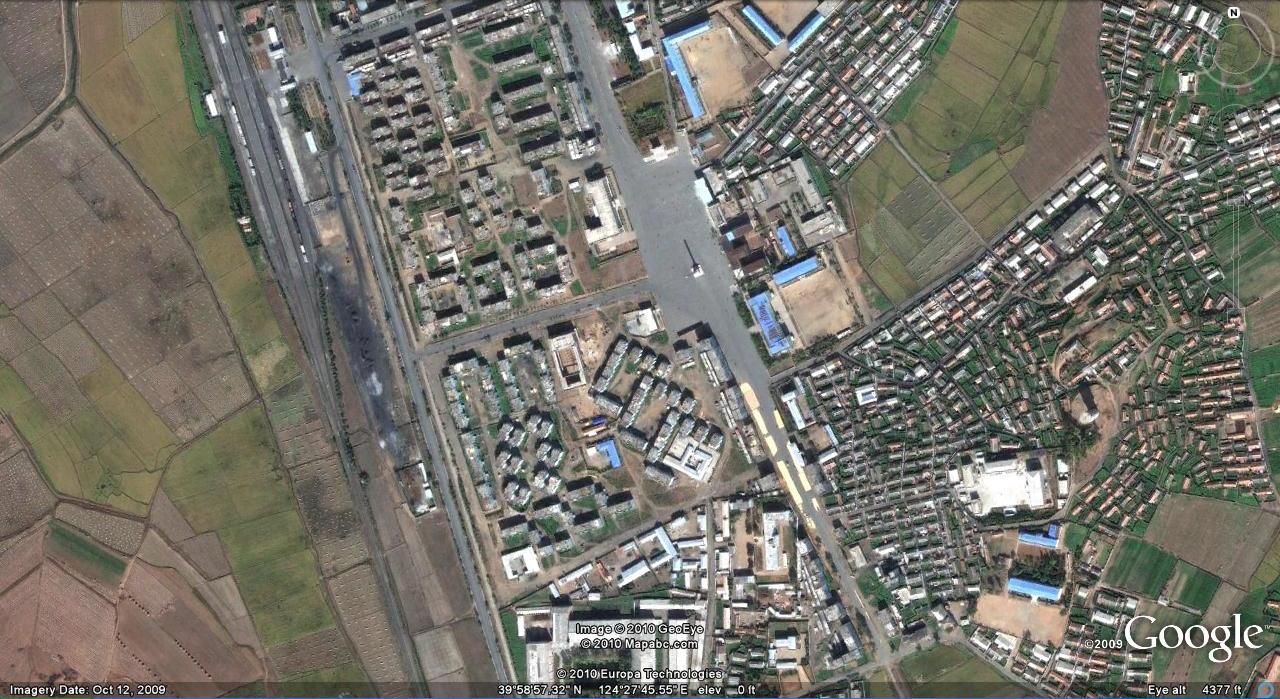
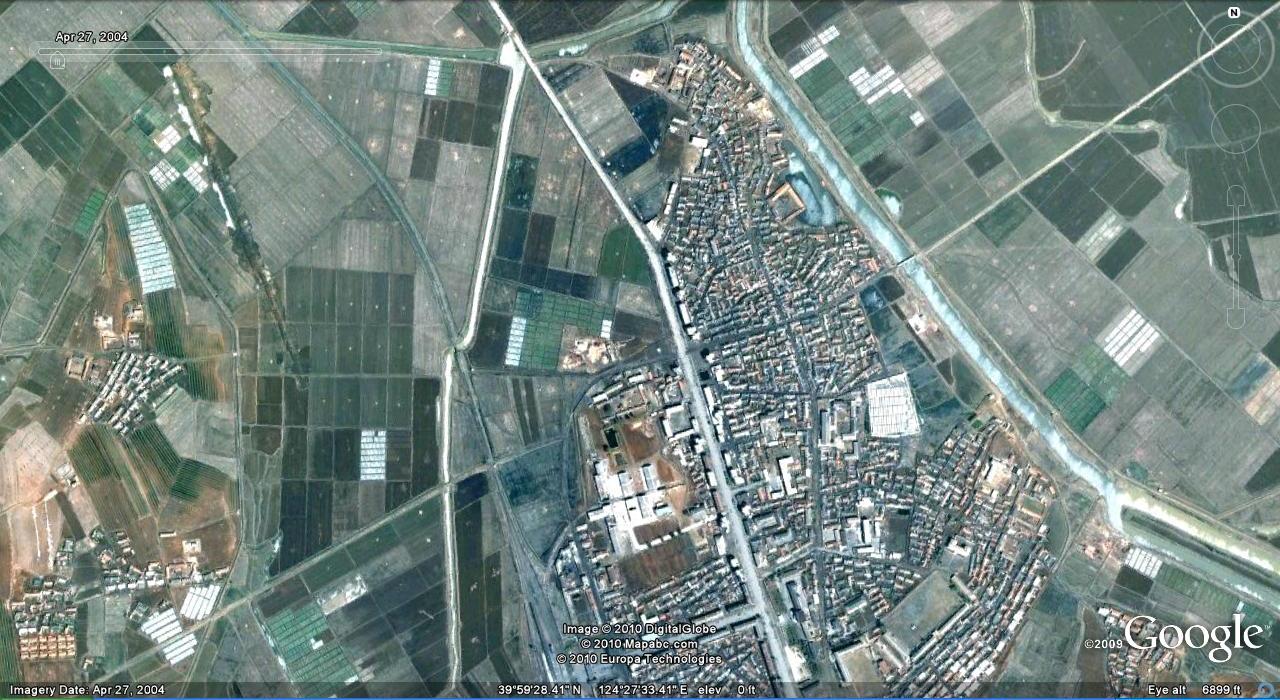
Reconstructed Ryonchon City (룡천시)
I have previously blogged about this here.

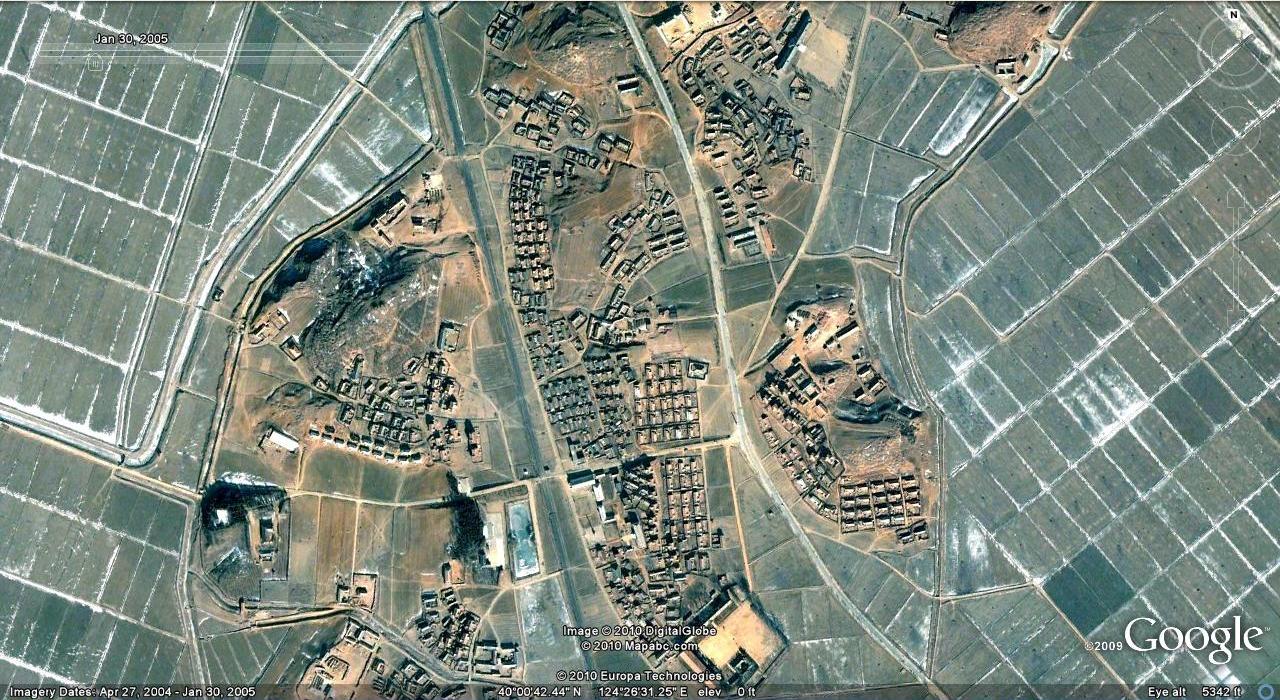
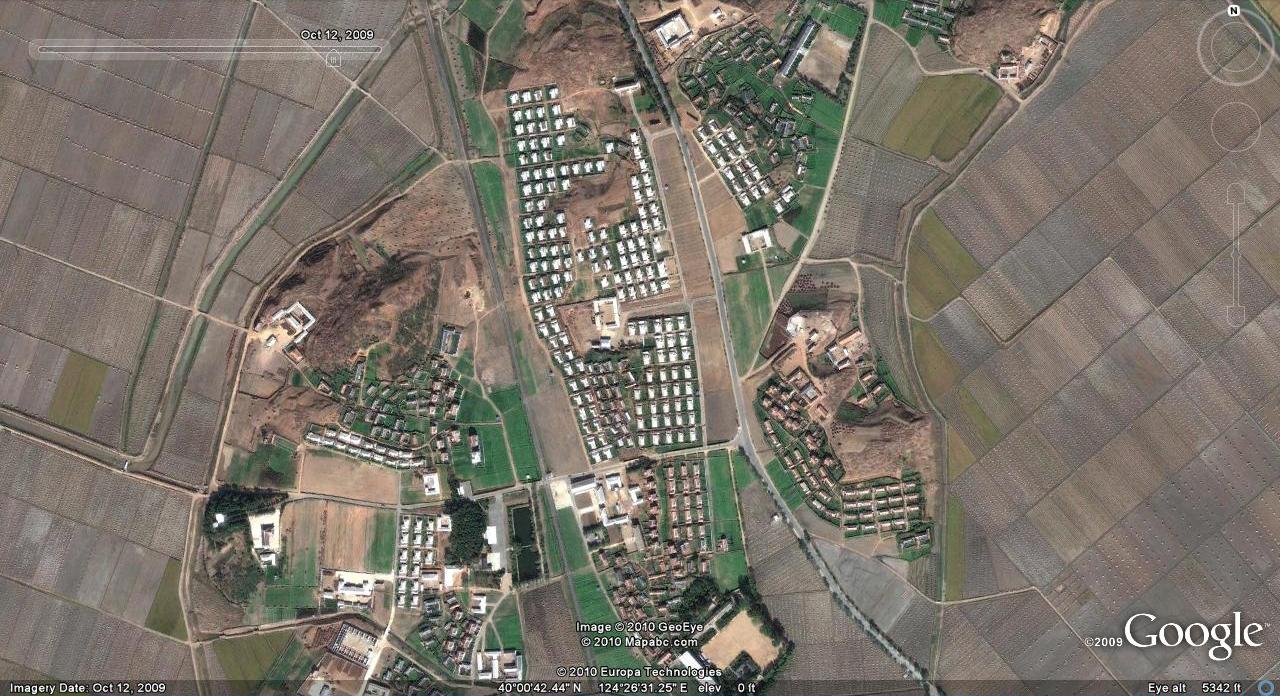
On the left is an image taken after the infamous 2004 Ryongchon explosion.  On the right is the city as it appears reconstructed in 2009.

Ryongchon offers another interesting secret.  In the past, the high street ran through the center of the city (North-South):

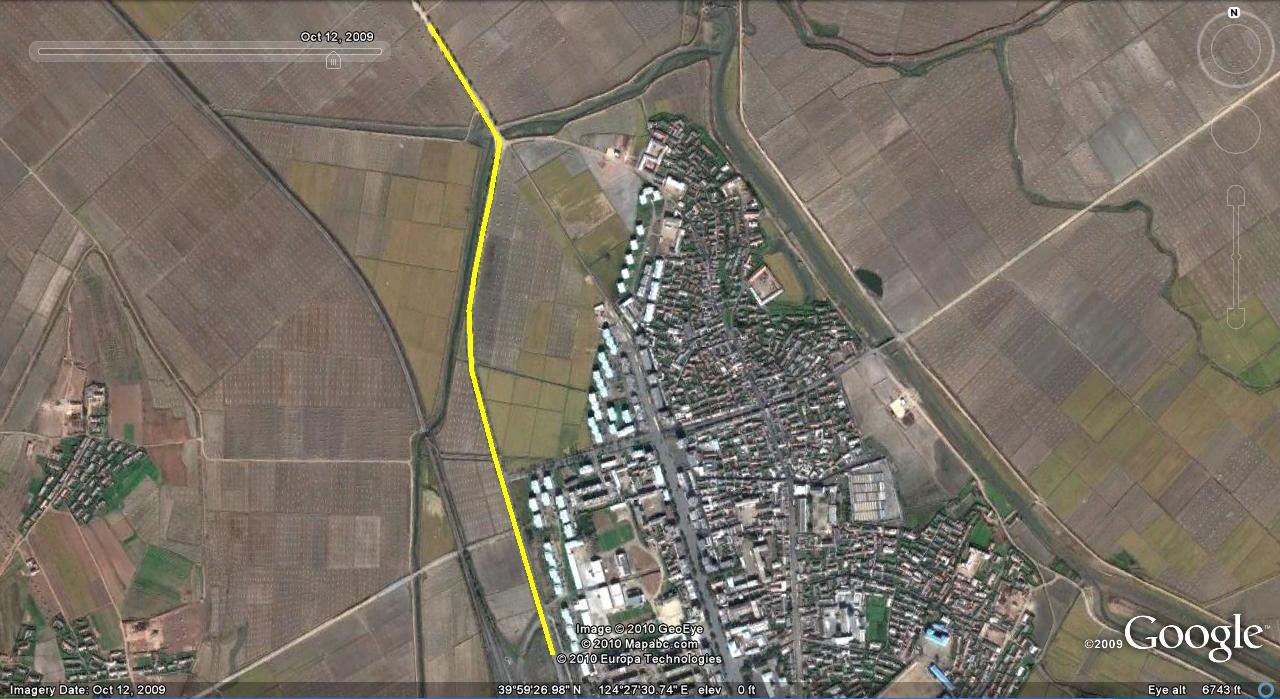
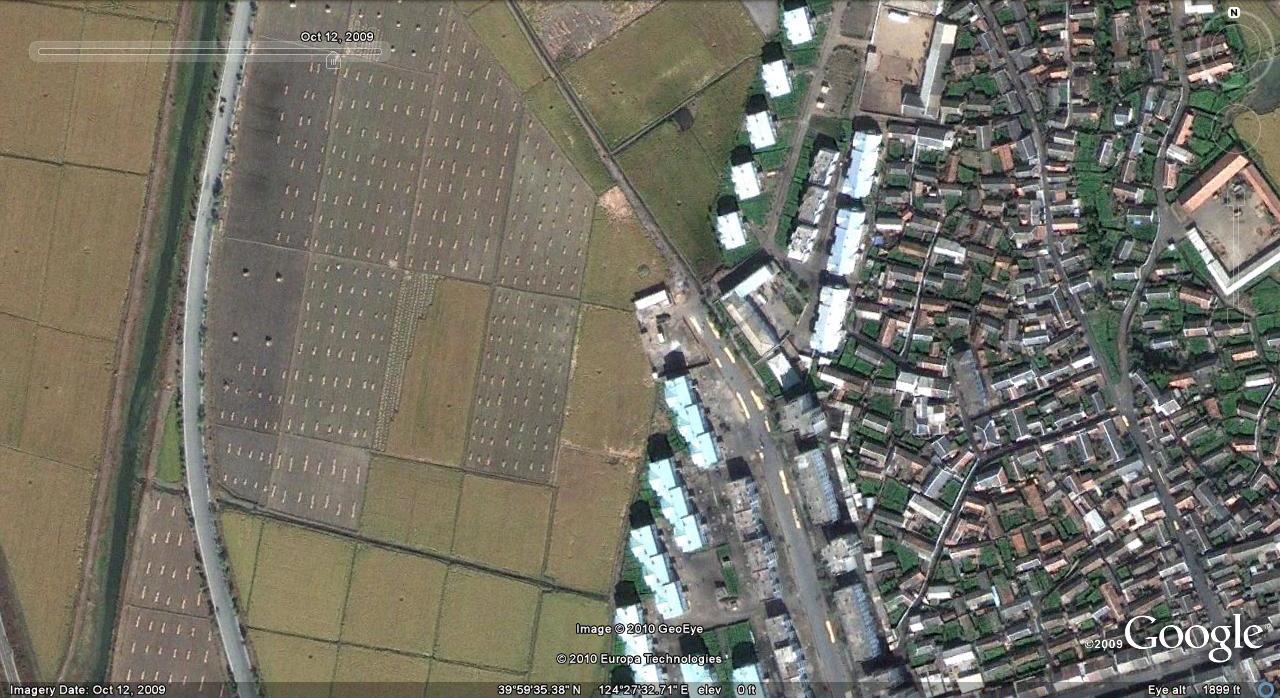
Today, however, traffic is routed around the western side of Ryongchon rather than through the center of town.  The road in the center of town has been converted into a public square of sorts (as can be seen in the images above), and the wide avenues that run the North-South distance of the city now come to an awkward end in the fields…

Bottom photos: North and south sides of town and their vanishing high streets

Also, in 2005 the North Korean government was building either a highway or canal on the western side of Ryongchon, but this effort seems completely abandoned today:

Share

DPRK promotes environemntal efforts

Wednesday, June 23rd, 2010

According to Reuters:

There are no private cars in North Korea and countless factory chimneys have not belched smoke in years, but state media said on Tuesday scientists were inventing new ways to cut air pollution and protect the environment.

The country “has directed a great effort” to research environmental protection, the state news agency KCNA reported.

“Researchers have developed a new material for removing exhaust fumes from automobiles so as to cut the greenhouse gas emissions and reduce air pollution 35-40 percent,” it said, without elaborating.

It also said “units” in the capital, Pyongyang, that caused pollution had been registered, suggesting that dirty industries were under pressure to get clean.

“They are now developing a gas and dust arrester necessary in production processes and new materials needed to secure environmental safety of products,” it said.

The isolated communist country’s state-run media periodically boasts revolutionary innovations in science and technology, despite a moribund economy and chronic food shortages.

Perhaps the most visible in recent years have been related to the relatively well-funded — and well-fed — military. North Korea has conducted two nuclear tests since 2006 and several missile launches, upsetting its neighbours.

North Korean scientists also invented a device using “locally available materials” to incinerate hospital waste, KCNA said, and the Environmental Protection Institute of the Ministry of Land and Environmental Conservation had intensified research into pollution-free vegetable production.

Here is the original KCNA story:

Scientific Achievements of Environmental Protection
 
Pyongyang, June 22 (KCNA) — The Democratic People’s Republic of Korea has directed a great effort to scientific researches for environmental protection.

Researchers have developed a new material for removing exhaust fumes from automobiles so as to cut the greenhouse gas emissions and reduce air pollution 35-40 percent.

They have also put the environmental management of industrial establishments on IT basis.

Meanwhile, they have registered units causing environmental pollution in Pyongyang and confirmed methods and procedures for preventing pollution. They are now developing a gas and dust arrester necessary in production processes and new materials needed to secure environmental safety of products.

Besides, they have invented a new device to destroy by fire such wastes from hospitals as contaminated injector and bandage with locally available materials.

Scientists of the Environmental Protection Institute of the Ministry of Land and Environmental Conservation have intensified a research in pollution-free vegetable production.

Read the full Reuters story here:
N.Korea says puts “great effort” into environment
Reuters
6/22/2010

Share