Archive for the ‘Statistics’ Category

More than 100 DPRK defectors in Japan

Thursday, October 21st, 2010

According to KBS:

Japan’s State Secretary for Foreign Affairs Takeaki Matsumoto says there are more than 100 North Korean escapees in Japan.

Matsumoto made the assessment on Thursday in response to a question posed by Democratic Party of Japan legislator Yosihu Arita during a meeting of a special House of Councillors committee on Japanese abductees.

Arita said a dozen North Korean escapees are under the protection of Japan’s diplomatic mission in China. He said there are reports that some of the escapees have been unable to leave China for nearly two years and urged the Japanese government to promptly address the matter.

In response, Foreign Minister Seiji Maehara said Tokyo will seek the early departure of the escapees in line with the interests of related countries.

Read the full story here:
‘More than 100 NK Escapees Have Entered Japan’
KBS
10/21/2010

Share

DPRK defectors targets of fraud in South

Sunday, October 17th, 2010

According to the AFP:

North Korean refugees struggling to adapt to a bewildering new life in South Korea are increasingly getting sucked into insurance frauds as their first taste of capitalism.

Insurance scams have for years been common in the South, and fraudsters in recent years have targeted the refugees as sometimes unwitting accomplices.

“Sometimes defectors get involved because they don’t know how the insurance system works. They just have no idea what they are doing is wrong,” an official at the Hanawon resettlement centre told AFP.

All North Koreans who flee their impoverished communist homeland for the South must spend their first 12 weeks at the centre, which lies about 80 kilometres (50 miles) south of Seoul.

It offers job education, information on South Korea and basic survival skills — such as buying a subway ticket, opening a bank account and using a credit card.

From May it has also offered a new two-hour course on insurance fraud, with investigators from the Financial Supervisory Service (FSS) warning about the possible consequences.

“We expect that through education, defectors will think twice before making a decision to become an accessory to fraud,” the official, who supervises the course, told AFP on condition of anonymity.

Newly arrived refugees get government financial help but often must repay big debts to the brokers who arranged their escape via China.

This makes them susceptible to taking part in frauds, which focus on bogus medical insurance claims.

After the refugee has bought a private policy or enrols in a state scheme, or both, insurance company workers typically conspire with hospital administrative staff to issue fake certificates of treatment.

When a refugee has been reimbursed by the insurance company, and sometimes by the government, he or she hands over a portion to the accomplices.

“I received about three million won (2,700 dollars) and used the money to pay debts when I came to South Korea,” one woman in her late thirties told the JoongAng Daily newspaper.

Police in Gyeonggi province surrounding Seoul, a known centre for the scams, said that over the past five years ending March refugees received a total of 3.1 billion won from 31 insurance companies in bogus claims.

“It’s prevalent and we are constantly investigating to catch them,” said a provincial police investigator.

The watchdog FSS says refugees typically send 30 percent of their takings from the frauds to brokers in China and the rest to family still in the North.

In one case in 2008, police said they had charged 41 refugees accused of receiving a total of 420 million won through bogus medical claims.

“Insurance fraud has become almost the common thing to do among defectors after they come to South Korea,” Chun Ki-Won, a priest who helps the refugees, told AFP.

“The primary reason why insurance fraud is rapidly increasing is because it’s becoming harder for defectors to adapt to a new environment.”

Refugees find it harder than their southern-born counterparts to find well-paid jobs and some complain of discrimination.

In a survey conducted by legislator Kim Young-Woo, 66 percent of refugees described their living conditions as difficult.

Some 56 percent said their monthly income is below 500,000 won (450 dollars) — officially deemed to be the lowest sum on which families can manage.

About 17,000 North Korean defectors have gone through the Hanawon centre since it opened 11 years ago, and it is currently holding about 500 people.

Read the full story here:
Insurance fraudsters target North Korean refugees
AFP
10/17/2010

Share

Inter-Korean trade up 51.3% in first half of 2010

Wednesday, October 6th, 2010

Institute for Far East Studies (IFES)
NK Brief No. 10-10-4-1
10/4/2010

Trade between the two Koreas in the first half of 2010 totaled 980 million USD, 51.3 percent more than the 650 million dollars-worth of trade last year. North Korea’s trade with China was also up, by 16.4 percent, to 1.28 billion USD. Kim Jong Il has made two trips to China and the North has taken other steps to boost cross-border trade with the Chinese.

According to a recent report comparing inter-Korean trade to that between North Korea and China, North-South trade in 2007 equaled 91 percent of Pyongyang’s trade with Beijing, but as inter-Korean relations chilled, that number fell to 65 percent in 2008. This year, that number climbed back up to 77 percent, largely because the Kaesong Industrial Complex, which has avoided political entanglement, has grown 96 percent since last year. Textiles and home electronics top the list of goods in inter-Korean trade, while minerals are the top item traded across the DPRK-PRC border.

North Korea’s import of South Korean goods increased by 63 percent to 430 million USD, while the North’s Chinese imports rose a mere 25 percent, but still totaled 930 million USD. 36 percent of South Korean exports to the North are raw materials for North Korean textile production, while 120 million USD-worth of electronics make up the second-largest export industry. Making up the largest sector, 27 percent (250 million USD) of North Korea’s imports from China are made up of minerals and crude oil, while textiles make up 12 percent and base metal resources make up 8 percent. South Korean imports have also grown 43 percent, to 550 million USD, since last year. In comparison, Chinese imports from North Korea shrunk one percent to 340 million USD. Clothing and other ready-for-market textiles made up 44 percent of North Korean exports to the South, while electrical and electronic goods made up 17 percent. Coal, iron, and other key resources made up 51 percent of DPRK exports to China, while zinc and other base metals make up approximately 20 percent.

Share

DPRK-China trade and investment growing

Friday, October 1st, 2010

According to Yonhap:

North Korea’s economic dependence on its strongest ally China is growing as its economy slips further into deeper isolation from the international community for its nuclear ambition, a report said Friday.

According to the report compiled by the Samsung Economic Research Institute, bilateral trade with China accounted for 52.6 percent of the North’s cross-border trade last year.

“North Korea’s so-called self-reliant economy is collapsing, and China is emerging as the communist state’s key supplier of economic goods,” the report said.

The report said China’s investment in North Korea surged to US$41 million in 2008 from a meager $1.1 million in 2003. China is also planning to spend $2.37 billion on construction of a transportation network that links the two countries, it said.

But the report said it is hard to characterize the countries’ economic ties as “subordinate,” as the North is also involved in trade with South Korea and other countries.

As with most Yonhap stories, they do not provide a link to the report, or even its name, so I cannot say much about the numbers. 

Here is the English webpage of the Samsung Economic Research Institute.  I have been unable to locate this partuclar study, but maybe you will have better luck.

Yonhap also tells us that the Chinese are working to create a trade zone along the North Korean border.  According to the article:

China is seeking to build an economic zone in the northeastern region bordering North Korea, aiming to promote trade with the world’s most reclusive country, officials said Friday.

Thirteen cities in the Dongbei region, commonly known as Manchuria, issued a joint proposal Thursday to build the “Yalu River Economic Zone” and to boost trade with North Korea. The Yalu River or the Amnok River in Korean is a river on the border between China and North Korea.

The participating cities include Dandong, Dalian, Tonghua and Mudanjiang, all of which are located either in the Liaoning province, the Jilin province or the Heilongjiang province. The three provinces make up the Dongbei region.

North Korea has long been reported as planning to build a free economic zone near the bordering river. A number of ports already exist on the river, used for border trade between the two countries.

Dandong in Liaoning Province, which borders the North Korean city of Sinuiju, has become the largest logistics hub for North Korean trade, handling 70 percent of bilateral trade.

Read the full Yonhap stories here:
N. Korean economic reliance on China further growing: report
Yonhap
10/1/2010

China eyes economic zone for trade with N. Korea
Yonhap
Kim Young-gyo
10/1/2010

Share

ROK endorses US$7m Inter-Korean Cooperation Fund

Thursday, September 30th, 2010

According to Arirang News:

South Korea’s Unification Ministry on Wednesday finally endorsed the Inter-Korean Cooperation Fund worth 8 billion won, or roughly 7 million US dollars in an effort to help North Korea recover from the aftermath of summer floods.

The total cost of aid to be sent is about 12.2 million dollars with about 7 million donated by the Council for the Promotion of Inter-Korean Exchange and Cooperation, chaired by Unification Minister Hyun In-taek and the rest coming from Seoul’s agriculture ministry.

The money will buy 5-thousand tons of rice to be shipped on October 25th from Gunsan Port to the North Korean city of Sinuiju.

Other aid includes 10-thousand tons of cement, three million cases of cup noodles and medicine.

Read the full story here:
S. Korea Endorses US$7 Mil. Inter-Korean Cooperation Fund
Arirang News
9/30/2010

Share

Inter-Korean trade increases in 2010 despite tensions

Thursday, September 30th, 2010

According to Yonhap:

Trade between South and North Korea surged in the first half of the year despite high tensions over the communist nation’s alleged sinking of a South Korean warship in March, a trade organization said Wednesday.

South Korea’s exports to the North soared 63 percent on-year to US$430 million in the January-June period with North Korea’s exports to the South jumping 43 percent to $550 million, according to the Korea International Trade Association (KITA).

Read the full story here:
Inter-Korean trade jumps in H1 despite soured relations
Yonhap
9/29/2010

Share

ROK estimates DPRK has 1 million tons of rice saved

Wednesday, September 29th, 2010

According to Yonhap:

North Korea’s rice reserves may total 1.1 million tons, which could feed the country for 110 days, a government source said Tuesday.

The source, who declined to be identified, said the estimate is based on continuous monitoring of rice stockpiles by the intelligence agencies in South Korea and the United States.

He said that while the total amount can be determined, it is hard to say if the rice is being reserved for the military or for the general population.

“Due to the nature of modern warfare it is pointless to separate if rice reserve will be used by the military or the civilian population in emergency situations,” the official said. He also declined to say if Pyongyang maintained 300 storage areas as claimed by some independent organizations.

Related to the rice reserve that North Korea may possess, an official from the National Intelligence Service (NIS) claimed in a meeting of lawmakers earlier in the day that recent remarks by Rep. Kim Moo-sung, who said Pyongyang held 1 million tons in rice reserves for the military, was not groundless.

Kim is the floor leader of the ruling Grand National Party and made the remark to point out that the North had the means to alleviate food shortages on its own to a certain extent.

The NIS official added that rice aid to North Korea must be based on clear cut strategies reflecting overall circumstances.

The Lee Myung-bak administration put the breaks on helping North Korea after a South Korean tourist was shot dead in a mountain resort in July 2008. The sinking of a South Korea Navy ship March further cooled inter-Korean relations with Seoul, making clear that it will effectively cut most exchange programs with the North.

Before 2008, Seoul regularly shipped 300,000-400,000 tons of rice to the North along with substantial amounts of fertilizers.

Read the full story here:
N. Korea’s rice reserves may total 1.1 mln tons: source
Yonhap
9/28/2010

Share

Rason: beyond Pyongyang lies a different world

Sunday, September 26th, 2010

Michael Rank writes in the Guardian:

If Pyongyang is North Korea’s showpiece city – albeit an empty and forbidding place – then the country’s interior is something else altogether.

In this desolate city [Rason] 800 kilometres from the capital, the main square turns to a sea of mud in the rain, and there are no street lights so it’s impossible to avoid the puddles at night.

Rason is 50km from the border with China, over a twisting dirt track through the mountains, but it could be another planet.

The cities on the Chinese side are frenetic with activity, skyscrapers sprouting like mushrooms in the rain and traffic jams unavoidable. Rason couldn’t be more different, stuck in a Stalinist time warp. Traffic chiefly consists of ox carts and Chinese lorries. Roads are repaired by teams of workers armed with shovels and picks.

Tourists are a rarity, just 20 so far this year and none at all in 2009, according to Simon Cockerell of Beijing-based Koryo Tours, which specialises in travel to North Korea.

Officially this is a “free economic and trade zone”. In practice that special designation doesn’t appear to make much difference.

The overwhelming majority of those who do venture in are Chinese, many of them lured by the area’s only apparent growth industry – a glittering casino and hotel built by a Hong-Kong multimillionaire.

The Emperor casino was supposed to have shut its doors in 2005 after a senior Chinese transport official gambled away more than 3.5 million yuan (£340,000), much of it public money.

But a few dozen Chinese were observed gambling in the smoky windowless rooms on the top floor of the venue on a recent evening.

Near the casino there is a small island that is linked to the mainland by a short causeway where tourists can relax over a seafood lunch consisting of raw sea urchins, chargrilled octopus and squid washed down with Chinese beer.

Not that Rason is awash with produce. In the 1990s, an acute famine killed many thousands. Although the worst is over, millions continue to go hungry and in Rason a British- charity, Love North Korean Children, makes enormous efforts to ensure that children in the area get enough to eat.

The charity feeds 2,500 children a day, and the youngsters in the Hahyeon nursery school looked well nourished when this reporter visited. But George Rhee, the charity’s founder and powerhouse, stressed that without the steamed buns his bakery provides “all these children would go hungry”.

Rason’s remoteness means it is easier to evade the central government’s relentless grip and benefit from trade, legal and illicit, with nearby China.

North Korea officially maintains the fiction that all economic activity is state-run. It therefore bans foreigners from visiting private markets which help to relieve dire shortages of even staple foods.

Yet during our visit, the Guardian was encouraged to shop in the market for crab for supper, which was cooked in a local restaurant. Apart from seafood, the market also sells cigarettes and alcohol imported from China.

For travellers who like to learn about their surroundings from the locals, North Korea is probably not the best destination.

The Guardian was closely manmarked by minders and ignored by locals. Local officials have been hoping to attract more tourists to Rason by building a golf course and racetrack, but it is hard to imagine these ever materialising in such an isolated and impoverished location.

Read the full story here:
North Korea: beyond the capital lies a different world
The Guardian
Michael Rank
9/26/2010

Share

South Korea to send hundreds of additional workers to Kaesong

Monday, September 20th, 2010

Institute for Far Eastern Studies (IFES)
NK Brief No. 10-09-20-1
9-20-2010

The South Korean Ministry of Unification announced on September 14 that the number of ROK workers allowed in the Kaesong Industrial Complex, previously limited to fewer than 600, would be increased by two to three hundred. In response to the sinking of the ROKS Cheonan, the South Korean government limited inter-Korean economic cooperation through the May 24 Measure, sharply cutting the number of South Korean workers in the joint industrial complex from around 1,000 down to 500. However, after companies in the complex voiced complaints over production losses caused by the measure, the government slightly raised the number of workers allowed, to 600, in mid-July. With this latest decision, the number will return to almost as many as were working prior to the May 24 Measure. This is the first sanction among those passed on May 24 to be practically rescinded.

A spokesperson for the Ministry of Unification stated, “Companies in the KIC have been complaining about growing difficulties in maintaining quality and of worker fatigue due to the reduction of employees [allowed in the complex],” and announced that the ministry had decided to increase the number of workers since it sees no physical threat to them. This announcement came as inter-Korean relations, which took a sharp turn for the worse after the sinking of the ROKS Cheonan, appear to be improving, with North Korea returning South Korean fishermen seized last month, the ROK Red Cross decision on September 13 to send disaster relief in response to flooding in the North, and working-level discussions on a reunion for separated families being held. However, the spokesperson also stated that although the number of workers allowed to travel to North Korea was being increased, no new or additional investments were being allowed in the KIC, as originally dictated by the May 24 Measure.

Even before the announcement to increase the number of workers in the KIC, the South Korean government had shown flexibility when it came to the May 24 Measure; contracts made before the measure were honored, and North Korean manufactured and agricultural goods have continued to be imported under agreements reached before the sanctions. The government was flexible on humanitarian aid, as well, continuing to provide assistance to the most destitute in North Korea despite the decision to suspend aid on principle. Medical aid, particularly to prevent the spread of Malaria, has also continued. Recently, the South Korean government decided to allow the ROK Red Cross to send 5,000 tons of rice and 10,000 tons of cement, worth approximately 100 million won, to North Korea in response to massive flooding. This is the first time since the Lee Myung-bak administration came to power that any rice aid has been sent to the North. It is very likely that it will be sent as private-sector aid.

Seoul continues to ban visits to North Korea, but private-sector organizations have been allowed to travel to the Kaesong region. Despite the May 24 Measure, exceptions have been made for South Koreans involved with economic cooperation in the KIC and the Mount Keumgang areas. Among the sanctions passed in May, the ban on North Korean ships operating in South Korean waters and the ban on new investment in the North are still being enforced, but the suspension of inter-Korean exchanges, travel to the North, and provision of humanitarian aid have all been eased.

Among the Ministry of National Defense measures, the only psychological warfare tactic employed has been through radio broadcasts, while the distribution of leaflets and the broadcasting over loudspeakers were canceled after North Korean protests. Joint U.S.-ROK anti-submarine warfare exercises in the West Sea were postponed, while the U.S. put on a show of force with the deployment of an aircraft carrier to the East Sea in late July. Maritime interdiction drills led by the ROK military are planned for mid-October. The South Korean government insists that the May 24 Measure continues to stand unchanged, yet the enforcement and execution of the details is less than uniform.

The government’s position is that the restriction on workers in the KIC was not a sanction aimed at North Korea, but rather, a measure to protect South Korean workers; therefore, easing this restriction cannot be seen as a lifting of the May 24 Measure. Ultimately, it appears that a slight improvement in inter-Korean relations has led to a small amount of flexibility in implementing the May 24 Measure, but that the government will continue to enforce the measure until North Korea takes responsibility for sinking the ROKS Cheonan.

Share

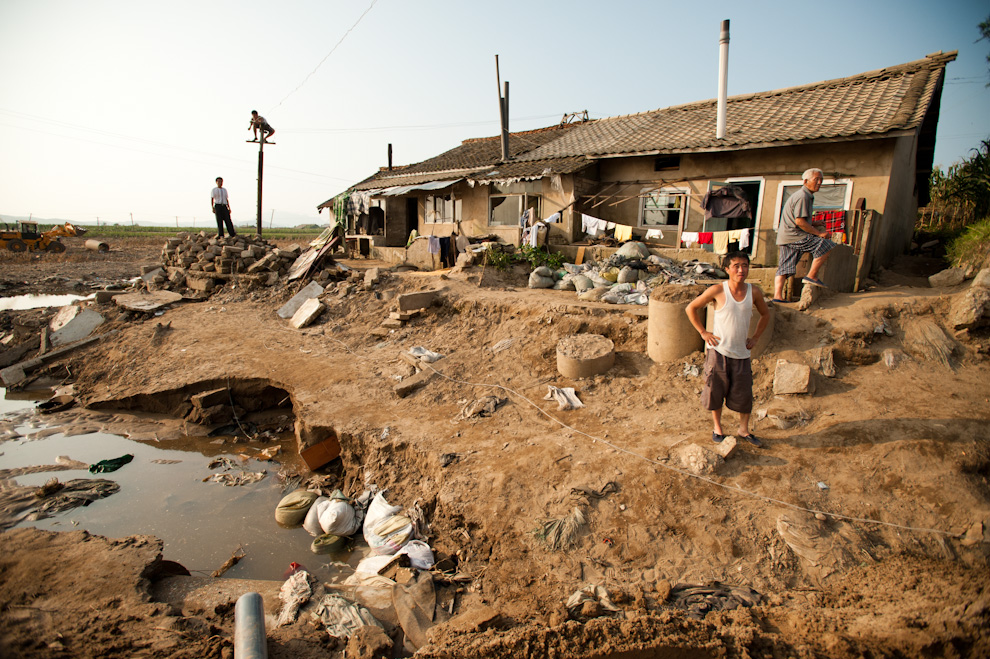
Sinuiju flood photos

Friday, September 17th, 2010

Samaritan’s Purse, the US-based, religious charitable organization, has published some pictures of their recent delivery of flood relief supplies to Sinuiju.

Here is one photo:


You should check out the other photos in the set here.

Here is a video they produced before takeoff.

Samaritan’s Purse is delivering a portion of the US government’s $750,000 flood relief campaign.

Additional information:
1. South Korean aid in response to the flood. China sends aid.

2. Video of Sinuiju. Official Chinese and DPRK photos of the flooding.

3. Here are previous posts about Samaritan’s Purse in the DPRK.

Share
