Archive for the ‘Statistics’ Category

Flood aid delivered to the DPRK (UPDATED)

Friday, October 5th, 2012

UPDATE 5 (2012-10-15): China is donating USD$1m to the UN World Food Program for use in the DPRK. Accoridng to ReliefWeb:

The Government of China has recently announced a contribution of US$1 million to WFP’s operation in DPR Korea. The donation will be used to assist children and their mothers who are most vulnerable to undernutrition.

In July 2012, WFP started a new operation in DPR Korea, focused on providing nutritional support to women and children most at risk of malnutrition. Much of the food distributed comes in the form of Super Cereal – specialised nutritious foods designed to address vital mineral and vitamin gaps in the regular north Korean diet.

The generous contribution from China will be used to buy around 1550 metric tons of maize, which will be the base ingredient for Super Cereal manufactured in DPR Korea and then distributed for one month to 400,000 children in hospitals, orphanages, and kindergartens. Pregnant and nursing mothers will also receive food rations.

WFP is in urgent need of an additional 30,000 metric tons of maize and 4,000 metric tons of cooking oil to ensure that the most vulnerable women and children in DPR Korea receive the nutritional assistance they need of the coming winter months.

China is an increasingly important donor to WFP, contributing over US$20 million to WFP operations in 2011.

UPDATE 4 (2012-10-5): According to KBS, the South Korean NGO Council for Cooperation with North Korea delivered flour to Pyongyang:

The delivered the 260 million won worth of aid to Gaeseong to help North Korean residents suffering from the natural disasters through the Inter-Korean Transit Office. It plans to deliver an additional 500 tons of flour within this month.

Eleven representatives of the council, which represents 55 domestic humanitarian aid donors to the North, crossed the border to the North to send the flour.

UPDATE 3 (2012-9-24): Radio Free Asia reports (in Korean) that Agape International will be sending 21 tons of baby food to the DPRK.  See the original article here.  See the article in English via Google Translate here.

UPDATE 2 (2012-9-24): Russia just recently forgave the DPRK’s Soviet-era debt and opened a Russian-gauge railway line to Rason, where they lease a pier. Additionally, the Russians are interested in building a gas pipeline that extends to South Korea. They are also providing Food assistance via the UN World Food Program to the DPRK. According to Itar-Tass:

Russia has delivered more than 4,000 tonnes of flour to North Korea, the Emergencies Ministry’s Information Department told Itar-Tass on Monday.

According to the Emergencies Ministry’s representative, the aid to North Korea was rendered in the format of the memorandum of mutual understanding signed between the Russian government and the United Nations’ World Food Program.

“Over 4,100 tonnes of flour were delivered to North Korea by sea. A vessel with another batch of the same weight of flour is planned to be shipped out from the Nakhodka seaport to the North Korean seaport of Chongjin on September 27,” the Information Department said.

UPDATE 1 (2012-9-19): Indonesia will also be sending food assistance through the UN World Food Program. According to the Jakarta Post:

Indonesia will send food aid worth US$2 million in hopes of improving the famine crisis in North Korea, said Coordinating Peoples Welfare Minister Agung Laksono on Wednesday.

“[We] have coordinated with the National Disaster Mitigation Agency (BNPB) to send aid to the World Food Program (WFP), which will later distribute it to citizens of the Democratic People’s Republic of Korea,” he said in Jakarta as quoted by tempo.co.

Agung also hoped that the humanitarian aid, which was initiated by President Susilo Bambang Yudhoyono, would strengthen diplomatic ties between the two countries.

North Korea is in a food crisis after its crops and food reserves were damaged by extreme weather.

After receiving news of the support, North Korean Ambassador to Indonesia Ri Jong Ryul cited a Korean proverb that says “a real friend’s quality is shown in the time of hardship.”

ORIGINAL POST (2012-9-20): The DPRK is to receive at least 1,000 tons of flour from two different donors.  These donors are were World Vision and JTS Korea, a Seoul-based Buddhist relief agency. Both gave 500 tons each via different channels. Interestingly, the World Vision assistance crossed the DMZ in trucks from South Korea.  The assistance from JTS was shipped from South Korea to Dandong where it will be exported to the DPRK.

Some coordination might be in order?

See more below.

According to the Associated Press (via Calgary Herald):

North Korea has accepted a shipment of emergency aid from relief agency World Vision to help victims of floods that killed dozens of people and submerged large amounts of farmland.

Twenty trucks carrying 500 tons of flour crossed the border into North Korea on Friday. World Vision says the aid will be sent to children in the North’s central South Phyongan (PYONG-ahn) province.

South Korean civic associations are also sending assistance. According to the Korea Times:

JTS Korea, a Seoul-based Buddhist relief agency, said a freighter carrying 500 tons of flour left the port of Incheon, west of Seoul, and will soon arrive in North Korea via the Chinese port city of Dandong on the border with the North.

The civilian aid for North Koreans was sent after the North was hit by severe floods in recent months, which left hundreds of people killed or missing.

“Our officials plan to visit North Korea in the near future to monitor the distribution of aid,” a JTS Korea official said.

The shipment came after North Korea last week rejected an offer by the South Korean government to donate 10,000 tons of flour, instant noodles and medicine as flood aid.

Officials at Seoul’s Unification Ministry in charge of North Korean affairs said Pyongyang turned down the proposal and openly displayed anger at Seoul’s refusal to give what the North said it needs most — rice and cement.

Read the full stories here:
North Korea accepts emergency aid from World Vision to help flood victims
Associated Press
2012-9-20

S. Korean civic group sends flood relief to NK
Korea Times
2012-9-20

Share

South Korean lawmaker claims DPRK luxury good imports increasing

Thursday, October 4th, 2012

According to the Donga Ilbo:

Saenuri Party lawmaker Yoon Sang-hyun, a member of the National Assembly`s foreign affairs, trade and unification committee, released Wednesday an analysis of closed trade data between North Korea and China, saying the North`s imports of luxury goods via Chinese customs reached 446.17 million U.S. dollars in 2010 and 584.82 million dollars last year. The figure was 272.14 million dollars in 2008 and 322.53 million dollars in 2009.

Imports were especially pronounced for high-end cars, TVs, computers, liquor and watches. Inbound shipments of luxury cars and associated components almost doubled to 231.93 million dollars last year from 115.05 million dollars in 2009. Ship exports increased more than 20 times from 17.48 million dollars from 840,000 dollars over the same period.

Artworks and antique imports reached 580,000 dollars last year, more than 10 times the figure of 50,000 dollars in 2009. Perfume, cosmetics and fur saw their inbound shipments double. Among items that saw sharp drops in imports were leather products and musical instruments.

In 2006, the United Nations banned member countries from exporting luxury goods to North Korea under U.N. Security Council Resolution 1718, entrusting them to decide on the items. South Korea also designated 13 luxury goods for the export ban in 2009. China has yet to designate its items, and North Korea is growing more dependent on imports from China.

The Daily NK also reported on the story.

Read the full story here:
N.Korea jacks up imports of luxury goods under new leader
Donga Ilbo
2012-10-4

Share

DPRK elderly population to double in next 40 years

Thursday, October 4th, 2012

According to the Daily NK:

The UN believes that North Korea’s elderly population will double in the next 40 years, casting an economic shadow over the country’s future.

The United Nations Fund for Population Activities (UNFPA) revealed over the weekend that 13% of the population of the country, approximately 3.32 million, is currently over 60, but that it believes this will double to 23% of the population, 6.12 million, by 2050.

Meanwhile, the number of people over 80 will increase by more than 2.5 times, UNFPA believes.

At the same time, UNICEF announced last April that North Korea’s young population will greatly reduce, with just 3 million people in their teens by 2050, a reduction of 24% over today’s number.

Northeast Asia has the fastest-aging population in the world; more than 30% of the world’s population over 65 is said to be living in the Northeast Asian region encompassing South Korea, North Korea, China, Japan and Russia.

You can read and analyze the DPRK census data here and here.

Read the full story here:
North Korea’s Population Ageing Fast
Daily NK
Kim Tae-hong
2012-10-4

Share

Some food, inflation, and trade data

Tuesday, October 2nd, 2012

These are all interesting data points. Do you think they offer reasonable journalistic evidence that the DPRK is practicing inflationary public finance?

First, Yonhap reports on DPRK food imports from China (2012-9-29):

North Korea’s grain imports from China slipped 16.3 percent on year in the first eight months of this year, in an apparent sign that the North may diversify its supply channels of grain, a Seoul researcher said Saturday.

North Korea imported 181,264 tons of rice, flour, corn and other grains from China in the eight-month period, compared with 216,535 tons for the same period last year, said Kwon Tae-jin of the state-run Korea Rural Economic Institute.

The decline in grain imports from China may be attributed to a rise in food aid from China and purchases from non-China markets such as Europe and South America, Kwon said.

“Including imports from non-China markets, North Korea’s total grain imports appeared to rise this year,” Kwon said in a report posted on his Web site, adding Pyongyang may “diversify its import channels.”

At the same time the Daily NK reports that food prices continue to rise (2012-10-2):

Internal sources informed Daily NK over the holiday that on September 29th the price of rice was 6,700 won/kg in Pyongyang, 7,000 won/kg in Onsung, North Hamkyung Province and 6,500 won/kg further west in Hyesan, Yangkang Province.

Not only do these prices far exceed those of Chuseok 2011, they even far exceed those of earlier this year.

The Hyesan source explained that on the day before the Chuseok holiday (Saturday) the atmosphere in the market was thus rather uncomfortable. “It was very slack,” she said. “People couldn’t buy anything easily, so most just seemed to be looking.”

Secondly, Yonhap reports that despite situations like those experienced by Xiyang or in Musan, mineral exports to China are up (2012-10-2):

North Korea’s exports of mineral resources recorded a 33-fold jump over the past decade with China remaining the biggest importer of the North’s iron ore and coal, a report showed Tuesday.

North Korea’s mineral exports stood at a meager US$50 million in 2001, accounting for 7.8 percent of its total exports, according to the report by Seoul’s Korea Trade and Investment Promotion Agency.

The mineral exports soared to $243 million in 2005 and $1.65 billion in 2011, accounting for 59.4 percent of the North’s total exports last year, the report said.

South Korea has estimated the total values of mineral deposits in North Korea at some $6.3 trillion.

Last year, North Korea exported $1.17 billion worth of anthracite coal and $405 million worth of iron ore, with China importing almost 100 percent of anthracite coal and iron ore, it said.

Share

DPRK – Russia trade grows

Saturday, September 22nd, 2012

According to Yonhap:

Bilateral trade between North Korea and its ally Russia surged nearly 50 percent from a year earlier in the first half, a report said Saturday.

According to the report from Seoul’s state-run Korea Trade-Investment Promotion Agency (KOTRA), the amount of bilateral trade between the two countries in the January-June period came to US$38.8 million, up 49 percent from the same period last year.

The report, however, noted such a large on-year increase was due to a large drop posted in the first half of 2011.

“The volume of bilateral trade between North Korea and Russia is still insignificant by any standard,” it said.

The increase was also caused by a 68.3 percent rise in shipments of Russian goods to North Korea with fuel and steel products accounting for 29.9 percent and 28.7 percent of total shipments, respectively.

North Korea’s exports to Russia dropped 10.9 percent on-year to $5.4 million, according to the KOTRA report.

Here are some previous posts on this topic:
1. Lankov on DPRK-Russia trade (2012-9-18).
2. Russia reported to forgive DPRK debt (again)
3. KOTRA numbers from June
4. Lankov on DPRK-Russia ties (2011-9-25)

Read the full story here:
Trade between N. Korea, Russia surges 50 pct in H1
Yonhap
2012-9-22

Share

Russia – DPRK trade

Tuesday, September 18th, 2012

Following (or perhaps concurrently with) the story on the Russia – DPRK debt forgiveness deal, Andrei Lankov writes about DPRK trade and investment in the Asia Times:

But a brief look at trade statistics makes one suspicious about claims in regard to Russia’s prominence in North Korean issues. It is not widely understood that summits and official rhetoric notwithstanding, actual trade between North Korea and Russia is miniscule, even by the meager standards of North Korea.

In 2011, trade volume between the two countries was merely US$0.12 billion. As inter-state trade goes, this practically means that Russia and North Korea have close to no trade. In the same year, Sino-Korean trade hit the $5.6 billion mark. If you compare this with other East Asian countries this is still peanuts, but it is nonetheless almost fifty times the level of Russo-North Korean trade.

One also might notice that the improvement in political relations between Russia and North Korea had absolutely no impact on Russo-North Korean bilateral trade volumes. If anything, the trade declined when the politicians were smiling and exchanging niceties.

Over the past 15 years, Russo-North Korean trade on an annual basis has fluctuated around the $100-$250 million mark (in a clear downward trend). Throughout the same period, Sino-North Korean trade has increased almost 10-fold.

It is strange that these obvious facts do not attract enough attention among those who like to talk about Russia’s supposed leverage in Pyongyang. These figures are easily obtainable and yet almost entirely overlooked. This seems to be because the figures do not easily fit into preconceived notions about Russo-North Korean relations; the inconvenient truth is that the political rhetoric shared between the two countries is often very shallow and lacking in an economic basis.

To be blunt, Russian businesses have no interest in North Korea.

North Korea is a very poor place that has few comparative advantages in the world market. Nonetheless such advantages do exist. First, North Korea has some mineral resources (iron ore,coal, copper, lead and so forth) which are largely to be found in the northern most part of the country. Second, it has a rather skilled and unbelievably cheap workforce. North Korean workers consider themselves lucky if they are paid $25 a month. But none of these two advantages are of any significance to corporate Russia.

Russian mining companies have all of Siberia at their disposal, and North Korea’s mineral deposits do not look all that impressive by comparison. Things are made even worse by the constant threat of political instability and the gross underdevelopment of transportation and infrastructure in general. Therefore, no major Russian mining firm is willing to invest in North Korea (some have been courted by Pyongyang, have always responded in the negative).

The pull of cheap labor is also not all that attractive to Russian companies. The Russian developmental model does not involve heavy reliance on light industry in general, nor in particular the manufacture of T-shirts and running shoes. There is a moderate need for cheap North Korean labor in Russia itself, and so for many decades North Korean workers have been employed in Russia. But the scale of these operations is quite limited, and likely to remain so (10-20,000 workers at most).

One can of course point at two much discussed projects of economic cooperation between Russia and North Korea – the proposed trans-Korean railway and proposed natural gas pipeline. The pipeline project was discussed during Kim Jong-il’s last trip to Russia in 2011, and as a result still attracts much attention. However, we should remember that the very similar trans-Korean railway was first officially approved in the late 1990s, but still remains on the drawing board and as elusive as ever. There is good reason to believe that a similar fate awaits the pipeline project: for years there will be talks, enthusiastic newspaper articles, even official visits, but not much in terms of actual construction.

Both railway and pipeline projects share one common feature: North Korea is treated as a space to traverse. Had this area been covered with tropical rainforest, or desert, it would have little impact on either of these projects, whose main task is to facilitate interactions between Russia and South Korea.

From a purely commercial view, a short-cut through North Korea makes perfect sense, but there are many political problems which ensure that we will have to wait for many years before any of these projects will begin in earnest.

The major problem is recurrent and perhaps incurable instability which blights the Korean peninsula. Once Russian companies start real construction, they will become hostages of the complex and often unpredictable clashes of power interests in and around the Korean peninsula.

Additional Information
1. Read more about the Rason railway project here.

2. Read more about the pipeline project here.

3. more economic statistics can be found on my DPRK Economic Statistics page

Read the full story here:
North Korea lacks rich relation in Russia
Andrei Lankov
Asia Times
2012-9-18

Share

2012 trade with China up in 1st half of 2012

Thursday, August 9th, 2012

According to Yonhap:

North Korea’s trade with China jumped nearly 25 percent in the first six months of this year, China’s customs office said Thursday, indicating that the North’s reliance on its neighboring ally on the economic front is growing.

According to the data released by the Chinese General Administration of Customs, the two allies’ trade came to US$3.14 billion during the January-June period, up 24.7 percent from the same period a year earlier.

The two countries signed the Sino-North Korean Mutual Aid and Cooperation Friendship Treaty in 1961, whereby China pledged to immediately render military and other assistance to its secretive ally.

The North’s exports to China totaled $1.3 billion during the first half of this year, up 22.2 percent from a year earlier.

Its imports from China grew 26.5 percent on-year to $1.84 billion over the cited period.

This resulted in a trade deficit of about $540 million for the North, the data showed.

Iron ore was North Korea’s leading export item, while China exported to North Korea crude oil and construction machinery, the customs office said.

With international sanctions in place amid the North’s nuclear ambitions, China has emerged as the communist state’s key supplier of economic goods.

Read the full story here:
N. Korea’s first-half trade with China jumps 25 pct
Yonhap
2012-8-9

Share

DPRK: WFP Sends Food To Flood-Hit Regions

Sunday, August 5th, 2012

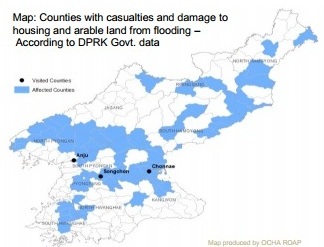
Pictured above: UN World Food Program map of affected areas.

According to the World Food Program web page:

WFP is sending a first batch of emergency food aid to flood-hit areas in the south of Democratic People’s Republic of Korea (DPRK) where torrential rains have left 88 people dead and over 60,000 people homeless.

The emergency food assistance will provide the flood victims with an initial ration of 400g of maize per day for 14 days.

Storms and heavy rain across the country between 18 and 29 July have caused widespread flooding, and in some places severe damage to homes, infrastructure and farmland. The most affected counties are Anju City and Songchon in South Pyongan Province, and Chonnae in Kangwon province.

A UN mission recently which recently travelled to flood-affected regions found considerable damage to maize, soybean and rice-fields damage (Read report). WFP continues to monitor the situation.

A comprehensive assessment of the food situation and of prospects for food production is scheduled for September.

The New York Times also reported on this story.

UPDATE 1 (2012-8-6): Vietnam is donating food to the DPRK.

UPDATE 2 (2012-8-7): The Red Cross is distributing aid in the DPRK.

UPDATE 3 (2012-8-8): The UN has created a portal through which all of the UN agencies are posting information. See it here. See here information on “Who is doing what”.

UPDATE 4 (2012-8-10): China donates US$1 in assistance to the DPRK.

Share

Kaesong Industrial Complex: Accumulative production output exceeds US$ 1.7 b

Friday, August 3rd, 2012

Institute for Far Eastern Studies (IFES)
2012-8-2

Kaesong Industrial Complex (KIC) has recorded 1.7 billion USD in accumulative production output as of May this year. The first phase construction of KIC consisting of some 3.3 square meters was completed in July 2006.

According to a report submitted to the National Assembly on July 25, the Ministry of Unification (MOU) specified that, out of the 123 companies in KIC, there were 51,452 North Korean employees (as of May 2012) and the accumulative export reached 1.21 billion USD out of the accumulative production output.

Despite the severed inter-Korean ties from the May 24 sanctions of 2010, the KIC continued to operate while most economic cooperation, social and cultural exchanges and humanitarian aid were halted.

The report also included MOU’s pledge to continue to support for stable development of KIC consisting of building fire stations and emergency medical facility and road repairs, among other measures.

Currently, there are water purification and supply plant (30,000 ton/day), waste water treatment plant (15,000 ton/day), waste landfill (60,000 ㎥), and waste incineration plants (12,000 ton/day) in operation and health and safety facilities such as police and fire stations, Green Doctors Hospitals are in the vicinity. Power is provided by South Korea with 100,000 kilowatts capacity power supply system.

In addition, MOU announced that it will continue to coordinate with North Korea to improve transportation, communication and customs system at the next meeting, and engage in negotiation to solve other issues including improvement of personal safety and labor shortages.

MOU also claimed it is making efforts to obtain the “Made in (South) Korea” labels for the products made in KIC for FTAs (Free Trade Agreement) with the EU, United States, and China. MOU officials are also a part of the South Korean FTA negotiation team.

Currently, the top agenda for the KIC is housing for North Korean employees. Unification Minister Ryu Woo-ik stated, “While I understand the positions of both North and the South, in which South Korean companies are in need of more labor and North Korea wants for more employment opportunities, dormitory construction for employees is a large-scale project similar to building a new town. Therefore, it must be coordinated carefully with North Korea to find the best solution.”

Share

Bank of Korea publishes 2011 DPRK economic estimates

Monday, July 23rd, 2012

A couple of weeks ago, the South Korean Central Bank, the Bank of Korea, published its estimate of the size and composition of the North Korean economy in 2011. You can read the finings (PDF) here. I have posted this and many other estimates of the North Korean economy on my “DPRK economic statistics page“.

Here is coverage of the report in Bloomberg/Business Week:

Gross domestic product in the communist nation increased 0.8 percent in 2011 after a 0.5 percent decline in 2010, according to an estimate published by the Bank of Korea in Seoul. The nation’s economy has contracted during four of the last six years, the bank’s data show.

“The manufacturing sector declined, but the agricultural industry enjoyed better weather and more use of fertilizer,” the Bank of Korea said in an e-mailed statement.

North Korea is projected to keep growing under the new leader as its economic ties with China and Russia develop.

“Mineral exports to China and dollars brought in by North Korean workers sent to China and Russia would have driven the country’s GDP growth,” said Koh Yu Hwan, a professor of North Korean studies at Dongguk University in Seoul. “North Korea is expected to be economically stronger under Kim Jong Un as it continues to increase transactions with its allies.”

Kim Jong Un has waged a nationwide campaign to “bring about a turn in agriculture” and increase crop yields, according to a June 7 report carried by the official Korean Central News Agency. North Korea’s agriculture and fisheries sector expanded 5.3 percent in 2011 while manufacturing fell 3 percent, according to the BOK report.

North Korea’s nominal GDP totaled 32 trillion won ($28 billion) in 2011, compared with South Korea’s 1,237 trillion won, the BOK said. North Korea’s per capita income was 1.33 million won while South Korea’s was 25 million won, according to its estimates.

After adjusting for inflation, North Korea’s economy remained smaller at the end of 2011 than it had been in 2008, according to the Bank of Korea.

Here is more from Strategy Page:

The North Korean economy is undergoing changes. In fact, last year there was actually some growth, with GDP increasing .8 percent, versus a .5 percent decline in 2010. The North Korea GDP (about $28 billion, compared to $1,100 billion for South Korea). Thus even with a larger population, the average South Korean has 20 times more income as their northern counterparts. Moreover, income distribution is quite different in the north, where about two-thirds of the population is very poor and very hungry. The other third contains the well-fed ruling elite (whose lavish country estates can be seen via commercial satellite photos) and their supporters (secret police, military officers, bureaucrats) plus the semi-legal merchant class that has been allowed to develop over the last six years to avoid total economic collapse.
The economic decline in 2010, was the result of agricultural (floods) and industrial (massive power shortages) failure. But China came to the rescue by offering to set up mining operations in North Korea and buy billions of dollars-worth of minerals each year. China rebuilt railroads to handle the increased traffic from the remote North Korean mines. In addition, China offered legal jobs for North Koreans in China. The only catch was that the North Korean government took most of the pay. Similar deals have long been used with Russia but China offered far more jobs under more comfortable conditions. Competition for these jobs is fierce in North Korea and the government selects those deemed least likely to run away.

Last year North Korea bought more fertilizer for farmers and the weather was pretty good. That, plus the growing income from Chinese run mines and North Korean workers in China made up for the continuing declines in manufacturing. A good year on the farm is a big deal in North Korea, where farming and fishing are 23 percent of the economy (compared to under three percent in the south). But this year all of Korea is suffering from a record-breaking drought. This is hurting the north a lot more than the south. Although the monsoon (jangma) rains recenly arrived, a month late, the damage was already done in the north. Three months of very hot and very dry weather has seriously damaged crops. The rains will save some of them but at least a fifth of this year’s crops will be lost.

Share