Archive for the ‘Statistics’ Category

China-DPRK trade increasing

Friday, July 20th, 2012

According to the Daily NK:

According to data released by a South Korean government-run think tank today, trade between North Korea and China during the first five months of this year increased 27.9% ($2.5 billion USD) over the same period last year.

The Korea Development Institute believes that imports into the North totaled $1.46 billion for the period, whereas exports to China increased 29% to total $1.05 billion, leaving North Korea with a $410 million trade deficit.

Much of the growth in North Korean exports lies in coal; anthracite, a compact mineral coal, now accounts for more than 58% of the country’s total exports, not to mention half of all Chinese imports during the period. China largely provided North Korea with energy products and machinery.

Excluding trade with South Korea, China accounted for 89.1% of North Korea’s total trade volume, the report reveals. Again, this is a dramatic increase over last year’s figure of 52.6%, showing Pyongyang’s growing reliance on trade with its only major ally.

Read the full story here:
Sino-NK Trade Trends Up Once More
Daily NK
Clara Fontana
2012-7-20

Share

DPRK-China Economic Cooperation: First Six Months in Review after Kim Jong Un’s Rise to Power

Thursday, July 12th, 2012

Institute for Far Eastern Studies (IFES)
2012-7-12

After Kim Jong Un’s succession following the death of his father, Kim Jong Il, added attention is drawn to the economic cooperation between China and North Korea.

The DPRK-China economic cooperation has totaled 990 million USD from January to April this year, a rise of 16.5 percent against the previous year. Other economic cooperation projects are also underway as appropriate system and regulations are currently being established along with recruitment and training of employees.

According to Yonhap News Agency on July 4, Chinese commerce ministry invited about 20 North Korean economic government officials and scholars to Tianjin for training in special economic zones from late May. The main purpose of the training was identified; to promote and revitalize the special economic zones in North Korea, including Hwanggumpyong and Wihwa Islands and Rajin-Sonbong.

The invited North Korean trainees are top officials from economic, administrative, finance, and customs sectors to receive two-month training in Tianjin from Chinese experts with years of experience and knowledge in the area of operations, management, and investment promotion of economic zones. The entire training cost is supported by the Chinese government with full support of education and accommodations.

The details of the program consisted of a month of training in theoretical background and a month of practical training in economic zones of Shanghai Pudong and Shenzhen.

Hwanggumpyong and Wihwa Islands began as China and North Korea partnered up to develop it as the next Kaesong Industrial Complex. Last June, China’s Commerce Minister Chen Deming and the DPRK’s vice-chairman of National Defence Commission Jang Song Thaek met and hosted the groundbreaking ceremony for the development of the area. However, the development in Hwanggumpyong area is making a slow progress.

On June 25, Kyodo News Service of Japan reported that China and North Korea both expressed to delay the joint development project of Hwanggumpyong for the lack of economic value after North Korea conducted its satellite launch. However, on the following day, Chinese foreign ministry made a statement that Hwanggumpyong joint development project was on track and criticized Kyodo for the inaccurate account of the situation.

China has obtained port usage right of Rajin Port in 2008, which connects Tumen River with Hunchun of Jilin Province in China. The construction for the 53 km-long road that connects Rajin with Hunchun is expected to be completed by the end of this year and sea route to this area will officially take off. China invested in the entire cost of construction as it hopes to develop it into an international distribution base, as a part of the Chang-Ji-Tu Development Project in Northeast China.

Nearly 70 percent of China-DPRK trade is located in Dandong and Sinuiju area. Many experts agree that it will be a matter of time before the development of Hwanggumpyong economic zone become full-fledged. Despite the apparent delay in development, North Korea has already established a Law on Hwanggumpyong and Wihwa Islands Economic Zone and joint management committee were formed consisting of Chinese and North Korean officials. Rapid progress in this zone can be expected after the New Yalu River Bridge is completed in 2014.

As economic trade and cooperation between North and South Korea ebbed, North Korea is likely to increase its efforts with China, combining the land and manpower of North Korea with China’s resources and technologies to develop other SEZs similar to Kaesong. However, a large-scale dispatch of North Korean employees to China will be difficult challenge to overcome.

Share

Inter-Korean visits drop 7% in 2012

Tuesday, July 10th, 2012

According to Yonhap:

The total number of South and North Koreans visiting each other’s country fell nearly seven percent in the first five months of 2012 from a year earlier, the Seoul government said Tuesday, as tensions persist over the North’s deadly attacks on the South in recent years.

A total of 47,432 South Koreans visited North Korea in the January-May period, while no North Koreans visited the South, according to data from the Unification Ministry, which handles inter-Korean affairs. The figure is down 6.9 percent from the same period last year, when the number of inter-Korean visits reached 50,925, including 13 North Koreans who visited the South.

Read the full story here:
Inter-Korean visits drop 7 pct this year
Yonhap
2012-7-10

Share

North Korean high-ranking official visits Taiwan

Thursday, June 28th, 2012

Institute for Far Eastern Studies (IFES)
2012-6-28

A high ranking North Korean official visiting Taiwan gave a statement that, “North Korea is using most of its resources for national defense and military.”

This was revealed in a report released by KOTRA Taiwan Trade Mission. In this report, Kim Jong Gi, the chairman of the Committee for the Promotion of International Tradeof DPRK visited the Taiwan-(North) Korea Business Association to attend a meeting discussing North Korean business trade.

Kim criticized South Korea, Japan and other neighboring countries for harboring antagonistic attitudes toward communist North Korea, and especially the United States for enforcing “violent sanctions” against North Korea.

He also admitted the country was suffering from economic hardships and food shortages since 1995 with four years of continuous natural disasters. In 2011, the total food needed is around 6.5 million tons but the actual production output was only 5.1 million tons, leaving the country 1.4 million tons short.

Kim also explained that North Korea experienced similar economic growth as South Korea and Taiwan in the 1970s and 1980s but as socialist countries began to collapse one after another in the early 1990s, North Korea’s economic trade agreements with other nations became null and hence hindered its economy and trade.

At that time, North Korea was signing purchase agreements on magnesium oxide (about 800,000 ton) with Eastern European countries every year and barter trade with other socialist nations. But with the fall of socialist countries, North Korea quickly lost its long-term trading partners and it failed to take appropriate and necessary actions. Thus, it fell into the vicious cycle of unsold commodities with insufficient funds, leading to inevitable economic downturn.

Kim was the highest official from the DPRK to visit Taiwan. The purpose for his visit was to 1) attract investment from Taiwan for Hwanggumpyong Island and Rajin-Sonbong Special Economic Zone, and 2) express gratitude toward the Tzu Chi Foundation, a Buddhist charity for continuous assistance to North Korea. The Tzu Chi Foundation is reported to have sent aid to North Korea nine times.

Share

China offers large-scale food aid to North Korea from February

Friday, June 22nd, 2012

Institute for Far Eastern Studies (IFES)
2012-6-22

China began to provide large-scale food assistance to North Korea from late February, reported KOTRA (Korea Trade-Investment Promotion Agency) in its recent report.

The Korea Business Center (KBC) in Canton, KOTRA’s overseas branch, released a report about the details of China’s food assistance to North Korea. “China is the largest supplier of material goods to North Korea but even the major North Korean experts in China do not have the exact figures of aid provided to North Korea.” Based on the information gained from local media and interviews with experts, “North Korea requested food assistance of at least 200,000 tons, as well as assistance in construction materials. The amount is estimated at more than 600 million yuan RMB.”

According to Chian Grain Reserves Corporation and Dalian Commodity Exchange, 6,600 million yuan RMB is equivalent to 150,000 tons of rice or 26.5 million tons of corn, calculated with the wholesale price in the Northeast China region. 600 million yuan RMB of rice exported to Shinuiju from Dandong can purchase about 17.1 million tons of rice.

Old rice and flour is being gathered in Dandong from all over China, and is being sold to North Korea at a very low cost without ever entering the Chinese domestic market. The KBC report evaluates that this is a welcomed change because North Koreans are not selective about their food, since they do not have enough money to buy food. It reports, “Cheap food is considered the best food,” and “North Korean customs automatically allows the food to enter the country and small amounts of a few tons of food is not even tariffed,” said an unnamed North Korean trader.

China’s recent food aid to North Korea was conducted largely in two ways: First, it was provided quietly without the public being notified; second, it went via the World Food Programme (WFP) and other international organizations. According to the WFP China Office, the recent 600 million yuan food aid to North Korea was not related to WFP aid to North Korea.

China is careful about releasing information related to its food aid to North Korea. However, what is known is that the aid consists of selling food at a low-cost and through nongovernmental exchanges. There are several trading companies in Dandong that ships food and other materials to North Korea when charitable organizations in Beijing make the request for shipment.

On the other hand, the May 24 (2010) Measures (of South Korea) has suspended all trade between North and South Korea. This has propelled North Korea-China trade to expand and the trade volume between the two nations increased 32 percent or 1.9 billion USD from January to April, compared to the same period of the previous year, according to the Korea International Trade Association.

During this period, North Korea’s export to China recorded 793 million USD, which also jumped 33 percent against last year and the revenues from import also increased 32.8 percent equalling 1.16 billion USD.

Share

White House issues statement on DPRK

Tuesday, June 19th, 2012

Here is the statement as posted on the White House web page (2012-6-18):

Notice — Continuation of the National Emergency with Respect to North Korea

NOTICE
– – – – – – –
CONTINUATION OF THE NATIONAL EMERGENCY WITH
RESPECT TO NORTH KOREA

On June 26, 2008, by Executive Order 13466, the President declared a national emergency pursuant to the International Emergency Economic Powers Act (50 U.S.C. 1701-1706) to deal with the unusual and extraordinary threat to the national security and foreign policy of the United States constituted by the existence and risk of proliferation of weapons-usable fissile material on the Korean Peninsula. The President also found that it was necessary to maintain certain restrictions with respect to North Korea that would otherwise have been lifted pursuant to Proclamation 8271 of June 26, 2008, which terminated the exercise of authorities under the Trading with the Enemy Act (50 U.S.C. App. 1-44) with respect to North Korea.

On August 30, 2010, I signed Executive Order 13551, which expanded the scope of the national emergency declared in Executive Order 13466 to deal with the unusual and extraordinary threat to the national security, foreign policy, and economy of the United States posed by the continued actions and policies of the Government of North Korea, manifested by its unprovoked attack that resulted in the sinking of the Republic of Korea Navy ship Cheonan and the deaths of 46 sailors in March 2010; its announced test of a nuclear device and its missile launches in 2009; its actions in violation of United Nations Security Council Resolutions (UNSCRs) 1718 and 1874, including the procurement of luxury goods; and its illicit and deceptive activities in international markets through which it obtains financial and other support, including money laundering, the counterfeiting of goods and currency, bulk cash smuggling, and narcotics trafficking, which destabilize the Korean Peninsula and imperil U.S. Armed Forces, allies, and trading partners in the region.

On April 18, 2011, I signed Executive Order 13570 to take additional steps to address the national emergency declared in Executive Order 13466 and expanded in Executive Order 13551 that will ensure the implementation of the import restrictions contained in UNSCRs 1718 and 1874 and complement the import restrictions provided for in the Arms Export Control Act (22 U.S.C. 2751 et seq.).

Because the existence and risk of proliferation of weapons-usable fissile material on the Korean Peninsula and the actions and policies of the Government of North Korea continue to pose an unusual and extraordinary threat to the national security, foreign policy, and economy of the United States, the national emergency declared in Executive Order 13466, expanded in scope in Executive Order 13551, and addressed further in

Executive Order 13570, and the measures taken to deal with that national emergency, must continue in effect beyond June 26, 2012. Therefore, in accordance with section 202(d) of the National Emergencies Act (50 U.S.C. 1622(d)), I am continuing for 1 year the national emergency declared in Executive Order 13466.

This notice shall be published in the Federal Register and transmitted to the Congress.

BARACK OBAMA

Share

Indonesia donates US$2 m to DPRK

Friday, June 1st, 2012

According to the Jakarta Globe:

President Susilo Bambang Yudhoyono has agreed to send $2 million in aid to North Korea, a move that is expected to create closer ties with the reclusive country but which has already drawn criticism from rights activists.

Foreign Minister Marty Natalegawa said the decision was driven purely by humanitarian motives, but analysts quickly suggested that the aid could be seen as an attempt by Jakarta to cozy up to Pyongyang after Kim Yong-nam, chairman of the Presidium of the Supreme People’s Assembly, visited earlier this month.

“We have considered the decision for a long time,” Marty said on Wednesday at a hearing with lawmakers in Jakarta.

“However, we’re still facing technical obstacles on how to ensure this humanitarian aid ends up in the hands of those who need it, not for other purposes.”

He said the government was considering working with the United Nations World Food Program or Unicef to ensure the funds reached the North Korean people.

Read the full story here:
Activists Criticize Jakarta’s $2m Gift To North Korea
Jakarta Globe
Ismira Lutfia
2012-6-1

Share

KOTRA on DPRK trade

Friday, June 1st, 2012

UPDATE (2012-9-19): The South Korean government is offering compensation to companies affected affected by the South Korean government’s policy decisions. According to the JoongAng Daily:

The Ministry of Unification announced a plan yesterday to pay cash to local firms financially distressed by the suspension of inter-Korean trade and economic cooperation.

The unprecedented aid totaling 7.5 billion won ($6.7 million) will go to South Korean businessmen who have financially suffered from Seoul’s imposition of economic sanctions on North Korea on May 24, 2010 in the wake of the North’s sinking of the South’s naval vessel Cheonan earlier that year, said Kim Hyung-suk, a unification ministry spokesman. The 7.5 billion won comes from the Inter-Korean Cooperation Fund.

The offer of cash aid to companies doing business with North Korea is a first. Previously, authorities provided loans worth a total of 56.9 billion won to 221 companies on two occasions in 2010 and this year.

The decision comes as all economic cooperation between Seoul and Pyongyang has been put on hold except at the Kaesong Industrial Complex, since the implementation of measure announced by the Lee Myung-bak administration in May 2010.

The sanctions on trade with North Korea in the wake of the sinking of Cheonan, which killed 46 naval officers in March 2010, stopped all business partnerships.

“As it is mainly small- and medium-sized companies that are in financial difficulties due to the halted economic activities in the North, we expect the funds to help them recover,” said Yoon Min-ho, director of the economic cooperation division at the ministry.

To be eligible, companies must have investment records in the North during the two years before May 2010 or a history of trading with Pyongyang one year before May 2010.

The ministry will provide between 5 million won and 20 million won to each company that invested in the North following due diligence. Business groups that invested more than $3 million in the North will be given the maximum amount of 20 million won.

For traders with volumes of trade of over $1 million, aid of 15 million won will be given.

Companies that invested in the Mount Kumgang tourism business, which was curtailed after a North Korean guard shot a South Korean tourist in 2008, can also apply for assistance.

Article citation: Kang Jin-kyu, “Cash aid for ailing investors in North”, JoongAng Daily, 2012-9-19

ORIGINAL POST (2012-6-1): Along with the anniversary of the “May 24 Measures”  we have seen many reports on the status of the DPRK – ROK trade relationship. I have previously blogged about the reports by the Korea Development Institute (KDI)Hyundai Research Institute and  Korea International Trade Association.

Now we have a new report by the Korea Trade-Investment Promotion Corporation (KOTRA).

Because I am unable to locate the original report (in Korean), I have posted commentary on the report below.

According to the Hankyoreh:

Seoul’s attempts to handle North Korean provocation by isolating it economically appear to have been ineffective. A report on 2011 North Korean trade trends released May 30 by the Korea Trade Promotion Corporation (KOTRA) had the country’s exports up by 84.2% and its imports up by 32.6% from the year before. The numbers did not include inter-Korean trade figures.

North Korea had trade of US$6.3 billion for 2011, comprised of US$2.8 in exports and US$3.5 in imports. This marked a 51.3% increase from the year before.

Its biggest export was coal, at US$1.17 billion, followed by minerals (US$400 million) and textiles (US$390 million). The largest import was petroleum and other fuels (US$810 million), followed by machinery (US$300 million) and electronics (US$270 million).

The country’s largest trading partner was China, with US$2.46 billion in exports and US$3.17 billion in imports last year, for total trade of US$5.63 billion, or 89.1% of all North Korean trade. In 2004, only 48.5% of North Korea’s trade was with China. The next largest trading partners were Russia, Germany, India, and Bangladesh, in that order.

Meanwhile, trade with South Korea slid amid Seoul’s efforts to isolate Pyongyang. A report on inter-Korean trade by the Unification Minister showed a total of US$1.7 billion last year, down nearly US$200 million from the US$1.9 recorded in 2010.

The numbers show that while inter-Korean economic cooperation is being stymied by the South Korean government‘s policies, North Korea has been making up the difference and then some by trading with other countries.

University of North Korean Studies professor Yang Mu-jin said, “Not only are the government’s isolation policies completely ineffective, but they’ve increased [North Korea’s] reliance on China. These policies have been proven ineffective and should be abandoned immediately.”

Here are some additional details from the Financial Times:

Trade with China increased 62.4 per cent from a year earlier to $5.63bn.

“The increased trade does not mean a better life for North Koreans because the hard currency earned from mineral exports to China was mostly spent on the large-scale events to promote the regime,” said Suh Jae-pyong, a North Korean defector who works for the Committee for the Democratisation of North Korea, a civic group.

Stephan Haggard comments on the KOTRA report on his blog:
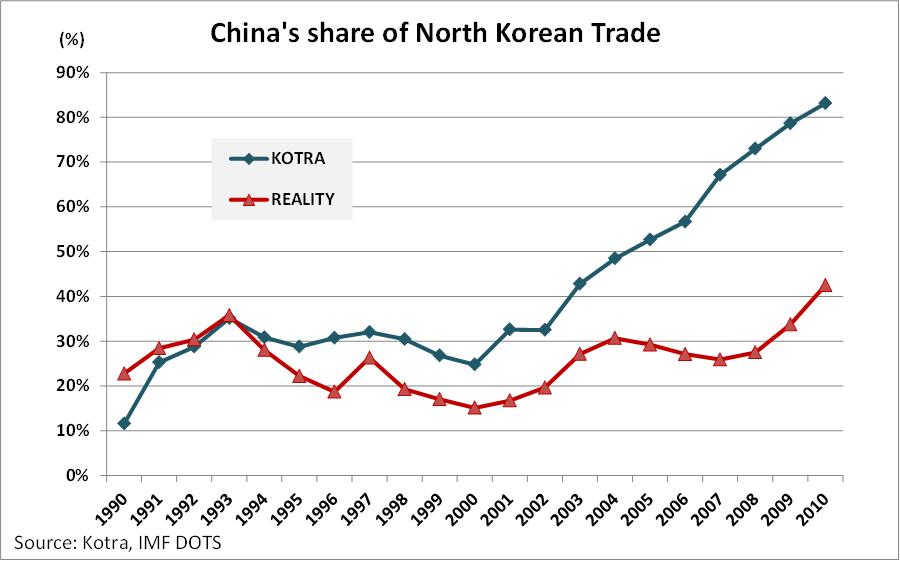
So how important is China to North Korea? The numbers cited are often wildly exaggerated in the policy debates, largely because of the difficulty of getting accurate information on the DPRK’s overall trade. The government of North Korea regards economic statistics as state secrets; as a result, all trade data has to be reconstructed by examining the “mirror statistics” of the country’s trade partners: by adding up what other countries say that they import from the country.

But even such an apparently simple exercise is fraught. First, a number of countires—including Iran—also do not provide reliable trade statistics. Second, nearly every year the statistical agency of some country around the world gets North and South Korea confused and reports an amazing spike in trade with North Korea, consisting of imports of North Korean cell phones and automobiles. Not!

The most widely cited source on North Korean trade is a South Korean public agency, KOTRA, which carefully screens the mirror data for such obvious anomalies. But KOTRA adopts a number of other conventions that distort the overall trade picture. In calculating North Korean trade it excludes the country’s trade with South Korea (on the constitutional grounds that inter-Korean trade is within the nation) and oddly ignores trade with many Middle Eastern countries that do in fact report trade with North Korea to the UN statistical agencies. We have never figured out why they do this, and it may have reasonable motivations, such as beliefs about the reliability of the data. But simply throwing the data out makes now sense.

The upshot is that the prominence of the trade partners that KOTRA does count is greatly exaggerated. The New York Times and Washington Post, for example, have both reported that China accounts for 80 percent of North Korea’s trade; even with smuggling that is wildly exaggerated given the ongoing important of Kaesong for North Korea’s balance of payments.

The actual figure, once North-South and other missing entries are accounted for, is roughly half as much by our estimates (see the figure above). But over 40% reliance on China is not trivial. Moreover, the prevalence of private firms in this trade—as we have reported in two recent working papers (here and here)—is high. Moreover, state-owned enterprises are themselves profit-driven. Even if Chinese authorities were aggressive in enforcing sanctions—which they do not appear to be—the opportunities for mischief are high.

Scott Snyder comments on the numbers here.

Read the full stories here:
North Korea keeps doing business in spite of isolation
Hankyoreh
Lee Jeong-hun
2012-1-1

N Korea trade soars on Chinese demand
Financial Times
Song Jung-a
2012-1-1

Sanctions Busing
Stephan Haggard
2012-6-12

Share

KDI report in Inter-Korean trade following 5.24 measures

Tuesday, May 29th, 2012

The Korea Development Institute (KDI)  recently published a report titled “5.24 조치 이후 남북교역과 북중무역의 변화: 데이터와 시사점”. The Daily NK translates this title to “Inter-Korean Trade and Changes in North Korea-China Trade after the May 24th Measure”. This report is part of KDI’s monthly series “KDI North Korea Economic Review” (KDI 북한경제리뷰) which you can check out on their web page.

You can download a PDF of this report here (PDF).

Here is what the Daily NK had to say about the report:

North Korea-China trade volumes have been increasing dramatically in the period 2009-2011, something which South Korean analysts tend to cite as a side-effect of the May 24th Measure.

The Korea Development Institute (KDI), in its recently released analysis, ‘Inter-Korean Trade and Changes in North Korea-China Trade after the May 24th Measure’, asserted, “North Korea-China trade in 2010 increased 29% (to $3.5billion) over the previous year. In 2011 the recorded amount was $5.6 billion, 63% more than the previous year.”

“Trade volumes have been going up drastically due to the 2010 May 24th Measure, and most of that trade has been North Korean exports to China,” it went on. “After the May 24th measure in 2010, North Korea’s exports to China increased 50% ($1.2 billion) compared to 2009. And in 2011 an increase of 107% ($2.5 billion) was recorded over 2010.”

In addition, “North Korea’s 2010 exports to China rose 21% compared to 2009, and in 2011 rose 39% compared to 2010. As North Korea’s exports to China led North Korea-China trade in 2010, North Korea’s trade deficit with China is also now declining.”

In 2001, North Korean exports to China were worth a mere $166 million, while imports weighed in with $570 million. In 2011, the last year on record, exports were worth $2.4 billion and imports $3.1 billion.

I cannot really comment on the story since my Korean is not good enough to read the report.

Read the full story here:
Trade Volumes Blamed on May 24th
Daily NK
Mok Yong Jae
2012-5-29

Share

South Korean firms losing money in the DPRK

Thursday, May 24th, 2012

According to the Hankyoreh:

South Korean businesses have suffered losses of up to ten trillion won (US$8.3 billion) from the cutbacks in inter-Korean economic cooperation under the Lee Myung-bak administration, figures show.

The losses taken by South Korean firms are fives times the 1.8 trillion won (US$1.7 billion) North Korea’s estimated losses. The results show an unintended effect of Seoul’s May 24 sanctions, which were meant to punish North Korea economically for the shooting death of a tourist at the Mt. Kumkang resort, the sinking of the Cheonan warship, and the shelling of Yeonpyeong Island. North Korea has offset these losses with increased cooperation with China.

Read more below…

(more…)

Share