Archive for the ‘Real estate’ Category

Middle East mogul visits Pyongyang

Thursday, September 6th, 2007

Korea Herald
Jin Dae-woong
9/6/2007

Mohamed Ali Alabbar, chairman of the biggest real estate company in the Middle East, visited North Korea yesterday, stirring speculation about his interest in a possible development project in the isolated country.

The Unification Ministry said the chairman of the United Arab Emirates’ state-run Emaar Properties PJSC flew to Pyongyang on his way to the Chinese coastal city of Dalian to attend a global business forum.

During the one-day stop-over, Alabbar visited a world peace center at the Pyeongchon district of Pyongyang, the ministry said. Sources said the visit also included a tour of hotels in the city.

Ahead of his trip to Pyongyang, Alabbar stopped in Seoul to receive an honorary doctoral degree in law from Sun Moon University affiliated with the Family Federation for World Peace and Unification. He flew to North Korea over the West Sea.

Alabbar is well known for his key role in transforming Dubai into a world-famous tourist city. He is a senior aide to Dubai’s Ruler Sheikh Mohammed bin Rashid al-Maktoum and leads the Dubai-based Emaar Properties, the Middle East’s biggest developer by market value.

Share

Increase in Homeless Families, Escalating Costs in Rice

Sunday, September 2nd, 2007

Daily NK
Yang Jung A
9/2/2007

HRW “irregularities and corruption provoked by governmental officials”

Recently, there has been an increase in kotjebi (homeless) families squandering around the vicinities of jangmadang (markets).

After interviewing 12 North Korean merchants who frequently travel in and out of North Korea as well as defectors, Kay Seok, a North Korea researcher for Human Rights Watch (HRW) revealed in an interview with Radio Free Asia on 29th, “Currently, the cost of food in North Korea is continuing to rise” and commented, “People are selling their homes to obtain food and as a result there has been an increase in kotjebi families.”

Seok said, “According to defectors, the number of street dwellers has increased as of the end of last year and beginning of this year” and explained, “If you compare these times, you can see more people do loitering around the city markets after the spring hardship. However, there are many people who have become kotjebi after selling their homes to buy food.”

Comparing the times of the hunger period in the 90s she said, “At the time, there were many kotjebi children having become orphans after their parents had died and hence, homelessness was directed at children” and asserted, “However, today there is an increase of homeless families who beg around jangmadang or steal goods during the day and then sleep in the same areas at night. These trends indicate that a large number of people are once again experiencing hardship as a result of hunger.”

She revealed, “As of early this year, the cost of food has steadily increased. According to various locations, costs have increased significantly in some areas” and “At present, 1kg of rice costs 1,000~1,200won at jangmadang. About this time last year, rice sold for 700~800won.”

Likewise, in August the DailyNK made reports indicating that the cost of rice had escalated to 1,200~1,300won (USD3.8~4.1) along the border regions and even 1,500won inner land.

Ms. Seok added, “The cost of rice is affected by various factors such as the distance in delivery and farms. Also, the closer you get to the border, the more rice is available from China.”

Regarding the cause in escalating rice costs she said, “Overall, agriculture and production decreased due to the flood last year. The fact that South Korea suspended its rice assistance following North Korea’s nuclear experiment also would have had a significant impact” and “Even this year, floods occurred in the agricultural regions and as a result, it is unlikely that prices will fall despite the harvest period in September and Oct.”

As for the reasons causing North Korea’s incessant food crisis Ms. Seok said, “Causes are the discrepancies in the North Korean government’s policies as well as irregularities and corruption by governmental officials.”

Share

North Korea Uncovered v.4 on Google Earth

Wednesday, August 29th, 2007

The most authoritative, publicly available map of North Korea
Version 4: August 29, 2007

Download it here 

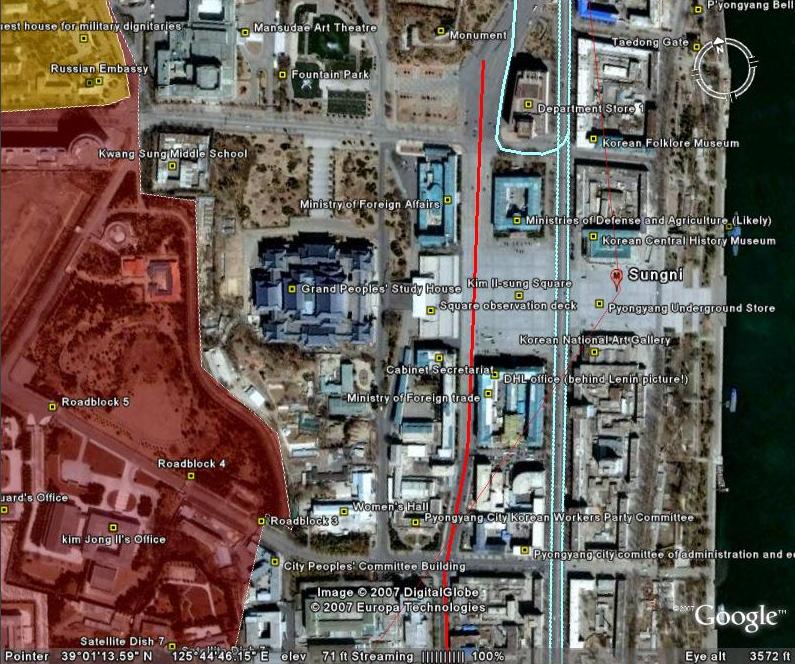
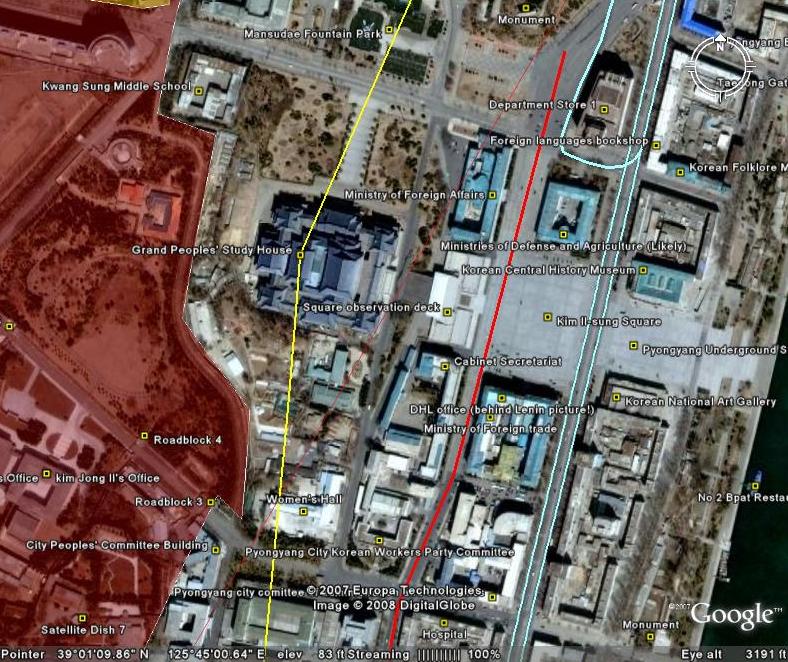
This map covers North Korea’s agriculture, aviation, cultural locations, manufacturing facilities, railroad, energy infrastructure, politics, sports venues, military establishments, religious facilities, leisure destinations, and national parks. It is continually expanding and undergoing revisions. This is the fourth version.

Additions to the latest version of “North Korea Uncovered” include the city of Manpo along the Chinese border, KEDO, Kumgang Resort expansion, Kaesong Industrial Zone, as well as a few more parks, antiaircraft sites, dams, mines, canals, etc. I have also added more links in the menu which will tell the viewer a bit about the locations themselves. I have also changed the color scheme to make the collage easier to view.

Disclaimer: I cannot vouch for the authenticity of many locations since I have not seen or been to them, but great efforts have been made to check for authenticity. These efforts include pouring over books, maps, conducting interviews, and keeping up with other peoples’ discoveries. In many cases, I have posted sources, though not for all. This is a thorough compilation of lots of material, but I will leave it up to the reader to make up their own minds as to what they see. I cannot catch everything and I welcome contributions.

I hope this map will increase interest in North Korea. There is still plenty more to learn, and I look forward to receiving your additions to this project.

Share

Flooding news

Thursday, August 16th, 2007

Youtube video of the flooding 
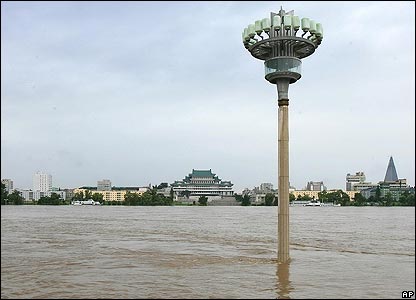
KIS square.jpg

North Korea: Deadly Rains Ruin Big Part Of Farmland
Washington Post

Burt Herman
Associated Press
Thursday, August 16, 2007; A11

North Korea on Wednesday detailed the devastation caused by some of the country’s heaviest-ever rains, saying more than one-tenth of the impoverished country’s farmland had been wiped out during peak growing season.

The North Korean government reported that hundreds of people were killed or missing in this month’s floods, with as many as 300,000 left homeless.

Footage from Associated Press Television News showed citizens working to rebuild roads, clear debris and shore up sandbags along rivers in flood-affected areas outside Pyongyang, the capital. Video images also showed a farmhouse that appeared to have been swept down a hillside by the rain.

If the government’s numbers on agricultural damage are confirmed, the destruction would be about one-quarter of that suffered in massive flooding in 1995. That disaster, coupled with outdated farming methods and the loss of the country’s Soviet Union benefactor, sparked a famine that is estimated to have killed as many as 2 million people.

The vivid portrait of damage, in reports from the North’s state-run media, appeared to be a cry for help from a desperate government that maintains strict secrecy of its internal affairs. But the North has previously exaggerated the extent of disasters to obtain aid and to cover up ineptitude in providing for its people in a centrally controlled economy.

The official Korean Central News Agency reported Wednesday that downpours along areas of the Taedong River were the “largest ever in the history” of measurements taken by the country’s weather agency.

An average of 20.6 inches of rain fell across the country from Aug. 7 through last Saturday, 2.1 inches more than downpours in August 1967, KCNA said.

The recent rains have submerged, buried or washed away more than 11 percent of rice and corn fields in the country, KCNA reported, citing Agriculture Ministry official Ri Jae Hyon. “It is hard to expect a high grain output owing to the uninterrupted rainstorms at the most important time for the growth of crops,” KCNA said.

The U.N. World Food Program estimated that the amount of damage the North Koreans reported to their fields would result in losses of about 450,000 tons of crops — adding to the 1 million ton annual shortage that the country already faces.

The amount is less than the 2 million tons that the North said was lost in the 1995 floods at the start of the famine, said Paul Risley, a spokesman for the U.N. agency. “Nonetheless, this would be an extremely serious reduction in the amount of the harvest,” he said.

The North is especially vulnerable to the annual heavy summer rains that soak the Korean Peninsula because of a vicious cycle in which people strip hillsides of natural vegetation to create more arable land to grow food, increasing flood risks.

U.S. Assistant Secretary of State Christopher R. Hill said the U.S. government was considering how it could help the North Koreans.

The disaster reports precede a planned summit this month between leaders of the two Koreas. South Korea’s government has been criticized by opponents at home and abroad for having given unconditional aid to the North during an international standoff over the communist state’s nuclear weapons program.

Aid was already expected to be a key topic at the summit. Marcus Noland, senior fellow at the Washington-based Peterson Institute for International Economics, said the latest disaster gives Seoul justification to expand assistance to its neighbor.

North Korea’s flooded ‘rice bowl’
BBC

8/16/2007

The UN World Food programme’s acting country director, Michael Dunford, has just returned from a visit to one of North Korea’s flood-affected areas, in the south of the country.

He told the BBC news website what he saw and how the floods are affecting a country already dependent on food aid.

“We went to Sogon, driving for about two hours to get there, and we saw extensive examples of flooding as we went down, with widespread inundation of arable lands which, of course, creates concerns as regards the long-term food implications.

We have been told by the government that the Kangwon province is one of the areas that is worst affected. The impression we are getting is that there is severe damage throughout the southern half of the country, across to the east.

The southern part of the country is the main food-producing area. As you go further north it is more mountainous and hence their ability to produce is limited.

The area that has been inundated is part of the ‘rice bowl’, hence this creates additional concerns as to what impact that may have.

We estimate that annually there is a food deficit of about a million tons of cereals – that’s maize and rice. So, in the past, North Korea has relied on bilateral, from China and South Korea predominantly, and also and multilateral support through the World Food Programme.

Collapsed houses

Last year, the amount of food that entered the county did not meet the food gap and hence we were concerned about the implications that was going to have for food security in the country and potentially the impact that may have on the most vulnerable.

Certainly for them to have the floods this year is only going to exacerbate the already food insecure situation in the country.

People are managing as best they can. We understand from the government that those who have lost their homes are now residing in either their place of work or some form of community shelter – either a schools or nursery, we expect.

We were dealing with local officials. They tell us that the waters have inundated houses, houses have collapsed, factories have been completely inundated and roads and bridges have been washed away. Certainly the impression we are getting is that this is very severe flooding.

We saw bridges that were knocked down, we saw roads that had been washed away. The infrastructure is typically old and anything that damages it further is going to have implications.

Wiped out

The landscape in the southern area is a combination of flatlands with quite dramatic mountains, there are fields with hills and mountains shooting up.

There are small villages and co-operative farms. These are very rudimentary houses – typically handmade.

People may have a small plot in the front of the house in which they try to grow their own vegetables – potatoes, beans, carrots, tomatoes – they are then surrounded by more extensive farmlands which have been damaged by flooding.

In one area, we were looking at what we thought was a river running through a field of maize but it was in fact the offshoot of a flooded river. Crops have just been wiped out.

We also saw a lot of areas that were completely underwater, knowing that the rice would not be able to recover.

This is the period of pollination and, hence, because the rice is underwater during this period, it won’t germinate and hence won’t produce for the harvest due in September-October.

N Korea floods devastate farmland
BBC

8/15/2007

Severe flooding in North Korea has destroyed more than one-tenth of the country’s farmland, according to the state news agency KCNA.

“As of 14 August, more than 11% of rice and maize fields were submerged, buried or washed away,” Ri Jae-Hyon, director of the Ministry of Agriculture, said.

Government officials also told aid workers in the region that 300,000 people may have been left homeless.

Aid teams visiting the area warned of a need for emergency shelter and food.

“Going forward, the crop damage is of major concern,” Michael Dunford, of the UN World Food Programme, told the BBC.

He added that he had been to see some of the damaged areas, and described the situation as “pretty grim”.

Food aid

“Areas of the capital, Pyongyang, have been inundated,” he said, “but certainly as you move out into the countryside there is widespread damage, and it is going to have a negative impact on DPRK [North Korea] most certainly.”

North Korea already suffered from severe food shortages, even before the floods.

About two million people are thought to have died from famine in the mid-1990s in North Korea, and the country remains dependent on foreign food aid.

United Nations Secretary General Ban Ki-moon has ordered a full evaluation of the needs of North Koreans and has promised assistance to the communist nation.

“I assured him that the United Nations will be prepared to render whatever possible humanitarian assistance and help to the DPRK (North Korean) government and people overcoming this difficulty,” he said after a meeting with North Korea’s UN envoy Pak Gil-yon.

The US and South Korea have both said that they would consider sending aid.

‘Huge damage’

North Korea made the rare plea for help after it announced late on Monday that storms since 7 August had led to “huge human and material damage”.

State news agency KCNA said hundreds of people were dead or missing.

Many areas were affected but worst hit were the three provinces of Kangwon, North Hwanghae and South Hamgyong, it said.

Television pictures from the capital Pyongyang showed people wading along streets through thigh-deep water after rivers burst their banks.

These floods are thought to be worse than the ones that hit last year. Hundreds of people are thought to have died in August 2006, but exact figures are not known.

Heavy rainfalls render 17,000 North Koreans homeless
Yonhap
8/15/2007

Hundreds of people were killed or missing in North Korea in heavy downpours that battered the impoverished communist country last week, a North Korean official said in a report on Wednesday.

The downpours, which flooded even the center of its capital, Pyongyang, and wide sections of the country’s western region, also left about 17,000 people homeless, said the official from Pyeongan Province in a report carried by Pyongyang Radio. 

South to Help North Recover From Floods
Korea Times
Jung Sung-ki
8/14/2007

South Korea is considering sending relief supplies to help the North recover from severe flooding, the Ministry of Unification said Tuesday.

Hundreds of people are dead or missing in North Korea following week-long torrential rain that has destroyed thousands of houses, and damaged roads and railway tracks, the North’s state media reported.

“North Korea seems to be suffering a greater loss of lives and property than it did during July’s flooding last year,” Seo Sung-woo at the ministry’s intelligence analysis bureau told reporters.

“I don’t think the inter-Korean summit will be affected by the floods. However, if the rains continue, it is hard to predict,” said Seo.

In 2006, monsoons rains hit much of the impoverished state, killing hundreds of people.

Floods in July that year left over 500 people dead and nearly 300 people missing, according to the Chonson Sinbo, a Japan-based pro-North Korean newspaper.

In the following month, Seoul sent $82 million worth of aid to Pyongyang. The South provided the North with 100,000 tons of rice and cement, five tons of iron, construction equipment, 80,000 blankets and 10,000 emergency kits, according to the ministry.

The North’s official Korean Central News Agency said this year’s heavy rain destroyed at least 30,000 homes of 63,300 families, and more than 540 bridges and sections of railway.

The agency said heavy downpours had caused “huge human and material damage.” Many parts of the country received between 30 and 67 centimeters of rain from Aug. 7 to 12, it said.

Gangwon Province was hit the hardest, with more than 20,000 homes damaged or destroyed.

Pyongyang and neighboring provinces including South Hwanghae and South Pyeongan were also badly affected, according to the report.

Experts blamed decades of reckless deforestation for North Korea’s flood problems, saying the country has been stripped of tree cover that provides natural protection.

The International Federation of the Red Cross (IFRC) emergency operations staff is on a 24-hour alert to monitor flood damage in North Korea and has distributed aid kits to some 500 families, its Web site said.

“People have been evacuated and brought to safety,” it said, and county governments are “appealing to cooperative farms to donate emergency food for homeless people.”

International Red Cross goes on alert in North Korea on flood damage
Yonhap

8/13/2007

The International Federation of Red Cross (IFRC) emergency operations staff is on a 24-hour alert to monitor flood damages in North Korea and has distributed aid kits to some 500 families, its Web site said Monday.

A bulletin dated Sunday said the torrential rain that started Aug. 5 has caused serious flooding in many parts of North Korea.
“People have been evacuated and brought to safety,” the IFRC Web site said, and county governments are “appealing to cooperative farms to donate emergency food for homeless people.”

“Warnings of high tides have been issued on national television. Indeed, weather forecasts predict continued heavy rains until Aug. 17.”

The Red Cross emergency operations room is on a 24-hour alert, it said, with its staff in the field assessing damage.

In a rare admission of a crisis, North Korea’s state run news agency said Monday the downpour so far has left hundreds of people dead or missing and destroyed more than 30,000 homes for 63,300 families.

The Korean Central News Agency said hundreds of public buildings, bridges and railway sections also were destroyed.
Share

Foreigners in Pyongyang

Sunday, August 12th, 2007

Korea Times
Andrei Lankov
8/12/2007

The Pyongyang of the 1970s and 1980s had a very small number of expatriates. Outside the capital, foreigners were unheard of _ unless they were Soviet or East European engineers who were contributing to some construction project. Nevertheless, a modest ex-pat community existed, and had its own traditions and folklore.

Since there were so few foreigners in Pyongyang, they attracted everyone’s attention _ especially on the city’s outskirts, where few foreigners ever ventured. Adults would stare at them, while kids would run behind the strange-looking visitor, shouting: “A foreigner, a foreigner!” Older children never forgot to take their hats off and greet foreigners with a respectful bow.

The children’s surprise was understandable. Most of them had seen foreigners only in the movies, if ever. The vast majority of the small foreign colony were diplomats who seldom ventured out of their respective embassies or, at least, out of their cars. Tourists also never left the city centre. Hence, a foreigner walking a Pyongyang street was a very unusual sight indeed.

A Soviet diplomat once went to a small currency shop located in our foreign students’ dormitory. This shop had only one sales assistant, a woman in her mid-30s. At the time she had her five-year old daughter with her. The girl was obviously seeing a foreigner for the first time in her life. However, it turned out that she had seen foreigners before in movies. Now, most Westerners depicted in North Korean cinema were perfidious and corrupt “American imperialists.” Thus, the polite girl greeted the stranger in the way foreigners were usually referred to in the movies. She said: “Hello, uncle American imperialist scoundrel!” (Anny?ng hasipnikka, mijenom aj?ssi!)

It’s difficult to say how many foreigners were in Pyongyang in the mid-80s. Most probably, in the whole country with its population of 20 million there would have been scarcely 1,000 permanent foreign residents (this figure excludes tourists and other short-time visitors). At the time, there were about 20 embassies in North Korea, mostly with a small staff. There were also about a hundred foreign specialists with their families, and a couple hundred students.

More “permanent” foreigners in the city were embassy staff. The majority of the smaller countries that had diplomatic relations with the DPRK appointed their Ambassador to China to represent their interests in North Korea as well, so permanent missions were few in number. Around 1980, the North Koreans built a special `embassy quarter’ in Eastern Pyongyang. Only a few embassies remained in Western Pyongyang _ including those of China and the then USSR.

In the center of the `embassy quarter’ there was a Pyongyang supermarket where foreigners bought some products, otherwise unavailable in the city. The shop accepted the `green’ currency certificates which could be exchanged for `soft’ currency of the Communist countries (in the late 80s they were more properly renamed `red’). Hard currency could be used in special hard-currency shops, first and foremost – in the central hard-currency supermarket which was aptly named Rakwon (`Heaven’). It was located in the centre of the city, and a majority of the shoppers were Koreans who had access to the hard currency.

In a small extension to the Pyongyang supermarket there was a remarkable institution known among ex-pats as the “kimch’i-bar.” I do not know why this rather cosy cafe was named a `bar’, nor what relation it bore to the famous Korean pickles. This small cafe was a usual meeting place for foreigners. In this cafe in 1984-85 one often would come across, say, the entire staff of the Maltese Embassy. For some incomprehensible reason, a leftist government of this Mediterranean island not only established diplomatic relations with North Korea, but actually dispatched an ambassador there. The poor gentleman had nothing to do, and he spent all his working days sipping beer in the `kimch’i-bar’…

However, the main meeting place was the Diplomatic Club, which was located near the old iron bridge over the Taedonggang River. It boasted a good restaurant, a cinema, and even a disco (social dancing was banned in North Korea from 1957 to 1985). Every evening the cinema showed foreign movies – of course, not from the decadent West, but from the brotherly Communist countries.

However, the major centres of Pyongyang ex-pats’ lives were hotels. Many interesting things happened in their lobbies and rooms.

Share

Development kicks off in DPRK’S Sinuiju special economic zone

Tuesday, August 7th, 2007

Institute for Far Eastern Studies
NK Brief No. 07-8-7-1
2007-8-7

According to a recent report from a North Korean insider, the border city of Sinuiju, in North Pyongan Province, was redesignated as a ‘Special Economic Zone’ in the first part of this year, and accordingly, full-fledged city development has been underway since last June, including the relocation to the city of 3000 families from Pyongyang.

The “NK Chosun” reported that this development was revealed by a North Korean official during a meeting with an associate in Dandong while on a recent visit to China. The official was quoted as stating, “Pyongyang citizens are being temporarily transferred to Sinuiju because they are ideologically prepared.” The official went on to share that the Pyongyang residents being moved to Sinuiju are the laborers that will work in the industrial zone, state security officials, police, and their families.

According to the associate in Dandong, “due to rumors of the relocation of Pyongyang residents, real estate prices in the Sinuiju area are skyrocketing.” While DPRK authorities are instituting a plan to relocate Pyongyang residents to Sinuiju, at the same time 3000 Sinuiju families are being banished from the city. Rumor has it that Sinuiju police and security forces have begun identifying residents with problematic blood lines and those considered to have ideological problems and announcing lists of ‘purgees’.

Even as large scale aggregate gathering at the mouth of the Yalu River is growing, all residents living in the vicinity of the Sinuiju train station were removed and barbed wire and dirt walls were set up around the outskirts of the area following its designation as a ‘Special Economic Zone’.

One DPRK source in Dandong stated, “The past plan for the Sinuiju Special Economic Zone promoted by Chinese [businessman] Yang Bin aimed to make money through a casino and entertainment facilities, but this time, according to the directives of Chairman of the National Defense Commission Kim Jong Il, a city is to be constructed that can fulfill the role of Kaesong Industrial Complex as well as Rajin-Sunbong .”

Share

DPRK taking steps to launch new economic area in Sinuiju

Thursday, August 2nd, 2007

According to the Choson Ilbo (2007-8-2):

North Korea early this year declared Shinuiju, a border town in North Pyongan Province, a special economic zone, North Korean officials said. Some 3,000 households in Pyongyang are to be relocated to Shinuiju under an urban development project launched there in June.

During a recent visit to China, a North Korean official told an official from the Chinese border city of Dandong the North will relocate Pyongyang citizens to the Shinuiju Special Economic Zone since they are “ideologically prepared.” Some will be assigned as workers to an industrial complex, who will be joined by officials from the Ministry of Public Security and the State Security Department, and police officers and their families.

A Dandong official said, “I understand that housing prices in the Shinuiju area have skyrocketed due to rumors that Pyongyang citizens will move in.” He said North Korean authorities plan to evict 3,000 households from Shinuiju to the city’s suburbs to make room for the newcomers. Public and state security officers in Shinuiju have begun making a list of those with dubious backgrounds and who are ideologically suspect, which rumor has it will result in a roster for eviction.

Meanwhile, the Yalu River estuary is being dredged and all private houses near Shinuiju Railway Station are being demolished, while the special economic zone is being surrounded new by barbed-wire tangles and fences.

A North Korean source based in Dandong said an earlier Shinuiju special economic zone project promoted by Yang Bin, a Chinese, was aimed at making money through casinos and entertainment facilities. But on North Korean leader Kim Jong-il’s instructions, the current project is designed to build a city that can play the same role as both the Kaesong Industrial Complex and the Najin-Sunbong Free Trade Zone.

Read the full story here:
N.Korea Starts Clearing Special Economic Zone
Choson Ilbo
2007-8-2

Share

Why Did the Apartment in Hyesan Collapse?

Wednesday, August 1st, 2007

Daily NK
Han Young Jin
8/1/2007

Regarding the Hyesan, Yangkang province “apartment collapse incident (Reported Daily NK 7/23),” an opinion has been brought forward that the direct cause is the change in the weight load that followed from a drastic removal of the interior wall.

An internal North Korean news source quotes a witness to the incident who states, “Starting on the morning of the 19th, two construction workers were carrying on with a project to remove the wall panel of a house. When the wall panel was about to be dismantled, the concrete floor from the floor above spilled out and one side of the seven-story apartment crumbled down.”

Among the residents who had lived in the collapsed apartment, it was a trend to remodel the interior to enlarge the drawing room in a modern Chinese style. This apartment was typically a place where the relatively affluent class such as customs or trade workers resided.

Without passing building safety inspections, households would remove the wall panel that divided the small room and the kitchen to create a drawing room where they could drink tea with guests.

North Korean apartments are distributed to residents in the form of a rental apartment and if apartment residents want to change the structure, they must report this to the City Administrative Bureau under the People’s Committee that acts as the Superintendence Office for residents. However, the City Administrative Bureau has been accepting bribes and looking the other way which makes the regulations only valid in theory.

The news source also claimed, “It seems the building couldn’t withstand it anymore and collapsed. Due to this incident, 26 people have died and there are dozens more in casualties.”

In addition, they also claimed, “the Public Security Forces evacuated the residents on the side of the building without damages and demolished the entire apartment. It was a place that was clearly visible even in China and as reconstruction was difficult, it seems they demolished it all.”

Defector Kim Ju Chan [pseudonym] who had spoken to his family who lives in Hyesan said, “There has been a rumor to be alert as the apartment collapse incident is a conspiracy of the South Korean National Intelligence Service. However, hardly anyone believes this and says that this couldn’t be the result of a NIS conspiracy but from the construction of the wall panels.”

As this incident occurred during the Local Assembly representative elections, the North Korean authorities have been spreading such rumors like “South Korean NIS invasion” to prevent any changes in public sentiment.

Kim said, “In the process of handling the building debris, they also withdrew bundles of money or anything that looked valuable from private households. As the majority of the apartment residents are powerful people, it seems as there will be no other trouble.”

20 Die in Collapse of 7 Story Apartment Building
Daily NK

Kim Young Jin

On July 23, sources inside North Korea reported that a 7 story apartment building collapsed in Hyesan-dong, Hyesan, Yangkang province, killing and wounding dozens. The building stood next to the Hyesan police station and crumbled with a massive “bang,” on July 19th. Frightened residents quickly gathered and began rescue operations with the help of soldiers and social security agents.

The building was home to 42 families, six on each floor. 20 bodies were found beneath the rubble and many wounded were sent to hospitals, some arriving days later. Casualties mounted due to the lack of rescue equipment. Because the incident occurred during working hours, most of the victims were reportedly old and feeble.

The source quoted a social safety agent from the police stand who, along with other authorities, believed the building had structural deficiencies from the beginning. Others said the building was only 15 years old and represented the latest in North Korean building styles.

He added that the rescue was hampered for at least 2 days while larger machinery was brought in. While waiting, the locals were confined to the use of shovels and hoes.

Mr. Lee, a defector from Hyesan, said in a telephone conversation with the Daily NK that there are two apartment complexes beside the Hyesan police station. One is the collapsed building which was built 15 years ago and the other is 8 stories. The complexes primarily housed party members, factory management staff, and trade company employees.

An affiliate of the National Intelligence Service in South Korea mentioned to the Daily NK that “we are investigating the incident after receiving intelligence from several sources.”

Share

Kim Jong Il’s Yacht, UNESCO, Golf, and the Taean Glass Factory

Tuesday, July 31st, 2007

Now available on Google Earth! 
(click above to download to your own Google Earth)

North Korea Uncovered v.3

Google Earth added a high-resolution overlay of the area between Pyongyang and Nampo.  In it, most of the Koguryo tombs listed with UNESCO are now distinguishable.  In addition, viewers can see the latest Kim Jong Il palace (including a yacht), the DPRK’s premier golf course, and the Chinese-built Taean Glass factory.  I have also made some progress in mapping out the DPRK electricity grid.

This is the most authoritative map of North Korea that exists publicly today.  Agriculture, aviation, cultural institutions, manufacturing, railroad, energy, politics, sports, military, religion, leisure, national parks…they are all here, and will captivate anyone interested in North Korea for hours.

Naturally, I cannot vouch for the authenticity of many locations since I have not seen or been to them, but great efforts have been made to check for authenticity. In many cases, I have posted sources, though not for all. This is a thorough compilation of lots of material, but I will leave it up to the reader to make up their own minds on the more “controversial” locations. In time, I hope to expand this further by adding canal and road networks.

I hope this post will launch a new interest in North Korea. There is still plenty more to learn, and I look forward to hearing about improvements that can be made.

Share

Purchase Popular Jangmadang Goods at State-Operated Stores

Tuesday, July 3rd, 2007

Daily NK
Yang Jung A
7/3/2007

A North Korean insider source relayed on the 2nd that citizens’ complaints have been rising because the North Korean government recently gave guidelines to sell a portion of products which have been selling with popularity at the jangmadang (markets) only at state-operated stores.

This source, who resides in North Pyongan, revealed in a phone conversation with DailyNK, “Recently, plastic floors have been popular, so “plastic sales” is earning a lot of money. However, government authorities have mandated that the commerce office directly oversee plastic floors and that they be sold at state-operated stores.”

The insider relayed, “Families above middle-class have been showing a lot of interest in acquiring furniture. Besides floors, drawers on which TV can be placed and cabinets displaying wines and others are very popular.”

Previously, floors made of paper covered the floors of houses, but since North Korean civilians’ standard of living started rising recently, Chinese-made plastic floors decorated in flowers is drawing popularity.

He said, “Rumor has been leaking that pork (1,700 North Korean won per kg), the price for which has declined recently, is also directly managed by the commerce office, along with plastic floors.” “Besides this, the complaints of merchants have been rising since rumor starting circulating that the list of items to be overseen by the office will increase.”

He added, “Would they want to do any business given that individual sales are discouraged and turned over to national control when sales go even remotely well? There are grievances due to the fact that earning a livelihood through jangmadang sales is not even allowed, on top of the lack of provisions.”

Further, he said, “Regulations regarding people engaging in “Chapan-Jangsa (sales by trucks)” using privately-owned buses or trucks exceeding eight tons have begun. If one is caught, the vehicles become registered as national property and the vehicle owner receives a salary from the country instead.”

“Chapan Jangsa” refers to carrying out wholesale while ferrying the load on trucks. The “plastic floor” and “Chapan Jangsa,” along with what is popularly known as “ice (drug) sales” are counted are the top three business that brings in the most amount of money.

“The complaints of people are high, but the scope of regulation is wide-ranging, so there are people who think that the inspections will stop after several times.”

Even guideline to prevent wearing of wedding dresses

He also said, “Since October 2006, there were even guidelines to prevent wearing of wedding dresses at weddings. Not only wedding dresses, but wearing white gloves were also prohibited.”

In North Korea, wearing wedding dresses at weddings became a trend seven to eight years ago. Nowadays, many civilians are known to wear them. Even if they do not wear wedding dresses, North Korea’s general wedding culture is donning flowers on the chest part of dresses and on the head and putting on white gloves.

Additionally, the insider relayed, “The size of the flower of the groomsmen and the bridesmaids should not be bigger than the groom’s and the bride’s. The flower of the groom and the bride is fixed at 7cm and the flower of the groomsmen and bridesmaids fixed at 5cm. In the case with those who go against the orders and get their pictures taken after marriage, the photo volunteer in charge’s volunteer card (employment permit) can be revoked.”

Share

An affiliate of 38 North