Archive for the ‘Real estate’ Category

North Korea Now: Will the Clock Be Turned Back?

Friday, February 15th, 2008

This morning I received an email from a reader at the Brookings Institution who shared an article by one of their visiting fellows.  Much of it was about US/DPRK foreign policy, but I thought the following excerpt was interesting from a social change perspective:

On a recent visit to Pyongyang, this author was impressed by the sheer scale of new economic phenomena in DPRK. In terms of variety of goods, activity, and scale, markets in North Korea’s central areas (less in the provinces) remind of Chinese provincial markets. Numerous restaurants serve good—and very cheap, by Western standards—food to customers flocking to them. New “service centers” (eundokwon), combining shops, saunas, and restaurants under one roof, have sprung up and are run by highly placed entities such as Party departments and “offices.” Every branch of the Party, military, and local authorities now operates trading companies. Real business managers have appeared, some engaged not only in the “shuttle” trade with China but in bigger projects (in construction, for example), and some corporations have amassed a considerable volume of business. Judging by the author’s experiences in the 1980s and 1990s, these “new Koreans” are much more realistic and open to contact with outsiders than was the case before. There are changes in the official line as well: North Korean economists explained that now, out of several hundred thousand products manufactured in the country, only several hundred are now centrally planned. For the vast majority of manufactured products, managers of the state-owned enterprises are given a free hand to determine their production targets and to get what they need through the “socialist wholesale market.”

Having witnessed the processes eventually leading to the denunciation of the command economy in the USSR, and the transition to a market-based economy, this author can testify that there are striking resemblances in certain aspects of contemporary daily life in the DPRK to the USSR in the 1970s and 1980s (the Chinese experience in the1980s, with private enterprise officially sanctioned, is less similar). At that time in the Soviet Union, a vast black market of goods and services began to form in major cities. Many of its dealers became (often after a prison term) the leading businessmen of the post-Soviet era.

For example, at that time there was no private property for apartments in Moscow or elsewhere, and no real estate market officially existed. But at the same time almost any Soviet in the course of his life would “change” one apartment for a better one, paying considerable sums of money to the former “owner.” Some shadowy dealers would buy apartments outright, bribing officials to get a “registration” (propiska), and many made a profession of acting as a “go-between.” Similar activities are sprouting like mushrooms around North Korea. A one-room apartment in Pyongyang is said to cost about US$5000, less in local areas. However, real estate in some small cities close to Pyongyang boast the same high prices, as various kinds of dealers and traders, who are not permitted to settle in Pyongyang, buy apartments there. Foreign currency flows freely and, like in the USSR, most things can be obtained for money. A Russian joke said: “if it is illegal, but very much desirable, it is not prohibited.”

The ground for developing market relations is well prepared. The “royal economy” serving the ruling class (Kim Jong-il’s immediate retinue and the top nomenklatura or kanbu), and a large part of the internationalized sector (joint ventures and free economic zones) operate on market principles. The next step, should the country’s leaders admit the need for developing the country and sustaining their power, should be “setting the rules of the game” by providing a legal framework for what already exists. For that, however, external security should be guaranteed to the regime—irreversibly and comprehensively. Only then will the hard-liners, who fear—with good reason—that reforms would invite subversion of the regime, be confident enough for real progress to take place. Nevertheless the words “reform” and “openness” (especially because of their “Chinese connotations”) are unacceptable to Pyongyang, and Kim Jong-il himself stated as much during his talks with Roh Moo-hyun in October 2007. Under the present leadership Pyongyang, any economic reforms would most likely never be called such and would take place in an unpublicized manner without discussion, which is not helpful in terms of public relations with the West and negative international sentiment about the regime.

The full article can be found here:
North Korea Now: Will the Clock Be Turned Back?
logo_sm.bmp

Georgy Toloraya, Visiting Fellow, Center for Northeast Asian Policy Studies
2/11/2008

Share

North Korea Google Earth (Version 7)

Friday, December 14th, 2007

The most authoritative map of North Korea on Google Earth
North Korea Uncovered v.7
Download it here

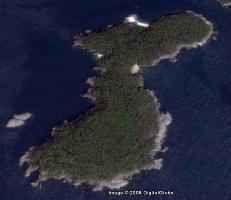
koreaisland.JPGThis map covers North Korea’s agriculture, aviation, cultural locations, manufacturing facilities, railroad, energy infrastructure, politics, sports venues, military establishments, religious facilities, leisure destinations, and national parks. It is continually expanding and undergoing revisions. This is the sixth version.

Additions to the latest version of “North Korea Uncovered” include: A Korean War folder featuring overlays of US attacks on the Sui Ho Dam, Yalu Bridge, and Nakwon Munitians Plant (before/after), plus other locations such as the Hoeryong Revolutionary Site, Ponghwa Revolutionary Site, Taechon reactor (overlay), Pyongyang Railway Museum, Kwangmyong Salt Works, Woljong Temple, Sansong Revolutionary Site, Jongbansan Fort and park, Jangsan Cape, Yongbyon House of Culture, Chongsokjong, Lake Yonpung, Nortern Limit Line (NLL), Sinuiju Old Fort Walls, Pyongyang open air market, and confirmed Pyongyang Intranet nodes.

Disclaimer: I cannot vouch for the authenticity of many locations since I have not seen or been to them, but great efforts have been made to check for authenticity. These efforts include pouring over books, maps, conducting interviews, and keeping up with other peoples’ discoveries. In many cases, I have posted sources, though not for all. This is a thorough compilation of lots of material, but I will leave it up to the reader to make up their own minds as to what they see. I cannot catch everything and I welcome contributions.

Share

Builder to Set Up Venture With North

Tuesday, December 11th, 2007

Korea Times
Ryu Jin
12/11/2007

Namkwang Engineering & Construction, a South Korean company which has recently been stepping up efforts for inter-Korean economic projects, plans to form a joint venture with a North Korean firm for construction works in the North and other countries.

Namkwang E&C CEO Lee Dong-chul told reporters Tuesday that his company, along with 516 Construction Company in the North, will seek to win construction orders in foreign countries including Angola as well as North Korean cities such as Gaeseong and Pyongyang.

“We signed a memorandum of understanding (MOU) for joint projects with the North Korean firm late last month,’’ he said in a press meeting. “They could be operated in the form of a joint venture, depending on the final agreement to be signed early next year.’’

Lee added that Namkwang would largely provide capital and construction technologies to the proposed joint-venture company while the North Korean firm would supply labor.

Founded about 50 years ago, 516 Construction Company is the only construction firm in the North Korean border city of Gaeseong where an inter-Korean industrial complex is located. It has constructed apartments in the city with more than 3,000 workers.

“Currently, the firm is building a steel-frame factory in the Gaeseong Industrial Complex including reinforced concrete, tiles and plaster work under a contract with us,’’ Lee said. “Maybe we can take part in construction works in Angola and Libya jointly.’’

Namkwang, which recently got government approval for cross-border projects, has invested some 7.6 billion won ($8.23 million) since October to build the steel-frame factory which would be used for the second-phase construction of the Gaeseong Industrial Complex.

Lee said that his company would also redouble efforts to get more orders for overseas construction in such countries as Angola, Libya and Vietnam next year. Namkwang has received orders worth $1.1 billion along with NIEC, a joint venture in Angola, since 2005.

Established in 1947, Namkwang has carried out a lot of large-scale projects in South Korea and also advanced to foreign countries such as Saudi Arabia, Iraq and the Philippines for construction of buildings, roads, dams and harbors on the back of its unique technology.

Share

Women of Hoiryeong Should Not Go out at Night

Sunday, November 25th, 2007

Daily NK
Lee Sung Jin
11/25/2007

A source inside North Korea reported on the 22nd of November that all sorts of crime are rampant in Hoiryeong of North Hamkyung Province, and locals, especially women are so afraid that they dare not go outside at night.

The source said, “At meetings of people’s units, locals received instructions not to go out late at night and women were especially advised to get back home not too late.” The source added, “Most crimes are committed by soldiers who have been posted to Hoiryeong for construction work.

Since early this year, the North Korean authorities have been carrying out apartment building construction and road expansion work in Hoiryeong under the project named “Embellishing Mother’s Hometown.” Hoiryeong is known as the birthplace of Kim Jong Suk, Kim Jong Il’s mother.

This year celebrates the 90th anniversary of Kim Jong Suk’s birth, and many construction projects are being proceeded under the slogan, ‘‘Let’s invite our benevolent general to Hoiryeong.’’ Last year in November, a mosaic mural depicting Kim Il Sung and Kim Jong Il was installed in both Poongsan-ri and Daedeuk-ri in Hoiryeong.

Early May, the nation’s new prime minister Kim Yong Il visited Hoiryeong by train. His train was loaded with glass and cement, and the minister delivered the construction material to Hoiryeong’s people’s committee, leaving a message saying, “Hoiryeong is the birthplace of Kim Jong Suk. Clean up and embellish the entire city.”

As the authorities started carrying out the extensive construction work in Hoiryeong, it needed more labor power. Starting with last month, the state began to bring construction units of the People’s Army into the city for the expansion and pavement works of the road between Hoiryeong-Chongjin. It is the solders of these construction units who are responsible for ongoing violent crimes such as rape and plunder occurring in Hoiryeong

The source said, “Ever since those soldiers came to Hoiryeong, the city has been afflicted with many incidents and crime, all of which concern the city’s party committee to great extents.” The source said, “Even though October is the harvest season, there is not enough corn left for harvest in many cornfields around construction sites.”

What is worse, many households are being sacked by the soldiers, and local residents cannot leave home empty even for a moment, the source said.

The city’s party committee is casting suspicion on the soldiers. However, it cannot recklessly push for an investigation against the soldiers because the committee lacks hard evidence and the army has gotten too powerful over the years.

“A few days ago, there was an incident where a soldier broke into a house, raped a twenty-two-year old woman, and ran away,” the source said. “In order to protect themselves from the soldiers, each community has placed a guard at its people’s unit guard post twenty-four hours a day, seven days a week, and made sure that the guard reports to the People’s Safety Agency in case an incident takes place.”

Individuals who go to a night market and females who get back home from the market late at night are particularly vulnerable. The Safety Agency of Hoiryeong has decided to increase the number of patrols and ordered the locals to organize their own securities in their areas, the source said.

A defector who came to the South in 2006 said, “People used to admire the People’s Army. Nowadays, the Army is treated as a gang of thieves.” The defector said, “The army behaves highhandedly, and there are always conflicts in the areas around army bases.”

Share

Working through Korean unification blues

Thursday, November 15th, 2007

Asia Times
Andrei Lankov
11/15/2007

For six decades, the myth of unification as Korea’s supreme goal has been enshrined in the official mythology of both nations. The lip service to this myth is still paid by virtually all political forces in both Koreas, but the actual policy of both Pyongyang and Seoul nowadays is clearly based on a very different set of assumptions and hopes: both sides try to avoid situations which might lead to unification.

There are good reasons for this quiet change of policy. The gap between the Koreas is too great; depending on which calculations you believe the per capita gross domestic product in the South is between 15 and 40 times higher than that of the North. Perhaps, nowhere in the world one can find two neighboring countries whose income levels would be so vastly different – and in this case the two countries happen to speak the same language.

The North Korean rulers know perfectly well that in a unified country they would be unable to keep their privileges, and also are likely to be held responsible for decades of gross human-rights abuses and economic mismanagement. South Koreans are no more willing to unify with their impoverished brethren – unification of Germany where the initial situation was much better, became an ordeal, so the unification of Korea would clearly become a disaster.

Therefore, South Korean politicians are doing everything possible to support the dictatorship in Pyongyang, assuming that “stability” in the North is necessary for South Korean economic prosperity. Sufficient to say that some 40% of all grain consumed in North Korea is either received from the South or produced with the help of the mineral fertilizer shipped by Seoul free of charge.

This policy is usually explained as a way to “create the environment for Chinese-style reforms”. This indeed might be its long-term goal, but for all practical reasons the major immediate outcome of massive South Korean aid is a continuous survival of the Pyongyang dictatorship. The statement that a “German scenario is unacceptable” has become a mantra of Seoul politicians.

However, over the past decades, Kim Jong-il’s regime has not shown the slightest inclination to reform itself. Obviously, the Pyongyang elite believes that the Chinese model, so enthusiastically extolled by the good-wishers from Seoul, is not acceptable for them. Perhaps they are correct in their fears. The existence of a rich and free South, always presented as another part of the same nation, makes the situation in Korea quite different from that of China or Vietnam.

Chinese-style reforms, if undertaken by Pyongyang, are bound to produce a certain openness of the country and certain relaxation of political control. As a result, the North Korean populace will soon learn about South Korean prosperity and will be less afraid of the regime’s repressive machine. It’s questionable to what extent the North Koreans would be willing to obey a government whose track record has been so bad after they see an attractive alternative of the South.

Hence, North Korean leaders have made a rational decision: to keep stability and their own privileges, in recent years they have used foreign aid to roll back the changes which happened in the mid-1990s. Instead of reforms, they now do everything possible to limit or ban private economic activity and reassert their control over society.

Despite the government’s resistance to reform, the North Korean system is gradually crumbling from below, and this slow-motion disintegration might turn into an uncontrollable collapse in any moment. A sudden death of even a serious illness of Kim Jong-il is almost certain to trigger a serious crisis. If this happens, all bets are off, but it seems that a collapse of the system, Romanian or East German style, is one of the most likely outcomes.

This is what people in the South fear most. Indeed, unification might indeed spell economic and social disaster for the rich South. There are different estimates of the “unification costs”, the amount of money that would be necessary to close the yawning gap between the two Korean economies. The most recent estimate was made public last October. A report prepared by a committee at the South Korean National Assembly states that if unification happened in 2015, it would cost US$858 million to raise North Korean per capita income to half of the South Korean level. This is guesswork, of course, but everybody agrees that the amount of money necessary for reconstruction of the impoverished North could ultimately be counted in trillions of US dollars.

The “unification cost” is a hot topic, but many problems are of a social nature and have nothing to do with money issues. For decades, North Korea has remained one of the world’s most isolated regimes whose rulers once perfected Stalinism to the level undreamt of by Joseph Stalin himself. The population, with the exception of a tiny elite, has very vague and distorted ideas about the outside world.

North Korea is a well-educated society, but the technology and science they teach at the colleges is of 1950s vintage. The average North Korean engineer has never used a computer. Society has been conditioned to perceive the total distribution of goods and services as the norm, and experts seem to agree that the average North Korean defector in the South has serious problems when it comes to making consumer or career decisions for oneself (no such decisions are necessary or even possible under the North Korean system).

So, it is easy to see why South Koreans are so afraid of unification. However, history does not flow in accordance with human desires. If the North Korean state collapses, South Koreans will have few choices but to prepare themselves for unification at time and under circumstances which they would not be too happy about.

As the East European revolutions of 1989-1990 (or, for that matter, of nearly all popular revolutions) have demonstrated, once changes begin, nobody can control the pace and direction of events. Now it is time to think what should be done if an emergency happens and the North Korean regime follows the fate of nearly all regimes which once were its models and aspirations – Albania, Romania and the Soviet Union itself. When a crisis starts unrolling, it doesn’t leave much time for rational thinking.

Alas, any open media discussion of this subject remains taboo in the South. There are fears that such discussions might annoy the North, undermining inter-Korean detente. The Korean nationalist left, now (barely) in power, still believes that the Chinese solution is possible and “progressive”, and also perceives any talks about regime collapse in the North as a reminder of the official anti-communism of the past. The right is slightly more realistic, but it seems that its supporters are not too eager to discuss the difficulties such a turn of events could bring about.

It will be a simplification to think that South Koreans are completely unprepared for such an eventuality. Seoul government agencies do not like to talk about it, but it is clear that somewhere in government there are secret files with short-term contingency plans, to be put in motion in case of a power collapse in the North. However, these plans deal with immediate consequences of the crisis, especially with handling of refugees, and not with the long-term strategy of reconstruction, and this strategy is actually the hardest part of the task.

The major task is to smooth the transition, to make the shock of unification less painful and more manageable. It seems that one of the possible solutions is a confederation. The idea of confederation has been suggested many times before, but in most cases it was assumed that the two existing Korean regimes would somehow agree to join a confederative state. Needless to say, one has to be very naive to believe that the North Korean rulers could somehow co-exist with South Korea, which even in its worst times was a relatively mild dictatorship committed to a market economy (and become a liberal democracy two decades ago).

Such confederation is plainly impossible. However, in this case we mean a different type of state union, a provisional confederation, whose sole and clearly stated task would be to lay the foundations for a truly unified state and to cushion the more disastrous effects of North Korea’s transformation.

Such a confederation will become possible only when and if the North Korean regime changes dramatically, and a new leadership in Pyongyang will have no reasons to fear the influence of the democratic and capitalist South. In other words, only a post-Kim government can be realistically expected to agree to such a provisional confederation. It does not really matter how this government will come to power, whether through a popular revolution, a coup or something else. As long as this government (most unlikely, bowing to pressure from below) would be genuinely willing to unite with the South, it might become a partner at these negotiations and a participant of the confederation regime.

The confederation regime should make North Korea a democracy, one that introduces political freedoms and basic political rights. There should be an explicit statement about the length of the provisional confederation regime, and 10 to 15 years seems to be ideal. A longer period might alienate common North Koreans who will probably see it as an attempt to keep them from fully enjoying the South Korean lifestyle while using them as “cheap labor”. On the other hand, a shorter period might not be sufficient for any serious transformations.

One of the tasks of such a provisional system will be to control cross-border movement. South Koreans are now haunted by nightmarish pictures of millions of North Koreans flooding Seoul and other major cities, where they will push the South Korean poor from unskilled jobs or resort to robbery and theft. Such threats are real, and the confederation will make it relatively easy to maintain a visa system of some kind, with a clearly stated (and reasonable) schedule of gradual relaxation. For example, it might be stated that for the first five years all trips between the two parts of the new Korea will require a visa, and North Koreans will not be allowed to take jobs or long-time residency in the South. In the following five years these restrictions could be relaxed and then finally lifted.

South Korean fears of a North Korean crime wave might be well-founded – notoriously tough North Korean commandos indeed make ideal mafia enforcers. However, the North Koreans also should be protected from the less scrupulous of their new-found brethren – for example, from South Korean real estate speculators. In the case of uncontrolled unification, South Korean dealers will rush to buy valuable property in the North, a task which will not be too difficult in a country where $10 a month is seen as a good income.

South Korean dealers vividly remember what happened in Kangnam, former paddy fields which were turned into a posh neighborhood in southern Seoul. In some parts of Kangnam land prices increased more than a thousandsfold within a decade or so, making a lucky investor super-rich, and there are good reasons to believe that the price of land in Pyongyang or Kaesong could sky-rocket as well.

However, it is easy to predict the resentment of those North Koreans who will lose their dwellings for what would initially appear to be a fortune, but soon will come to be seen as small change. If real estate speculations are left uncontrolled, in a few years entire North Korean cities could become the property of South Korean dealers – with predictable consequences for relations between northerners and southerners. Hence, the provisional confederation regime, while encouraging other kinds of investment, should strictly control or even ban the purchase of arable land and housing in the North by South Koreans.

Another painful issue is that of land reform, distributing the land of state-run agricultural cooperatives among individual farmers. One of the major challenges would be claims of land owners who lost their property during the North Korean radical land reform of 1946. A majority of the dispossessed landlords fled to the South in 1945-1953 when some 1.5 million inhabitants of the North crossed the border between the two Koreas. Their descendants now live in the South and, as both anecdotal evidence and some research testify, carefully kept the old land titles. It is just a minor exaggeration to say that an arable plot in the North usually has an aspiring landlord residing in Seoul. These claims remain technically valid since the Republic of Korea has never recognized the North Korean land reform of 1946.

For generations, the North Koreans have been told by their government that the collapse of the communist regime will bring back the nasty landowners who have been laying in wait in the South. If in this particular case the propaganda statements are correct, this would produce a very serious negative impression on North Koreans, further increasing their alienation and disappointment.

Under protection of the confederation regime, a land property system could be redesigned, or rather created from scratch. The recognition of the 1946 land reform and its results is a necessary first step. To placate former owners, some partial compensation might be paid, even though the present author is not certain whether grandchildren of former landlords, usually rich and successful men and women, are really in dire need of such compensation.

As the next step, the cooperative property should be distributed among its members, preferably among the people who are really present in their villages (perhaps, a free rent system might be the first step). At any rate, by the end of the confederation period, land and real estate in North Korean should be safely privatized, with North Korean residents (and, perhaps, recent defectors) being major or even sole participants in this process.

One of the more controversial parts of the package might be a general amnesty for all crimes committed under the Kim family regime. This is especially necessary because the fear of persecution seems to be one of the reasons which keeps the North Korean elite, including its lower ranks, united around the inefficient and brutal regime. They believe that collapse of the Kims’ rule will mean not only the bend of their privileges (which actually are quite small – only a handful of top officials enjoy a really opulent lifestyle in North Korea), but they are more afraid of judicial persecution and even mob violence.

It is not incidental that North Korean officials and guides in Pyongyang ask one foreign visitor after another about the fate of former East German bureaucrats. Indeed, despite considerable liberalization in recent years, the regime remains exceptionally brutal, and its officials have no illusions about this. Unfortunately, this fear of persecution has kept the murderous regime going for the past decade or so and led to many more deaths.

One might argue that such unconditional amnesties to all Koreans is probably “unethical”. Perhaps, but let’s face it: the sheer scale of the crimes committed makes any serious and fair investigation impossible. About half million people have been in prison during those decades, and many more exiled, and nobody will be capable of investigating all these cases carefully and impartially. A great number of people have been directly or indirectly involved with the human-rights abuses, and again, it is impossible to investigate a few hundred thousand former officials who by the nature of their job might have been responsible for some criminal actions. Hence, only partial, selective symbolical (and therefore largely politically motivated) justice can be served at best.

A general amnesty would solve two problems: first, it will make former North Korean bureaucrats less willing to resist changes; second, it would diminish the scale of intrigue and manipulations, since people would not be fighting to avoid the fate of arbitrarily chosen scapegoats. It should become part of the law, and to be taken seriously the amnesty should be made as straightforward and unequivocal as possible.

Of course, amnesty does not mean complete forgiveness. There might be restrictions for former party and secret police officials to occupy certain positions in a post-Kim Korea (a policy pioneered by Eastern Europe). It might be a good idea to create non-judiciary commissions to investigate former abuses, like it was done in post-apartheid South Africa. This commission might lead to truly awful discoveries, but the promise of amnesty should be kept even if it will become clear that North Korean prison camps were not much different from Adolf Hitler’s Auschwitz or Pol Pot’s Tuol Sleng in Cambodia.

The confederation treaty also should include some legal measures which will make certain that North Koreans will not remain the source of “cheap labor”, to be used (and abused) by South Korean businesses.

For example, the military of the two Koreas should be integrated first, and there should be large quotas reserved for former North Korean servicemen in the united army. Politically, the North Korean military might become a hotspot of social discontent: the 1.2 million-strong North Korean armed forces probably lack the skills necessary for modern warfare, but this force consists of professionals who have not known anything except the barracks life and intense nationalist indoctrination. If former military officers are given commissions in the post-unification forces, their skills and zeal will find a good and useful outlet. Otherwise, the very same people are likely to join the ranks of organized crime.

It is also important to provide large admission quotas for North Korean youngsters at major South Korean universities. Korean society is both hierarchical and meritocratic, and being a graduate of a major Seoul school is a necessary condition of entry for nearly all important jobs. It is not incidental that the entire life of a middle-class South Korean family is often designed to facilitate exam preparations for the children.

Unfortunately, for decades to come even the most gifted North Koreans will be unable to compete on equal terms with much better prepared South Korean students, and this means that they can realistically hope to get only to lower-level universities, usually in the North. Both actual and perceived quality of education in those schools will remain relatively low for decades, and this will ensure that North Koreans, even with “new” college-level education, will be permanently relegated to subaltern positions. Hence, affirmative actions are necessary, even if such measures are certain to provoke an hysterical outcry from Seoul and Busan parents.

The confederation regime will help to solve another important problem – that of the North Korean middle class. As East Europe demonstrated, a majority of active supporters of democracy and reform has come from local-educated urban groups, a close analogue of the Western “middle class”. The same is likely to happen in Korea.

However, the same people will become very vulnerable after unification. Who will hire an engineer who has not seen a computer? What can be taught by a social science teacher who spent his or her college years memorizing Kim Il-sung’s genealogical tree and the “Dear Leader’s” asinine pronouncement on everything, from rice planting to nuclear physics? Who will visit a former North Korean doctor whose medicine is essentially on the 1950s level?

During the confederation regime, special efforts could be made to re-educate those people, at least partially, preparing them for a new environment while still allowing them to continue their professional work in the North. Most of them will be unable to adjust, unfortunately, but at least the 10 or 15 years leniency will give a chance to the lucky and determined few, and will also provide others with time to find other ways to make a living.

The confederation model does have serious shortcomings. For example, there are good reasons to believe that the new North Korean political elite will consist largely of Kim-era officials (or their children) who will retain their old habits, including that of corruption and inefficiency. A Northern democratic government would be prone to populist decisions, based on pressure from below, and North Koreans are likely to have particularly naive views on how their society and economy can and should operate, so some mistakes introduced via popular vote might become ruinous and costly.

But no ideal solution is possible. One should not harbor too many illusions. The recovery of North Korea will be prolonged and painful. Even if unification happens tomorrow, the difference between the two Koreas will remain palpable until 2050, if not longer. Tensions, misunderstanding and even outright hostility between northerners and southerners are bound to continue for a long time.

There are no easy and simple solutions. But the current state of affairs cannot continue indefinitely, and it is time to think how unavoidable problems can be mollified. The current policy of Seoul administrations merely helps to postpone the problems created by Korea’s division, and the disastrous choices made by the North half of the country. But sooner or later, Korea and the entire world will have to face these problems – and solve them.

Share

Google Earth North Korea (version 6)

Sunday, November 11th, 2007

The most authoritative map of North Korea on Google Earth
North Korea Uncovered: Version 6
Download it here

kissquare.JPGThis map covers North Korea’s agriculture, aviation, cultural locations, manufacturing facilities, railroad, energy infrastructure, politics, sports venues, military establishments, religious facilities, leisure destinations, and national parks. It is continually expanding and undergoing revisions. This is the sixth version.

Additions to the newest version of North Korea Uncovered include: Alleged Syrian nuclear site (before and after bombing), Majon beach resort, electricity grid expansion, Runga Island in Pyongyang, Mt. Ryongak, Yongbyon historical fort walls, Suyang Fort walls and waterfall in Haeju, Kaechon-Lake Taesong water project, Paekma-Cholsan waterway, Yachts (3), and Hyesan Youth Copper Mine.

Disclaimer: I cannot vouch for the authenticity of many locations since I have not seen or been to them, but great efforts have been made to check for authenticity. These efforts include pouring over books, maps, conducting interviews, and keeping up with other peoples’ discoveries. In many cases, I have posted sources, though not for all. This is a thorough compilation of lots of material, but I will leave it up to the reader to make up their own minds as to what they see. I cannot catch everything and I welcome contributions.

Share

The Best Identity in North Korea Is Being Pyongyang’s “Front Road” Resident

Thursday, November 1st, 2007

Daily NK
Kim Min Se
11/1/2007

Behind Pyongyang’s welcoming crowd at the time of the Vietnamese Communist Party’s Secretary General Nong Duc Manh and President Roh Moo Hyun’s visits, buildings, apartments, and residential homes could be spotted.

Residing in Pyongyang itself can be considered upper-class in North Korea. Defectors say that civilians who live apartments surrounding the city’s highways represent the highest class within North Korea.

North Korea calls roads that Kim Jong Il uses frequently or is able to use as “front roads.” The factor which is considered the most when allocating residents on these roads is preventing terrorist directed toward Kim Jong Il.

To reside in surrounding apartments of Pyongyang’s roads, potential residents have to go through a strict background search. Party members in Pyongyang, municipal party leaders, influential persons of the army and the administrative branch receive first priority. Besides this, average residents have to pass stringent background investigations.

It is difficult for even Pyongyang civilians to reside a day in these apartments. Even when visiting parents and siblings, it is not easy to stay overnight.

Ms. Kim, a defector from Pyongyang, said, “To reside in an apartment adjacent to Pyongyang’s front roads, we have to go through the National Security Agency, the Safety Agency, and Party investigative agencies. This is because all kinds of “top-ranked events” related to Kim Jong Il frequently occur on the road.

Ms. Kim said, “If a ‘top-ranked event’ is planned or is going on, the residents of nearby apartments have to undergo daily lodging inspections almost daily.”

Ms. Kim said, “A key aim of the inspections is to prevent illegal lodging of outside civilians (from zones other than Pyongyang) in these apartments. This is to prevent any outbreaks from possibly occurring at the events or when Kim Jong Il’s car passes by.”

She also said, “Even when residing in Pyongyang, people cannot freely stay at the apartments of parents or siblings near the roads. If one has to stay over, no matter the time of the night, he has to go to the Safety Agency, report to the officer in charge, register in detail information about family and kin, and get approval.”

Lee Ae Ran, a defector, said, “It is very important for Pyongyang residents to live near the “front roads.” That is a measure of the confidence North Korean authorities have in you and these residents receive better treatment than other civilians.”

Ms. Lee said, “At the ‘World Youth Student Festival,’ held in Pyongyang in `’89, all apartment residents were given a set of color TVs due to the fact that foreigners can suddenly drop by. Another time, the state provided ham only to the residents living near the ‘front roads,’ so Pyongyang residents called this region the ‘ham region’ and areas that are not near the roads ‘non-ham regions.’”

Ms. Lee was also said, “Civilians who live near the roads also suffer a lot. Daily street-cleanings are a must and people have to clear roads even in the middle of the night during winter.” When asked if cleaning snow is challenging, she was noted as saying, “If the snow is not properly cleared, the Great’s Leader’s car will be at risk on the icy roads.”

In North Korea, where Kim Jong Il’s safety is considered top priory, most Pyongyang residents were expelled to remote areas on account of their family backgrounds up until mid`70s.

Mr. Kim said, “The authorities banished residents of the capital to the rural areas regularly, just as one weeds a garden regularly.”

Ms. Lee said, “I don’t know how many people were purged to the countryside. When I tried to find a high school classmate in Pyongyang back in `92, only 16 out of 53 had remained. Most likely, over 50% were banished because of their family backgrounds.”

Share

North Korea on Google Earth

Saturday, October 6th, 2007

Version 5: Download it here (on Google Earth) 

This map covers North Korea’s agriculture, aviation, cultural locations, manufacturing facilities, railroad, energy infrastructure, politics, sports venues, military establishments, religious facilities, leisure destinations, and national parks. It is continually expanding and undergoing revisions. This is the fifth version.

Additions to the latest version of “North Korea Uncovered” include updates to new Google Earth overlays of Sinchon, UNESCO sites, Railroads, canals, and the DMZ, in addition to Kim Jong Suk college of eduation (Hyesan), a huge expansion of the electricity grid (with a little help from Martyn Williams) plus a few more parks, antiaircraft sites, dams, mines, canals, etc.

Disclaimer: I cannot vouch for the authenticity of many locations since I have not seen or been to them, but great efforts have been made to check for authenticity. These efforts include pouring over books, maps, conducting interviews, and keeping up with other peoples’ discoveries. In many cases, I have posted sources, though not for all. This is a thorough compilation of lots of material, but I will leave it up to the reader to make up their own minds as to what they see. I cannot catch everything and I welcome contributions.

I hope this map will increase interest in North Korea. There is still plenty more to learn, and I look forward to receiving your additions to this project.

Share

Control of North Korean Civilian Migration Begins for the Summit

Friday, September 28th, 2007

Daily NK
Kwon Jeong Hyun
9/28/2007

With the 2nd Inter-Korea Summit Talks coming up in five days in Pyongyang, the North Korean authorities have officially begun regulations of civilian migrations.

An inside source in North Korea said in a phone conversation on the 27th, “Control of civilians have become significantly toughened due to events of national importance, so the top (government) has completely limited travel permit approval numbers of average civilians to Pyongyang and the border regions.”

People’s Units’ chairs are in the midst of temporarily working on a reporting system which analyzes the data of civilian migrations and daily reports them to the security office.

North Korea still requires travel permits for moves to other regions from the place of residence. The inspection of permits becomes even more difficult when public transportation such as rails are used.

In particular, entry into Pyongyang, Yongbyun (nuclear power plants), Hwadaegun (Musoodan rocket launching site), and the northern border unit requires special travel permissions that are different from normal permits. For these special regions, an approval number, which signifies “special business,” is needed.

After the March of Tribulation, incidents of the Safety Agents issuing travel permits after receiving bribes were rampant, but recently, the regulation of such permits and travel restrictions on special regions have become more stringent. Restrictions on the issue of travel permits have significantly increased since the Local People’s Assembly representative elections on July 29th.

The source said, “After Chuseok (fall holiday), the order restricting the issue of all border and Pyongyang-related permits was announced at the People’s Unit meeting. With the Summit talks several days ahead, meetings of key leaders have all been cancelled and all entry and exit prohibited.”

Further, he said, “The northern border region or other controlled areas are not exceptions. Money will not do anything when trying to attain travel permits. Due to the fact that the issue of permits, with the exception of deceased reports, has been completely disallowed in surrounding cities of Pyongyang, such as Pyongsung or Nampo, the discontents of merchants who are dependent on travelling are high.”

With restrictions on civilian migrations, the price of commodities at the Jangmadang (market) has also been raised. Chinese products have to be brought back from the North Korean-Chinese border region, but because travel permits have not been issued, the transport of goods is difficult.

For industrial products, if the border region lowers the price, then prices go up in inland regions such as Kangwong, South and North Hamkyung, etc., because Chinese products coming in from border cities Shinuiju and Hyesan, Yangkang are not able to move inland. The inland is the opposite. However, the amount of rice coming in from inland regions is high, so their prices end up hiking up.”

However, the source said, “This time, the management will probably end at one-time inspection because the South Korean President is visiting. The jangmadang price levels will not skyrocket.”

Regulations regarding private visits of Chinese through Chinese travel agencies have not occurred yet.

It appears that the North Korean authorities, in order to prevent accidents and events which could happen around the Summit talk period, have strengthened preventative means.

One source who is residing in Musan, North Hamkyung, said, “In order to ensure the success of national events, lectures for leaders, with the content of hindering behind-the-scenes maneuvering of enemies and accidents and events on a timely basis, are taking place. Strict disciplinary actions for those who divulge national secrets and illegal use of cell phone are being emphasized.”

The source relayed, “Border guards are telling smugglers, ‘Wait just a few more days. After the national event (the Summit Talks), regulations will be relaxed. The situation nowadays is that smuggling is self-restrained.”

Share

Unintended Separation of Young Married Couples

Monday, September 24th, 2007

Daily NK
Yang Jung A
9/24/2007

Choi (25) from Hamheung, South Hamkyung Province, married with his fiancé last Spring. Wedding ceremony was accompanied by his neighbors, friends and relatives. Happy life afterwards seemed awaiting the newly wed couple.

All of sudden, serious problem emerged. As in South Korea, North Korean married man provides housing while married woman brings furniture and other basic goods. Rarely a newly wed couple lives with their parents.

However in these days, due to rising house prices, couples have hard time finding new homes. Even if they are fortunate enough to find one, sometimes police or local government officials intervene and confiscate houses for private sales of property, which is, in principle, still illegal in communist North Korea.

Confiscated houses are distributed to Army officers or discharged veterans. Choi’s house was forfeited, too. He went to the police office and protested, but police guards bluntly replied; “Then you can live with your parents.”

The Chois are now in debt to buy another house. And for a while, since there is no house to live together, the newly weds are residing in their parents’ houses separately.

Faulty construction in Yongcheon

Kim (female, 55) live with fear. Her little apartment in Yongcheon, North Pyongan Province, is so weak that it might crumble to ground someday.

She and her family lost home in 2004 Ryongchun station exploision. They had lived in tents for several months until local government finally told them a plan to build new houses for refugees. Delight soon turned to disappointment, however. The apartment was well built outside but faultily done so inside.

Rumors spread that new houses built after Ryongchun incident was so hastily constructed that vulnerable to sudden collapse. Materials were poor and construction phase was too quick. Some houses were not even equipped with proper electricity. Cracks emerged soon.

A neighbor of Kim told her that some party officials embezzled money and materials provided upon Ryongchun residents after the explosion.

For Kim who is living in anxiety, state and the Dear Leader are no more venerable.

Photo market in NK

Hwang (male, 20) from Chongjin, North Hamkyong Province, has father who is involved in Sino-Korean trade. Thanks to his rich dad, Hwang seldom goes to work and instead hangs out with friends. He owns a lot of foreign stuff, which attracts many friends.

His most precious is a Japanese digital camera. While walking down the street with the camera on his hand, every girl looks upon him with envies.

Even in Chongjin, there are an increasing number of people who bring digital cameras. Using digital camera grew fast since three to four years ago. And some people take and sell pictures of customers, 2000 NK won (less than a US dollar) per pic.

According to a friend in Hwoiryeong, it is sold five hundred won per picture taken from digital camera, taking five days.

Share

An affiliate of 38 North

