Archive for the ‘Political economy’ Category

Kim Jong Un loves basketball…

Thursday, July 16th, 2009

This web page has avoided focusing too much on the DPRK’s leadership transition because so much of the discussion is purely speculative.  But the Washington Post has published an interesting article which fills in some of the blanks on Kim Jong Un’s biography (Kim Jong il’s successor du jour) which gives us some insights into Pyongyang’s elite youth culture.

To begin with, we now know that KJU briefly went to a public school in Switzerland from 1998-2000 where he went by the name “Pak Un.” He did not attend the same Swiss school as his older brothers.  Sources from the school describe him as a swift learner who was quiet in class and uncomfortable around girls, but “fiercely competitive” on the basketball court.  Classmates also recall that he didn’t speak out against America.

Despite the short time he spent in Western Europe, however, he did show a love of American basketball, decorating his apartment with personal photos with Kobe Bryant, attending an NBA exhibition game in Paris and sporting Nike Air Jordan shoes.

The full article is worth reading below:
Who Will Succeed Kim Jong Il?
Washington Post
Andrew Higgins
7/16/2009

Further notes:
1. Basketball is popular in the DPRK–maybe the second most popular sport after football (soccer).  Is it such a stretch to assume that elite North Korean youths get together to talk about or even watch NBA games? (There is also a baseaball field in Pyongyang here)

2. Kim Jong il is/was a Michael Jordan fan.  Madeline Albright gave him a basketball signed by Michael Jordan which is probably on display in the International Friendship Exhibition.

3. Kim Jong Chol (and probably Kim Jong nam) attended the International School of Bern (locaton here).  The North Korean embassy in Bern is here. Kim Jong Un reportedly attended the Schule Liebefeld Steinhölzli (located here).  However, I am a little confused about where he lived.  The article states that KJU lived in Liebefeld (Bern suburb) at No. 10 Kirchstrasse (10 Kirch Street), not at the DPRK’s embassy which was just down the road.  I wonder why that is…

4. Kim Jong Un’s older brother, Kim Jong Chol, was photographed attending the 2006 World Cup in Germany where he also attended an Eric Clapton concert.

5. Kim Jong nam, Kim Jong il’s eldest son (and a nice guy I hear), spends most of his time in Macao.  His son (KJI’s grandson) was recently photographed with his South Korean school friends at a Rain concert.

6. Charles Jenkins claims he bought Michael Jackson tapes on the Pyongyang black market.

Share

Pyongyang Strikes Back: North Korean Policies of 2002–08 and Attempts to Reverse “De-Stalinization from Below”

Wednesday, July 15th, 2009

Andrei Lankov
Asia Policy 8, July 2009
The National Bureau of Asian Research

Download the article (PDF) here. 

Executive Summary
This article explains why the North Korean government has attempted to reassert state control over society—which had been eroding from 1994–2002—and offers predictions regarding the impact that this shift will likely have on North Korean society.

Main Argument
From 1994 to 2002 North Korean society changed tremendously: state-run industry collapsed, the rationing system ceased to function, and free-market activity, though still technically illegal or semi-legal, became most citizen’s major source of income. Although not initiated by the government, in 2002 some of these spontaneous changes won the belated and conditional approval of the regime.

The evidence emerging in the last three to four years demonstrates, however, that the North Korean government has chosen not to tolerate those changes. This policy of recrudescence, while economically self-destructive, makes political sense because the existence of an affluent and free South Korea makes North Korea far more insecure. The leadership in Pyongyang has reason to believe that any domestic liberal reform in North Korea would lead to a regime collapse.

Policy Implications
1. Pyongyang’s decision to reject reformist policies is based on a rational and well-informed assessment of North Korea’s domestic and international situation. Therefore, the outside world can do very little to influence the regime’s position, and thus there is no chance of meaningful reform in North Korea in the foreseeable future as long as the current regime remains in power.

2. Because the current policy makes sustainable economic growth impossible, the North Korean government will need to rely on stratagems to secure vital foreign aid, with the U.S. being one of the main (but not only) targets of these maneuvers. The “North Korean problem” will remain a part of the international landscape in the foreseeable future.

3. If the current attempt by the government at counter-reform fails, this failure will create additional avenues for influencing the North Korean government from within.

Download the article (PDF) here. 

Share

DPRK military strenghtens hold on economic interests

Wednesday, June 10th, 2009

UPDATE: IFES has contacted us with an update to this report:

“North Korea exports between 2-3 million tons of coal, collecting approximately 200 million USD.”

Original Post:
Institute for Far Eastern Studies (IFES)
NK Brief No. 09-6-9-1
6/9/2009   

The North Korean military, which has recently taken a hard-line position internationally with rocket launches, a nuclear test and inter-continental ballistic missile (ICBM) launch preparation, appears to be strengthening its position domestically, as well. It has reportedly taken charge of coal exports, previously the responsibility of the Cabinet, and other key economic interests.

According to sources inside North Korea, authority to export anthracite, the North’s most valuable export item, was transferred from a trading company under the control of the Cabinet to a military trading company earlier this year. North Korea exports between 200-300 tons of coal each year, collecting approximately two billion USD in foreign currency. Previously, this was shared among branches of the government, with the military, the Korean Workers’ Party and the Cabinet all similar export quotas.

One source stated, “Recently, China’s trade minister signed a contract for 60,000 tons of coal from a military-run trading company, and delivered one million USD-worth of corn as payment,” noting, “previously, North Korea’s trade partner [with China] was the Cabinet-controlled trade company.” The same source went on to note that it was “exceptional that as North Korea suffers from foreign capital shortages, it demands payment not in cash, but in corn…it looks like it is measure for military use.”

Other sources reported that, as of this year, the military has also taken control of the Bukchang Thermoelectric Power Plant, the country’s largest steam-powered electrical station. The Bukchang plant, built with Soviet supplies in 1968, can produce up to 2 million kW of electricity. It was formerly operated by the Ministry of Electric Power Industry, which is under the control of the Cabinet, but at the beginning of year, some authorities were purged on charges of bribe-taking and providing power designated for government facilities to foreign capital enterprises and other businesses. Since then, the military has run the plant.

The increased number of economic assets in control of the military reflects the military’s recently-strengthened position within the regime. The North Korean economy can be divided into several sectors: Kim Jong Il’s private fund, managed by Party operations; the military-industrial ‘second economy’; and the official economy, under the control of the Cabinet. The military’s increasing control over the official economy appears to be a move to completely implement ‘Military-first Politics.’

Share

The Party Cell

Monday, May 18th, 2009

Daily NK
Yoo Gwan Hee
5/18/2009

In North Korea, the Korean Workers’ Party (KWP) cell is the lowest ranked organizational unit. The KWP is composed of the Central Committee, provincial committees, city and county committees, primary party committees, sectional party committees, and the party cell at the lowest level. The party cell, as the fundamental unit, carries out the Party’s aims and implements its decisions.

Every member of the Party is officially affiliated with a party cell. In principle, even the “Great Leader” Kim Il Sung and the “General” Kim Jong Il are included in the party cell structure and must carry out their roles and responsibilities such as reporting to the party cell secretary, undergoing reeducation sessions, and strictly adhering to party rules.

The rules and regulations of the KWP stipulate, “The party cell is the basis of life in the Party and, as such, concentrates the masses on the Party and is the combat unit of the Party which directly implements the party line and policies.”

The party cell has between 5 and 30 members; units with 31 or more members form a primary party committee with further cells beneath.

General meetings of the cells, as the leading organization of the Party, must be held at least once a month. The party cell secretary is an unpaid official.

The rules and regulations also delineate the duties of party cells as follows: ▲ establish the one-ideology system among the party members and the working masses; ▲ expand the lower ranks; ▲ enhance the party involvement of the members; ▲ strengthen the ideological education of both newly-admitted and candidate members and working masses; ▲ accept the requests of the working masses and combat counterrevolutionary elements; ▲ strengthen the societal organization of the working masses; ▲ embody the Cheongsan-ri spirit and the mindset of anti-Japanese guerillas in all business activities; ▲ toughen the Worker and Peasant Red Guard and prepare for mobilization; and ▲ report the party expenditures of the members and the candidate members to the party committees.

For the purpose of strengthening the party cells, the first party cell secretaries competition was held in the Pyongyang Gymnasium in March 1994. The second such competition was held 13 years later over a two-day period on October 27 and October 28, 2007 at the April 25 Cultural Hall.

In 1990, after the Chosun Central News Agency’s (KCNA) No. 5 Bureau No. 2 Cell members sent a letter pledging their utmost devotion to Kim Jong Il, the “Party Cell of Loyalty” concept was launched.

To stimulate the “Party Cell of Loyalty” idea, meetings, recitals of official speeches, decisions and decrees and research discussions were emphasized upon.

In this year’s New Year’s Editorial, the party cell was designated as the advance offensive vanguard unit and it was demanded that party members and workers collectively stir up reform.

Share

Tax free North Korea

Saturday, March 21st, 2009

By Benjamin Katzeff Silberstein

Archived article from KCNA in 2009, acknowledging North Korea’s turn to a formally tax-free economy system in 1974 (found through a cached page here):

March 21. 2009 Juche 98

DPRK, First Tax Free Country

Pyongyang, March 21 (KCNA) — The DPRK promulgated the historic law on liquidating the tax system, a legacy of the old society, once and for all on March 21, Juche 63 (1974), declaring the DPRK, the first tax free country in the world.

President Kim Il Sung saw to it that the Third Session of the Fifth Supreme People’s Assembly of the DPRK adopted and promulgated the law to the whole world.

He expounded the establishment of a fair tax system in his famous work “The Ten-Point Programme of the Association for the Restoration of the Fatherland” already in the period of the anti-Japanese revolutionary struggle. After the national liberation (August 15, 1945), he made every possible effort to do away with the predatory tax system of the Japanese imperialists, establish a popular and democratic one in the country and lessen the tax burden of the people in a systematic way.

The DPRK reduced the income tax of the factory and office workers by 30 percent, alleviated the tax burden of private traders and industrialists considerably and scaled down the agricultural tax in kind from 25 percent of grain output to 20.1 percent again in 1955 after the Korean war, and to 8.4 percent from 1959.

Along with the progress of the socialist construction, the growth of income of the state-owned economy and the heightening of the political and ideological awareness of the working people, the agricultural tax in kind, which had been introduced right after the liberation, was completely abolished by the year of 1966 in accordance with the publication of “Theses on the Socialist Rural Question in Our Country” by the President. The tax paid by the people accounted for some two percent of the state budget revenue.

He promulgated his famous work “On Abolishing the Tax System” as a law of the Supreme People’s Assembly and thus abolished the tax system for good and brilliantly realized the long-cherished desire of the people.

The promulgation of the law was a historic event which brought to reality the ardent desire of the Korean people to live in a tax-free country and made them as the proud masters of the country free from tax. This opened up a new tax-free era for the humankind and demonstrated the incomparable superiority of the Korean-style socialist system and the might of the independent national economy.

Share

2009 Supreme People’s Assembly (s)elections

Friday, March 6th, 2009

UPDTE 5: (h/t Werner) Here is a link to the full list of SPA members (in Korean).   Kim Jong il’s district, 333, is the only one not published.  Jang Song Taek (Kim’s borther in law) is representing district 31.

UPDATE 4: Michael Madden sends in more biographies of prominent North Koreans:

Kim Kyong Hui, biography here
Ju Sang Song, biography here
Ji Yong Chun, biography here
Choe Ryong Hae,  biography here
Kim Yong Ju, biography here

UPDATE 3: Daily NK coverage of the election results here. 

UPDATE 2: Yonhap reports that fewer lawmakers were replaced than in the 2003 election, when there was a 50% turnover.  Choe Sung-chol, vice chairman of the Asia-Pacific Peace Committee handling inter-Korean affairs, was removed from the Assembly, according to its new list. 

UPDATE 1: The AP is reporting that none of Kim Jong il’s sons were (s)elected to the SPA.  Who was (s)elected?  I am still waiting on the full list, but the AP reports the following:

Members of the new parliament announced Monday included Kim Yong Nam, the North’s No. 2 official and the ceremonial head of state; Jang Song Taek, head of the Workers’ Party’s administrative department and Kim Jong Il’s brother-in-law; and Kang Sok Ju, the first vice foreign minister.

Read the full story here

ORIGINAL POST: On Sunday, March 8, the DPRK will hold “our-style elections” for members of the Supreme People’s Assembly.  Organizaitonal charts of the North Korean government can be found here, although they are based on the a de jure reading of DPRK’s legal procedures not the de facto operation of the political system.  A list of top policymakers (in state offices) can be found here.  I will post relevant material as it becomes available.  In the meantime, here is some related information:

1. DPRK recent military personnel changes.

2. Kim Jong il nominated for SPA.

3. CIA publishes list of policymakers.

4. DPRK ministerial shakeup.

5. Election day pictures: 1, 2, 3.

6. KCNA coverage of the election: 1, 2, 3, 4, 5, 6, 7.

7. Biographies if prominent NK policy-makers by Michael Madden posted below.

The Associated Press provides some context for the (s)election:

North Korea holds elections Sunday for its legislature, the Supreme People’s Assembly. A look at key factors in the upcoming poll:

WHAT’S AT STAKE: Voters will elect the country’s 12th Supreme People’s Assembly for a five-year term. The assembly currently has 687 deputies but the number, which is linked to the country’s population, could change.

WHY IT’S IMPORTANT: Legislatively, the assembly is a rubber-stamp body. But since members double as key officials, the election provides a glimpse of the ruling elite in the secretive country.

WHO’S RUNNING: Only one candidate runs in each constituency. By law, individuals and organizations can recommend candidates, but the ruling Workers’ Party is widely believed to pick candidates. North Korean leader Kim Jong Il is running in constituency No. 333.

THE VOTE: Officially, it’s a secret vote. In reality, it’s not. To vote against a candidate, voters go to a special booth to cross out the name, making it obvious who is doing so. Defectors say opposing a candidate is unthinkable. Polls typically open from 9 a.m. to 6 p.m. and results are announced the following day.

TURNOUT: In the last election in 2003, turnout was 99.9 percent, state media said. All citizens aged 17 or older are eligible to vote.

The Donga Ilbo offers, “6 Rising Stars in the North Korean Elite”:

A report by the South Korean Unification Ministry presented to the National Assembly yesterday mentioned six politicians among the 20 most frequently mentioned by the North’s official daily Rodong Shinmun last year as rising stars in Pyongyang’s hierarchy.

The six were not mentioned in 2007.

One North Korea expert said, “North Korea’s leadership has been controlled by Kim Jong Il. Those frequently mentioned by media can be considered powerful politicians. After the elections Sunday, North Korea’s political elite will be replaced. In the process, we need to pay more attention to the rising stars.”

The most notable among the six is Ri Yong Chol, first secretary of the Central Committee of the Kim Il Sung Socialist Youth League. He ranks 15th for being mentioned 45 times last year.

Since being elected secretary in December 2007, Ri has often appeared on the political scene. He even had an interview with the state-run (North) Korean Central News Agency on the implementation of projects announced in a New Year’s joint editorial.

Kim Jong Il established the league, a fringe organization of the ruling Workers’ Party whose previous name was the Socialist Working Youth League, to strengthen the political foundation of his successor.

To lure the “third and fourth generations of revolution,” Kim renamed the body the Kim Il Sung Socialist Youth League after his late father.

In 2007, the list of the North’s top 20 politicians had nobody from the league. Ri’s rapid rise indicates Kim Jong Il’s strategy to strengthen the power of his successor.

Kim Thae Jong, vice director of the international department of the party’s Central Committee, ranks ninth for appearing 62 times in the media. He was a frequent player in diplomacy last year and even appeared in the royal box when North Korea held a national event to commemorate the 17th anniversary of Kim Jong Il’s taking office as supreme commander of the North’s military in December last year.

In 2007, Vice Marshal Kim Il Chol was the sole military officer among the top 20 elites but fell out of last year’s list.

Replacing him were marshals Hyon Chol Hae (11th) and Ri Myong Su (13th). Hyon accompanied Kim Jong Il most often last year and Ri ranked second in that category.

Among Cabinet members, Foreign Trade Minister Ri Ryong Nam, who was mentioned by media 43 times, ranked 17th. Kim Jong Il appointed nine new ministers including Ri last year.

Most of the six ministers appointed since October last year have been emerging technocrats.

Michael Madden submits these brief biographies of some DPRK notables:

Kim Ki-nam, biography (PDF), photo
Ri Yong-mu, biography (PDF)
Kim Il-chol, biography (PDF), photo
Jon Pyong-ho, biography (PDF)

Jang Brothers

Jang Sung-taek, PDF biography here, recent photo with Kim Jong il here.

Jang Sung-gil
Birth date: January 13, 1939
Last known position: Lieutenant General, KPA

Positions held:
1981: Colonel, and Vice-Commanding Officer, Second Corps, KPA
1982: Colonel, and Commanding Officer, 13th Division, Second Corps, KPA
Vice-Commanding Officer, Second Corps, KPA
1985: Major General, Commanding Officer, 32nd Division, Fifth Corps, KPA
1992: Vice-Commanding Officer, Fourth Corps, KPA
1992: Promoted to Lieutenant General, KPA (April)*
1996: Commanding Officer, 105th Division, Ryu Kyong-su Tank Command, KPA (December)

Presumed to be relieved of command of the 105th Tank Division, during JST’s p.n.g. status.

*General Jang is part of the same 1992 class that promoted Kim Yong Chun

Jang Sung-u
Born: 1935, Kangwon Province
Education
Kim il Sung Military Academy

Positions held:
1971: Vice Department Director, Organization and Guidance Department, CCKWP
1977: Promoted to Major General, KPA
1980: Member, CCKWP (October)
1982: Dlegate, 7th SPA (February)
Awarded Order of Kim il Sung (April)
1984: Promoted to Lieutenant General, KPA (May)
1986: Delegate, 8th SPA (November)
1988: Director-General, Reconnaissance Bureau, MPAF
1989: 1st Vice Director, Public Security Department (January)
1990: Delegate, 9th SPA, representing Saenal, South Hwanghae (April)
Promoted to Colonel-General, KPA (presumed April)
Member, Qualification Screening Committee, SPA (May)
1991: Director, General Political Bureau, State Security Department (December)
1992: Interim Position in the Central Command, KPA (April)
Director-General, General Political Bureau, State Security (May)
1994: Commanding Officer, Third Corps, KPA
Member, Kim il Sung Funeral Committee [#85]
1995: Dismissal, as Director-General, General Political Bureau, State Security Department (November)
1996: Commanding Officer, Third Corps, KPA (July)
1998: Delegate 10th SPA (July)

Jang’s inner circle

Cho Chun Hwang
Position: First Vice Department Director, Propaganda and Agitation Department, CCKWP
Education:
Baccalaureate, History, Kim il Sung University

Previous positions:
1972-1990: Mr. Cho worked as a staff member, division director, and department deputy director in the Propaganda and Agitation Department of the CCKWP.
1991: Vice Department Director, Propaganda and Agitation Department, CCKWP
1997: First Vice Department Director, Propaganda and Agitation Department, CCKWP (June)
2000: Vice Department Director Propaganda and Agitation Department, CCKWP (July)

Ri Yong Bok
Position(s): Chief Secretary, Nampho City People’s Committee
Member, 11th SPA
Member, Qualification Screening Committee, SPA

Positions held:
1972: Chairman, KIS League of Socialist Working Youth (December)
Presidium member and delegate, 5th SPA (December)
1982: Vice Department Director, Youth Guidance and Three Revolutions Department, CCKWP (June)
1998: Delegate (606 ED), 10th SPA (July)
Appointed Chief Secretary, Nampho City People’s Committee

Ri Kwang Gun
Position: unknown, possibly in Europe; former Minister of Foreign Trade
Born: 1935
Education:
Namsan Senior Middle School
Pyongyang Foreign Language Institute, German Department
Kim il Sung University

Positions held:
1965: Lecturer, German Department, Pyongyang Foreign Language Institute
1972: Professor, German Department, Kim il Sung University
1977-1978: Ministry of Foreign Trade
1979: State External Economic Affairs Commission
1987: 1st Secretary, Economic Affairs, DPRK Representative to Germany
1991: State External Economic Affairs Commission
1997 (presumed): Korea General Equipment Import and Export Corporation
2000: Appointed Minister of Foreign Trade, DPRK (December)

O Kuk Ryol
Born:  1931, Jilin, PRC
Education:
Mangyongdae Revolutionary School
Kim il Sung University
USSR Croatia Military University (1962)

Positions held:
1964: Promoted Major-General, KPA Air Force
Appointed, Dean, KPA Air Force Academy (November)
1967: Promoted Lieutenant-General and Commanding Officer, KPA Air Force (October)
Delegate, 4th SPA (November)
1970: Appointed Members, CCKWP (November)
1972: Delegate, 5th SPA (December)
1977: Appointed Vice Chief of Staff, KPA (October)
Delegate, 6th SPA (November)
1978: Appointed Alternate Member, Political Bureau, CCKWP
1979: appointed Chief of Staff, KPA (September)
[His command of the KPA Air Force was succeeded by Jo Myong Rok]
1980: Promoted to Colonel General, KPA (September)
Member, CCKWP; Member, Political Bureau (October)
Member, Central Military Committee
1982: Delegate, 7th SPA (February)
Member, Central People’s Committee
Awarded Order of Kim il Sung (April)
1985: Promoted General, KPA (April)
1986: Delegate, 8th SPA (November)
1988: Removed as KPA Chief of Staff (February)
Removed from the Political Bureau, CCKWP (April)
Removed from Central Military Committee (April)
Appointed Director of Civil Defense, CCKWP (November)
1989: Appointed Department Director, Strategy Department, CCKWP (July)
1992: Order of Kim il Sung (April)
1994: Member, Kim il Sung Funeral Committee (#45) (July)
1995: Member, O Jin-U Funeral Committee (#43) (February)
1998: Delegate (356 Electoral District), 10th SPA (July)
2003: Delegate, 11th SPA
2009: Appointed Vice Chair, NDC (February)

Ongoing: Member, CCKWP; State Funeral Committee

Jang rival

Ri Jah Gang
Postion held:  1st Vice Department Director, Organization and Guidance, CCKWP
Born: 1930
Education:
Kim il Sung University

Positions held:
1973: Cadre, Organization and Guidance Department, CCKWP
1975: Vice Director, Organization and Guidance Department, CCKWP
2001: 1st Vice Director, Organization and Guidance Department, CCKWP (July)

On the list of so-called reliable members of the KPA, General Jang Song-u is near the top.  General Jang’s last known position was in the Third Army Corps, whose primary mission is the military defense of Pyongyang.  The Third Army Corps is also responsible the maintenance and support of the Kamsusan Memorial Palace, where General Jang serves as a kind of military officer in residence.   General Jang has always had the support of his younger brother, Jang Song-taek, and the brothers’ careers have advanced on parallel paths in the KPA and the KWP.  Although, due most likely to his military affiliation and the advantage of age (he is eleven years older than Song-taek), General Jang was the first brother admitted to the CCKWP apparatus when he was assigned as a Vice Director of the Organization and Guidance Department CCKWP in 1973.  This was the same year that another Kim Jong il associate with KPA duties, Ri Ji Gang, was assigned to Organization and Guidance.  Based on the accounts of KPA and DPRK State events from the KCNA, General Jang was neither reassigned nor demoted when his brother was removed from the Organization and Guidance Department and confined to his chalet.  Among the capacities in which General Jang has served: he was the commanding military officer in the troop review and parade on the 50th Anniversary of the KWP Foundation in 1995 and; he has assumed interim operational command over the Escort/Bodyguard Units.  Jang Song-u occupies the intersection of the politico(politburo)-military structure and the intelligence agencies (including State Security and the Escort/Bodyguard Units).  The conjunction of General Jang’s political connections and military assignments give him a significant role in matters concerning succeeding governments to Kim Jong il.  In many ways, General Jang’s profile resembles that of those close Kim il Sung aides who eased Kim Jong il into his current job.

Share

Lankov on DPRK social change

Tuesday, March 3rd, 2009

Writing for the American Enterprise Institute, Andrei Lankov argues that neither sanctions nor direct engagement will change the North Korean system.  Quoting from the summary of his paper:

North Korea must be transformed from within. Neither sanctions nor direct engagement will work. What is needed is an effort to increase contacts between North Korea and the outside world through cultural and educational exchanges and through economic cooperation that exposes North Koreans to South Koreans and their vastly better way of life. Increased radio and video penetration combined with support for defectors who can aid the transformation when the Kim Jong Il regime ends will also be necessary.

Dr. Lankov’s paper can be read here.

A PDF can be downloaded here.

(more…)

Share

Celebratory rations issued for Kim Jong il’s birthday

Thursday, February 26th, 2009

Institute for Far Eastern Studies (IFES)
NK Brief No. 09-2-26-1
2/26/2009

It has been reported that 2-3 day’s worth of special rations were issued to parts of North Pyongan and South Hwanghae provinces, including to those North Koreans working in the Kaesong Industrial Complex, to mark the February 16 birthday of Kim Jong Il.

For families with more than four members, 2 kilograms of rice and 2 kilograms of noodles, with corn making up the rest of the rations. Smaller families received a kilogram each of rice and noodles, in addition to corn. Recently, rations have been in very short supply, even on farms, so North Koreans have been very much looking forward to these special rations.

Since last year, the number of guards stationed at farms was increased sharply, along with increasingly more intrusive house searches, as the theft and consumption of food by those living on the farms was banned. Over the past few years, as the state failed to provide steady rations to the farmers and families on the agricultural plots, these farmers began stealing rice from the cooperative farms as a means to maintain their lifestyles.

However, in November and December of last year, inspections were carried out in cities and districts as grain management on farms was strengthened, leading to an increase in theft of foodstuffs. Those caught stealing would be dragged in front of labor authorities and often sentenced to confinement.

The districts receiving these special rations were all specifically chosen by North Korean authorities. Hweryong City, in North Hamgyong Province, is the hometown of Kim Jong Il’s mother, Kim Jong Sook, while the Samjiyon district, in Yanggang Province, is where Kim Jong Il claims to have been born. Kaesong was thought to have been chosen in order to propagandize the rations to the outside world.

One source reported that in 2006, an anti-socialist group emerged in the city of Hweryong, and that leaders of citizen groups were appealing, “It is difficult to live in our mother (Kim Jong Sook)’s hometown…Let’s all flee to China,” and since Kim Jong Il became aware of the uprising, special rations have been given on holidays and other special occasions. That said, currently, Kim Jong Il’s practice of gift giving continues to be aimed at the leading class in the North, with city and district Party secretaries also receiving gifts, along with central Party authorities. Gifts are also provided to state heroes and model laborers.

See previous posts on Kim’s birthday rations here.

See photos of Birthday rations from the Daily NK here.

Share

Kim Jong il nominated to run for SPA

Friday, February 6th, 2009

UPDATE: From the Institute for Far Eastern Studies:

The 12th election of representatives for the North Korean Supreme People’s Assembly, scheduled for March 8, and the opening of the session of the 12th SPA, expected to occur in late March or early April, will mark the launch of the third government under Kim Jong Il

Kim Jong Il was elected to his current position of NDC chairman by 10th SPA in 1998, and was reelected in 2003 by the 12th SPA. In those cases, as well, the Constituency No. 333 announced his nomination. It is expected that all other election constituencies across the country will begin holding celebratory events for Kim soon in order to disseminate propaganda portraying Kim as the representative for all the North Korean people.

Over at One Free Korea, Joshua points out KCNA’s gushing coverage of Kim Jong il’s nomination as a candidate in the upcoming elections for the Supreme People’s Assembly :

Pyongyang, February 4 (KCNA) — Upon hearing the news that General Secretary Kim Jong Il was nominated as a candidate for deputy to the 12th Supreme People’s Assembly at Constituency No. 333, the entire army and people are full of great happiness and pride of having the peerlessly great man as the leader of the nation.

Anti-Japanese revolutionary fighter Hwang Sun Hui said that the anti-Japanese revolutionary fighters were very happy to hear the news. She went on:

A few days ago the officers and men of the People’s Army nominated Kim Jong Il as a candidate for deputy to the SPA with boundless reverence. This is the unanimous will and ardent desire of the entire people.

On receiving this happy news with the February 16, the greatest holiday of the nation, ahead, I can hardly repress the swelling emotion.

We anti-Japanese revolutionary fighters will uphold the leader’s plan of building a great, prosperous and powerful nation in the van of the people.

Vice-premier of the DPRK Cabinet Thae Jong Su, noting that having nominated Kim Jong Il as a candidate for deputy to the SPA this time again is the unanimous will of the entire army and people and a great auspicious event of the nation, said:

Kim Jong Il has been leading the Party and the revolution along one road of victory for scores of years, thus performing great feats which will remain immortal in the history of the country.

He is the peerlessly great man who has defended firmly and developed in depth President Kim Il Sung’s Juche-oriented idea and line on state building and demonstrated the dignity and might of the DPRK all over the world with his original Songun politics.

All the officers and men of the People’s Army and the people came to have as a firm faith through life that he is the destiny and future of our country and nation and the symbol of all the victories.

Needless to say, the coverage from Singapore is far more sober and satisfying:

NORTH Korean leader Kim Jong-Il was Sunday nominated to run in next month’s parliamentary elections, a requirement if he to stay on as supreme army commander, a South Korean official said.

Elections for the rubber-stamp Supreme People’s Assembly should have been held last year, but did not go ahead amid reports that the 66-year-old Mr Kim suffered a stroke in August. They are now set for March 8.

He is legally required to be a lawmaker in order to be eligible to serve as chairman of the powerful National Defence Commission, which runs North Korea’s 1.1-million-strong army. It is in this capacity that Kim rules the country.

South Korean unification ministry spokesman Kim Ho-Nyoun told AFP that the North’s state television reported that Kim had been nominated to run in the 333th district for the polls.

Candidates are picked by either the government or the ruling communist party, and it is common for only one candidate to run for each electoral seat.

In the last elections in 2003, the North Korean media boasted a 99.9-percent voter turnout and 100-percent support for every candidate.

A new assembly usually reaffirms his chairmanship of the National Defence Commission, and brings a reshuffle of the cabinet and military leadership, the officials say.

Some analysts in Seoul have forecast the elections also may bring changes to North Korea’s leadership, in preparation for a post-Kim era.

Read the full story here:
NKorea’s Kim to run in polls
AFP via Stratits Times
2/1/2009

Share

North Korean party delegation visits Britain amid hopes for restart of dialogue

Friday, January 30th, 2009

By Michael Rank

asha_centre.jpg

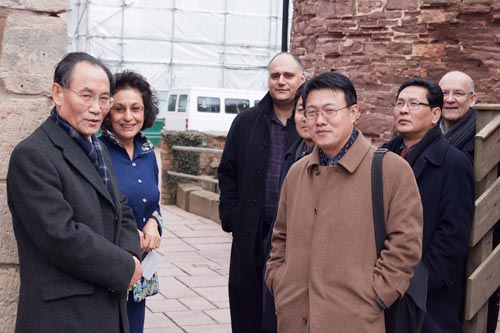
Pictured above on the left: Pak Kyong Son, Vice Department Director of the Korean Workers Party Central Committee.  Pictured on the right: Glyn Ford, Member of the European Parliament.
Photo by Irina kalashnikova, [email protected]
www.irinakalashnikova.com

LONDON – Britain is hosting the first ever delegation from the Workers’ Party of Korea (WPK) amid hopes that this will help to restart a dialogue between Pyongyang and the European Union on human rights, denuclearisation and other issues and lead to transfers of renewable energy technology to North Korea.

Labour Party member of the European Parliament (MEP) Glyn Ford, one of Europe’s top North Korea experts who has visited Pyongyang a dozen times, told NKEW that he was pressing the delegation to agree to reopen the dialogue that was broken off in 2005 after the EU sponsored a resolution at the United Nations in Geneva that was highly critical of North Korea’s human rights record.

He said it was hard to tell whether the four-member delegation would recommend reopening of the dialogue to decision-makers in Pyongyang. “It’s not the style of North Korea to make decisions on the spot,” Ford noted. He said he personally had opposed the resolution, which was supported by the US and Japan, because it was almost certain to result in suspension of the highly sensitive dialogue which had only just begun.

The four-man delegation is visiting Britain for a week and they are also going to Bristol and Cambridge. Ford accompanied the group to Bristol as this west of England city lies in his Euro-parliamentary constituency, and it is close to the possible site of a giant barrage across the river Severn which is currently being considered as a source of generating green electricity.

He said a deal on the nuclear issue and on reviving the human rights dialogue could result in the EU agreeing to provide wind, tidal and other renewable technology to North Korea, just as the EU has provided €500 million ($640 million) in humanitarian aid over the last eight years.

The delegation includes a scientist with a background in renewable energy, added Ford who has an MSc in marine earth science. He said the west coast of Korea has a tidal range of 11 metres (36 feet), which could make it highly suitable for an electricity-generating barrage. The Severn has a tidal range of 14 metres, the second highest in the world.

Tidal barrages are an attractive means of generating electricity because tides, unlike wind, are highly predictable, but the environmental cost of building a barrage over the Severn, up to 10 miles long, could be huge and there is considerable public opposition to the plan. But such factors are likely to loom less large in North Korea.

Ford said he had met three of the four-man delegation on previous visits to Pyongyang, and that he knew two of them fairly well. He is hoping to visit Pyongyang again with a European Socialist delegation at the end of March.

The group have already had a meeting with Foreign Office officials, who Ford said had presumably also pressed the North Koreans on human rights and the nuclear issue.

Apart from the North Korean visit to the UK, Britain’s Lord Alton, a veteran campaigner for human rights in North Korea, is due to visit Pyongyang early next month. Alton, a devout Catholic, is scheduled  to meet the chairman of Korean Religion Association and visit the Russian Orthodox church and the Jangchung Catholic church in Pyongyang. He will be one of the first Western visitors to the Russian Orthodox church, which opened in 2006 amid considerable official fanfare.

The WPK delegation’s visit to Britain has received little if any media attention so far. In fact hardly anyone would have known about it if the generally extraordinarily uninformative North Korean news agency KCNA had not announced on January 27 that “A delegation of the Workers’ Party of Korea led by Pak Kyong Son, vice department director of its Central Committee, left here today to visit the UK.”

Share
