Archive for the ‘International Organizaitons’ Category

Good Friends publishes price data

Tuesday, April 15th, 2008

North Korea Today No. 119 Apr 2008
End of March, Price of Rice and Maize Reaches Highest Level in History

prices.JPG

(click on image for more legible version)

The price of foodstuffs is increasing at an incredible pace. On March 30th, for the first time in the country, the price of rice went over the 2,000won per kilogram mark and was traded for 2,050won in the city of Nampo. In the case of maize, the situation is even more extreme. The rumors that the price of maize would go over 1,000won in April became a reality and was being sold for 1,000won in places like Pyongyang, Chungjin, and Hamheung, while in Nampo, it was being traded for 1,050won. In other outlying regions, maize was still being traded at high prices ranging from 900won-950won. Only in areas like Onsung, Hoeryung, and some border areas in North Hamgyong Province was rice being traded at the comparatively low price of 1,600won for rice and 650-750won for maize.

Share

South Korea continues imports of DPRK coal

Monday, April 14th, 2008

From Yonhap:

A North Korea-registered cargo ship carrying coal arrived in South Korea’s port city of Ulsan Sunday amid increased cross-border tensions, according to maritime police.

The 2,496-ton freighter Changseong carrying a 29-member crew docked at the port, South Gyeongsang province, around 10:20 a.m. earlier in the day.

The ship carried 4,000 tons of coal, the first batch of 12,000 tons to be delivered by April 25, the police said.

And how much are they paying? IFES has the answer…

North Korea, in keeping with rising international coal prices, appears to have hiked up the export price of heating briquettes twice in the last three months. A North Korea insider in Shenyang, China recently reported, “North Korea’s Trade Bureau Price Control Division raised export prices at least twice as this month came around, so the export price soared up to 50 USD per ton,” and, “As the rising international coal price trend continues, there is a high probability that North Korean heating briquette prices will also rise further.”

Last year, North Korean heating briquettes were exported at 30 USD per ton, but as 2008 rolled around and international prices suddenly shot up, DPRK coal prices rose by over 50 percent, putting a significant burden on Chinese importers. However, Chinese importers still prefer DPRK briquettes as shipping costs from alternatives such as Vietnam or Indonesia still make North Korean imports relatively inexpensive.

It has been reported that the DPRK Trade Bureau has approved the export of briquettes to China at below-official prices of 44~45 USD per ton in cases in which there is Chinese capital or equipment has been invested in the coal mine. These charcoal briquettes are North Korea’s largest export item, with China importing 170 million USD-worth in 2007 alone.

So if South Korea was lucky enough to get China’s price (an assumption that might not be the case): 12,000 tons (by April 25) x USD$50/ton= $600,000

Read the full articles here:
N. Korean cargo ship visits Ulsan  
Yonhap
4/13/2008

DPRK coal briquet export prices jump this year
Institute for Far Eastern Studies (IFES)
(NK Brief No. 08-4-10-1)
2008-04-10

Share

Koryo Tours quarterly update published

Wednesday, April 9th, 2008

Koryo Tours, run by Nick Bonner, Simon Cockerell, and Hannah Barraclough, has published its quarterly report.  Read it here.

Inside, readers will learn about the upcoming year in North Korean tourism (Americans likely allowed in for Arirang in the fall) as well as other information on the NY Phil’s performance in Pyongyang and the World Cup qualifier in Shanghai. 

Share

North Korean businesses expanding in Russia

Saturday, April 5th, 2008

From the Donga Ilbo:

A black Benz with the red license plate of “087” passed by quickly. 087 is a number used exclusively for the sedans of North Korean diplomats. It was easy to tell that the North Korean embassy located on this street recently purchased the luxurious sedan.

“The North Korean embassy has been full of life since the latter half of 2006 because of the increased number of North Korean workers sent to Russia, diversified businesses and growing efforts to secure energy supplies,“ said North Korean defectors that the Dong-A Ilbo report team met in Moscow.

North Korean workers will construct the next APEC forum venue:

In order to prepare for the APEC, the Primorsky regional government (on the North Korean border) plans to issue work permits to 12,000 North Korean workers in 2008, four times higher than the number of those last year. A foreign national, who has hired North Korean workers, said, “North Korean senior officials are lobbying fiercely in order to increase the quota for laborers. They even arrange free tours of North Korea for Russian government officials.”

North Korea companies revived:

Recently, North Korean companies, such as Daedong River, Neungra, Baekdu and Goonpyo, have established their offices in many parts of Russia.

A 39-year-old North Korean defector who has stayed in Russia for 12 years said, “I believe, out of the 49 Russian provinces, North Korean firms have established their offices in about 30 provinces. Some 90 percent of them are responsible for overseeing North Korean workers.”

Joint ventures between Russia and North Korea, which went into hibernation after the United States froze North Korea’s account at Macau’s Banco Delta Asia in 2005, have recently resumed their activities. “Joint companies, which were active in the early 1990s, such as Dongbang Seafood and Far East Marine Transportation, have resumed their businesses,” said one Korean-Russian residing in Nakhodka.

Wages and Taxes:

“North Korean companies, which are spread across Russia, have been collecting about $400 to 500 from each North Korean worker every month. It is then used as high ranking officials’ business expenses,” said a 46-year-old North Korean defector.

“The discontent of workers is growing because high ranking officials dine out at fancy restaurants and their wives purchase expensive clothes with money earned by them,” added the defector.

(Uncle Sam is the only other government I know of that also taxes the income its citizens earn outside of its territory)

The story also makes a big deal out of the fact that the North Koreans pay huge bribes to do business in Russia, but who doesn’t?

Big players, who deliver a large sum of bribes to Russians, have also recently emerged. A captain of a North Korea freight ship was caught March 12 on site while shipping 100 tons of crude oil without reporting to customs at the Slavyanka shipyard, southern Vladivostok. It was found that the captain gave $45,000 to the president of the crude oil storage company as a kickback.

Read the full sotry here:
N.Korea’s Businesses Thriving in Russia
Donga Ilbo
4/4/2008

Share

Scrap metal smuggling rampant in North Korea

Friday, April 4th, 2008

Institute for Far Eastern Studies (IFES)
NK Brief No. 08-4-4-1
4/4/2008

As smuggling scrap metal across the DPRK-PRC boarder has become widespread among North Korean residents lately, police are investigating the illegal trade, leading to the arrest of all of the residents in the border region that were involved in the smuggling. On April 1, the Daily NK quoted a source inside North Korea reporting that a group was arrested while transporting six tones of scrap metal to smuggle out to China via the highway connecting Yanggang Province’s Kabsan Town and Hyesan City, and subsequently imprisoned.

Those arrested were from ‘Unit 8’, an office in Hyesan under the direction of the People’s Trading Bureau regional office tasked with delivering and selling gold, food, oil and other goods in China and returning with materials needed in the North.

According to the source, “An order was handed down by the central government at the beginning of March to ‘come down hard on those scrap metal smugglers’, and the police and security force investigation is ongoing.” The source went on to report that in the Kumsandong Fertilizer Factory in Hyesan, “everything metal that wasn’t bolted down is gone, and only the walls of the factory remain…in the future [authorities] will punish scrap metal smugglers severely.”

It appears that scrap metal smuggling began to become popular in 2004, but these days, in the border areas, starving soldiers are using military vehicles to buy scrap metal from regions further from the border, then selling them in the Hyesan-Jangbaek border region. In the Yanggang and North Hamkyung Regions of North Korea, famine first spread in the mid-1990s, at which time emerged the presence of smugglers who quietly amassed copper, aluminum, nickel, and other metals and sold them in China. In response, North Korean authorities attempted to crack down, using public firing squads as a deterrent, but as border guards were in the pockets of smuggling residents of the border region, they became implicated in the cross-border illegal trading, and the crack downs became effectively useless.

Share

World Cup Qualifier: Under dogs vs. Running dogs

Tuesday, April 1st, 2008

Update 2 – 6/9/2008: YouTube video of the game

Both national anthems played

North Korean tem thanks the fans 

Update 1 –  4/3/2008: Interesting coment on DPRK sports social norms below… 

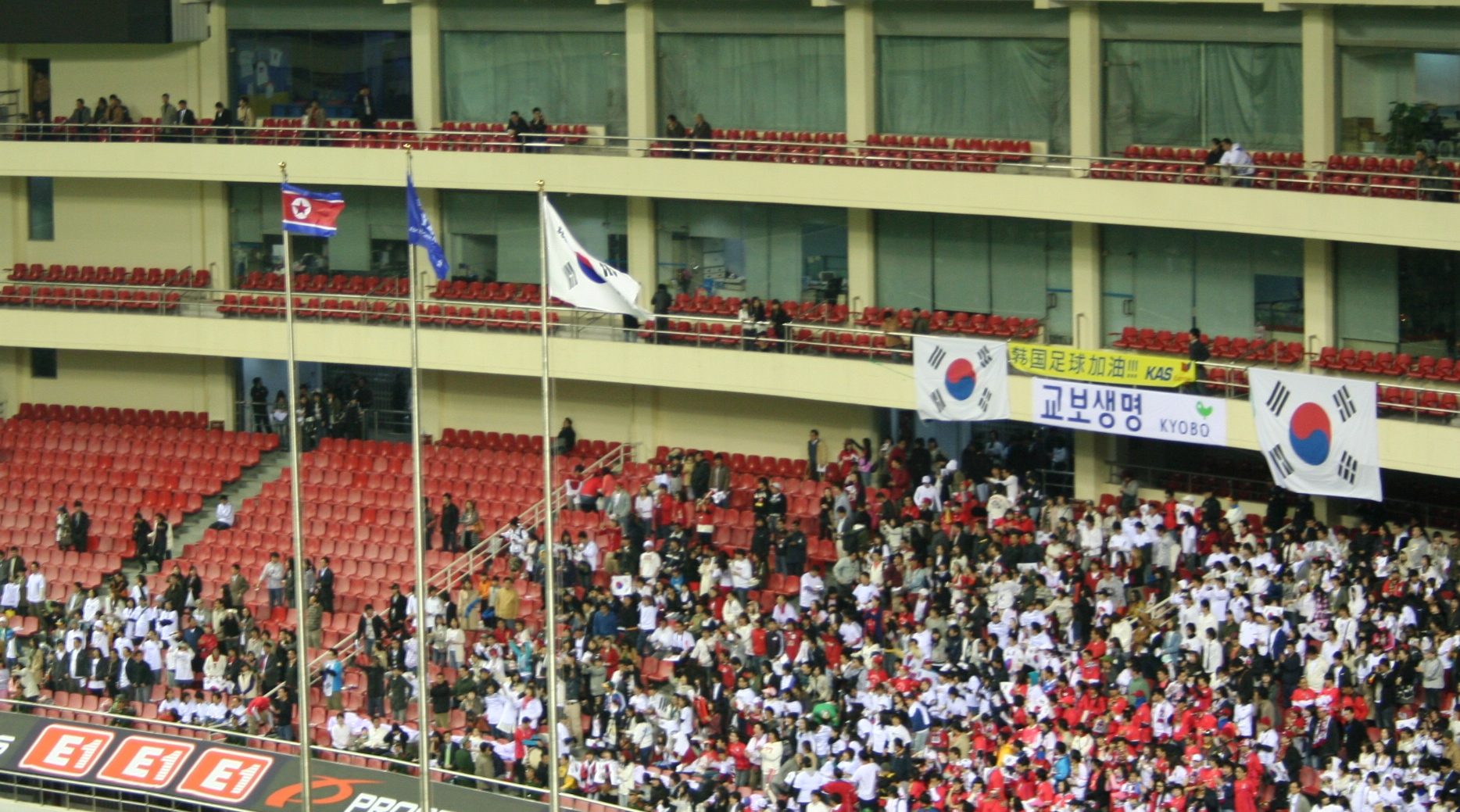
By pure serendipity I happened to be in Shanghai last week when the DPRK and South Korea faced off in their first world cup qualifier.  As readers are aware, this match was supposed to be held in Pyongyang, but after the DPRK refused to raise the South Korean flag (preferring instead a single “unification” flag), FIFA moved the game to Shanghai.

dprkflags.jpg

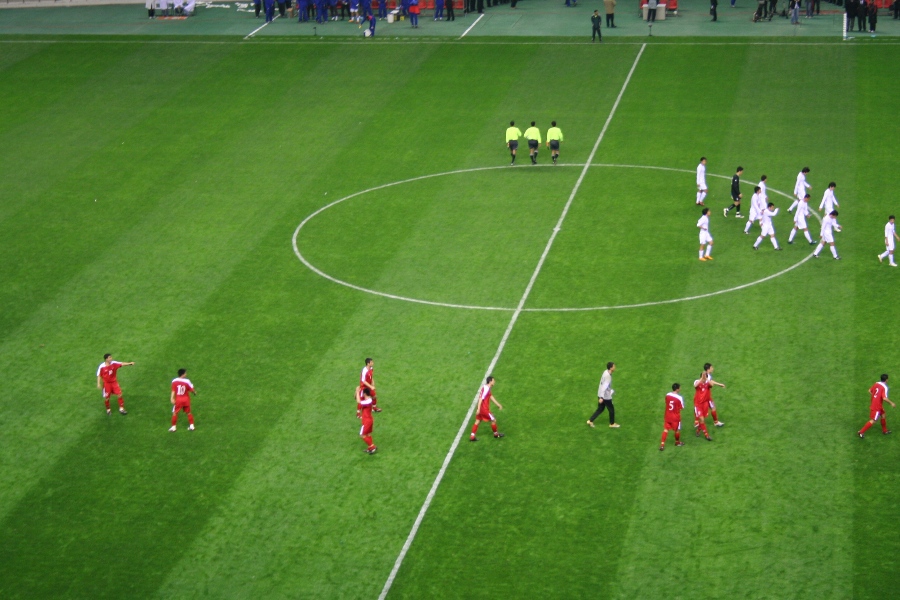
gameshot.jpg

Both flags were raised and national anthems were played–then the players took to the field.  The game was pretty exciting.  Although the final score was 0-0 both teams played like they wanted to win.  The South Koreans were the clear favorites, so it was a surprise when the game ended in a tie.  Fortunately, I could not contact my bookie from China.

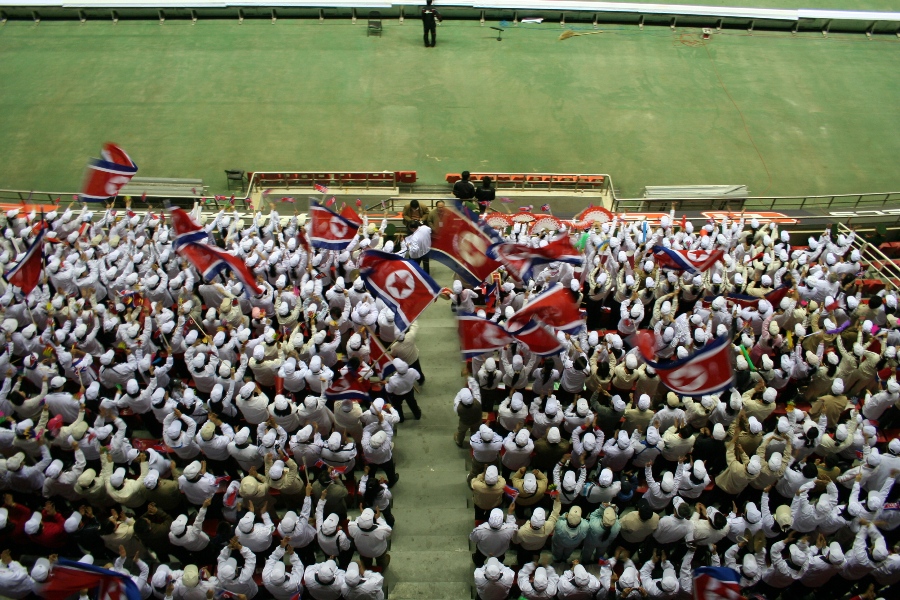
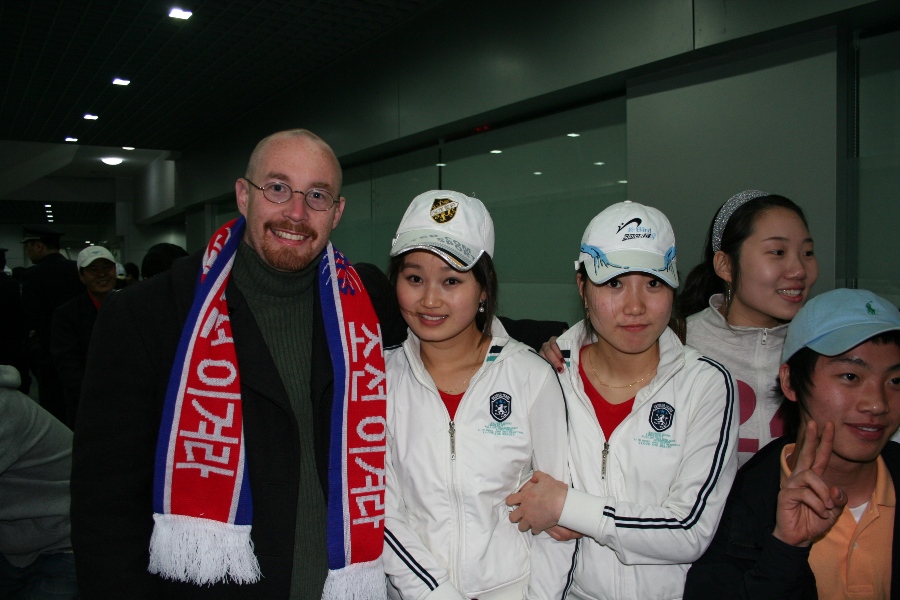
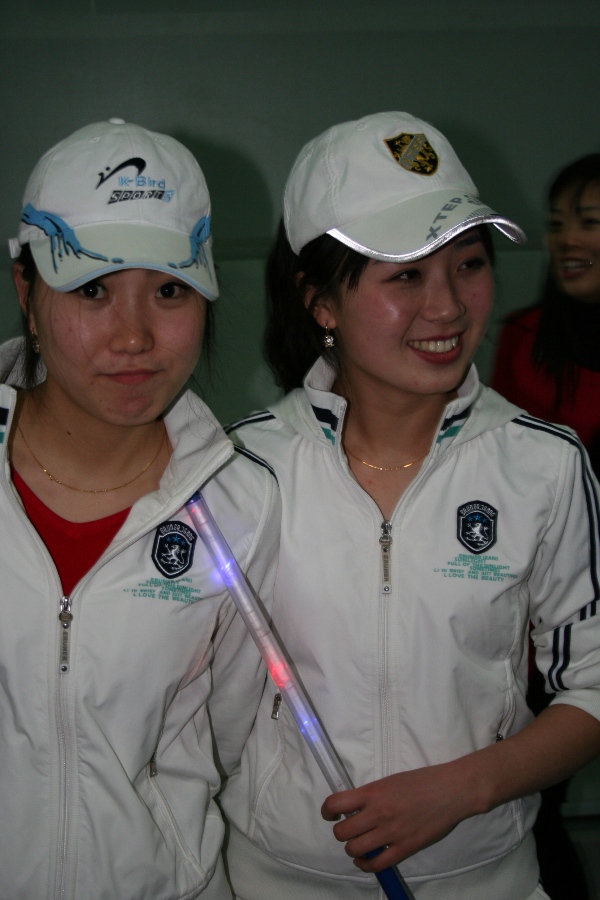
dprkfans.jpg dprkfans2.jpg

Above: the North Korean fans sitting directly below me.

Although it was a “home” game for the North Koreans they were drastically out-numbered by Southerners and contained together in their own section.

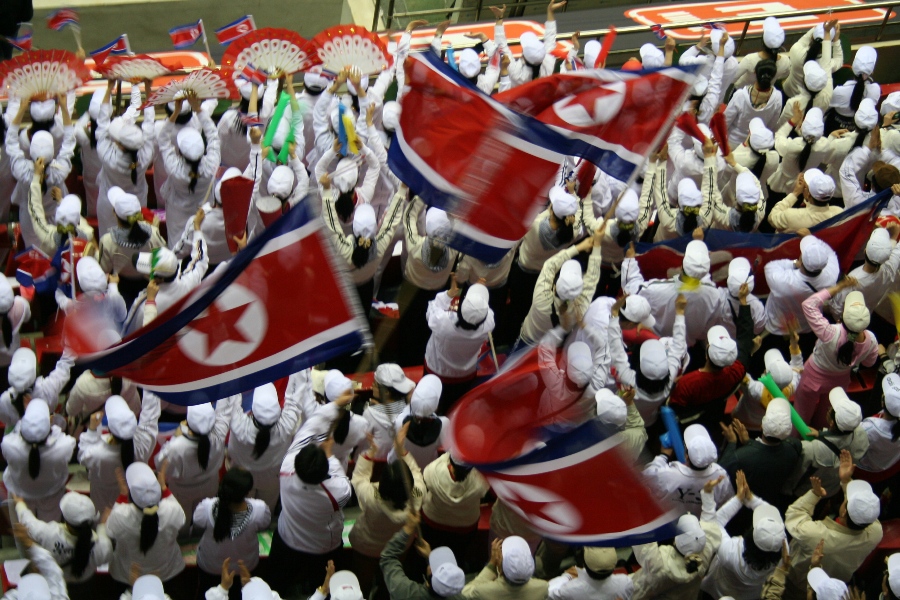
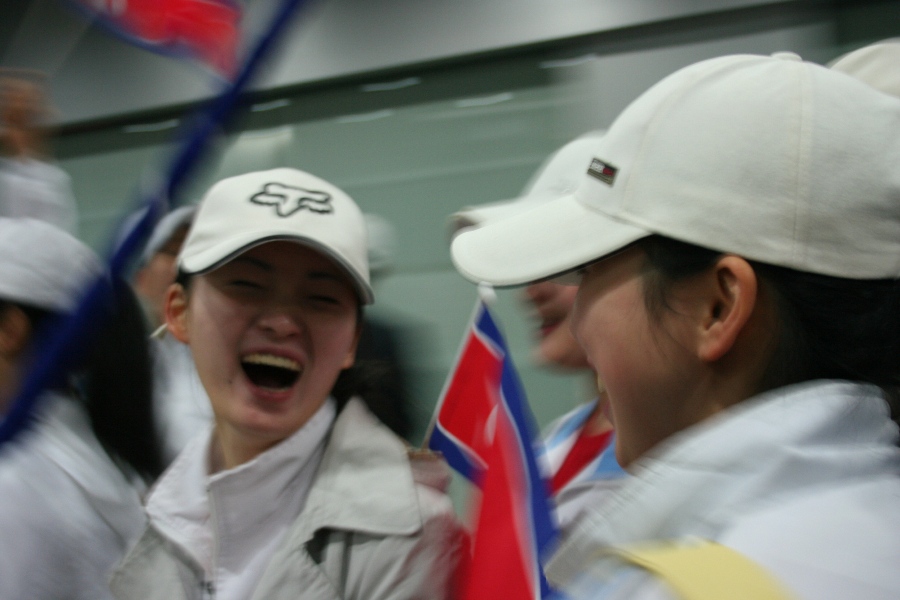
dprkfun2.jpg dprkfun.jpg dprkfun3.jpg

Scarves available from Koryo Tours!

The Northerners were quite accessible, however, in the hallways at half-time and after the game. The few I spoke with were language students, business students, engineering students, and businessmen, mostly all from Beijing and Shanghai.  They were organized into groups like Japanese tourists, but it was nice they made the effort bringing out some supporters for the home team. 

Thanks to Simon for the tickets, scarves, and the title.

UPDATE
nkmonitor:
The DPRK fans seem pretty friendly. By the way, where they mostly Chaoxian Zu or actual DPRK citizens? Where they aware of the controversy surrounding the match?

Simon: 
All the ones in white clothes (as seen in the pics taken from above) were full-on DPRK citizens, as mentioned in the piece above they were mostly working in Beijing and Shanghai; there were airline staff, businessmen, students, waitresses, etc all there. The Chinese chaoxian zu seemed to be sitting on the upper stand across the stadium, at least there were a load of people dressed drably, not really making any noise and they had a couple of NK flags out so I assume this was them. The NKs in the lower stand made a bit of noise and had big singalong at the end. When people attend matches in Pyongyang they tend to just sit in silence regardless of how it is going so this did make a refreshing change from that scenario.

Share

Air China finally lands in Pyongyang

Monday, March 31st, 2008

According to Reuters, Air China on Monday launched service to North Korea, making it the world’s only foreign airline to fly regularly to Pyongyang.

The Beijing-Pyongyang flight route was postponed by three months after Air China said preparatory work took longer than expected.

Air China will fly the return trip three times per week, making Pyongyang a Star Alliance destination, the airline grouping led by Singapore Airlines, Lufthansa and United Airlines.

Air China said previously that it saw the financial potential in the route, primarily from the Chinese tourist business.

I predicted that Air China would primarily service Chinese customers, with Westerners sticking with Air Koryo, the North Korean airline. In separate conversations with Koryo Tours and Walter Keats both tour operators expressed a preference for Air Koryo because of its flexibility and unique atmosphere, neither of which Air China can easily match. 

The time-warp effect travelers feel when boarding an Air Koryo flight, however, might be soon diminished.  Largely at the insistence of Beijing, Air Koryo has recently updated its fleet to meet international safety standards.  Although the stewardesses appearance and speaker announcement welcoming arrivals to the land of “juche paradise” will likely remain the same, the 1950’s era deco interior will certainly take on a more conventional feel. 

Source material here:
Air China launches flights to North Korea
Reuters
Simon Rabinovitch
3/31/2008

Share

Pyongyang International Trade Fair and IT delegation

Monday, March 31st, 2008

GPI Consulting is once again hosting an IT business delegation in conjunction with the Pyongyang International Trade Fair this spring. 

Marketing language:
Business trip to the “11th Pyongyang International Trade Fair” (May 2008)
North-Korea is slowly opening up to the outside world. The trade with neighboring China and South-Korea is already growing fast, and also several European companies are conducting business. An excellent way to collect information and to make new contacts is by visiting the annual “International Trade Fair”, wich takes place from 12-15 May in Pyongyang. Companies interested in exploring business opportunties in North-Korea are invited to join our 10-17 May IT-business mission. The participants will be offered a tailormade program, with a focus on the International Trade Fair. For European companies, it is possible to make use of a collective European stand: for only 600 Euro, they can present their products or services to the public (or have them presented by local staff).   
 
IT- and multimedia study tour to North-Korea (May 10-17, 2008 )
The main focus of our business mission is to explore IT opportunities in North Korea. The goal of this studytour is to give the participants detailed information about offshoring. The IT-participants will visit firms in Pyongyang in the field of IT, animation, 2D and 3d design, cartoons, computer games, mobile games,and BPO. The business mission will have an informal character, with some attention to cultural or touristic elements. The trip will start in Beijing, and after returning from North Korea, an extension of the stay in China is possible in order to visit additional firms. The program of the tour has been added, and can also be found at: www.gpic.nl/NK-IT-tour.pdf   
 
Contact Information: 
Paul Tjia (sr. consultant)
GPI Consultancy, P.O.  Box 26151, 3002 ED Rotterdam, The Netherlands
tel: +31-10-4254172  fax: +31-10-4254317 E-mail: paul@gpic.nl  Website: www.gpic.nl

Share

Chollima Leadership Program announced…

Thursday, March 27th, 2008

This new program, co-sponsored by LiNK and the International Republican Institute (IRI), seeks to invest North Korea’s future by teaching former North Korean citizens  leadership and organizational skills so they may bring benefits to the DPRK when the doors are opened.

Fifteen candidates of different ages, genders, and experiences will be selected on the basis of their potential to benefit from the program.

The three week program will be hosted in Seoul where workshops will be conducted by experts and trainers from various countries and backgrounds.  Topics to be covered include: democracy and governance, rule of law, international human rights, comparative movements, comparative politics, business protocol and etiquette, and leadership development.

All applications must be submitted with all components completed by March 31, 2008. If you feel you, or others you know, would be a good candidate for the Chollima Leadership Program, please contact jane (at) linkglobal.org for more information and an application.

Here is a summary on the IRI web page.

Share

DPRK citizens turn to batteries, bicycles to solve energy shortages

Monday, March 24th, 2008

Institute for Far Eastern Studies (IFES)
NK Brief No. 08-3-24-1
3/24/2008

North Koreans, long suffering from a chronic engergy shortage, are now putting forth efforts to solve even this electrical issue on their own.

The Daily NK, a South Korean-based human rights organization, has learned from interviews with North Korean residents that these days, even in farming villages, families with regular incomes are relying on batteries to light their houses and power their televisions.

Many batteries are being imported from China, and there are also many households using bicycle-mounted generators to produce electricity to overcome energy shortages. Despite the fact that these North Koreans are living in a Socialist country that fails to provide them electricity, they are coming up with their own methods for solving problems.

According to these North Koreans, there is a difference in the way they are solving the electrical shortages in the cities and in the farming communities. In the cities, many are using rechargable car batteries. There, power is provied from around 8:00am to 1:00pm, and then again in the evenings from around 8:00pm until 11:00pm. During these times, batteries are recharged and then used later for lighting and watching television.

In order to use these batteries to watch television or videos, direct current needs to be transformed into 220-volt alternating current, requiring a small power converter. The prohibitive cost of such a converter means that in farming commuities, the use of batteries to power households is difficult.

This has led many in rural areas to find a slightly different method of solving their energy needs. In farming villages, small generators attached to the rear wheel of bicycles so that ‘human power’ is used to produce electricity.

The cost of a used car battery in North Korea is around 70,000 won, while a new battery could run as much as 120,000~160,000 won*. Batteries produced in China are of high quality, but if there is ever a problem, it is difficult to have them repaired. Therefore, ‘Daedong River’ car batteries produced in North Korea are preferred.

* The current black-market currency exchange rate is approximately 2,500 DPRK Won/ USD.

Share

An affiliate of 38 North