Archive for the ‘International Organizaitons’ Category

North Korea prepares to celebrate 60th Anniversary with a new mass games

Monday, May 12th, 2008

Koryo Tours Press Release
5/12/2008

British run Koryo Tours have just been informed that this year’s Mass Games in North Korea have been expanded to include two different events, both staged in Pyongyang’s May Day stadium with a full compliment of 100,000 performers. Running from August 4th until the end of September every day bar Sunday will see a 100 minute afternoon performance of an all-new Mass Games show named ‘Prosper the Motherland!’ staged specially for the 60th anniversary of the foundation of the Democratic People’s Republic of Korea, 9th September 1948. The classic ‘Arirang’ an 80 minute gymnastic and socialist realism extravaganza will be performed in the evening.

Koryo Tours are running their usual full compliment of tours during this time and details can be found on their website.  Koryo Tours offer regular group tours, tours for US citizens (only possible during the Mass Games), specialized trips including to Mount Paekdu, independent tours for small groups, as well as many others. This will likely be a bigger opening event than the Olympics and on a larger scale than ever before.

Share

North Korea on the Precipice of Famine

Tuesday, May 6th, 2008

Peterson Institute for International Economics Working Paper
May 2008
Stephan Haggard, University of California, San Diego
Marcus Noland, Peterson Institute for International Economics
Erik Weeks, Peterson Institute for International Economics

Download the paper here: haggard_noland_weeks_pb.pdf

Abstract:

North Korea is on the brink of famine. As detailed [in this policy brief], the margin of error between required grain and available supply has virtually disappeared. Local food prices are skyrocketing even faster than world prices. Aid relationships have been soured and the regime’s control-oriented policy responses are exacerbating distress.  Hunger-related deaths are nearly inevitable and a dynamic is being put in place that will carry the crisis into 2009, even if as expected, the US announces that it is sending 500,000MT in return for a signed nuclear declaration.
 
The US can provide aid in ways that maximize its humanitarian impact while limiting the degree to which aid simply serves to bolster the regime.  We know that aid is diverted.  Yet given the fragmented nature of markets in North Korea, diverted aid often finds its way into markets in the catchment area where it is delivered.  Geographically targeting aid to the most adversely affected regions and providing it in forms such as barley and millet that are not preferred by the elite can increase the ameliorative impact of assistance.  The Bush Administration has taken up the first part of this equation–requiring that most of its contribution to the World Food Program be targeted at the worst affected regions–but it could do more on the second part: providing aid in forms less preferred for elite consumption. It can also encourage others such as South Korea to follow suit.
 
The US should also exercise quiet leadership with respect to the refugee question as well. The Chinese government’s practice of returning North Korean refugees may reflect a natural self-protective response against the threat of a flood of migrants and even the breakdown of the North Korean regime; it was, after all, the notorious “hole in the fence” that helped precipitate the collapse of the Eastern European regimes. But the policy of returning refugees does not conform with China’s obligations under the refugee treaty and does not in the end serve the country’s underlying political objectives either; it simply serves to cutoff another escape valve, however small, that has contributed to taking pressure off of a rapidly deteriorating situation.

Share

Peterson Institute event featuring Marcus Noland

Friday, May 2nd, 2008

On Wednesday I attended a panel discussion featuring Marcus Noland, co-author (with Stephan Haggard) of Famine in North Korea, and three North Korean defectors.  Here is the video of the event.  Below is the information on the event from the Peterson Institute website:

Press release (slightly updated w/ comments from the talk)
North Korea is once again headed toward widespread food shortage, hunger, and risk of outright famine. According to Peterson Institute Senior Fellow Marcus Noland, “The country is in its most precarious situation since the end of the famine a decade ago.”
figure-1.JPG

Click for larger view

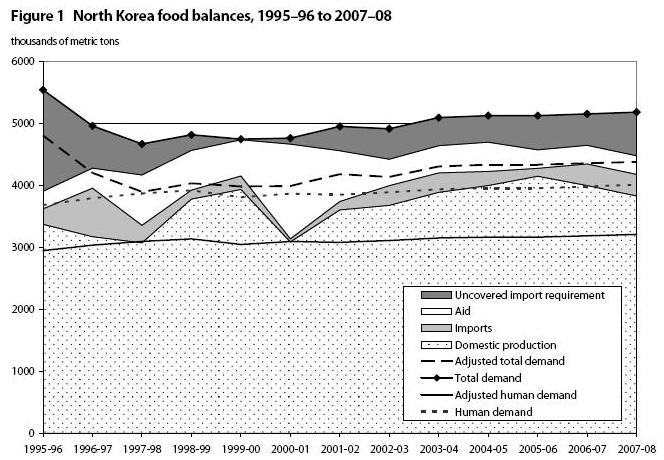
Calculations by Noland and Stephan Haggard, University of California, San Diego, indicate that the country’s margin of error has virtually disappeared. For technical reasons, estimates produced by the United Nations’ World Food Program and Food and Agriculture Organization (total demand) probably overstate demand implying recurrent shortages year after year (figure 1 above). Noland and Haggard argue that in recent years available supply has exceeded more appropriately calculated grain requirements (adjusted total demand) but that this gap has virtually disappeared. “This is a yellow light about to turn red,” says Noland.
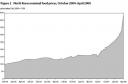
 figure2.JPG
Click for larger view

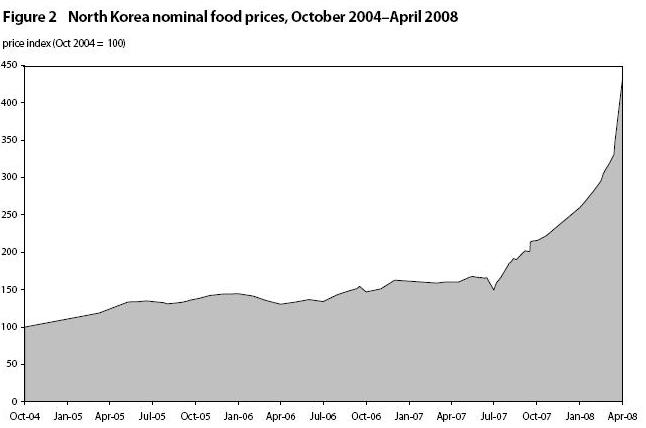
Food prices have almost tripled in the last year, skyrocketing at a rate faster than either the overall rate of inflation or global food prices (figure 2 above). Anecdotal reports describe a breakdown in institutions and increasingly repressive internal behavior. Noland and Haggard forecast that the North Korean regime will ultimately weather this challenge politically by ratcheting up repression and scrambling, albeit belatedly, for foreign assistance.

The North Korean food crisis, now well into its second decade, presents a difficult set of ethical choices. North Korea is critically dependent on food aid, but the government has recklessly soured its relations with the donor community. Yet in the absence of vigorous international action, the victims of this disaster will not be the culpable but the innocent. As of this writing, it already may be too late to avoid at least some deaths from hunger, and shortages of crucial agricultural inputs such as fertilizer are setting the stage for continuing food problems well into 2009.

Paper presentation
Noland discussed two recent papers, written with Haggard and Yoonok Chang, Hansei University, which are based on a pathbreaking survey of more than 1,300 North Korean refugees in China (11 different cities).  The survey provides rare and extraordinary insight into both life in North Korea and the experiences of the refugees in China.

Paper 1: Exit Polls: Refugee Assessments of North Korea’s Transition 
Results from a survey of more than 1,300 North Korean refugees in China provide insight into changing economic conditions in North Korea. There is modest evidence of slightly more positive assessments among those who exited the country following the initiation of reforms in 2002. Education breeds skepticism; higher levels of education were associated with more negative perceptions of economic conditions and reform efforts. Other demographic markers such as gender or provincial origin are not robustly correlated with attitudes. Instead, personal experiences appear to be central: A significant number of the respondents were unaware of the humanitarian aid program (40%) and the ones who knew of it almost universally did not believe that they were beneficiaries (96%). This group’s evaluation of the regime, its intentions, and accomplishments is overwhelmingly negative—even more so than those of respondents who report having had experienced incarceration in political detention facilities—and attests to the powerful role that the famine experience continues to play in the political economy of the country.

Paper 2: Migration Experiences of North Korean Refugees: Survey Evidence from China 
Chronic food shortages, political repression, and poverty have driven tens of thousands of North Koreans into China. This paper reports results from a large-scale survey of this refugee population. The survey provides insight not only into the material circumstances of the refugees but also into their psychological state and aspirations. One key finding is that many North Korean refugees suffer severe psychological stress akin to post-traumatic stress disorder. This distress is caused in part by their vulnerability in China, but it is also a result of the long shadow cast by the North Korean famine and abuses suffered at the hands of the North Korean political regime: first and foremost, perceptions of unfairness with respect to the distribution of food aid, death of family members during the famine, and incarceration in the North Korean gulag, where the respondents reported witnessing forced starvation, deaths due to torture, and even infanticide and forced abortions. These traumas, in turn, affect the ability of the refugees to hold jobs in China and accumulate resources for on-migration to third countries. Most of the refugees want to permanently resettle in South Korea, though younger, better-educated refugees prefer the United States as a final destination.

Other speakers: Several North Korean defectors also spoke as part of North Korean Freedom Week here in Washington DC.  Comments and biographies below:

Kim Seung Min: Founder and Director of Free North Korea Radio, the broadcasting program providing news and information to North and South Korea and China. Kim attended both elementary and high school in Pyongyang before serving in the North Korean Army. He escaped from North Korea to China in 1996 but was arrested and repatriated. While traveling from Onseong to Pyongyang to face punishment for leaving the country without government permission, he jumped from a moving train to escape to China again and eventually made his way to South Korea. He worked as a laborer at a coal factory in Yenji, China, until his uncle in South Korea helped him to escape to South Korea. He attended Yonsei University and Graduate School at Joong Ang University, where he received a Master of Arts degree. After serving in leadership roles in the North Korean defector groups, he founded Free North Korea Radio, which was available on the internet beginning April 2004 and began broadcasting on shortwave in December 2005 with regular daily broadcasting beginning in April 2006. (Born 5/6/62 in Jangang Do, North Korea)

*Mr. Kim was a captain in the KPA for 16 years.  He talked about how soldiers were no better off in terms of access to food than ordinary North Koreans.  Starting in 1986, the DPRK state limited food supplies to the military to only rice, leaving the generals up to their own devices for feeding the army.  This led to a break-down in discipline and now people resent the personal behavior of many soldiers who are looking for food.

Kang Su Jin:Founder and Representative of the Coalition for North Korean Women’s Rights, the only organization focused specifically on increasing awareness of the horrors facing North Korean women in China, the role of women in democratizing North Korea, empowering and encouraging North Korean women who have resettled in South Korea, and building cooperation with other organizations. Kang was a member of the elites from Pyongyang and was the Manager of Supply from 1991 to 1998 of the Bonghwasan Hotel in Pyongyang, the biggest hotel in Pyongyang, which catered to high-ranking party and army officials and was used for special events. When food distribution stopped in Pyongyang in 1996, the regime announced that all hotels had to operate on their own, and conditions became very difficult for the workers. Kang visited China and saw how much better off the people were and decided to defect to South Korea. (Born 10/23/66 in Pyongyang, North Korea)

Kim Young-il:President and Founder of People for Successful Korean Reunification (P-SCORE), an organization founded in the fall of 2006, specifically to ensure the successful reunification of the Koreas would not adversely affect the South Korean economy. To that end, PSCORE, chiefly composed of young people, studies other reunification models, informs about the human rights conditions in North Korea, and prepares and educates young North Koreans to be ready to help lead a reunified Korea. Because Kim was not born into an elite family in North Korea, he was not allowed to attend university and was destined to become a coal miner after serving his mandatory military service. While in the military he witnessed many people including soldiers dying of starvation. His own uncle died of starvation and his cousins were left to wander the streets. His family made the decision to defect to China in August of 1996 instead of starving to death in North Korea. They survived there for five years bribing the police not to turn them in until they safely defected to South Korea in January 2001. Lim received a BA in Chinese from Hankook University of Foreign Studies in August 2006. (Born 4/10/78 in Hamheung, North Korea)

*Mr. Kim still communicates with people in the DPRK on a regular basis.  He said that the price of rice inside the DPRK is sensitive to external supply shocks (or even the rumors of external supply shocks).  This means that reports of aid cut offs could result in temporary domestic price spikes even if aid is delivered.

UPDATE: Photo and coverage in the Daily NK.

Share

NKIDP Document in focus: North Korea in 1956

Monday, April 28th, 2008

Summary by James Person, North Korea International Documentation Project:

This Document (full journal article including documents here) consists of a memorandum of a conversation between DPRK Ambassador Li Sangjo to Moscow and Soviet Deputy Minister of Foreign Affairs N.T. Fedorenko, as well as a letter addressed to N.S. Khrushchev. Li sought a meeting with either Khrushchev or A.I. Mikoyan to press upon the Soviet leadership the gravity of the situation inside the DPRK and KWP CC following the historic 1956 August Plenum.
 
In the letter, Li described in detail the actions of the party leadership after being criticized both before and during the August Plenum by opponents to Kim Il Sung’s development strategies. Although the existing historiography, as well as North Korean propaganda characterizes the events of August 1956 as an attempted coup, Li suggested that the challenge was a democratic one aimed at eliminating the serious consequences of the personality cult and ensuring intra-party democracy and collective leadership, completely in accordance with the statutes of the KWP accepted at the Third Party Congress in April 1956. However, sycophantic and hostile elements in the party leadership “took revenge” on those who “courageously” criticized them. Li, who had long been a proponent of outside intervention, encouraged fraternal assistance. Despite the failure of earlier attempts to press upon Kim Il Sung the need to reform through comradely criticism by fraternal leaders, Li asked that a senior Soviet official be sent to Pyongyang to call a new plenum with all present, including the purged members of what became known as the “consumer goods group.” Li also indicated that he had sent a similar request to Mao Zedong.

Read the documents from the Soviet archives, including historical context here.

Share

Is South Korea’s engagement hindering the growth of North Korea’s markets?

Saturday, April 26th, 2008

On April 23, the Korea Institute for International Economic Policy (KIEP)hosted, “The Lee Myung-Bak Administration’s Policy toward North Korea: Denuclearization or Disengagement.”  In this seminar they essentially answered this question with a ‘yes’.

According to the Daily NK coverage of the event:

[Dong Yong Seung, the Chief of the Security and Economics Department of the Samsung Economic Research Institute stated,] “While economic exchange between North Korea and China has been business-to-business, in the case of Kaesong, the exchange has been controlled from a single control tower, the North Korean regime. That is, the condition has been set up for government-to-government economic exchange to facilitate North Korean government’s planned economy. Economic cooperation in the style of South Korea’s has been obstructing North Korea’s rational transformation.”

In a sense, he is arguing that South Korea’s support for the Kaesong Zone yields results more similar to foreign aid than private economic exchange.  If this is the case, South Korea, and just about everyone else, could learn from China’s strategy for investing in North Korea.

As Judge Posner put it:

All the problems that foreign aid seeks to alleviate are within the power of the recipient countries to solve if they adopt sensible policies. If they do not adopt such policies, then foreign aid is likely to be stolen by the ruling elite, strengthening its hold over the country, or otherwise squandered. What we can do for poor countries is reduce tariff barriers to their exports. With money saved from eliminating foreign aid, we could compensate our industries that would be hurt by import competition from poor countries and thus reduce political opposition to tariff reform.

Share

Market activity flourishes in the DPRK

Thursday, April 24th, 2008

Institute for Far Eastern Studies (IFES)
NK Brief No. 08-4-21-1
4/21/2008

The March issue of “Rimjingang”, a magazine publishing stories on life inside North Korea as reported by defectors and those still inside the DPRK, contains an eye-opening report on activities in North Korea’s markets.

Since 2003, North Korean authorities have legalized DPRK markets throughout the country. The previously existing farmers’ markets were remodeled into ‘combined’ general markets and all traders were permitted to sell their wares. After the legislation was passed, even in Pyongyang general markets emerged in each neighborhood.

According to the magazine, more than 60 markets have been set up, with each market housing around 50 traders. The use of mannequins at clothing stores and attractive price tags used to catch the eye of the shopper are in force. These days, it is not even surprising to hear cassette players extolling the virtues of a particular vendor’s goods. Sellers here do not speak abruptly to customers as they might in a State-run store. In markets, one can hear respectful language used even to children. These are not ideas taught by the labor bureau, but rather independent ideas put to use by the sellers.

Stalls selling a variety of seafood can also be found in a number of markets. Mackerel, squid and flatfish from the East Sea are among the surprisingly fresh products on display. This seafood is not on display courtesy of the North Korean government, but rather is delivered by private entrepreneurs running refrigerated trucks from the coast to Pyongyang. According to the magazine, a number of delivery services are in operation, providing goods to the highest level of North Korean society.

Around Pyongyang, a number of flower sellers have also popped up in the capitalist markets. It is custom to give flowers whenever there is an event in honor of Kim Il-sung or Kim Jong-il; but these days it is also popular for couples to give each other flowers as gifts. Even before the emergence of these markets, there was nothing that couldn’t be found in Pyongyang as long as someone had the money to purchase it.

Currently, women under the age of 39 are prohibited from working in markets, and efforts to extend this restriction to women under 49 have raised tension with many women trading in the markets. ‘Good Friends’, an organization aiding North Korea, has reported that recently thousands of women have organized in protest against security forces in the farmers’ market in Chungjin.

Share

Air Koryo’s new Tupolev

Monday, April 21st, 2008

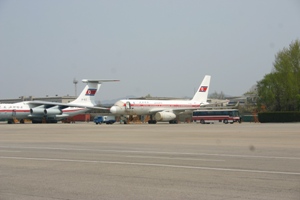
A recent traveler with Koryo Tours sent this photo of Air Koryo’s new Tupolev parked at Pyongyang’s Sunan Airport.  According to a woman at the airport, it starts flying May 1, 2008 (May Day).

airkoryothumb.JPG

Click on the image for larger view

Share

Nosotek: First European software firm based in DPRK

Sunday, April 20th, 2008

 “Nosotek is the first European-invested software development & research company in the DPRK, with the head office in Pyongyang.” – Interview with Mr. Ju Jong Chol (Vice-President of Nosotek)

Klaus-Martin Meyer: Mr. Ju, you are the Vice President of a very interesting company named Nosotek (www.nosotek.com). Could you please tell us something about this venture?

Ju Jong Chol: Nosotek is the first European-invested software development & research company in the DPRK, with the head office in Pyongyang.

It is founded by the General Federation of Science and Technology (GFST) of DPRK and experienced European IT-entrepreneurs. Felix Abt, the president of the European Business Association (www.eba-pyongyang.org) is one of Nosotek’s directors.

Nosotek is jointly run by European IT engineers together with their Korean counterparts. We have presently 50 engineers and a strong production line. We expect rapid growth thanks to our qualified, experienced and committed staff.

Klaus-Martin Meyer: What are Nosotek’s main products?

Ju Jong Chol: As we specialize on offshore IT outsourcing services we already have produced a large range of software products. Among our finished products, you find scientific software, video games, web applications, embedded software and 3D virtualization tools.

In case our customer needs a field of service where we don’t have experienced engineers in our own staff, the GFST will help us finding good people among the scientists of the universities. We can rely on sustainable DPRK and European engineering and business ressoucces.

Klaus-Martin Meyer: The DPRK is not the Silicon Valley or Bangalore. What are the customer’s benefits to do Business with Nosotek?

Ju Jong Chol: Of course, we’re not Silicon Valley or Bangalore. But we take the challenge to compete with these locations. The DPRK government took the strategic decision to give strong support to our IT industry which now bears fruits.

In the DPRK, software engineers have an average academic math level superior to their western or Indian counterparts.

Computer science education involves understanding of deep low level processes: when was the last time you hired a PHP programmer to realize he was quite at ease in assembler?

Klaus-Martin Meyer: Outsourcing to Asia is often identified with a risk of IP leak. Many western companies are complaining that after outsourcing their partners start copying their technology.

Ju Jong Chol: Then they are all invited to do their outsourcing projects in the DPRK! Our country is well known to have strong laws to protect secrets and we respect the value of IPs. And unlike what is common in other countries like China, there is only very little fluctuation of the workforce. Like in Japanese companies, our employees usually enter the company after university and stay their entire business life with the high personal motivation. This does not only help to keep trade secrets, it also helps to keep the experienced persons, who are needed for long-term partnership.

Klaus-Martin Meyer: How are the working conditions at Nosotek?

Ju Jong Chol: Our employee’s working conditions are far better than average, compared with both domestic and international standards: They work with state-of-the-art hardware, have free lunch, more holidays than in Europe and even a one-week vacation trip to a touristic place every summer, which is completely paid by the company.

Klaus-Martin Meyer: How difficult is it for you to acquire international business? What exactly are the main challenges?

Ju Jong Chol: Currently the main problem is the US sanctions against our country. For example, western customers are threatened by the US to prevent doing business with us. At the moment, it is very difficult to transfer money to DPRK. Luckily, together with our European partners we found good solutions and our customers will make their contracts with companies outside of DPRK.

Klaus-Martin Meyer: Is it possible to name some of your reference projects?

Ju Jong Chol: Unfortunately, this is not possible. Our policy is not only to respect our customer’s trade secrets and software IP, but also not to disclose the names of our customers. But please be assured, that some of our work products are used in large public companies, all over the world including USA.

Klaus-Martin Meyer: There are quite a lot companies from South Korea and also international companies working at the Kaesong special economic zone in North Korea. Are these Companies potential customers for Nosotek?

Ju Jong Chol: We are doing business all other the world. Of course, companies from Kaesong may be potential customers. Currently, our main focus is on Europe and Japan.

Klaus-Martin Meyer: The last question is our famous 5-years-questions. What is Nosotek’s outlook for the next five years?

Ju Jong Chol: Our goal is to create public awareness of the DPRK as a place where IT outsourcing can be done at the best ratio between price and quality. Nosotek will grow and the business volume will highly increase.

Source here.

Share

Air Koryo and DPRK tourism update

Friday, April 18th, 2008

This morning the International Herald Tribune published an interesting AP story on Air Koryo, North Korea’s state airline.

As has been mentioned before, Air Koryo recently began upgrading its fleet–but guess who will seemingly be on the first flight? 

The airline also has taken delivery of its first new jet in years. South Korea’s Yonhap news agency, quoting diplomatic sources in China, reported Thursday that North Korea’s reclusive leader Kim Jong Il was likely to fly to Vietnam and China on the new plane next week.

Kim is widely believed to shun air travel. His previous trips abroad by luxurious special train were shrouded in secrecy and reports speculating on his destinations beforehand were not always accurate.

And although the economy at large is not doing so well, Air Koryo business is brisk. 

“The golden days are now[.]  They’re busier than ever,” says Nick Bonner of Koryo Tours. (paragraph edited)

In 1998, his Koryo Tours — which despite being similarly named for an ancient Korean dynasty is unrelated to the airline — escorted just 98 tourists to North Korea. The number doubled to 200 in 2006 and last year jumped to a still minuscule 1,100. Some of his customers also get into the country by train, a much longer trip.

Bonner said a roundtrip ticket on Air Koryo between Beijing and Pyongyang costs 2,550 Chinese yuan (US$365; €230) for economy and 4,340 yuan (US$621; €390) for business class.

What are Air Koryo’s most recent routes:

Air Koryo now has just three regularly scheduled international routes. Domestic service is said to be virtually nonexistent.

It flies roundtrip three times a week between Pyongyang and Beijing and twice a week to the northeastern Chinese city of Shenyang, an important source of trade for North Korea.

The other is return service once a week to Vladivostok. A flight to Khabarovsk, another city in the Russian Far East, stopped in 2005. The airline also had flew to Bangkok and Macau in recent years.

About the fleet upgrade: 

Perhaps illustrative of Air Koryo’s improving fortunes, in December it acquired a twin-engine Tu-204-300 jet manufactured by Russia’s OAO Tupolev, adding to its fleet of other Tupolev, Antonov and Ilyushin jets and turboprops.

Tupolev mentions the deal on its Web site, though did not disclose financial terms when asked.

A non-North Korean with intimate knowledge of the airline, who refused to be identified, confirmed the deal, adding North Korean pilots were receiving training in Russia with the craft set to begin operations at the end of April.

Although the article insinuates that economics are largely behind the fleet upgrade, a little nudging by China certainly did not hurt.  China gave Air Koryo a deadline to meet Beijing safety standards.  But despite China’s concern for air safety, Air Koryo still has one of the best records in the business:

Though concerns about safety have been raised — Air Koryo is banned from flying in the European Union — the carrier has apparently had just one major accident, a crash in West Africa in 1983 when the airline was known under a different name.

The plane, an Ilyushin 62 carrying 23 people, was en route to Conakry, the capital of Guinea, on an “international non-scheduled passenger” flight, when it went down in the Fouta Djall mountains, according to the Aviation Safety Network Web site. All aboard perished.

Air Koryo made its first flight to South Korea in August of 2000 to ferry 100 separated family members for temporary reunions with long-lost relatives in the South. The airline has made occasional flights to South Korea for special purposes as relations have warmed in recent years.

The article does not mention the other (minor) mishap in 2006:

On August 15, 2006 aircraft from Air Koryo (Tupolev 154B-2) on an international scheduled passenger flight from Beijing, China (Beijing Capital Airport) to Pyongyang, North Korea (Sunan International Airport) experienced a runway mishap (exited runway) during landing rollout after landing in bad weather at Sunan International Airport. No injuries were reported and damage to plane was minor. (Wikipedia)

Read the full article here:
North Korea’s quirky Air Koryo survives and, increasingly, appears to thrive
International Herald Tribune (AP)
4/18/2008

Share

Muted birthday celebration

Tuesday, April 15th, 2008

Rumors of food shortages in North Korea seem to be popping up everywhere (even on this website), so now any change in Pyongyang’s standard operating procedure is interpreted in the media as a direct result of this condition.  Changes in regime behavior might be related to food shortages, but then again, we are talking about the DPRK, and we don’t really know how or why many decisions are made.

The latest North Korean “Kremlinology” comes from Yonhap:

With neither foreign artists singing in praise of Kim, who is dubbed the “Sun of mankind” by the communist state, nor the standard massive gymnastic display performed by about 100,000 people on show, North Koreans started the two-day holiday in a low-key manner.

The North traditionally spends a lot on celebrating one of the nation’s biggest holidays on a grand scale, inviting many foreign musicians and art groups to perform in the “April Friendship Art Festival” that marks the birthday of the nation’s founder and unveiling large public monuments.

Pyongyang, however, has scaled down the previously annual event to a biennual in what analysts said is a measure to save badly needed foreign currency because of worsening hardships facing the country.

and as for Arirang…

The Koryo Tours website claims that Arirang will take place from August to the end of September.  This could change, but it is 2-4 weeks shorter than the last couple of years (although those were interrupted by floods!).

Read the full story here:
N. Korea marks late leader’s birthday amid economic hardship
Yonhap
Shim Sun-ah
4/15/2008

Share

An affiliate of 38 North