Archive for the ‘International Organizaitons’ Category

DPRK not about to collapse

Sunday, May 31st, 2009

Newsweek has an interesting article which makes the case that the DPRK economy is not as bad as the public tends to think.  According to the article:

…North Korea isn’t broke—and its economy has been moving away from collapse in recent years-. The Hermit Kingdom may not be getting rich—the CIA estimates its GDP at roughly $40 billion, ranking 96th in the world. But it’s not failing either, and for the past decade, its economy has grown at an average rate of about 1.5 percent a year, according to South Korean statistics. While Seoul estimates that the North’s GDP shrank by 2.3 percent last year, some analysts say it actually expanded, arguing that South Korea’s recent figures on the North are deflated for political purposes.

To understand how the Dear Leader has managed this, you must first drop a few of the myths surrounding his country. First, the North Koreans haven’t been living in caves for the past two decades, nor is their economy de-industrializing, as is sometimes reported. Instead, with help from Beijing, Pyongyang has revamped its outdated infrastructure in recent years and repaired the mining facilities that were battered by massive floods during the mid-’90s. It now aims to shift from recovery to growth, with a focus on steel production, mining and light-industrial manufacturing.

Second, the North doesn’t have to rely on the black market to support itself. True, Pyongyang has sold missiles to Iran, Syria and Pakistan, and annual revenue from such exports is roughly $100 million, but analysts say that other illicit activities like drug trafficking and counterfeiting add very little to that sum. According to a former U.S. diplomat in East Asia who asked not to be named discussing sensitive intelligence, during the Bush years Washington investigated the oft-heard counterfeiting accusations, and found that the notes in question had actually been produced privately by former Chinese military officials, in China. “The Treasury Department couldn’t find a single shred of hard evidence pointing to North Korean production of counterfeit money,” the American says.

The biggest myth is that North Korea remains isolated. Despite supposedly comprehensive sanctions, Pyongyang today has diplomatic and commercial relations with more than 150 countries, including most European Union members. North Korea trades its abundant gold reserves—estimated at 1,000 to 2,000 tons—in cities like London, Zurich and Hong Kong, and buys and sells shares on the New York Stock Exchange via a legitimate London-based brokerage firm it essentially owns. While there are no figures on the volume of such transactions, the former U.S. diplomat says that such activities are “a substantial source of hard currency for North Korea.” In recent years, European firms have also begun eyeing investment opportunities there; In 2004, the London-based energy firm Aminex signed a 20-year deal with Pyongyang for exclusive rights to explore on- and offshore oil-and-gas deposits. Other companies are looking for ways to exploit the North’s cheap labor supply, and while most of these deals have yet to take off for technical and political reasons, ties to the outside world are expanding. In 2008, the country’s overall trade rose 30 percent from the previous year, reaching a record $3.8 billion, including imports of $2.7 billion, according to Seoul’s Korea Trade-Investment Promotion Agency.

North Korea has proved adept at avoiding restrictions: when Tokyo slapped it with sanctions five years ago, Pyongyang simply reshuffled its deals, turning to the BRIC economies as well as South Korea and Singapore. Meanwhile, China now accounts for nearly three quarters of North Korea’s total trade, sending it crude oil, petroleum and manufactured goods in exchange for coal, steel and rare metals like tungsten and magnesite. The North’s natural resources have become a major growth engine: the Musan mine in the country’s northwest is now said to be one of the largest iron-ore fields in Asia, and could eventually yield 10 million tons of ore a year.

Finally, there’s the southern connection. Despite deteriorating relations between Seoul and Pyongyang, factories at the joint Kaesong Industrial Complex are still operating at full gear, earning the North about $35 million annually—enough for eight or nine No-dong missiles. And that figure was projected (before the current crisis hit) to jump to $100 million by next year, says Lim Eul Chul of Seoul’s Kyungnam University.

I should point out that the CIA estimate of the DPRK’s GDP is among the highest.  Most other estimates are below $30 billion for 2008.

Read the full article here:
How Kim Affords His Nukes: The myth of a failing economy.
Newsweek
5/30/2009

Share

Koryolink mobile services

Sunday, May 24th, 2009

UPDATE: Excellent information in the comments

ORIGNAL POST: Last week many press reports claimed that the DPRK’s newly launched 3-G mobile phone service includes limited Internet access.  To take one example from the Associated Press:

North Korea has begun limited Internet service for mobile phone users, a government Web site reported, months after launching an advanced network in cooperation with an Egyptian telecoms company.

The service allows North Koreans to access a Web site through their phones to see news reports carried by the country’s official Korean Central News Agency as well as news about the capital Pyongyang, according to the government-run Uriminzokkiri Web site.

Uriminzokkiri did not give any further details in its report Thursday on whether the service is restricted to the capital Pyongyang or is available elsewhere.

The number of mobile phone users had reached 20,000 by the end of March, including some foreigners, Tokyo-based Choson Sinbo newspaper, considered a mouthpiece for the North Korean regime, said earlier this month.

I have not yet been able to locate the story on Uriminzokkiri, but according to a follow up story in the AP:

The Korean-language Web site as seen on an ordinary computer screen also allows viewers to listen to North Korean music, get information about books, art and investment opportunities in North Korea and even engage in Internet chatting. It was unclear, however, if those services were available in the mobile version.

So the “Web site” is actually a portal, and I am 99.99% sure that  it is not connected to the Internet at all but to either the DPRK’s intranet network, called “Kwangmyong,” or to a newly built self-contained computer network.  As an aside, however, many North Koreans (in Pyongyang anyhow) are aware of the internet

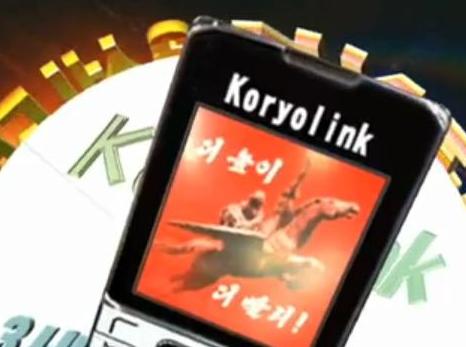
Strangely, here is an advertisement of sorts about the DPRK’s mobile network which several readers have sent to me.  I believe this was produced by the Chongryun, but this is merely a guess:

koryolink.JPG

Click on image for You Tube video

Here is a little history on the DPRK’s experiences with mobile networks (via teleography):

Mobile phones are tightly controlled in North Korea and were banned until November 2002. Two months later incumbent fixed line telco Northeast Asia Telephone and Telecommunications (NEAT&T) launched GSM-900 services under the banner SUN NET. However, cellular devices were once again banned following an explosion on a train in June 2004, which was thought to have been triggered remotely by a wireless handset. In January 2008 Egypt-based telecoms operator Orascom Telecom announced to the surprise of most that CHEO Technology, a joint venture between itself (75%) and Korea Post and Telecoms Corp (25%), had been awarded a licence to operate 3G wireless services by the government. Under the terms of its licence, CHEO is permitted to provide mobile telephony services for 25 years, the first four of which on an exclusive basis. The company launched the country’s first 3G network in the capital in December 2008 under the name Koryolink. By April 2009 CHEO had reportedly signed up 20,000 subscribers and its 3G network had been expanded to include the main road running up to the northern city of Hyangsan, with national coverage expected by 2012.

Read more here:
NKorea opens limited Internet cell phone service
Associated Press (via Forbes)
5/21/2009

NKorea allows limited Internet cell phone service
Associated Press (via Yahoo)
Kwang tae Kim
5/22/2009

Share

DPRK cancels Kaesong contracts

Saturday, May 16th, 2009

In what is certainly not good news for foreign investors, the North Korean government has announced that it is unilaterally canceling agreements with the South Koreans regarding the Kaesong Industrial Zone.

According to the Korea Times:

North Korea announced Friday the nullification of all contracts on rent, salaries and taxes at the Gaeseong Industrial Complex, asking the South to empty the industrial estate unless it honors the North’s wishes to amend related laws and rules.

The notification came about five hours after the two Koreas were unable to set a date for talks due to their wrangling over the release of a Southern worker detained by the North.

The North continued, “We are nullifying contracts and benefits on rent, salaries and taxes that we have offered in the Gaeseong complex in accordance with the June 15 Joint Declaration.”

The report added that the North will begin to adjust laws and rules to meet with the current situation.

“South Korean companies and officials must accept the notification, if not, they can evacuate from the complex,” it said.

In the article, Andrei Lonkov makes the following comment:

“North Koreans are clearly looking for some leverage over the South, and it they come to see the park as a hostage project, they will it use to put forward escalating demands,” he said.

He predicted, “If the South Korean government bows to the pressure and makes concessions, there is no doubt that in weeks or months Pyongyang manipulators will make new demands, probably more outrageous.”

“One can hope that the project will survive. Nonetheless, it will become dangerous if Seoul, in trying to save this important project, starts to succumb to Pyongyang’s blackmail. So, the project should be supported, at a cost to South Korean taxpayers, but not at the cost of unprincipled political concessions,” he added.

This has been a rough year for the Kaesong Zone.  I have kept a running timeline of events in the zone which you can see here.

UPDATES:

1. According to the Choson Ilbo: “North Korea earns some US$33.52 million a year from the Kaesong Industrial Complex, making the inter-Korean joint venture a significant cash cow for the impoverished country.”

2. According to Reuters:

News late on Friday that North Korea was cancelling all wage, rent and tax agreements with South Korea on the joint Kaesong factory park just north of their heavily armed border weighed on stocks in companies that have production units in the factory park, but had a limited impact on the broader market.

“Seoul market participants have become quite immune to North Korea-related news and tend not to react sensitively unless the development has a scale of impact that may affect South Korea’s sovereign rating,” Lee said.

3. NK pointman on South Korea, Choe Sung Chol, allegedly executed.  According to Bloomberg:

North Korea executed a former official in charge of inter-Korean relations, accusing him of allowing the population to develop a favorable image of South Korea, Yonhap News reported.

Choe Sung Chol, who was the point man on South Korea during the Roh Moo Hyun administration that ended in February 2008, was killed last year, the news agency reported last night, citing an unidentified person familiar with North Korean affairs.

While Choe was officially charged with bribery, he was executed for ignoring opponents and pressing ahead with closer ties with South Korea that threatened to make the communist state too dependant on its richer neighbor, Yonhap reported.  

4. The Choson Ilbo reports on the productivity of Kaesong’s Northern workers:

The basic monthly salary of North Korean workers at the complex is US$63.4, consisting of $55.1 in wages and $8.3 in social insurance. In addition, overtime work pay amounts to between $11 to 18.3 a month, and a welfare package subsidizing lunches, snacks and transport costs is provided at a range of between $36.6 and 47.9 per month. In total, the monthly salary of a North Korean worker ranges from $110 to 130, which, the companies argue, is comparable to that earned by workers in China and Vietnam.

A survey of some 40 firms operating at the complex was carried out after the first round of talks on April 25 to discover why these firms were having difficulty accepting North Korea’s demands. According to the survey, the productivity of an individual North Korean worker is just 33 percent that of a South Korean worker. In comparison, the productivity of Chinese and Vietnamese workers is 96 and 85 percent that of South Korean workers, respectively.

The companies also argue that it is difficult to accept North Korea’s demand to pay land use fees from next year, considering the fee they paid for building factories there. The fee for building factories in the Kaesong industrial park was $394 per one sq. m of land, compared to $122 in China and $65 in Vietnam.

5. According to the Korea Business Consultants newsletter (May/June 2009):

South Korea’s point man for North Korea said May 18 that the joint industrial enclave at Kaesong, just across the DMZ in the North, is “in turmoil” after the DPRK voided contracts governing the facility the same day, sending shares in firms that operate there tumbling. The KOSPI fell by 0.44 percent upon receipt of the news.

Read more below:
N. Korea Scraps Gaeseong Contracts
Korea Times
Kim Sue-young
5/15/2009

N. Korea declares inter-Korean contracts on Kaesong venture invalid
Yonhap
5/15/2009

N. Korea scraps contracts with South on joint venture amid tension
Yonhap
Kim Hyun
5/15/2009

Cabinet reshuffle
NKeconWatch.com

N.Korean Kaesong Workers’ Productivity Lags Far Behind S.Korean Workers
Choson Ilbo
5/19/2009

Share

Art in the DPRK

Wednesday, April 22nd, 2009

The Art Newspaper  published an interesting piece on how artists are trained and art is produced in the DPRK.

On artistic training:

All DPRK artists are members of state-run studio complexes where the art is actually created, and every artist has a formal ranking. These start at level C, move up through B and A, followed by “Merited Artists”, then “People’s Artist”. There are around 50 “Merited Artists” still working today and perhaps 20 “People’s Artists”, the best known being Son U Yong, Kim Chun Jon, Jong Chang Mo, Li Chang and Li Gyong Nam. Almost all artists working in oil and brush-and-ink are men but there are exceptions—for example Kim Song Hui, well known for her brush-and-ink work, is also a People’s Artist. There is also the Kim Il Sung Prize but artists normally have to be at least over 50 to receive this highest accolade, the most famous recipient being Jong Yong Man.

The top art institute is the Pyongyang University of Fine Art with various sections: brush-and-ink, oil, sculpture, ceramics, mural painting and industrial arts. Young artists are selected from around the country and if they are judged sufficiently skilled they will study here. Pyongyang University requires a minimum of five years study: at the moment there are 7-10 students studying oil painting and around 20 studying Korean brush-and-ink painting. In total there are around 150 students a year in the fine art department. Students enjoy class outings to local factories and much time is devoted to object and life drawing although not with nude models but, for example, girls in swimming costumes.

After finishing university the students are selected by various art studios—the Paekho or Central Art Studio, the Songhwa established in 1997 for retired artists, and the most active studio-compound, the Mansudae in Pyongyang.

On artistic style:

The art itself looks like classic Social Realist propaganda, that Beaux Arts technical tradition received through Russia, maintained by the Soviet Union and now, with the transformation of China, only being practised in North Korea, unchanged for more than 50 years. Abstract painting does not exist as it is deemed bourgeois and anti-revolutionary, and if some representational art can be purely aesthetic without political overtones, many landscapes do portray places of the revolution or of political significance.

Obedience to the ideology and excellence in its clear communication to others are what matter rather than any individual glory. This ensures an anonymity to much DPRK production that only its cognoscenti can penetrate. Experts can not only assign an artist’s name to a work, they can also determine whether it is an “original” or one of endless “copies” of an image.

Ever since the founding of the state in 1948, certain themes have maintained their place in the officially approved iconography of the “Fatherland” and it is hard to establish which artist first produced a specific image and when. These same images can be reproduced countless times over the decades. Thus much detective work is required to trace the origin of an image, the only real source being the annual “Yearbook” cataloguing official production.

As [Nick] Bonner explains: “The skill level is very high in academic drawing and painting, but the production is massive and it’s hard to find ‘pure’ pieces, you have to know the provenance or where things were first found.” Indeed, even the museums display copies, ostensibly to “preserve” the quality of the originals kept in storage.

More information on the Mansudae Art Company:

Here visitors, especially foreign tourists, are welcome to see the artists working in their small studios, watch the instructional video on the operation of the company, and buy some work from the large gift shop. Prices at the very top end for a “People’s Artist” can reach as high as €15,000, the favoured currency for all foreign transactions.

Woodblocks are a North Korean speciality, though nowadays they have been almost entirely replaced by lino prints with an attractive rich ink finish. The first ever exhibition of such prints in the United States, loaned from Bonner’s collection, opened last year at New York’s Korea Society, which is currently touring through the country. Initial editions are often very small, less than ten, but if the image proves popular the lino is either re-cut by the same artist or by a “copy” artist and signed by him.

At Mansudae there are also small-scale ceramic sculptures available, naturally of a propagandist nature, as well as more classical ceramics. There is even a startlingly realistic sculpture, reminiscent of Duane Hanson, of North Korea’s most famous ceramicist Uchi Soun (1919-2003) and examples of his widely-exhibited work for as much as €10,000 a pot. There are also striking large-scale figurative watercolours on paper and the highest-quality work, local ink paintings called “Chosonhwa”, some of which will be “thematic art” on revolutionary themes, as each artist will produce at least one a year for the state to show his support for the country. Mansudae employs some 150 of these ink-artists, compared with perhaps 60 oil painters. With some 1,000 members Mansudae produces at least 4,000 top level original works a year, though it also has a factory-style section producing copies for western hotels. Employees, who work a five day eight-hour week, are paid, dependent on level, at a similar rate to the national average, €35 a month for a worker and €70 for a technician.

More information on art in the DPRK: 

1. The Paekho Art Studio has partnered with Felix Abt to sell their art internationally.  Their web page is here.   The Mansudae Art Studio also launched a web page (click here).

2. Nick Bonner has a huge collection of North Korean art.  I have seen quite a bit of it, and it is impressive.  He also sells North Korean art through the Pyongyang Art Studio.

3. There are a couple of books on North Korean Art.  They are very different: North Korean Posters: The David Heather Collection and Art Under Control in North Korea.

4. (h/t Werner) The Mansudae Overseas Development Group, which has been building monuments and buildings across the developing world (mostly in Africa) is part of the Mansudae Art Studio.  

Read more below:
Inside the Democratic People’s Republic of North Korea
The Art newspaper
Adrian Dannatt
3/18/2009

Share

North Korea’s revolutionary operas

Wednesday, April 22nd, 2009

I was looking at the Koryo Tours web page and found the following information on North Korea’s revolutionary operas:

In the DPRK there are five revolutionary operas, all created in the early 1970s, which have been termed in North Korea as ‘immortal classics’.  In order of production date these are; Sea of Blood, The Flower Girl, A True Daughter of the Party, Tell O’ the Forest! and The Song of Mt. Kumgang. These operas are still performed to this day and on the occasions that performances take place it is even possible for tourists to attend the shows, the performing language is of course Korean but when foreigners are in attendance English language supertitles are beamed onto a wall beside the stage so that the narrative can be followed by visitors. All operas are full-scale, large cast efforts with amazingly high production values and these 5 shows have sustained their popularity over the decades. All of them of course contain strong political messages that reflect the issues concerning the country at the time of their writing up until the present day and people of all ages attend the shows frequently. For complete information on what comprises and constitutes a Revolutionary Opera and what characteristics and values it must have then there is only one book to read; On the Art of Opera by Kim Jong Il.

I have posted descriptions of the five operas below (each also from the Koryo Tours web page):

(more…)

Share

DPRK cell phone subscribers top 20,000- costs, services detailed

Wednesday, April 22nd, 2009

Institute for Far Eastern Studies (IFES)
NK Brief No. 09-4-22-1
2009-04-22

Since 3G cellular phones were first offered in North Korea last December, more than 20,000 customers have signed up for service. According to a recent report by the Choson Sinbo’s Pyongyang correspondent, the North’s cellular network is capable of providing voice and SMS services to as many as 126,000 customers in the Pyongyang area and along the highway between Pyongyang and Hyangsan, and is available to North Korean residents as well as foreigners in the North.

Anyone can procure a cell phone in the North by submitting required information on an application to a service center, along with an application fee of 50 Yuan, or approximately one Euro, or 130 Yen. Currently, telephones are selling for between 110 Euros for basic handsets, to as much as 240 Euros for phones with cameras and other functions. When a phone is turned on, a white ‘Chollima’ horse graphic appears over ‘Koryolink’ in blue, all with a red background. The trademark is said to mean, “The Choson spirit, moving forward at the speed of the Chollima to more quickly and more highly modernize the information and communication sector.”

To use one’s phone, a pre-paid phone card must be purchased. Three types of phone cards are sold for 850 won (A), 1700 won (B), and 2500 won (C), with ‘B’ and ‘C’ cards offering 125 and 400 minutes ‘free air time’, respectively. In order to see to it that its customer base continues to grow, the communications company plans to adjust prices, and offer services such as television and data transmission. Video and picture transmission and other technological preparations have already been made.

As has been previously reported, the service is provided by CHEO Technology Joint Venture Company, owned by the Choson Posts and Telecomm Corporation (KPTC) and Egypt’s Orscom Telecom Holding. There are now two service centers within Pyongyang. In December of last year, only one International Communications Center was established, but as service grew, a temporary sales office was set up in mid-March. The North Korean government purports to provide cellular service as part of its plan to improve the lives of the masses, and the number of subscribers is climbing daily. CHEO Technology plans to extend the coverage area to every major city, along all highways and along major rail routes throughout the country by the end of the year, with the ultimate goal of providing cellular service to every residential area in the nation by 2012. 

Share

North Korea’s programming industry

Sunday, April 19th, 2009

I came across this video (in Dutch with some English) featuring Leonid Petrov and Paul Tjia.  It contains some interesting information on North Korea’s computer programming industry.

computer-industry.JPG

Click on image to see film 

Paul Tjia of GPI Consultancyin the Netherlands has been running technology business delegations to the DPRK for several years.  Their next delegation will be taking place this May.  To learn more, you can read the marketing leaflet in PDF here.

Share

Friday Fun: Tourism, humor, and keeping up with the Joneses

Thursday, April 9th, 2009

Tourism:
koryotourslogo.jpgKoryo Tours has notified the world that the DPRK will be putting on the Arirang Mass Games again this summer.  American tourists will be allowed to attend–click here to book your tourMost other passport holders can opt for a longer visit–click here to check out the dates and locations.   I saw the mass games in 2005, and it is something I will never forget.


Humor:

Someone posted a North Korean comedy routine on Youtube.  If you have ever wondered if North Korean women wear Kim Jong il jumpers, consider the question resolved…though I am still not sure how funny it is.

dprkstandup.JPG

PART 1, PART 2

My local Korean language expert cannot understand the dialect over the audience noise and the music, so if any viewers out there know what it is about, please post in the comments below.  Here is an older post of North Korean (and other communist) jokes.

Keeping up with the Joneses:
The Guardian published a humorous comparison between the North and South Korean ambassadors in London.  Check out the PDF here.

Share

Limits of the “Lips and Teeth” Alliance: New Evidence on Sino-DPRK Relations, 1955-1984

Monday, March 30th, 2009

From the Wilson Center’s North Korea International Documentation Project:

The North Korea International Documentation Project is pleased to announce the publication of the latest addition to NKIDP Document Reader Series, Limits of the “Lips and Teeth” Alliance: New Evidence on Sino-DPRK Relations, 1955-1984.

The collection was specially prepared for the joint NKIDP-United States Institute of Peace conference, North Korean Attitudes Toward China: A Historical View of Contemporary Difficulties, and contains newly obtained documentary evidence on North Korea’s relations with China throughout the Cold War from Russian, (East) German, Albanian, and Hungarian archives. The 24 documents contained in the reader shed new and invaluable light on Pyongyang’s perspective of the Sino-DPRK relationship, and may force a reevaluation of the U.S. strategy of relying on China’s political leverage over North Korea to resolve contemporary disputes over North Korea’s nuclear weapons and ballistic missile programs.

Limits of the “Lips and Teeth” Alliance: New Evidence on Sino-DPRK Relations, 1955-1984 was edited by NKIDP Coordinator James Person with indispensable assistance from Tim McDonnell. NKIDP is part of the Center’s History and Public Policy Program directed by Dr. Christian Ostermann. This publication, like all NKIDP publications, was made possible by a generous grant from the Korea Foundation and is available for download free of charge from the NKIDP website.  

Download a PDF of the NKIDP reader here.

Share

DPRK bans goods from markets

Sunday, March 22nd, 2009

Institute for Far Easter Studies (IFES)
NK Brief No. 09-3-20-1
2009-03-20

According to the North Korea Intellectuals Solidarity group, North Korean authorities released a list of goods banned from markets across the country on March 15. The ban goes into effect on April 1. The official list is said to include almost all wares currently being sold in the North’s markets, effectively banning market operations and practically outlawing private trade.

It was also reported that notices posted in the Hyesan and Wei Yan markets, in Yanggang Province, included not only a list of over 200 goods banned from sale, but also dictated the price at which allowable goods were to be sold.

Any goods from the United States or South Korea are specifically banned, as well as goods manufactured through inter-Korean projects such as joint ventures or from within the Kaesong Industrial Complex. Medicines and other supplies provided by the United Nations or other international organizations are also banned. Prices on foodstuffs were set, with Chinese millet to be sold at 1800 won, foxtail millet at 1700 won, and adzuki beans at 2100 won. Prices for privately harvested grains, eggs, tofu, poultry, pork, soybean oil, and other goods were also announced.

This measure appears to be in line with ongoing efforts underway since last year to close the North’s markets. While its effectiveness remains to be seen, if authorities succeed in shutting down markets, it could further exacerbate the North’s critical food shortages. In October of last year, North Korean authorities from regional commerce management offices throughout the country announced a ban on the sale of Chinese and South Korean goods, industrial products, and rice, corn and other grains, but this policy was never enforced.

Share

An affiliate of 38 North