Archive for the ‘International Organizaitons’ Category

European insurers and LinkedIn nervous about the Swiss

Friday, March 20th, 2009

Over the last few years, the European Union has pursued an engagement policy with North Korea.   MEP Glyn Ford makes regular trips to Pyongyang to facilitate diplomatic progress; the German Freidrich Naumann Foundation runs economic education courses; European donors founded the Pyongyang Business School; and a small group of European ex-pat businessmen formed a de facto chamber of commerce, the European Business Association in Pyongyang.  Although European companies have experienced mixed success in the DPRK they continue to look for new opportunities

This morning, however, Felix Abt, a Swiss director of the PyongSu Pharmaceutical Joint Venture Co. in Pyongyang informs me that his life insurance policy (purchased from a European company) has been cancelled. 

“A European life insurance company cancelled my life insurance because I am a dangerous person living in a dangerous country. Credit card organisations cancel credit cards for such persons in such countries, health insurance companies come up with other reservations and limitations and the latest organisation that has just expelled me is LinkedIn with a very curious explanation.”

I am unsure how the cancellation of life insurance policies could impact other Europen investments in the DPRK, but the marginal effect cannot be positive.  Mr. Abt has been a resident of Pyongyang for years where he manufactures Western-quality pharmaceuticals.  Needless to say, the DPRK is very much in need of his services, so it is a shame that after all this time he is now considered a liability by his insurer.

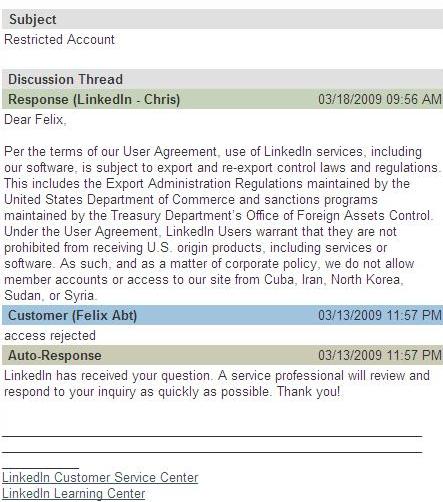
Mr. Abt also forwarded his rejection from the business networking site LinkedIn, which is posted below:
 

linkedin.JPG

Apparently LinkedIn‘s legal department considers logging into the server as “receiving goods of US origin” (the software I presume), and so it prohibits account holders, or even logging in, from Cuba, Iran, North Korea, Sudan and Syria—even if they are Swiss.

Share

DPRK scales back humanitarian work

Monday, March 16th, 2009

Below are excerpts from the Financial Times:

Pyongyang has told Washington that United Nations World Food Programme [WFP] staff will be barred from distributing food aid after March. The Stalinist regime has also told US non-governmental organisations to leave this month, and rescinded permission for other humanitarian groups to visit, the Financial Times has learned.

In an agreement last year, the US agreed to provide North Korea with 500,000 tonnes of food. The WFP was responsible for distributing 400,000 tonnes, with a consortium of NGOs led by MercyCorps in charge of the remainder.

In recent months, however, after North Korea refused to allow sufficient numbers of Korean speakers to join the WFP team, Washington halted food supplies.

Pyongyang has responded by barring food aid workers from operating in the country. So far, the US has supplied 100,000 tonnes to the WFP, and another 70,000 tonnes to the NGOs, which has not been completely distributed.

A US State Department official said that while the US was satisfied with the number of Korean speakers who were allowed to join the NGOs, it was unhappy that the same situation was not true for the WFP, which is responsible for distributing 80 per cent of the food. In addition to MercyCorps, the other NGOs are World Vision, Global Resource Services, Christian Friends of Korea and Samaritan’s Purse.

The official said the US was also responding to North Korea blocking aid workers from conducting a nutritional survey, which was included in the agreement.

“US aid workers have enjoyed tremendous co-operation in the countryside from North Koreans and we hope the DPRK government in Pyongyang will allow them to continue to feed the hungry,” said a Senate aide involved in North Korean issues. “Food aid should be separated from politics.”

Even before the North Korean threat, WFP had been forced to scale back operations because of the break in US funding. The WFP has only received 4.5 per cent of its $504m budget for North Korean operations. A WFP spokesperson said 4.5m of the 6.2m North Koreans targeted under the programme were not receiving assistance as of December.

“WFP hopes that the US will review the humanitarian situation and that food shipments will resume soon,” the spokesperson added.

North Korea recently informed the US that Eugene Bell, World Care and Kirk Humanitarian – three other US NGOs operating in North Korea – would not be allowed to make visits that were already approved. Pyongyang told the US that the planned visits were being cancelled because of “recent developments”.

Nancy Lindborg, president of MercyCorps, said North Korea sometimes temporarily blocked NGOs from visiting. However, she added that she was “hopeful and confident” that the visits would resume. She said her consortium had a “good working relationship” with its North Korean partners.

Read the full article here:
N Korea-US distrust halts food aid
Financial Times
Demetri Sevastopulo
3/17/2009

Below: State Department Briefing, Mercy Corps Press Release
US State Dept press briefing
Robert Wood, Acting Department Spokesman
March 17, 2009

QUESTION: Do you have anything to say or to confirm about North Korea cutting off or saying it does not want U.S. food aid —
MR. WOOD: Yeah.
QUESTION: — and kicking out U.S. NGOs over an accelerated timeline?
MR. WOOD: Yeah, yeah. North Korea has informed the United States that it does not wish to receive additional U.S. food assistance at this time. And we will work with U.S. NGOs and their North Korean counterparts to ensure that food that’s already been delivered – excuse me, food that’s already in North Korea is distributed to the intended recipients. And one of the things I also want to mention is that we have aimed to implement the U.S.-DPRK food aid program according to the terms agreed to by the United States and the North Korean Government in May 2008.
And I will give you just a breakdown in terms of the amount of food aid that we have provided. The U.S. has delivered 169,000 metric tons of U.S. food to North Korea in 2008 and 2009. The last shipment of U.S. food aid, which was nearly 5,000 metric tons of vegetable oil and soy blend, arrived in North Korea in late January and is being distributed by U.S. NGOs.
QUESTION: (Inaudible) of that?
MR. WOOD: Of which one, the 5,000 metric tons? Yeah, I am sorry. I don’t have any – any value here. We can try and get that to you in the Press Office.
QUESTION: Could you say when you were notified of this and how you were notified?
MR. WOOD: I don’t know, but it was obviously communicated to us by the North Koreans. I don’t know how that was done, whether it was done through the New York channel or some —
QUESTION: (Inaudible)?
MR. WOOD: Yeah, I just – I don’t know.
QUESTION: Last week maybe?
QUESTION: Just a clarification?
MR. WOOD: Yeah.
QUESTION: You said it’s being distributed by U.S. NGOs or UN NGOs?
MR. WOOD: U.S.
QUESTION: U.S.
QUESTION: Of the (inaudible) metric tons, what is it of? Is it grain? Is it – what is it?
MR. WOOD: Well, I’ll have to get the specifics on it, but I refer to our last shipment of U.S. food, which was, you know —
QUESTION: Oil and soy blend.
MR. WOOD: That’s right. I don’t have that breakdown. We can certainly try and get that for you, Sue.
QUESTION: Okay. .
QUESTION: (Inaudible), are you disappointed in this?
MR. WOOD: Of course. Absolutely. I mean, this was a program intended to try to help get food to needy North Koreans, and we’re obviously disappointed in that. This, you know, does not help us implement this agreement that we reached with the North back in 2008, so —
QUESTION: Well, not only does it not help you implement it, it kind of – I mean, are they abrogating the agreement?
MR. WOOD: Well, I don’t have the actual text of the agreement, so I can’t say with absolute specificity that they’re in violation of it. But we have an agreement to try to deliver, you know, this food assistance, and now the North is saying they do not want to receive any more assistance. So you know, we’re concerned about it.
But the food that is there right now in North Korea, we’re going to work with U.S. NGOs, with their North Korean counterparts, to make sure that this assistance gets to the people who —
QUESTION: Can you be a little bit more explicit about why you’re concerned about it, why you’re disappointed?
MR. WOOD: Well, I mean, clearly this is food assistance that the North Korean people need. That’s why we’re concerned. You know, this humanitarian assistance that we provide to the North has nothing to do with the Six-Party Talks. This is about our true humanitarian concern for these people. And as you know, the food situation in North Korea is not a good one, and so we’re very concerned about it.
QUESTION: Did they give you any explanation why they won’t – they didn’t want any more?
MR. WOOD: They have just said that they do not want to receive any additional food assistance at this time. That’s about as far as they went.
QUESTION: But no reason was provided at all? Just a one-sentence note you got?
MR. WOOD: I mean, it’s – I don’t know if it was one sentence that was given to us, but you know, that was the bottom line. And that’s the most important part of this.
QUESTION: And when did they inform you?
MR. WOOD: It was, I think, over the last couple of days, I believe.
QUESTION: Robert, do you know what the accelerated timeline for the withdrawal of the NGOs will be?
MR. WOOD: I don’t know.
QUESTION: It was supposed to be the end of May.
MR. WOOD: Yeah, I don’t know. Again, probably the best folks to address that are the North Koreans.

Press Release by relief organizations:
FOR IMMEDIATE RELEASE

March 19, 2008                                                                     

STATEMENT OF NGO PARTNERS ON CESSATION OF FOOD AID PROGRAM IN THE DEMOCRATIC PEOPLE’S REPUBLIC OF KOREA (DPRK)

Contacts:  Joy Portella, +1.206.437.7885, jportella@sea.mercycorps.org

March 19, 2009—The following is a statement issued by the NGO Partners that have been distributing food aid in the DPRK through a program supported by the U.S. Agency fro International Development (USAID). The NGO Partnership is led by Mercy Corps, co-led by World Vision, and includes Christian Friends of Korea, Global Resource Services and Samaritan’s Purse:

This week, North Korean authorities have asked us to close the USAID-supported food assistance program that we have been operating since June 2008. Our joint team, dedicated to this program, will leave the DPRK by the end of March.
 
We are saddened by this decision, but are very proud of what the program has accomplished.  Working closely with our North Korean partner, we have ensured that food reached almost one million vulnerable children, pregnant and nursing mothers and the elderly.
 
Each of our organizations has worked in the DPRK for more than a decade. We remain committed to assistance in that country, and our individual, on-going programs focused on health, water, sanitation and agriculture will continue as before.
 
The NGO Food Assistance program is part of a larger 500,000 metric ton initiative supported by USAID in which the World Food Program was to distribute 400,000 metric tons of food and the NGO Partners were to distribute 100,000 metric tons.  In the ten months of this program, 169,000 metric tons of food has been delivered to the DPRK, of which the U.S. NGOs have brought in 71,000 metric tons of food.  This food from NGOs has benefitted more than 900,000 people in the two north west provinces of Chagang and North Pyongan.
 
This has been a model program with unparalleled monitoring cooperation to ensure that food gets to those most in need. Our in-country staff of 16 people has worked closely with our North Korean partners.
 
The NGO food assistance program was scheduled to run until the end of May 2009. Until the end of the month, we will work with our North Korean partners to ensure a proper close-out.
 
We remain committed to helping the people of the DPRK to overcome hunger and improve their lives. The food program resulted from the tremendous humanitarian need in the DPRK. We will continue to work—as individual agencies and in cooperative partnerships—to address these needs. We hope the success of this program will serve as a model for the future.

Share

“Let’s plant more trees!”

Friday, March 6th, 2009

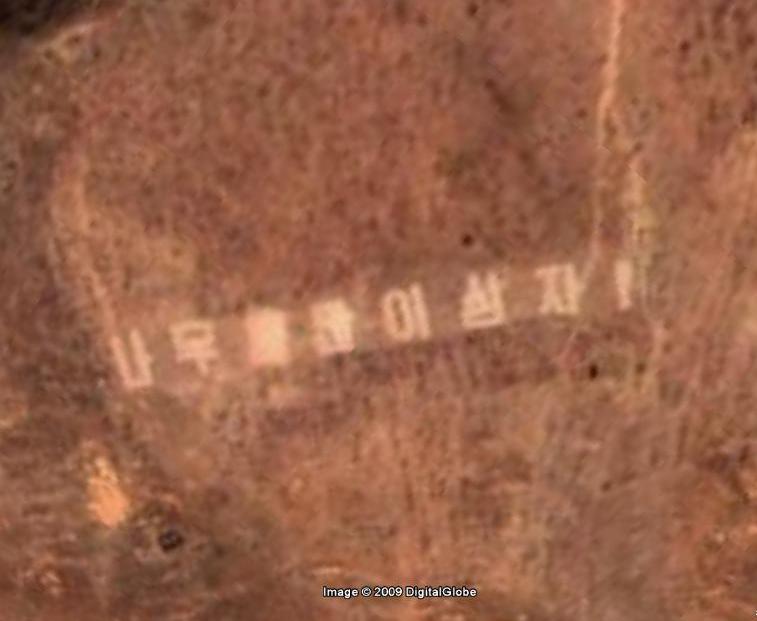
letsplantmoretrees.JPGAs regular Google Earth users are aware, the DPRK has experienced significant deforestation in recent decades from both private and state actors. The former have cleared land for fuel/heat and private food production. The latter have felled forests to export lumber. However, without private property rights over the lumber and corollary price signals, we have witnessed yet another “tragedy of the commons”–the over extraction of a common-pool resource. 

As can be seen in the image above, official reforestation campaigns have been launched several times.  According to Good Friends, the most recent was announced last September, shortly before the DPRK appointed a new forestry minister, Kim Kwang-yong.  According to the Yonhap article below, however, South Koreans and Europeans have been supporting reforestation projects in the DPRK for nearly ten years:

North Korean workers and students rolled up their sleeves Monday for Tree-planting Day, state-run media said, amid continuing aid from South Korea despite damaged political relations.

North Korea has a high deforestation rate, as residents have cut down trees for fuel. Deforestation is closely linked to the country’s chronic food shortages, as barren mountain slopes leave rice farms prone to severe flooding by summer monsoons, according to aid workers in Seoul.

The North Korean government has banned cutting trees and sought to make its country greener with aid from South Korea and some European governments.

“Covered with trees are mountains and fields of the country from the foot of Mount Paektu, the sacred mountain of the revolution, to the military demarcation line and from the eastern coast to the western coast,” the Korean Central News Agency said in an English-language report titled “Greening and Gardening Campaign Gets Brisk.”

“The tree-planting campaign is being briskly undertaken everywhere in the country … changing the appearance of the country beyond recognition day by day,” it said.

South Korean government and civic groups have been operating sapling fields in the North Korean cities of Kaesong and Pyongyang, as well as near the North’s scenic resort Mount Kumgang, providing seedlings, equipment and technology since 1999. The project has cost South Korea some 9 billion won (US$5.7 million), according to the Ministry of Unification.

Aid workers said the inter-Korean forestry project has continued even though Pyongyang cut off all government-level dialogue in response to Seoul’s hardline policy toward it that began last year.

Ahn Sun-kyong, an aid worker from Green One Korea, an umbrella group of over a dozen non-governmental organizations in Seoul, said it plans to build a seed preservation facility and an apple farm in Pyongyang as new projects this year.

“There may be certain limitations, but this non-governmental exchange project will continue,” Ahn said.

Hwang Jae-sung from the Korean Sharing Movement, which operates the Kaepung sapling field in Kaesong as a member of Green One Korea, said most trees are prematurely cut by residents, who also rake up fallen leaves for fuel.

“Deforestation is directly linked to the food problem,” Hwang, who last visited Kaesong in November, said. “We believe tree planting in North Korea is not only useful for preventing floods, but also can be another means of resolving the food shortages in the North.”

The aid groups say 16-18 percent of North Korean forests, or 1.5-1.6 million hectares out of the North’s 8.9 million hectares of forests, are believed to be deforested. About 80 percent of North Korea is covered by mountains.

Although the support offered by these groups is necessary to restore ecological health and productive power of the DPRK’s agricultural lands, an unfortunate consequence will likely be growing restrictions on private food production which will necessarily require the North Korean people to once again rely on the state for food distribution.

Read previous posts on forestry and environmental protection here.

Read the Yonhap story here:
N. Koreans work to make country green on Tree-planting Day: report
Yonhap
Kim Hyun
3/2/2009

Share

IFES February 2009 recap

Thursday, March 5th, 2009

Institute for Far Eastern Studies (IFES)
(NK Brief No. 09-3-3-1)
3/3/2009

INTER-KOREAN RELATIONS
As February began, North Korea continued to publicly warn that the two Koreas were on a path toward war, stating on February 1 that downward spiraling relations between the two Koreas were brought on by ROK President Lee Myung-bak The (North) Korean Central News Agency (KCNA) printed that Lee’s policies toward the North were “the very source of military conflicts and war between the North and the South,” and warned that tensions on the peninsula “may lead to an uncontrollable and unavoidable military conflict and war.”

Poll results released by the Korea Economic Research Institute on February 2 indicated that 68.4 percent of South Koreans support President Lee Myung-bak’s aid-for-denuclearization policy toward the North, and a separate poll by Gallup Korea showed on February 23 that 62 percent of South Koreans blame North Korea for strained inter-Korean relations.

A South Korean official stated on February 4 that 3,000 tones of steel plates that were to be sent to North Korea as part of the energy aid-for-denuclearization deal reached in 2007 would be delayed due to the North’s recent saber-rattling. According to the official, “It is hard to predict when we will send the steel plates. For now, we are not even seriously considering the timing…North Korea should first change its attitude.”

The South Korean government has shot down a project by an ROK journalist organization that would allow the exchange of news with North Korea. It was reported on February 4 that a Unification Ministry Spokesman Kim Ho-nyoun stated, “There are concerns that the exchange of news articles may undermine national security, public order and the interests of the general public.”

On February 16, it was reported the ROK Defense Minister Lee Sang-hee has mandated field commanding officers in all branches of the South Korean military to immediately respond to any North Korean provocation without first seeking permission from superiors. This has further heightened concerns over the possibility of a naval confrontation in the Yellow Sea around the disputed Northern Limit Line.

On February 19, North Korean media warned, “Now that the political and military confrontation between the North and the South has gone into extremes, a physical clash may break out at any moment,” and, “North-South relations have reached such a pass that there is no way to improve them or bring them under control.”

INTER-KOREAN TOURISM
Hyundai Asan, the South Korean company running the Kumgang Mountain tourist resort and the Kaesong City tours in North Korea is on the brink of bankruptcy. A Hyundai representative stated on February 4, “We are reaching a critical situation…unless the tours resume by April, it will be difficult for us to stay afloat.” Hyundai Asan brought in 255.5 trillion Won, or approximately 170.3 million USD, through tour sales in 2007, but in 2008, the company sold only 228.8 billion Won, or 152.5 million USD-worth of tours in 2008. The company employed 1,084 workers when tours were in operation, but has cut back to 479 employees. Of those, approximately 20 percent are receiving only 70 percent of their wages while they work from home. The tours have been on hold since a South Korean tourist was shot and killed at the Kumgang resort last summer.

ROK lawmaker Song Hun-suk stated on February 22, “Since the suspension of the [tourism] program, dozens of South Korean businesses and approximately 1,000 travel agents that offered organized trips to the North have gone to the brink of bankruptcy,” and he reported that approximately 30,000 North and South Koreans were on the verge of unemployment due to the travel ban, with 80 percent of shops and restaurants in South Korea’s Gosung, Gangwon Province, which is near the border, have been forced to close due to the absence of tourists passing through.

INTER-KOREAN TRADE
On February 3, the Korea International Trade Association (KITA) launched a new website, “Inter-Korean Economic Cooperation Information Center”, at http://interkoreatrade.kita.net. The website is designed to provide information and education on North Korean investment and inter-Korean cooperation

On February 8, South Korea’s Unification Ministry released statistics for 2008 regarding the Kaesong Industrial Complex. According to the ministry, production in the complex was up 36 percent over the previous year, reaching a value of 251.42 million USD. The total value of goods produced in the complex since it began operations in 2005 comes to 524.84 million USD.

The Economic Times ran an article on February 15 titled, “Ever heard of Gaesung? Gear up for its products,” in which it reports that the India-South Korea Comprehensive Economic Partnership Agreement (CEPA) soon to be signed will mean that India recognizes goods produced in the Kaesong Industrial Complex as South Korean goods.

ROK UNIFICATION MINISTER
On February 12, Korea University Professor of Political Science Hyun In-taek was sworn in as the new South Korean minister of unification. At his inauguration, Hyun stated that he is willing to meet with North Korean counterparts “at any time, at any place” in order to repair inter-Korean relations. Hyun has been criticized as being a hardliner, and an architect of the Lee Myung-bak administration’s “Vision 3000: Denuclearization and Openness” policy. Hyun was a key advisor during Lee’s presidential campaign, at which time Lee introduced the Vision policy, and was also a member of Lee’s presidential transition team, which at one point had advocated the shuttering of the Ministry of Unification.

U.S.-DPRK RELATIONS
A group of high-ranking former U.S. officials now advising the Obama administration on the DPRK visited North Korea during the first week of February. The group included Stephen Bosworth, Jonathan Pollack, Morton Avramowitz, and Leon Sigal. The delegation reported that North Korea does not appear to be rushed, and that they had taken a “wait and see” attitude in Pyongyang. Bosworth stated that “[North Korean officials] understand the Obama administration will need some time to sort itself through the policy review and the expressed patience, there is no sense of alarm or urgency.” He also noted that the officials were willing to move forward with denuclearization talks.

Leon Sigal stated on February 1, just prior to his visit to the North, “the Obama administration should promptly send a high-level emissary, perhaps former President Bill Clinton or former Secretary of State Henry Kissinger, to Pyongyang.” Sigal also wrote in an online opinion piece that Obama should “hold a summit meeting with Kim Jong-il in return for North Korea disposing some of its plutonium.”

On February 2, the U.S. State Department announced that it would impose sanctions on three North Korean companies for missile export violations. In accordance with the Arms Export Control Act, the Export Administration Act of 1979, the International Emergency Economic Powers Act, the National Emergencies Act, Executive Order 12851 of June 11, 1993, Executive Order 12938 of November 14, 1994, the Korea Mining and Development Corporation, the Mokong Trading Corporation, and Sino-Ki are subject to Nonproliferation Measures and Category II missile sanctions.

U.S. Secretary of State Hillary Clinton stated on February 13 that the Obama administration would be willing to normalize bilateral relations with North Korea if the North is genuinely prepared to completely and verifiably eliminate its nuclear weapons program. She stated that the U.S. would have a “great openness” to North Korea, and added, “It’s not only on the diplomatic front,” but that Washington had a “willingness to help the people of North Korea, not just in narrow ways with food and fuel but with energy assistance.” Two days later, North Korea’s head of state Kim Yong Nam reaffirmed that North Korea would “develop relations with countries that are friendly toward us.”

On February 17, Clinton reiterated the U.S. offer of a peace treaty officially ending the Korean War, normalization of relations, and aid, but stated, “The decision as to whether North Korea will cooperate in the six-party talks, end provocative language and actions, is up to them,” and , “If North Korea abides by the obligations it has already entered into and verifiably and completely eliminates its nuclear program, then there will be a reciprocal response,” indicating that North Korea will have to make the next move.

During a trip to South Korea, Clinton stated that North Korea was “badly miscalculating” if it thinks it can “drive a wedge” between Washington an Seoul, and that “North Korea is not going to get a different relationship with the United States while insulting and refusing dialogue with the Republic of Korea.”

U.S. SPECIAL ENVOY TO NORTH KOREA
Following his return from a trip to North Korea at the beginning of the month, former U.S. Ambassador to South Korea Steven Bosworth was named by Secretary of State Clinton as the Obama administration’s special representative for North Korea. He will remain dean of the Fletcher School of Law and Diplomacy at Tufts University, but will now be responsible for coordinating U.S. policy regarding the DPRK. Special Envoy Sung Kim is responsible for ‘day-to-day’ negotiations with Pyongyang.

UK-DPRK RELATIONS
A British parliamentary delegation arrived in North Korea on February 3, coinciding with a visit to London by a DPRK Workers’ Party of Korea delegation. EU Parliament member Glyn Ford stated that he hoped to reopen dialog that was broken off in 2005 on human rights, and denuclearization, hinting that restarting dialog could lead to the transfer of renewable energy technology to the North.

PRC-DPRK TRADE
It was reported on February 24 that trade between China and North Korea reached 2.78 billion USD in 2008, a 41.2 percent increase over the previous year. DPRK imports were up 46 percent, at over 2.03 billion USD, while its exports to China grew 29.7 percent, to 750 million USD. Mineral resources made up 54.7 percent of North Korea’s exports to China, and machinery and electronics made up the majority of imports.

DPRK NUCLEAR PROGRAM

(NKeconWatch: Although this is simply a reprint of the IFES report, I have been notified by NTI that this report is inaccurate. According to NTI Communications Director Cathy Gwin:

“I am writing to respond to your post that referred to erroneous reports that the Nuclear Threat Initiative (NTI) is preparing to open an office in Seoul ” in order to help prepare DPRK nuclear scientists for peaceful civilian employment.

The Nuclear Threat Initiative (NTI) has worked in the past to develop ideas on how governments could apply cooperative threat reduction (CTR or “Nunn-Lugar”) approaches as part of a solution to the North Korean nuclear challenge.  However, we have no current program to carry out those activities ourselves, nor do we have a program to retrain North Korean scientists.  In addition, we have no current plans to open an office in South Korea, and we do not have branch offices in Ukraine or Kazakhstan.  We have a main office in Washington, DC and a presence in Moscow.

January 31 was the deadline for North Korea to shut down and seal the Yongbyon nuclear reactor as part of 6-Party negotiations, but it failed to meet the deadline. Christopher Hill stated on February 3 that the U.S. would “hold on for a few more days,” but that “we’re not happy that the DPRK essentially has missed this very important deadline.”

On February 2, it was reported that the Nuclear Threat Initiative (NTI) would open a new office in Seoul in order to help prepare DPRK nuclear scientists for peaceful civilian employment. The NTI is in the process of building a program to retrain the North’s experts, and “is also considering ways to support not only nuclear scientists at Yongbyon, but also farmers near Yongbyon who provide them with rice,” according to Roy Kim, a professor at Drexel University.

The U.S. government criticized Pakistan’s decision on February 6 to release Abdul Qadeer Khan from house arrest. Khan as been under house arrest for the past 5 years, after admitting to selling nuclear weapons technology to North Korea, as well as Iran and Libya. In 2004, A.Q. Khan took full responsibility for selling the nuclear secrets, stating that the military and government were unaware of his actions. He recanted this confession last year, stating that he had been a scapegoat.

DPRK MISSILE LAUNCH PREPARATIONS
Several countries have reported intelligence pointing to a launch by North Korea of a Taepodong-2 long-range missile. The U.S. State Department warned on February 3 that “a ballistic missile launch by North Korea would be unhelpful and, frankly, provocative,” while the ROK Foreign Ministry noted that a missile launce would “constitute a clear breach of the UN resolution” adopted in 2006. Chinese Foreign Ministry Spokeswoman Jiang Yu stated, “We hope all the parties can recognize that maintaining stability is in the common interest of the people of the Korean Peninsula.” Preparations appear to be underway at its Musudan-ri base, near the DPRK-PRC border. A Taepodong-2 is thought to have a range of 6,700 kilometers (4,150 miles).

Amid reports that it was preparing the missile launch, North Korea’s Rodong Sinmun printed, “The DPRK’s policy of advancing to space for peaceful purposes is a justifiable aim that fits the global trend of the times. There is no power in the world that can stop it,” and, “ As long as developing and using space are aimed at peaceful purposes and such efforts contribute to enhancing human beings’ happiness, no one in the world can find fault with them.” North Korea continues to deny preparations for a long-range missile launch, and insists that it is preparing to launch a satellite

According to a researcher at the South Korean Agency for Defense Development, if North Korea were to launch a satellite, “given the size of the rocket, the satellite will likely be a low-orbit device,” and low-orbit devices usually need to be fired toward either the North or South Pole in order to successfully reach orbit. This would mean North Korea would need to use Chinese, Russian, Japanese or South Korean airspace.

JAPANESE FIRM, DPRK MISSILES
On February 26, Japanese police raided Toko Boeki, a Tokyo trading company with ties to the DPRK residents’ association in Japan. The company is suspected of trying to export magnetic measuring instruments that could be used to manufacture missiles to North Korea via a third country.

DPRK MOBILE COMMUNICATIONS
It was reported on February 5 that North Korea’s new 3G cellular network, built by the Egyptian company Orascom Telecom, has been very popular. Orascom Telecom Chairman Naguib Sawiris stated, that in the first two weeks of service, “so far we have about 6,000 applications. The important point is that they are normal citizens, not the privileged or military generals or party higher-ups. For the first time, they have been able to go to a shop and get a mobile phone.”

DPRK SPORTS
North Korea’s soccer squad defeated South Arabia 1-0 as it moved closer to the World Cup finals. The North now has seven points in Group 2, after four games, and is in second place, with only South Korea having more points. North Korea has not been in the World Cup finals since 1966.

KIM JONG IL BIRTHDAY CELEBRATIONS
Kim Jong Il’s 67th birthday was marked on both sides of the DMZ. In the North, ceremonies were held throughout the country on February 16, and special rations were provided to the people of the country, with extra noodles, rice and other grains given out to mark the day.

In South Korea, the Abductees’ Family Union marked the day by flying 100,000 leaflets with North Korean currency and criticisms of the North’s leader. South Korean authorities announced plans to investigate, as it is illegal for South Koreans to possess North Korean bank notes without permission.

DPRK SUCCESSION
More rumors were heard in February concerning who might succeed Kim Jong Il as leader of the North Korean regime. Kim’s youngest son, Kim Jong-un has reportedly registered as a candidate for the March 8 parliamentary elections, which would launch his political career. In addition, an editorial marking Kim Jong Il’s 67th birthday stressed the “inheritance of bloodline of Mount Paektu,” further stoking rumors that one of Kim’s sons may be next in line.

DPRK CENSUS
Results of a preliminary census by the United Nations Population Fund were released in February. According to the data, there were 24.05 million North Koreans as of October last year, with 11.72 million males and 12.33 million females. South Pyongan Province was the most populous, with 4.05 residents. 3.26 million people reside in the North’s capital, Pyongyang. This census, conducted by the United Nations Population Fund, was the first in 15 years to be conducted in North Korea.

Share

International Crane Foundation

Friday, February 27th, 2009

On my last visit to North Korea in 2005, fellow Atlanta native Ted Turner was also in Pyongyang (not at the Yangakdo unfortunatley, but the centrally-located Koryo Hotel) working to secure the DMZ as a crane reserve.  It turns out that this effort is fairly well organizaed and funded.  Below, I have attached some articles, names, and organizations involved in this movement:

The International Crane Foundation

Since 1974, ICF has been involved in conservation efforts for the Korean Demilitarized Zone (DMZ), the three mile wide strip of land between the divided neighbors that provides a home during migration or winter for half of the world’s White-naped Cranes and a quarter of the world’s Red-crowned Cranes.

Conservation in Korea

“For more than three decades, I have been coming to Korea to see the cranes that spend the winter along the DMZ. About one-third of the world’s 2,500 Red-crowned Cranes depend on the DMZ and the nearby Civilian Controlled Zone (CCZ) as their only remaining sanctuary on the peninsula. The Cheorwon Basin in the central highlands has the greatest numbers of cranes, while smaller flocks live in the Yuen Cheon valley, the lower reaches of the Imjin River, and the tidal flats around Kangwha Island.

The Red-crowned Crane is an auspicious symbol of good luck and long life throughout the Orient and cranes worldwide are a symbol of peace. Now perhaps the Red-crowned Crane can be a flagship for the conservation of the DMZ.

I have always tried to help my Korean colleagues in their efforts to save that priceless strip of land that’s carpeted by a grasslands, wetlands, and forests restored by the creative forces of nature over more that a half-century. Although it has been exciting to see modernization sweep it’s magic wand over Korea, it is alarming that humans now have such power to transform landscapes so quickly.

If the remaining natural landscapes of the DMZ and the CCZ are to be saved for nature, Korean conservationists from all walks of life must join together in a united front to negotiate with those more interested in development. This is now possible through a movement started in 1996 by two Korean Americans, Dr. Ke Chung Kim (a scholar) and Mr. Seung-ho Lee (a businessman).

To promote the conservation of the DMZ, they created a non-governmental organization called the DMZ Forum. I am honored to serve on the Board of Directors.

Under the leadership of Mr. Hall Healy (an environmental planner), the DMZ has created a Coalition for the Conservation of the DMZ. Although this Coalition had its birth in the USA, its operation will be “Koreanized” with leadership from an effective and prestigious Korean citizen and supported by a coalition of individuals and organizations primarily from Korea, but also from other nations. Only through the power of partnership, can these treasures of nature from “The Land of the Morning Calm” be saved.”

Recently, ICF held an event.  Here is the email they sent out (h/t Mike):

For years, hundreds of the magnificent Red-crowned Cranes wintered in lowland wetlands and organically-maintained agricultural fields in the DPRK.  With the rise of chemical fertilization after the Korean War through its alliance with the USSR, crops were plentiful in the DPRK, and the field gleanings provided sustenance for the cranes.  With the collapse of the USSR, the cheap source of fertilizer dried up, and after two decades of chemical dependence the organic farming methods had been lost.  Hungry humans foraged for food where the cranes had once wintered.  The cranes moved south, in and around the DMZ and the Civilian Controlled Zone (CCZ).  These two zones, however, have been targeted by developers as potential sites for future cities.  The plan for the re-introduction of wintering cranes in the DPRK addresses teaching the local people organic farming methods anew and relies on using captive cranes to attract wild cranes during their autumn migration.

Through collaboration among colleagues of the Korean University in Tokyo, the State Academy of Sciences in Pyongyan, Democratic People’s Republic of Korea (DPRK, or North Korea), BirdLife International, the International Crane Foundation, and Pisan Cooperative Farm of the DPRK, work is underway to restore the Red-crowned Cranes as winter visitors on the Anbyon Plain located in DPRK.  The project began in the spring and summer of 2008, and it is hoped that it will lead to communication between the DPRK and the Republic of Korea on the conservation of red-crowned Cranes in both nations.

From the event’s web page:

Through collaboration among colleagues of the Korean University in Tokyo, the State Academy of Sciences in Pyongyan, Democratic People’s Republic of Korea (DPRK, or North Korea), BirdLife International, the International Crane Foundation, and Pisan Cooperative Farm of the DPRK, work is underway to restore the Red-crowned Cranes as winter visitors on the Anbyon Plain located in DPRK.  The project began in the spring and summer of 2008, and it is hoped that it will lead to communication between the DPRK and the Republic of Korea on the conservation of red-crowned Cranes in both nations.

For years, hundreds of the magnificent Red-crowned Cranes wintered in lowland wetlands and organically-maintained agricultural fields in the DPRK.  With the rise of chemical fertilization after the Korean War through its alliance with the USSR, crops were plentiful in the DPRK, and the field gleanings provided sustenance for the cranes.  With the collapse of the USSR, the cheap source of fertilizer dried up, and after two decades of chemical dependence the organic farming methods had been lost.  Hungry humans foraged for food where the cranes had once wintered.  The cranes moved south, in and around the DMZ and the Civilian Controlled Zone (CCZ).  These two zones, however, have been targeted by developers as potential sites for future cities.  The plan for the re-introduction of wintering cranes in the DPRK addresses teaching the local people organic faming methods anew and relies on using captive cranes to attract wild cranes during their autumn migration.

More links:
The DMZ Forum web page

DMZ Coalition

Media hits

Share

Celebratory rations issued for Kim Jong il’s birthday

Thursday, February 26th, 2009

Institute for Far Eastern Studies (IFES)
NK Brief No. 09-2-26-1
2/26/2009

It has been reported that 2-3 day’s worth of special rations were issued to parts of North Pyongan and South Hwanghae provinces, including to those North Koreans working in the Kaesong Industrial Complex, to mark the February 16 birthday of Kim Jong Il.

For families with more than four members, 2 kilograms of rice and 2 kilograms of noodles, with corn making up the rest of the rations. Smaller families received a kilogram each of rice and noodles, in addition to corn. Recently, rations have been in very short supply, even on farms, so North Koreans have been very much looking forward to these special rations.

Since last year, the number of guards stationed at farms was increased sharply, along with increasingly more intrusive house searches, as the theft and consumption of food by those living on the farms was banned. Over the past few years, as the state failed to provide steady rations to the farmers and families on the agricultural plots, these farmers began stealing rice from the cooperative farms as a means to maintain their lifestyles.

However, in November and December of last year, inspections were carried out in cities and districts as grain management on farms was strengthened, leading to an increase in theft of foodstuffs. Those caught stealing would be dragged in front of labor authorities and often sentenced to confinement.

The districts receiving these special rations were all specifically chosen by North Korean authorities. Hweryong City, in North Hamgyong Province, is the hometown of Kim Jong Il’s mother, Kim Jong Sook, while the Samjiyon district, in Yanggang Province, is where Kim Jong Il claims to have been born. Kaesong was thought to have been chosen in order to propagandize the rations to the outside world.

One source reported that in 2006, an anti-socialist group emerged in the city of Hweryong, and that leaders of citizen groups were appealing, “It is difficult to live in our mother (Kim Jong Sook)’s hometown…Let’s all flee to China,” and since Kim Jong Il became aware of the uprising, special rations have been given on holidays and other special occasions. That said, currently, Kim Jong Il’s practice of gift giving continues to be aimed at the leading class in the North, with city and district Party secretaries also receiving gifts, along with central Party authorities. Gifts are also provided to state heroes and model laborers.

See previous posts on Kim’s birthday rations here.

See photos of Birthday rations from the Daily NK here.

Share

McAskill seeking investors for Chosun Fund

Tuesday, February 24th, 2009

Bradley Martin writes in Bloomberg this morning:

A U.K. businessman is seeking to raise $50 million to invest in North Korea, reviving a 2005 plan after the U.S. government removed the communist regime from its list of countries that support terrorism.

ChosunFund Pte. Ltd. will join with North Korean partners for mining and energy projects, Colin McAskill, founder of the Singapore-incorporated fund, said in an interview.

“The country holds huge natural resources but is capital starved and lacks the technology and management skills with which to develop them,” McAskill said.

North Korea’s economy collapsed in the 1990s with the demise of communist regimes in Eastern Europe that had provided aid and favorable trade terms. McAskill scrapped the original fund after U.S.-imposed sanctions that led to a freezing of North Korean deposits at international banks.

The U.S. government removed the terrorist designation last October in exchange for wider scrutiny of North Korea’s nuclear weapons programs. U.S. Secretary of State Hillary Clinton said Feb. 20 that ties with North Korea won’t improve as long as it continues provocative verbal attacks on South Korea.

McAskill, 69, said he has been consulting on potential North Korean projects since 1987. While the country attracts one-off investment deals such as a recent contract licensing Orascom Telecom Holding SAE to provide wireless telephone services, it has struggled to raise money from global financial markets since defaulting on overseas debt in the 1970s.

London-based emerging markets money manager Fabien Pictet & Partners Ltd. was considering a fund that would invest in South Korean companies that do business with the North. The idea is “on hold for the time being,” Jonathan Neill, managing director, said in an e-mail.

Read the full story here:
North Korea Fund Seeks $50 Million After Terror Label Removed
Bloomberg
Bradley Martin
2/24/2009

Share

DPRK deepens reliance on China trade

Tuesday, February 24th, 2009

DPRK trade deficit with China nears USD$1.3 billion
Institutue for Far Eastern Studies (IFES)
NK Brief No. 09-3-5-1
2009-03-05

As North Korean dependence on trade with China continues to grow, the amount of overall trade hit a record high in 2008, however its trade deficit rose along with it. According to recent statistics released by China’s Customs Bureau and the Ministry of Commerce, trade between the DPRK and PRC in 2008 was worth a total of 2.78 billion USD, a 41.2 percent increase over the mere 1.97 billion USD recorded in 2007.

DPRK exports to China were worth 750 million USD, a 29.7 percent rise, while imports from China totaled 2.03 billion USD, up 46 percent, which led to a record 1.28 billion USD trade deficit. Mineral resources accounted for more than half (54.7 percent) of North Korea’s exports to China, while the majority of imports were machinery and electronic goods.

The North’s trade deficit with China has continued to grow for the past five years straight. In 2004, the North’s trade deficit was a mere 210 million USD, but this more than doubled, to 580 million USD, in 2005, rose to 760 million USD in 2006, and then hit 810 million USD in 2007. The reason for the sudden jump in the North’s trade deficit appears to be the globally rising cost of raw materials, and therefore Pyongyang’s trade deficit is expected to continue to rise rapidly in the near future.

This deficit is exacerbated by the North’s isolation from the rest of the international community, leaving it little choice but to continue trading at prices set by the Chinese. With the currently frigid relations between Pyongyang and Seoul, and the deadlock in 6-Party Talks, tensions on the Korean Peninsula make it increasingly difficult for North Korea to trade with other countries, so its dependence on China and Chinese goods is expected to continue to grow. 

And according to the Choson Ilbo:

Trade between North Korea and China totaled US$2.78 billion last year, up 41.2 percent from $1.97 billion in the previous year, according to the statistics released on Monday by the China Customs and China’s Ministry of Commerce. North Korea’s imports topped $2.03 billion, up 46 percent from the previous year, but its exports stood at $750 million, up only 29.7 percent.

As a result, North Korea’s trade deficit with China reached a record high of $1.28 billion, up a whopping 57.7 percent from $810 million in 2007. It has been rising steadily from $210 million in 2004.

Mineral resources accounted for 54.7 percent of the North’s exports to China, while machinery and electronic equipment took up the biggest portion of imports.

The figures are attributable to the drastically increased prices of raw materials and the North’s deepening dependency on China. “North Korea’s dependence on China appears to be rising steadily because foreign countries other than China are reluctant to trade with the North because of strained inter-Korean relations and the stalled six-party talks,” said a North Korea export in Beijing diplomatic circles.

Read the full article here:
N.Korea’s Reliance on China Trade Deepens
Choson Ilbo
2/24/2009

Share

Doing Business with North-Korea Seminar

Wednesday, February 18th, 2009

Wednesday 4 March, 14:00 – 17:30
KVK The Hague, Randstadzaal
Koningskade 30, 2596 AA  Den Haag

This event is sponsored by GPI Consultancy (see previous posts here).

Speakers include:

Willem Lobbes, boardmember of the Dutch Korean Tradeclub, Director of Lobbes Insurance Consultants

Representative of the DPRK Embassy in Bern, Switzerland

Egbert Wissink, CEO of NovolinQ BV

Professor Evert Jacobsen, University of Wageningen

Kees van Galen, CEO VNC Asia Travel
 
Paul Tjia, Director of GPI Consultancy

The AGENDA can be found here (PDF).

The REGISTRATION FORM can be downloaded here.

Share

Kangsong Taeguk and the Chollima campaign

Saturday, February 14th, 2009

This week the Wilson Center’s North Korea International Documentation Project (NKIDP) held a conference on the DPRK’s chollima campaign and the first five year plan.  For the conference, the Wilson Center published a collection of declassified archival documents.

nkidp_documentreader.jpgThe volume consists of select (East) German, Polish, Chinese, and Czech archival documents that provides context for discussion on North Korea’s Chollima Movement, launched in the mid-1950s and recently revived by the North Korean leadership to make the DPRK a “strong and prosperous” state by 2012. The collection, compiled by NKIDP is by no means comprehensive, however, in selecting the materials, the editors sought to include some of the most important materials available and made a substantial effort to mine relevant official archives. The document reader is organized chronologically, starting with December 1956 and ending in May 1963.

Download a PDF of the document here.

Share

An affiliate of 38 North