Archive for the ‘International Organizaitons’ Category

Paul White published September 2010 DPRK Business Monthly

Monday, September 27th, 2010

You can download the PDF here.

Topics discussed include:
Kim Jong Il Praises China’s Economic Advance
“NK Keen on Investment in Mining”
DPRK Pavilion Day Marked at Shanghai Expo
NGO Initiatives in DPRK: Triangle Génération Humanitaire (France)
Choson Exchangers Train NK in Finance, Economics, Law
ROK Civic Bodies Seek to Help NK Flood Victims
Seoul’s NK Trade Ban Hits ROK Firms Hard
Can North Korea embrace Chinese-style reforms?
Pyongyang Night Life Buzzing
Hamhung Makes Economic Strides
Pomhyanggi Cosmetics Enjoy Popularity
P’yang Hosts International Film Festival
New Numerical-control Machine Tool
Climate Map to Aid Agriculture
New Rice Strain Suitable for Double Cropping
Online Medical Service Working Well
NK’s New Money-Making Venture: Video Games
Day-care Center Opens for Kaesong Complex Children
Seoul to Allow More of its Citizens to Work at Kaesong

Share

Rason: beyond Pyongyang lies a different world

Sunday, September 26th, 2010

Michael Rank writes in the Guardian:

If Pyongyang is North Korea’s showpiece city – albeit an empty and forbidding place – then the country’s interior is something else altogether.

In this desolate city [Rason] 800 kilometres from the capital, the main square turns to a sea of mud in the rain, and there are no street lights so it’s impossible to avoid the puddles at night.

Rason is 50km from the border with China, over a twisting dirt track through the mountains, but it could be another planet.

The cities on the Chinese side are frenetic with activity, skyscrapers sprouting like mushrooms in the rain and traffic jams unavoidable. Rason couldn’t be more different, stuck in a Stalinist time warp. Traffic chiefly consists of ox carts and Chinese lorries. Roads are repaired by teams of workers armed with shovels and picks.

Tourists are a rarity, just 20 so far this year and none at all in 2009, according to Simon Cockerell of Beijing-based Koryo Tours, which specialises in travel to North Korea.

Officially this is a “free economic and trade zone”. In practice that special designation doesn’t appear to make much difference.

The overwhelming majority of those who do venture in are Chinese, many of them lured by the area’s only apparent growth industry – a glittering casino and hotel built by a Hong-Kong multimillionaire.

The Emperor casino was supposed to have shut its doors in 2005 after a senior Chinese transport official gambled away more than 3.5 million yuan (£340,000), much of it public money.

But a few dozen Chinese were observed gambling in the smoky windowless rooms on the top floor of the venue on a recent evening.

Near the casino there is a small island that is linked to the mainland by a short causeway where tourists can relax over a seafood lunch consisting of raw sea urchins, chargrilled octopus and squid washed down with Chinese beer.

Not that Rason is awash with produce. In the 1990s, an acute famine killed many thousands. Although the worst is over, millions continue to go hungry and in Rason a British- charity, Love North Korean Children, makes enormous efforts to ensure that children in the area get enough to eat.

The charity feeds 2,500 children a day, and the youngsters in the Hahyeon nursery school looked well nourished when this reporter visited. But George Rhee, the charity’s founder and powerhouse, stressed that without the steamed buns his bakery provides “all these children would go hungry”.

Rason’s remoteness means it is easier to evade the central government’s relentless grip and benefit from trade, legal and illicit, with nearby China.

North Korea officially maintains the fiction that all economic activity is state-run. It therefore bans foreigners from visiting private markets which help to relieve dire shortages of even staple foods.

Yet during our visit, the Guardian was encouraged to shop in the market for crab for supper, which was cooked in a local restaurant. Apart from seafood, the market also sells cigarettes and alcohol imported from China.

For travellers who like to learn about their surroundings from the locals, North Korea is probably not the best destination.

The Guardian was closely manmarked by minders and ignored by locals. Local officials have been hoping to attract more tourists to Rason by building a golf course and racetrack, but it is hard to imagine these ever materialising in such an isolated and impoverished location.

Read the full story here:
North Korea: beyond the capital lies a different world
The Guardian
Michael Rank
9/26/2010

Share

Choson Exchange Update

Sunday, September 26th, 2010

According to Choson Exchange:

Post-Lecture Brief on North Korea’s Economy/Business Environment

This is our report from our lecture series on Finance and Economic Strategy in Pyongyang. It captures things we learn that will enable us to provide better training, and helps to inform readers on North Korea’s business and economic environment. Highlights are below.

Need and demand for skills upgrading: Lecturers agreed that there is a strong need for training as participants’ financial knowledge and skills, with a few exceptions, are shallow. This is also reinforced by our survey findings. More importantly, participants expressed strong interest in further training programs, which is not always the case in North Korea.

Managing Knowledge-Based Economies & FDI of key interest: Based on discussions with participants, knowledge-based economies and the management of FDI inflows are of great interest to our audience.

Newly-formed economic institution non-operational as yet: An institution meant to play a key role in economic development and was formed in recent years have not yet become operational.

Choson Exchange also received some coverage in the Korea Times:

While the outside world has been keen to know what was going on inside North Korea regarding the unfulfilled high drama of a key Workers’ Party conference, a group of foreigners actually stayed in Pyongyang during that time, meeting with top officials such as Choe Thae-bok, secretary of the Workers’ Party Central Committee.

“Choe Thae-bok highly commended our work and sent the president of Kim Chaek University and the vice president of the State Academy of Sciences to meet with us privately,” said Geoffrey See, a Singaporean, who led an international group of 11 people, hailing from the United States, the U.K., New Zealand, China, and Malaysia.

Besides the group’s diverse country representations, their academic credentials are also pretty impressive. See is a recent Yale graduate. The others are from universities such as Oxford, M.I.T, and University of Chicago.

They were not in North Korea for political purposes, but their presence attracted enough attention from North Koreans. Reporters from the North’s official Korean Central News Agency also tagged along with them.

Apparently, the North Koreans were quite impressed by their academic backgrounds too. “The North Korean official would introduce us to others by saying: `This person is from this university.’ And people would respond: ‘Oh, I heard about the name of the school!’” See said.

What See and his friends are doing now may not hit the international headlines. But it’s potentially a very significant step that may have a lasting implication for the future of the world’s most isolated nation.

See is the director of the Choson Exchange, a non-profit organization that provides training to North Koreans in international finance, economics and law.

“North Koreans need some kind of help in these areas,” See said in an interview at a coffee shop in Beijing Friday afternoon.

In Pyongyang, See and his group members taught North Koreans how to use computers for e-training in finance. They also offered lectures on the U.S. subprime crisis and the possibility of the Chinese yuan as an international trade settlements currency.

Although North Korea is under international sanctions, what See’s group does is not illegal as they only offer educational training and don’t do business with North Koreans.

In interacting in an “up-close and personal” manner, See and his group discovered something surprising. “The North Koreans were actually quite sophisticated people. They know what’s happening in the outside world,” said a financial analyst who went to Pyongyang with See, but preferred not to be identified.

All people in the Choson Exchange work on a volunteer basis. For their North Korean trip, they bought their own airplane tickets, and paid for meals and lodgings too. They also have full-time jobs as bankers, consultants, lawyers and Ph.D. students.

Naturally, a question arises as to “why” they do all this?

“We get this question a lot,” said See. “Very few outside people are involved in North Korea today. We want to provide training and make a greater impact,” he said.

“The financial institutions we met are very keen to have us train them and help build the institutions ― especially the newly formed State Development Bank. There is an incredible demand for training,” See said.

Ultimately, the members of the Choson Exchange want their efforts to be part of a greater humanitarian engagement crusade to help North Korea to become integrated into the international community.

Adventurism and personal intellectual curiosity about the “veiled country” was part of their drive as well. “North Korea is opaque, which makes it even more interesting. It fascinates me,” said the financial analyst.

While being frank about their motivations, they were also cautious about not to be seen as naive either. “We don’t want to be seen as a young and idealistic bunch,” said See, who will spend several months at the Kim Il-sung University starting from March next year to share Singapore’s economic development model.

While they are committed to a long and determined effort, they are financially crunched. “What we need most at this time is more funding. We need at least two full-time staffers who will manage our administrative work,” said See, who also hopes to sponsor some North Koreans for overseas training programs.

It’s not clear whether See’s effort of helping North Korea to “come out” will work eventually.

“We don’t assume that they will open up,” See said. “But if you don’t try, you never know.”

Share

South Korea to send hundreds of additional workers to Kaesong

Monday, September 20th, 2010

Institute for Far Eastern Studies (IFES)
NK Brief No. 10-09-20-1
9-20-2010

The South Korean Ministry of Unification announced on September 14 that the number of ROK workers allowed in the Kaesong Industrial Complex, previously limited to fewer than 600, would be increased by two to three hundred. In response to the sinking of the ROKS Cheonan, the South Korean government limited inter-Korean economic cooperation through the May 24 Measure, sharply cutting the number of South Korean workers in the joint industrial complex from around 1,000 down to 500. However, after companies in the complex voiced complaints over production losses caused by the measure, the government slightly raised the number of workers allowed, to 600, in mid-July. With this latest decision, the number will return to almost as many as were working prior to the May 24 Measure. This is the first sanction among those passed on May 24 to be practically rescinded.

A spokesperson for the Ministry of Unification stated, “Companies in the KIC have been complaining about growing difficulties in maintaining quality and of worker fatigue due to the reduction of employees [allowed in the complex],” and announced that the ministry had decided to increase the number of workers since it sees no physical threat to them. This announcement came as inter-Korean relations, which took a sharp turn for the worse after the sinking of the ROKS Cheonan, appear to be improving, with North Korea returning South Korean fishermen seized last month, the ROK Red Cross decision on September 13 to send disaster relief in response to flooding in the North, and working-level discussions on a reunion for separated families being held. However, the spokesperson also stated that although the number of workers allowed to travel to North Korea was being increased, no new or additional investments were being allowed in the KIC, as originally dictated by the May 24 Measure.

Even before the announcement to increase the number of workers in the KIC, the South Korean government had shown flexibility when it came to the May 24 Measure; contracts made before the measure were honored, and North Korean manufactured and agricultural goods have continued to be imported under agreements reached before the sanctions. The government was flexible on humanitarian aid, as well, continuing to provide assistance to the most destitute in North Korea despite the decision to suspend aid on principle. Medical aid, particularly to prevent the spread of Malaria, has also continued. Recently, the South Korean government decided to allow the ROK Red Cross to send 5,000 tons of rice and 10,000 tons of cement, worth approximately 100 million won, to North Korea in response to massive flooding. This is the first time since the Lee Myung-bak administration came to power that any rice aid has been sent to the North. It is very likely that it will be sent as private-sector aid.

Seoul continues to ban visits to North Korea, but private-sector organizations have been allowed to travel to the Kaesong region. Despite the May 24 Measure, exceptions have been made for South Koreans involved with economic cooperation in the KIC and the Mount Keumgang areas. Among the sanctions passed in May, the ban on North Korean ships operating in South Korean waters and the ban on new investment in the North are still being enforced, but the suspension of inter-Korean exchanges, travel to the North, and provision of humanitarian aid have all been eased.

Among the Ministry of National Defense measures, the only psychological warfare tactic employed has been through radio broadcasts, while the distribution of leaflets and the broadcasting over loudspeakers were canceled after North Korean protests. Joint U.S.-ROK anti-submarine warfare exercises in the West Sea were postponed, while the U.S. put on a show of force with the deployment of an aircraft carrier to the East Sea in late July. Maritime interdiction drills led by the ROK military are planned for mid-October. The South Korean government insists that the May 24 Measure continues to stand unchanged, yet the enforcement and execution of the details is less than uniform.

The government’s position is that the restriction on workers in the KIC was not a sanction aimed at North Korea, but rather, a measure to protect South Korean workers; therefore, easing this restriction cannot be seen as a lifting of the May 24 Measure. Ultimately, it appears that a slight improvement in inter-Korean relations has led to a small amount of flexibility in implementing the May 24 Measure, but that the government will continue to enforce the measure until North Korea takes responsibility for sinking the ROKS Cheonan.

Share

German entrepreneurs in DPRK

Friday, September 17th, 2010

The German version of the Financial Times has published an interview (of sorts) with Volker Eloesser and his DPRK JV technology firm, Nosotek. Below I have posted an English translation of the article.

FT: You think the economy in North Korea is starving. That is right! Nevertheless, it attracts entrepreneurs there like Eloesser Volker from Germany. He tells Anna Lu the story of his life in the land of Kim Jong-il.

North Korea is one of the most isolated and inaccessible countries in the world. Nevertheless, there are millions of university trained Koreans and entrepreneurs living in the country. Volker Eloesser is one of the entrepreneurs. Eloesser runs a company in Pyongyang. The IT company is known as Nosotek and is a joint venture with the North Korean state. It is not very simple to talk to Eloesser about his life and work in North Korea. The lines are too unstable to North Korea, with numerous eavesdroppers. Not everything can be talked about openly. The following article is the outcome of countless emails between Pyongyang and Hamburg.

VE: “Why do we work in North Korea? There are signs that the country can develop into a booming region. Recently, a short report about the iPad was broadcast. Videos from South Korea are widely circulated amongst students. The policy change may not be imminent, but it is unstoppable. Once that happens, property prices will increase.

This is the strategy of most foreign companies here: Real estate speculation, even if the permits for foreigners are only granted in a joint venture status. Many of the companies produce products as a matter of form and do not make any significant profits. Other opportunities include buying up restaurants, shop buildings and swimming pools. Just imagine if someone would have built a restaurant in China in 1985 in Tiananmen Square. Or at Alexander Platz in East Berlin. Opportunities like these do not happen often in the world.

FT: Volker Eloesser operates an IT company in Pyongyang, North Korea and hopes the country develops into a booming region.

VE: Naturally, we only invest very little into production. Nosotek develops software and apps for the iPhone. We are quite successful. One time, we were even in the top ten in the App Store. Our customers do not want us to mention the name of our company or our employees’ names on the product. Although it is going well, we do not generate profits yet. Our headquarters is located in one of the most sought after residential areas in Pyongyang, not far from the center. The area boasts multi-story, stucco houses and easy metro access. These are some of the best conditions possible, so we are optimistic.

Unfortunately, many things are expensive here. The bulk of the goods are imported and therefore, cost twice as much as they would in China. Power, logistics and communications are almost prohibitive. However, wages are way below Chinese standards, which is a key benefit if you get good people. There are plenty here, all with a university degree in computer science or mathematics, some have doctorates. They seem to wait for an announcement of a job opening. I only have to ask my Korean partner and 14 days later new people are coming in for a trial. I can say nothing about the wages.

FT: In fact, the average salary in Pyongyang is around 3,000 Won a month. After a devastating currency reform and crop failures in recent years, this affords an employee about three kilos of rice. Eloesser does not say it, but we hear such things from aid workers in the region. The aid workers do not wish to be identified. Eloesser further:

Eating together in the common area.

VE: “In total we have 45 Korean employees, including five women. I, am the only European. We all eat in the company common area every single day. I particularly like the octopus salad and will miss it if I relocate. After work, colleagues remain a little longer and often sing songs to the guitar. The atmosphere is friendly. Nevertheless, it is not always easy. Koreans are very proud people who love their country and their culture and know nothing else.

It is not easy to convince them to do something differently. For many it is difficult to recognize a foreigner as an authority, and if they do not understand the meaning of a statement it is often not performed. However, the biggest difficulty is much different: We have an IT company without access to the internet. We solve this problem by delegating the development of online components to partner companies in China. Here in North Korea you can only do things offline. At home I have true internet access, but it is very slow and rather expensive.”

FT: In fact, one can only get on the internet via a satellite dish in North Korea. The acquisition cost to use the internet according to a local charity is the equivalent of 11,000 euros. The monthly expense may be up to 700 euros, depending on how many users share the connection.

VE: “Pyongyang itself has changed in the last few years. Since 2005, the first time I was here, the traffic has doubled. The days of empty roads are long gone, such images only haunt the internet. Instead of old taxis or Ladas, North Korean Pyonghwas and Malaysian Proton sedans are on the road now. Bicycles are hardly center. They may only drive on the sidewalks. There are lots of military jeeps or SUVs from Russian, Chinese and local manufacturers.

You meet uniformed people everywhere in North Korea, but not all are military. Civilians bear just as many olive green suits with no weapons or rank insignias. The rest are soldiers. Soldiers are often used to harvest and help with road and house construction. I never feel threatened by the military presence as a foreigner. I feel I am treated with respect. People think; if he was not important for our country, he would not be here. Nevertheless, I am of course aware that somebody writes reports about me. Wherever I go, if I am at a restaurant or at work, somebody knows me. He notes when and where I parked my car and statements like this interview will be read by the authorities. At first I thought they listened to me at my apartment. However, even if they have actually done this, I think it has become boring for them.

Sometimes I can understand their suspicions; the reports by many Western media outlets are biased. Recently, the North Korean government printed a picture of children splashing around in Wonsan. People abroad believed the picture was staged, but this type of activity is common in the summertime heat.

FT: Sense of unwritten prohibitions

VE: The authorities are particularly suspicious of journalists and tourists because they do not know their true intentions. We are entrepreneurs and largely left alone. We are not required to go to political events or memorials. As a business man you have one clear goal, business. It is understood and supported. Life would be easier if we knew what we can and cannot do. Unfortunately, this is not written anywhere. It is better to hold back. Over time, you develop a sense of unwritten prohibitions. I have my own opinion about the policy, but I will keep it to myself. I make sure I never have a camera with me, not even on my phone. I do this so no one thinks I want to photograph something without permission. I live in the Bulgarian Embassy because there are no mixed residences. I never visit North Koreans at home and do not talk to them on the street. I do talk to children occasionally. They are not afraid of foreigners and like to try out their English vocabulary. They will say things like; “How old are you?” Where do you come from? Bye-bye.” Then they run away giggling.

Basically, I lead a fairly normal life here. I can move around in my free time and go to the mountains and play golf or tennis. There is a night life in Pyongyang with bars and karaoke. More precisely, there are two types of night life, one for locals and one for foreigners. For example, I do not get tickets to the local cinema. Today I went to an amusement park that many North Koreans visit. The park was built in 2010 and is equipped with fair attractions like the kind they have once a year in small German towns.

Shopping is not a problem. There are no signs of a food shortage as the shops are packed. Curiously, a kilo of chicken on the market is often cheaper than a kilo of vegetables. This may be because chickens can live in backyards and on balconies. Vegetables cannot, that would require offseason greenhouses, which are not found in North Korea. Imported goods usually have astronomical prices. For example; a Hungarian salami costs the equivalent of 42 euros. Other products like yogurt cannot be found in the summer because the refrigeration is inadequate. Sometimes I shop at the diplomatic supermarket and buy things like Haribo, Mosel wine and milk chocolate.”

FT: Of course, the well-equipped shops have a catch; purchases must be paid for in euros.

VE: “By the way, last Saturday night something strange happened. I had an accident. A man ran out in front of my car. He was in dark clothing and came out of nowhere across the eight-lane main road. I slammed on the brakes, but the car hit him, and he fell onto the road. When someone came to help him up, he quickly departed from the scene of the accident. You call that a victim’s escape?

A short time later, three police officers arrived on motorcycles. They were friendly and professional, and they even offered me a cigarette. In some other countries, I would have been imprisoned or would have been asked to pay an exorbitant bribe. Here I was only given a warning, because I had forgotten my passport and driver’s license and the technical inspection (also here) was outdated by nine months. That was all. There was not a victim. Only screeching tires in the night.”

The original German verison can be found here:
Unser Mann in Pjöngjang
Financial Times (German edition)
9/12/2010

Share

Sinuiju flood photos

Friday, September 17th, 2010

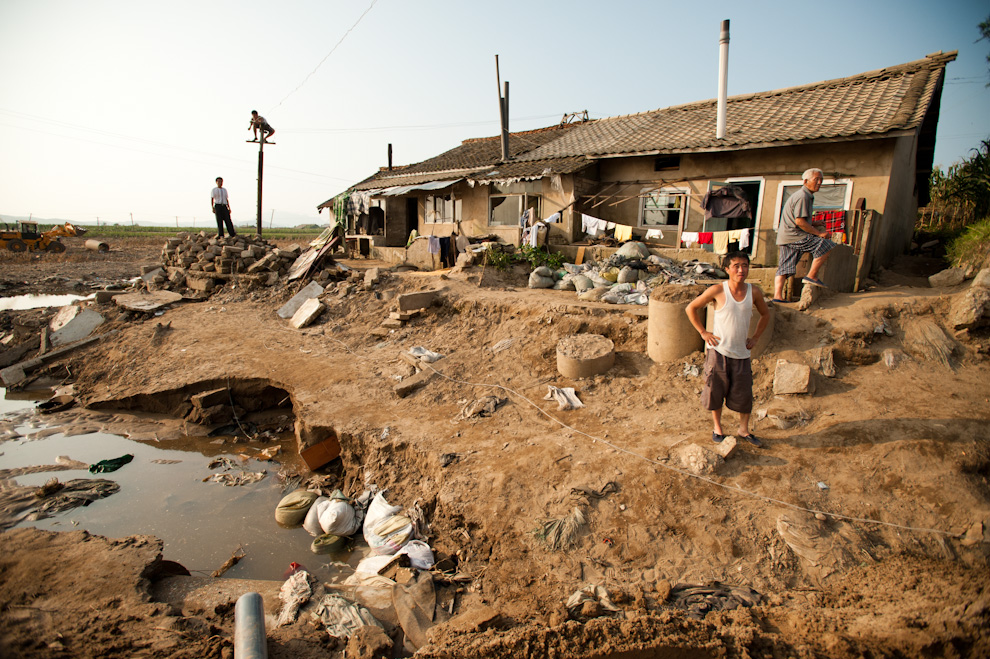
Samaritan’s Purse, the US-based, religious charitable organization, has published some pictures of their recent delivery of flood relief supplies to Sinuiju.

Here is one photo:


You should check out the other photos in the set here.

Here is a video they produced before takeoff.

Samaritan’s Purse is delivering a portion of the US government’s $750,000 flood relief campaign.

Additional information:
1. South Korean aid in response to the flood. China sends aid.

2. Video of Sinuiju. Official Chinese and DPRK photos of the flooding.

3. Here are previous posts about Samaritan’s Purse in the DPRK.

Share

Latest reunification study puts cost at US$3 trillion

Tuesday, September 14th, 2010

Here is the report (in Korean) on the KFI web page.   Here is that page translated with Google Translate.

The report was also carried in the English language media. 

According to Reuters:

The cost of reunifying the two Koreas, split since shortly after World War Two, would tot up to about 3,500 trillion won ($3 trillion), the Federation of Korean Industries said on Tuesday.

Not one of 20 economists surveyed by the federation expected reunification in the next five years but almost half said it would happen in 10 to 20 years.

Nearly half also said the largest cost associated with reunification would be in efforts to cut the wealth gap between the wealthy South and the impoverished North.

“The costs to minimize the gap between South and North Korea over the long-term are expected to be greater than the initial cost of reunification,” the federation said in its report.

South Koreans earn an average about $19,230 a year while North Koreans earned about $1,065 in 2008, according to South Korea’s Unification Ministry.

Concerns about the costs prompted South Korean President Lee Myung-bak to propose a “reunification tax” last month.

“In the short term the shock to the Korean economy will be great but in the long-term reunification will be positive,” the survey said.

The two Koreas are still technically at war as hostilities in 1950-53 Korean War conflict ended in a truce, not a peace treaty.

Yonhap also covered the report:

Most of the experts also said the divided Koreas will likely be reunified within the next 30 years, according to the survey conducted by the Federation of Korean Industries (FKI), the largest business lobby in South Korea.

The questions raised by the FKI came after President Lee Myung-bak proposed introducing a new “unification tax,” which he said will help lessen the financial burden of reuniting with the communist North.

Of the 20 experts surveyed, 63.1 percent said the reunification of the two Koreas will cost more than that of Germany, about $3 trillion. The amount includes the initial costs of stabilizing the nation following a reunification, but also the costs of eradicating any economic and social disparities between the two Koreas.

Half of the respondents said the country needed to begin discussing ways to pay such enormous costs of reunification, while 20 percent said such discussions must begin immediately.

“It also showed every respondent saw the need for such discussions as no one answered such discussions were unnecessary,” FKI said in a press release.

None of the respondents said the reunification will take place within the next five years, but 95 percent, or 19 out of the people surveyed, said the two Koreas will likely be unified before 2040.

They all agreed the unification with North Korea will be a great burden on the South Korean economy in its near future, but a great opportunity in the long term.

Here are links to previous posts on this topic.

Read the full stories here:
The cost of reunifying Korea? About $3 trillion
Reuters
9/14/2010

Experts say Korean unification will cost over US$3 trillion
Yonhap
9/14/2010

Share

Middlesbrough vs. DPRK Ladies

Sunday, September 12th, 2010

Pictured above: April 25th Sports Club field in Sadong-guyok (사동구역) where the matches were held (Google Maps)

UPDATE 4 (2011-4-25): To mark the ten-year anniversary of DPRK-UK diplomatic relations in September 2010, the British Embassy in Pyongyang and Koryo Tours arranged for the Middlesbrough Ladies Football Club to travel to the DPRK for two friendly matches against the DPRK’s national ladies team.  In addition to the two matches, the ladies team spent an afternoon training children at a local school, and an edited version of the film Bend it like Beckham was shown on North Korean television.  If you can access Facebook, you can see pictures of the visit here and  some videos here.

I managed to get video of one of the matches that was aired on North Korean television, so I edited it and posted it to YouTube:

It is in severn parts.  Part 1 of 7 is here.  The resolution is not great, but I am not a professional video editor!

Koryo Tours now has the ambitious goal of bringing a DPRK women’s football team to Middlesbrough.  According to a recent Koryo Tours newsletter:

We are therefore looking to take a North Korean women’s football team to the UK in 2012.  We also plan to bring a female DPRK film crew to accompany the squad and make a documentary of their time in the UK for both North Korean and international screening.

We do have support from both the British Embassy in Pyongyang and various international institutions but we also need financial support.  It would be extremely useful to have introductions to companies or individuals who you think might be interested in helping us.

Contact Koryo Tours for more information.

UPDATE 3: Sky News has a good summary of the events and a video.

UPDATE 2: According to the BBC, the Middlesbrough FC Ladies lost their second game.

UPDATE 1: According to the AFP, the Middlesbrough FC Ladies lost their first game.

ORIGINAL POST: According to the Guardian:

North Korea, the most secretive country on earth, the nation George Bush located on the Axis of Evil, where the flame of Marxism-Leninism still burns strong, will this week welcome its first British football team: 14 Teesside women players aged from 17 to 23, and their manager, Marrie Wieczorek.

On Thursday, Middlesbrough FC Ladies set off on a football tour with less bar-hopping (it’s illegal to leave your hotel without your guide) and probably more talk about dialectical materialism than usual. “I think it is going to be a bit of a culture shock,” says Wieczorek. “The whole place is shrouded in secrecy.”

At a time of mounting speculation that Kim Jong-il may be stepping down and appointing his son as successor, the team will fly to Beijing and then board an Air Koryo flight to Pyongyang, where they will play two games.

Middlesbrough Ladies will, in their way, be making history. The Democratic People’s Republic of Korea (as it prefers to be known) has so little contact with the outside world that the tour represents one of the most significant cultural exchanges of recent years. But it is also the latest episode in the entirely unlikely relationship between Middlesbrough and North Korea.

Historical link

Back in 1966, when England hosted the World Cup, North Korea played its three group games in the town, and Dave Allan, Middlesbrough’s media manager, said that a bond had existed ever since.

“It wasn’t that long after the Korean War and there were people in Teesside who’d fought in that, and when the Korean team came they were seen as the enemy,” Allan said. “But people really just took them to their hearts. It helped that they played in red, which was the Middlesbrough team colour. But it really was the people themselves, non-stop smiling, and very friendly and open.”

In 1966, North Korea beat Italy in what is routinely referred to as “one of the greatest upsets in World Cup history”, but the team’s failure to win a single game in this year’s finals – the first time they had qualified since then – led to rumours that the national coach had been sent to be “re-educated” on a building site on his return home.

In 2002, Nick Bonner of the travel company Koryo Tours tracked down the 1966 players and brought them back to Middlesbrough in what is still North Korea’s most important non-political exchange with the outside world.

“You don’t hear much about Middlesbrough in this country. But in North Korea they love us,” said Wieczorek. Even more astonishing, she said, they also love women’s football. The North Korean women’s team is currently fifth in the world, and it is as popular a spectator sport as the men’s game.

“Here, on the other hand, it was a battle to even play it when I started out 34 years ago,” said Wieczorek, “and although we’re supported by Middlesbrough FC we still have to raise our own money for transport.”

Culture shock

In North Korea, visitors are expected to bow before statues of the Supreme Leader. Do the Middlesbrough team have any idea what to expect?

Acting captain Rachael Hine, a mortgage adviser with Santander, said: “We know it’s going to be different. But nobody really knows how different.

“We’re just trying to go there with an open mind.”

This was a philosophy that has already been tested. “I told the girls their mobile phones will be confiscated at the airport,” said Wieczorek. “Their jaws just dropped.”

Read the full story here:
Middlesbrough Ladies’ North Korean football tour guarantees place in history
Guardian
Carole Cadwalladr
9/12/2010

Share

Some North Koreans signal frustration with succesion

Wednesday, September 8th, 2010

According to the Washington Post:

Almost every night, seeking to gather opinion from a country where opinion is often punishable, Kim Eun Ho calls North Korea. He talks mostly to people in Hoeryong city in Hamgyong-bukto province, and the conversations never last long. Hoeryong city employs 14 men who monitor the region’s phone conversations, Kim believes, and typically they can tap a call within two or three minutes. Kim says he knows this because, as a North Korean police officer before he defected in December 2008, he sometimes monitored the conversations.

But these days, with Pyongyang preparing for a Workers’ Party convention that could trumpet the rise of leader Kim Jong Il’s youngest son, Kim Eun Ho and other defectors who speak regularly to North Koreans hear plenty of opinions reflecting what he described as a broad sentiment against hereditary succession.

“Of 10 people I talk to,” he said, “all 10 have a problem with Kim Jong Eun taking over.”

Just as North Koreans know little about their potential future leader, the rest of the world knows almost nothing about North Korean opinions. Recent academic research, based on surveys with defectors, suggests that North Koreans are growing frustrated with a government that allowed widespread starvation in the early 1990s and orchestrated brutal currency reform in 2009 that was designed to wipe out the private markets that enable most residents to feed themselves.

The defectors are motivated to emphasize the worst-case scenario in their homeland. There are some who think that Kim Jong Eun will take power and gradually lead North Korea to Soviet-style reforms. Some defectors say that even though the younger Kim is largely unknown, they hope he’ll allow for a free economy after his father dies.

Still, in South Korea, an emerging patchwork of mini-samples suggests that many North Koreans view their government as a failed anachronism, and they see the young general, as he’s called, as a sign of the status quo. They associate Kim Jong Eun with the December 2009 currency revaluation. They don’t know his age – he’s thought to be in his late 20s – but they think he’s too young to be anything more than a figurehead.

Sohn Kwang Joo, chief editor of the Daily NK, a Seoul-based publication focusing on North Korea, receives frequent reports from stringers in four North Korean provinces. Those ground-level reporters, gathering information mostly from intellectuals, farmers and laborers, suggest to Sohn that “eight or nine out of every 10 people are critical of Kim Jong Eun.”A recent report from PSCORE, a Seoul-based nongovernmental organization promoting harmony on the Korean Peninsula, suggested that two party officials were sent to a gulag last month for slandering the chosen heir. Kim Young Il, a PSCORE director who was in China during Kim Jong Il’s recent trip, said: “Criticism of Kim Jong Eun is very strong. . . . What you see now is face-level loyalty, but it’s not genuine.”

Kim Eun Ho, the former North Korean police officer, works as a reporter for Seoul-based Free North Korea Radio. The nightly routine testifies to the difficulty of gathering information from within the world’s most reclusive state.

Kim first calls a friend who lives close to the Chinese border, where a smuggled foreign cellphone receives a clear signal. When Kim reaches his friend, the friend uses a second phone – a North Korean line – to call one of Kim’s police sources in Pyongyang. The friend then places the North Korean phone and the Chinese phone side-by-side, volume raised on the receivers, allowing Kim an indirect, muffled connection.

For extra caution, the conversations rely on code words.

“For general citizens, Kim Jong Eun is vastly unpopular,” Kim says. “People cannot take him seriously, in reality. He just suddenly appeared, and he’s too young.”

A defector-based survey released in March, co-written by North Korea experts Marcus Noland and Stephan Haggard, provided the first sharp indication of growing discontent with Kim Jong Il’s regime, linked in large part to an information seal that no longer keeps everything out. North Koreans have access to South Korean television shows. Some travel to China for business.

For now, though, experts and U.S. officials see little likelihood that North Koreans’ closely guarded skepticism about their government will pose a threat to the government. Without churches and social clubs, North Koreans have few places where opinion can harden into resistance.

“They’ve almost perfected the system of social control,” says Katy Oh Hassig, an expert on North Korea at the Institute for Defense Analyses, which does research for the Pentagon.

Like Kim Eun Ho, Jin Sun Rak, director of Free North Korea Radio, calls his old country almost every night. His wife and 14-year-old daughter live in North Korea. He decided to defect – telling nobody but his brother – in 2008, after traveling to China and seeing the relative wealth. The first time he went, hoping to sell 80 grams of unrefined gold, he bribed a border guard and carried a dagger, tucked near the lower part of a leg. His first night in China was “beyond imagination.” He said he went to a restaurant, had some drinks and ended up at a karaoke bar where he knew none of the songs. Days later, he returned to North Korea with some money and a new frame of reference.

“Whenever they say something,” Jin said of the government, “they’re lying. They’re as worthless as barking dogs.” As for a greater cynicism about the government, Jin said: “I think it’s something unstoppable now. People’s minds have been changed. Young people know the value of money. They don’t want to be party members anymore. They’ve been exposed to the private markets.”

Jin, who lives in Seoul, rarely talks to his wife and daughter. He doesn’t think it’s safe to tell them his opinion.

Read the full story here:
N. Koreans may be frustrated with government and likely rise of Kim Jong Eun
New York Times
Chico Harlan
9/8/2010

Share

DPRK software exports

Monday, September 6th, 2010

According to Bloomberg:

North Korean leader Kim Jong Il has found an unlikely ally to help raise cash for his impoverished regime: The Dude, the pot-smoking underachiever played by Jeff Bridges in the movie “The Big Lebowski.”

Programmers from North Korea’s General Federation of Science and Technology developed a 2007 mobile-phone bowling game based on the 1998 film, as well as “Men in Black: Alien Assault,” according to two executives at Nosotek Joint Venture Company, which markets software from North Korea for foreign clients. Both games were published by a unit of News Corp., the New York-based media company, a spokeswoman for the unit said.

They represent a growing software industry championed by Kim that is boosting the economy of one of the poorest countries in the world and raising the technological skills of workers. Contracting with North Korean companies is legal under United Nations sanctions unless they are linked to the arms trade.

“From the government’s point of view, foreign currency is the main reason to nurture and support these activities,” said Andrei Lankov, an academic specializing in North Korea at Seoul- based Kookmin University. “These activities help to fund the regime, but at the same time they bring knowledge of the outside world to people who could effect change.”

The technological education of graduates from North Korean universities has “become significantly better,” Volker Eloesser, a founder of Pyongyang-based Nosotek, said in an e- mail. Companies with “hundreds or even thousands of staff each” operate in North Korea, he said.

Double-Edged Sword

Better trained programmers may also bolster the regime’s cyberwarfare capabilities, said Kim Heung Kwang, who taught computer science at universities in the north for 19 years before defecting to South Korea in 2004. South Korea’s presidential office said July 28 the nation had received intelligence that North Korea may plan an Internet-based attack.

Won Sei Hoon, director of South Korea’s National Intelligence Service, told lawmakers last October that North Korea’s postal ministry was responsible for cyber attacks in July 2009 on dozens of websites in South Korea and the U.S.

President Barack Obama widened U.S. financial sanctions on North Korea on Aug. 30, freezing assets of North Korean officials, companies and government agencies suspected of “illicit and deceptive activities” that support the regime’s weapons industry.

Seeking Capability

“Any sort of transaction that gives cash to the North Korean government works against U.S. policy,” said James Lewis, a senior fellow at the Center for Strategic and International Studies, a Washington-based policy group. “The coding skills people would acquire in outsourcing activities could easily strengthen cyberwar cyber-espionage capabilities. Mobile devices are the new frontier of hacking.”

North Korea’s information technology push began in the 1980s as the government sought to bolster the faltering economy, said defector Kim. That drive also led to the creation of a cyber-military unit in the late 1990s, he said. He runs North Korea Intellectuals Solidarity, a group composed of defectors who have graduated from North Korean universities.

Nosotek’s Eloesser disputed any connection between programming for games and cyber-espionage.

“Who could train them, as neither me nor the Chinese engineers who are cooperating with the Koreans have those skills ourselves?” he asked in an e-mail. “Training them to do games can’t bring any harm.”

Joint Venture

Nosotek is a joint venture between the science and technology federation and foreign investors, company vice president Ju Jong Chol said in an e-mail. He said federation members developed both “Big Lebowski Bowling,” set in a rendition of the bowling alley where The Dude spent much of the movie drinking White Russians, and “Men in Black,” in which players battle invading aliens. Eloesser confirmed his comments.

Both games were published by Ojom GmbH, a unit of a company called Jamba that was bought by News Corp. and later renamed Fox Mobile, according to Fox Mobile spokeswoman Juliane Walther in Berlin. They came out after News Corp. took a controlling interest in Jamba in January 2007 and before it bought the remainder in October 2008. Ojom was eliminated in a May 2008 reorganization, Walther said.

When asked whether Fox Mobile distributes games developed in North Korea, Walther said that the unit “has extensive partnerships with content producers in all areas, with operators, and with the biggest media companies worldwide, including various Asian companies.”

No More Details

She said the company could not provide more details on where partners are based or confirm “if and how” North Korean companies were involved in development for Ojom. Dan Berger, a News Corp. spokesman in Los Angeles, declined to comment further. News Corp. is controlled by Chairman and Chief Executive Officer Rupert Murdoch, 79.

Eloesser founded Elocom Mobile Entertainment GmbH in 2003, which later became a subsidiary of Ojom. He said he first visited North Korea in 2005 and helped found Nosotek in 2007.

Nosotek offers clients billing through either a Hong Kong or Chinese company, according to its website, which promises “skills, secrecy, dedication.”

Such practices allow the funds to flow to North Korea, said Paul Tjia, director of Rotterdam, Netherlands-based GPI Consultancy, which helps companies outsource overseas, including to North Korea. Other companies contract with Chinese firms that then subcontract to North Korean companies, he said.

It is “impossible to estimate” how much revenue North Korea earns through software development, he said.

Nosotek’s wares are “of similar good quality to those from other companies in Europe or America,” according to Marc Busse, digital distribution manager at Potsdam, Germany-based Exozet Games GmbH, which has distributed games for Nosotek.

Foreign companies that are reluctant to do business in North Korea need to understand that investment there can help the country modernize and reduce its isolation, Tjia said.

“Most companies are still reluctant, which we think is unfortunate,” he said. North Koreans “need investment, like China in the 1970s.”

Read the full story here
Kim Jong Il Bowls for Murdoch’s Dollars With Korean Video Games
Bloomberg
Matthew Campbell and Bomi Lim
9/6/2010

Share

An affiliate of 38 North
