Archive for the ‘International Organizaitons’ Category

3.6% of South-North cooperation fund spent in 2010

Monday, October 25th, 2010

Institute for Far Eastern Studies (IFES)
NK Brief No. 10-10-25-1
10/25/2010

There has been a sharp drop in inter-Korean exchanges resulting from the chill in relations on the peninsula. This has led to a mere 3.6 percent of the inter-Korean cooperation fund being tapped as of the end of September. In 2009, 8.6 percent of the allocated funds were spent, but this year, even at the end of the third quarter, not even half that much has been allocated.

The National Assembly’s Unification, Foreign Affairs and Trade Committee found in an audit of the Ministry of Unification’s public documents that almost 1.2 trillion Won had been allocated for inter-Korean cooperative projects, but a mere 41.7 billion Won had been spent. 1.4 billion Won was spent on socio-cultural exchanges, while 13.1 billion Won was spent on humanitarian aid, 10.7 billion Won supported economic cooperative projects, and 16.7 billion Won was advanced in support of those companies and groups planning additional projects. On the other hand, the Ministry of Unification is loaning 60 billion Won from the inter-Korean cooperation fund to South Korean companies invested in economic cooperative projects that are suffering losses due to the May 24 measures, which restrict exchanges due to the sinking of the Cheonan.

In 2008, the first year of Lee Myung-bak’s administration, only 18.1 percent of the inter-Korean cooperation fund was spent, and this percentage has fallen every year since. Now at an all-time low, it appears that the rate of spending will continue to fall in the future. With the May 24 measures, the Kaesong Industrial Complex was exempted from trade restrictions. In addition, other inter-Korean trade worth approximately 80 million USD (90 billion Won) has been permitted. This includes 639 different cases of imported goods manufactured from raw materials or parts sent to the North prior to the May 24 restrictions, amounting to 31.15 million USD, and 269 cases of pre-ordered exports amounting to just over 49 million USD.

On the other hand, losses due to the halt of tourism to Mount Keumgang and Kaesong have amounted to 628.5 billion Won over the last two years. According to a report submitted to the National Assembly by the Korea Tourism Association on the impact of halting these tourism projects, losses of 548.2 billion Won had been incurred by August, and that is expected to grow to 628.5 billion Won by the end of the year.

Mount Keumgang tours were halted in July 2008, while Kaesong tours were stopped in November of the same year. Since then, the Korea Tourism Association has lost 10.5 billion Won in profits, while private-sector companies including Hyundai-Asan and its partners have lost 465.2 billion Won. In addition, restaurants, rest stops, visitor centers and other businesses in the border town of Koseong, Kangwon Province have lost 72.5 billion won due to the lack of tourists travelling across the border to Mount Keumgang, pushing total losses by the government and private sector to over 500 billion Won.

Share

North Korea’s market restrictions revisited

Wednesday, October 20th, 2010

Reuters published a concise report of the DPRK’s recent restrictions on market activity which is compiled from work by Marcus Noland and Stephan Haggard.  Here is the Reuters report:

Reclusive North Korea has imposed a series of measures since 2008 to rein in market activity, foreign trade, and activity across the border.

A Peterson Institute for International Economics policy brief published this year outlines some of the rules put in place:

2008
January – Women under 40 banned from trading in markets, followed by efforts to redeploy them to workplaces.

April – Wide-ranging Antisocialist Conscience Investigation of Sinuiju, the country’s main land port with China, including the books of trading organizations. Restrictions placed on carrying merchandise on bicycles and carts in Sinuiju.

July – Party, police, and market management office coordinate efforts to limit large sales in the Pyongsung market, an emerging wholesale center for the country in Pyongan province.

October – Nationwide ban on sale of shoes in markets and new restrictions limiting trade in foodstuffs to individually cultivated fruits and vegetables.

November – Major directive announcing the conversion of markets back to the more restrictive farmers’ market format. Markets to be open only on the 1st, 11th, and 21st of each month, and to be limited to retail sales of individually cultivated food; other foodstuffs and manufactures to be sold through the ‘public distribution system’ and state-run stores. Major cities, including Pyongyang, Hamheung, Soochun, Kaesung, and Chungjin, set up model farmers markets.

2009
January – National Security Agency special investigative unit scrutinizes names, number of family members, and livelihoods of households in the National Border Area suspected of involvement in border crossing and trade. Public education campaigns and increased punishment for border crossing.

March – New controls over lodging and movement without passes in National Border Area [and] imposition of strict movement controls in connection with the Supreme Peoples Assembly elections; intensified controls following the elections.

May – Announcement of 150-day campaign accompanied by renewed implementation of market restrictions on women under 40 and restricted items, including products of joint ventures, industrial goods, and American and South Korean products. Punishment of emergent back-alley markets and ‘sell and run’ sales. Public education campaigns against market activities.

June – Closure of Pyongsung market in Pyongan province.

July – Increased control and surveillance over households in National Border Area with defectors.

November – North Korea announces a reform to replace all currency in circulation with new bills and coins.

The Peterson Institute report mentioned in this article can be found here (PDF).

I should also point out that many of these dictates were uniformly unenforceable and many have been rescinded (including the 10-day rule) since the currency reform was implemented.

Read the full story here:
Factbox: How North Korea has tightened controls
Reuters
10/20/2010

Share

‘Rimjingang’ in the Wall Street Journal

Tuesday, October 19th, 2010

According to the Wall Street Journal:

There are several news organizations supporting journalists in North Korea. One is Rimjin-gang magazine, a division of AsiaPress International, based in Osaka. The founder and editor of Rimjin-gang is a Japanese journalist by the name of Jiro Ishimaru. As the world’s journalists were reporting from Pyongyang last week, Mr. Ishimaru was in the U.S., presenting his reporters’ remarkable videos, photographs and articles to American audiences. A book containing English-language translations of some of the magazine’s best stories was published on Oct. 15.

Rimjin-gang is the Korean name for the Imjin River, which begins in North Korea and runs south across the demilitarized zone. It is a symbol of North Koreans sending information to the South, Mr. Ishimaru says. “I came to realize that outsiders attempting to shed light on North Korea hit a wall that is simply impossible to breach. No one can report on a nation better than its own people.”

Mr. Ishimaru runs a staff of 10 reporters. For security reasons, each reporter operates independently without knowledge of the identity of his colleagues or what they are doing. The reporters are men and women who want to do something with their lives and who want to help their country, Mr. Ishimaru says. They believe that “if you don’t do something, you are just a slave.”

Mr. Ishimaru recruits his reporters in the border regions of China, home to tens of thousands of North Korean refugees who have escaped across the Yalu or Tumen rivers. He and colleagues from South Korea give the budding journalists a crash course in the basics of journalism and teach them how to use essential technology. The journalists then go back to North Korea with enough money to travel around the country, pay bribes if they get into trouble, and eventually return to China.

It is next to impossible for ordinary North Koreans to get close to military installations, the gulag or Kim Jong Eun. So the reporters have decided to focus on day-to-day life in North Korea, especially starvation, the growing market economy and corruption. They have produced more than 100 hours of video on these subjects. Among the tapes I viewed were ones that showed bags of rice labeled “WFP”—for the United Nations World Food Program—being sold in a marketplace, and soldiers using a military truck as a bus service for paying customers.

The information doesn’t flow just one way. Mr. Ishimaru’s reporters also try to get information about the outside world into North Korea, usually in the form of CDs containing videos of South Korean soap operas, news shows or documentaries. Before DVD players came into use in China, VCD players—video CD players—had a short run of popularity. Chinese merchants now sell these discarded devices, along with CDs, across the border in North Korea. It’s against the law to possess a VCD player or to watch South Korean videos, but the law-enforcement system has broken down enough that more and more North Koreans are taking the risk, assuming that if they get caught they can bribe local officials to look the other way.

Here are previous posts featuring information from Rimjingang.

Read the full story here:
A Free Press Stirs in North Korea
Wall street Journal
Melanie Kirkpatrick
10/19/2010

Share

[ROK] Investors in DPRK take huge hits; interest in FDI plummets

Monday, October 18th, 2010

Institute for Far Eastern Studies (IFES)
NK Brief No. 10-10-18-1
10/18/2010

The majority of joint ventures investing in North Korea have suffered significant losses since the South Korean government began to enforce sanctions as a result of the sinking of the ROKS Cheonan. On average, companies have incurred losses of almost one billion won, and most companies are no longer interested in investing in the North.

According to the Korea Chamber of Commerce and Industry, a survey of 500 companies (200 inter-Korean economic cooperative schemes and 300 other companies involved in business with the North) showed that 93.9 percent of respondents said they had suffered losses due to trade restrictions put in place due to the Cheonan incident, while 66.5 percent responded that they faced “financial difficulty” due to the sanctions. The companies have suffered an average of 974 million won in losses.

Investment and operational losses due to the ‘all stop’ order from the government amounted to 51.9 percent of losses reported, while 26 percent of respondents pointed to a reduction in orders and 22.1 percent blamed an increase in transportation and other associated costs. One company importing anthracite from the North turned to China, Vietnam, Russia, and other vendors after inter-Korean trade was restricted, but due to each country’s efforts to secure its own natural resources, this year’s sales are expected to be more than 10 billion won less than that seen last year.

Another company, investing in textiles, was strategically producing hand-made works in a North Korean factory, but now production has come to a halt and it may not be able to deliver goods it has produced. A source from the factory stated, “Personnel and raw material expenses in China, Vietnam, and other countries mean that profit margins will be minimal, and there is no alternative.” The same source also stated, “Special funds were distributed from the government, but [companies] are concerned about how long they can hold out.”

As companies invested in North Korea suffer losses in the wake of the Cheonan incident, interest in North Korea investment opportunities is also waning. 82.7 percent of responding companies believe that “even if economic cooperation was normalized, there would be no new investments or continuation of existing projects,” and 76.9 percent of respondents believed that “because of the uncertainty of the North Korean system” non-economic issues would dampen investment enthusiasm. 13.7 percent stated that difficulties with transportation and other infrastructure issues would discourage investment, and 9.4 percent of respondents answered, “North Korean authorities’…interference and restrictions” would turn away foreign investors.

Among those businesses not involved in cooperative economic ventures, 41.5 percent pointed to “North Korea’s overall reform and opening,” while 22.2 percent chose “guaranteeing the security of investments and expanding domestic SOC” as being necessary to propel investment in North Korea. Another 19.7 percent answered, “security issues like North Korean denuclearization” were necessary for improvement in the investment environment.

Many also voiced concerns over the ongoing ban on inter-Korean exchanges. When asked about the impact on business if sanctions against the North were to continue, 5.18 percent of respondents stated, “opportunities for foreign investors will suffer,” while 25.6 percent responded that the North’s economic reliance on China would grow, and 22.6 percent feared that the national image would suffer due to an increase in the security risk.

63.6 percent of respondents call for strengthened protection for investors, including protection against losses as well as guarantees on operational freedoms. 20.1 percent called for easing restrictions on businesses in the Kaesong Industrial Complex, and 16.3 percent pointed to the need for more monetary support.

Even after the government’s announcement halting inter-Korean exchanges on May 24, , inter-Korean trade worth approximately 80 million USD (90 billion won) was recorded due to a number of goods with special exceptions. 639 different cases of imported goods manufactured from raw materials or parts sent to the North prior to the May 24 restrictions amounted to 31.15 million USD, while 269 cases of pre-ordered exports amounted to just over 49 million USD.

This survey was conducted from August 12 to September 1, calling or faxing 200 companies invested in inter-Korean cooperative schemes and 300 of the 1000 companies involved in sales.

Share

Special rations issued for 10/10 party anniversary

Monday, October 11th, 2010

Institute for Far Eastern Studies (IFES)
NK Brief No. 10-10-11-1
10/11/2010

On October 7, Pyongyang announced that special rations would be distributed to the people of North Korea in celebration of the 65th anniversary of the establishment of the Korean Workers’ Party (October 10). Daily NK reported that an informant in North Hamgyeong Province had said, “This morning the chairman of my people’s unit went door to door announcing that on the 8th and 9th there would be food distribution for the holiday, so we could expect to get the food allocated to us from the state-run store on these two days.” When residents asked why the rations were being dispersed, the local people’s unit chairman explained that the regime was doling out “liquor and cooking oil because a decree has been handed down from above telling us to deliver [holiday rations] commemorating the Party Delegates’ Conference and the founding day of the Party.” It was also explained that the event was “twice as delightful” since the Party anniversary and the re-election as Secretary General of Kim Jong Il fell at the same time, and that since Kim Jong Un was named as the successor, the regime was seeking to create a celebratory atmosphere.

Until the 1990s, authorities provided rations along with many forms of propaganda on the birthdays of Kim Jong Il and Kim Il Sung, on New Year’s Day, the anniversary of the founding of the Party, and other significant holidays. After the ‘arduous march’ of the mid 1990s, however, it became difficult for the state to provide for the people, and the rations slowly disappeared. Holiday rations became the responsibility of local committees, so that residents of some districts would receive corn while another might receive potatoes. Outside of Pyongyang, however, it became difficult to find anyone still receiving alcohol, meat or cooking oil, with these goods reserved only for certain government workers or those in special industries.

When rations are handed out, goods and food are distributed to local stores, at which they are packaged for distribution to each household. Rations are generally distributed one to two days prior to a holiday, although sometimes not actually arriving until the holiday. On a holiday, a line can be seen in front of every state store as families gather to receive their handout.

On February 16, North Korea celebrated both Kim Jong Il’s birthday and the lunar New Year with a four-day holiday, but even then most residents received no alcohol. Soldiers and government workers above a certain level might receive one bottle of liquor and a kilogram of meat. This year, the autumn harvest festival Chuseok was advertised as a four-day celebration of the ‘biggest national holiday’, but this was mere propaganda. With many regions suffering from devastating floods, local authorities were told to handle holiday arrangements on their own.

Daily NK reported that local authorities were told to be ready to clean out their desks if they were unable to provide holiday rations, so at least cooking oil and alcohol rations were expected, but residents were still unsure how much they might receive. In previous years, people each received 100g of oil, but now they would be happy to receive even half that much. A family of four could at least expect about one bottle of liquor and half a bottle (200g) of cooking oil.

Radio Free Asia reported that at least four orders had been passed down for state-run stores and restaurants to distribute holiday rations, and that on September 30, an order was issued to provide one bottle of alcohol, 500g of oil, one kilogram of pork, toothbrushes and toothpaste, soap, laundry detergent, underwear, socks, and a pair of shoes to each household, and for state-run restaurants to provide liquor and food at state-set prices (cheaper than prices in local markets) for ten days.

Share

Inter-Korean trade up 51.3% in first half of 2010

Wednesday, October 6th, 2010

Institute for Far East Studies (IFES)
NK Brief No. 10-10-4-1
10/4/2010

Trade between the two Koreas in the first half of 2010 totaled 980 million USD, 51.3 percent more than the 650 million dollars-worth of trade last year. North Korea’s trade with China was also up, by 16.4 percent, to 1.28 billion USD. Kim Jong Il has made two trips to China and the North has taken other steps to boost cross-border trade with the Chinese.

According to a recent report comparing inter-Korean trade to that between North Korea and China, North-South trade in 2007 equaled 91 percent of Pyongyang’s trade with Beijing, but as inter-Korean relations chilled, that number fell to 65 percent in 2008. This year, that number climbed back up to 77 percent, largely because the Kaesong Industrial Complex, which has avoided political entanglement, has grown 96 percent since last year. Textiles and home electronics top the list of goods in inter-Korean trade, while minerals are the top item traded across the DPRK-PRC border.

North Korea’s import of South Korean goods increased by 63 percent to 430 million USD, while the North’s Chinese imports rose a mere 25 percent, but still totaled 930 million USD. 36 percent of South Korean exports to the North are raw materials for North Korean textile production, while 120 million USD-worth of electronics make up the second-largest export industry. Making up the largest sector, 27 percent (250 million USD) of North Korea’s imports from China are made up of minerals and crude oil, while textiles make up 12 percent and base metal resources make up 8 percent. South Korean imports have also grown 43 percent, to 550 million USD, since last year. In comparison, Chinese imports from North Korea shrunk one percent to 340 million USD. Clothing and other ready-for-market textiles made up 44 percent of North Korean exports to the South, while electrical and electronic goods made up 17 percent. Coal, iron, and other key resources made up 51 percent of DPRK exports to China, while zinc and other base metals make up approximately 20 percent.

Share

Collective farm diplomacy

Monday, October 4th, 2010

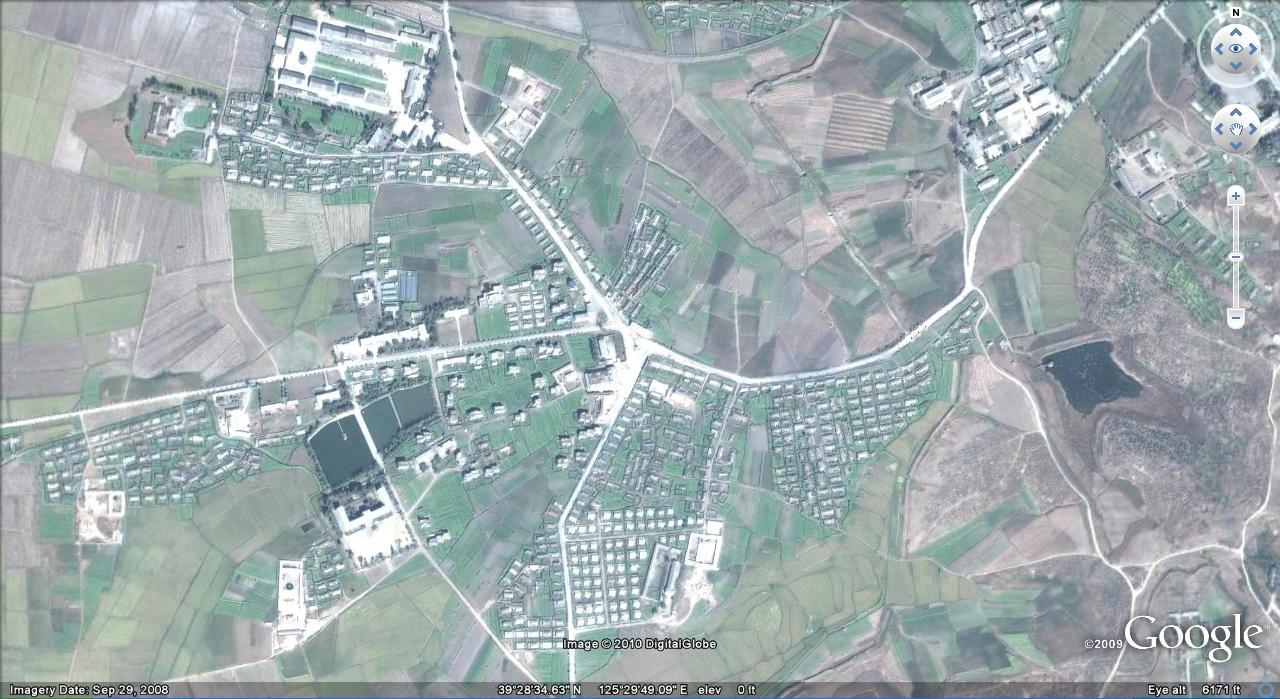
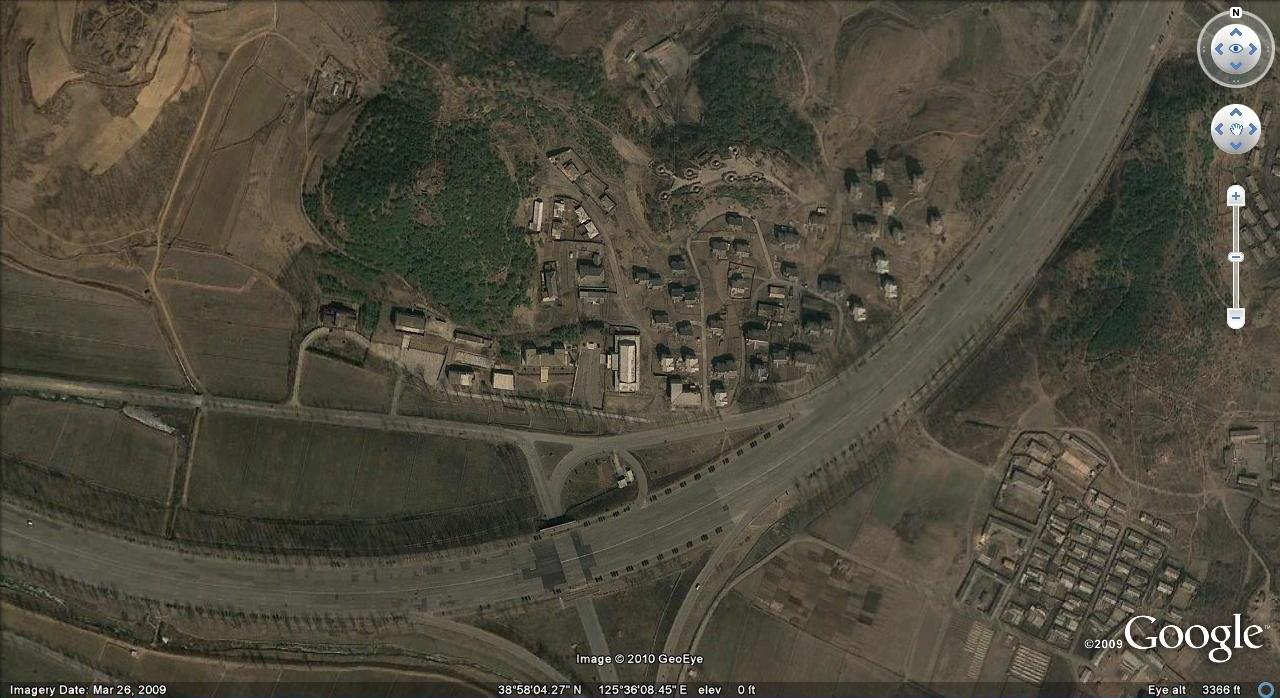
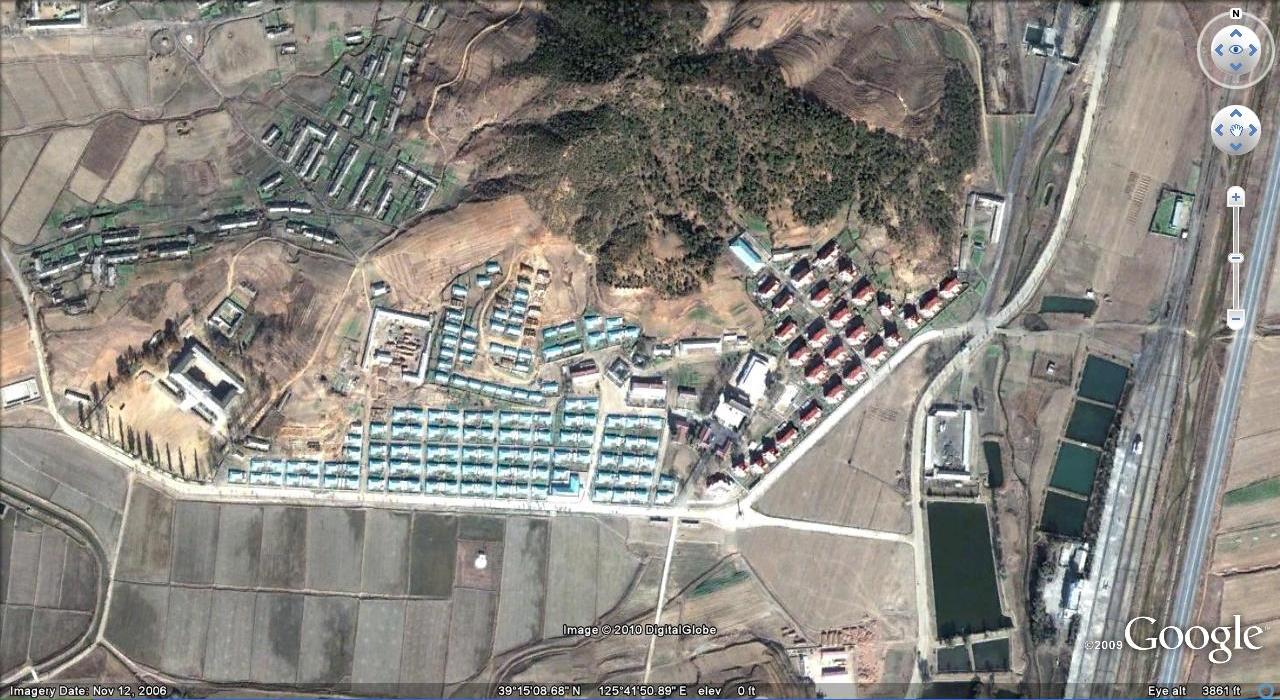
For the same reasons that President Obama has a tendency to take visiting dignitaries to my favorite hamburger restaurant in Arlington, VA, the North Koreans have designated “friendship farms” for countries the North Koreans enjoy or expect to enjoy cozy relations.  Below I have identified a few for you to check out on Google Earth.

DPRK-Iran Friendship Ripsok Cooperative Farm


iran-friendship-farm.JPG

Coordinates: 39°28’34.69″N, 125°29’48.92″E
This farm has been mentioned in this capacity in KCNA four times: here, here, here, and here.
Date first mentioned: May 17, 2007

DPRK-Russia Friendship Kochang Cooperative Farm


russia-friendship-farm.JPG

Coordinates: 38°58’3.82″N, 125°36’4.67″E
It has been mentioned in KCNA at least 26 times.  See here.
Date first mentioned:  June 23, 1999

DPRK-China Friendship Thaekam Cooperative Farm


china-friendship-farm.JPG

Coordinates: 39°15’4.41″N, 125°41’53.06″E
This farm has been mentioned at least 29 times in KCNA.  See here.
Date first mentioned: June 1, 1997

I have also located friendship farms for: Laos, Poland, Cuba, Bulgaria, Vietnam, Malaysia,  Indonesia, Germany, Palestine, Cambodia, Mongolia, India, Syria, Nigeria, Libya, Egypt, New Zealand, Yugoslavia, and Pakistan.

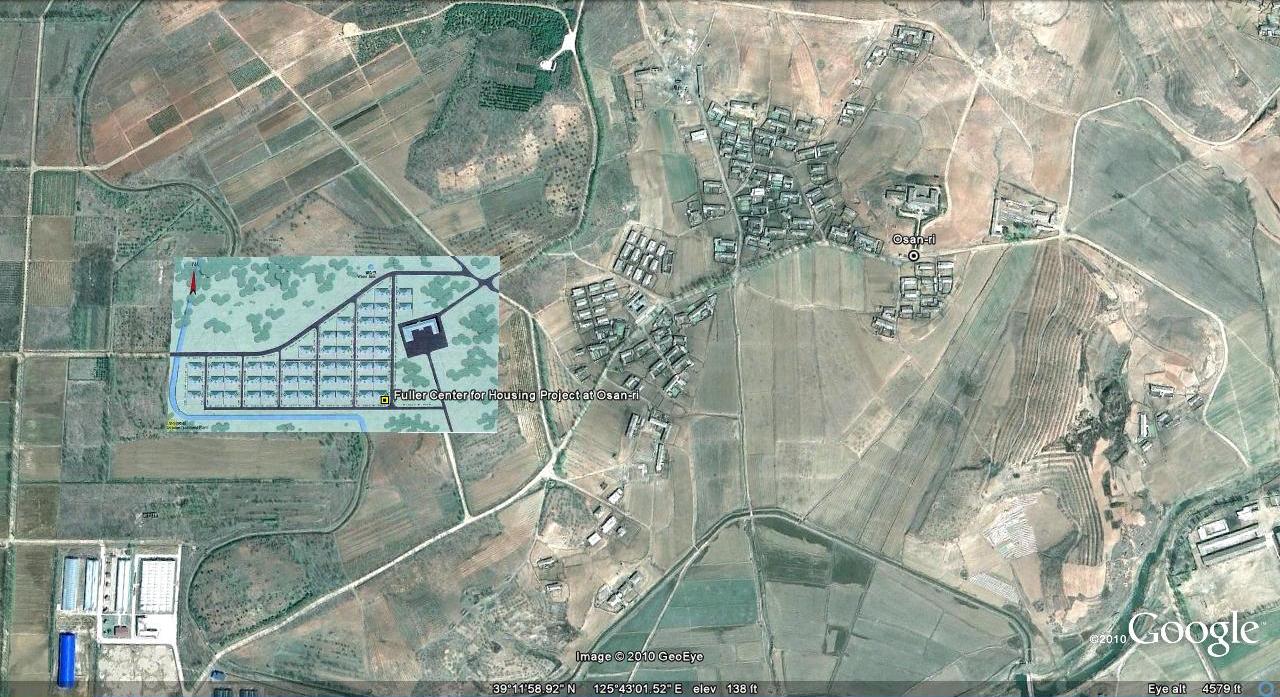
The United States does not yet have a friendship farm in the DPRK, but maybe someday it will be Osan-ri in Sunan-kuyok, Pyongyang. This is where the Fuller Center plans to launch a housing project. Their planned location and site plans are posted below.

Jimmy Carter, who founded Habitat for Humanity, has recently endorsed this project. (UPDATE: more here and here)

Thanks again to Google Earth and GeoEye.

Share

Koryolink mobile phone update

Thursday, September 30th, 2010

…from the Korea IT Times:

Back in 2008, North Korean mobile operator Koryolink entered the mobile communications business to serve 126,000 subscribers, but demand far exceeded the company’s expectations. Therefore, Koryolink plans to secure enough mobile phone circuits so as to serve all the people who wish to use mobile communications services.

In addition, the Choson Sinbo, a newspaper based in Japan, reported that the number of North Korean mobile subscribers would break the 600,000 mark by the end of this year. That means just one year and four months after 3G mobile carrier Koryolink started its business in December of 2008, the number of mobile subscribers topped 120,000 as of April of this year. The mobile communications bureau of the Chosen Post said, “In 2009, base stations were put up throughout Pyongyang and communications networks have been complemented. And major highways leading to Pyongyang (e.g. Pyongyang-Hyangsan, Pyongyang-Nampo highways), major railways sections, and each province have been equipped with communications networks.

“In the future, more than half of the counties and towns will have networks with the rest scheduled to be equipped within this year” said the Chosen Post. North Korea is planning to expand mobile connectivity to the entire nation by 2012. Those who wish to use 3G services can go to mobile service centers called “Bongsaso”, pick up an application form and submit it with a payment (the price of the mobile phone plus a 50 euro subscription fee). The prices of terminals range from 110 euro to 240 euro and some mobile devices have built-in cameras. The basic mobile device is supplied by China’s Huawei Technologies.

In the future, the 3G mobile communications service will go beyond simple voice calls: Multimedia services such as TV phones and high-volume, high-speed communications will be made possible. The subscription fees, call charges and the prices of mobile phones will go down. On the hardware front, North Korea aims to develop and manufacture its own hand-held mobile phones, but at the moment, mobile phones will be imported from foreign nations, primarily from China. For now, a new production line is planned to be built by a joint venture company, which was formed by foreign capital and the Chosen Post, to assemble imported parts into finished goods.

North Korea said it would set up a nation-wide mobile communications system in order to modernize its communication system. Building an upgraded mobile communication system has been of great interest to North Korean leader Kim Jong-il, so this project is expected to gain momentum quickly. According to South Korean mobile carriers and South Korea’s Korea Communications Commission (KCC), only senior government figures are using mobile phones right now in the North. Yet the general public will soon get their hands on mobile devices.

As for the North Korean mobile communications industry, getting foreign investors can be a problem. But the real issue lies with North Korea’s poor electricity grids, which are so insufficient that anticipated high electricity demand from maintaining network facilities and charging mobile phones may not be met. Regardless, it is indeed very encouraging that the North offers 3G mobile communication services to the public. I believe that the commercialization of 3G mobile communication services would serve as a stepping stone to North Korea’s gradual reform and market opening, which are deemed to be inevitable in the end.

Read the full story below:
North Korea’s Mobile Communications Service
Korea IT Times
Choi Sung
9/30/2010

Share

DPRK newspaper stresses prudence of ‘Juche economy’

Thursday, September 30th, 2010

Institute for Far Eastern Studies (IFES)
NK Brief No. 10-09-28-1
9/28/2010

While hopes had been raised following Kim Jong Il’s recent visit to China that the North may undergo some reform and opening, an editorial in the Rodong Sinmun, newspaper of the Workers’ Party of Korea, emphasizes the prudence of following the DPRK-style ‘Juche’ Economy’, and rejecting support from foreign powers. The article, which appeared on September 18, stressed the value of Juche as the tool for reviving the economy, and stated that there was no greater sin than passing on a “crippled economy” to the next generation. It emphasized the selfishness of living well only by the support of outside powers, as this provides no sustainable economy for future generations.

The paper went on to call on North Koreans to work together, stating that “there is no time like the present, when the principle of realizing Juche stands out in its universality,” and said that it is the current trend of economic development to “develop the resources of one”s own country, and to concentrate efforts on using [domestic] materials… If we actively develop our inexhaustible resources, we can live wealthily and raise the funds necessary for the construction of an economically strong state.” After stressing the implementation of Juche and self-reliance, the newspaper added, “If we rely on our own strengths and bring in foreign capital, we can avoid the serious crisis we are now facing, or we ultimately would not be able to choose this path.”

The newspaper also emphasized that the people of North Korea, “descendants of Comrade Kim Il Sung,” must not live selfishly, and “must not retreat even half a step on the road to Juche implementation,” urging that the current state of dependence on outside technology and resources cannot be tolerated. Kim Jong Il is quoted as saying that Juche must be firmly established in every realm of construction and development “today, tomorrow, and always” as the “revolutionary spirit of revival through one’s own efforts” is lifted high, and all problems must be resolved through one’s own strength. In particular, he is quoted as emphasizing “there can be not even a little flunkeyism and reliance on the outside,” and promising that the Workers’ Party will strive “to build an independent economy based on Juche philosophy.”

It is nothing new for North Korea to call for the establishment of a Juche-driven self-reliant economy, but it is noteworthy that the Rodong Sinmun would run such an article soon after Kim Jong Il’s trip to China and China economic development was so highly lauded. Kim said during his summit with Hu Jintao at the end of last month that China’s development was “spirited” everywhere and that China had “developed quickly after reform and opening.” The Rodong Sinmun editorial is likely a result of concerns that expectations for reform and dependence on outside forces might be growing within North Korea following Kim’s remarks about Chinese growth, and that this could complicate the effort to appoint Kim Jung Eun as successor.

Share

Inter-Korean trade increases in 2010 despite tensions

Thursday, September 30th, 2010

According to Yonhap:

Trade between South and North Korea surged in the first half of the year despite high tensions over the communist nation’s alleged sinking of a South Korean warship in March, a trade organization said Wednesday.

South Korea’s exports to the North soared 63 percent on-year to US$430 million in the January-June period with North Korea’s exports to the South jumping 43 percent to $550 million, according to the Korea International Trade Association (KITA).

Read the full story here:
Inter-Korean trade jumps in H1 despite soured relations
Yonhap
9/29/2010

Share

An affiliate of 38 North