Archive for the ‘Finance’ Category

US-NK Financial Talks Scheduled in New York Next Week

Wednesday, November 14th, 2007

Korea Times
11/14/2007

U.S. and North Korean officials will meet in New York early next week to reopen talks on addressing Pyongyang’s alleged illicit financial activities, sources here said Tuesday.

Daniel Glaser, assistant treasury secretary in charge of terrorism financing, will lead the U.S. delegation to the talks scheduled Monday to Tuesday, according to the sources. It was not yet clear who will represent North Korea at the meeting. Previous sessions were led by O Kwang-chol, president of the Foreign Trade Bank of Korea.

The meeting is the first since the two countries resolved a banking issue that for over a year delayed North Korean denuclearization negotiations. The U.S. Treasury in September 2005 sanctioned Banco Delta Asia (BDA), a Macanese bank, for abetting North Korea’s laundering of money acquired through smuggling, counterfeiting and arms proliferation. The bank froze all North Korea-related accounts, and Pyongyang boycotted the denuclearization talks in protest.

The issue was settled with the release of some $25 million in North Korean money at the BDA early this year.

Sources said next week’s meeting will address North Korea’s suspected illicit activities that led to the Treasury’s sanctions, including Pyongyang’s counterfeiting of American currency.

North Korea has been accused of producing and circulating fake$100 bills, known as “supernotes” because of their near-authenticity, and smuggling contraband goods.

Share

North Korea, China Will Start $10 Billion Fund, Yonhap Reports

Tuesday, November 13th, 2007

Bloomberg
Bomi Lim
11/13/2007

North Korea’s Daepung Investment Group will set up a $10 billion fund with China Development Bank to help Chinese firms operating in North Korea, Yonhap News reported, citing the company’s vice president.

The fund will be used to help Chinese companies build roads, railways and ports in North Korea, Daepung Vice President Bae Kyeong Hwan was quoted as saying. Bae didn’t say how much each country will contribute the fund.

Daepung also plans to set up a bank to attract investment from overseas, the report said.

China is North Korea’s biggest trading partner and an important provider of food and fuel. North Korea is isolated from most of the rest of the world and has received virtually no foreign investment.

Share

Ignoring Buffett, Fabien Pictet Eyes North Korea Fund

Sunday, November 11th, 2007

Bloomberg
Bradley Martin
11/2/2007

Fabien Pictet & Partners Ltd., a British money manager that specializes in emerging markets, plans to establish a fund focused on joint ventures in North Korea.

Fabien Pictet has applied to North Korea’s embassy in London for permission to visit Pyongyang to explore opportunities, Chief Executive Officer Richard Yarlott said in an interview. The closely held firm initially would buy into South Korean companies doing business in the north, he said.

“It would be very difficult to put more than $50 million directly into North Korea,” said Yarlott, 47, who helps manage $750 million of bonds and equities. “But it would be very easy to put $500 million into listed South Korean companies and then later, as we see specific private equity opportunities, go with them.” He declined to give further details.

A North-South agreement on economic cooperation, signed Oct. 4, may foster cross-border projects in industries such as mining and shipbuilding. Still, that prospect isn’t enough to lure billionaire investor Warren Buffett to a northern plunge.

“Things would have to change a whole lot before we can make investments,” said Buffett, chairman and CEO of Berkshire Hathaway Inc., during a visit to South Korea last week.

Buffett, who owns shares of South Korea’s Posco, Asia’s biggest steelmaker by market value, rates the nation’s stocks as “modestly cheaper” than most around the world. The benchmark Kospi index’s price-to-earnings multiple of 15.4 for current year estimated earnings is the lowest in Asia-Pacific after Thailand.

London-based Fabien Pictet, set up in 1998, invests in countries from Brazil to the Ukraine.

It started a South Korean equity fund, Three Kingdoms Korea Fund Inc., in 2004 partly to be ready for a northern push, Yarlott said.

LG Corp., Hyundai

South Korean companies — including units of LG Corp., the country’s fourth-largest industrial group, and Hyundai Corp. — have $2 billion to invest over the northern border, he said.

Three Kingdoms Korea has had a total return of 88.5 percent from April 30, 2004, to Sept. 28 this year. South Korea’s Kospi has risen 126 percent in the same period.

Foreign investment in North Korea has been legal since 1984 and repatriation of profits since 1992. The country doesn’t permit private ownership of assets and hasn’t established a stock exchange.

South Korea’s closely held Hyundai Asan Corp., which started a northern tourism business in 1998, has been reported to be struggling to avoid or reduce operating losses.

London-based Anglo-Sino Capital Partners Ltd., which in 2005 created Chosun Development and Investment Fund to focus on direct investment in North Korea, last month doubled its investment target, citing strong interest.

“We have raised the fund from $50 million to $100 million,” Colin McAskill, chairman in London of Koryo Asia Ltd., the Chosun fund adviser, said in an interview.

The fund will concentrate on direct transactions with North Korean companies that have been active internationally and have track records as foreign currency earners, he said.

Some investors say it’s too early to call North Korea an emerging market.

“I’m 77 years old and the thought that the day would come in my time — it’s very flattering but it’s a long way off,” said Buffett, also known as the “Sage of Omaha.”

Yarlott said the country was changing. “North Korea, like China, will develop a stock market,” he said.

“At this rate, even the sage will get a look-in.”

Share

Google Earth North Korea (version 6)

Sunday, November 11th, 2007

The most authoritative map of North Korea on Google Earth
North Korea Uncovered: Version 6
Download it here

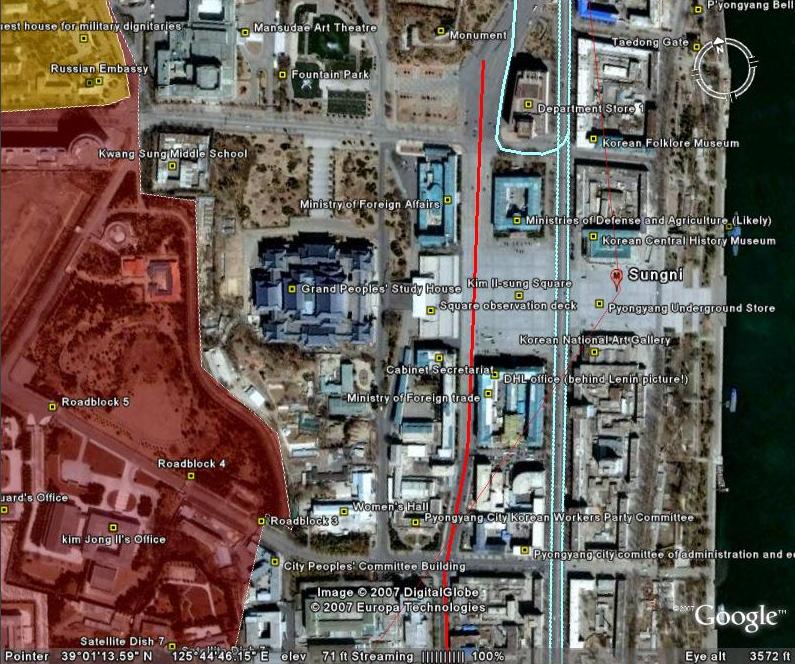
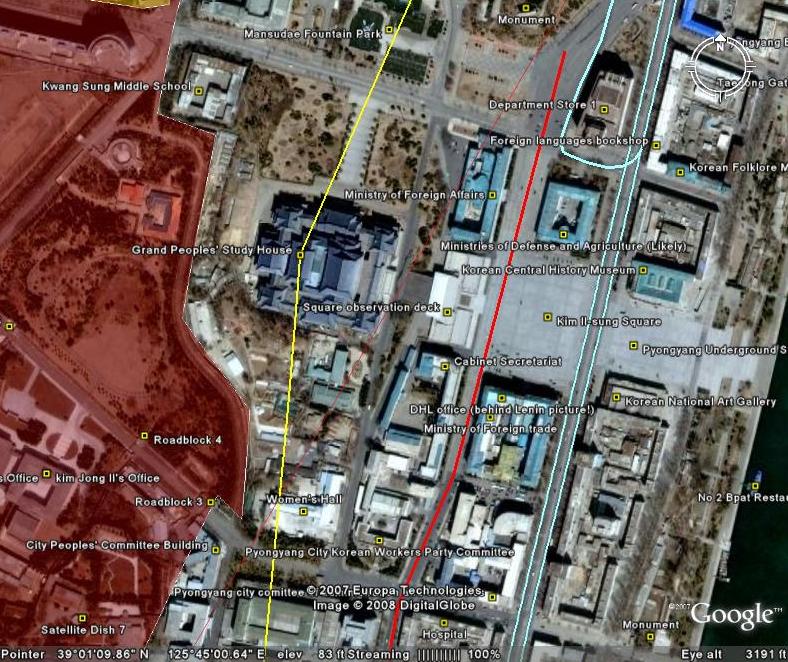
kissquare.JPGThis map covers North Korea’s agriculture, aviation, cultural locations, manufacturing facilities, railroad, energy infrastructure, politics, sports venues, military establishments, religious facilities, leisure destinations, and national parks. It is continually expanding and undergoing revisions. This is the sixth version.

Additions to the newest version of North Korea Uncovered include: Alleged Syrian nuclear site (before and after bombing), Majon beach resort, electricity grid expansion, Runga Island in Pyongyang, Mt. Ryongak, Yongbyon historical fort walls, Suyang Fort walls and waterfall in Haeju, Kaechon-Lake Taesong water project, Paekma-Cholsan waterway, Yachts (3), and Hyesan Youth Copper Mine.

Disclaimer: I cannot vouch for the authenticity of many locations since I have not seen or been to them, but great efforts have been made to check for authenticity. These efforts include pouring over books, maps, conducting interviews, and keeping up with other peoples’ discoveries. In many cases, I have posted sources, though not for all. This is a thorough compilation of lots of material, but I will leave it up to the reader to make up their own minds as to what they see. I cannot catch everything and I welcome contributions.

Share

Ignoring Buffett, Fabien Pictet Eyes North Korea Fund

Friday, November 2nd, 2007

Bloomberg (via DPRK studies)
Bradley Martin
11/2/2007

Fabien Pictet & Partners Ltd., a British money manager that specializes in emerging markets, plans to establish a fund focused on joint ventures in North Korea.

Fabien Pictet has applied to North Korea’s embassy in London for permission to visit Pyongyang to explore opportunities, Chief Executive Officer Richard Yarlott said in an interview. The closely held firm initially would buy into South Korean companies doing business in the north, he said.

“It would be very difficult to put more than $50 million directly into North Korea,” said Yarlott, 47, who helps manage $750 million of bonds and equities. “But it would be very easy to put $500 million into listed South Korean companies and then later, as we see specific private equity opportunities, go with them.” He declined to give further details.

A North-South agreement on economic cooperation, signed Oct. 4, may foster cross-border projects in industries such as mining and shipbuilding. Still, that prospect isn’t enough to lure billionaire investor Warren Buffett to a northern plunge.

“Things would have to change a whole lot before we can make investments,” said Buffett, chairman and CEO of Berkshire Hathaway Inc., during a visit to South Korea last week.

Buffett, who owns shares of South Korea’s Posco, Asia’s biggest steelmaker by market value, rates the nation’s stocks as “modestly cheaper” than most around the world. The benchmark Kospi index’s price-to-earnings multiple of 15.4 for current year estimated earnings is the lowest in Asia-Pacific after Thailand.

London-based Fabien Pictet, set up in 1998, invests in countries from Brazil to the Ukraine.

It started a South Korean equity fund, Three Kingdoms Korea Fund Inc., in 2004 partly to be ready for a northern push, Yarlott said.

LG Corp., Hyundai

South Korean companies — including units of LG Corp., the country’s fourth-largest industrial group, and Hyundai Corp. — have $2 billion to invest over the northern border, he said.

Three Kingdoms Korea has had a total return of 88.5 percent from April 30, 2004, to Sept. 28 this year. South Korea’s Kospi has risen 126 percent in the same period.

Foreign investment in North Korea has been legal since 1984 and repatriation of profits since 1992. The country doesn’t permit private ownership of assets and hasn’t established a stock exchange.

South Korea’s closely held Hyundai Asan Corp., which started a northern tourism business in 1998, has been reported to be struggling to avoid or reduce operating losses.

London-based Anglo-Sino Capital Partners Ltd., which in 2005 created Chosun Development and Investment Fund to focus on direct investment in North Korea, last month doubled its investment target, citing strong interest.

“We have raised the fund from $50 million to $100 million,” Colin McAskill, chairman in London of Koryo Asia Ltd., the Chosun fund adviser, said in an interview.

The fund will concentrate on direct transactions with North Korean companies that have been active internationally and have track records as foreign currency earners, he said.

Some investors say it’s too early to call North Korea an emerging market.

“I’m 77 years old and the thought that the day would come in my time — it’s very flattering but it’s a long way off,” said Buffett, also known as the “Sage of Omaha.”

Yarlott said the country was changing. “North Korea, like China, will develop a stock market,” he said.

“At this rate, even the sage will get a look-in.”

Share

Kim Jong-il Interested in Vietnam-Style Reform Policy

Sunday, October 28th, 2007

Korea Times
Jung Sung-ki
10/28/2007

North Korean leader Kim Jong-il has expressed intention to model after the Vietnam-style economic reform and openness policy, dubbed “Doi Moi,” a report said Sunday.

Vietnam adopted the reform policy in 1986 to establish a market economy such as liberalization of trade and finance with foreign countries, decentralization of state economic management and reliance on the private sector as an engine of economic growth.

Kim made the remarks during a meeting with Nong Duc Manh, secretary-general of Vietnam’s Communist Party, in Pyongyang last week, Yonhap News reported, citing the Sunday edition of the weekly Yazhou Zhoukan, a Hong Kong-based international Chinese business daily. The newspaper carried an interview with Vietnamese Foreign Minister Pham Gia Khiem who accompanied the secretary general on his Pyongyang visit.

“Chairman Kim highly evaluated the achievements Vietnam’s Doi Moi has made in the past 20 years while meeting with Secretary General Manh,” Khiem was quoted as saying, adding the North Korean leader accepted Manh’s proposal for Kim’s visit to Hanoi.

The ongoing visit to Hanoi by North Korean Prime Minister Kim Yong-il aims to prepare for Kim’s visit to Vietnam, the report said.

The North Korean premier, who arrived in Hanoi Friday, visited several industrial and tourist sites in Vietnam, including Halong Bay, one of the biggest tourist attractions for foreigners, reports said.

Diplomatic sources in Hong Kong, however, were quoted as saying it is remarkable that Kim Jong-il expressed an interest in Doi Moi, but it is not likely for the communist North to closely follow the reform program.

The reason why the North is eyeing Vietnam’s economic program could have something to do with China’s lukewarm attitude to Pyongyang’s efforts to build special economic zones near the North’s border with China, they said.

Hanoi’s reform has often been referred to as a model for North Korea’s underdeveloped economy to emulate.

Chief U.S. nuclear envoy Christopher Hill said during a visit there in May that North Korea should “move on in the way that Vietnam has done so well.”

North Korea, Vietnam agree to boost bilateral ties
Yonhap

10/27/2007

North Korea and Vietnam said Saturday they have agreed to forge closer cooperation in the sectors of agriculture, culture and tourism, in their first high-level meeting in five years.

The agreement was reached after a meeting of visiting North Korean Premier Kim Yong-il and Vietnamese Prime Minister Nguyen Tan Dung.

Kim, who is in charge of economic policy, arrived in Hanoi on Friday for a five-day stay, as part of the first leg of a tour to Southeast Asian nations that include Malaysia, Cambodia and Laos.

Vietnam has shifted to a market economy since the mid-1980s and Hanoi’s reform is seen by many as a model for North Korea’s underdeveloped economy to emulate.

Share

Ministry streamlines investing in North

Tuesday, October 23rd, 2007

Joong Ang Daily
10/23/2007

Regulatory filing requirements to invest in North Korea will be eased, and the Export-Import Bank of Korea will manage information on investment activities in the North, according to a Ministry of Finance and Economy release yesterday.

For an amount below $300,000, an investor will no longer need to hand in an annual financial report to the bank handling the company’s foreign exchange deals for investments in the North.

For an amount below $1 million, an investor will only need to report briefly.

The bank dealing with foreign exchange transactions will need to report the investor’s financial information to the Export-Import Bank of Korea instead of the Ministry of Unification and the Finance Ministry.

Share

Privileged Pyongyang Citizens No Longer Enjoy Privileges in the Market.

Monday, October 22nd, 2007

Daily NK
Lee Sung Jin
10/22/2007
(Click on image for original size)
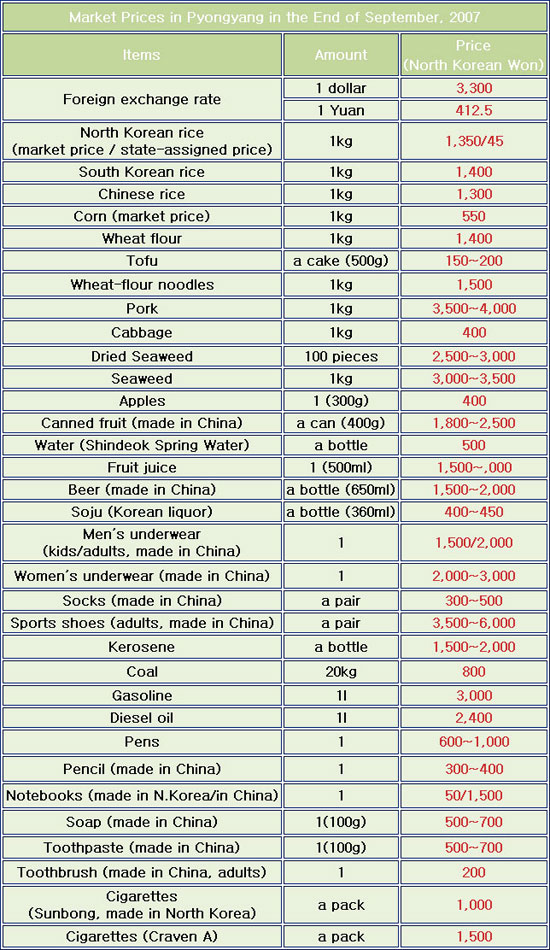
dprkmarketprices.jpgAccording to DailyNK’s research on prices in North Korea conducted in late September, the prices in Pyongyang are similar to the prices in other parts of the country. The finding shows that Jangmadang (markets) economy has been going through integration and similar distribution process across North Korea.

In the past, domestic commodities were sold cheap, and foreign products were sold expensive in Pyongyang.

DailyNK has been conducting quarterly research on prices in the central such as Pyongan Province and Hamkyung Province and northern areas.

This time the research result shows that the price of rice in a Jangmadang in Pyongyang is 1,350 won/kg, which is similar to the price of rice in Sinuiju, 1,400won/kg. In North Korea, the rice price serves as a gauge for price trends.

In Pyongyang, the exchange rate is about 330 thousands won to 100 dollars, which is the same as the exchange rate in other places. The most famous imported cigarettes, Cat (Craven A) is sold at the same cost of 1,500 won in Pyongyang and other areas.

Subsidiary food is more expensive in Pyongyang. The price of cabbage is 400 won/kg, 50 won/kg higher than cabbage price in Sinuiju. The price of pork ranges from 3,500 to 4,000/kg, 500~1,000 won/kg higher than the pork price in other areas.

The prices of seafood such as brown and green seaweed, and dried Pollack are cheaper in Pyongyang. Seafood caught in Kangwon Province and neighboring areas is transported to markets in Pyongyang in refrigerator car. Since the demand is high, seafood is sold in great quantities, and the price remains low in general.

Movie ticket prices range from 200 to 400 won. Telephone service is charged five won per minute. Overall, the price range for each commodity is high, and many different kinds of goods are available in Jangmadang.

Imported items from China such as socks, sports shoes, or underwear are expensive being sold at a cost of 1,000 won in Pyongyang. That is because there are extra shipping rates and labor costs imposed on Chinese goods transported to Pyongyang. On the contrary, in Sinuiju, imported goods from China are circulated on the market right away.

Often, retail prices are higher in Pyongyang because of high levels of consumption among Pyongyang citizens. However, cigarettes or liquor produced in Pyongyang, or clothes from South Korea circulated to other areas via Pyongyang are sold cheap in Pyongyang.

However, in these days the differences in regional price levels have almost disappeared.

A defector from Pyongyang, Ahn Chul Min (a pseudonym) who came to South Korea in 2006 said, “Prior to 2002, there were individuals who hung around from place to place and made money on price differences. But nowadays, the retail prices are almost uniform across the country because people just use a telephone and find out where to get items they want at what prices.

“Since there is no big difference in retail prices, retailers are not doing well in business,” Ahn added, “Instead, individuals driving a truck and selling goods wholesale are making good money.”

Ahn said, “Not everyone who lives in Pyongyang is well-to-do. Despite of their locations whether in Pyongyang or Chongjin, all markets have goods from South Korea and China. The poor people even if they live in Pyongyang should buy cheap and low quality of products from China. In contrast, those who live in Chongjin and have money can buy goods from South Korea anytime.”


Market Prices Consistent Throughout DPRK
Institute for Far Eastern Studies (IFES)
NK Brief No. 07-10-25-1

10/25/2007

The results of a survey conducted by Daily NK on the price of goods in Pyongyang at the end of September show that prices in the capital were similar to those in rural areas. This is an indication that markets throughout the country are integrated, and evidence that goods can be circulated from region to region.

In the past, the price of domestic goods in Pyongyang was relatively cheep, while imported goods were sold at high prices. During that time, Daily NK carried out local price surveys in central regions such as Pyongan and Hamkyung provinces, as well as in northern areas. According to this latest survey in Pyongyang, the cost of one Kg of rice, the standard measure of the cost of goods in North Korea, was 1,350 won, similar to the 1,400 won price in Sinuiju, and the 1,250 won cost in Hyeryung. An exchange rate of 3,300 won per USD is also in line with rural exchange rates, as is the 1,500 won price tag on a pack of Craven A cigarettes, the most favored imported cigarette in North Korea.

Non-essential food goods are more expensive in Pyongyang than in outlying areas, with one Kg of lettuce selling for 400 won, 50 won more than in Sinuiju. Also, pork in the capital runs between 3,500 and 4,000 won per Kg, which is 500 to 1,000 won more than it would cost elsewhere in the country.

On the other hand, seaweed, dried Pollack, and other marine products are cheaper in Pyongyang than elsewhere. Ocean harvests from Kangwon and neighboring provinces are brought to Pyongyang markets by way of refrigerated trucks. Because of high demand, a variety of goods get delivered, yet overall, prices are held fairly low.

Overall, the price range on a particular ware was very wide, indicating that there was a variety of products available in the markets. The survey found that goods such as undergarments, socks, sneakers imported from China were selling for the high cost of 1,000 won each. In Sinuiju and other northern areas, goods from China are brought directly to markets, but by the time these same goods reach Pyongyang, additional labor and transportation costs force prices up. Pyongyang residents typically have more money to spend than those in rural areas, also leading vendors to raise prices on some goods, however cigarettes and alcohol produced in Pyongyang and distributed to rural areas, as well as South Korean goods which reach DPRK markets by way of Pyongyang, are slightly less expensive in the capital.

Recently, regional price differences have nearly disappeared. Prior to 2002, some traders earned their living traveling from region to region exploiting price differences. However, now with one simple phone call, North Koreans can find out where and for what price goods are being sold, leading the majority of retail prices to be similar throughout the country.

Share

Kwon to Seek International Financing for N. Korean Projects

Friday, October 19th, 2007

Korea Times
Lee Hyo-sik
10/18/2007

Finance and Economy Minister Kwon O-kyu plans to call on the global financial community to increase support for North Korea’s economic projects when he attends the annual meetings of the International Monetary Fund (IMF) and the World Bank in Washington D.C on Oct.20-22. The country’s top economic policymaker will also ask international financial institutions to allow the Stalinist state to become a member.

Kwon is planning to brief IMF meeting participants as well as U.S. administrative officials and lawmakers on the outcome of the inter-Korean summit between President Roh Moo-hyun and North Korean leader Kim Jong-il early this month.

He has said the government will attract funds from the World Bank and other international financial institutions, as well as from the private sector, for a range of large-scale inter-Korean economic cooperation projects, which is expected to cost billions of dollars over the years.

Hyundai Research Institute projected that the establishment of a special peace zone in the West Sea area and other economic cooperation projects between the two Koreas will cost $11.2 billion (10.3 trillion won). The state-run Korea Development Bank (KDB) and other institutions have put forth even larger spending estimates for the envisioned economic cooperation between the two Koreas _ as much as 60 trillion won over the next 10 years.

While in the U.S., Kwon is also scheduled to meet with the U.S. trade representative Susan Schwab to discuss the ratification of the Korea-U.S. free trade agreement (FTA). He plans to ask Schwab as well as other U.S. administrative and congressional officials to urge the Congress to quickly approve the bilateral trade accord.

He will also have a series of interviews with the U.S. media to promote the trade agreement and publicize the second inter-Korean summit. Seoul and Washington signed the deal in June, and Korea submitted the agreement to the National Assembly last month for ratification.

However, there has recently been growing opposition to ratification of the Korea-U.S. FTA in the U.S. Congress. Many lawmakers, including Democratic Party presidential contender Hillary Clinton, are openly opposing the agreement, claiming it will have negative effects on the U.S. manufacturing industry and job growth. They also said Korea should do more to open its markets to U.S. industrial and agricultural products.

To promote Korea as a regional financial hub, minister Kwon plans to hold a meeting with heads of leading international investment banks and prominent financers to ask for more investment in Korea and increasing cooperation with Korean financial firms.

Additionally, a number of local bankers and heads of other financial institutions will converge in the U.S. capital for the meetings and hold talks with executives from global financial institutions.

Bankers include Kookmin Bank President Kang Chung-won, Woori Financial Group Chairman Bahk Byong-won, Shinhan Bank President Shin Sang-hoon, Hana Bank President Kim Jong-ryul and Export-Import Bank of Korea President Yang Cheon-sik.

Among others, Korean Federation of Banks Chairman Yoo Ji-chang, Korea Asset Management Corp. CEO Kim Woo-suk and Korea Investment & Securities CEO Yoo Sang-ho are flying to Washington.

Marcus Noland Response… 

N.K. needs technical help before joining int’l financial institutions: U.S. expert
Yonhap

10/19/2007

North Korea must first receive technical assistance from international financial institutions before it can join them and begin receiving monetary aid, a U.S. expert said Friday.

Pyongyang, viewed as one of the most secretive regimes in the world, has to provide certain economic data and follow standardized practices and procedures in order to be able to join financial institutions, Marcus Noland, a senior fellow at the Institute for International Economics, told Yonhap in an e-mail interview.

Noland proposed first inviting North Korea in as an observer “to begin the process of education and technical assistance to support their economic transition” into full membership.

North Korea had said it wanted to join such institutions in 1996, but lost all interest after finding out it would not immediately begin receiving money, according to Noland.

Since then, it has not indicated willingness to adopt the transparency and openness required for membership into the institutions, he said.

Outside aid to the North is heavily constrained by various sanctions, notably by the U.S., which brands Pyongyang as a state sponsor of terrorism. The designation requires Washington to vote against monetary loans and assistance programs to North Korea through international organizations, such as the World Bank and the International Monetary Fund (IMF).

In an annual IMF meeting here next week, South Korean Finance Minister Kwon O-kyu is expected to call on the global community to increase support for North Korea’s economic development, and to allow Pyongyang to become a member of global financial institutions.

His recommendations follow an inter-Korean summit earlier this month that highlighted economic cooperation and progress in six-nation efforts to denuclearize the Korean Peninsula.

Noland questioned whether Pyongyang would be willing to be subjected to the scrutiny required for a membership into the international financial system.

“Frankly speaking, the most important thing that the international financial institutions could immediately provide to the North Koreans is technical assistance,” he said.

“But again, it is not at all clear that they are particularly interested in becoming members of these organizations or reforming their internal practices in ways that would allow them to make full use of membership.”

Such assistance could involve setting up processes, procedures and regulations to reform North Korea’s laws and practices, he said.

North Korea also has to provide the necessary data, a process which international institutions could assist by providing basic standards, such as data collection standards.

North Korea and financial institutions also need to come up with a strategic plan, said Noland. If, for example, Pyongyang wanted to set up a stock exchange, the institutions would assist in starting it and revising relevant laws in the North, he said.

Share

EBA Press Release: Pyongyang International Trade Fair

Wednesday, October 10th, 2007

Europen Business Association
October 2007

EBA.JPG18 European companies are participating at the European booth organized by the European Business Association (EBA) in Pyongyang. This has been the largest ever participation of European companies at a Trade Fair in Pyongyang. The 18 EBA-member companies come from 6 European countries and are engaged in banking, IT, pharmaceuticals, maritime transportation, railways, courier services, industry, mining, solar driven water pumps, energy saving technology, commodity inspection, cosmetics and other consumer goods and general trading. Some already operate in joint ventures with Korean partners or found other forms of close business cooperation, particularly in the fields of banking, mining, internet services, logistics, software development and pharmaceuticals.

The EBA will continue to make efforts to attract more European companies to invest and do business in the DPRK in the coming years and will share its experience to help make the endeavors of the newcomers and their Korean partners a success. The EBA closely cooperates with the DPRK Chamber of Commerce and the Korea International Exhibition Corporation to facilitate the participation at exhibitions, to intensify trade between European and DPRK-enterprises and to enhance the identification of suitable business and investment opportunities for European companies.

Pictures of the European booth will be published on http://www.eba-pyongyang.org/
Felix Abt, President
Dr. Barbara Unterbeck, PR-manager
European Business Association
President´s Office
Chang Gwang Foreign Residential and Office Building
10th Floor, No. 10-2
Central District
Pyongyang
The Democratic People’s Republic of Korea
http://www.eba-pyongyang.org/


Share