Archive for the ‘Economic reform’ Category

KWP reps visit Chinese counterparts

Thursday, October 21st, 2010

According to the Choson Ilbo:

The senior secretaries of all North Korea’s 11 metropolitan and provincial party committees paid a rare collective visit to a senior member of the Communist Party of China in Beijing on Tuesday.

The North Korean delegation led by Mun Kyong-dok, the senior secretary of the Pyongyang municipal party committee, met with Zhou Yongkang, a member of the Politburo Standing Committee who ranks ninth in the hierarchy, to discuss economic cooperation.

Zhou was quoted by the official Xinhua news agency as saying it was “the first time” in the history of bilateral relations that senior secretaries of the Workers Party’s metropolitan and provincial committees have visited China as a group. “I wish that you will expand exchange with various Chinese regions you’re visiting and achieve success from your tours.”

The North Koreans also met with their Chinese counterparts to discuss investment in development projects in the North. The Chinese officials were in Beijing to attend the fifth plenary session of the 17th Communist Party Central Committee.

A South Korean government official said, “The North Korean officials’ visit to Beijing is equivalent to all 16 South Korean metropolitan mayors and provincial governors flying to Washington as a group to discuss exchange and cooperation with ruling-party lawmakers and state governors in the U.S.” He said since Kim Jong-il’s son Jong-un was established as the official successor to the leadership, the North and China have increased the frequency of personnel exchanges “to discuss more substantive matters than before.”

The profiles of the Chinese delegation that attended the 65th anniversary celebrations of the North Korean Workers Party were also exceptional. It included senior officials of the three Chinese northeastern provinces — Sun Zhengcai, the secretary of the Jilin provincial party committee, Chen Xi, the deputy secretary of the Liaoning provincial party committee, and Du Yuxin, the deputy secretary of the Heilongjiang provincial party committee.

They were welcomed at Sunan Airport by Ju Yong-sik, the senior secretary of the party committee in Jagang Province, a border region. The senior secretaries of the party committees in all four North Korean provinces bordering China — Ju from Jagang Province, Ri Man-gon from North Pyongan Province, O Su-yong from North Hamgyong Province and Kim Hi-taek from Yanggang Province — attended a dinner that evening in honor of the Chinese delegation.

“There have recently been more signs of the North and China deepening and developing economic cooperation, including various development projects focusing on the border areas,” a Unification Ministry official said. “It seems that after the North’s Workers Party and the Chinese Communist Party finished talks at headquarters level, their provincial party committees have now begun concrete cooperation.”

Military exchanges are also increasing ahead of the 60th anniversary of the day the Chinese joined the Korean War on Oct. 25.

The official North Korean Central Broadcasting Station on Tuesday reported a delegation of Chinese People’s Volunteer Veterans led by Wang Hai, a former Air Force commander, and the People’s Liberation Army’s art troupe arrived in Pyongyang for the anniversary.

O Kuk-ryol, vice chairman of the National Defense Commission, and Pak Jae-kyong, vice minister of People’s Armed Forces, hosted a reception for them.

On Oct. 14, a North Korean Army delegation led by Pyon In-son, another vice minister of People’s Armed Forces, visited China, to tour PLA units. Quoting the North’s official Rodong Sinmun daily, Xinhua said, “Friendship bonded by blood in the previous generations is being handed down to the next generation.”

A South Korean security official said, “The North is apparently trying to counter the South Korea-U.S. military alliance, which has been strengthened since the sinking of the Navy corvette Cheonan in March, by intensifying military ties with China, as well as attempting to escape international economic isolation by leaning on China.”

Mike has more at NK Leadership Watch.

Read the full story here:
N.Korea, China Grow Ever Closer
Choson Ilbo
10/21/2010

Share

North Korea’s market restrictions revisited

Wednesday, October 20th, 2010

Reuters published a concise report of the DPRK’s recent restrictions on market activity which is compiled from work by Marcus Noland and Stephan Haggard.  Here is the Reuters report:

Reclusive North Korea has imposed a series of measures since 2008 to rein in market activity, foreign trade, and activity across the border.

A Peterson Institute for International Economics policy brief published this year outlines some of the rules put in place:

2008
January – Women under 40 banned from trading in markets, followed by efforts to redeploy them to workplaces.

April – Wide-ranging Antisocialist Conscience Investigation of Sinuiju, the country’s main land port with China, including the books of trading organizations. Restrictions placed on carrying merchandise on bicycles and carts in Sinuiju.

July – Party, police, and market management office coordinate efforts to limit large sales in the Pyongsung market, an emerging wholesale center for the country in Pyongan province.

October – Nationwide ban on sale of shoes in markets and new restrictions limiting trade in foodstuffs to individually cultivated fruits and vegetables.

November – Major directive announcing the conversion of markets back to the more restrictive farmers’ market format. Markets to be open only on the 1st, 11th, and 21st of each month, and to be limited to retail sales of individually cultivated food; other foodstuffs and manufactures to be sold through the ‘public distribution system’ and state-run stores. Major cities, including Pyongyang, Hamheung, Soochun, Kaesung, and Chungjin, set up model farmers markets.

2009
January – National Security Agency special investigative unit scrutinizes names, number of family members, and livelihoods of households in the National Border Area suspected of involvement in border crossing and trade. Public education campaigns and increased punishment for border crossing.

March – New controls over lodging and movement without passes in National Border Area [and] imposition of strict movement controls in connection with the Supreme Peoples Assembly elections; intensified controls following the elections.

May – Announcement of 150-day campaign accompanied by renewed implementation of market restrictions on women under 40 and restricted items, including products of joint ventures, industrial goods, and American and South Korean products. Punishment of emergent back-alley markets and ‘sell and run’ sales. Public education campaigns against market activities.

June – Closure of Pyongsung market in Pyongan province.

July – Increased control and surveillance over households in National Border Area with defectors.

November – North Korea announces a reform to replace all currency in circulation with new bills and coins.

The Peterson Institute report mentioned in this article can be found here (PDF).

I should also point out that many of these dictates were uniformly unenforceable and many have been rescinded (including the 10-day rule) since the currency reform was implemented.

Read the full story here:
Factbox: How North Korea has tightened controls
Reuters
10/20/2010

Share

Did the DPRK foil an explosive smuggling attempt?

Tuesday, October 19th, 2010

According to the Daily NK:

Three North Korean Senior Middle School students have been caught trying to carry explosives into North Korea, according to a Radio Free Asia (RFA) report today.

Citing a source from Hyesan, RFA reported, “On the 11th, immediately after Chosun Workers’ Party founding day, 15-year old Songbong Senior Middle School student Kang and two others were caught trying to bring explosives in from China,” adding, “As a result of this, the security authorities have been put on emergency alert and the border totally closed.”

The RFA report explains that the three crossed the border into China with the help of border guards and smuggled back 10kg of explosives in two bags, but were caught at the entrance to a village by a community watch guard unit consisting of workers.

According to another source, “I’ve heard a number of rumors, including that they brought the explosives to destroy the bridge that passes by Wangdeok Station.” However, the source added, “Whether this is true or not I cannot say.”

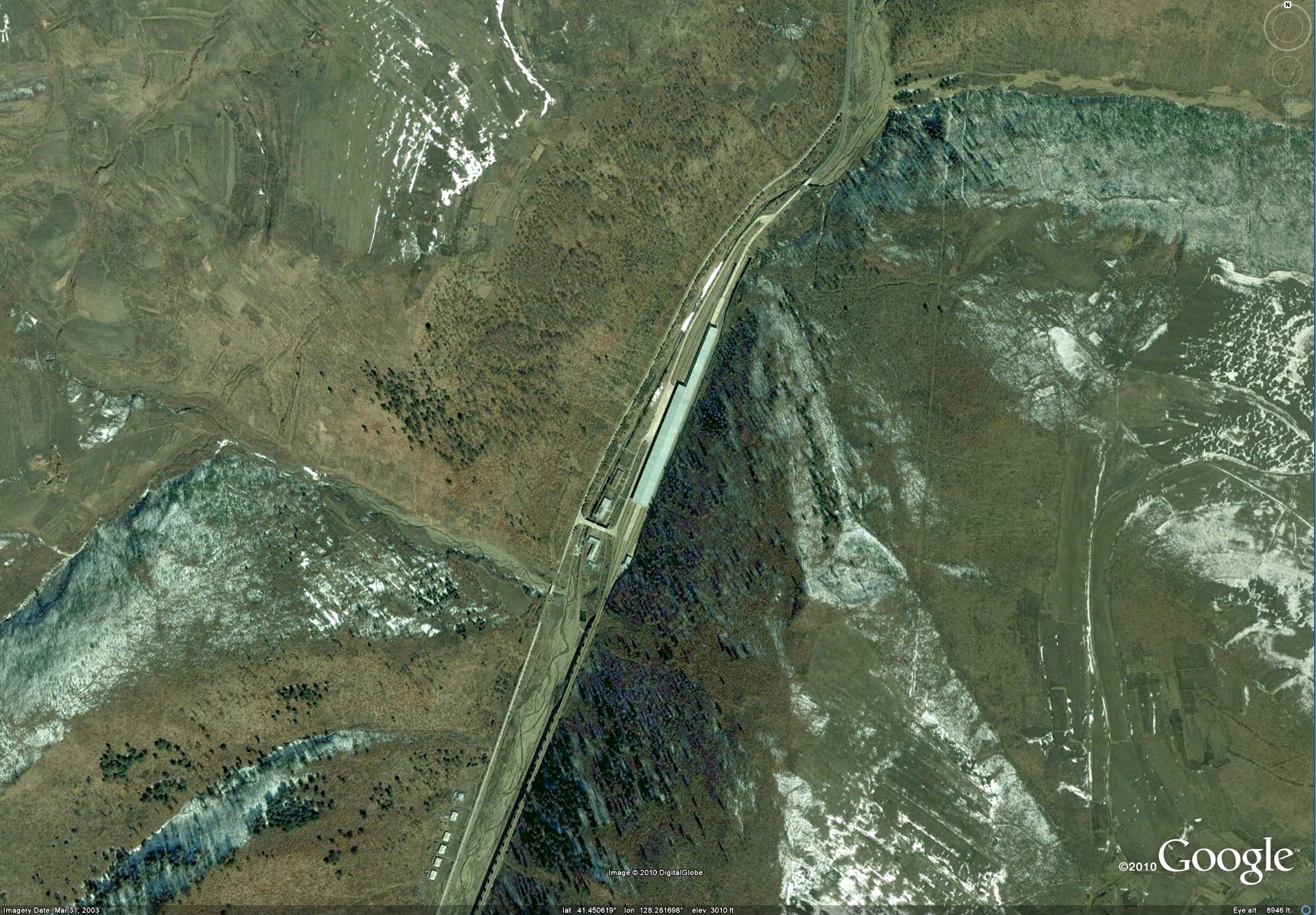
Wangdeok Station is among a number of stations in North Korea on lines reserved for the exclusive use of Kim Jong Il.

The North Korean authorities are apparently at a loss to explain the case, because the students were just the children of normal workers; they did not have criminal records and were only interested in literature and reading.

Since the event occurred, the Yangkang Province authorities have stepped up security, with provincial committee cadres and students from Hyesan Agriculture University patrolling in the area around Bocheonbo Combat Victory Monument and the local statue of Kim Il Sung. They have also dispatched tens of guards to idolization sites such as Hyesan Revolutionary Museum and Kim Il Sung Revolutionary Activities Institute.

The report also added information on further similar cases: in 1997, a group of people were arrested after smuggling explosives into the country, allegedly in order to blow up the city’s statue of Kim Il Sung, and there has also been an arson case involving Kim Jong Suk Art Theatre and persons with complaints against the Kim Jong Il system.

It should be stated that stories such as these should be regarded with some skepticism since almost all of the facts are unverifiable.

For what it is worth, here is a satellite image of the  Wangdeok Leadership Train Station in Hyesan ( 41.448124°, 128.277445°):

Share

Future Sinuiju development affecting Dandong today

Tuesday, October 19th, 2010

According to the Daily NK:

In Dandong, the number of people studying the Chosun language (Korean) is increasing, while real estate prices are rising on the back of rumors that Shinuiju, just across the North Korean border, will soon be opened up to trade and investment.

One anonymous Korean-Chinese trader who already engages in business with North Korea in the area told The Daily NK on the 15th, “The rumor among Chinese traders who have recently been in North Korea has it that ‘The North Korea authorities will open Shinuiju sooner or later.’”

As a result, he said, “There is currently an upsurge in the price of apartments and shops in Dandong, while the number of people wanting to learn the Chosun language is increasing.”

The trader explained that for the last three or four years the real estate market in Dandong has been flat. However, with reports of Kim Jong Eun’s internal appointment as the successor spreading earlier this year, the price of Hanquosheng, Dongfang Minzhu, Taiyang Dasha and other luxury apartments has increased by more than ten percent over the course of the summer.

The source pointed in particular to the fact that the price of apartments under construction in the Langtou Port area has gone from 2,000 Yuan/m² (approximately $300) in May to 3,200 Yuan/m² (approximately $480) in October. The neighborhood has particularly bright prospects as it is the location for the planned Second Yalu River Bridge under an agreement made during the visit to Pyongyang of Chinese Premier Wen Jiabao in 2009.

The Daily NK’s Korean-Chinese source explained that those primarily responsible for fuelling the real estate gains are Korean-Chinese from the Northeastern provinces of China.

He reported, “Since Dandong has geographical advantages, being cool in summer and warm in winter, as well as being able to provide for North Korea’s development of Shinuiju, the city has emerged as the best investment location for Korean-Chinese people.”

“The expectation that Kim Jong Eun is still young and has experience of life in Switzerland; therefore he knows well the need to develop the country and will have no choice but to make that decision, is driving the investment by Korean-Chinese,” the source added.

Naturally, the presumption that Shinuiju will soon offer some new opportunities for business is producing a new trend for learning the North Korean language.

Wang, a 21 year-old student from a university in Dandong said, “Chinese students know that South Korean is different from Chosun,” and went on, “Until now, South Korean has been all the rage thanks to Hallyu (as the South Korean cultural influence in wider Asia is known), but recently the number of students wanting to learn Chosun has been drastically increasing.”

There are presumed to be roughly 3,000-4,000 North Koreans residing in Dandong, including students. Some of them exchange languages with Chinese students, while some others give private classes for between five and ten Yuan an hour.

Alongside which, private Korean language institutes in Dandong are enjoying increased demand.

One South Korean who manages a Korean language institute in Dandong told The Daily NK, “In the case of Korean language institutes in downtown Dandong, each class has seen an increase of four or five students for this fall semester. Alongside Hallyu, the expectation that Shinuiju will open up has meant that the number of Chinese young people wanting to learn Korean is steadily increasing.”

Read the full story here:
Shinuiju Development Making Waves in Dandong
Daily NK
Park In Ho
10/18/2010

Share

[ROK] Investors in DPRK take huge hits; interest in FDI plummets

Monday, October 18th, 2010

Institute for Far Eastern Studies (IFES)
NK Brief No. 10-10-18-1
10/18/2010

The majority of joint ventures investing in North Korea have suffered significant losses since the South Korean government began to enforce sanctions as a result of the sinking of the ROKS Cheonan. On average, companies have incurred losses of almost one billion won, and most companies are no longer interested in investing in the North.

According to the Korea Chamber of Commerce and Industry, a survey of 500 companies (200 inter-Korean economic cooperative schemes and 300 other companies involved in business with the North) showed that 93.9 percent of respondents said they had suffered losses due to trade restrictions put in place due to the Cheonan incident, while 66.5 percent responded that they faced “financial difficulty” due to the sanctions. The companies have suffered an average of 974 million won in losses.

Investment and operational losses due to the ‘all stop’ order from the government amounted to 51.9 percent of losses reported, while 26 percent of respondents pointed to a reduction in orders and 22.1 percent blamed an increase in transportation and other associated costs. One company importing anthracite from the North turned to China, Vietnam, Russia, and other vendors after inter-Korean trade was restricted, but due to each country’s efforts to secure its own natural resources, this year’s sales are expected to be more than 10 billion won less than that seen last year.

Another company, investing in textiles, was strategically producing hand-made works in a North Korean factory, but now production has come to a halt and it may not be able to deliver goods it has produced. A source from the factory stated, “Personnel and raw material expenses in China, Vietnam, and other countries mean that profit margins will be minimal, and there is no alternative.” The same source also stated, “Special funds were distributed from the government, but [companies] are concerned about how long they can hold out.”

As companies invested in North Korea suffer losses in the wake of the Cheonan incident, interest in North Korea investment opportunities is also waning. 82.7 percent of responding companies believe that “even if economic cooperation was normalized, there would be no new investments or continuation of existing projects,” and 76.9 percent of respondents believed that “because of the uncertainty of the North Korean system” non-economic issues would dampen investment enthusiasm. 13.7 percent stated that difficulties with transportation and other infrastructure issues would discourage investment, and 9.4 percent of respondents answered, “North Korean authorities’…interference and restrictions” would turn away foreign investors.

Among those businesses not involved in cooperative economic ventures, 41.5 percent pointed to “North Korea’s overall reform and opening,” while 22.2 percent chose “guaranteeing the security of investments and expanding domestic SOC” as being necessary to propel investment in North Korea. Another 19.7 percent answered, “security issues like North Korean denuclearization” were necessary for improvement in the investment environment.

Many also voiced concerns over the ongoing ban on inter-Korean exchanges. When asked about the impact on business if sanctions against the North were to continue, 5.18 percent of respondents stated, “opportunities for foreign investors will suffer,” while 25.6 percent responded that the North’s economic reliance on China would grow, and 22.6 percent feared that the national image would suffer due to an increase in the security risk.

63.6 percent of respondents call for strengthened protection for investors, including protection against losses as well as guarantees on operational freedoms. 20.1 percent called for easing restrictions on businesses in the Kaesong Industrial Complex, and 16.3 percent pointed to the need for more monetary support.

Even after the government’s announcement halting inter-Korean exchanges on May 24, , inter-Korean trade worth approximately 80 million USD (90 billion won) was recorded due to a number of goods with special exceptions. 639 different cases of imported goods manufactured from raw materials or parts sent to the North prior to the May 24 restrictions amounted to 31.15 million USD, while 269 cases of pre-ordered exports amounted to just over 49 million USD.

This survey was conducted from August 12 to September 1, calling or faxing 200 companies invested in inter-Korean cooperative schemes and 300 of the 1000 companies involved in sales.

Share

Pyongyang trade fair begins today

Monday, October 18th, 2010

The Pyongyang International Trade fair is held twice a year: once in the spring and once in the fall.  The Fall 2010 fair begins today.  It is always held at the Three Revolutions Museum in Northern Pyongyang (satellite image here).

According to KCNA:

International Trade Fair to Be Held in Pyongyang 
 
Pyongyang, October 12 (KCNA) — The 6th Pyongyang Autumn International Trade Fair will be held at the Three-revolution Exhibition from October 18 to 21.

The fair will draw some 140 companies of the Democratic People’s Republic of Korea and other countries, exhibiting more than 57,000 pieces of 2,300 kinds with electrical machinery, steel goods, electronics products, foodstuffs, daily necessities, medicines, building materials, chemical goods and rolling stocks included.

Commercial consultation and activities for exchange and economic cooperation will also be held during the fair.

According to Ryu Jong On, a section chief of the Korean International Exhibition Corporation, businesses of China, Russia, Malaysia, Mongolia, Syria, Germany, Brazil and other ten countries have already entered their names for the fair.

Share

North Korea’s cultural life

Friday, October 15th, 2010

Tania Branigan visited Pyongyang for The Guardian and wrote a long article on North Korean culture.  Most of the information is familiar to long-time DPRK watchers, though there were a few nuggets of information I had not heard before.  I have posted these below:

But who knew that The Da Vinci Code was a hit in this strictly controlled city? That Céline Dion is a karaoke favourite? Or that the mass performances are not only a tribute to the leadership and motherland, but the way that many young people find partners?

Few foreigners see this city at all. Around 2,000 western tourists visited last year, plus perhaps 10 times as many Chinese visitors. The expatriate population, excluding Chinese and Russian diplomats, and including children, stands at 150.

There are certainly signs of change here: Air Koryo has new planes and three gleaming airport buses to ferry passengers from runway to terminal. Last week a vast new theatre opened, as did an apartment complex, although it may be destined for officials. The 105-storey Ryugyong hotel – more than two decades in construction – is finally glass-sheathed and due to open in 2012. That year will mark the 100th birthday of the country’s founder, Kim Il-sung. But it is hard to see how it can achieve its pledge to become “a great, powerful and prosperous nation” by then – even given the Stakhanovite industrial efforts lauded in its newspapers.

Pyongyang is lucky: no one is plump, but nor is there noticeable emaciation. Dr Andrei Lankov, associate professor at Kookmin University in Seoul, says the official income in Pyongyang is around 3,000 won a month, but many have ways of making money on the side and – unlike other North Koreans – its residents receive subsistence food rations. Most top those up at markets that are legal though never formally acknowledged (officials insist that “everything is public”). At the turn of the year, the government embarked on currency reforms to eradicate an increasingly independent group of “kiosk capitalists”. But wiping out hard-won savings caused highly unusual public discontent and even, reportedly, unrest.

You can read the full article here:
The cultural life of North Korea
The Guardian
Tania Branigan
10/15/2010

Share

Obstacles to reform

Friday, October 15th, 2010

Victor Cha writes in the Washington Post:

The real problem is the system itself. Even if the young Kim is enlightened, there are three obstacles to reform. First, despotic regimes such as North Korea’s cannot survive without an ideology to justify their iron grip. And the ideology that accompanies the son’s rise appears to look backward rather than forward.

I call it “neojuche revivalism.” It is a return to the conservative and hard-line “juche” (self-reliance) ideology of the 1950s and ’60s, harking back to a day when the North was doing well relative to South Korea. Neojuche revivalism is laced with “songun” (military-first) ideology, which features the North’s emergence as a nuclear weapons state (Kim Jong Il’s one accomplishment during his rule). This revivalist ideology leaves no room for an opening-up, because it blames the past decade of poor performance on “ideological pollution” stemming from experiments with reform.

Second, true reform in the post-Kim Jong Il era would require the courage to loosen the political instruments of control that allow the regime to keep its iron grip on the people. The dilemma the young Kim faces is that he needs to reform to survive, but the process of opening up will undeniably lead to the end of his political control. This was perhaps the most important lesson North Korea learned from the end of the Cold War.

Finally, even if Kim Jong Eun is an enlightened leader who has the courage to attempt such reform, he will be dealing with a generation of institutions and people who are the most isolated in North Korean history. The generals, party officials and bureaucrats of the Cold War era were far more worldly than those of the post-Cold War years. Kim Il Sung’s generation was able to travel freely to East Bloc countries. Kim used to vacation with Communist leaders such as East Germany’s Erich Honecker and Romania’s Nicolae Ceausescu. By contrast, Kim Jong Il’s generation saw Ceausescu executed and the Chinese Communist Party almost lose power in Tiananmen Square. The generation of leadership the young son will inherit sees nothing comforting about the outside world.

The full article is worth reading here:
Without a loosened grip, reform will elude North Korea
Washington Post
Victor Cha
10/15/2010

Share

Markets spreading in DPRK

Thursday, October 14th, 2010

I have added links to satellite imagery of the markets mentioned in the story as well as made one correction.

According to the Chosun Ilbo:

About 300 markets are doing lively business throughout North Korea despite the regime’s attempt to suppress them, according to data an intelligence agency submitted to Grand National Party lawmaker Yoon Sang-hyun of the National Assembly’s Foreign Affairs, Trade and Unification Committee on Wednesday.

“Markets in the North are places where goods are transacted and information is exchanged at the same time, Yoon said. “They pose a threat to a regime that is hostile to markets.”

The regime has tacitly allowed markets to expand to make up for the shortage of daily necessities in the wake of a botched currency reform and international sanctions, but they have boomed alarmingly.

Typical examples are the Tongilgori (satellite image) and Jungang (satellite image) markets in Pyongyang. The Tongilgori Market, in Rakrang District, opened in August 2003. It has three buildings and a parking lot. The Jungang Market in Jung District is a single domed building with a parking area.

There are two famous markets in South Pyongan Province: the Kangso Market (satellite image), which opened in 2004, and the Doksan Market, which opened the following year. The Doksan Market is the largest center of wholesale and retail goods in the North and has played a role as a distribution point of goods from Rajin-Sonbong, Sinuiju and Wonsan. But it was reportedly closed down during a crackdown in June last year. [I believe the article mistakes the “Doksan Market” with the “Phyongsong Market” (satellite image) which is actually the largest market in the country]

The Chaeha Market (satellite image) in Sinuiju, near the Chinese border, is a distribution point for goods imported from China. Goods bought there are distributed throughout the North.

The Hoeryong Market (satellite image) in Hoeryong, North Hamgyong Province across from China, was established by the regime to secure financial sources and put foreign goods under easy control. The regime has allowed Chinese vendors to sell goods there.

In a bid to rein in the markets, the regime set out one control policy after another, including the ban on grain transactions in the markets in October 2005, a crack-down on illegal markets in 2007, and an attempt to turn general open-air markets into farmers’ markets in late 2008, but apparently failed to achieve tangible results.

Last year, the regime banned the sale of industrial products and the circulation of foreign currency. But it had to begin relaxing the bans in February in the face of protests and violent attacks on market control officials.

“We have to pay attention to what happens in North Korean markets because that is where a change will occur first and they will be the first places where we can see the impact,” Yoon said.

Read the full story here:
Markets Booming in N.Korea
Chosun Ilbo
10/14/2010

Share

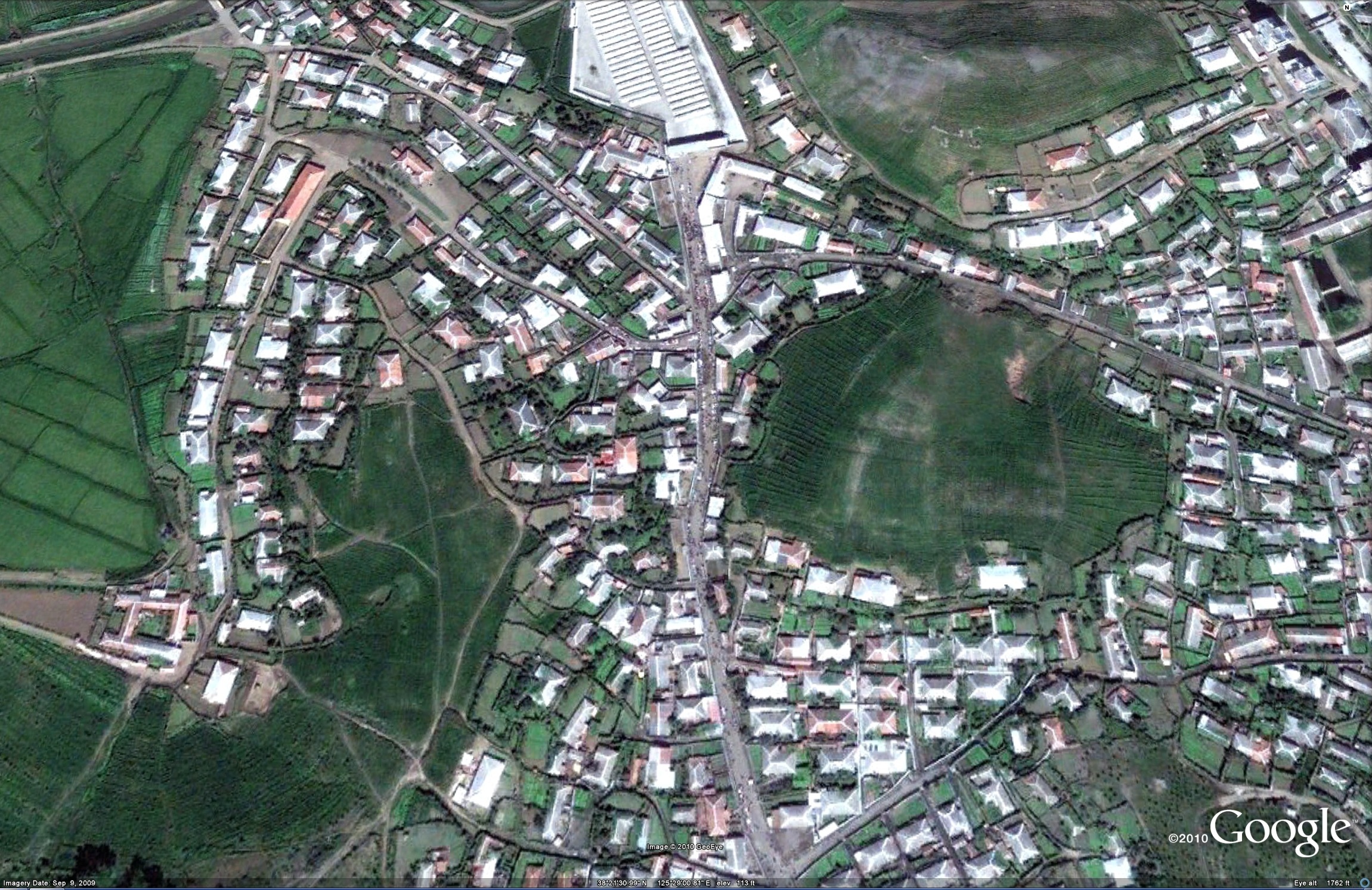
Sinchon Street Market

Thursday, October 7th, 2010

Even when the official marketplace is closed, there is still plenty of street trading.

Click image for larger version
38°21’32.50″N, 125°29’1.18″E
Sept 9, 2009
Google Earth/GeoEye

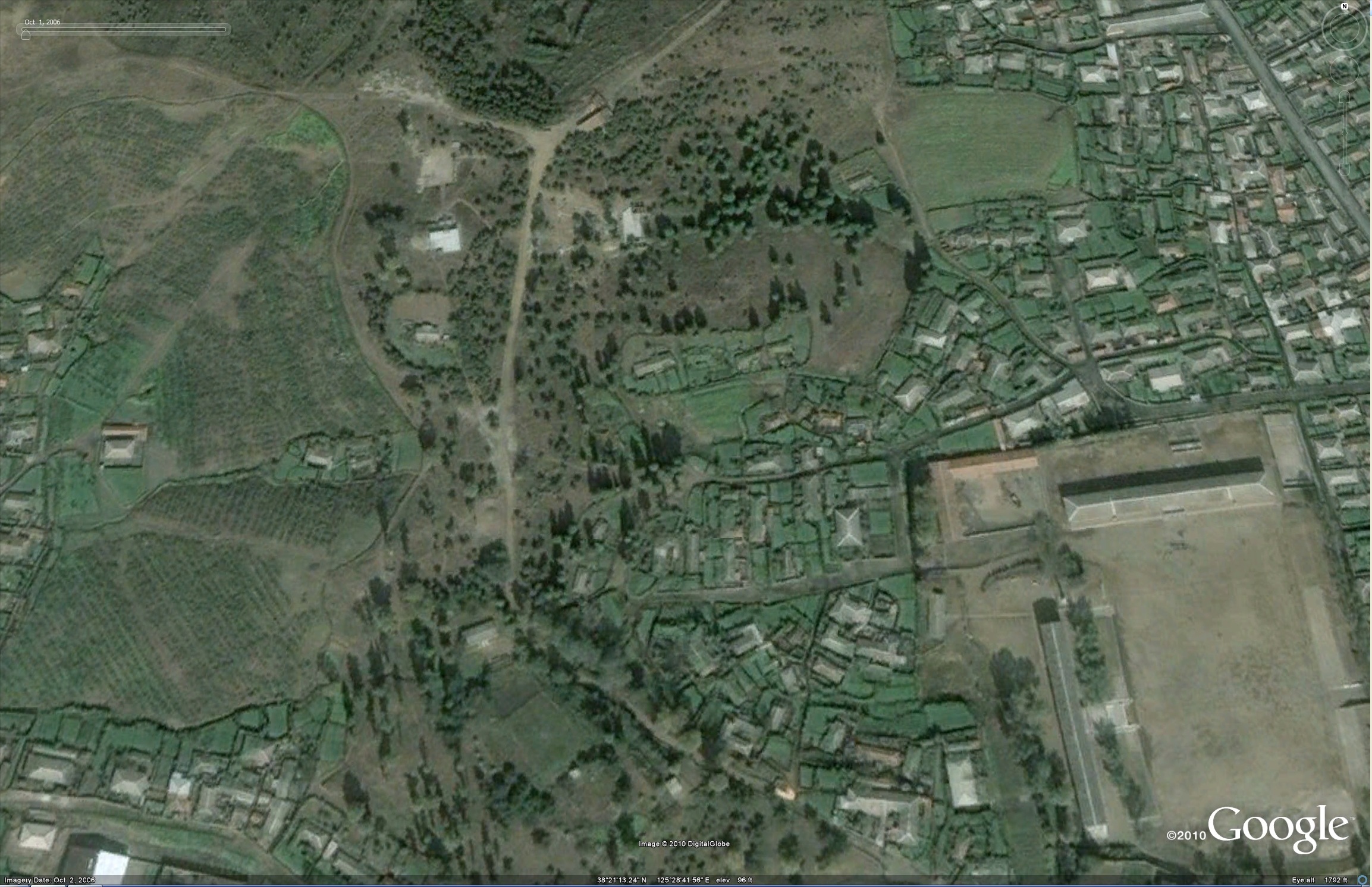
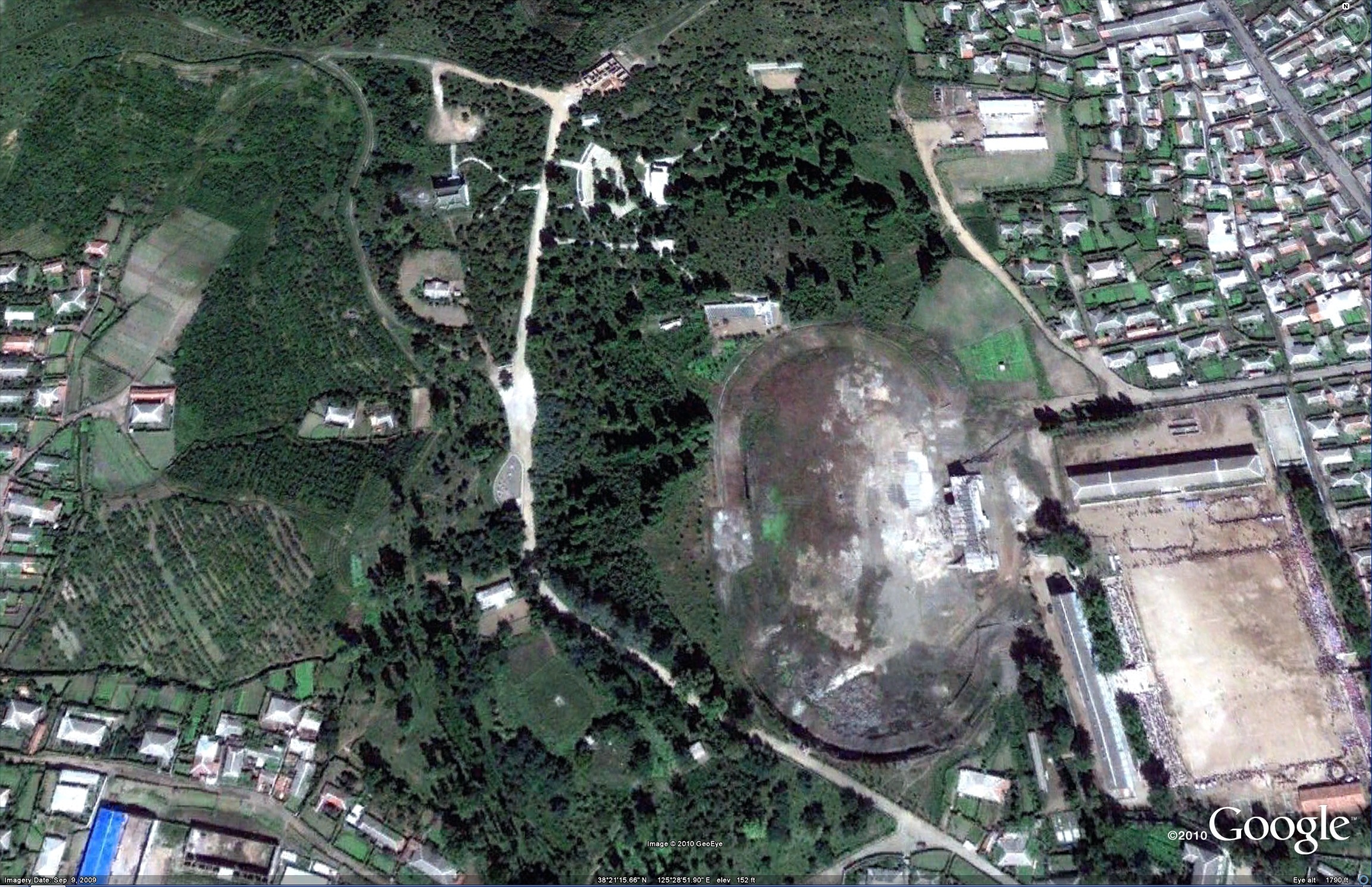
Sinchon also appears to be getting some 2012 construction support.  The city is building a new stadium and park with open air theater and pavilion:


Click images for larger versions
38°21’16.36″N, 125°28’48.94″E
October 2, 2006 (L), Sept 9, 2010 (R)
Google Earth/GeoEye

Share