Archive for the ‘Economic reform’ Category

Recent articles on Rason’s future

Wednesday, May 4th, 2011

According to the Hankyoreh:

China is stepping out into the Pacific through the gates of North Korea’s Rason Special District. North Korea, which has been declaring its aim of creating a “strong and prosperous nation by 2012,” is actively welcoming the move from China.

A number of sources, including officials with the Jilin Province government in China, reported that a groundbreaking ceremony is to be held on May 30 for a highway linking the North Korea cities of Wonjong and Rason, bordering directly on Quanhe in Hunchun, Jilin Province. A number of leaders from both countries are scheduled to attend the ceremony, which is to take place in Rason (Rajin-Sonbong), North Korea.

A Chinese official working on preparations for the project said in a recent interview with the Hankyoreh that the event would be “an occasion for declaring North Korea-China economic cooperation and North Korean openness to the world.” The official added that dozens of officials from the Chinese central government would be attending, including a number of leaders.

The construction effort is a signal announcing the opening of Rason and large-scale economic cooperation between North Korea and China. In addition to the groundbreaking ceremony for the highway, which is to be a major channel tying North Korea and China together economically, efforts to develop China’s Rajin Harbor and transport large amounts of coal through it are beginning in earnest.

The Rason development effort is taking place according to China’s “blueprints” in everything from the planning to investment and management. Local sources said that China and North Korea have already formed a special joint steering committee for the district, and that it has been decided that the chairman will be from China.

The Rason urban development plan jointly drafted by China and North Korea includes the development of international freight brokerage, export processing, and financial regions. According to a North Korean video, models for the plan include Dalian and Tianjin, which Kim Jong-il inspected in 2010 during a visit to China.

An official with the Yanji city government said, “North Korea is also aware that keeping its doors closed will only lead to death, but it is concerned that the regime will be destabilized if it opens up all at once, so it plans to first open up Rajin and develop it as a ‘test region.’”

“They are adopting the Chinese model, learning from China about legislation, taxes, and benefits to lure businesses,” the official added.

The effort is being pursued promptly, in contrast with previous North Korea-China economic efforts, which tended to amount to little more than words. The reason for this is that the central governments in Beijing and Pyonyang are directly taking care of economic cooperation through the medium of Rason’s development.

A Chinese government official reported that Chinese Minister of Commerce Chen Deming traveled to North Korea to sign a memorandum of understanding, and that China and North agreed on a plan for joint investment in and administration of Rason’s highway, port, and industrial park construction. The official added the Chinese Prime Minister Wen Jiabao personally signed policy documents upgrading Hunchun to a special economic district in line with the Rason development plans.

Meanwhile, North Korea formed an office in its central government to directly administer Rason Special City, replaced old officials who failed to make progress with Rason’s development over the years, and sent in young officials from the central government, including Rason Special City secretary Im Kyong-man, sources reported.

China needs the Rason development to ensure the success of its current national development plan for Changchun, Jilin, and the Tumen River basin, while North Korea decided to cooperate with China to address its economic problems and stabilize its succession framework. Analysts say North Korea hopes to tout successful development of Rason as an achievement of Kim Jong-un.

The development project is proceeding in a very specific and far-reaching way. “This is Korean land, but the industrial complex is being operated as Chinese and will hire North Korea workers to earn foreign currency” for North Korea, said an official with a Chinese company in charge of a large-scale construction effort in Rason.

The electricity shortage issue, which had previously been a major stumbling block to investment, has been resolved by China. A source in Hunchun said, “Plans are being examined to either send surplus power from Hunchun’s thermoelectric power plants to Rason, or for a company in Jilin Province to retrofit an old Soviet crude oil plant in the Sonbong region into a coal-burning power plant.”

Even Chinese officials have been astonished at the active measures from Pyongyang. A Rajin representatives’ office opened in downtown Yanji, the seat of the Yanbian Korean Autonomous Prefecture, is hard at work drawing in investment.

“If Chinese investors want to take a look at Rason, they can drive their cars in for themselves with an invitation from the Rajin representatives,” explained a source in Yanbian.

In the border city of Hunchun, money and people have begun shifting toward the North Korean side. Construction of 500 apartments for Chinese people working in Rason began in late March, according to officials at a construction company commissioned to carry out the project. Capital and labor investment for the Hunchun-Rason highway construction is coming entirely from China, and a number of the roughly 500 Chinese workers needed to begin have already arrived in Rason with six-month passes issued by North Korea. Large Chinese corporations such as Changli, Shangdi Guanquan Investment, and FAW are known to be undertaking investment in Rason.

According to the Korea Herald:

Despite its reputation as one of the most closed nations in the world, North Korea is, at least partly, opening up to market economy conventions, evident in its effort to cultivate its specially designated economic zone.

North Korea designated Raseon the country’s first free trade zone, as a “special city” in January 2010. The city, which borders both China and Russia, was dubbed a free trade zone along with nearby Sonbong in 1991, even though foreign investment never materialized.

In recent years, the North has tried to reinvigorate the trade zone, signing an accord with Russia to restore railways that could help rejuvenate the port there. Russia invested 140 million euro ($202 million) in the Rason project in late 2008.

In recent months, North Korea appears to have initiated a media campaign for Rason, beckoning foreign investors as Pyongyang struggles to resuscitate its moribund economy, according to informed sources and media reports.

According to a source familiar with North Korean affairs, the city has seen both new factories built and upgrades of previous ones.

A couple of large Chinese companies have also reportedly signed deals on either providing construction parts or investments in the region’s resources development.

Chinese commerce officials from the central government and the nearby Jilin Province have also reportedly held talks with their Pyongyang, Rason counterparts regarding such business transactions.

The city is also becoming more urbanized, according to sources. Apartments and road construction repairs are sprouting, while the number of daily logistics traffic across the nearby North Korea-Chinese border has nearly doubled to some 200 trucks in late April, compared to some 100 trucks just three months ago.

The North Korean leader Kim Jong-il recently traveled to the city, a move that analysts see as underlining the regime’s desire to promote the trade city to lure foreign investment.

The KCNA reported on April 22 that Kim visited the city’s Rajin Shipyard where he was briefed on different processes of shipbuilding. There he highlighted the importance of the shipbuilding industry and urged for the introduction of new production technology.

It was the first time that the North’s tightly controlled media reported the name of the shipyard and Kim’s visit there. Known as one of three major shipyards in North Korea, the Rajin Shipyard is believed to have built warships and submarines, according to sources in Seoul.

Increasing media reports from North Korea on Rason also seems to back claims that the country is putting its weight behind the city.

On April 19, the KCNA filed a profile report on Rason’s tourism industry, touting its historic relics, cultural facilities and fantastic seascape “and introducing tourist hot spots in and near the city.

In an earlier, March 30 report, the KCNA said that the city has adopted “a preferential tariff system” for foreign investors and traders.

“Choe Kwang-nam, an official in charge of economic cooperation of the Rason City People’s Committee, told the KCNA that the zone provides favorable business conditions to foreign investors through the preferential tariff system,” it said.

“Foreign investors and businesses are allowed to conduct diverse economic and trade activities and have a free choice of investment forms and business,” it quoted Choe as saying.

Read the full stories here:

N.Korea’s Rason Special District could open country to China
Hankyoreh
Park Min-hee
2011-5-4

Investment, projects seemingly brim in N. Korea border city
Korea Herald
2011-5-4

Share

Two decades of economic reforms in North Korea and Cuba

Sunday, May 1st, 2011

The Korea Economic Institute has published the latest in its Academic Paper Series:

“Similar Policies, Different Outcomes: Two Decades of Economic Reforms in North Korea and Cuba”
Dr. José Luis León-Manríquez, Universidad Autonoma Metropolitana

North Korea and Cuba benefitted economically from Soviet Union support, but after the collapse of the Soviet bloc, both countries had to reexamine their policies. Since 1990, these two countries have tried various economic reforms under their centrally planned economies. Which country has been more effective in their efforts? As the two nations are both undergoing leadership transitions, how likely are further economic reforms?

Download the paper (PDF) here. Listen the presentation here.  See the presentation video here.

Share

Kim Jong-il actively making field guidance visits in the economy sector

Friday, April 29th, 2011

Institute for Far Eastern Studies (IFES)
(NK Brief 11-04-27)

Kim Jong Il is continuing to make field guidance visits around Ryanggang and the Northern Hamgyong Province.

The Rodong Sinmun reported on April 23 that Kim Jong Il visited Rajin Shipyard. Rajin Shipyard is known for producing ships necessary for advancing fishing, marine transportation, and foreign trade industries. Chairman Kim emphasized the importance of self-reliance, especially on the need to adopt the latest science and technology and partake in the mass technical innovation movement by implementing CNC (Computer Numerical Control) technology into ship design, assembly, and manufacturing.

According to the Korean Central News Agency (KCNA) on April 20, Kim also gave field guidance at Kim Chaek Iron and Steel Complex and newly built Susongchon General Foodstuff Factory in Northern Hamgyong Province. The Rodong Sinmun on April 22 also reported that the DPRK leader provided field guidance at Hyesan Youth Mine in Ryanggang Province. At the Hyesan Youth Mine, he said “The major project of the Party is to complete the technological modernization to radically increase the production of mineral ores.”

At the recent visitation to Songjin Steel Complex at Kim Chaek City, Kim once again emphasized self-reliance. Kim stated, “The self-reliance of the metal industry is the permanent path of our economy.” He further added, “Despite the imperialist’s sanctions and blockade, we reached the highest level of metal production from the revolutionary spirit of self-reliance. The Party’s traditional slogan of self-reliance is the only weapon of victory leading to our nation’s triumph and prosperity.”

North Korea announced that Songjin Steel Complex established Juche steel production system at the end of 2009. At the complex, Kim gave praise to the facility by saying, “The completion of steelmaking process of Juche steel with our own technology is a greater victory than the success of a third nuclear test.”

However, Kim Jong Un, the vice-chairman of the Central Military Commission and the named successor of the DPRK was not included in the list of entourage in the recent field guidance given by the senior Kim at Kim Chaek Iron and Steel Complex, Hyesan Youth Mine and Najin Shipyard.

Kim Jong Il is reported to have conducted 35 official activities in the first quarter of 2011. Although it is a decrease from last year’s number of 41, it is still higher than the average of 21(1999-2010) in the first quarter. The breakdown of the activities of Kim is as follows: 12 economy-related visitations, 10 attendances at performances, 9 inspections at military bases or other military related activities and lastly, 4 meetings with diplomatic delegations.

The economy-related inspections were the highest in the first quarter since 2009. This trend reflects Kim’s intentions of concentrating on inspecting the economic sectors early on in the year to encourage results in this sector. A notable point is that self-reliance and incorporation of CNC was mentioned at all industrial facilities that Kim inspected.

Among the entourage, Kim Jong Il’s sister, Kim Kyong Hui, director of the Light Industry Department of the Korean Workers’ Party (KWP), accompanied the leader 28 times on his recent inspections. Kim Ki Nam, the KWP Secretary and Director of Publicity and Information Department made 24 trips, Kim Jong Un and Tae Jong Su, KWP Secretary and Director of the General Affairs Department made 22 trips each, and Chang Song Taek (Jang Song Thaek), the husband of Kim Kyong Hui and vice-chairman of the National Defence Commission, is known to have made 20 accompaniments.

Recently, North Korea has been making changes in the planned economy by naming the new Central Bank chief, upgrading the State Price Bureau to the State Price Commission, and establishing the State General Bureau of Economic Development.

Kim Jong Il has conducted a total of 161 official activities last year, his most active year since the official launch of the Kim Jong-Il regime in 1998.

Share

SPA designates Kumgang resort intl tourism center

Friday, April 29th, 2011

UPDATE: DPRK to Set Up Special International Tour Zone at Mount Kumgang
Institute for Far Eastern Studies (IFES)
NK Brief (11-05-2)
2011-5-3

According to KCNA news agency, the Presidium of the DPRK Supreme People’s Assembly issued a decree on April 29 to set up a special zone for international tours at Mount Kumgang. It reported the special zone in Kangwon Province would include Kosong-eup and Onjong-ri of Kosong County; Samil-po, Hae-Kumgang, and Nae-Kumgang areas in Kumgang County, and Thongchon County.

The Central Tourist Guidance Agency expressed its intentions of increasing new tourist destinations depending on the progress made in the special zone. In addition, it also announced the annulment of October 2002 decree on the Kumgang Special Tourism Zone, which rescinded the exclusive rights of Hyundai Asan.

Previously on April 8, the DPRK’s Korean Asia-Pacific Peace Committee (KAPPC) informed Hyundai Asan that it would retract the monopoly rights of Hyundai. Instead, it expressed plans of entrusting the tours from the North through foreign businesses while Hyundai will continue to lead the tours from the South. The North announced the Mt. Kumgang tours will be renewed through appropriate national measures.

The KCNA explained, “The DPRK’s sovereignty will be exercised in the special tour zone.” Additionally, the DPRK is encouraging free investment in the special zone by corporations, individuals and other economic bodies and such investments are protected by law.

On the May issue of South Korean monthly magazine Minjog 21, the Committee of Investment and Joint Ventures of the DPRK and Kempinski Group was reported to have reached an agreement on its entrance into the Kumgang tourism project. The magazine also reported the Kempinski Group’s plans of modernizing the Wonsan Airport, development of Wonsan City into a resort town, and building roads connecting Wonsan with Kumgang.

Kempinski Hotels is a luxury hotel group known for its five-star hotels and resorts and recently expanded into Asia with current projects underway with India and China. Kempinski is majority owned by the Crown Property Bureau of Thailand and the royal family in Bahrain. Once the Kempinski Hotel is completed in Wonsan, it is expected to become an international resort town linked with Mt. Kumgang Special Zone.

The Mt. Kumgang tours from the North are expected to be managed by the Kempinski Hotels while the tours from the South will be still managed from Hyundai. An interview on April 13 by Ri Jong Hyok, vice-chairman of the KAPPC commented, “The buildings and facilities built by Hyundai will come to ruins if left at its current unoccupied stage. This is the reason why we are attempting to restart the tours, but only until the South decides to resume the tours.”

The Committee of Investment and Joint Ventures was upgraded from Joint Venture and Investment Guidance Bureau last July, becoming a central state organization in charge of all projects related to investments and joint ventures from overseas.

ORIGINAL POST: According to Yonhap:

North Korea’s rubber-stamp parliament said Friday that it will set up a special zone for international tours of the country’s troubled mountain resort in an apparent move to induce foreign investment.

The North “will encourage free investment in the development of the special zone by corporate bodies, individuals and other economic bodies and will protect by law the invested capital and properties and income and other profits to be gained through business,” the North’s Supreme People’s Assembly said in a decree carried by the country’s official Korean Central News Agency (KCNA).

The legislature said North Korea’s sovereignty will be exercised over the zone that includes several areas on Mount Kumgang, a scenic resort on the country’s east coast.

It also said the agency in charge of tourism will take relevant measures to increase new tourist destinations, depending on the progress in the special zone development. No details were provided.

Lee Jong-joo, a spokeswoman for South Korea’s Unification Ministry handling inter-Korean affairs, said the North’s move appears to be aimed at attracting foreign capital to develop the resort.

A spokesman for Hyundai Asan, a key South Korean tour operator in the mountain resort, said his company had no immediate comment on the North’s announcement. He asked not to be identified as he was not authorized to speak to media.

The decree came weeks after Pyongyang terminated exclusive tourism rights for Hyundai Asan, citing skepticism over the resumption of the joint venture.

The two Koreas launched the joint tour program in 1998 as part of moves to boost cross-border reconciliation and cooperation, providing a legitimate source of hard currency to the cash-strapped North.

However, Seoul suspended the tour program in 2008 when a female South Korean tourist was shot dead after straying into an off-limits military zone near the resort.

Pyongyang claims it has done everything to shed light on the shooting and guarantee the safety of future tourists, but Seoul says it has yet to receive a formal apology for the shooting or government-to-government promises to enhance safety.

Here is the KCNA statement:

Pyongyang, April 29 (KCNA) — A special zone for international tour of Mt. Kumgang will be established in the DPRK.

A decree on this decision was issued by the Presidium of the DPRK Supreme People’s Assembly on Friday.

According to the decree, the special zone is to be set in the area of Mt. Kumgang in Kangwon Province and the zone will include the township and some areas of Onjong-ri in Kosong County, Lagoon Samil, Sea Kumgang area, Inner Kumgang area of Kumgang County and some areas of Thongchon County.

The DPRK sovereignty will be exercised over the zone.

The DPRK will encourage free investment in the development of the special zone by corporate bodies, individuals and other economic bodies and protect by law the invested capital and properties and income and other profits to be gained through business.

The Central Tourist Guidance Agency shall take relevant measures to increase new tourist destinations, depending on the progress made in the SZ development.

The decree of the SPA Presidium on “Setting Up Mt. Kumgang Tourist Zone in the DPRK” issued on Oct. 23, 2002 is no longer valid.

Aside: So there are two DPRK agencies that deal with tourism: KITC and the “Central Tourist Guidance Agency”?

Historical information:

The Kumgangsan resort was the scene of a terrible tragedy, the shooting of a South Korean tourist.  Allowing a joint-Korean investigation of the murder became a precondition by the South Korean government for resuming tourism to the resort.

On March 4th 2010, the DPRK first threatened to revoke contracts with the South Korean Hyundai-asan stating that a future guarantee of safety was sufficient for resuming tourism.

Later in th month, Hyundai-asan’s chief offered to resign.

In April 2010, the DPRK “seized” the Hyundai properties in the Kumgangsan resort.

Shortly afterwards, Chinese tourists began arriving at the resort (here and here).

The Donga Ilbo reported that the NDC took over the properties and put them in the Korea Taepung International Investment Group portfolio.  If the property was under Taepung control and has now been put under normal ministerial control, then this signals that Taepung’s sun might have set.

If possible, I would expect that Hyundai-asan will attempt to bring suit in South Korea against whichever company chooses to set up in the zone.

Read the full sotry here:
N. Korea to set up special int’l tour zone at Mount Kumgang
Yonhap
2011-4-29

Share

Chinese in DPRK, Koreans in PRC

Thursday, April 28th, 2011

According to Yonhap:

The number of North Koreans officially visiting China reached 28,600 in the first three months of the year, up 35 percent from the same period last year, a news report said Wednesday.

More than half of them visited China to work in either factories or restaurants, while 6,000 people visited China for conferences or businesses, the Voice of America reported, citing Chinese government data.

The VOA also said 700 North Koreans toured China for sightseeing, while fewer than 100 North Koreans visited China to meet relatives or friends and 7,300 visitors had other purposes. The report did not elaborate.

The data did not include information on North Koreans staying illegally in China after defecting, the VOA said.

Tens of thousands of North Korean defectors are believed to be hiding in China, a major land route through which many North Korean defectors travel to Thailand and other Southeast Asian countries before resettling in South Korea.

According ot the Choson Ilbo:

Chinese tourists will start visiting Russian and North Korean cities without visas on Wednesday under a formal agreement between Beijing and the two countries. The tour course starts in the Chinese border city of Hunchun in the lower reaches of the Duman (Tumen) River and goes on to eastern Russia and the Rajin-Sonbong special economic zone in North Korea.

A group of 21 tourists left Changchun, the capital of northeast China’s Jilin Province, on Tuesday for the Hunchun. Travelers will then visit Slavyanka, Vladivostok and Khasan, the official Xinhua news agency said. They then go to North Korea by train and tour the cities of the Duman River and the Rajin-Sonbong area.

The four-day tour starts every Wednesday and costs 2,300 yuan (approximately W390,000). Only Chinese travelers are eligible for the visa-free arrangement.

Read the full stories below:
Number of N. Korean visitors to China rises in first quarter
Yonhap
4/27/2011

Chinese Tourists Visit Russia, N.Korea Visa-Free
Choson Ilbo
4/28/2011

Share

Inter-Korean mining projects suspended

Monday, April 25th, 2011

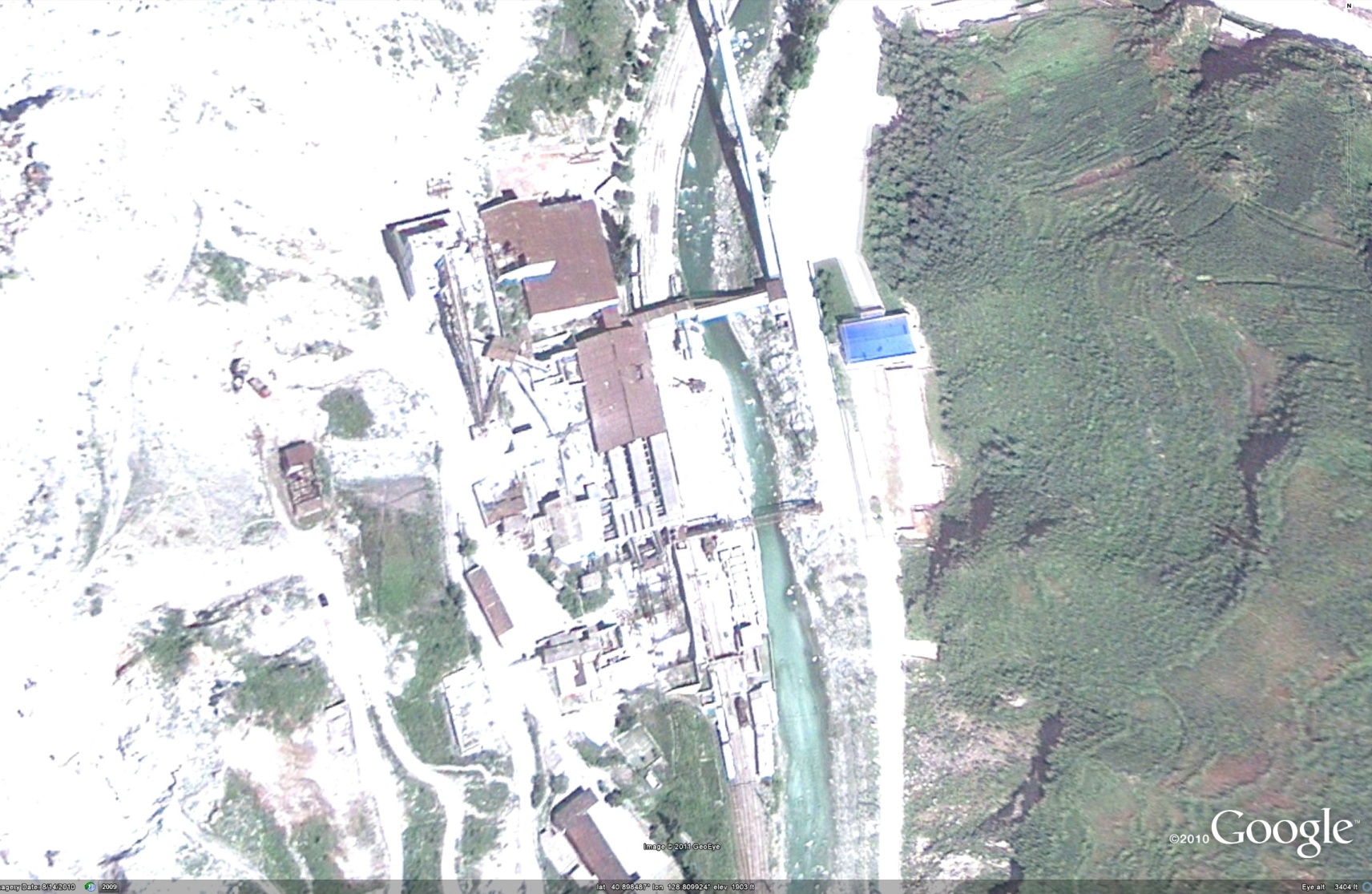
Pictured above on Google Earth: Ryongyang Mine Ore Dressing Plant (Pre-renovation)

According to the Hankyoreh:

“We invested a lot of money, and now we cannot even find out the present status.”

Korea Resources Corporation (KORES) President Kim Shin-jong let out a deep sigh as he explained about the development status of the Hwangnam graphite mines in North Korea at a forum held by the corporation on Apr. 15. The event was organized amid a sense of profound concern, with a number of North Korean mineral resources development efforts running aground amid worsening inter-Korean relations.

According to accounts Sunday from officials with the Ministry of Unification and KORES, South Korea is currently involved in a total of ten North Korean coal mine development efforts. Investment for seven of these comes from the government, including the ministry and KORES, while the other three involve private sector investments. None of them has followed their original schedule since the Lee Myung-bak administration came into office.

The most representative case is that of the Hwangnam graphite mines. This was the first North Korean resource development effort undertaken as an inter-Korean economic cooperation venture, and progress was quick enough that the graphite produced there was being imported into the South right up until the Lee administration came into office. Now, the situation has changed completely.

A company official conveyed the situation by saying, “Since 2008, the Hwangnam Coal Mine has been forgotten completely.”

The situation is the same for the Komdok, Ryongyang, and Taehung coal mines in the area of Tanchon, South Hamgyong Province, an effort spearhead directly by the Unification Ministry.

An official with the ministry said, “We had already finished the third feasibility examination by February 2008, but since then there has been no further progress as inter-Korean relations have worsened.”

The Ryongyang mine contains large deposits of the rare metal magnesite, a material South Korea does not produce.

Exploration has also been effectively halted at the Ayang mine in Sinwon County, South Hwanghae Province, where KORES completed an on-site investigation following the signing of a September 2007 memorandum of understanding on mineral development with North Korea, and the Pungchon mine in Yonan County, South Hwanghae Province, where the first inter-Korean joint drilling effort was undertaken in October 2008.

The situation has been particularly severe for the privately invested projects.

An official with one company engaged in a fertilizer effort said, “We carried out three rounds of working-level discussions in North Korea and China regarding the mining of apatite, but all of them have been suspended since the current administration took office.”

“If these projects had just gone ahead properly, we would not have had to buy apatite at high prices from faraway places like Nauru,” the official lamented.

Apatite, one of the key ingredients in fertilizer, is one of the mineral resources for which South Korea depends entirely on imports.

With South Korea’s development projects in North Korea at a standstill, China’s have taken flight. According to KORES figures, Chinese exports of North Korean military, which stood at the $300 million level in 2005, showed a sharp rate of annual increase to reach more than $900 million in 2010. In the space of five years, the amount of North Korean minerals purchased by China rose more than threefold. Industry observers are calling the situation “hoarding” of North Korean minerals by China. Government authorities are known to have determined that even strategic minerals listed as forbidden for overseas export, including uranium, have been going into China since late last year.

The problem is that the situation is becoming more severe as time passes. Because North Korea’s mineral transportation infrastructure of highways and ports is still deficient, the focus has been on developing minerals in areas near the North Korean-Chinese border, but there is a strong chance that China will extend its reach further into the country going ahead.

“China wants to seize North Korea’s mineral resource industry through expanded infrastructure cooperation with North Korea,” said Jeong U-jin, head of the natural resource strategy office at the Energy Development Institute.

Many observers are saying that thawing inter-Korean relations is an urgent priority if South Korea is to take full advantage of the value of North Korean mineral resources. Noting that the potential value of North Korean mineral resources is as much as 7 quadrillion won, a KORES official said, “Suffice it to say that as improvements in inter-Korean relations get put off, North Korean resources will all head overseas.”

According to the North Koreans, production at the mines is up nonetheless!

Read the full story here:
Inter-Korean coal mine projects suspended during Lee administration
Hankyoreh
Ki Kyung-rok
4/25/2011

Share

Lankov on private farming in the DPRK

Monday, April 25th, 2011

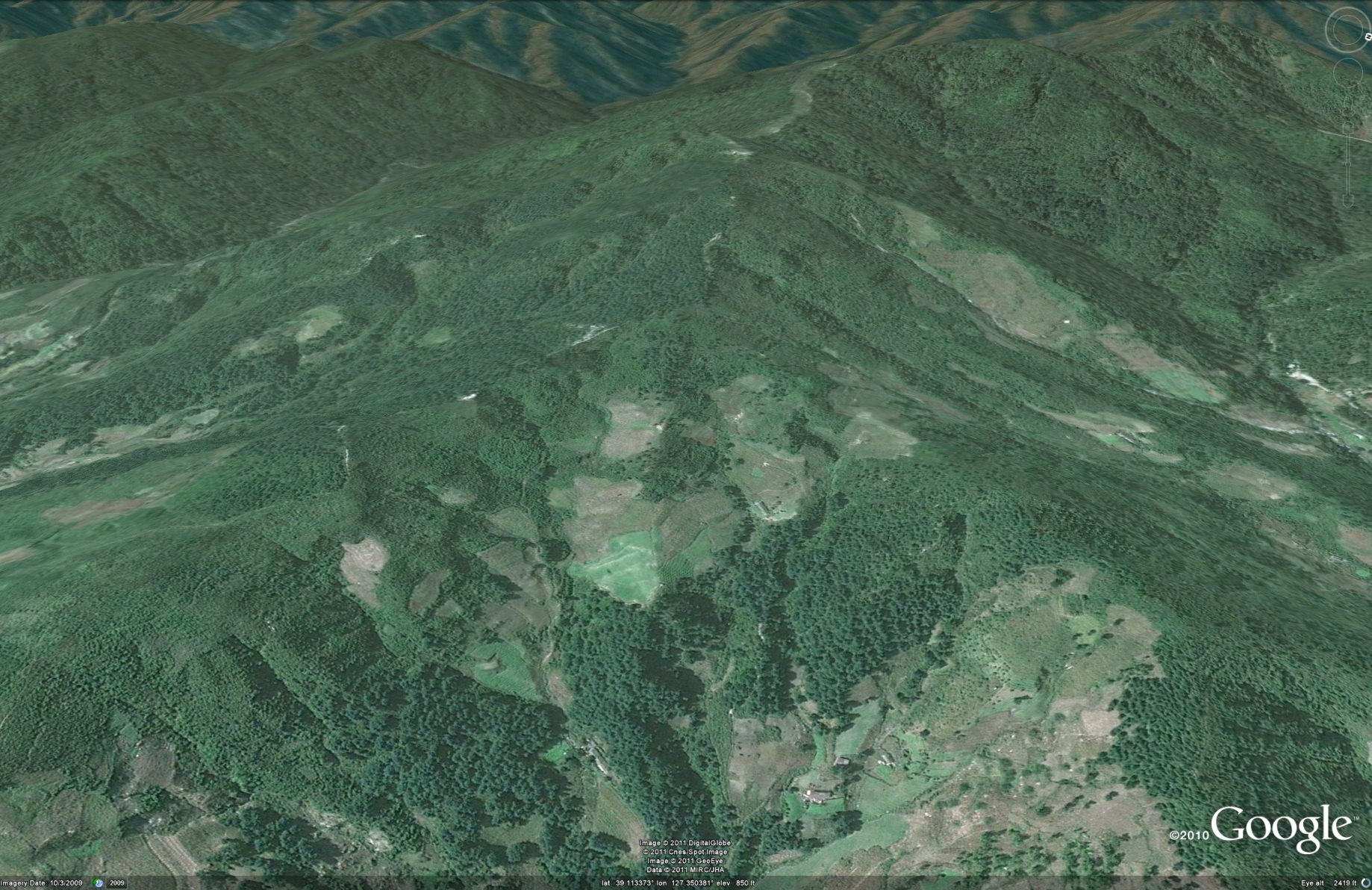
Pictured above on Google Earth: hill-side farming plots in the DPRK

Lankov writes in the Korea Times:

Every visitor to North Korea who has passed through mountainous areas in the country has seen some peculiarities of the modern North Korean landscape.

Somewhere high in the mountains one can see small fields of strange, irregular shapes which look quite different from the orderly, rectangular shapes of the cooperative farm fields. If asked about these fields, North Korean minders will probably avoid giving a straight answer. This is understandable ― even though the existence of such fields is tacitly accepted by the authorities, from a purely ideological view, which minders are obliged to present, these fields are not supposed to exit.

We are referring to sotoji, private plots, which have been spreading across North Korea over the last 15 years and now play a major role in food production in North Korea.

It would be only a minor exaggeration to say that in his policies, Kim Il-sung tended to be more Stalinist than Joseph Stalin himself. He took the state-run economy to its natural (or unnatural) extreme and collective farming was no exception. Once upon a time, the North Korean peasantry was herded into so-called “agricultural cooperatives.” The description of these institutions as cooperatives is actually misleading because they were essentially state-run farms, where farmers had basically no influence over management or income distribution.

But North Korea has one important peculiarity: unlike Stalin’s Soviet Union, in North Korea farmers were not allowed to cultivate even small private plots. In the Soviet Union a farming family would be allowed a plot which might have been as large as a few thousand square meters. In North Korea, the maximum size of an individual plot was limited to a paltry 100 square meters – barely enough to grow some pepper and spice and clearly not enough to make any meaningful economic difference.

This was done on purpose ― North Korean policy planners assumed that farmers, being deprived of any alternative means of existence, would work more efficiently in state-owned fields. In agricultural cooperatives farmers essentially worked for their daily ration ― one full day of work was rewarded with 700g of grain (similar to the ration of the average worker in a city).

This system was never especially efficient but for a few decades it managed to exist and function somehow. However the collapse of the North Korean economy in the early 1990s produced a devastating blow to state-run agriculture. In 1995 and 1996 the harvests were around half of what was necessary to keep the North Korean population alive, so many North Koreans starved to death (the exact numbers are disputed but it seems that between 500,000-1,000,000 perished) and the survivors began to look for ways to make a living outside the state-run-economy. Predictably enough, farmers did what one would expect them to do ― they began to develop their own food production.

Unlike their Chinese counterparts, the North Korean elite refused to disband the state-run agricultural cooperatives. Therefore farmers had no choice but to acquire land on their own, outside of what would be normally considered arable land. Usually they went to the mountains, since all arable land in the valleys had long been cultivated within state-run farms.

In some cases, farmers would make agreements with local forestry departments whose officials agreed to turn a blind-eye to unlawful activities in protected forest areas. In some other cases the local authorities tolerated and even encouraged the sotoji cultivators.

A quick look through satellite images of North Korea shows the widespread nature of the sotoji phenomena. In some counties near the Chinese border, the percentage of land under the cultivation of sotoji owners roughly equals that under cultivation by state-run farms. In other areas the level of private production may be smaller but it seems clear that private food production makes a major contribution to North Korea’s food supply today.

Indeed, in the above-mentioned borderland counties, sotoji fields seem to produce as much as 60 percent of all food sold on the local market. This might be an exception because the current county in question is covered by mountains and contains a lot of places where people can hide from police. Nonetheless sotoji produced food is found widely in the country’s markets.

In the last 15 years or so, North Koreans have developed a large and successful private economy of which the sotoji phenomenon is an important part. However their cultivators are not high on the newly emerging social ladder. Sotoji are usually tilled by people who do not have the money, skills or inclination to start a more conventional business. Some of them are essentially market-orientated enterprises which make profit but the majority lose money.

Nonetheless, the random new shapes of North Korean mountains nowadays are yet another reminder of how much the country has changed over the last two decades.

Read the full story here:
Sotoji — small private plot
Korea Times
Andrei Lankov
2011-4-24

Share

Remittances from North Korean defectors

Thursday, April 21st, 2011

Andrei Lankov writes in the East Asia Forum:

Until some 10 years ago, defection from North Korea implied that the person’s connections with his or her homeland would be broken for a long time, or perhaps even forever. North Korea was a huge black hole from where almost nothing could get out. But this is not the case anymore.

The number of North Korean defectors in South Korea has increased tremendously. In 2000, there were merely 1,400 North Koreans residing in the ROK. Now, a decade later, their numbers exceed 21,000.

These people are usually described as ‘defectors,’ but this name is misleading since almost none of them were driven by purely political considerations when they decided to leave North Korea. In most cases, they initially move to China, looking for food and better paying jobs. Only later do they usually find ways to move to South Korea, where, as they assume, their lives would be easier and more stable than in China.

To some extent these expectations are proven correct. By South Korean standards, North Korean refugees are not doing too well, their income being roughly half the income of the average South Korean. Nonetheless, even the 1 million won per month, plus subsidised housing and healthcare, are usually seen by refugees as affluence.

However, being Koreans they do not forget about their family members left behind in North Korea. In some cases the refugees save money to pay a professional defection specialist (simply called a broker) to relocate their family members to South Korea. A typical defection costs about 2-3 million won, but in some complex cases (for example, when the family members are old and fragile, very young or live far away from the border), it might cost considerably more.

Not everybody is willing to bring their entire family here and not every North Korean family wants to move to Seoul. Instead, defectors send money to their families back in the North. In recent years these transfers have dramatically increased in scale.

Remittances to the North are, strictly speaking, illegal according to both South and North Korean law. Nonetheless there is no way to stop this activity and, frankly, neither government is really willing to do so.

Last December the Database Centre for North Korean Human Rights conducted a survey of the economic situation of North Korean refugees in South Korea. According to the survey, 49 per cent of refugees regularly send money to their families in the North. The average amount sent by one person is estimated to be about 1 million won per year.

On balance the researchers estimated that about $10 million is sent North by defectors annually. There have been other attempts to estimate the scale of the remittances but those estimates are not much different ― most authorities agree that the annual amount is within the range of $5-$15 million. The $10 million is not a reliable amount for such a poor country as North Korea. After all, the Gaeseong Industrial Complex, often described as a major cash cow for the regime, generates some $20-$35 million a year.

Of course, one cannot make a bank transfer at a Citibank branch somewhere in the North Korean wilderness, and Western Union has yet to open its offices in the North. Remittances are made in cash and handled by the same networks of brokers who also smuggle people, letters and mobile phones to and from North Korea. Usually, money is first paid to a broker or their representative in South Korea and then moved or wired to China. Then the cash is smuggled across the border from China to the North. If the recipient lives near the border, they usually get the money straight from the smuggler. For those who live further south (in Pyongyang for example) the money might be delivered by a courier.

The complexity and risk of such an arrangement implies that service fees are expensive. The transaction fee currently fluctuates at 20-30 per cent of the total, so from the $1,000 sent by a refugee from Seoul, only $700-$800 will reach her relatives. Nonetheless, the system is quite reliable and incidents when the money does not reach its intended destination are rare.

Judging by anecdotal evidence, such money seems to be used for investments by North Korean recipients, most of whom run small businesses or workshops.

Politically, these remittances are important. North Koreans nowadays suspect that South Korea is not the destitute American colony the official propaganda used to criticize. These regular remittances make a difference; they reinforce the understanding that South Korea is a very rich place indeed. In the long run the spread of this knowledge does not bode well for the people who are now in control in Pyongyang.

Read the full story here:
Remittances from North Korean defectors
East Asia Forum
2011-4-21

Share

Gyeongui line to resume normal operations

Wednesday, April 20th, 2011

Institute for Far Eastern Studies (IFES)
NK Brief (11-04-20)

Railroad services to Kaesong Industrial Complex on the Gyeongui Line increased from 21 to 23 times a day from April. Mainly a seasonal change, the last departure service into Kaesong has been pushed back to 5:00 pm from 4:30 pm and the arrival time also changed accordingly from 5:00 pm to 5:40 pm.

With the half of the Mount Kumgang tours, the Donghae Line is running on a more flexible schedule based on demand. Currently both lines are operating. There are 417 South Korean citizens currently residing in North Korea, with the majority (404 people) at the Kaesong Industrial Complex.

According to the Export-Import Bank of Korea, the volume of loans by the businesses operating economic cooperation with North Korea increased over the years, from 10.8 billion KRW in 2008, to 15.4 billion KRW in 2009, and 41.6 billion KRW in 2010. The increase comes as a surprise considering the enforcement of sanctions against the North from the Cheonan incident caused all inter-Korean exchanges and cooperation to discontinue except for the KIC.

The Export-Import Bank (Exim Bank) in coordination with the Ministry of Unification has continued to provide loans to businesses engaged in inter-Korean cooperation through a special loan program called, “Special Economic Exchanges and Cooperation Loan.” Special consideration was given to these small businesses suffering since the imposition of government sanctions.

Last year, a total of 25 businesses (11 economic cooperation-related, 13 exchange-related) received special loans from the Exim Bank. The loans were used mainly for stabilizing the business management to cover various business expenses including tariffs, shipping, material, distribution, manufacturing and labor costs, as well as other additional taxes and interests.

On the other hand, North Korea’s Korean Asia-Pacific Peace Committee informed Hyundai that it would retract the company’s monopoly over the tour of Mt. Kumgang, which was supposed to expire in 2028. Hyundai Asan expressed regret over the North’s decision by saying, “The agreements that were reached on Mt. Kumgang tourism must be honored and cannot be declared void or lose their validity on unilateral notification. The North’s statement should be withdrawn.”

The spokesperson of Hyundai also stated, “The root of this problem is caused by the stalled tourism project. The only solution is to resume the tours to Mt. Kumgang at the earliest time possible.” It further added its intention of working closely with the South Korean government to restart the tours. Since the suspension of Mt. Kumgang tours after a female tourist was shot and killed in July 2008, Hyundai Asan has been hitting dead ends with the project.

Regarding its plan to retract Hyundai, North Korea is pointing the finger at the “South Korean government’s vicious North Korea policy.” According to North’s Uriminzokkiri website, terminating Hyundai’s monopoly rights was an “inevitable decision based on low prospect for resuming the tours of Mount Kumkang.” It further added, “Although the South Korean government is condemning our decision as against international norms, the situation is compelling the DPRK to exercise our rights which is in accordance with domestic and international laws.”

Share

KJI 1st quarter 2011 OSG roundup

Wednesday, April 20th, 2011

According to the Daily NK:

Kim Jong Il was less active in the first quarter of 2011 than in the same period of last year, clocking just 35 public appearances in comparison with 41 in 2010.

The news was revealed by the Ministry of Unification this morning, following its periodic analysis of North Korean TV and radio news reports.

Kim’s most regular companion during his first quarter nationwide on-site inspections was the director of the Party’s Light Industry Department, sister Kim Kyung Hee, who was by his side 28 times.

Revealing the statistics, Ministry spokesperson Lee Jong Ju explained, “Although this is less than the 41 cases in the same period last year, when compared to the average number of National Defense Commission Chairman Kim Jong Il’s public appearances in the first quarter since 1999, 21, it can be seen as relatively active.”

The statistics reveal a total of 12 appearances by Kim at sites in the economic sphere, ten appearances at performances by various groups, and nine events involving the military.

“Appearances are focused on the economic sphere at the beginning of most years, which can be seen as an attempt to encourage more results,” Lee also pointed out. 40% of Kim’s total of 161 on-site appearances in 2010 were in the economic sphere, and were concentrated in the first quarter in 2009 as well as 2010.

“Particularly, the fact that Chairman Kim Jong Il is making a talking point out of self-reliant production and the CNC technology of industrial facilities at every industrial location he has visited this year is interesting,” Lee added, noting the oft-drawn link between modern technology and the succession propaganda of Kim Jong Eun.

Behind Kim Kyung Hee on the record of visits came Party Propaganda Secretary Kim Ki Nam (24), Central Military Commission Vice Chairman Kim Jong Eun and Party Administration Secretary Tae Jong Su (22 each), and National Defense Commission Vice Chairman Jang Sung Taek (20).

“North Korea can thus be said to be a place running a system with family at its core,” Lee concluded.

Read the full story here:
Kim Maintains Economic Focus in 1st Quarter
Daily NK
Kim So Yeol
2011-4-20

Share