Archive for the ‘Economic reform’ Category

Orascom releases 2011 Q1 shareholder report

Friday, May 20th, 2011

You can see the whole report here (PDF).

According to Martyn Williams (PC World):

The number of 3G cellular subscriptions in North Korea passed half a million during the first quarter, the country’s only 3G cellular operator said this week.

The Koryolink network had 535,133 subscriptions at the end of March, an increase of just over 100,000 on the end of December 2010, said Orascom Telecom. Egypt’s Orascom owns a majority stake in Koryolink, which is operated as a joint venture with the state-run Korea Posts and Telecommunications Co.

Subscriber growth has been strong ever since the network was launched in late 2008, but the most recent quarter delivered the first signs that Koryolink is having to work harder for new subscribers.

The January to March period was the first time since the third quarter of 2009 that the number of new subscribers during the quarter failed to be more than the previous quarter. In the October to December quarter, the company added just over 130,000 new customers.

Revenue for the quarter was a record US$25.7 million, a jump of 185 percent on the same period of 2010. Orascom doesn’t disclose net profit figures for the company.

The company is keen to launch new value-added services to raise average revenue per user (ARPU) and during the quarter it began offering MMS (Multimedia Messaging Service). Customers gave the service a positive response, Orascom said.

But despite the efforts, ARPU fell to its lowest level since service began in 2009. At just US$12.7 per month, it was down 40 percent on the same period last year.

Orascom also launched pre-paid cards denominated in euros to boost foreign exchange earnings from North Korea. The scratch cards offer free voice and value-added service use during off-peak hours.

The company’s network now covers 92 percent of the population.

North Korea is one of the world’s most heavily controlled countries and communication is severely restricted. Most cell phones don’t have the ability to make or receive international calls.

The Daily NK offers some additional information:

Cell phone customer numbers are rising while the price of the handsets is falling, according to sources from inside North Korea.

One such source from Pyongyang reported on the 18th, “The phone bill is no different from in the past, only the price of the cell phone itself is falling.”

According to sources, in Pyongyang a single-piece handset has gone from $280 to $250, and a clamshell design from $400 to $380 (at the exchange rate in South Pyongan Province, one dollar is presently worth 2,500 North Korean won, while a kilo of rice continues to drift in the 2,000 won range).

The source explained, “Cell phone users keep increasing. In Pyongyang, approximately 60% of people between their 20s and 50s use cell phones. Especially for the younger generation in their 20s and 30s, a cell phone is seen as a necessary item,” he said.

A source from Shinuiju also commented, “Around three out of ten young people have got a cell phone, and prices have been cut a bit.”

A source from South Pyongan Province agreed, too, saying, “Cell phone bills and prices have dropped compared with in the beginning. A basic cell phone (single-piece) is $225 and an expensive one is $300. You pay 30,000 won in our money, and then you can use it for 200 minutes.”

The source went on, “But when you buy a $10 card, you can use it for 600 minutes. This is a state policy to earn dollars.”

He explained that according to the jangmadang exchange rate, $10 is currently 25,000 won, meaning that payment for credit in dollars is of huge benefit in terms of value for money.

However, there is still an application fee of $800 and registration fee of $100, as before.

The source reported, “Cell phone traders purchase cell phones using their families’ and relatives’ names,” because only one handset per person is allowed. “Since there are many people who have obtained a cell phone in another’s name, their cell phones occasionally get confiscated when they go to the telephone office to pay the bill and get their ID checked.”

In a connected story, Radio Free Asia reported on the 19th that Koryo Link has added another 100,000 subscribers to its books since the end of last year, bringing the total number to 535,133 as of the end of March.

However, in contrast with Pyonyang and the interior areas of North Korea where usage is growing, the battle in the border region is still to restrict and control cell phone usage. Distinguishing a Chinese cell phone is not easy, so cracking down on the practice of using them is not easy, either, and therefore the method of applying for a cell phone has been made more difficult, among other measures.

According to one Yangkang Province source, “One person who took cell phones brought in by smugglers in March, remodeled and sold them was arrested by the People’s Safety Ministry, and in the light of that the process for applying for a cell phone here got stricter. The person who wishes to buy the phone must have the signature of a National Security agent now. In the beginning, there was no such rule.”

In North Korea, applications for cell phones are handled by sales offices; however, the procedure is more difficult now, and so some get the handset from a smuggler and only the number from the local office, in order to avoid the process. Of course, bribes are necessary to facilitate that, currently approximately $400-$450 in Yangkang Province.

According to sources, an official North Korean cell phone works on a different frequency to those from China in order to stop their being used to connect outside the country. However, if the frequency of a smuggled phone is changed to match North Korea’s, then the cell phone can be used.

And according to Mobile Business Briefing:

Orascom Telecom’s North Korean mobile arm, koryolink, surpassed the half a million subscriber mark in the first quarter, representing growth of 420 percent year-on-year. Orascom noted during its Q1 earnings yesterday that its North Korean subscriber base has reached 535,133, up from 125,661 a year earlier. While the numbers are still relatively small, Orascom’s North Korean venture – which was first launched in December 2008 – is being closely watched; koryolink is the only commercial operator in the notoriously secretive and totalitarian country and therefore has huge growth potential – as well as being a risky investment. Orascom said that current mobile penetration in North Korea is just 2 percent. Its revenue from koryolink rose 185 percent year-on-year to US$25.8 million in Q1, while earnings (EBITDA) hit US$22.6 million, giving it an impressive EBITDA margin of 87.6 percent.

koryolink’s network currently consists of 341 base stations covering the capital Pyongyang, 14 main cities as well as 72 smaller cities, Orascom said. The network also extends over 22 highways. As of the end of Q1 2011, koryolink covers 13.6 percent of the country’s territory and 92 percent of its population. In January 2011, koryolink launched MMS services for the first time, the latest addition to its VAS portfolio. The firm has also focused on maximising foreign currency revenue, launching in February a recharge card that can be bought in Euros.

Share

Kaesong production sets monthly record

Wednesday, May 18th, 2011

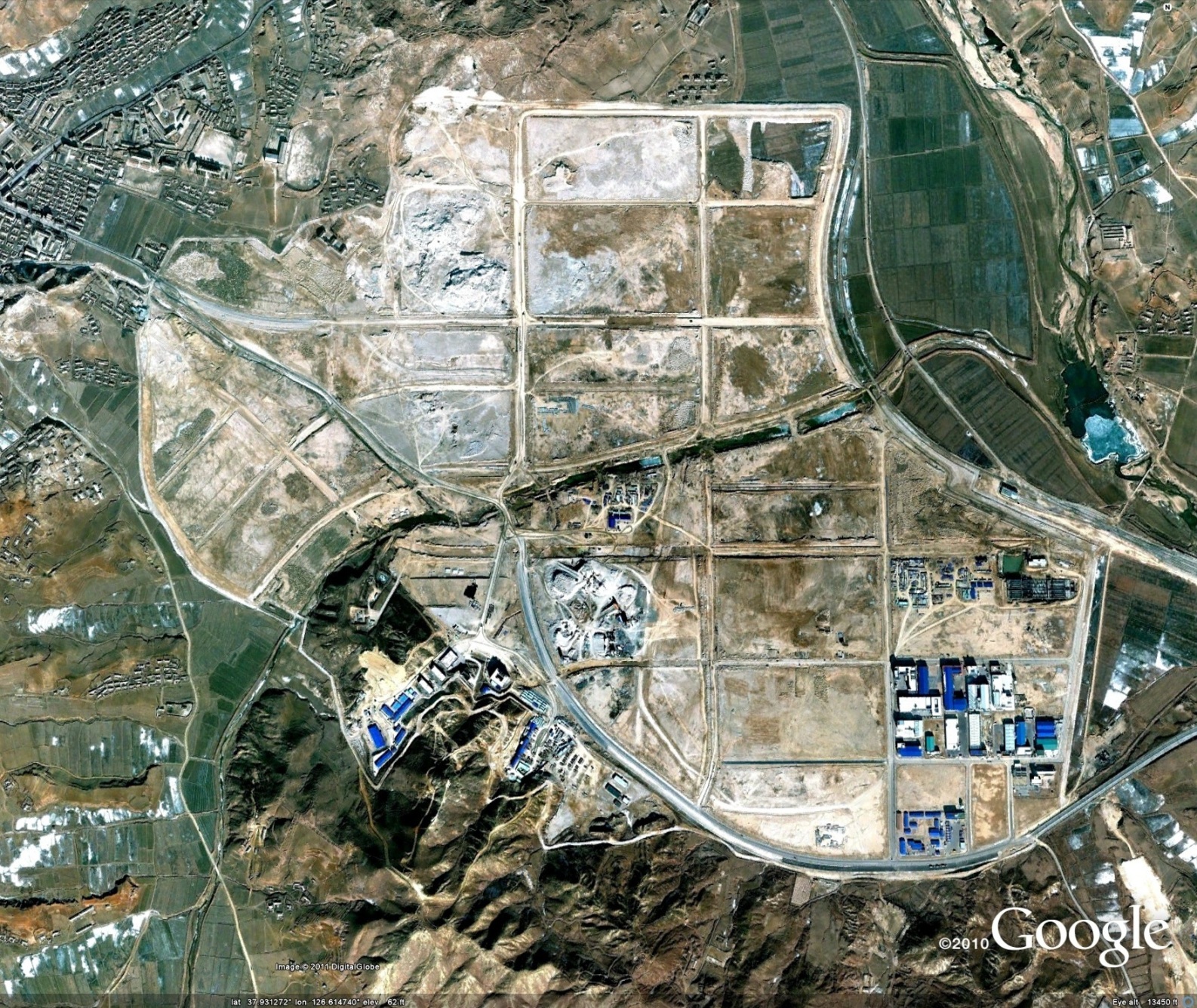
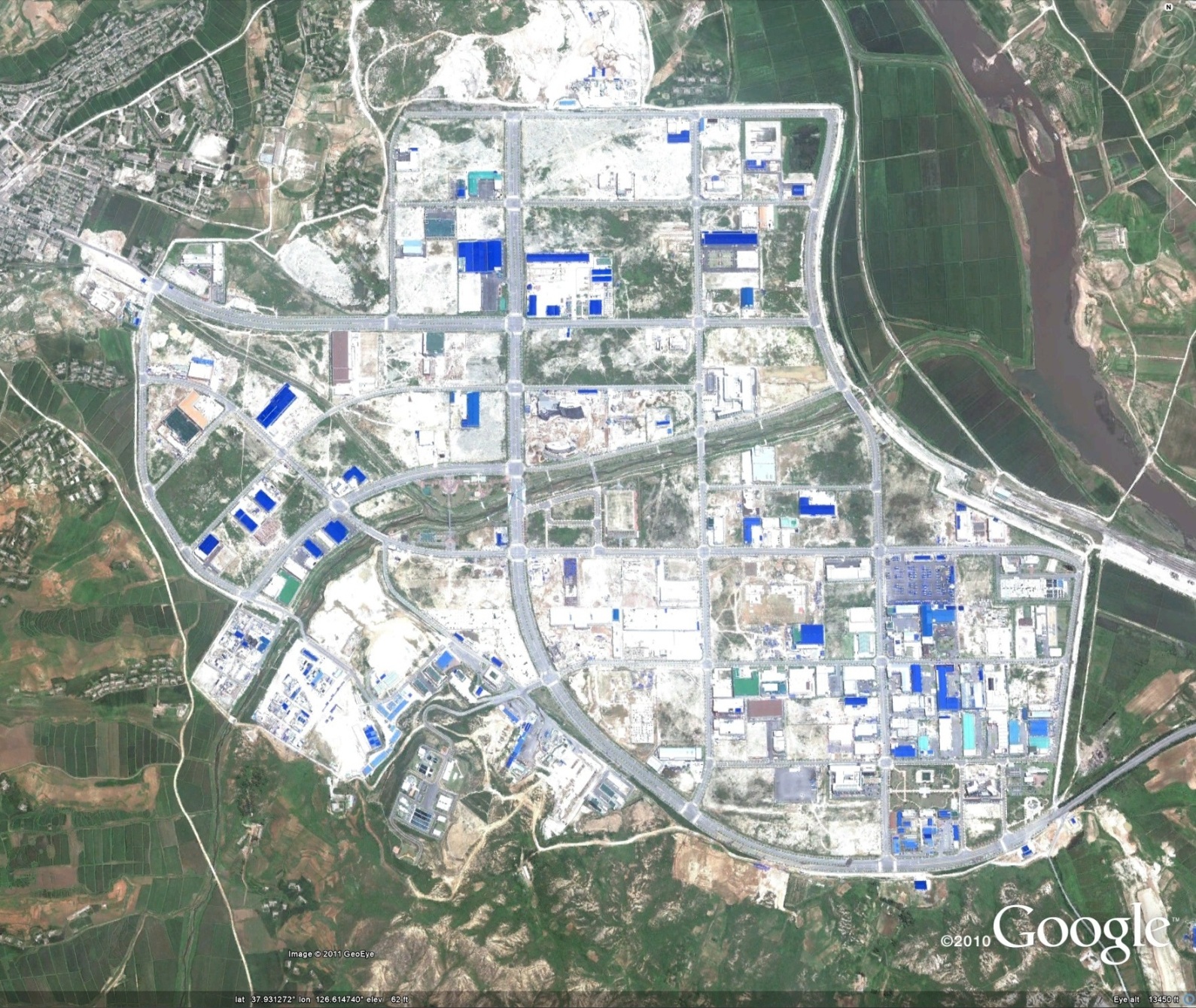
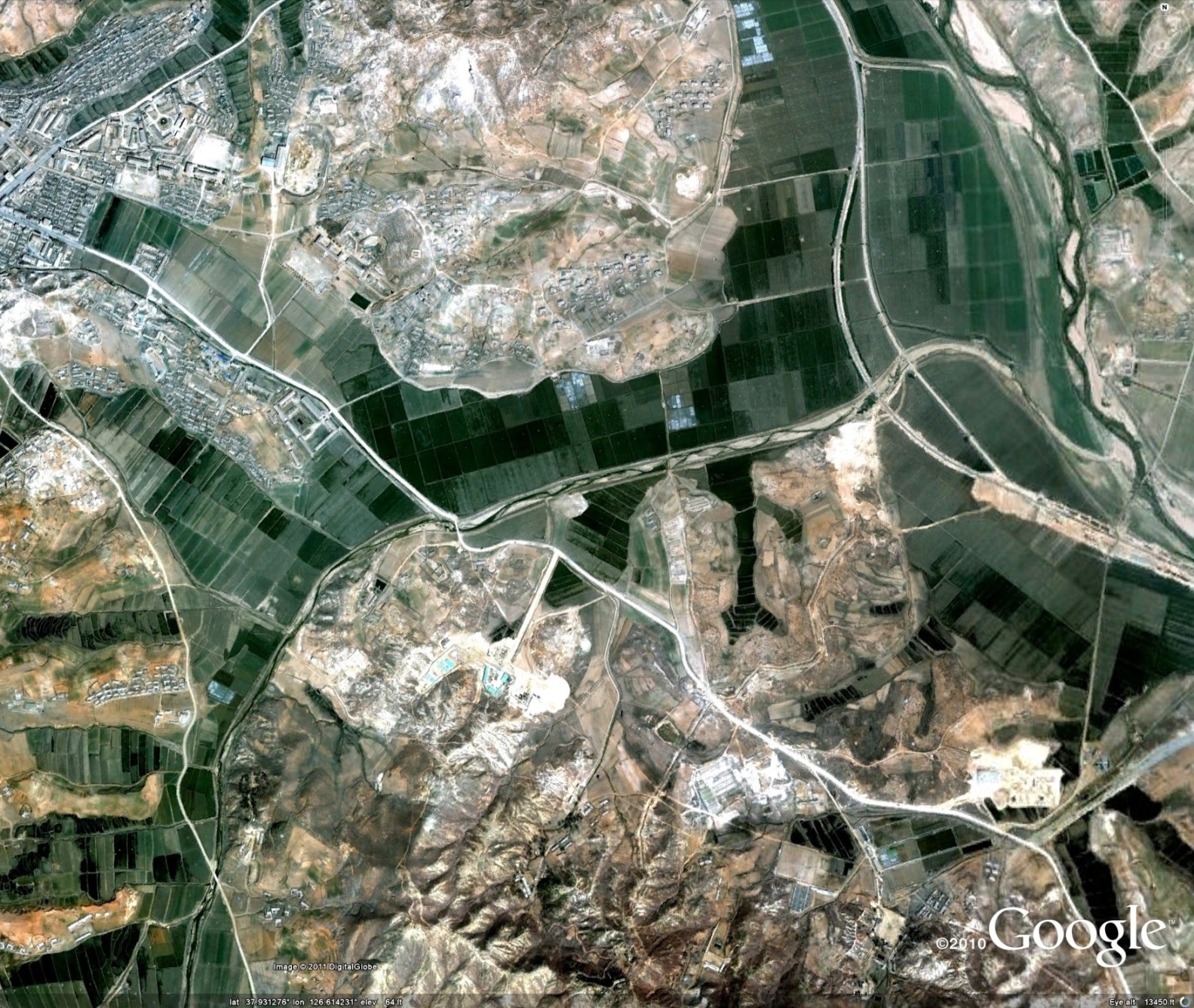
Pictured above (Google Earth): Growth of the Kaesong Industrial Center (Apr. 2004, Jan. 2006, Sept. 2009)

According to Yonhap:

South Korean factories in an industrial complex in North Korea produced goods worth US$34.7 million in March, setting a monthly output record since the two Koreas launched the zone in 2004, Seoul’s Unification Ministry said Wednesday.

The complex, a key symbol of rapprochement between the two Koreas, combines the South’s technology and management expertise with the North’s cheap labor.

More than 46,000 North Koreans work for about 120 South Korean firms operating in the North Korean border city of Kaesong to produce clothes, utensils, watches and other low-tech goods.

The two divided Koreas managed to maintain the zone despite a chill in their relations over the North’s two deadly attacks on the South last year that killed 50 South Koreans.

A couple of days ago I posted a story about the growth in number of North Korean workers at the complex.

UPDATE (2011-5-27): The Wall Street Journal’s Korea Real-Time offers some 2010 joint-Korean trade and aid umbers:

For the full year, general trade between the two Koreas amounted to $118 million, down 54% from $256 million in 2009.

But the joint industrial complex at Kaesong, a city just inside North Korea on the west side of the inter-Korean border, continued to flourish.

The volume of trade at the Kaesong Industrial Complex, goods moving into the approximately 120 factories there and then being shipped back south after North Korean workers added value, rose 54% to $1.44 billion last year from $941 million in 2009.

As part of the penalties following the Cheonan incident, the South Korean government limited the number of South Koreans who could stay at the Kaesong complex. The result: one-day visits to the complex soared, lifting the total number of South Koreans who visited the North.

For all of 2010, 130,119 South Koreans went to the North while just 130 North Koreans visited the South. In 2009, 120,616 South Koreans went to the North and 246 North Koreans visited the South.

South Korea’s assistance to North Korea also dropped sharply last year, to 30.1 bililon won from 77.5 billion won a year earlier. The South’s direct government assistance was 8 billion won, down from 10.4 billion won in 2009.

Private assistance from South Korea also fell to 20 billion won in 2010, from 37.7 billion won in 2009.

Read the full story here:
Production at Koreas’ industrial complex sets monthly record
Yonhap
2011-5-18

Share

Some current economic data points

Tuesday, May 17th, 2011

According to Daily NK:

Things are growing more difficult for many North Korean people as they pass through the spring lean season, according to a new interview with a citizen from the edge of Pyongyang, Kang Mi Soon. There has been little distribution this year, even in the capital, which has traditionally received preferential treatment, and while people are trading to try and improve matters, it’s not easy at the moment.

This is because, as a lingering after-effect of the currency redenomination, a lot of people have exhausted their reserves of cash, while prices have returned to levels commensurate with before the redenomination. In spite of relative commercial freedom in the jangmadang, the number of transactions has fallen and the class of small traders which lives day-to-day is struggling.

Kang, who hails from Gangdong County in Pyongyang, revealed this and more news from the city in an interview she gave to The Daily NK in Yanji, where she recently visited relatives,

The following is a transcript of the interview with Kang:

– What is the state of the distribution system?

In December last year and then January this year, there were eight days-worth of distribution. In February there were ten days, including the 16th (Kim Jong Il’s birthday), but in March there was no distribution. In April there were five days, including the Day of the Sun (Kim Il Sung’s birthday).

(One day of distribution ordinarily means 700g of rice or other grain for laborers, 900g for miners and workers in other strategic industries, 800g for members of state security, 400-500g for students (depending on grade) and 300g for housewives)

– Is the jangmadang operating well?

The jangmadang is working normally. However, the situation is that though the number of sellers is on the rise, people do not have money so products are not selling well.

– What things are selling the most?

Mostly, rice and corn are the mainstays of jangmadang sales. Since February of this year, there has been a drastic reduction in sales of other household items and industrial products. Though the supplies of rice and corn in the jangmadang are similar to last year, the number of buyers and the amounts being bought are both decreasing.

– What is the overall situation in terms of prices?

Overall, they have risen to a level similar to that of before the redenomination. In the case of Chinese products, prices have increased to more than before the redenomination. Socks made in China were 1,500won before, but now they are 2,000won.

– They say that the food situation during the spring lean season is hard. Can you tell us more?

Starting from last year, after the currency redenomination, the situation started getting worse, and this year it is really bad.

– Has anyone starved to death?

In Gangdong [Kangdong] County, since the beginning of February about twenty people, including two families which committed suicide, have died of hunger.

(Gangdong County had a population of 221,539 in 2008)

– What is the overall food supply situation?

60% of people in the county are living off three meals a day of corn porridge or corn flour noodles, 30% on corn rice and the remaining 10% are eating three meals of rice a day. In March and April of last year, the number of people eating three meals of rice was 30 or 40%, and less than 5% were living on corn porridge or noodles; the rest are corn rice.

– What about other regions?

With the exception of central Pyongyang and other big cities (Sinuiju, Pyongsung, Chongjin etc), it seems to me that other rural regions are in the same situation as Gangdong. The price of rice looks likely to stay the same or rise, and so, until around June 10th when the potatoes are gathered, the numbers of starving people is likely to rise.

Read the full story here:
Gangdong County Hit by Spring Shortages
Daily NK
Choi Cheong Ho
2011-5-17

Share

Number of DPRK workers at Kaesong complex continues to grow

Tuesday, May 17th, 2011

According ot the Choson Ilbo:

The number of North Korean workers at the Kaesong Industrial Complex has been growing even as Seoul halted all other trade with the North after deadly attacks on the Navy corvette Cheonan and Yeonpyeong Island last year.

There were 46,420 North Korean workers at the industrial park at the end of February, up 11 percent from 42,415 a year ago, according to the Unification Ministry on Sunday. This represents a monthly increase of 334. The industrial park’s output rose from $256.47 million in 2009 to US$323.32 million last year.

Why the increase?

Since all other inter-Korean trade has been suspended, the Kaesong Industrial Complex is the sole window for the North to obtain a steady legal supply of hard cash. The monthly wage of workers at the complex averages at around $100, but they only see between 30 and 50 percent while the rest goes to the regime.

“The workers get their wages in North Korean won or daily necessity coupons, and the North Korean authorities take all the dollars,” said a North Korean source. That amounts to some $4.6 million every month.

If the number of workers keeps increasing at the same rate, the North is expected to earn nearly $60 million this year. With the sources of hard currency exhausted, the North finds it profitable to assign even one more workers to the complex, but that also benefits the South Korean firms there. “North Korean worker wages are far more competitive than those in China and Southeast Asia,” said a staffer with an apparel firm at the complex. “At present we employ 1,200 North Korean workers, and the more we employ, the more profit we can make.”

And Lee Im-dong, a former secretary-general of the businesses association at the complex, said, “We have asked the North Korean authorities for additional manpower of 20,000. As far as the Kaesong Industrial Complex is concerned, our interests completely coincide with those of North Korea.”

The supply of additional workers is not easy. The available labor force in Kaesong and vicinity was already exhausted several years ago, so there is even a joke that “all the healthy in Kaesong now work at the industrial park.” The authorities have turned old buildings in Kaesong into boarding houses for workers recruited from Pyongyang, Pyongan and Hamgyong provinces, said the source.

“The fact that the North is going extra mile to bring more workers to Kaesong shows how desperately it needs dollars,” opined the Unification Ministry official.

Read the full article here:
N.Korea Keeps Sending More Workers to Kaesong Complex
Choson Ilbo
2011-5-17

Share

Pyongyang Spring International Trade Fair 2011 opens

Monday, May 16th, 2011

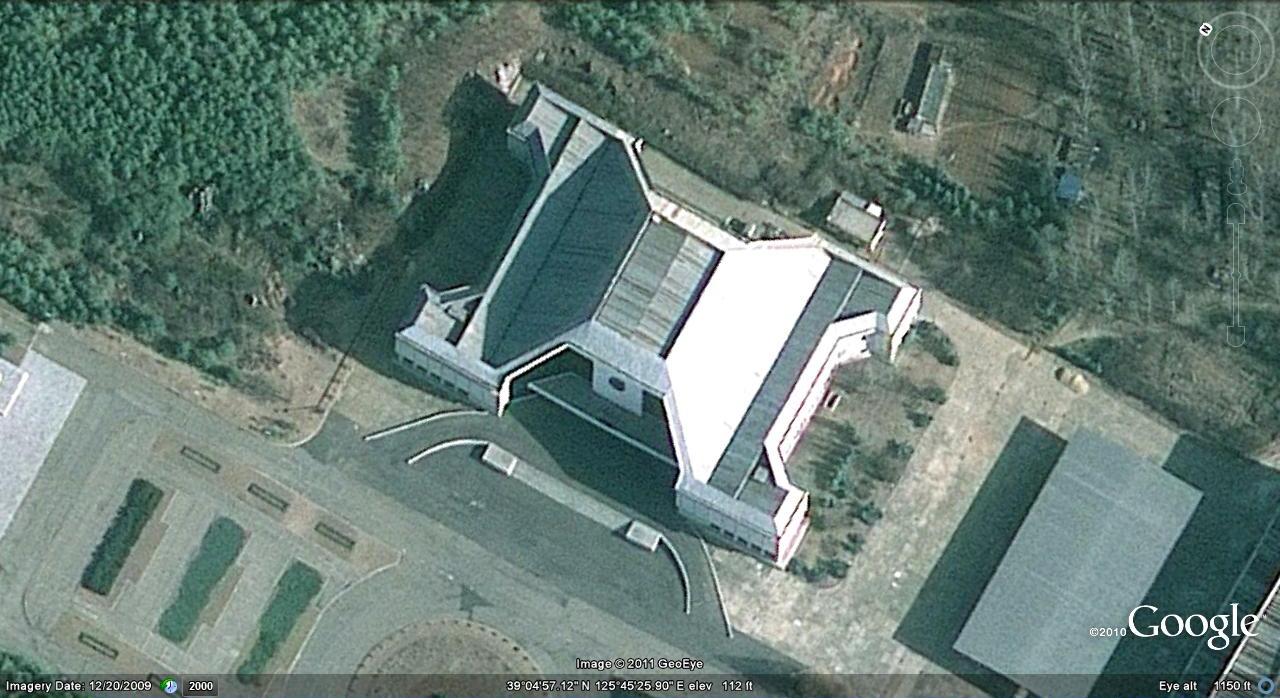
Pictured above (Google Earth): The location of the Trade Fair
in the Three Revolutions Museum compound, Pyongyang

According to KCNA:

Pyongyang Spring Int’l Trade Fair Opens

Pyongyang, May 16 (KCNA) — The 14th Pyongyang Spring International Trade Fair opened at the Three-Revolution Exhibition Monday with due ceremony.

Present there were Vice-Premier Kang Sok Ju, Minister of Foreign Trade Ri Ryong Nam, officials in the field of foreign trade and delegations from several countries and regions.

Diplomatic envoys of several countries and officials of foreign embassies here were also present.

Kim Mun Jong, director of the Korean International Exhibition Corporation, made an opening address to be followed by a congratulatory speech by O Ryong Chol, vice-minister of Foreign Trade.

The speakers said that the fair will provide multi-lateral economic and trade activities and scientific and technological exchanges among several countries and regions, expressing hope that the entrants would gain good success through broad contacts.

The DPRK will further economic and cooperative relations with other countries on the principles of equality and mutual benefits, they said.

After the opening ceremony the attendants looked round exhibits from companies of the DPRK, China, Germany, Malaysia, Mongolia, Syria, Switzerland, Singapore, Britain, Australia, Austria, Italy, Indonesia, France, Poland and Taipei of China.

A reception as regards the opening of the fair was given at Pyongyang Koryo Hotel the same day.

Uriminzokkiri posted a video of the trade fair on You Tube. Watch it here.

Share

Ministry of Unification not keeping up with ROK business in the DPRK

Monday, May 16th, 2011

According to the Choson Ilbo:

A panel of experts says the Unification Ministry has a cavalier attitude to South Korean companies doing business with North Korea. The panel, led by Kim Young-yoon of the Korea Institute for National Unification, tried to find out how many firms there are and what they do.

The experts say that according to ministry figures, 1,017 South Korean companies are doing business in the joint Korean Kaesong Industrial Complex, Mt. Kumgang, Pyongyang, as well as Nampo, Haeju, Rajin and Sinuiju. But the ministry does not even have contact numbers for 188 of those companies, and the phone numbers of 259 are wrong, meaning it only has accurate numbers for 570.

That begs the question whether the tally is even remotely accurate. “Even if businesses have an office in North Korea, most of them are headquartered here,” said one of the experts. “So it shouldn’t be very difficult to assess the status of these businesses, and inaccurate statistics show that the ministry has not done its job properly.”

The probe was prompted by a request from some firms doing business with North Korea to the National Assembly’s Foreign Affairs and Unification Committee to review business in the North and give them a clear picture after the government halted all trade with the North except the Kaesong complex on May 24 last year.

The panel had planned to publish a white paper on May 24 this year, but apparently scrapped the idea due to the lack of basic information.

A response from a Unification Ministry official only adds to the confusion. “We gave them a list of 720 companies, including 584 that are involved in trade with North Korea, 122 that are based in the Kaesong Industrial Complex and 20 in Mt. Kumgang,” he said. “I don’t know where they got the 1,017 figure from.”

Read the full story here:
Ministry ‘Confused’ Over Firms Doing Business with N.Korea
Choson Ilbo
2011-5-16

Share

On the DPRK’s informal credit markets…

Monday, May 16th, 2011

According to the Daily NK:

Loan-sharking of both money and food is back to being widespread in North Korea these days, and sources say this is causing problems.

The activity is said to have waned for a time in the face of strict crackdowns during the currency redenomination in 2009; however, according to sources, a lot of those people who were expropriated by the currency redenomination have now started borrowing money from loan sharks in order to begin trading or get access to food, meaning it has spread widely once again.

A source from Hyesan, Yangkang Province explained on the 13th, “Those without funding for trade tend to borrow money at high interest. If they borrow money from an acquaintance, the interest rate is five percent, or they make an agreement with a loan-shark, who they don’t know well, to give ten percent.”

“Some loan-sharks get from 15 to 20 percent interest from smugglers for loans over a single night! Even though it is risky, depending on the regulations, they lend money to smugglers because they can earn large sums of money in just a few days.”

Loan sharks have been the target of crackdowns for years. In August 1997, the Ministry of Public Security (formerly the People’s Safety Ministry) released a decree stating that authorities could go so far as to execute those caught loaning food at high interest rates. Additionally, right before the currency redenomination in September of 2009, the National Security Agency cracked down on loan-sharking, releasing a decree calling on officials to “Map out measures to uproot usury.”

However, given that even agents of the People Safety Ministry use loan-sharking for the trading activities of their families, the crackdowns are doomed to fail.

According to sources from several provinces, the activity is also more common in rural areas than in cities, because in cities people have more survival mechanisms, but rural people do not have many alternative ways to get hold of money or food.

Loans are used in these agricultural areas in order to borrow grain from March to May, and are paid back double in the harvest season. In Yangkang Province, meanwhile, when people borrow one kilogram of rice or flour, they must pay it back in the form of 2.5 or 3 kg of potato starch, since the major product of the province is potatoes.

It is the kind of interest rate that was applied during the March of Tribulation, but people still apply it now.

This is a vicious circle of poverty, another defector pointed out. “Those who suffer loan-sharking each year face another worrying fall because their harvest must be paid to the loan sharks.”

The author of this Daily NK story unfortunately chooses to describe the DPRK’s “informal lenders” as “loan sharks,” making them morally equivalent to thieves and bullies, rather than describing them as lenders in a high-risk market.  This sort of pejorative name-calling is common among those who don’t understand how credit markets work, particularly in a high-risk business environment such as the DPRK.

The reality is that informal and black market lenders in the DPRK are making de jure illegal loans from their own savings.  This means that if the loan is officially discovered, the lender (and probably the borrower) will face criminal charges.  Even if the lender is not arrested, he must pay regular protection money to keep it that way.  Additionally, there is little property in the DPRK which can be credibly used as collateral in a loan, which means that even if the loan is not discovered by the authorities, if the borrower defaults or absconds with the funds there is little the lender can take possession of to recover his capital.  This level of risk requires borrowers to pay much higher interest rates to coax scarce lenders into the market.

In addition to the high interest rates that black market lenders usually charge, they also earn a bad reputation for their resort to “informal” mechanisms to insure and recover these loans.  Some insurance mechanisms, such as lending to family members and close acquaintances, might work well.  Other mechanisms, such as making threats of harm (and following through), are not as widely respected. But these are “technological” adaptations and responses to the DPRK business environment, not purely sadistic behavior.  In other words, these market practices are completely predictable given the institutional environment and not unique to the DPRK.  If the DPRK court system impartially enforced contracts, and collateral could be legally secured, these sorts of technologies would be unnecessary.

I am not claiming that black market lenders are angels, or even pleasant people (in fact some of them may be powerful individuals in the party and security infrastructure), but they are financing the development of the DPRK’s unofficial economy out of nothing more than financial self-interest.  Without their efforts a whole class of informal and black market entrepreneurs would be unable to access capital markets to start new businesses or finance operations.  The unpleasant side of black market lending should not be placed on the market participants themselves, but on the DPRK’s policymakers who have pursued economic policies that have made this sort of behavior necessary.

Read the full Daily NK story here:
Loans Creating Circle of Poverty
Daily NK
Kang Mi Jin
2011-5-16

Share

China Exim Bank delegation visited DPRK in April

Monday, May 9th, 2011

According to the Donga Ilbo:

Members of the credit rating agency under the Export-Import Bank of China are known to have visited North Korea around the “Day of the Sun” on April 15, otherwise known as the birthday of the Stalinist country`s founder Kim Il Sung.

A source in Beijing said, “Around 10 people from the Export-Import Bank of China made a 10-day trip to North Korea ahead of the Day of the Sun. They not only visited Pyongyang but also other cities.”

The agency provides sovereign credit ratings for countries around the world. Critics say the members visited the North to seek further economic cooperation, adding their trip holds more meaning than attending the holiday event because they also visited other cities.

Another source in Beijing said, “The Chinese government is mulling financial benefits including no-interest loans to Chinese companies investing in the [North’s] city of Rason.”

Beijing seems to be preparing to invest in the Hunchun-Rason area near the Tumen River and Dandong-Sinuiju’s Hwanggeumpyong region near the Yalu River, where Pyongyang-Beijing economic cooperation is vital.

Read the full story here:
China`s Exim Bank delegation visited N. Korea last month
Donga Ilbo
2011-5-9

Share

Number of South Koreans in Kaesong zone increases

Sunday, May 8th, 2011

According to Yonhap:

A daily average of more than 600 South Korean workers are currently staying at the Kaesong Industrial Complex in North Korea, up from the 500-level in the past several months, according to a Seoul ministry Sunday.

The increase reflects a reduction in military tensions between the two Koreas, officials at the Unification Ministry that handles inter-Korean affairs said.

The ministry’s data showed that around 650 South Koreans stay at the industrial park, located just north of the inter-Korean border, per day starting last month.

“With regard to the number of production-related manpower, we are granting permission to stay (there) with more flexibility starting in the middle of April,” a ministry official said, requesting anonymity. “The number is expected to gradually increase down the road as well.”

He said the ministry’s flexible stance is attributable to petitions from companies in the Kaesong complex and the alleviation of security concerns of South Korean workers as inter-Korean tensions have eased a bit.

Read the full story here:
Number of S. Koreans at Kaesong rebounds amid letup in tension
Yonhap
2011-5-8

Share

Koryolink employee numbers and other info…

Sunday, May 8th, 2011

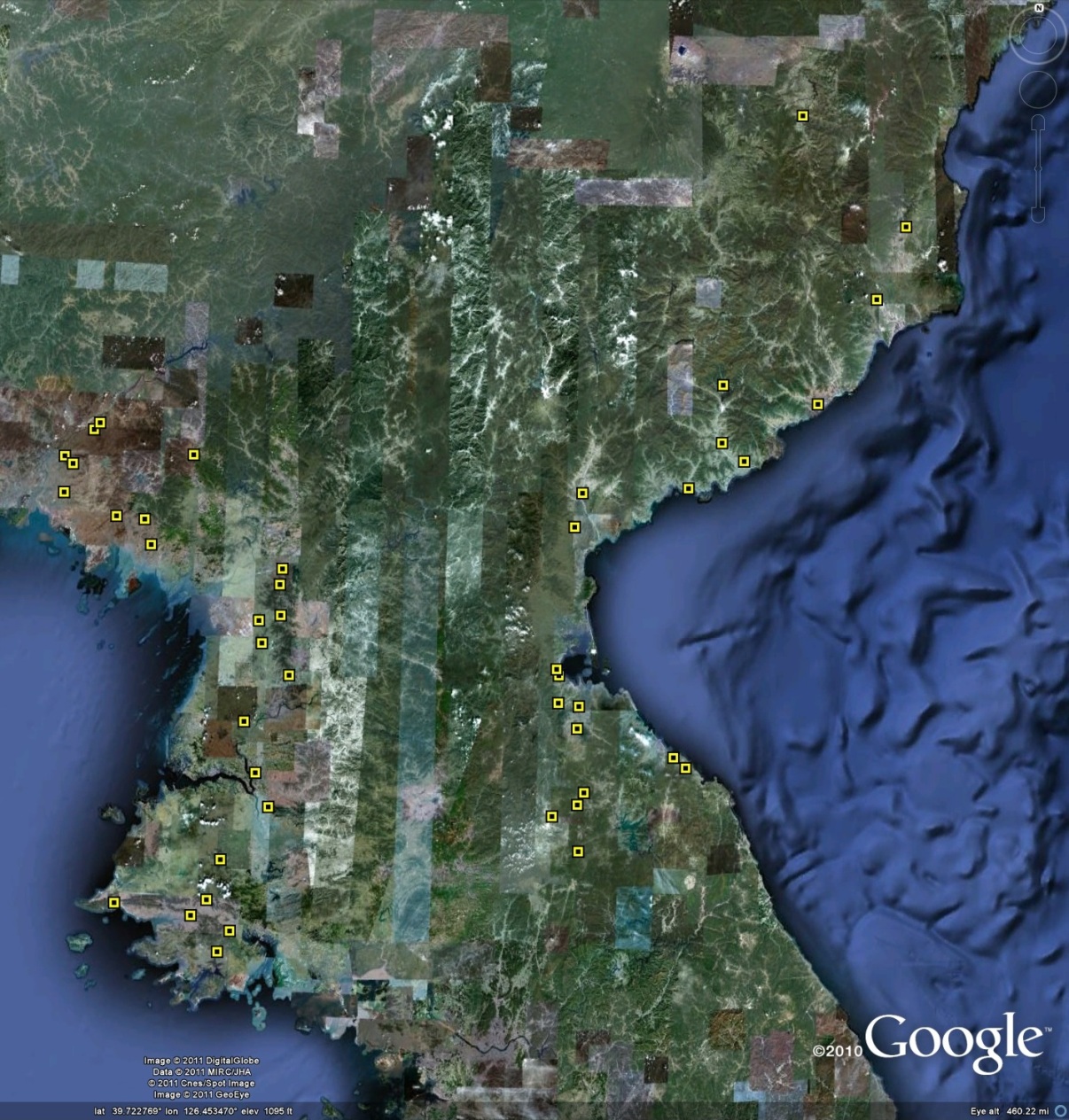
Pictured above: Locations of Koryolink (Orascom) moblie phone towers I have identified in the DPRK.  Supposedly 300 exist in total.

The German Financial Times published a story on Orascom.  Much of it was familiar material, but it did contain one interestign nugget I had not seen before:

Etwa 20 Ägypter und mehr als 200 Nordkoreaner arbeiten für Koryolink – die meisten der Expats im Management, ein Großteil der Nordkoreaner als Techniker und im Service. Für die Kundenbetreuung wurde ein modernes Callcenter eingerichtet. Das Netz deckt die Großstädte, die Autobahnen und die Schienenwege ab, insgesamt etwa 15 Prozent der Staatsfläche. In dem Gebiet leben 91 Prozent der Bevölkerung.

And putting this through Google Translate we get:

Throughout the country, told Heikal, meanwhile, more than 300 transmitters spread. Some 20 Egyptians and more than 200 North Koreans work for Koryolink – most of the expatriates in management, the majority of North Koreans as a technician and service. For customer support a call center was established. The network covers the major cities, highways and rail lines, totaling about 15 percent of state land. In the field 91 percent of the population live.

The service has grown to over 500,000 users but still remains out of the hands of the vast majority of the population:

Auch wenn jetzt theoretisch jeder ein Handy haben darf, sind die Tarife für die meisten Nordkoreaner unbezahlbar. 200 Freiminuten und 20 SMS kosten im Monat 800 nordkoreanische Won, nach offiziellem Wechselkurs sind das rund 5,50 Euro. Dazu kommen die Freischaltgebühr und die SIM-Karte für 50 Euro – zahlbar in Devisen. Wer sich nichts in der wuchernden Schattenökonomie dazuverdient, kann sich das nicht leisten.

And again, via Google Translate:

Even though now may theoretically have a cell phone each, the rates for most North Koreans are priceless. 200 free minutes and SMS cost 20,800 North Korean won per month, according to the official exchange rate is around 5.50 €. Then there are the activation fee and the SIM card for € 50 – payable in foreign currency. Anyone who does nothing, earned in the sprawling shadow economy can not afford that.

And on the human resources front…

Auch bei seinen nordkoreanischen Mitarbeitern bemerkt er Veränderungen. “Vom technischen Können her sind sie sehr gut, die Herausforderungen lagen eher im kaufmännischen Bereich und im Marketing”, sagt Heikal. “Aber wir bilden sie im Unternehmen aus, und wir organisieren für sie Trainings im Ausland, vor allem in China. Ich spüre, dass sich ihre Mentalität über die vergangenen drei Jahre gewandelt hat. Sie beginnen, das Geschäft zu kapieren.”

Bisher sind nordkoreanische Angestellte noch nicht ins oberste Management vorgestoßen, aber mittelfristig sollen sie die ägyptischen Expats ablösen. Natürlich wünscht sich das Regime, dass die eigenen Leute dort die Verantwortung übernehmen – und hegt trotzdem, wie so oft, schwere Bedenken dagegen. “Auf der Managementebene muss man mit der Außenwelt kommunizieren”, gibt Heikal zu bedenken. “Wir diskutieren das mit den Behörden. Sie verstehen das Problem, aber ich denke, das wird noch etwas dauern.” Er lächelt. “Im Rückblick erkennt man enorme Verbesserungen und Veränderungen, aber wir haben noch viel vor uns. Eine ganze Reihe von Dingen wird noch eine Menge Geduld brauchen.”

via Google Translate:

Even with his North Korean employees, he noticed changes. “From her technical ability, they are very good, the challenges were more in the commercial sector and in marketing,” says Heikal. “But we are training in the company, and we’ll arrange for her training abroad, especially in China. I feel that their mentality has changed over the past three years. You begin to understand the business.”

So far North Korea’s workers are not pushed into top management, but the medium they are to replace the Egyptian expatriates. Of course, the regime hopes that their own people over there take the responsibility – and still cherishes, as so often, serious concerns about it. “At the management level needs to communicate with the outside world is,” says Heikal pointed out. “We discuss with the authorities. You understand the problem, but I think it will take some time.” He smiles. “In retrospect, there are vast improvements and changes, but we still have a lot to us. A whole series of things still need a lot of patience.”

Read the full story here:
Die Pyramidenbauer von Pjöngjang
German Financial Times
2011-5-8

Share