Archive for the ‘Economic reform’ Category

Kim Jong-il visits Kwangbok Department Store

Friday, December 16th, 2011

UPDATE (2011-12-19): KJI’s financial manager appears on tour of Kwangbok.  According to Yonhap:

The head of a shadowy North Korean agency charged with managing slush funds for leader Kim Jong-il has again appeared in public after five months.

Recent footage from the North’s state television network showed Jon Il-chun standing closer to Kim than Kim’s heir apparent son, Kim Jong-un, on an inspection tour of a supermarket in Pyongyang.

Kim Jong-un is being groomed to succeed his father Kim Jong-il as the country’s next leader in what would be the country’s second hereditary power transfer.

Jon and Kim Jong-un were also seen standing side by side on an escalator at the Kwangbok Area Supermarket, according to recent photos released by the North’s official Korean Central News Agency.

Jon, who has rarely been exposed to media, was last seen on Kim’s trip to a factory in July.

He heads Office 39, which has often been referred to as Kim’s “personal safe” for its role in raising and managing secret funds for the North Korean leader.

The office is also believed to be involved in counterfeiting US$100 bills and drug trafficking.

Last year, the United States blacklisted Office 39 as one of several North Korean entities to come under new sanctions for its involvement in illegal activities such as currency counterfeiting.

ORIGINAL POST (2011-12-16): According to the Daily NK:

Chosun Central News Agency (KCNA) today reported news of an onsite inspection by Kim Jong Il, Kim Jong Eun and others to the Kwangbok District of Pyongyang, the city’s commercial center. The main site on the visit was reportedly the newly expanded and redesigned Kwangbok Department Store.

The redevelopment of the store was ordered by the elder Kim following his trips to China earlier this year, where he was repeatedly exposed to the full force of China’s commercial development.

According to KCNA, “To enhance the people’s welfare and improve their lives, upon the direct suggestion and boundless affection of the fatherly General with his perpetual concern for the people, Kwangbok Department Store, which was constructed in October, 1991, has been transformed anew into the commercial center of Kwangbok District.”

“From warehouse to sale, the realization of information technology and numerical control of all management operations guarantee accuracy and speed, and the store has been stocked to guarantee the utmost convenience of visitors,” it went on.

KCNA went on to say that Kim Jong Il listening to information from related officials, and subsequently declared himself satisfied with the way the store matched the people’s needs in all areas, from sales plans to the amount and quality of goods available.

“We must proceed with the kind of commercial activity that can sell to the people of the capital city those things that they would not be able to live without in their daily lives such as clothing, shoes, food, conveniences, family items, school goods and cultural things, and leave them with no complaint,” he emphasized.

Read the full story here:
Kim Satisfied with “Transformed” Store
Daily NK
Kang Mi Jin
2011-12-16

Share

Two years after the DPRK’s currency revaluation

Tuesday, December 13th, 2011

Institute for Far Eastern Studies (IFES)
2011-12-8

It has been two years since the implementation of North Korea’s currency revaluation and the South Korean government recently has presented an assessment of it, evaluating it as a complete failure, as exchange rates have skyrocketed and inflation set in.

It has been largely evaluated as having weakened the government control over the market and the people.

In the report released by South Korea’s Ministry of Unification (MOU), the prices of rice and exchange rates have returned previously to the level before the measure went into effect. The prices of rice per kg that cost between 20 to 40 KPW in December 2009 has jumped to 3,000 to 5,000 KPW as of November of this year, which is more than a 2,300 times increase.

The price of rice that went for 2,400 KPW early this October is believed to be close to 5,000 KWP currently.

The fluctuation of rice price is allegedly associated with preparation for next year’s celebration (i.e., of North Korea becoming a “strong and prosperous nation”). According to an anonymous North Korean government official, rice is being stockpiled to be released next year during the celebration period.

North Korea has self-proclaimed 2012, the centennial birthday of Kim Il Sung, as the first year of the “strong and prosperous nation.” While it may be ephemeral, it said it will normalize rice distribution for next year.

The exchange rate for KPW in December 2009 was 35 North Korean won to one USD; a year later, it soared to 2,000 won, and it is currently worth 3,800 won.

At the time of the currency revaluation, the usage of foreign currency was completely banned. This in return made the exchange rate spiral up. In February of this year, North Korea eventually abandoned this measure.

One Chinese yuan is also worth about 400 KPW, standing shoulder to shoulder with the value of the US dollar. About 300 markets that exist currently in North Korea are affected by the soaring exchange rate of the yuan, raising the prices of Chinese products on the market.

North Korea also has increased wages for the workers a hundred fold during the currency redenomination; but life for the people has become harder due to hyperinflation.

The average monthly salary of a North Korean worker is about 3,000 KPW; however, the monthly expenses for an average family of four hovers around 100,000 KPW.

The MOU has announced that the currency reform implemented by the North Korean government two years ago was intended to weaken the role of the markets, and regulate the new-rich, generate supplies of capital for the construction industry, and adjust the amount of domestic currency in circulation. In the end, the reevaluation ended up achieving the opposite.

At the time, the government prohibited sales of imported and industrial products on the market and promoted marketization of agricultural goods. But the people’s dependency on markets is as high as ever, leading to a relaxation of market regulation in February 2010.

The MOU also stated, “There is growing distrust of the government among North Koreans from the failed policy which in effect undermined the power of the government to control the market and the people.”

The Daily NK also reported some similar information:

The price of rice in North Hamkyung Province and other areas along the Sino-North Korean border has passed 5,000 won per kilo. This represents a rise of over 1,000 won in little over a fortnight, after similar reports came out two weeks ago asserting that the price had passed 4,000 won in late November.

Sources have independently reported that the 5,000 won mark has been passed in markets in the cities of Hoeryeong and Musan, both in North Hamkyung Province, and Hyesan in Yangkang Province. The exchange rate of the Chinese Yuan against the North Korean won has simultaneously jumped from the low 700s to 800 in Hyesan and over 1,000 in Musan and Hoeryeong.

Reporting the news, one Hoeryeong-based source told The Daily NK, “The price rises have left people living hand-to-mouth, and the endless government controls and crackdowns mean people have no idea what to do. The atmosphere in the jangmadang has gotten really ugly on rumors that prices are going to rise further.”

A source from Musan pointed out, “The Yuan seems to go up every day, and now that rice has passed 5,000 won a kilo people have no idea what they’re going to eat to survive.”

“We’ve already given up on the idea of eating rice cake for the Chinese New Year,” the trading source from Hyesan said, going on, “Chosun rice now costs 5,000 won a kilo while Chinese rice is 3,800 won. Wherever you go people are up in arms about it.”

Most locals blame the rapid rise in the cost of living on the strength of the Yuan against the North Korean won. In this way, the lack of confidence in the local currency promoted and enhanced by the 2009 currency redenomination seems to be having a direct effect on the price of rice.

“Everybody prefers to use Renminbi to Chosun money, so by the time you wake up in the morning the thing which has risen again is the price of the Yuan. Because the exchange rate is rising, it is inevitable that the price of rice goes up as well,” the source from Hyesan explained.”

Interestingly, according to the border region sources there is no great difference in the physical volume of rice in the market. However, because the Yuan has become the main currency for both the supply and demand sides of the market, prices have risen in accordance with the change in the exchange rate. The use of the Yuan as the medium of exchange between locals was already becoming institutionalized even before the recent rises.

The rapid price rises are also encouraging traders to try and obtain more locally-grown rice.

The source from Hyesan said, “Train stations in North Hamgyung and Hwanghae Provinces are in complete chaos when there is a train because of all the traders trying to bring in local rice, as well as the agents regulating them,” while the source from Musan said, “Many people are stocking up on food while they can because of reports that food prices will keep rising until next spring.”

Marcus Noland also blogged about the price of food and US$ exchange rate in the DPRK last week.

Read the full Daily NK story here:
Rice Tops Key 5,000 Won Mark
Daily NK
Lee Seok Young
2011-12-13

Share

“Chinese company” given access to Kumgang facilities

Tuesday, December 13th, 2011

According to Yonhap :

North Korea has allowed a Chinese company to do business at its scenic mountain resort, a source said Tuesday, in an apparent attempt to revitalize the resort at the center of a dispute with South Korea.

The company plans to organize a cruise tour to Mount Kumgang on the North’s east coast for Chinese tourists from Hong Kong and other eastern Chinese ports, said the source familiar with the issue.

The company, which won permission to run the business until the end of 2026, also plans to run a casino, a duty free shop and a hotel in the resort, the source said.

The move comes just months after North Korea made a trial cruise from its northeastern port city of Rajin to the mountain resort to try to attract Chinese tourists.

North Korea has launched a series of tourism programs for the Chinese in an apparent bid to earn much-needed hard currency.

For a decade, South and North Korea jointly ran the tour program at the resort, a key symbol of reconciliation on the divided Korean Peninsula.

Still, Seoul halted the cross-border tour program following the 2008 shooting death of a tourist by a North Korean soldier near the resort.

Seoul has demanded a formal apology from Pyongyang for the incident, in addition to improved security measures for tourists, before resuming the tour program, a key cash cow for the North.

However, the North has expelled South Korean workers from the resort and disposed of all South Korean assets there after it unsuccessfully tried to pressure Seoul to resume the tour program.

South Korea has asked foreign countries not to invest or engage in tourism activities at the mountain resort as part of its moves to protect its property rights there.

Dear Yonhap: Would it have been too much trouble to give us the name of the Chinese company or tell us anything about it?

Read the full story here:
N. Korea permits foreign company to run business at its scenic resort
Yonhap
2011-12-3

Share

Celebrate the socialist way!

Tuesday, December 13th, 2011

According to the Daily NK:

The North Korean authorities are currently employing various means to encourage frugality, an idea which has recently come to include ‘kwanhonsangje’ (the four ceremonial occasions; coming of age, marriage, funeral and ancestral rites).

In recent years there has been official criticism of the fact that engagement ceremonies, wedding gift exchanges between families and even the table for ancestral rites have become occasions full of over-spending, empty formalities and vanity.

Recently, Daily NK obtained a copy of the October issue of monthly magazine ‘Socialist Cultural Life’, to which social studies scholar Jang Seong Nam submitted a piece, ‘Let’s Perform Kwanhonsangje the Socialist Way’, in which he declared, “kwanhonsangje should be performed according to the demands of the Party and social development.”

The article emphasized, “We are taking the lead, seeing kwanhonsangje performed in the socialist way as a valid and unavoidable problem in the establishment of the new military-first socialist life.”

“Because old, feudalist, superstitious, empty formalities and bizarre foreign customs are not disappearing, we are strongly demanding action on this problem,” it went on, adding, “Rejecting bizarre foreign customs crushes the Imperialists’ policy of ethnic extermination under the banner of ‘globalization’.”

The article also looked in more detail at problem issues surrounding kwanhonsangjae.

“A sufficient engagement,” it proclaimed, “has two people and their parents meeting to confirm the marriage, and wedding ceremonies should be a gathering at someone’s home.”

Regarding funeral arrangements and ancestral rites, it recommended, “Commemorate a death by placing a medal or honorary certificate before an image of the deceased along with flowers, while the various commemorative services on the 3rd day or the birthday of the deceased should be eliminated.”

Getting into minutae, it added of a groom’s suit color, “Discard the convention of wearing a black or dark blue suit; men should wear bright colors according to season.”

In these ways, the article asserted, kwanhonsangjae becomes an aesthetic and modern set of customs with a uniquely Chosun ethnic color.

The piece appears to show both the state’s desire to restrain consumption but also to reassert ‘socialist’ attitudes and encourage nationalist attitudes, thus pushing back against the impact of foreign ideas coming in via overseas media, South Korean dramas and so on.

‘Socialist Cultural Life’ is distributed monthly to all official organs and enterprises. Its publisher, Labor Group Publishing House, publishes various other magazines including ‘Chosun Women’, ‘Worker’ and ‘Agricultural Worker’. As a part of the Party Propaganda and Agitation Department, its various publications are among the state’s most ubiquitous propaganda weapons after the daily Workers’ Party mouthpiece, ‘Rodong Shinmun’.

Read the full story here:
Celebrate the Socialist Way!
Daily NK
Lee Seok Young
2011-12-9

Share

SEZ Law Enacted by Supreme Assembly

Friday, December 9th, 2011

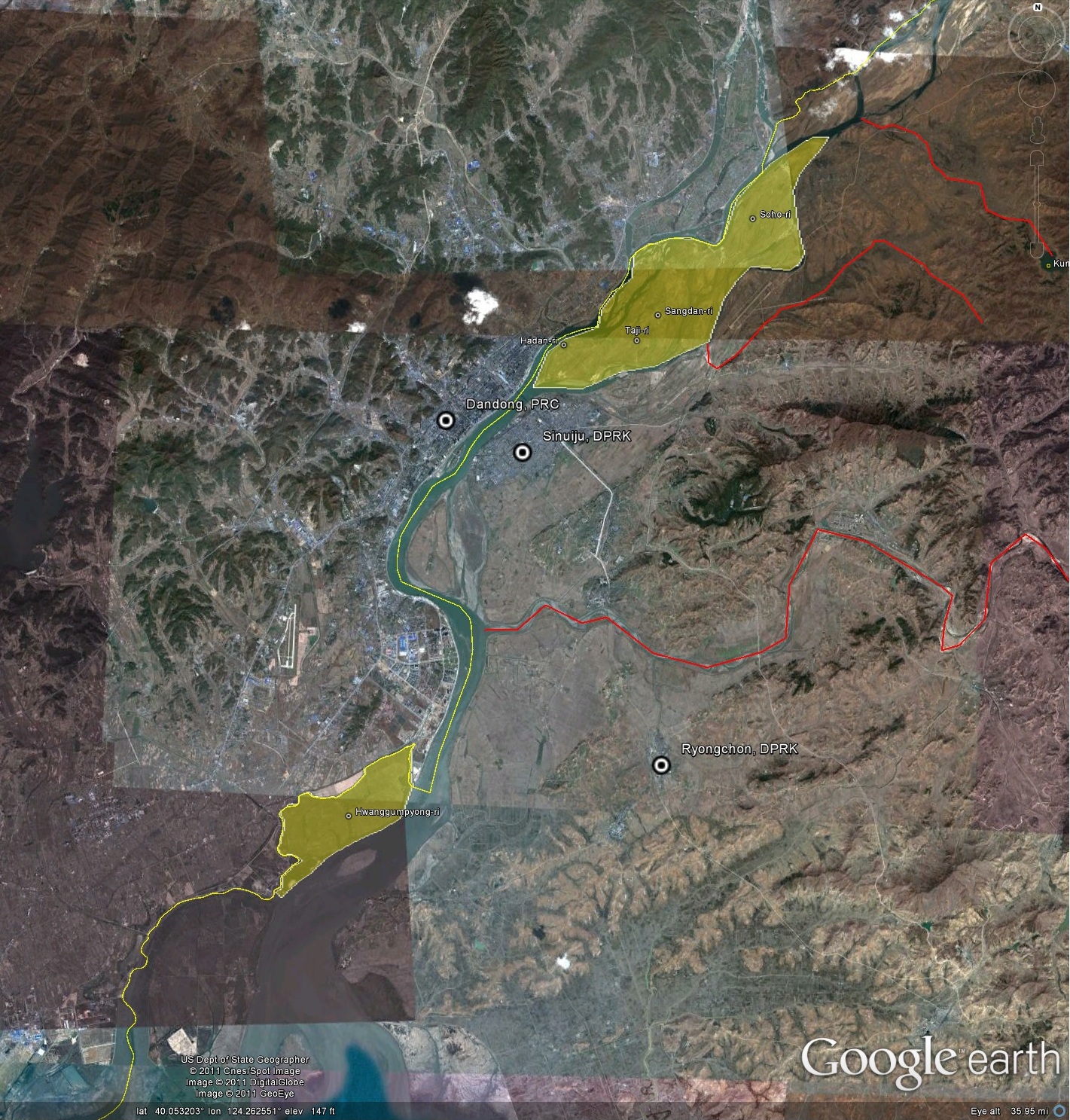
Pictured Above (Google Earth): The Hwanggumphyong and Wiwha Island SEZ on the Yalu/Amnok River which separates the DPRK and PRC.

UPDATE 1 (2012-3-19): Read the laws governing the SEZs here.

ORIGINAL POST (2011-12-9): According to the Daily NK:

North Korea has enacted a law governing activities at Hwanggeumpyeong and on Wihwa Island, two new special economic zones in the vicinity of Shinuiju on the Sino-North Korean border.

Chosun Central News Agency revealed the news this morning, stating, “The Hwanggeumpyeong-Wihwa Island Economic Zone Act was adopted by the Standing Committee of the Supreme People’s Assembly of the Chosun People’s Democratic Republic.” It did not offer any further details.

The provisions of the new law are reported to have been circulated to various Chinese governmental and economic figures, and it is said to contain provisions reflecting successful elements in the development of China’s own special economic zones.

Naturally, one key part of the intent behind the new law’s enactment appears to be to reassure potential Chinese investors of the stability of the investment climate in North Korea.

At this stage, although there was a large opening ceremony for the zone in June this year attended by Workers’ Party figures including Jang Sung Taek, who plays a key role in the attraction of overseas investment to North Korea, the pace of construction remains limited.

However, there may not be long to wait. Dai Yulin, who heads the Municipal Committtee of the Chinese Communist Party across the Yalu River in Dandong told the China Daily back in September, “Concrete plans for the development of the Hwanggeumpyeong Special Economic Zone will be completed by the end of this year.”

Read the full story here:
SEZ Law Enacted by Supreme Assembly
Daily NK
Kim Tae Hong
2011-12-9

Share

S. Korean businessmen to meet in Kaesong

Tuesday, December 6th, 2011

According to Yonahp:

Top executives of more than 120 South Korean companies operating in the Kaesong Industrial Complex plan to meet in the North’s border city this week, in the first such meeting to discuss pending inter-Korean business issues, an organizer said Tuesday.

The CEO conference is scheduled to bring together the heads or local representatives of 123 South Korean firms and other related officials on Wednesday, said Bae Won-joo, one of the organizers of the meeting.

A Unification Ministry official said the meeting was designed to discuss issues related to the operation of the industrial complex. He did not give further details and asked not to identified, citing office policy.

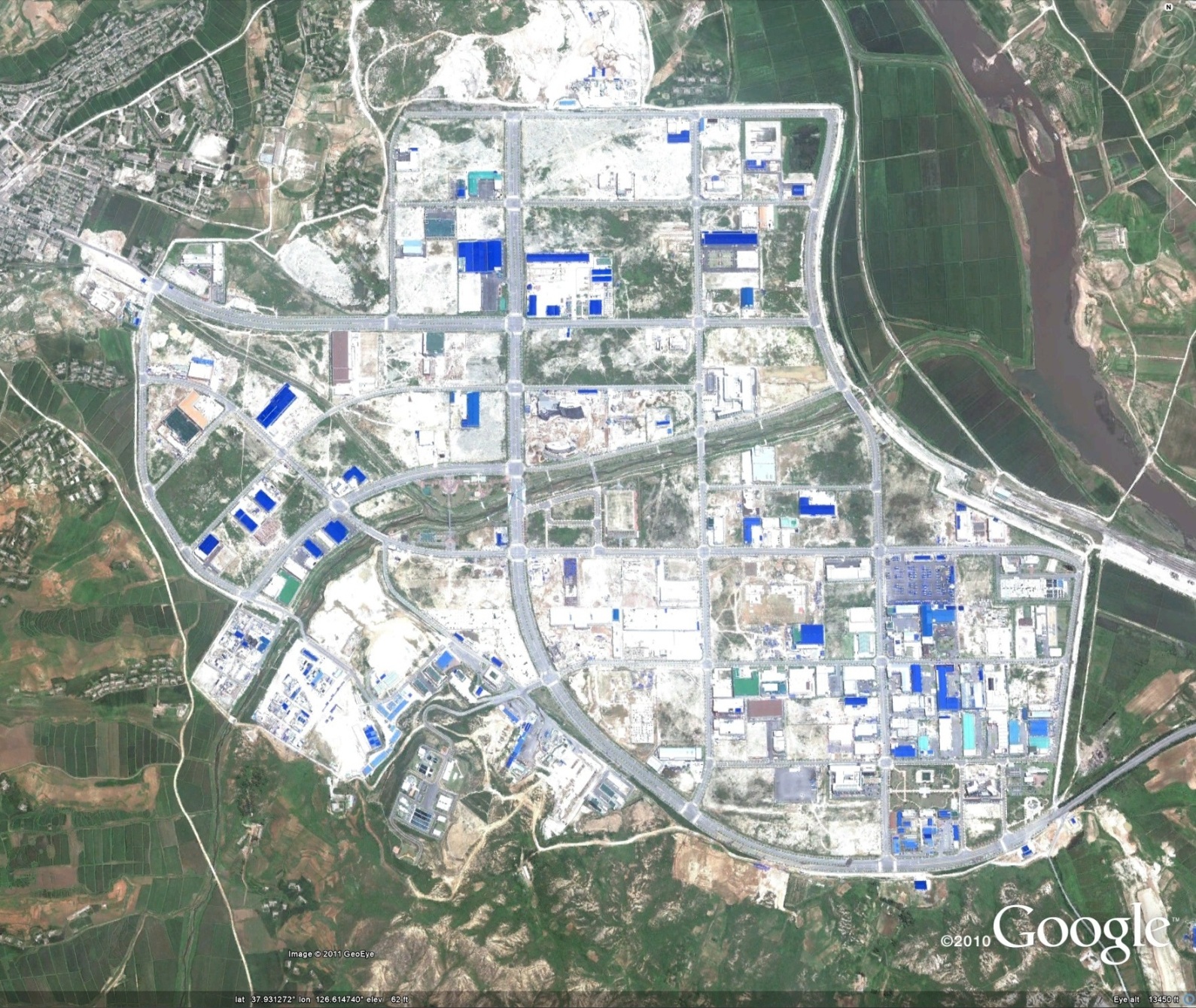
Previous posts on the Kaesong Industrial Zone can be found here.

Read the full story here:
S. Korean businessmen to meet in N. Korea’s industrial park
Yonhap
2011-12-6

Share

Noland on DPRK inflation (post currency renomination)

Monday, December 5th, 2011

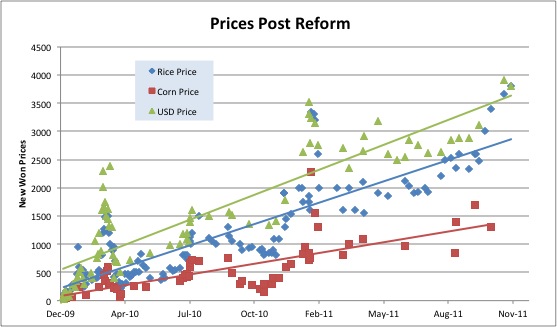
Marcus Noland has crunched some numbers to some up with an approximate inflation rate for the DPRK won after it was renominated in November 2009. According to his post:

The chart above shows the trajectory of prices for rice, corn, and the US dollar since January 2010 (i.e. after the huge step-jump in real prices in December 2009 following the currency reform). A simple regression of the prices (technically their logarithmic values) against time suggests that since the beginning of 2010, inflation on an annualized basis has averaged 131 percent for rice and 138 percent for corn. The won has depreciated against the dollar at a 136 percent annualized rate. A monthly breakdown of price movements suggests that while remaining high, the rate of inflation has attenuated, declining in 2011 relative to 2010.

The co-movement of the blackmarket exchange rate and grain prices would be consistent with a small, open economy in which prices are roughly constant in hard currency terms, but are skyrocketing in terms of the rapidly depreciating domestic currency. In the extreme this could depict an economy that was effectively becoming dollarized.

He also refers to a recent report that prices have not fallen with the autumn harvest and that that the DPRK had suspended anthracite coal exports to China out of fear of domestic shortages.

In general I think the findings are plausible and I am glad that this number is finally out there for the public to reference.  I have just a couple of additional points of inquiry….

If the price and exchange rate data are from public sources, then they are probably geographically concentrated in the provinces that border China. Since there are significant barriers to arbitrage in the DPRK, I expect a large degree of regional price differentiation.  Hypothetically, what would be the effect on these findings of an increase in observations from the “southern” provinces (if that were possible)? If the data are not geographically concentrated and represent a national sample, what would we expect to see if these regressions were run for each province, and how would they compare to the aggregated findings?

A working paper in the making?

UPDATE: A comment from an individual who works with Mr. Noland:

Thanks for sharing this piece on post currency reform inflation. You raise some good points on the regionality of our pricing data. It is true that we don’t have a lot of observations from southern provinces, but it is not all northern either. We get our price data from a number of sources including, but not limited to, Daily NK Market Trends, NK Today reports, and various NGO publications. This gives us a good mixture of general country level price data as well as regional data from provinces such as Pyongyang, North & South Hamyung, North & South Pyongan, & Yanggang. Before the currency reform, we also had a good number of observation from southern areas including North Hwanghae & Gangwon.

Marcus Noland and Stephan Haggard analyzed regional price differences in a previous paper, as well as discussing other issues such as the possible tendency to increase data collection during times of distress and the possibility that organizations might cherry-pick the data that they release, all of which could affect the statistical analysis of this data.

See the paper here (PDF).

Their analysis found that regional price differences are less systematic than one might expect.

On a related note, Ask a Korean also recently translated another Korean article by Ju Song-ha which deals with food prices in the DPRK. You must read it.


Share

North Korea’s new class system

Saturday, December 3rd, 2011

Andrei Lankov writes in the Asia Times:

It is often overlooked how much North Korea has changed over the past 20 years. Its Stalinist and militaristic facade is carefully maintained by the state, but in the new circumstances it is increasingly misleading. Behind this official veneer of militant posters and goose-stepping soldiers, the society itself has changed much.

In a nutshell, the past two decades were the time when the state was steadily retreating from the private life, and also was losing its ability (perhaps also its will) to control the daily activities of its subjects as well as how they made a living. One of many significant changes has been the steady decline in the significance attached to family background (known as songbun in North Korean parlance) – once the single most important factor that determined the life of a North Korean.

Family background did matter in other communist countries as well, but to a much lesser extent. For example, in the Soviet Union immediately after the 1917 communist revolution, scions of aristocrats, descendants of priests, and merchants faced many kinds of discrimination. It was more difficult for them to enter a college or to be promoted, and they were more likely to be arrested for alleged political crimes. However, this discrimination had disappeared by the late 1940s, so in the days of my youth, in the 1970s and 1980s, it had become quite normal in the USSR to boast about real or alleged aristocratic family roots.

North Korea is very different. In 1957, the authorities launched a large-scale and ambitious investigation of the family backgrounds of virtually all North Korean citizens. As a result of this and subsequent investigations, by the mid-1960s the entire population was divided into a number of hereditary groups, somewhat akin to the estates of medieval Europe. Career chances and life prospects of every North Korean were determined, to a very large extent, by his membership in one of these strictly defined groups.
The major criteria of classification were quite straightforward: the songbun (origin) of the North Korean was largely defined by what his or her direct male ancestors did in the 1930s and 1940s.

The official songbun structure was quite elaborate and changed over time. However, at the first approximation, there have been three groups in North Korea, usually known as “core”, “wavering” and “hostile” classes. Every single North Korean had to belong to one of these groups.

The “hostile class” included people whose ancestors in or around 1945 were engaged in activities that were not to the regime’s liking. Among others, this group included descendants of clerks in the Japanese colonial administration, Christian activists, female shamans, entrepreneurs, and defectors to the South. Members of the hostile class faced the greatest number of restrictions: They could not live in Pyongyang or other major cities and they could not be admitted to good colleges or universities. People whose songbun was exceptionally bad would not even be drafted into the military.

Members of the “core class” included those whose direct male ancestors contributed toward the foundation and strengthening of the Kim family regime. They were descendants of anti-Japanese guerrillas, heroes of the Korean War, or party bureaucrats. For all practical purposes, over the past half-century, only these people could be promoted to key positions in the North Korean state and party bureaucracy. They constituted the hereditary elite.

In the days of Kim Il-sung’s rule, from the early 1960s to the early 1990s, songbun was of paramount significance. It determined where people lived and worked and even what they ate. Most marriages were also concluded between people of the same or similar songbun.

It was also important that the songbun was, in essence, unchallengeable. It was inherited from one’s father and was then bestowed on one’s children. The mother’s songbun did not matter. I know a couple where the husband’s songbun was bad (he was a “landowner’s grandson”), but the wife had the best songbun imaginable, being a descendant of a family that once was involved with the anti-Japanese guerrillas of Kim Il-sung. Frankly, such a marriage was rare and unequal – in most cases women of such standing would be as reluctant to marry a man of low origin as, say, a European noble lady from the 17th century. However, in this particular case the marriage did take place, much against the resistance of the girl’s parents.

In due time, though, the spouses discovered that the wife’s songbun did not really matter. Their daughter, a promising athlete, could not be sent for further training, since her songbun was bad: the great-granddaughter of a minor landlord could not compete on the national level and, for that matter, could be accepted only to a junior college.

In Kim Il-sung’s era – that is, before 1994 – the state was in near-complete control of an individual’s life. The only way to achieve high status and affluence was to climb the official bureaucratic ladder. As a North Korean friend put it in the late 1980s: “I hate officials, but I want to become an official, because in our country, only officials can live well.” Indeed, in Kim Il-sung’s North Korea all material goods were distributed by the state and almost all income was derived from work in state industry or the state bureaucracy.

But things started to change dramatically in the early 1990s. The state sector, suddenly deprived of Soviet subsidies, collapsed. North Koreans suddenly discovered that food rations were no longer forthcoming and their official monthly salary would only buy 1 or 2 kilograms of rice. Predictably, mass starvation followed, killing at least a half-million people.

To survive, the North Korean people literally rediscovered capitalism. Estimates vary, but the consensus is that over the past 10-15 years, the average North Korean family has come to draw most of its income from what can be described as black-market activities. Actually the so-called black market is not particularly black, since the government – in spite of occasional crackdowns – has tacitly tolerated its existence since the mid-1990s. Nowadays North Koreans work on individual fields on steep mountain slopes, they establish private workshops to produce garments and assorted consumer goods, and they smuggle and trade.

The new and increasingly dominant unofficial economy is in essence capitalist. As such, it rewards those who are sufficiently industrious, greedy, intelligent, ruthless and disciplined – and in some cases, it rewards them handsomely. Social inequality is growing and many a successful merchant or workshop owner lives better than a middle-ranking bureaucrat. A successful entrepreneur might have all trappings of luxury – including, say, a Chinese motorbike or a refrigerator, which in North Korea can be seen as roughly equivalent to a Lexus and a yacht.

The success in the emerging new economy is usually unrelated to one’s songbun. In fact, sometimes it seems that people with bad songbun tend to be more successful nowadays – perhaps because back in the 1990s they had no expectations of the state and were the first to jump into the murky waters of the emerging North Korean market economy.

Of late, the previously attractive career avenues have lost much of their allure. For example, in the past, many North Koreans were willing to do their long and tedious military service, which lasted some seven to 10 years. This popularity was easy to explain: For a person with average songbun, this would be the only way to get into the bottom tiers of the bureaucracy. As a North Korean told it, recalling the time of her youth, the 1970s: “The only way to become somebody was to go into the military, join the Korean Workers Party while on the active service, and then come back to become an official.”

Recently, however, military service has lost much of its popularity. Few people would be willing spend 10 years in a squalid barracks so as eventually to become a minor official in the city administration. Such a job is still attractive, to be sure, but it seems preferable to become a smuggler or a merchant, whose income far exceeds that of a petty bureaucrat.

Still, on the very top, songbun is important, since the key administrative positions are held by those with good songbun, and a mid- or high-level official can make a nice income by milking the private economy. Hence people with good songbun still often think about capitalizing on the real or alleged contribution of their ancestors to the establishment of the North Korean regime. However, for a majority the emergence of markets opened a new, faster and more attractive (but also more risky) avenue of social mobility.

North Korean society has become defined by one’s relationship to money, not by one’s relationship to the bureaucracy or one’s inherited caste status. Money talks, and for better or worse, in North Korea, money talks ever louder. As a female refugee in her early 40s put it recently: “Under Kim Il-sung, songbun was very important, it decided everything. Under Kim Jong-il, things are different – your family background still matters, but money nowadays is more important than social background.”

Read the full story here:
North Korea’s new class system
Asia Times
Andrei Lankov
2011-12-3

Share

DPRK employment at Kaesong continues to grow

Friday, December 2nd, 2011

According to the Daily NK:

According to records released today by the Ministry of Unification, there were a total of 48,242 workers in the Kaesong Industrial Complex at the end of September, up from 6013 when the project was launched in 2005.

Following the recent resumption of construction at the complex, the number of workers is now expected to grow further.

Revealing the data, an official with the Ministry of Unification commented, “Labor has been provided sufficient for Kaesong Complex enterprises to overcome labor shortages. If conditions get better allowing workers from further away to get employed, it looks like numbers will increase even more.”

The more than 48,000 North Korean workers in the Kaesong Complex bring in $50 million annually for the North Korean government.

As word of the good working environment that the Kaesong Industrial Complex offers spreads, the area is reportedly attracting internal migrants.

“The good reputation of Kaesong among workers has spread to Shinuiji, so they are moving to the area. But accommodation problems have to be solved before any can be hired,” the official explained.

The educational backgrounds of the workers include 81.8% with a high school diploma, 9.5% college graduates and 8.7% from professional schools.

Their base pay plus bonuses and incentives add up to roughly $100 dollars per person, though much of this is lost in payments to the North Korean state.

Here and here are recent post on road construction in Kaesong.

Here are previous posts on the Kaesong Industrial Zone.

Read the full story here:
Kaesong Still Growing
Daily NK
Kim Yong Hun
2011-12-02

Share

International Trade Fair held to attract foreign investments

Thursday, December 1st, 2011

Institute for Far Eastern Studies (IFES)
2011-11-30

Pyongyang International Trade Fair is held every spring and fall. The exhibition is increasing in size and attracting European and other foreign investments.

Japan-based newspaper, the Choson Sinbo reported on November 22 that during the period of the exhibition, over hundreds of business talks went back and forth between the North Korean and foreign companies and over 50 trade contracts and investment agreements were reportedly signed, with total amount of trade reaching in the millions in USD. At the Seventh Pyongyang Autumn International Trade Fair, held from October 17–20, one contract between a European company was reported to have been over 10 million USD alone.

Initially, the trade fair drew about 100 participating companies with just about 100 trade items. This year, however, roughly 300 companies had participated and over a thousand goods were on display.

It was also reported that “The items presented at the fair represented all sectors of social economic development with machineries, electronic goods, building materials, transportation, chemicals, clothing, food, medical and other consumer goods. In addition to these items, trade items are transitioning from light industry and consumer goods to the state-of-the-art products with CNC technology.”

Recently, multinational companies are exploring ways to enter into the North Korean markets through such international trade fairs.

According to the North Korean press, Chinese companies such as Haier, manufacturer of home appliances, and electronics and television manufacturer Changhong are in attendance at every trade fair held in Pyongyang. This time, particular attention was paid to European companies seeking investment opportunities in North Korea, such as a German paper manufacturing company, French flooring company, and Sweden’s GIA Industries, which is known as a mining equipment supplier.

The trade fair, which used to be held once a year in the spring, is now also being held in the autumn season to meet the increasing interests from multinational companies doing trade in Pyongyang. The scale of the fair has been upgraded as well. Normally the event was held only at the first two floors of the Three-Revolution Exhibition House; but to accommodate for growing size, discussion for building an international exhibition center is currently underway.

In the North Korean analysis, certain factors point to the success of the trade fair: 1) North Korea’s economic revitalization policy that focused on modernization of the people’s economy with large-scale construction projects, as these are gaining attention from overseas companies; and 2) North Korea’s assertive trade goals with economic modernization in mind and the hosting of international trade fairs, which are resulting in long-term trade contracts and an increasing amount of trade.

Additional Information:
1. Previous posts on the Pyongyang International Trade Fair can be found here.

2. Rason (Rajin-Sonbong) also recently held its first international trade fair.

Share