Archive for the ‘Economic reform’ Category

DPRK’s Premier Choe Yong Rim makes onsite inspections

Tuesday, May 22nd, 2012

Institute for Far Eastern Studies (IFES)
2012-5-22

In the past, it was usually Kim Jong Il or Kim Jong Un who made on-the-spot guidance and inspections. However in the recent years, that has changed. Premier of the DPRK Cabinet Choe Yong Rim, is making onsite inspections in economic sectors, while the director of the Korean People’s Army (KPA) General Political Bureau, Choe Ryong Hae, is doing the same at construction sites.

The KCNA reported on May 15 that Choe Yong Rim and Choe Ryong Hae each made on-the-spot visits.

First, Choe Yong Rim visited the Hwanghae Iron and Steel Complex on May 15.

The KCNA reported that the “workers of the complex are making achievements in updating it and producing heavy-duty rails true to the behests of General Secretary Kim Jong Il.”

The news also added “Going around gas generation and high temperature air combustion heating process and various other places, the premier learned in detail about the progress made in updating the complex and held a consultative meeting.”

Premier Choe was also reported to have visited the 15th Pyongyang Spring International Trade Fair on the same day where he stressed “the need to positively develop the bilateral and multilateral cooperation among countries and regions in the economic and trade fields.”

The 15th Pyongyang Spring International Trade Fair was held from May 14 to 17 at the Three-Revolution Exhibition Hall with over 270 countries participating. The KCNA reported the exhibit was organized by the Korean International Exhibition Corporation, the sole body in charge of any international trade fair held in the country. On May 10, the KCNA released an article that covered the major achievements of the Corporation, for having won special prizes, gold and silver cups and certificates at international trade fairs. Furthermore, the corporation is known to have made import and export contracts with many countries in Asia, Europe, and other regions.

On the other hand, Choe Ryong Hae was reported to have visited Pyongyang Folk Park on the same day and inspected the progress made in the construction for the park, which is in its final stages.

The KCNA described the park to be, “associated with the noble intention of the great men of Mt. Paektu to provide the Korean people with better cultural and emotional life while valuing the folk tradition.”

Choe Ryong Hae examined the construction site and “encouraged the soldier-builders for their labor achievements for making innovations day by day true to the teachings provided by Supreme Commander Kim Jong Un.”

In addition, he commanded for the construction of the park to be completed at the highest level that was “initiated by General Secretary Kim Jong Il and for which the Supreme Commander has shown concern for.”

Share

UK energy company pulls out of North Korea

Wednesday, May 16th, 2012

By Michael Rank

Independent British energy company Aminex PLC has withdrawn from North Korea, citing ‘”the volatile and unpredictable politics of the area”, just two years after signing a deal covering a 50,000 sq km area off the country’s east coast.

Aminex said it was “in the best interests of shareholders for the Company to withdraw from the Korean exploration programme and not participate in seismic acquisition. This decision will allow Aminex to focus on growing its African portfolio.”

The company first signed an agreement for co-operation in oil and gas with the North Korean government in 2004, but this failed to make progress. In 2010 it introduced a new foreign partner, Singapore-based Chosun Energy Pte Ltd, which provided finance for the initial stages and a regional base in Singapore. Aminex said at the time that “despite challenging international politics,” it had “succeeded in maintaining strong relations with the Korean authorities”, resulting in the production sharing contract signed in May 2010.

But industry sources said Stuard Detmer, who was made Aminex CEO last September, was less enthusiastic about North Korea than his predecessor Brian Hall, who remains executive chairman, and this had contributed to the company’s decision to pull out of the DPRK.

Aminex’s main focus is now on Tanzania, where in February it made the first gas discovery in the onshore Ruvuma basin, having also disposed of an oilfield in Texas.

Aminex said in 2010 that the agreement “involves reprocessing and reinterpretation of old seismic data plus acquisition of new marine seismic data during an initial period. Licence holder] Korex believes that the East Sea has great potential for significant discoveries of oil and gas, while recognising the political challenges in the region and the need to ensure that any international sanctions are strictly observed.”

See previous posts about Aminex here.

Share

South urges DPRK agricultural reforms

Wednesday, April 25th, 2012

According to Yonhap:

President Lee Myung-bak on Friday urged North Korean leader Kim Jong-un to give up the collective farm system and privatize state-owned agricultural land to help enrich the North and its residents.

“North Korea should abandon its collective farm system and shift to the privatization of agricultural land. If so, rice will be abundant in two to three years. Farmland privatization will help individuals earn more and the state increase revenues,” Lee was quoted by his spokesman Park Jeong-ha as saying in the lecture.

“(Farmland reform) is a must for North Korea. All the young leader has to do is the (reform). It is the most urgent matter and has to precede its market opening. Continued dependence on aid will only produce beggars.”

President Lee’s statement stresses the short-term economic benefits of moving away from collective farming: More food, higher incomes to farmers, improved fiscal position, and thus, increased political legitimacy for the Kim Jong-un government. However, from a political and strategic viewpoint he is probably hoping that North Korean agricultural reform will pave the way for broader economic reforms — as was the case in China. However, it is worth noting that China’s agricultural reforms, which ended the misery of the Great Leap Forward and laid the foundation for broader economic reforms, were not created in Beijing.  They were developed and implemented by a single village of scared, hungry farmers:

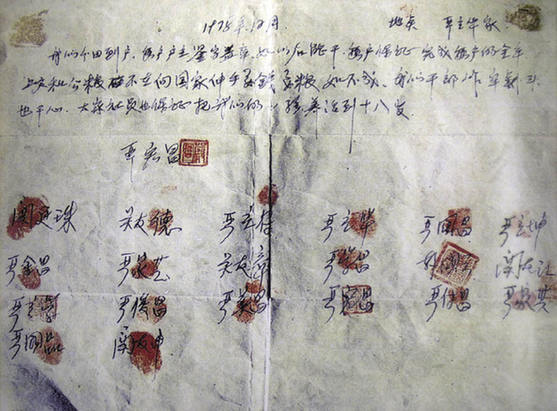
Pictured above (via Marginal Revolution): Farmers from 18 households in Xiaogang village (Fenyang County, Anhui Province) signed this contract bringing a de facto (not de jure) end to collective farming.

Economists Tyler Cowen and Alex Tabarrok said the following of the Xiaogang Contract:

The Great Leap Forward was a great leap backward – agricultural land was less productive in 1978 than it had been in 1949 when the communists took over. In 1978, however, farmers in the village of Xiaogang held a secret meeting. The farmers agreed to divide the communal land and assign it to individuals – each farmer had to produce a quota for the government but anything he or she produced in excess of the quota they would keep. The agreement violated government policy and as a result the farmers also pledged that if any of them were to be killed or jailed the others would raise his or her children until the age of 18.

The change from collective property rights to something closer to private property rights had an immediate effect, investment, work effort and productivity increased. “You can’t be lazy when you work for your family and yourself,” said one of the farmers.

Word of the secret agreement leaked out and local bureaucrats cut off Xiaogang from fertilizer, seeds and pesticides. But amazingly, before Xiaogang could be stopped, farmers in other villages also began to abandon collective property. In Beijing, Mao Zedong was dead and a new set of rulers, seeing the productivity improvements, decided to let the experiment proceed.

The rapid increase in China-DPRK trade and information exchanges raises the question of just how many North Koreans have heard of the Xiaogang contract or how many villages have implemented similar measures?

For its part, the Workers Party has employed a mixture of both top-down agricultural policies and accommodation of bottom-up economic innovations to increase food availability. From a top-down perspective, the DPRK has promoted “technological inputs” (fertilizer production, terraced hillsides, large irrigation projects, land reclamation, land rezoning, new foodstuff factories, improved management techniques, CNC) and multilateral aid outreach (official and private food aid from abroad). From a bottom-up perspective, the DPRK has offered and expanded economic incentives (kitchen/private plots, farmers’ markets, general markets, July 2002 Measures, 8.3 Measures, accommodation of some illegal activity,  family-based work team units on collective farms).  The combination of all these efforts, however, has obviously not resulted in food security–for a number of reasons that are too  lengthy for a simple blog post.

If you are interested in learning more about the DPRK’s agricultural policies, I have posted below some papers (PDF) covering different stages in the North Korean agriculture sector: Pre-war, post war (collectivization), and post famine (arduous march). They are all well worth reading:

1. Lee Chong-Sik, “Land Reform, Collectivisation and the Peasants in North Korea”, The China Quarterly, No. 14 (Apr. – Jun., 1963), pp. 65-81

2. Yoon T. Kuark, “North Korea’s Agricultural Development during the Post-War Period”, The China Quarterly, No. 14 (Apr. – Jun., 1963), pp. 82-93

3. Andrei Lankov, Seok Hyang Kim, Inok Kwak, “Relying on One’s Strength: The Growth of the Private Agriculture in Borderland Areas of North Korea”

Share

North Korea redefines ‘minimum’ wage

Wednesday, April 25th, 2012

Andrei Lankov writes in the Asia Times:

When one talks about virtually any country, wages and salaries are one of the most important things to be considered. How much does a clerk or a doctor, a builder or a shopkeeper earn there? What is their survival income, and above what level can a person be considered rich?

Such questions are pertinent to impoverished North Korea, but this is the Hermit Kingdom, so answering such seemingly simple questions creates a whole host of problems.

Read the full story below:

(more…)

Share

Border Security Goes Back to NSA

Sunday, April 22nd, 2012

According to the Daily NK:

Information from inside North Korea suggests that jurisdiction over border security has been moved from the Ministry of People’s Armed Forces to the National Security Agency(NSA), in a special order given by new leader Kim Jong Eun which has seen border security units undergoing an administrative switch to the NSA on April 16.

Read more below:

(more…)

Share

KCNA: DPRK encourages foreign investment

Friday, March 23rd, 2012

Click image above to see KCNA video of interview with Yun Yong-sok, vice department director of DPRK Joint Venture Investment Committee

According to KCNA (2012-3-23):

The Democratic People’s Republic of Korea is willing to further improve its environment for foreign investment, Yun Yong Sok, a vice department director of the DPRK Committee for Investment and Joint Venture, told KCNA.

He said:

The nation’s economy is gaining momentum, with many industrial establishments and power stations being built across the country.

It is a consistent policy of the DPRK Government to enhance economic cooperation with other countries, while beefing up its self-reliant national economy.

In December last year, the government amended investment-related laws, including the DPRK Law and Regulations on Foreign Investment, laws on joint venture and joint collaboration and the Law on Foreign-funded Businesses and Foreigners’ Tax Payment, in step with the nation’s developing economy and international practices.

It enacted the law on economic zone on Hwanggumphyong and Wihwa islets in the River Amnok and revised and supplemented the law on the Rason economic and trade zone.

The joint development and management in the two economic zones takes on a new way of cooperation. Now it has been under way in a creditable way, driven by the active efforts of both sides of the DPRK and China.

Contracts on joint venture and joint collaboration have been on increase with the investment environment changing for the better.

Rare earth abundant in the country and infrastructure projects lure foreign investment in the DPRK.

The committee will pay deep attention to ensuring the interests of foreign investors, while invigorating the exchange and cooperation with governments, investors and businesses.

In other news, KCNA has adopted the American colloquialism “beefing up”.

Share

Inter-Korean trade up 36% in 2012

Thursday, March 22nd, 2012

According to Yonhap:

Despite rising cross-border tension, the trade between South and North Korea surged 36 percent from a year ago to US$320 million in the first two months of this year, government data showed on March 16.

The data provided by the Korea Customs Service indicated that the trade via the inter-Korean industrial complex has not been affected by tensions on the Korean Peninsula.

South Korea slapped sanctions on the North in May 2010 in retaliation for the deadly sinking of a South Korean warship earlier that year, though it keeps intact the complex in the North’s western border city of Kaesong.

The complex, a key outcome of the inter-Korean summit in 2000, marries South Korean capital and technology with cheap labor from the North. It is now home to more than 120 South Korean small and medium-sized companies.

Tensions have flared anew in recent weeks as the two Koreas traded militaristic rhetoric against each other over Seoul’s defamation of the dignity of North Korea’s new leader Kim Jong-un and his late father, former leader Kim Jong-il.

Read the full story here:
Inter-Korean Trade Surges 36 Percent This Year
North Korea Newsletter No. 202 (March 22, 2012)
Yonhap

Share

On the Kaesong Industrial Zone and international tariffs

Thursday, March 22nd, 2012

According to Business Week:

Gaeseong, which is within sight of South Korean and U.S. guard posts along the Demilitarized Zone, was developed as a joint special economic zone in 2005 and now employs about 50,000 North Koreans, according to the Unification Ministry in Seoul.

More than 120 South Korean companies, including Daewha Fuel, underwear maker Good People Co. and watchmaker Romanson Co. (026040) paid the North Korean government about $60 million to $70 million last year to cover labor costs for workers, said Park Soo Jin, the deputy spokeswoman at the Unification Ministry. Authorities in Pyongyang then paid the employees in local currency and vouchers, she said.

Trade Minister Bark Tae Ho said on March 14 that he will try to persuade the U.S. and European Union to recognize products made in Gaeseong as South Korean.

Singapore Tariffs
The EU and South Korea have agreed to establish a committee this year to examine the issue, Tomasz Kozlowski, ambassador for the EU delegation in Seoul, said in an e-mailed statement. Aaron Tarver, a spokesman at the U.S. Embassy, said in an e-mail that the trade pact does not include any products from North Korea, including those from Gaeseong, without commenting further.

Singapore has reduced tariffs covering more than 4,000 products from Gaeseong under its bilateral trade pact with South Korea, said Lee Sang Mok, Deputy Director at Korea Customs Service. Some products are also covered by agreements with the 10-member Association of Southeast Asian Nations, India, Peru and the European Free Trade Association consisting of Switzerland, Iceland, Liechtenstein and Norway, Lee said via e- mail and telephone.

The value of output from Gaeseong jumped from $14.9 million in its first year to $402 million in 2011, according to the Unification Ministry. During the past seven years, its production totaled $1.5 billion. That compares with $40 billion for North Korea’s annual gross domestic product, according to the CIA World Factbook.

“The U.S. seems to want more progress in North Korean nuclear and human rights issues before including Gaeseong in FTA,” IBK’s Cho said.

Yoo of Daewha Fuel Pump said he plans to spend 1 billion won ($885,000) this year to boost capacity in Gaeseong by 50 percent and forecasts sales to jump to 65 billion won this year from 45 billion won in 2011. His company, which also makes parts in plants in South Korea, supplies automakers including Hyundai Motor Co., Honda Motor Co. and Nissan Motor Co., he said.

The minimum monthly base salary paid by companies at Gaeseong is about $64, according to the Unification Ministry’s Park. Yoo, who was speaking at Incheon near Seoul, estimated labor costs would be 20 times higher in South Korea and three times higher in China.

“The security issue is of course a big risk but every business has a risk,” Yoo said. “Gaeseong has survived all the clashes and threats, including the sinking of a warship and the shelling of a South Korean island”.

Read the full story here:
North Korea’s Gaeseong Pushed for Inclusion in FTA
Business Week
Eunkyung Seo and Sangwon Yoon
2012-3-22

Share

KCNA publishes DPRK SEZ laws

Monday, March 19th, 2012

Just a few days after Choson Exchange published a PDF copy of the “Law of the Democratic People’s Republic of Korea on the Rason Economic and Trade Zone”, KCNA published laws on both of its recently announced special economic zones along the Chinese border (Rason and Hwanggumphyong). I have posted both laws below in text-recognized PDF format.

Law of the Democratic People’s Republic of Korea of the Hwanggumphyong and Wihwado Economic Zone
Published by KCNA on March 17, 2012
Download PDF here.

Law of the Democratic People’s Republic of Korea on the Rason Economic and Trade Zone
Published by KCNA on March 17, 2012
Download PDF here.

Here is the original 1993 Law on Rason (in Korean) along with 1999 and 2002 revisions (PDF).

UPDATE 1: See Marcus Noland’s comments here.

UPDATE 2: The Institute for Far Eastern Studies (IFES) published the following…

Details Released for the Law on the Hwanggumpyong and Wihwado Economic Zone
Institute for Far Eastern Studies (IFES)
2012-4-4

North Korea recently announced that the Law on the Hwanggumpyong and Wihwado (Islands) Economic Zone, with seven chapters and 74 articles, was approved by the Presidium of the Supreme People’s Assembly (SPA) on December 3, 2011.

On the same day, the text of the amended Law on the Rason Economic and Trade Zone was also released.

The newly passed law on Hwanggumpyong and Wihwado included the details of the management policy stating,“Management and operation of the industrial parks and designated areas of the Zone shall be undertaken by the management committee under the guidance and assistance of the central guidance authority of special economic zones and the North Pyongan Provincial People’s Committee” and asserted, “Other institutions shall not get involved in the work of the management committee.”

The details of the law are as follows:

Article 1 specifies the objective of the zones is to provide strict guidelines that can contribute to the development and expansion of foreign economic cooperation and exchange. Hwanggumpyong and Wihwado Economic Zone was designated as the “special economic zone of the Democratic People’s Republic of Korea,” under the jurisdiction of North Pyongan Province and Hwanggumpyong Island and Wihwa Island districts.

Article 3 states the development of the Zone was to be carried out regionally and in phases, centered around several industries — IT, light industry, agricultural, commerce, and tourism — in Hwanggumpyong Island and Wihwa Island, and will follow the Wihwa Island Development Plans.

In comparison, the Rason Economic and Trade Zone passed on January 31, 1993, was announced as a development area for high-tech industry, international logistics business, equipment manufacturing, primary processing industry, light industry, service business and modern agriculture industries.

Article 6 on the section for “Promotion, Prohibition, and Restriction of Investment,” specifies that the government will encourage investments particularly in the highly competitive sectors in the international market. In contrast, those investments or business activities that can harm the safety, health, and morality of the (North Korean) people or the environment will be prohibited or restricted.

Article 7 stipulates that management and operation of the zone will fall under the central guidance authority of special economic zones and North Pyongan Provincial People’s Committee. Here, it was emphasized that no other organizations can meddle with management and operation of the zone.

Article 8 covers the interests of the investors, in protecting their property, interest and rights. It states, “The property, legitimate income and invested rights of investors in the Zone shall be protected by the law. The State shall not nationalize or expropriate the property of the investors.”

Article 9 provides guidelines for the protection of personal safety, human rights, prohibition of illegal detention and arrest.

Article 13 (Development Method of the Zone) states that the land in Hwanggumpyong will be leased to companies but will be developed and managed comprehensively. The land lease term is set at 50 years from the date of issuance of the land use certificate, with options for renewal.

Chapter 4 (Establishment of Enterprises, Economic and Trade Activities), considered the core section of this law, indicates the specifics of business activities, from establishment, accounting, taxes, wages, employment, and other technical and administrative contents.

Article 36 is particularly eye-catching, which indicates that priority in employment must be given to North Korean residents and the minimum monthly wage will be determined by the management committee.

Lastly, corporate income tax rate set at 14 percent of the profit will be reduced to 10 percent to those businesses in the sectors encouraged by the state (Article 43).


Share

DPRK demand for overseas training

Monday, March 19th, 2012

Radio Free Asia published an article on North Korean demand for overseas training.  Since the article is only available in Korean, however, a very helpful colleague has translated it for me to post here:

It is noted that North Korea is sending government officials and field specialists abroad for training with the purpose of reconstructing the economy following the inauguration of the Kim Jung-un era. Five North Korean technology inspectors recently visited a coal-chemical factory in Shanxi, China. The inspectors observed the process of creating different chemicals using coal and they showed particular interest in the factory’s systematic settings.

Also, early last month, the Energy Preservation Technology Inspection Team, including director-level officials of Science Technology Committee, underwent field training in China on construction materials and architectural technology to enhance energy efficiency.

Agape International of Switzerland (NGO), which facilitated the training, said North Korean government officials observed a Chinese insulation factory, construction company, etc. over the course of 10 days.

Additionally, a team of 30 North Korean railroad specialists participated in a commissioned training program at a Railroad institution in Russia. Recently there has been a great increase in North Korea’s request for training arrangements mediated by International and Nongovernmental Organizations.

According to a source which wished to remain anonymous, the increase is notable since North Korea has had a reputation for declining or canceling overseas training programs even after they have been arranged.

Whether the recent demand and interest for overseas training in economic fields reflects an attempt to improve the fallen economy or not remains to be seen.

Read the full story (in Korean) here:
북, 김정은 등장 후 해외연수에 적극적
Radio Free Asia
2012-3-14

Share