Archive for the ‘Economic reform’ Category

KCNA announces new printing joint venture company

Tuesday, June 26th, 2012


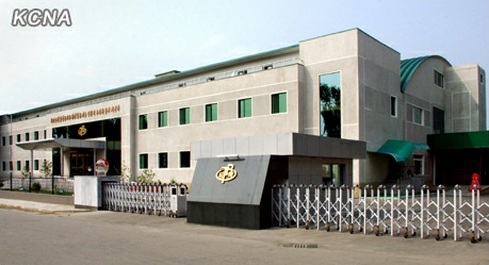
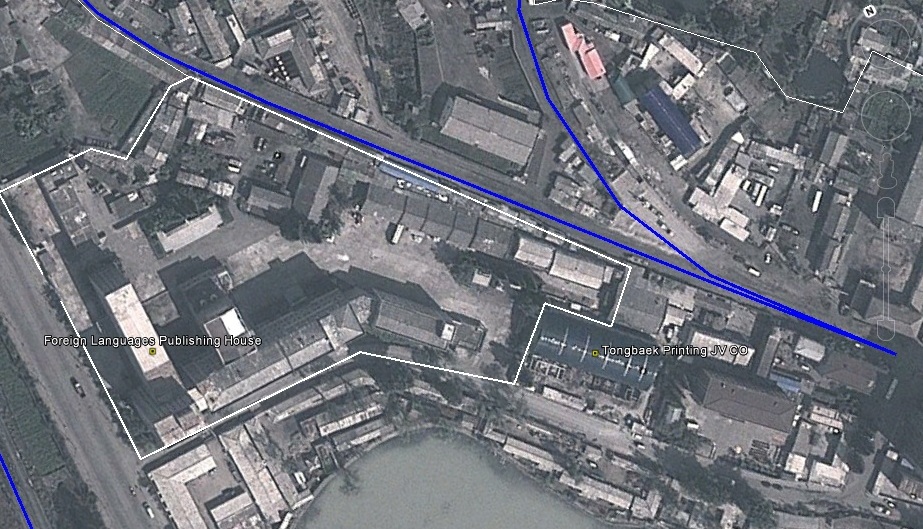
Pictured above: A KCNA image of the factory and the view from Google Earth (39.043378°, 125.728149°)

According to KCNA (2012-6-25):

Pyongyang, June 25 (KCNA) — The Printing Factory of Tongbaek Printing Joint Venture Company [동백인쇄합영공장] under the Foreign Languages Publishing House was commissioned with due ceremony on Monday.

The factory was jointly established by the Foreign Languages Publishing House of the DPRK and the Oriental Yongli Hong Kong Int’l Investment Co., Ltd. and Jiangsu Zhongcai Printing Co., Ltd. of China. The factory will produce and sell varieties of printed materials and trade marks.

Attending the ceremony were Ri Kwang Gun, chairman of the Commission for Joint Venture and Investment, officials concerned and employees of the factory, Huang Junjie, vice mayor of Danyang City, Jiangsu Province of China, personages of the two Chinese companies, Wu Shiguang, councilor in charge of culture, and officials of the Chinese embassy here.

Choe Kyong Guk, director and editor-in-chief of the Foreign Languages Publishing House, addressing the ceremony, said that technicians and builders of the two countries built the factory in a short span of time.

He expressed belief that the factory would make a positive contribution to meeting the interests of the peoples of the two countries.

Jiao Xiaoping, manager of the Tongbaek Printing Joint Venture Company, in a congratulatory speech referred to the process of the construction of the factory, stressing the need to operate the company well.

At the end of the ceremony, the participants planted trees and looked round the production processes.

A reception was given on the same day.

Share

PRC approves international cooperative demonstration zone in Jilin

Monday, June 18th, 2012

UPDATE 1 (2012-6-18): According to Yonhap:

South Korean firms and China’s Jilin Province agreed to engage in joint venture projects worth 3.9 trillion won (US$3.4 billion), a local business organization said Monday.

Under the memorandum of understanding reached in Seoul, 48 South Korean companies and 48 Chinese regional government agencies and businesses will form partnerships to move forward on various business projects, the Korea Chamber of Commerce and Industry (KCCI) said.

The two sides will engage in such areas as agriculture, construction, energy, distribution and tourism, South Korea’s largest private economic organization said.

Lotte Group, the Korea Software Enterprise Association and HS Machinery Co. have expressed interest in business tie-ups with Jilin, which is located in northwestern China and includes Yanbian Korean Autonomous Prefecture. The province also borders North Korea to the south.

The KCCI said Jilin is one of China’ main heavy industrial hubs with average annual growth in the past three years reaching 13 percent. Such growth promises considerable business opportunities for South Korean companies wanting to diversify into emerging markets.

ORIGINAL POST (2012-5-3): According to China Daily:

The Chinese government announced Wednesday that it has approved the establishment of an international cooperative demonstration zone in Northeast China’s Jilin province to boost cross-border cooperation in the region.

In a document posted on the central government’s official website, the State Council said the zone is expected to expand investment cooperation in northeast Asian regions.

Located in the port city of Hunchun, the demonstration zone will cover 90 square km and include an international industrial cooperation zone, a border trade cooperation zone and economic cooperation zones — one between China and the Democratic People’s Republic of Korea (DPRK) and another between China and Russia, it said.

The demonstration zone will focus on the development of local manufacturing and processing industries, including those for auto parts, agricultural and animal products, seafood, new materials, medicines, textiles and garments, the document said.

The Tumen River in Hunchun straddles the borders of China, Russia and the DPRK. In 1992, China, Russia, the DPRK, the Republic of Korea (ROK) and Mongolia launched a joint development project in the Tumen River area, a move made to strengthen regional cooperation in the area.

The State Council has called for more efforts to boost the construction of Sino-DPRK and Sino-Russia international transit corridors and promote cross-border economic cooperation between China and the two countries.

More supporting policies, including fiscal and taxation support, will be implemented to encourage the development of new energy, new material equipment manufacturing and other projects in the demonstration zone, according to the State Council.

The construction of the demonstration zone will also make border regions more open to the outside and strengthen the social and economic development of local areas, the document said.

And according to the Daily NK:

The authorities in China’s Jilin Province are investing billions of Yuan in multiple projects along the Sino-North Korean border. The construction is concentrated in areas adjacent to major North Korean border towns in the mountainous region, giving it the hypothetical potential to provide massive opportunities for future Sino-North Korean economic growth.

According to Jilin Shinmun and other local media outlets, the high-speed train, which will allow travel from Hunchun to Changchun in two hours at speeds of up to 250kph, is under construction at a predicted cost of 37.7 billion Yuan.

Jilin Province is also planning a “five border region highway” in its 12th Five-Year Plan from 2011 to 2015. The Changchun to Hunchun leg is already open, while legs from Changchun to Huyinan, Songjangheo to Changbai, Changchun to Mt. Baekdu to Yanji, Changchun to Linjiang and Changchun to Jibian are under construction with the typical degree of Chinese speed. Among these locations, Changbai, Linjiang and Jibian all face major North Korean towns (Hyesan (Yangkang Province), Chungkang (Jagang Province) and Manpo (Jagang Province).

The province is also putting weight behind railway construction travelling towards North Korea; from Nanpin to nearby Musan (in North Hamkyung Province), Kayisan to Sambong (in North Hamkyung Province) and Changbai to Hyesan.

When all the construction is complete, there will be a bridgehead connecting the Tumen to the Yalu and linking all North Korea’s major cities with the Chinese economic miracle. If trade and cooperation between the two countries grows more active than it is now, the newly built highways and railways will form the core pathway for commercial distribution.

However, there are also major concerns with the plan. First and foremost, defection will become more difficult when the new developments are complete. The regions where highways and railways are now appearing have long been major defection routes or hiding places for new defectors.

In particular, a warning device installed by Jilin police in border villages, while an improvement in terms of public security, can also be used to report North Korean defectors to the authorities. The device, known as the ‘BF-01’, has been installed in 6,000 homes along the border at a cost of 5 million Yuan, connecting them with public security offices in an emergency. When pressed, names, addresses and the sound from the scene is transmitted to the local police station, border guards and neighbors.

“Regardless of whether North Korea conducts a nuclear test, it seems that North Korea and China are developing the northeastern region,” Shin Jong Ho, a research fellow with the Center for Northeastern Asian & Inter-Korean Affairs, part of the Gyeonggi Research Institute, commented. “In the future, if cooperation between North Korea and China gets better then these transportation routes will be very useful.”

Read the full stories here:
China approves int’l border cooperation zone
China Daily (Xinhua)
2012-4-25

Border Region Getting Huge Boost
Daily NK
Park Seong Guk
2012-5-3

Share

Ari Sports Factory

Monday, June 11th, 2012

The Hankyoreh has published an interesting about a inter-Korean economic project in Dandong, China.

According to the article:

Taking its name from the traditional song “Arirang,” Ari Sports was established in Nov. 2011 with a 500 million won investment from the city of Incheon and 23 workers from North Korea. It is managed not by a North or South Korean organization, but by China’s Yunnan Xiguang Trade.

The football sneaker and sports clothing production plant was originally planned for Pyongyang’s Sadong District. Efforts began in 2008, and the building was nearly complete when the May 24 measures were passed in 2010 and it had to be abandoned. The factory in Dandong is a temporary structure erected in its stead.

Inter-Korean Athletic Exchange Association standing committee chair Kim Gyeong-seong said, “It’s frustrating not to be able to use the good land and facilities we had in Pyongyang.”

“I hope we are soon able to produce and sell soccer shoes and clothes in Pyongyang,” Kim added.

Song said, “Things are difficult right now between North and South Korea, but if we all work together we can overcome it.”

He added that the company was a “small but meaningful project taking place at a time when economic cooperation has been shut off.”

The company has received orders for three thousand pairs of soccer shoes as of May. It currently plans to produce and sell two to three thousand pairs a month. To achieve this, it is organizing a football contest for working people nationwide at the first Incheon Peace Cup event to commemorate the June 15 Summit on June 16 and 17.

I have never heard of this project and I have been unable locate any other articles on the factory. Despite its relative obscurity, however, the North Korean workers know how to deal with the foreign press (they stay on message):

On June 9, the company was visited by around fifty participants in the Incheon-Dandong-Hankyoreh West Sea Cooperation Forum, including Incheon Mayor Song Young-gil and Hankyoreh Foundation for Reunification and Culture chairperson and former Unification Minister Im Dong-won. Located in a farming village on the outskirts of Dandong in China’s Liaoning Province, Ari Sports has 1,600 square meters of floor space on a plot of land also measuring 1,600 square meters.

North Korean workers expressed their frustration with the inability of economic cooperation projects to move forward due to the state of inter-Korean relations. Workers Kwon Ok-kyong, Kim Kum-ju, and Kim Myong-hwa said they wished production and sales could proceed smoothly.

When asked about working at the company, Cho Sang-yon said, “Well, it’s not as good as working in my home country.”

Pak Hyok-nam said, “I’d like to see bigger economic cooperation projects between North and South.”

I have been unable to learn anything else at all about this project.  If you are able to find company logos, web page, photos, or even factory locations on Google Earth, please let me know.

Read the full story here:
Factory in China continues producing soccer shoes in spite of frosty relations
Hankyoreh
Kim Kyu-won
2012-6-11

Share

Fewer Japanese cars reported on DPRK roads

Thursday, May 31st, 2012

According to the Daily NK:

Japanese-made vehicles are disappearing from the streets of North Korea, six years after Kim Jong Il decreed that it should happen. Indeed, just two years ago it seemed that a majority of the vehicles on the streets were still those made by Toyota, Nissan and Mitsubishi, but this is no longer the case.

According to a Chongjin source who spoke with Daily NK yesterday, “In accordance with a 2010 National Defense Commission order saying that all Japanese cars had to be off the streets by last December, now you can hardly see any Japanese private cars or vans in the entire country.”

The NDC order reportedly pertained to private cars and vans of 1.5T or less, although the source said that trucks of Japanese origin are also meant to be phased out over the next couple of years as well.

The move is said to relate to a decree issued by Kim Jong Il in 2006 in which he demanded that all Japanese cars had to be gotten rid of. He apparently issued it after watching unhappily as a Japanese car overtook his own on the Pyongyang-Wonsan highway.

Another case is instructive in showing the degree of official dislike. In 2008, Namkang Trading Co. had already been importing second hand Japanese cars through Rasun for some time. However, a provincial Party secretary received a report on the removal of Japanese cars, and as a result more than 300 such cars were gathered in a local stadium and turned into scrap metal using fork cranes as cadres watched on.

But it was not really until four years after Kim’s original decree that implementation hit its stride, because it took some time to secure sufficient replacement vehicles. Pyongyang municipal, Party, state and security organs were the first to lose theirs in 2010, followed in 2011 by factories, enterprises and foreign currency earning units.

According to the source, “At the time, there were more than 100 perfectly good vehicles taken from North Hamkyung Provincial Party Committee alone.” The transportation head in the province apparently commented that “tens of thousands of perfectly sound vehicles have been gotten rid of nationwide.”

However, in October, 2010, Kim Jong Il delivered cars as gifts to key individuals and organizations. There were nationwide events held to celebrate receipt of the vehicles. Cadres at provincial Party departmental head and above received Chinese vehicles, while local Party secretaries and people’s committee chairmen received Russian ones. Factories and enterprises were subsequently ordered to purchase vehicles produced domestically in Nampo by ‘Pyeonghwa Motors’, a joint venture with the Seoul-based Unification Church, but this didn’t always happen.

The relative popularity of Japanese vehicles in North Korea stems in part from their build quality, which allows them to traverse the often sketchy North Korean roads, and in part from the fact that they used to represent a good trading opportunity in the 1980s and 90s. At that time, such vehicles could be imported from Japan and sold on to Chinese businesses at a profit margin of up to 400%. Domestic popularity was one of the inevitable side-effects of this trade.

Previous posts on this topic here (2007-7-11) and here (2007-7-27).

Read the full story here:
Japanese Cars Crashing Out
Daily NK
Choi Song Min
2012-5-31

Share

Consumer culture changing DPRK

Wednesday, May 30th, 2012

Arirang News has posted a video on the changes in consumer culture in the DPRK. It highlights just how much things have changed since the days of Kim Il-sung:

Share

Visa-free Rason tourism for Chinese citizens

Tuesday, May 29th, 2012

According to Choson Exchange:

Chinese tourists will have visa free access to the border regions linking Yanbian Autonomous Region, Rason Special Economic Zone and Russia, according to a report originating with Jilin Radio that surfaced in South Korean media today.

The report doesn’t give an date for implementation, but does state that the previous tourism agreement governing the border region (signed in 2010) will be streamlined. It still takes 10 days for a Chinese traveler to get permission to visit Rason. This process will drop to 2-3 days.

If accurate, this could go a long way towards boosting tourism in the SEZ. After all, a Beijinger or Shanghaiian might well be more willing to spend the money to visit the region if they can get two countries in the same trip. At the risk of overgeneralizing, Asian tourists seem eager maximize passport stamps above all else on international tours. This desire could be effectively exploited if Rason and Russia’s Primorsky Krai province coordinate their marketing.

Also, now that the road to Rason is paved, the ease with which Chinese gamblers can reach the Emperor Casino and Hotel greatly increases and arguably makes the destination seem more normal and therefore attractive. One wonders if the casino’s fleet of crimson humvees, once needed to whisk high-rollers along the laborious dirt road from, will now be replaced by Mercedes or Lexuses. (Lexi?)

Last year, the SEZ experimented with self-drive tours for Chinese citizens, though there has yet to be any follow-up on it.

For westerner tourists thinking of visiting Rason, we recommend Krahun, a company that has had a presence in Rason for over a decade and know the region exceptionally well.

Read the full story here:
Visa Free Rason Tourism for Chinese Citizens
Choson Exchange
Andray Abrahamian
2012-5-29

Share

Jaeil Credit Bank deposit information

Monday, May 28th, 2012

Dr. Seliger has sent in some interesting information on financial products being advertised to North Koreans. I will post it over the next few days.

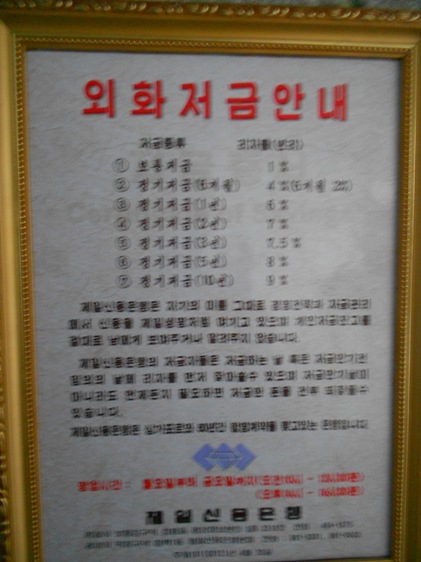
Today we will look at the marketing materials for the  Jeil Credit Bank in Pyongyang:

Here is what the marketing poster says:

외화저금안내 Currency savings guide

저금종류 리자률                (년리)% Interest Rate
Types of savings              (per annum)%

보통저금
Usual saving 1%

정기저금(6개월)
Regular Saving (6 month) 2.5%

정기저금(1년)
Regular Saving (1 year) 6%

정기저금(2년)
Regular Saving (2 year) 7%

정기저금(3년)
Regular Saving (3 year) 7.5%

정기저금(5년)
Regular Saving (5 year) 8%

정기저금(10년)
Regular Saving (10 year) 9%

제일신용은행은 자기의 이름 그대로 경영전략과 자금관리에서 신용을 제일 생명처럼 여기고 있으며 개인저금잔고를 절대로 남에게 보여주거나 알려주지 않습니다.
Jeil Credit Bank, as the name of itself, consider credit of management strategies and money management as our life and does not show or share ones account information to others.

제일신용은행의 저금자들은 저금하는 날 혹은 저금 만기 전 임의의 날에 리자를 먼저 찾아 쓸 수 있으며 저금만기날이 아니라도 언제든지 필요하면 저금한 돈을 전부 되찾을 수 있습니다.
Jeil credit bank customers can withdrawal the interest before maturity at any time and if needed, all of the money from the savings can be withdrawn before maturity.

제일신용은행은 싱가포르와 50년간 합영계약을 맺고 있는 은행입니다.
Jeil Credit Bank has a 50 years joint venture contract with Singapore.

영업시간 월요일부터 금요일까지 오전 10시~12시 20분, 오후 14시~16시 20분
Business hours: Mon-Fri 10 am – 12.20 pm, 2 pm – 4.20 pm

제일신용은행
Jeil Credit Bank

Share

China cracking down on DPRK border-crossers and underground economy

Friday, May 25th, 2012

According to the BBC:

China has launched a drive against illegal immigration in a north-eastern region bordering North Korea.

The campaign in the Yanbian Korean Autonomous Prefecture in Jilin province mainly focuses on North Koreans fleeing poverty and persecution at home.

China is known to routinely repatriate North Koreans who often slip across the border undetected.

Human rights groups say many face punishment when they return.

“Foreigners who illegally enter, work and overstay are hidden troubles, and they might pose potential threats to social stability,” Li Yongxue, a police official from Yanbian, was quoted by state-run China Daily newspaper as saying.

The police say they want to stamp out criminal activities to maintain order. They add that those without proper documents will be sent back.

Many of these illegal immigrants have relatives in China, some come to work, while others use China as a staging post before moving to other countries, according to the BBC’s Michael Bristow.

A police officer from the province told the BBC that it was a sensitive year in China, with officials stressing the need for stability ahead of a leadership change this year.

Read the full story here:
China targets illegal immigration at North Korea border
BBC
2012-5-25

Share

South Korean firms losing money in the DPRK

Thursday, May 24th, 2012

According to the Hankyoreh:

South Korean businesses have suffered losses of up to ten trillion won (US$8.3 billion) from the cutbacks in inter-Korean economic cooperation under the Lee Myung-bak administration, figures show.

The losses taken by South Korean firms are fives times the 1.8 trillion won (US$1.7 billion) North Korea’s estimated losses. The results show an unintended effect of Seoul’s May 24 sanctions, which were meant to punish North Korea economically for the shooting death of a tourist at the Mt. Kumkang resort, the sinking of the Cheonan warship, and the shelling of Yeonpyeong Island. North Korea has offset these losses with increased cooperation with China.

Read more below…

(more…)

Share

North-South Korea and Chinese trade

Wednesday, May 23rd, 2012

The Joongang Ilbo reports some recent statistics from, the Kaesong Industrial Zone and some trade statistics between the two Koreas and China.

Inter-Korean and China trade (Joongang Ilbo):

Exactly two years ago, on May 24, 2010, in the aftermath of the deadly sinking of the Cheonan warship, the Lee Myung-bak administration imposed sanctions against North Korea that forbade all inter-Korean trade and South Korean investments in the North.

[…]

Statistics from the Korea International Trade Association show that the volume of inter-Korea trade in 2011 dropped by 10.4 percent, falling to about $1.7 billion from $1.9 billion in 2010. The Kaesong Industrial Complex, which was exempted from the sanctions, accounted for most of the inter-Korean trade.

In contrast, the volume of trade between North Korea and China surged by 62.4 percent in 2011, from $3.4 billion in 2010 to $5.6 billion.

“After stopping trade with South Korea, factories in Pyongyang and Nampo cities turned to Chinese companies and now work for them,” a South Korean businessman said on condition of anonymity. “It took so much time and money for us to teach North Korean employees and now Chinese companies enjoy the fruits of our labor.”

The North Korean government responded to the South Korean sanctions:

As talks between the two authorities have been halted, North Korea has unilaterally decided to raise taxes on income and management of the complex.

In fact, the North Korean regime earns significant money from the complex. South Korean firms pay the North Korean government an average of $126.4 per month for each North Korean worker. The government then distributes 5,000 won of North Korean currency and some food coupons to each employee per month. This wage is desirable compared to other worker payments in the North.

Analysts calculate that the regime is holding at least $50 million from the $77.8 million of the North Korean employees’ annual income.

At current black market rates, there are appx 4,450 DPRK won to for US$1.

The article notes, however, that the Kaesong Industrial Zone continues to grow:

Located only three kilometers away from the Military Demarcation Line, the inter-Korean complex has 123 South Korean companies and about 51,000 North Korean employees.

Currently, the South Korean government is implementing a scheme to build more roads and infrastructure for South Koreans crossing the border to commute to the complex (see here and here).

“Although Kim Yong-chol, former head of the policy planning office of the North’s powerful National Defense Commission, who has exerted a huge influence on operating the Kaesong complex, repeatedly threatened to shut down the complex since the May 24 sanctions, he’s recently been more cooperative, saying ‘Let’s make it better,’” a high-ranking government source told the JoongAng Ilbo.

Unlike the frosty inter-Korean relations, the sales performance of the joint industrial complex is positive. For the past three years, 55 South Korean firms additionally moved into the complex and the annual output value surpassed $400 million in 2011, jumping from $180 million in 2007.

Last year’s volume is 30 times that of the $14.91 million in 2005, when the complex made its first yearly outputs. The total output value since 2005 has accumulated to $1.5 billion.

[…]

Currently, roughly 160,000 people are living in Kaesong city and approximately one out of three are working in the complex

The article also reports on additional DPRK-China projects that are not necessarily a result of higher barriers to commerce between the two Koreas (dredging, mining, labor mobility, and SEZs):

“A Chinese firm based in Yanji is now implementing a 60-kilometer-long (37-mile) dredging project in the Tumen river bed,” a government-affiliated research official said.

“It’s not simple dredging work, but a plan to mine the iron ore buried nearby.”

“In the river bed, about 30 percent of the sand contains iron ore,” the official said.

The regime also exports their labor forces to their closest ally.

“Most of the local people left for South Korea to get a decent job and the average wage for a Chinese worker is increasing,” a Chinese factory manager in Yanji said. “So we are planning to hire North Korean workers instead.”

Pyongyang and Beijing are also focusing on developing the two special economic zones, Rason and Hwanggumpyong in northeastern North Korea.

When Chen Deming, the Minister of the Chinese Ministry of Commerce of China, and South Korean Trade Minister Park Tae-ho had a bilateral meeting on May 2 to start negotiations on the Korea-China free trade deal, they included a provision stating the two countries will allow preferential tariffs on goods produced in designated zones.

“Hwanggumpyong is like a Kaesong Industrial Complex to China,” a South Korean authority said. “The Hwanggumpyong zone has the same function as Kaesong, composed of China’s capital and technology and North Korea’s land and labor forces.”

In the Rason Economic Zone, China has finished construction paving the 53-kilometer-long road connecting the Rason zone and a local tax office in Wonjong-ri, a North Korean village close to China.

The Chinese government also arranged a harbor near the Rason area, constructing a pier that can accept a three million-ton ship and building a bus route between an express bus terminal in China and the zone.

“If China uses the Rason harbor, they can save $10 per metric ton,” Jo Bong-hyeon, a senior official at the Industrial Bank of Korea, said. “It’s really good business for China, enough to invest money on building infrastructure in the zone.”

Read the full story here:
Kaesong complex running well despite sanctions
JoongAng Ilbo
2012-05-23
Share