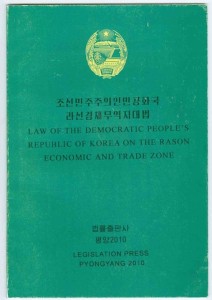
In 2010, the DPRK revised the laws governing Rason Special Economic Zone.
This booklet, scanned into pdf form, sketches out the new laws in both Korean and English (English is in the back half). It was at this time that the authorities removed Rason from provincial administration, giving it more autonomy in some ways, while also giving authorities in Pyongyang a more direct link to planning for the SEZ.
Potentially interesting clauses include:
– Ships regardless of nationality are permitted to port (article 26)
– Business licenses can be revoked if DPRK law is “seriously” violated. (article 15)
– Prices will be set between the buyer and seller, though some basic consumer goods may be fixed by the local government. (article 26)
– Disputes may be resolved by arbitration either in the DPRK or a 3rd country. (article 45)
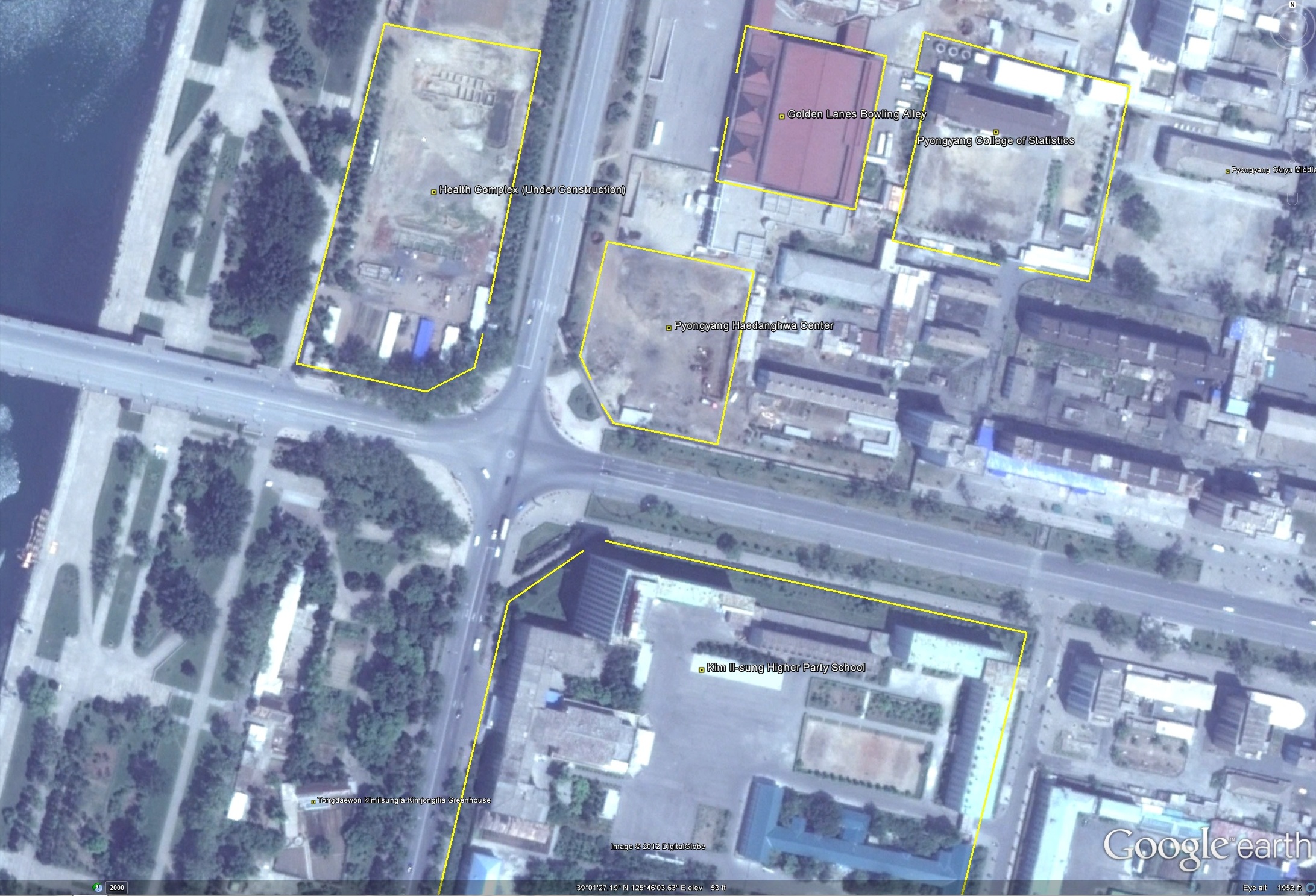
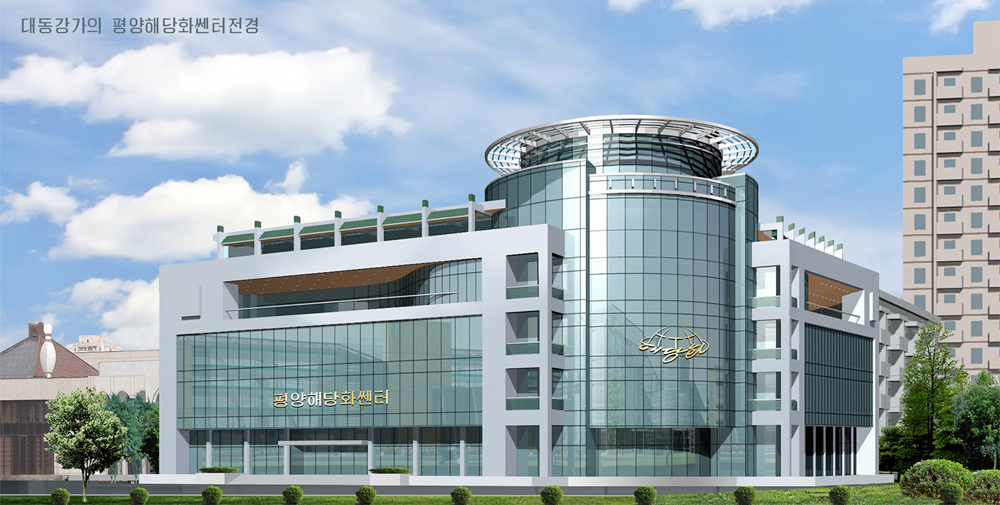
Pictured above: (L) The location of the new Haedonghwa Center under construction in Pyongyang (Google Earth), and (R) a representation of the building’s exterior
The Korea Pyongyang Haedanghwa Foodstuff Company (조선평양해당화식품회사는) has launched a new web page on the Naenara portal providing content in English, Korean, and Chinese.
Using information from the web page I was able to locate the position of the Haedanghwa Center (pictured at the top of this post). It is obviously still under construction. The lot on which the center is being built has been empty for the last dozen years and lies directly across the Taedong River from the new construction on Mansudae Street.
North Korea has established an investment insurance firm recently in what is believed to be an effort to attract more foreign investment by reducing risks stemming from uncertainties in the communist nation, a source said Sunday.
The North’s firm is expected to purchase reinsurance from an international company, the source said. The system is similar to an insurance measure that South Korea’s government has been operating to compensate its businesspeople for lost investment in the North.
It marks the first time Pyongyang has introduced such an insurance system for foreign investors.
“For foreign investors, this could ease concerns about investment loss risks stemming from uncertainties of North Korea,” said the source familiar with economic affairs in the communist nation. The source said, however, that it is questionable how effective the measure will be in drawing outside investment.
North Korea has long sought to attract foreign investment to revive its broken economy, but with little success because investors stayed away from one of the most closed nations, which is under international sanctions over its pursuit of nuclear and weapons of mass destruction.
The source also said that the word, “reform,” has been used among North Korean bureaucrats, and that this could signal that Pyongyang may announce a set of bold economic reform measures around April’s commemoration of the 100th birthday of late North Korean founder Kim Il-sung.
“Reform” has been considered a taboo word in the North, along with the term, “openness,” because Pyongyang has rejected international calls for it to reform and open up to the outside world as part of a U.S.-led attempt to topple the autocratic regime.
Should Pyongyang take any economic reform measures, they would mark the first such steps since new leader Kim Jong-un took over the isolated nation after his late father Kim Jong-il died of a heart attack in December.
Read the full story here:
N. Korea sets up insurance firm to attract more foreign investment Yonhap
2012-3-11
The Unification Ministry said Tuesday it will allow South Korean companies to bring new equipment into their factories at a joint industrial complex in North Korea in an easing of sanctions on the communist nation.
The ministry’s decision, effective from this week, is a follow-up measure after a group of eight ruling and opposition lawmakers last month visited the border city of Kaesong to meet with South Korean company officials and help work out problems with operating factories there.
More than 50,000 North Koreans work for 123 South Korean firms operating in the industrial zone to produce clothes, utensils, watches and other goods. The project serves as a key legitimate cash cow for the impoverished communist country.
According to a survey conducted by the ministry of the 123 firms after the parliamentary delegation’s visit, 15 firms wanted to move 803 pieces of equipment worth 4 billion won (US$3.5 million) out of the complex.
Thirty-two companies had plans to remodel the current factories or facilities, the survey showed.
The ministry is also considering expanding bus routes for North Korean workers to help employers hire more workers living farther away from the complex, officials noted.
Read the full story here:
Seoul eases limits on factories, equipment in Kaesong complex Yonhap
2012-3-6
North Korea is likely to make an official announcement of its new economic development plan in April to commemorate the centennial anniversary of Kim Il Sung’s birthday, which is also celebrated as a national holiday in North Korea as the “Day of the Sun.” In addition to the new economic plan, North Korea is also planning to align organizations and establish appropriate legislations in the foreign economic sector. The Daepung Group was recently consolidated with the Joint Venture and Investment Committee (JVIC).
According to an unnamed North Korean source, “many organizations in North Korea with overlapping functions or with unsatisfactory performance were merged as a part of promotion of North Korean socialism. The Daepung Group was merged as a bureau under the JVIC.”
The two chiefs of the Daepung International Investment Group (Daepung Group) were Workers’ Party of Korea (WPK) Unification Strategy Department Director Kim Yang Gun, who served as the chairman of the board, and Pak Chol Su, a Korean-Chinese businessman, who headed the group as the president and elected standing vice-chairman. They were in charge of attracting large foreign investment needed for the “10-Year State Strategic Plan for Economic Development (2011-2020).”
The WPK Director of Administration Jang Song Thaek is in charge of the Daepung Group and the JVIC and is likely to have ordered the merge of the two organizations to increase work efficiency. Kim Yang Gun’s position as the head of Daepung weakened after the souring of inter-Korean relations despite his efforts to bring investment from the South. As a result, Kim will likely step down from his position and Pak Chol Su and the executive management of the JVIC will likely manage the Daepung Group in the future.
The JVIC has also faced changes in its organization with the appointment of Ri Gwang Gun as the new head of the JVIC. Other foreign investment companies and related organizations were merged and the roles of the directors were revised.
The Beijing office of the JVIC has opened its doors in December 30 last year. North Korea is likely to dispatch experts and professionals from various organizations to provide “one-stop service” to attract more investment to North Korea, starting from this April.
Kim Chol Jin is the person in charge of the JVIC Beijing Office. The Rason Special Economic Zone (SEZ) and Hwanggumpyong SEZ will have a change in leadership, as Hong Suk Hyong will replace Kim Il Young as the new vice-chairman.
The previous chairman of the JVIC, Ri Su Yong, who was also the former ambassador of the DPRK to Switzerland, is now serving as the new advisor to Kim Jong Un at the Secretary’s Office.
I have been pretty busy lately so blog posts have taken a hit. I am mostly caught up now, but there were several 38 North publications released in February that I wanted to highlight:
UPDATE 1 (2012-2-21): According to the Korea Times, this store is now providing people with a legal window to exchange local for hard currency:
North Korea is apparently allowing foreign currency to be exchanged at unofficial, black market rates at a newly-renovated department store in Pyongyang, according to a diplomatic source who recently visited the country, Tuesday.
The source said people could exchange euros, dollars and yuan at kiosks at Kwangbok Area Supermarket, which recently opened after refurbishment and is said to resemble department stores in the South. The North has long kept the value of its local currency artificially high.
Euros were being exchanged at the rate of one euro for 4,420 North Korean won, while the official rate is around 130 won per euro, the source said.
“They are exchanging hard currency at a rate that seems to be an unofficial rate,” the source told The Korea Times. “People can also shop at the department store using foreign currency by taking their receipts to the booths.”
…
The source added that the exchange rates were written on a board inside the kiosks.
ORIGINAL POST (2012-1-6): See the original post below.
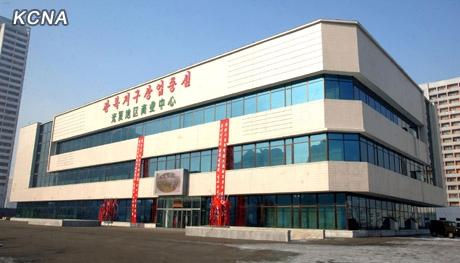
Pictured Above: (L) The original facade of the “Kwangbok Department Store (광복백화점)”. (R) The new facade of the “Kwangbok Area Supermarket (광복지구상업중심)”
Here is KCNA coverage of the opening of the facility (Posted to YouTube):
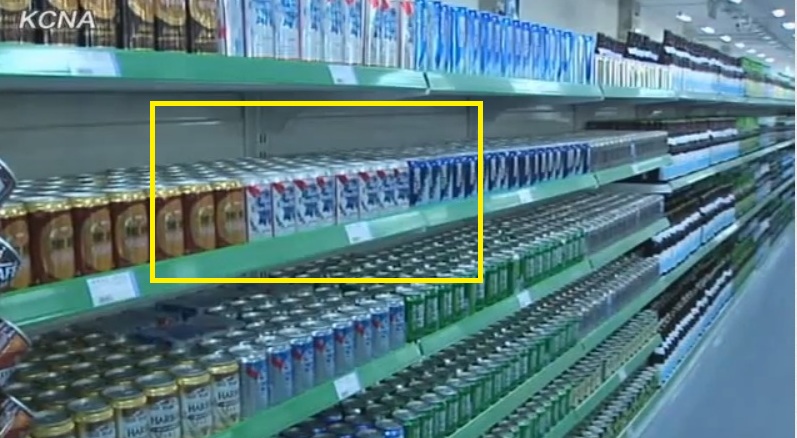
Astute observers will notice the American beer, Pabst Blue Ribbon, featured prominently in the beer section.
Here is coverage of the opening in KCNA (2012-1-5):
Pyongyang, January 5 (KCNA) — The Kwangbok Area Supermarket was opened with due ceremony on Thursday.
All business service at the supermarket built as a commercial service center has been put on IT and digital basis. Customers can buy varieties of goods according to their taste and requirements in the sales rooms on each floor stacked with household appliances, electronic products, foodstuff, fibre, sundries and others.
Present there were officials concerned, officials of the Korea Taesong General Trading Corporation, officials and employees of the Kwangbok Area Supermarket, members of the Feihaimengxin Trading (Beijing) Co. Ltd. staying in the DPRK and the Chinese embassy here.
O Ryong Il, general president of the Corporation, said in his speech that the work to build the supermarket was successfully completed under the energetic leadership of leader Kim Jong Iland the dear respected Kim Jong Un and the positive efforts of the peoples of the two countries.
He expressed belief that the supermarket would help towards improving the people’s living standard and promoting the well-being of the two peoples through better service and management.
Xue Rifei, executive managing director of the Feihaimengxin Trading (Beijing) Co. Ltd., said in his speech that Kim Jong Il and Kim Jong Un gave field guidance to the supermarket on December 15, 2011 and named it the Kwangbok Area Supermarket.
He expressed the expectation that an effort will be made to reenergize the supermarket to win high appreciation for its best management, service and credit.
The Korea Taesong General Trading Corporation is a sanctioned organization, and according to the US Treasury, it is a “key node” in the illicit activity of Office 39. According to NK Leadership Watch:
One of the participants at the opening ceremony was Jon Il Chun (Chon Il-chun), deputy director of the Korean Workers’ Party’s Finance and Accounting Department and section chief of Office #39. Mr. Jon accompanied Kim Jong Il on a visit to the Kwangpok store in mid-December 2011, which was KJI’s last reported public appearance before his death.
On a more casual note, the supermarket marks a point of administrative departure from the way department stores are typically managed in socialist countries. The Kwangbok Department Store (the former name) was one of Pyongyang’s premier formal retail outlets. For decades it operated in the same way as other socialist department stores: customers ended up standing in three lines before they were able to collect their merchandise (one line to order, another line to pay, and another line to pick up). The new Kwangbok Supermarket has adopted a market-style check out line. Though unnoticed by foreigners, this is the first such check out line I have seen in a North Korean department store.
The supermarket is supplied with home and foreign-made products which are in demand in the country.
Although I have not acquired data specific to this store, I believe it is reasonable (even rational) to assume that if the supermarket sells imported goods it will charge had currency for them. This opinion is based on the following assumptions: 1. The Chinese investors will not accept North Korean won under any circumstances. 2. The goal of Office 39 is to acquire hard currency for the Kim family. 3. North Korean retail outlets frequently post prices in multiple currencies so I don’t see any reason why it would be different here. Today a plurality of North Koreans can easily acquire foreign exchange.
Here is my working assumption of the business model: Chinese partner acquires merchandise and imports it to the DPRK. Sales in hard currency go towards allowing the Chinese supplier to recover its costs. Chinese partner either earns a profit from a markup it charges Kwangbok or it divides the profit with Office 39 along some agreed percentage.
If Chinese profits are earned from a cost-plus markup that it charges Kwangbop, then the partnership is closer to an exclusive supplier deal rather than a true joint equity deal. The North Koreans could cheat on this deal by finding cheaper suppliers and decreasing its purchases from the Chinese partner. If after-sales profits are split between the Chinese and Office 39, then both partners will need auditors on hand to make sure the books are accurate. The Chinese partner will also need a good relationship with the Chinese embassy if it runs into problems with the DPRK managers should they unilaterally change the terms of the contract (the split).
UPDATE 1 (2012-2-28): The Japanese police have raided the heaquarters of Chongryun (Chosen Soren), the Pro-DPRK General Association of Korean Residents in Japan, over its alleged ties to the computer smuggling ring. According to the BBC:
Japanese police have raided the offices of a pro-North Korean organisation suspected of a role in the illegal shipment of computers to North Korea.
Japan maintains a total ban on exports to North Korea.
It is part of a range of sanctions over North Korea’s nuclear programme and its abduction of Japanese nationals in the 1970s and 80s.
Earlier this month police arrested a businessman accused of exporting PCs to North Korea through China.
On Tuesday, about 100 riot police entered the Tokyo offices of an organisation connected to the Pyongyang-affiliated General Association of Korean Residents in Japan, officials say.
Because there are no diplomatic relations between the two countries, the association has functioned as North Korea’s de facto embassy in Japan.[
The raid came after prosecutors last week indicted Lee Soon-Gi, 49, who is accused of illegally exporting 100 second-hand personal computers to North Korea through China, officials said.
The affiliate organisation may be involved in the shipments, police say.
But the association has strongly criticised the raid which it described as an “unjustified and illegal investigation”.
ORIGINAL POST (2012-2-19): According to the Yomuri Shimbun:
The president of a Tokyo-based dealer in secondhand personal computers exported more than 4,000 items to North Korea, according to investigation sources.
Many of the items are believed to have been sold on the black market to senior members of the ruling Workers’ Party of Korea, the sources said.
Lee Sungi, president of Popura-Tec, was arrested earlier this month by the Metropolitan Police Department’s Public Safety Department on suspicion of violating the Foreign Exchange and Foreign Trade Law.
The 49-year-old has been arrested on suspicion of exporting 100 notebook computers to North Korea. In addition, Lee has told police that he shipped more than 4,000 personal computers and liquid-crystal displays to that country on four occasions from 2008 to 2009.
A North Korean trading company based in Dalian, China, brokered the deals, selling the products to a computer shop in Pyongyang, the sources said.
The shop was run by a North Korean computer engineer who once worked at a Chinese company as a software developer. He reportedly contacted Lee in March 2007, saying: “There’s demand for about 1,000 personal computers a month [in North Korea]. I’m interested in buying Japanese products,” according to the sources.
E-mails he sent to Lee suggested there were hundreds of computer shops throughout North Korea, of which 20 were in the capital. However, most of the country’s computer users do not use these shops because they cannot afford to buy their products.
Instead, they usually buy their computers through the black market, the sources said.
Most of the personal computers Lee exported from Japan were secondhand products, including some that had been leased to central and local government offices, according to the sources.
The North Korean computer engineer reportedly sold about 500 products per month to the black market, setting prices at 200 dollars or less for a desktop computer, and a maximum of 300 dollars for a notebook computer, the sources said.
This was still expensive for North Korea, which meant only senior members of North Korea’s ruling party and other wealthy individuals could purchase them, according to the sources.
It is reportedly common for North Korean computer users to buy new products when their items break down because there are almost no after-sales services in the country, according to the sources.
The largest of a collection of overseas restaurants run by the North Korean authorities,‘Pyongyang Koryogwan’ opened for business in Dandong, China on Thursday. An opening ceremony was held in front of the restaurant, which is located at the entrance to Dandong’s development zone.
The ribbon-cutting, which lasted for 30 minutes beginning at 9:30AM, included North Korean and local Chinese government officials, the restaurant management team and more than 50 female staff members, over 100 people in total. Staff must have been freezing after spending the whole time in Korean traditional dress despite sub-zero temperatures.
The restaurant is staffed by more than 200 workers from North Korea, 120 of whom are general staff, with the remainder working in the kitchens or on administrative tasks. The menu is mostly a collection of different sets, with the cheapest item being cold noodles at around USD$4.75.
Read the full story here:
Dandong Opening for New NK Restaurant Daily NK
Choi Cheong Ho
2012-02-17
The South Korean government will allow companies operating in the Kaesong industrial complex in North Korea to bring new facilities or build plants there. Against this background, regulations banning new investment in the complex under a sanction against North Korea, which made May 24 last year, will be massively eased.
Park Soo-jin, vice spokeswoman of the Unification Ministry in Seoul, said Wednesday, “We will ease sanctions on North Korea imposed May 24 last year to support the operations of plants operating (in the Kaesong complex), including allowing the entry of necessary facilities and construction of warehouses.” “We will also actively examine working-level talks with Pyongyang to resolve the issue of supply of North Korean workers. We are willing to negotiate with the North on building dormitories and tackling passage, customs and telecommunications matters and personal safety.” The ministry is also mulling putting artificial grass on a soccer field within the complex to improve living conditions of South Korean staff.
The latest decision is a follow-up measure after members of the special parliamentary committee for inter-Korean relations development and the National Assembly`s Foreign Affairs, Trade and Unification Committee visited the Kaesong complex Friday and urged the resolution of difficulties facing companies operating there. Having offered Tuesday working-level talks to Pyongyang for family reunions, Seoul apparently hopes to expand amicable relations through this deregulation.
The Unification Ministry said last year`s sanctions will remain in force since expansion of large-scale investments will still be banned, including new corporate advances into the complex and plant construction. The latest measure, however, is still a big step forward because until now, Seoul had approved just facility entry into the complex for repair purposes, while going forward, additional facilities could be allowed for production activities. Plant construction was initially allowed for seven companies, which had been suspended due to last year’s sanctions.
Certain projects are already in place, including the construction of fire stations and emergency medical facilities, as well as repair of roads for commuting by North Korean workers. The South Korean ban on visiting North Korea excluding the Kaesong complex and Mount Kumgang area, which was effected last year, was also eased following approval of trips to North Korea for social and cultural exchanges, including the recovery of Kaesong Manwol pavilion.
Read the full story here:
Seoul to partially lift restrictions on biz complex in N. Korea Donga Ilbo
2012-2-16