Archive for the ‘Economic reform’ Category

Mixed prospects for economic reform under Kim Jong-un regime

Thursday, July 26th, 2012

Institute for Far Eastern Studies (IFES)
2012-7-19

There is increasing speculation that the new Kim Jong Un regime is pushing toward economic reform. This may be due to Kim’s young age, as he is considered to be more open to change than his father.

According to an unnamed South Korean official, there is a growing prospect that North Korea will soon release a new economic reform measure. More and more testimonies from North Korean defectors suggest that since Kim Jong Il’s death, reform measures are slowly taking place. But it is unclear when such new economic reform measure will occur.

North Korea’s behavior also implies that certain economic reform may occur. The spokesperson for the DPRK’s foreign ministry made a statement last month to the KCNA, “The dear respected Kim Jong Un has already set forth a goal of Korean-style development and strategies and tactics for enabling the Korean people to live well with nothing to desire more in the world. He is now wisely leading the general advance of the Korean people for economic construction and improving the standard of people’s living.” This indirectly suggests that the Kim Jong Un regime will put forth a new economic measure.

On the other hand, the content and timing of such still remains uncertain. According to the NK Intellectuals Solidarity, the Central Committee of Workers’ Party decided on a policy to introduce a new economic management system on August 1, one that would be centered around the cabinet.

However, the South Korea-based online newspaper Daily NK released an article on July 10 quoting its source from North Pyongan Province that a new “June 28 Measure” was released internally. This measure is reportedly a type of “our-way” new economic management system, to be enforced from October 1.

What path North Korea will take with the new economic reform is unknown. However, the reform will comprise various economic sectors including agriculture, commerce, production and distribution. Details of the reform are unavailable.

The NK Intellectuals Solidarity predicted that new measures will be centered around the legalization of permitting private investment and commercial activities in service and trade sectors and private contract system for agriculture.

In contrast, Daily NK expects the core of the new economic measure will involve downsizing of cooperative farms (from 10-to-25 people in size to 4-to-6 people) and permit farming in unused lands; enforce government procurement system based on market price and strengthening self-supporting accounting system for companies.

The Choson Sinbo, a Japan-based pro-North Korean newspaper ran an editorial on July 11 that North Korea’s economic revival strategy is to follow the global trend but doing it “our-way.” The news also added that North Korea has already entered the path toward economic restoration and praised Kim Jong Un’s “our-style development goal and strategy” to improve the lives of the people while following the current trend of knowledge-based economy.

The news explicated that emphasis on “following the global trend” did not mean following and copying other nations but aimed for the nation to develop and rise on its own to reach the most advanced level of society. In addition, it is considered a refute against South Korea’s over interpretation about the possibility for opening and reform in North Korea during the Kim Jong Un era.

Share

Rason architecture development concept being implemented

Wednesday, July 25th, 2012

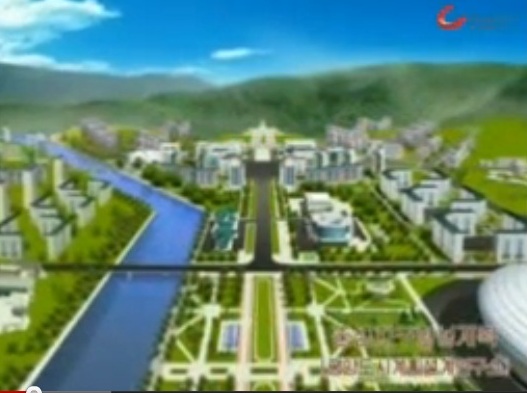
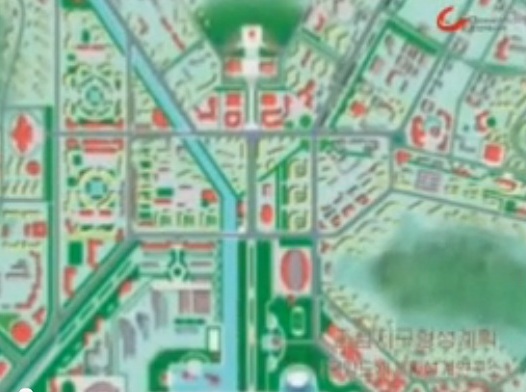
On 2010-11-5, the Choson Ilbo published a report on a North Korean video which portrayed an urban/architectural vision for the future of Rajin (Rason). I have uploaded this video to YouTube:

A better-quality version of the video can be found on Youku (PR of China) here.

For those of you who don’t want to watch the video again, here are the relevant images:


The video begins with a quote by Kim Il-sung who insists that the DPRK needs to make Rason better than Singapore after-which it elucidates the viewer as to how this task will be accomplished.  Part one of the video focuses on the reconstruction of downtown Rajin, where a broad new north-south boulevard lined with new housing and facilities is set to become the new city center.

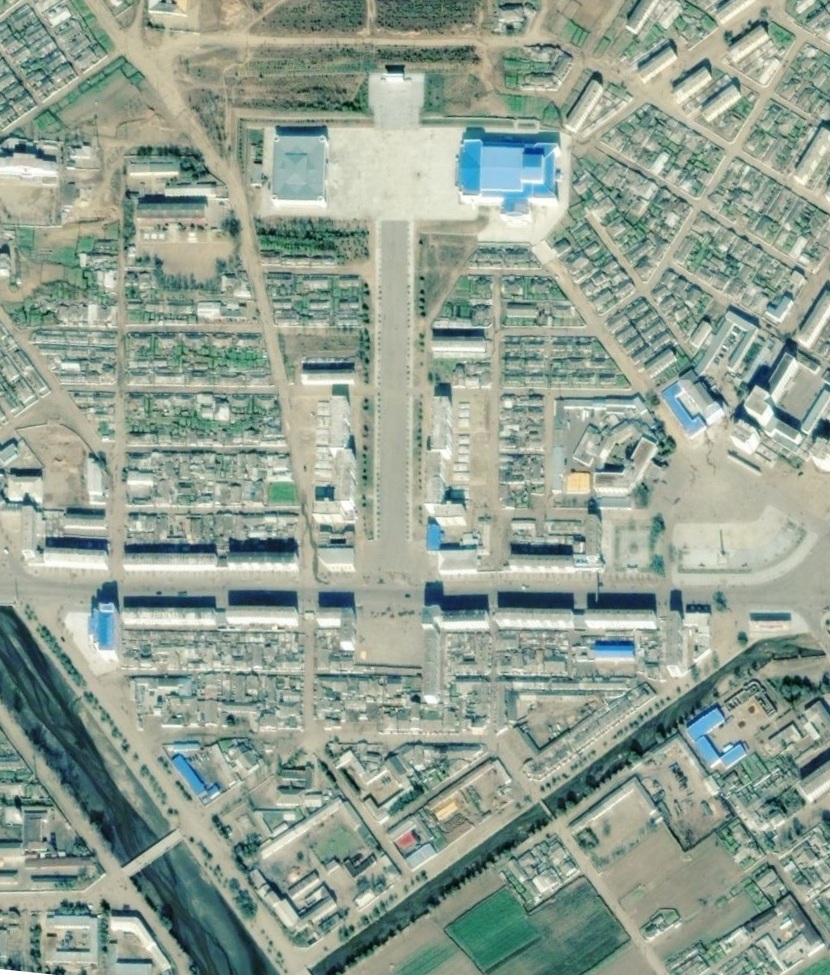
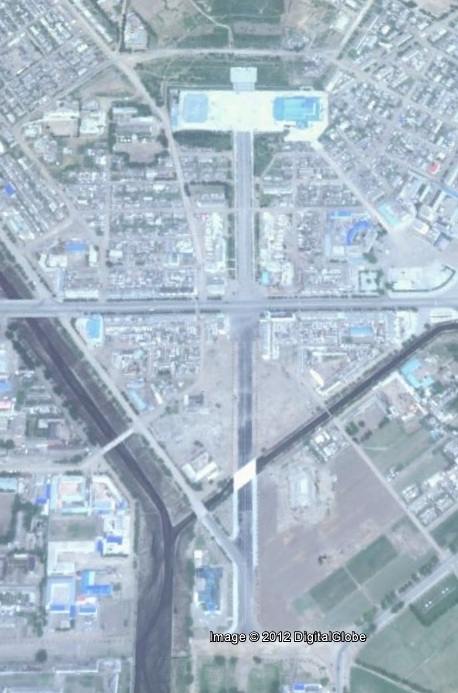
When I first saw this video I interpreted it as more “wishful thinking” on the part of North Korea’s urban planners than a manifestation of actual policy proposals. According to new[ish] satellite imagery on Google Earth, however, it appears that the North Koreans are actually going for it:


The image on the left is an old one archived on my computer so I unfortunately don’t know the date. The image on the right is from Google Earth and was taken on 2011-6-19.  The recenlty released Google Earth image actually predates the release of the North Korean video–so this is what the city looked like when the video was made public. Unfortunately I have not yet seen any new tourism photos from this area to determine if construction has continued to the present day.

Many houses have been demolished to make way for the new road, and I am not sure to where the dislocated families have been moved. If progress continues, however, many more Rajin residents can expect to see their homes demolished to make way for new high-rise apartments. To see a good example of the urban transition, look at what happened in Ryongchon.

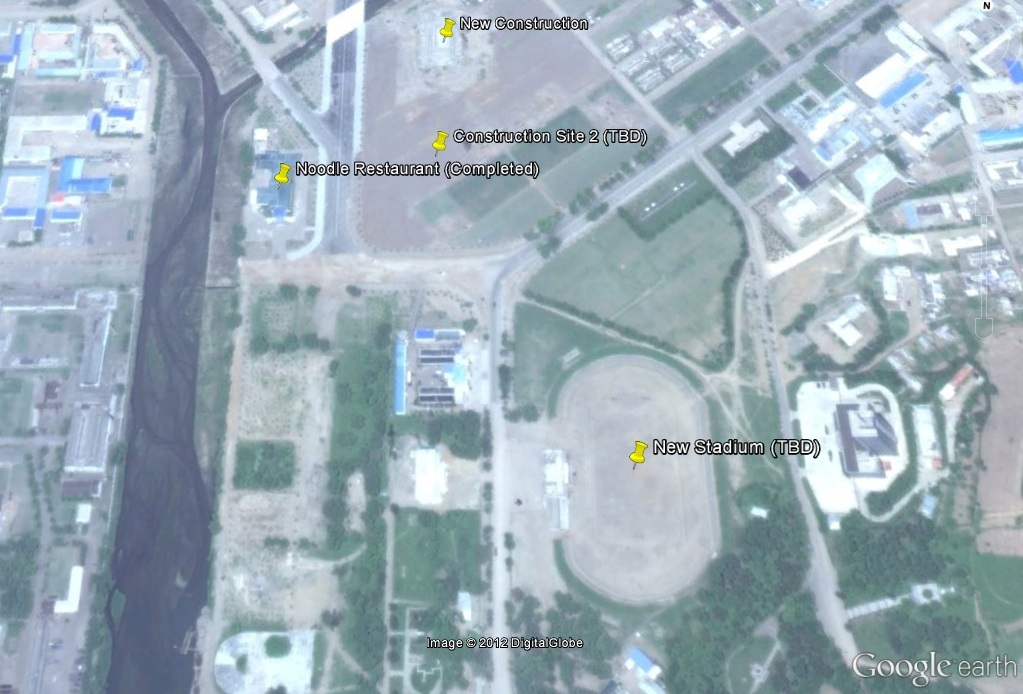
Along the south end of the new road, we can see proposed construction projects in various stages of implementation–from “completed” to “unstarted”:

The Rajin Noodle Restaurant has long been completed.  A new project to the north-east of the restaurant has been launched.  I am not sure, but I believe it is either a new library or health complex. South of that is a construction site that has not yet been launched.  The video also shows a large new stadium scheduled to replace Rajin’s humbe sports field and gymnasium.  This work does not appear to have begun either.

If any readers can understand the video and pass along any helpful information I would appreciate it.

UPDATE 1: Calvin Chua of Choson Exchange writes in with the following commentary:

In general, these are three main characteristics of their urban plan which I gather from the video.

1) Functional Zoning
Like any typical urban master plan, Rason is divided into various zones: commercial, leisure, residential, distributed according to its geographical characteristics of hilly regions and the sea.

2) Emphasis of Axis and Roundabouts
There is a great emphasis on the long axial roads meeting at roundabouts which are filled with monuments and civic buildings. I believe this is largely influenced by their urban plan for Pyongyang which is planned according to early 20th century socialist urban model. In principle, it is should be efficient for vehicular movement and transportation of goods.

3) Relationship with Mountain and Sea and the 3D Effect Narrative
The urban plan is also built upon a visual narrative of the harmony between the mountain and the sea where the buildings are designed and placed strategically to provide a 3-dimensional effect‘입체감’ (a term that is constantly repeated throughout the video).

Aesthetics aside, Rason’s urban plan seems to be quite basic, it lacks the dynamism of other new SEZs, research parks that are currently being developed. Increasingly, cities are becoming more complex and developing the software infrastructure (data cables, monitoring systems, green technologies, etc) are becoming as equally important as developing the physical infrastructure (buildings and roads). New business parks like Songdo in Incheon are fully wired up jointly by IBM and Cisco. Urban planning and management has become a thriving business for tech companies like Siemens to construction conglomerates like Bechtel which offer one-stop solutions from financing to construction and layout grids for the city.

While Rason is far less sophisticated than Songdo, but in order to be a well-functioning SEZ, it needs to consider and provide better urban management systems beyond physical infrastructure. Rason would need to consider the project on a longer term basis since the urban infrastructure provided today will have economic ramifications in future. For example, to rewire or install new technological infrastructure in future would cost much more than planning for future expansion. Perhaps, it will be interesting to uncover their plans for these ‘soft’ infrastructures together with the organisations (multidisciplinary conglomerates) that would invest in them.

However, luck isn’t on Rason’s side, its development might be hindered by its geographical constraints. It is locked within hilly ridges and to pipe cable infrastructure to it might be costly and it also prevents future expansion of the city. As such, there are many hurdles for Rason to cross before becoming a well-functioning city.

UPDATE 2 (2012-10-18): Calvin Chua offers more data in this post on the Choson Exchange web site.

Share

North Koreans study China’s Huaxi Village

Friday, July 20th, 2012

They should be studying Xiaogang Village! But instead they are studying Huaxi Village. Why? According to the Joong Ang Ilbo:

For the past six months, seven working-level North Korean officials have been staying at the Longxi International Hotel, located in a 72-story skyscraper in Huaxi Village, in China’s Jiangsu Province, a local government official told the JoongAng Ilbo in a telephone interview.

They’re allegedly trying to learn the secrets of Huaxi Village, known as China’s richest village but one that is still dedicated to socialism.

Huaxi Village is one of the richest places in China and a symbol of a model mixing socialism and capitalism. All the residents are shareholders of the local conglomerate and earn dividends at the end of every year according to its profitability.

“Roughly 20 North Koreans recently toured Huaxi Village,” a local resident told the JoongAng Ilbo. “The seven working-level North Korean officials have been staying in the village for six months learning how to manage a modern-style hotel.” Intriguingly, all seven are women.

The 328-meter (1,076-foot)-high Longxi International Hotel was completed last October and cost 3 billion yuan ($471 million). The five-star hotel has 800 rooms, including suites that go for 99,999 yuan per night.

“Officials from North Korea’s Foreign Ministry and the North Korean Embassy in Beijing also visited the village,” the resident said. “I’m not quite sure whether the women workers are from the ruling Workers’ Party, but they are mostly in their 20s.

“They have a great interest in learning about the dramatic growth of the village,” he continued. “They reportedly receive some kind of wages [from North Korea].”

Starting in 1978, the village’s residents actively participated in the reforms led by Deng Xiaoping. Wu Ren Bao, 84-year-old local secretary of the village, said in an interview with the JoongAng Ilbo in October 2011, “We accepted whatever was needed to make people rich and develop the village.”

Read the full story here:
Title
Joong Ang Ilbo
Chang Se-jeong, Jeong Yong-soo
2012-7-20

Share

Lankov on bribery

Friday, July 13th, 2012

Below I have posted some excerpts from a recent Andrei Lankov article on bribery in the DPRK along with the economic bullet points:

Bribery has little to do with ethics or honesty but relative costs and benefits:

The incorruptibility of the old bureaucracy has a rather simple and rational explanation: Most of the time, it did not pay to be a corrupt official under Kim Il-sung. Money was of surprisingly little use in the 1960s and 1970s, when pretty much everything was rationed and distributed by the state according to predetermined quotas and norms.

In those days officials lived significantly better than the average North Korean, no doubt. But they were affluent not because they had significantly more money (the wage differential between a top official and a humble worker was remarkably low), but rather because they had access to higher-quality goods and services that were not available to the common people. One of my North Korean interlocutors said: “Back in the 1980s, I did not care about money. Nobody did, since money did not buy much in those days.” In those days, in the 1970s or 1980s, one had to be an official to drink beer every week, to smoke cigarettes with filters, or feast on pork a few times a month. But officials did not buy these goods at market; rather they received them from the state as part of their special (very special) rations.

In this situation, it did not make sense for an official to accept bribes as a reward for overlooking some misbehavior or violations of some rules. Money would not be particularly useful and at the same time there was a significant risk of being caught. If caught, an unlucky official would at best lose his or her job and at worst even freedom, and no amount of money would compensate for this disaster.

In highly regulated economies, bribery and growth are positively correlated:

We are conditioned to see official corruption as an evil, but in present-day North Korea, corruption might be a life-saver. The average North Korean gets most of his or her income (about 75%, if recent estimates are to be believed) from private economic activities – these include private agriculture, trade and small-scale household production, and myriad other things. Nonetheless, nearly all of these activities remain technically illegal. Unlike China, North Korea has never undertaken serious economic reform, so private economic activities are still considered crimes, even though they have long become, in practice, a universal norm (and without such activities many would be unable to stay alive).

The only reason these activities are able to exist is corruption. Without widespread corruption, many more North Koreans would probably have perished in the great famine because there would have been no way to have private agriculture, and it would have been nearly impossible for private traders to move food across the country, delivering it to areas where the food situation was especially dire. After all, trade in grain and long-distance travel for commercial purposes are both technically crimes. No markets would be possible had the local bureaucracy been serious about enforcing a multitude of bans and restrictions on commercial activities.

Although corruption will lead to low levels of growth, it will impede overall development in the long-term:

Even when the Kim family regime meets its eventual demise, when a new North Korea emerges, the culture of corruption may remain as part of its heritage. And perhaps eventually it will become a serious burden to a resurgent North Korean economy.

Regarding this last point, see this post.

Read the full story here:
North Korea’s culture of bribery
Asia Times
Andrei Lankov
2012-7-13

Share

DPRK-China Economic Cooperation: First Six Months in Review after Kim Jong Un’s Rise to Power

Thursday, July 12th, 2012

Institute for Far Eastern Studies (IFES)
2012-7-12

After Kim Jong Un’s succession following the death of his father, Kim Jong Il, added attention is drawn to the economic cooperation between China and North Korea.

The DPRK-China economic cooperation has totaled 990 million USD from January to April this year, a rise of 16.5 percent against the previous year. Other economic cooperation projects are also underway as appropriate system and regulations are currently being established along with recruitment and training of employees.

According to Yonhap News Agency on July 4, Chinese commerce ministry invited about 20 North Korean economic government officials and scholars to Tianjin for training in special economic zones from late May. The main purpose of the training was identified; to promote and revitalize the special economic zones in North Korea, including Hwanggumpyong and Wihwa Islands and Rajin-Sonbong.

The invited North Korean trainees are top officials from economic, administrative, finance, and customs sectors to receive two-month training in Tianjin from Chinese experts with years of experience and knowledge in the area of operations, management, and investment promotion of economic zones. The entire training cost is supported by the Chinese government with full support of education and accommodations.

The details of the program consisted of a month of training in theoretical background and a month of practical training in economic zones of Shanghai Pudong and Shenzhen.

Hwanggumpyong and Wihwa Islands began as China and North Korea partnered up to develop it as the next Kaesong Industrial Complex. Last June, China’s Commerce Minister Chen Deming and the DPRK’s vice-chairman of National Defence Commission Jang Song Thaek met and hosted the groundbreaking ceremony for the development of the area. However, the development in Hwanggumpyong area is making a slow progress.

On June 25, Kyodo News Service of Japan reported that China and North Korea both expressed to delay the joint development project of Hwanggumpyong for the lack of economic value after North Korea conducted its satellite launch. However, on the following day, Chinese foreign ministry made a statement that Hwanggumpyong joint development project was on track and criticized Kyodo for the inaccurate account of the situation.

China has obtained port usage right of Rajin Port in 2008, which connects Tumen River with Hunchun of Jilin Province in China. The construction for the 53 km-long road that connects Rajin with Hunchun is expected to be completed by the end of this year and sea route to this area will officially take off. China invested in the entire cost of construction as it hopes to develop it into an international distribution base, as a part of the Chang-Ji-Tu Development Project in Northeast China.

Nearly 70 percent of China-DPRK trade is located in Dandong and Sinuiju area. Many experts agree that it will be a matter of time before the development of Hwanggumpyong economic zone become full-fledged. Despite the apparent delay in development, North Korea has already established a Law on Hwanggumpyong and Wihwa Islands Economic Zone and joint management committee were formed consisting of Chinese and North Korean officials. Rapid progress in this zone can be expected after the New Yalu River Bridge is completed in 2014.

As economic trade and cooperation between North and South Korea ebbed, North Korea is likely to increase its efforts with China, combining the land and manpower of North Korea with China’s resources and technologies to develop other SEZs similar to Kaesong. However, a large-scale dispatch of North Korean employees to China will be difficult challenge to overcome.

Share

ROK firm pays tax to DPRK

Wednesday, July 11th, 2012

According to Yonhap:

A South Korean company in the inter-Korean industrial zone in North Korea paid about $7,000 in corporate income tax to the North last year, the Unification Ministry said Wednesday.

It was the first time a South Korean company has paid a tax to North Korea since 2004 when the two Koreas opened the complex in the North’s border city of Kaesong to boost cross-border economic cooperation.

South Korean companies in Kaesong are subject to a 10 percent to 14 percent corporate income tax, but their taxes are exempted for five years after first generating profits, and are reduced by 50 percent for the ensuing three years, according to the ministry, which handles inter-Korean affairs.

The company and three others also paid about $153,000 in corporate income taxes to the North’s authorities this year for their profits in fiscal year 2011.

The development indicates that some South Korean companies have begun to make money for their operations in the industrial complex that marries South Korean capital and technology with cheap labor from the North.

The complex is now home to more than 120 South Korean small and medium-sized companies, which produce clothes, utensils, watches and other goods.

Last year, the production of the industrial complex reached an all-time high of US$400 million. The complex has produced $1.65 billion worth of goods since 2004.

A ministry official said more South Korean companies are expected to pay corporate income taxes to the North next year. He did not give details on how many South Korean companies make money in Kaesong.

Read the full story here:
S. Korean company in Kaesong paid first corporate tax to N. Korea
Yonhap
2012-7-11

Share

Food and other commodity prices on the increase

Tuesday, July 10th, 2012

The Daily NK reports that food is now at record prices (5,oooW/kg) despite the food market operating under ‘normal’ operations. According to the article:

The price of rice has hit 5,000 North Korean Won/kg in the market in Hyesan, Yangkang Province. This is the first time that the psychologically significant price point has been reached under ‘normal’ market operations in the region.

A source from the city told Daily NK today, “The price was just 4,500 won as recently as the 5th, but this morning it reached 5,000 won. The prices of all other items are also on the rise, and as corn and rice prices rise in the midst of an already difficult food situation, many households are buying less food.”

Rice prices in other regions are rising too, other sources have informed Daily NK. Rice was selling for 4,500 won in Musan, North Hamkyung Province on the 5th, and had already exceeded 5,000 won in Muncheon, Kangwon Province on that same day.

Rice prices in North Korea tend to reflect the upward (or downward) trend in the exchange rate of the day, indicating the strong causal relationship between them. So it is no surprise that whereas the Chinese Yuan exchange rate was 800 to 1 on July 5th, it had risen to 810-820 won/Yuan by July 9th, and today reached 860 won/Yuan (July 10th).

Increasing exchange rates and rice prices will inevitably exert upward pressure on all prices, aggravating inflation. Naturally, people are complaining, “How are we meant to survive when rice is so expensive?” the source commented.

Prices rises are of course not the problem–they are a symptom of the problem: the DPRK has a poorly developed agricultural production and and distribution infrastructure. Although the North Korean people have shown great ingenuity at developing local coping mechanism do deal with adverse agriculture supply shocks (such as hoarding, making liquor, preserving food, cultivating private plots, and using cell phones to solve problems), they still lack access to crop insurance, futures markets, infrastructure, security of land and earnings, inflation, etc.

Read the full story here:
Rice Arrives Back at 5,000 Won
Daily NK
Kim So Yeol
2012-7-10

Share

Lankov on the North Korean economy

Saturday, July 7th, 2012

Andrei Lankov highlights in a recent Asia Times article some observations (qualitative data) that indicates the DPRK has seen significant growth in recent years. He is careful to qualify his observations with caveats that the level of growth in the country as a whole (as opposed to Pyongyang) remain more difficult to determine.

More expensive shops stocking luxury goods are becoming more numerous as well. Gone are the days when a bottle of cheap Chinese shampoo was seen as a great luxury; one can easily now buy Chanel in a Pyongyang boutique; and, of course, department stores offer a discount to those who spend more than one million won on a shopping spree. One million won is roughly equivalent to US$250 – not a fortune by the Western standards but still a significant amount of money in a country where the average monthly income is close $25.

The abundance of mobile phones is much talked about. Indeed, North Korea’s mobile network, launched as recently as late 2008, has more than one million subscribers. It is often overlooked that the old good landline phones also proliferated in the recent decade. A phone at home ceased to be seen as a sign of luxury and privilege, as was the case for decades. Rather, it has become the norm – at least, in Pyongyang and other large cities.

The capital remains badly lit in night, but compared with the norm of some five or 10 years ago, the situation has improved much. The electricity supply has become far more reliable, and in late hours most of the houses have lights switched on.

Of course, this affluence is relative and should not be overestimated: many people in Pyongyang still see a slice pork or meat soup as a rare delicacy. The new posh restaurants and expensive shops are frequented by the emerging moneyed elite, which includes both officials and black/grey market operators (in some cases one would have great difficulty to distinguish between these two groups). In a sense, Pyongyang’s prosperity also reflects the steadily growing divide between the rich and poor that has become a typical feature of North Korea of the past two decades.

Nonetheless, those foreign observers who have spent decades in and out of Pyongyang are almost unanimous in their appraisal of the current situation: Pyongyang residents have never had it so good. It seems that life in Pyongyang has not merely returned to pre-crisis 1980s standards but has surpassed it.

And how can we explain these developments? Lankov offers three theories:

The first seems to be the growth of private economic activity. Estimates vary, but most experts agree that the average North Korean family gets well over half its income from a variety of private economic activities.


The second reason is the gradual adjustment of what is left of the state-controlled economy. Nowadays, North Korean industrial managers do not sit by helplessly when they cannot get spare parts or fuel from the state – as was often the case in the 1990s. Instead, they try to find what they need, often getting the necessary supplies from the private market.


The third reason is, of course, Chinese economic assistance and investment.

Read the full story here:
North Korea’s pools of prosperity
Asia Times
Andrei Lankov
2012-7-7

Share

ROK develops and enforces workplace behavior code for Kaesong workers

Thursday, July 5th, 2012

Yonhap reports on an interesting development in the Kaesong Industrial Zone: the development and enforcement of workplace conduct policies.

According to the report:

A South Korean worker was banned from working in an inter-Korean industrial zone in North Korea’s border city of Kaesong for two weeks in May for a minor offense, the Unification Ministry said Thursday.

It was the first time a South Korean has been denied access to the complex under a demerit point system designed to strengthen law and order among the hundreds of South Koreans in the complex.

The construction worker received 3 out of maximum 10 penalty points in May for causing a quarrel and breaking a glass in a karaoke room inside the complex, said the ministry, which handles inter-Korean affairs.

South Korea introduced the penalty system in January for more than 700 South Korean workers in the complex to handle offenses ranging from traffic accidents to violence and murder, including sexual crimes.

The penalty points range from 2 to 10, depending on the offense.

If the total cumulative points exceed 10, the offender is permanently banned from the complex while those who earn nine demerits are suspended from visiting the complex for three months, according to the ministry.

South Korean workers with seven or eight demerits are suspended from the complex for two months and those with three or four demerits are suspended for two weeks.

Read the full story here:
Unruly S. Korean worker suspended from Kaesong complex in May
Yonhap
2012-7-5

Share

DPRK officials receiving SEZ training in China

Wednesday, July 4th, 2012

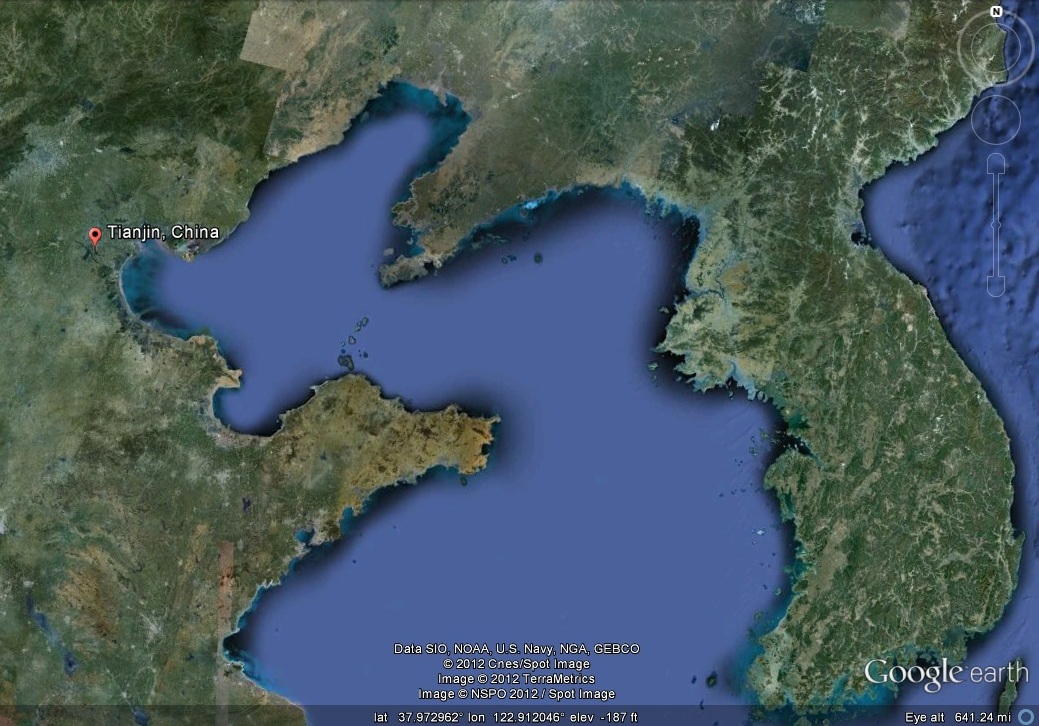
Pictured Above: Tianjin’s location relative to the DPRK

The Daily NK reports:

“A group of 20 trainees made up of economic officials and academics from the DRPK Ministry of Trade has been receiving training in Tianjin since the end of May upon an invitation from the Chinese Ministry of Commerce.”

“The aim of the training is the vitalization of North Korea’s special economic zones at Hwanggeumpyeong, Wihwa Island and Rajin-Sonbong,” he added.

According to the source, the North Koreans, who come from the finance and economics, administration and taxation sections of the ministry, will remain in China for two months. The costs of the program, including accommodation and training fees, are being covered by the Chinese side, and they are staying in a state guest house.

For the first month, the 20 were reportedly due to receive training in techniques pertaining to the operation, management and attraction of investment to SEZs from Chinese experts. For the second, they are set to receive field training in Shanghai, seeing how China’s SEZs operate.

Previous posts on Hwanggumphyong are here.

Previous posts on Rason are here.

Read the full Daily NK story here:

20 NK Officials Getting Schooled in Tianjin
Daily NK
Chris Green
2102-7-4

Share