Archive for the ‘Economic reform’ Category

Paul Tija on outsourcing in the DPRK

Thursday, August 23rd, 2012

Paul Tjia of GPI Consulting has written an article in the August issue of the American magazine Communications of the ACM on outsourcing in the DPRK. Here is a link to the article (PDF):

Inside the hermit Kingdom: It and Outsourcing in north Korea

Here is a blurb from Mr. Tjia:

Somewhat unexpectedly, the Democratic People’s Republic of Korea has a sizeable IT sector. Some 10,000 professionals work in the field, and many more have IT degrees. They are already engaged in outsourcing contracts for other countries, and keen to expand further.

Share

Jang Song-thaek visits China

Thursday, August 23rd, 2012

UPDATE 13 (2012-8-23): The Institute for Far Eastern Studies reports on Jang’s visit to China:

Jang Song Thaek’s Visit to China: Outcomes and Limitations
Jang Song Thaek, vice chairman of National Defence Commission of North Korea recently visited China and is raising many speculations about the outcome of the visit.

From August 13, Jang led 50 North Korean delegations to China, including high ranking officials such as Ri Kwang Gun, the chairman of the joint venture investment committee, Ri Su Yong, the former chairman of the same committee, and Kim Hyung-jun, deputy foreign minister. Together with the Chinese officials, Jang visited Rajin-Sonbong (Rason) special economic zone, and Hwanggumpyong and Wiwha Islands, and discussed the issues of expanding economic cooperation with China.

Jang attended a meeting with China’s Minister of Commerce Chen Deming, titled the Third Meeting of the DPRK-China Joint Steering Committee for the Development of Hwanggumpyong and Rason Districts. In addition to the meeting, Jang visited Jilin and Liaoning Provinces, asking for China’s active assistance and investment in these areas.

Jang also met with Wang Jiarui, head of the International Department of the Communist Party of China (CPC) Central Committee, President Hu Jintao and Premier Wen Jiaobao in Beijing to discuss the future economic cooperation between the two nations and to request for China’s further economic assistance.

North Korea was successful in obtaining positive response from China, promising to help the economic development of North Korea. China has agreed to provide electricity and other necessary infrastructures, including roads and communication network, to push forward with the joint development of Hwanggumpyong and Rason.

However, it is still unclear whether Jang’s visit to China will lead to actual revitalization of bilateral economic cooperation. Chinese companies are still cautious about investing in North Korea with its inadequate infrastructures and legal framework and volatile political situations posing as risks to their investments. Other than labor force export, natural resources development and agricultural and fishery product trades, there is yet to be other model for successful economic cooperation.

Chinese companies consistently argued investment in North Korea can be viable only under the condition that government guarantees or other safety mechanisms are provided to protect the investments of the Chinese companies.

However, in the recent agreement signed by Jang Song Thaek and Chen Deming, two sides have agreed to abide by the principle of development cooperation, to be “led by the governments, based on enterprises, and to achieve mutual benefit and win-win through market operation.” Thus, Chinese government has expressed its intentions to not provide government guarantees for the investments and North Korea has not put forth appropriate policy to soothe the apprehensions of the investors.

Moreover, there are more hurdles to be overcome in Rason and Hwanggumpyong development. Although China gains access to the East Sea through Rason, serving as an important logistics and manufacturing hub in the Northeast Asia reaching South Korea, Russia, and Japan, still no major investment is seen in the area due to the poor industrial infrastructures and basic industries.

Hwanggumpyong and Wihwa Islands are also faced with challenges of its own. Geographically it sits in close proximity to Dandong, in the Chinese territory and while North Korea is pursuing for joint development in the area, China is still passive in the development of this area. This area also frequently fall victim to severe flooding, costly in repairs and maintenance.

China is likely to continue to support North Korea’s economic revitalization efforts and the security of its regime. For North Korea, direct aid is limited and economic cooperation is the most effective option for economic recovery but until it fully accepts the international norm and open up to the outside world, it will be difficult to achieve full economic revitalization.

UPDATE 12 (2012-8-22): Marcus Noland comments on the visit and the agreement here.

UPDATE 11 (2012-8-20): The Choson Ilbo reports that Jang received no official support from Beijing as a result of the visit:

Jang left without receiving any pledges of material support from Beijing, a high-ranking government official here said on Sunday.

Asked about a reported request for US$1 billion in loans from China, the official said, “I have yet to hear of any economic support from China to North Korea, whether it involves $1 billion or $1 dollar. China stressed market principles to Jang.”

UPDATE 10 (2012-8-18): The Hankyoreh reports on a number of investment deals that were inked between the DPRK and Chinese enterprises:

The success of the zones’ development is crucial for North Korea in its current push for economic reforms and improvements to living conditions. This accords with Beijing’s strategy of leading Pyongyang into a gradual normalization through reforms and openness, with an eye to eventually resolving its nuclear program issue.

Another positive signal for Pyongyang is the string of Rason investment declarations by large Chinese corporations following Jang’s visit.

The Yatai Group, a major construction and real estate conglomerate, signed a contract with the Rason people’s committee to develop a construction materials complex in the city. On Friday, the large state-owned Ludi Group announced it would also be investing in Rason. Its director, Zhang Yuliang, announced in an interview with the People’s Daily website people.com.cn that his company would be taking on the construction of basic facilities at Rason, including a power grid.

UPDATE 9 (2012-8-18): Xinhua reports on Wen’s meeting with Jang:

Jang is in China for the third meeting of the joint steering committee for developing and managing the Rason Economic and Trade Zone and the Hwanggumphyong and Wihwa Islands Economic Zone.

Wen said both sides should give priority in developing and managing the zones as well as implement the consensus reached by the joint steering committee.

The premier said the two governments should strengthen the leadership and planning of the cooperation on the zones, improving laws and regulations; encourage relevant regions for active participation with close coordination; and let the market play its role creating favorable conditions for land and tax.

He called on the committee to encourage businesses to invest in the zones and help enterprises solve their problems, and improve customs and quality inspection services to help with bilateral cooperation.

UPDATE 8 (2012-8-18): Reuters reports on Jang’s visit with Wen Jiabao.

Premier Wen Jiabao encouraged North Korea to allow “market mechanisms” help revamp its economy, state media said on Saturday, and laid down other pre-conditions as China tries to wean its impoverished ally off its dependence on Chinese aid.

As well as allowing freer rein to market forces, the Chinese premier also recommended Pyongyang encourage economic growth by improving laws and regulations, encouraging business investment and reforming its customs services.

China’s President Hu Jintao also met Jang in a clear show of support for the North and its new leadership. Jang is seen as the driving force behind reforms that the isolated and destitute North is believed to be trying and for which it desperately needs Chinese backing.

So far North Korea has received around $300 million in non-financial direct investment from about 100 Chinese companies, mainly in the food, medicine, electronics, mining, light industry, chemicals and textile sectors.

China’s exports to North Korea rose 20.6 percent last year to $2.28 billion from 2010, while imports plunged 81.4 percent to $147.4 million, according to Chinese customs figures.

Those numbers are dwarfed by trade with South Korea, China’s third-largest trading partner.

UPDATE 7 (2012-8-17):

Hu Jintao Receives DPRK Delegation
Beijing, August 17 (KCNA correspondent) — President Hu Jintao, general secretary of the C.C., the Communist Party of China, met the delegation of the DPRK-China Joint Guidance Committee led by Department Director of the C.C., the Workers’ Party of Korea Jang Song Thaek who paid a courtesy call on him at the Great Hall of the People in Beijing on Friday. The delegation took part in the third meeting of the DPRK-China Joint Guidance Committee for the joint development and management of the Rason Economic Trade Zone and Hwanggumphyong and Wihwado Economic Zones.

Jang Song Thaek conveyed greetings of the dear respected Kim Jong Un to Hu Jintao.

Expressing deep thanks for this, Hu Jintao requested Jang Song Thaek to convey his warm greetings and sincere congratulations to Kim Jong Un.

Hu Jintao, on behalf of the party, government and people of China, expressed sincere sympathy and consolation over the recent flood that hit the DPRK, causing huge damage.

He hoped that the Korean people would eradicate the aftermath of the disaster and bring the living of the people in the afflicted areas to normal as soon as possible under the leadership of First Secretary Kim Jong Un.

Noting that China and the DPRK are friendly neighbors linked by the same mountain and rivers, he said that the policy of the Chinese party and government to attach importance to and develop the China-DPRK friendship from the strategic viewpoint and on long-term basis would remain unchanged in the future, too.

He expressed his willingness to strengthen the high-ranking visits, cooperation in various fields and the exchange of views on international and regional problems and upgrade the bilateral relations to a new level as agreed by both sides.

He was rejoiced over the fact that the development of the two economic zones has entered a practical phase thanks to the common efforts, wishing that a good example of economic cooperation would be set.

The Chinese party and government support the Korean comrades following the road of development suited to their actual conditions and wish them greater success in their efforts to build a thriving nation under the leadership of First Secretary Kim Jong Un, he said.

The talk proceeded in a comradely and friendly atmosphere.

Present there were members of the DPRK-China Joint Guidance Committee, Ji Jae Ryong, DPRK ambassador to China, Chen Deming, minister of Commerce of China, Wang Jiarui, head of the International Liaison Department of the C.C., the CPC, Zhang Ping, head of the National Development and Reform Committee, Shi Xuren, minister of Finance, Wang Min, secretary of the Liaoning Provincial Committee of the CPC, Sun Zhengcai, secretary of the Jilin Provincial Committee of the CPC, Zhang Zhijun, executive vice-minister of Foreign Affairs, Chen Jian, vice-minister of Commerce, and Liu Hongcai, Chinese ambassador to the DPRK.

UPDATE 6 (2012-8-16): Xinhua reports on the visit:

The Rason Economic and Trade Zone will focus on the development of raw materials, equipment, high-tech products, light industry, the service sector and modern agriculture, the MOC said after the meeting.

It will gradually become an advanced manufacturing base, as well as an international logistics center and regional tourism center for northeast Asia.

The Hwanggumphyong and Wihwa Islands Economic Zone will focus on the development of the information industry, tourism, modern agriculture and garment manufacturing, the ministry said.

The DPRK passed and promulgated the Law for the Rason Economic and Trade Zone and Law for the Hwanggumphyong and Wihwa Islands Economic Zone in December 2011, Shen said.

“Construction on the two economic zones has entered the stage of introducing enterprises to invest in the zones,” he said.

The two sides will continue to make joint efforts to make laws and regulations, make detailed preferential policies, improve construction planning inside the zones and attract companies to invest in the zones.

“Both sides will make full use of their respective advantages and build the zones into models of China-DPRK economic and trade cooperation and platforms for economic and trade cooperation with the rest of the world,” Shen said.

The MOC said Tuesday that China and the DPRK will continue to follow the principle of “government-guided, enterprise-based, market-oriented and mutually beneficial” cooperation in developing the two economic zones.

The meeting was jointly presided over by Minister of Commerce Chen Deming and Jang Song Taek, chief of the central administrative department of the Korean Workers’ Party.

UPDATE 5 (2012-8-16):

Chinese Officials Vow to Make All Efforts to Implement DPRK-China Agreed Points
Pyongyang, August 16 (KCNA) — The delegation of the DPRK-China Joint Guidance Committee sojourned in Jilin and Liaoning Provinces, China on Tuesday and Wednesday.

Department Director of the Central Committee of the Workers’ Party of Korea Jang Song Thaek, head of the delegation of the DPRK-China Joint Guidance Committee, met and had friendly talks with Sun Zhengcai, secretary of the Jilin Provincial Committee of the Communist Party of China, in Changchun City and Wang Min, secretary of the Liaoning Provincial Committee of the CPC, in Shenyang.

Sun Zhengcai extended congratulations to the successful third meeting of the above-said committee.

He said that Jilin Province is a significant place featured by historic relics on President Kim Il Sung and leader Kim Jong Il, recollecting with deep emotion the days when he was received by Kim Jong Il who visited the province in 2010.

The Jilin Provincial Committee of the Communist Party of China and the Jilin Provincial People’s Government will make efforts to implement the points agreed at the third meeting of the China-DPRK Joint Guidance Committee, he concluded.

Wang Min said he was pleased with the achievements made by the Korean people in building a thriving socialist nation under the leadership of the dear respected Kim Jong Un.

He underscored the need to contribute to boosting the traditional Sino-DPRK friendly relations provided by the leaders of the elder generations of the two countries by stepping up the joint development of the Hwanggumphyong and Wihwado Economic Zones.

UPDATE 4 (2012-8-15): The Associated Press reports on the meetings:

The ministry said the two sides signed a number of cooperation agreements related to their development of the two special economic zones: Rason on the Korean Peninsula’s northern tip and Hwanggumphyong, an island in the Yalu River that marks their border to the southwest.

It said plans for Rason would see it becoming a manufacturing base, logistics center and tourism hub, though the new agreements were still primarily focused on basic infrastructure, such as a plan to transmit electricity directly to the zone overland from China.

The Hwanggumphyong zone will focus on information technology, tourism, agriculture and garment manufacturing, it said.

Rason has recently begun to develop thanks to Chinese infrastructure projects, but Hwanggumphyong has languished since ground was broken last year.

The China Daily said in an editorial Wednesday that Chinese investment in the zones would help North Korea’s battered economy and improve stability on the Korean peninsula.

“The DPRK is in urgent need of capital to help revitalize its waning economy,” the paper said. “It can be expected that as a result of the agreements, Chinese investment in the special economic zones of the DPRK will increase rapidly.”

It noted that bilateral trade last year was $5.7 billion, up from $3.5 billion in 2010.

UPDATE 3 (2012-8-14): Ri Chol was among the group of DPRK leaders traveling to Beijing.

UPDATE 2 (2012-8-14): The Daily NK reports on Jang’s trip to China:

The level of popular interest in Jang’s visit is a reflection of two things: first, his relative importance in the North Korean power structure, and second, the fact that he is the highest North Korean official to visit Beijing since the official launch of the Kim Jong Eun regime late last year. Both these facts serve to make it highly likely that the remit of the trip extends quite a long way past the economic agenda cited by KCNA, presumably to encompass political and military concerns as well.

According to one diplomatic source in Seoul, “Kim Jong Eun quite possibly assumes that China harbors some anxiety about his newly launched system. Jang will probably explain the recent purging of former Chief-of-Staff Lee Young Ho, since this only made China more concerned.”

Sohn Gwang Joo, a senior researcher with the Gyeonggi Research Institute, went further, declaring, “The main reason behind Jang’s trip to China is to emphasize that ‘Chosun-China friendship transcends generations’, and that without the political, economic and military support that comes from that friendship, the Kim Jong Eun system cannot be maintained.”

“When Jang Sung Taek meets with high-level cadres including Xi Jinping, the two will discuss the issue of a bilateral summit,” Sohn added, noting the likelihood that such a summit is likely to occur after China’s own leadership transition in October.

Lee Tae Hwan, a researcher with the Sejong Institute, noted also that there is certainly more to the visit than KCNA made public, explaining, “There are a bunch of people who can solve economic problems like those at Rasun, Hwanggeumpyong and Wihwa Island, it doesn’t have to be someone as influential as Jang Sung Taek.”

“Therefore, Jang’s trip to China is not a working-level visit. He is raising the level of bilateral communication.”

UPDATE 1 (2012-8-14):

Third Meeting of DPRK-China Joint Guidance Committee Held
Beijing, August 14 (KCNA) — The third meeting of the DPRK-China Joint Guidance Committee for the joint development and management of the Rason Economic Trade Zone and Hwanggumphyong and Wihwado Economic Zones was held in Beijing on Tuesday.

Present there were members of the delegation of the DPRK-China Joint Guidance Committee led by its DPRK side Chairman Jang Song Thaek who is department director of the Central Committee of the Workers’ Party of Korea and Ji Jae Ryong, DPRK Ambassador to China.

Also present there were members of the delegation of the China-DPRK Joint Guidance Committee led by its Chinese side Chairman Chen Deming, minister of Commerce of China and Liu Hongcai, Chinese Ambassador to the DPRK.

The meeting reviewed the work done for developing them since the second meeting of the joint guidance committee.

In the Rason Economic Trade Zone, a master plan for developing the zone was mapped out, reconstruction of ports and railways made brisk headway, the project for reconstructing Rajin-Wonjong highway is nearing its completion and a work has made brisk headway in various fields including tourism and agricultural cooperation and measurement for the transmission of electricity from China was finished.

In the Hwanggumphyong Economic Zone, favorable preconditions were created for substantially starting the development project including the fixing of the spot for border passage according to the drafted detailed plan.

The meeting stressed the need to quickly start the Wihwado Zone development and show the world the will of both sides for the development of both zones.

At the meeting, both sides appreciated as the successes made since the second meeting the amendment, enactment and announcement of the law on the two economic zones, the agreement of development plans, the establishment of management committee, the work of various panels of the joint guidance committee, the training of management officials of the two economic zones, the promotion of already started projects, the border passage and positive progress in tele-communication cooperation through the joint efforts of the two governments.

Both sides reaffirmed that it plays an important role in consolidating and developing the traditional relations of DPRK-China friendship to invariably implement the historic agreement on the joint development and management of the two economic zones reached between the top leaders of the two countries in line with mutual interests.

Both sides said in unison that to develop the two economic zones of weighty significance in boosting exchange and cooperation in all fields between the two countries, developing economy and achieving regional stability and prosperity is in line with the common interests of the two peoples.

They agreed upon a series of matters of jointly pushing forward the top priority processes in creating environment favorable for investment in the two economic zones to meet international standard and mutual interests.

They agreed to make sure that the two governments support and encourage local governments and enterprises push forward this work now that all the matters related to the development of the two economic zones were agreed upon and have reached the phase of implementation. They also agreed to positively promote the development of the Wihwado zone.

They agreed to hold the fourth meeting of the Joint Guidance Committee in Pyongyang in the first half of 2013.

Minutes of the third meeting and the Agreement on Economic and Technological Cooperation between the Governments of the DPRK and the PRC were signed by Jang Song Thaek and Chen Deming.

A ceremony of declaring the establishment of the Management Committee of the Rason Economic Trade Zone and the Hwanggumphyong Economic Zone took place and relevant documents including The Basic Agreement on Investment in Port and Industrial District of the Rason Economic Trade Zone, A MOU on setting up the Management Committee of the Hwanggumphyong Economic Zone for Joint Development and Management between the North Phyongan Provincial People’s Committee of the DPRK and the Liaoning Provincial People’s Government of the PRC and A MOU on Designing Processes for Basic Facilities in the Hwanggumphyong Economic Zone for the Joint Development and Management between the North Phyongan Provincial People’s Committee of the DPRK and the Liaoning Provincial People’s Government of the PRC were signed during the meeting.

The Chinese Ministry of Commerce gave a reception in connection with the successful third meeting that day.

ORIGINAL POST (2012-8-13): According to KCNA:

DPRK Delegation Leaves for China
Pyongyang, August 13 (KCNA) — A delegation of the DPRK-China Joint Guidance Committee Monday left here for Beijing, China to take part in the third meeting of the committee.

It was headed by its DPRK side Chairman Jang Song Thaek who is a department director of the Central Committee of the Workers’ Party of Korea.

The meeting is reportedly to discuss the joint development and joint management of Rason Economic Trade Zone and Hwanggumphyong and Wihwado Economic Zone.

Share

Chongjin’s “Mansudae-style” apartments

Thursday, August 23rd, 2012

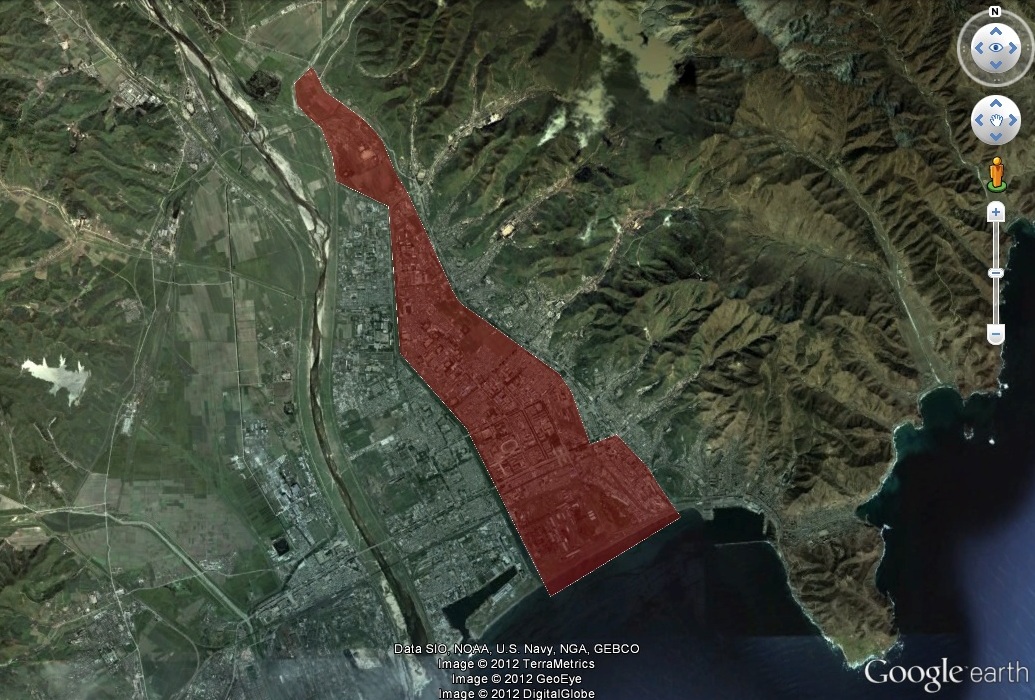
Pictured above (Google Earth): Pohang District, Chongjin (in red)

UPDATE 1 (2012-8-23): The Daily NK, which has been the only organization to cover the housing construction in Chongjin (see original post below), reports on the classic problem of political allocation of resources (in this case housing) in socialist economies. According to the article:

A source from Chongjin told Daily NK yesterday, “This rumor started going around that the apartments they are building would first go to decorated soldiers, veterans and discharged military officers, and then the rest would be distributed to ordinary people. As soon as that happened, a group of 40 or more people, many of whom had already seen their former homes demolished and thought they had priority on the housing list, got really angry.”

“The crowd went repeatedly to both the local administrative office and the district people’s committee to demand that a list of those assigned homes be made public,” he added.

During the protests, the source said, “Those who found they were not on the list warned that they would not stand idly by if their new homes were stolen from them. They didn’t back down from the guys from the Ministry of People’s Safety either, not for more than 30 minutes.”

The head of the local administrative office vacated his post due to the trouble and hasn’t been seen since, something that has made the aggrieved individuals even angrier. Upper level cadres are also refusing to meet them, and lower level figures are trying to wash their hands of the whole affair, saying that the list of those assigned apartments can no longer be changed. No longer thinking that the problem can be solved at the district level, the group has sent a letter to the provincial authorities outlining their grievances.

“Their point is that the authorities said that only a small number of the apartments would go to those people (decorated soldiers, veterans and discharged military officers), while most of them were supposed to go to ordinary families,” the source explained.

The source also explained the backdrop, saying that thousands of homes in the Namgang and Pohang areas of the Pohang district of the city have been destroyed since last June, and that the displaced residents from those homes have all been living with relatives and friends while waiting for the chance to move into what they thought were to be their new dwellings.

The problem is not over yet, either. According to the source, “It also looks like some facilities like shops and restaurants that were not on the original plans for an area around the amusement park are also being built, which will reduce the volume of housing available. Who can say how people from that area who’ve lost their homes will object if they lose out.”

This article is interesting to me because it answers a couple of questions I have had for some time: “What happens to families displaced by urban construction projects?” [Answer: for the most part, they go live with family members until replacement housing is allocated] and “How is new housing allocated if not through de-facto sales?” [Answer: Ideally through an objective and enforceable list based on “need”. However, this process is often corrupted. See here, here and here].

ORIGINAL POST (2012-8-14): According to the Daily NK:

It has been confirmed that affluent local wholesale traders have been co-opted to support the construction of apartment buildings in Chongjin, North Hamkyung Province.

A Chongjin source told Daily NK yesterday, “The construction of high-rise apartment buildings in the Pohang district of the city is being done by enterprises and ‘shock troops’, but there are also local go-betweens at the forefront connecting affluent traders from the region with the construction teams so that the latter can get materials as needed.”

The source went on, “It seems that most of the province’s rich people have gathered here. You can tell that there are people with genuine power involved in the construction by how fast the buildings are going up now.”

Since last May, Chongjin has been working to follow in the footsteps of the Mansudae area of Pyongyang by constructing apartments for 10,000 households, including 2,000 in the Pohang district. The project is said to be part of North Hamkyung Province Party Secretary Oh Soo Yong’s determined effort to show loyalty to the regime of Kim Jong Eun. However, the Party and state lacks the power to follow through on the plans.

The situation is not rare. Rich people and brokers acting as go-betweens are actively involved in all types of construction projects in North Korea today. This was even the case when Pyongyang planned the building of 100,000 apartments in time for the 100th anniversary of the birth of Kim Il Sung earlier this year. Indeed, all North Koreans know that “without the go-betweens this country’s economy would seize up.”

Usually, the North Korean authorities get factory enterprises and units of ‘shock troops’ to do the state’s construction and set in place plans to secure the necessary cement, steel and other materials, but this part very rarely goes according to plan.

For one thing, factories need to be bribed if the construction sites want to get their materials delivered on time, so the middlemen have a close relationship with the factories. Meanwhile, the rich people who finance the construction later receive a share of the finished apartments in return.

Currently in Chongjin, a home on the 3rd or 4th floor of such an apartment costs about $5,000. A rich man investing $7,000 dollars in the construction of a building can expect to make about $3,000 in profit. Other floors cost $3,000-$4,000 at current rates. However, in Pyongyang prices are much higher, with apartments on the 3rd or 4th floor trading for as much as $10,000 dollars.

The source said, “There are nicely dressed men striding around the construction site checking on progress, and these are the rich folk.”

The publicly available satellite imagery of Chongjin is too old to show recent construction, and since I have no budget, staff, or connections to people who have the ability to get new satellite imagery, I cannot show you any recent pictures.

Despite the lack of physical evidence, however, I have good reason to believe that new residential construction is underway in Chongjin.  This is because I do have publicly-available imagery of other DPRK cities and towns which are being “upgraded” with new apartment blocks. Recently I wrote about construction in Rason. I will post imagery of additional towns and cities if I get the time.

Read the Daily NK story here:
Rich Traders Invest in Chongjin Construction
Daily NK
Choi Song Min
2012-08-10

Share

Kaesong production increases in first half of 2012

Wednesday, August 22nd, 2012

Yonhap reports that the Kaesong Industrial Zone has experienced growth in both the nominal dollar value of its output (I do not know what exchange rate is used to determine the dollar value for accounting and reporting purposes) and the number of employed North Korean workers.

According to Yonhap:

Output in North Korea’s Kaesong industrial park jumped 23 percent in the first half of this year from a year earlier as more North Korean laborers worked at the South-North joint industrial project, Seoul said Tuesday.

The value of products manufactured at the industrial zone in the North Korean border city amounted to US$236.08 million during the January-June period of this year, compared with $192.01 million for the same period last year, according to the Unification Ministry, which handles inter-Korean issues.

The Kaesong Industrial Complex’s monthly production value surpassed the $40-million level for the first time in March before nearing $43 million in both May and June, according to the ministry.

The total number of North Korean workers in the Kaesong park stood at 51,310 as of the end of June after touching the 50,000-level in January. The number for January last year was 46,194, the ministry said.

Mentioned before on this web page, but nowhere else in English as far as I have seen, is the notion of foreign exchange risk built into the procedures that govern the Kaesong Industrial Complex.  The exchange rate risk stems from the fact that costs (payments made to the North Koreans) are denominated in US dollars whereas revenues (the output produced in Kaesong sold in South Korea) are denominated in South Korean won.  This means that if the dollar was to unexpectedly appreciate against the South Korean won, firms in the Kaesong Zone would find themselves in a bind with prices paid for inputs rising relative to the revenues received from sales. I am not sure what contingencies the architects of the Kaesong Zone have built in preparation for this scenario so if you seen anything about it, please let me know.

Previous posts on the Kaesong Industrial Zone here.

Read the full story here:
Kaesong industrial park’s output up 23 pct in H1
Yonhap
2012-8-21

Share

KoryoLink update (sort of)

Friday, August 17th, 2012

It is getting harder to know specific information about the DPRK’s mobile phone network…such as how many subscribers have signed up or how revenues/profits are doing.

In December 2011 Orascom Telecom finalized a demerger and the KoryoLink portfolio (the DPRK’s 3G mobile phone network) was transferred to a new holding company, Orascom Telecom Media and Technology Holding S.A.E. (OTMT).

According to the Orascom Q1 2012 shareholder report (p15):

Under the terms of the VimpelCom transaction, VimpelCom, Weather II and OTH agreed on a demerger plan (the Demerger”) pursuant to which the Company‟s investments in certain telecom, media and technology assets (the “SpinOff Assets”), which were not intended to form part of the VimpelCom business going forward, would be transferred to a new company, Orascom Telecom Media and Technology Holding S.A.E. (“OTMT”). The Demerger was performed in accordance with the guidelines of the Egyptian Financial Supervisory Authority and in particular decree no. 124 of 2010 and was completed in December 2011. The split of OTH shares by the way of the Demerger resulted in OTH shareholders holding the same percentage interest in OTMT as they held in the Company. The Demerger plan was initially approved in a shareholders meeting dated 14 April 2011 and subsequently on 23 October 2011. Approval from the Egyptian Financial Supervisory Authority was received in December 2011.

As a result of the Demerger, during November and December 2011, ownership of the following Spin-Off Assets was  transferred from the Company to OTMT:

[…]

75% ownership in CHEO Technology Joint Venture Company, together with all other assets and businesses located in
North Korea;

95% ownership in Orabank NK;

[…]

Other than the reference above, the Q1 report does not mention KoryoLink or even the DPRK. As you would expect, KoryoLink is not mentioned in Orascom’s Q2 2012 Shareholder Report either.

OTMT (the new holding company) has a web page, however it contains remarkably little information. Here is what it has to say about KoryoLink:

Koryolink

A joint venture between OTH [Orascom Telecom Holdings] and the state-owned KPTC [Korea Post and Telecommunications Company] and included as part of the assets held by OTMT following the demerger. OTMT holds, a 75% stake in [Cheo Technology Joint Venture Company] with KPTC. The company is North Korea’s only 3G Mobile operator. By June 2011, Koryolink’s network covered more than 75% of North Korea’s population (estimated at 24.5 million).

Being the first company of its kind and scale in North Korea, koryolink established many precedents; a first of its kind call center to provide customer service; a launch announcement in major newspapers and on radio despite almost non-existent marketing and advertising industries; and the implementation of a koryolink advertising billboard, the first of its kind in Pyongyang.

KPTC is the “Korea Post and Telecommunications Company” which is nominally controlled by the DPRK’s Ministry of Post and Telecommunications.

This OTMT page shows five financial reports for the year, however, only one of them is in English (an audit by Deloitte in June 2012). All the other reports are in Arabic. The audit report includes aggregate financial information from “CHEO Technology (KoryoLink)”; however, it does not contain any detailed company information. Hopefully this will change in the future.

The OTMT web page does not mention OraBank at all.  According to this organization chart, however, it appears to be held by a separate holding company under the OTMT umbrella, the Oracap Holding Co./Oracap Far East Ltd.  I have not been able to find out much more than that.

Additional information welcome.

Share

Changsong County held up as economic example (again)…

Sunday, August 12th, 2012

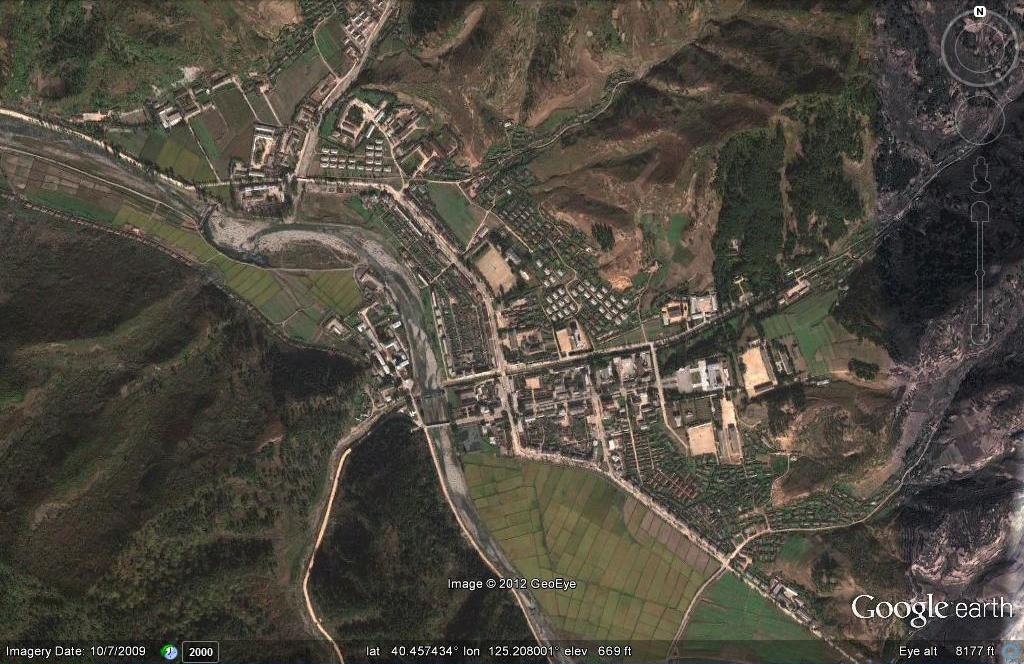
Pictured above (Google Earth) is Changsong Town in North Pyongan Province.

There has been a lot of talk about economic reform in the DPRK in recent weeks (see here). One of the aspects of these reforms has been greater local/regional control over economic policies and outcomes.

On August 9, the Daily NK reported that Changsong is “again being put forward as a model for the spontaneous economic development of regional cities and counties as the regime works to foster a different mindset prior to impending economic changes”. According to the article:

On the 8th, Rodong Shinmun published an editorial entitled, ‘Let Our Country Be Prosperous in the Spirit of the Changsung Joint Session’ in an edition that also featured seven other related articles. The articles served as a timely reminder of the joint session of central cadres, their provincial counterparts and economic sector officials held on August 7th and 8th in Changsung County.

[…]

Utilizing the history lesson, Rodong Shinmun emphasized, “The fundamental essence of the Changsung Joint Session was increasing the role of the county in developing regional industry and agricultural accounting, and enhanced the people’s lives by the strength of our household itself.”

It went on, “In every city and district, we must resolve to decisively raise the productivity of our land to solve issues of food insecurity, and must thoroughly implement the Party’s agricultural revolution.”

On days prior, Rodong Shinmun, KCNA and other state-run media outlets also reported in various forms the idea that ‘all the counties in the country are going to follow the example of Changsung County.’ For example, on the 7th it introduced a new food processing plant in Changsung County itself.

Analyzing these moves, Kwon Tae Jin, a researcher with the Korea Rural Economic Institute told Daily NK, “When it comes to the agricultural sector, the county is at the center of everything. This is a way of passing the center’s role to the regions at a time when the center (the Ministry of Agriculture) cannot play its role properly.”

“The purpose of emphasizing the responsibility of the Cabinet and the counties at the same time is to readjust the system,” Kwon added, while the head of North Korea Strategy Center, Kim Kwang In added, “Since the center cannot do what it needs to, they want the regions to deal with survival.”

The move is also intended to raise the likelihood of the 6.28 Policy succeeding. In Kim’s words, “The regime is pushing regional self-reliance prior to the announcement of the new policy.”

I have previously written about the “Changsong Joint Conference” here.

Interestingly, this narrative paints the 6.28 policy as an effort to decentralize economic production because Pyongyang can no longer afford the old policies, yet for propaganda purposes, it is being portrayed as the continuation of a movement personally launched by Kim Il-sung 50 years ago!

Changsong has indeed seen a lot of recent construction. According to KCNA (2012-8-4):

County, Model in Local Economic Development

Pyongyang, August 4 (KCNA) — Changsong County, North Phyongan Province of the DPRK, has become a model in the development of local economy in the new century. Great changes have taken place in all aspects of production and construction in a matter of little over one year.

Local industrial factories have been placed on a modern and scientific basis to lay a firm foundation for reenergizing production and improving the standard of people’s living. The county seat has taken on a new appearance to suit the specific features of a county.

President Kim Il Sung provided field guidance of devotion to the county, once known as remote mountainous county, more than a hundred times in his lifetime with a noble intention to turn it into a model to be followed by all other counties.

There began a new history of mountains of treasures in the county under his care. As a result, the Changsong joint meeting of local party and economic officials was held in the county in August 1962.

Leader Kim Jong Il made sure that the spirit of the joint meeting was fully displayed generation after generation. He gave an instruction to the county to raise a new torch for effecting a dramatic turn in the local industry in November 2010.

The dear respected Marshal Kim Jong Un has led a drive to face-lift the county as required by the building of a thriving nation so that the year 2012, the 50th anniversary of the joint meeting, may shine as a proud year and a year of new changes in the development of local industry.

All local industrial establishments in the county have undergone dramatic changes as required by the new century in a matter of little over one year.

All production processes at the foodstuff factory ranging from feeding of raw materials to packing and forwarding have been automated and its overall processes sterilized to ensure high quality and hygienic safety of products.

Its textile mill has installed new type machines. Technological updating has made brisk headway at all industrial establishments in the county including paper, furniture and chemical and daily necessities factories.

There has sprung up a new food processing factory. All its processes computerized, the factory mass-produces processed meat and vegetables, varieties of soft drink, and confectionary.

A garment factory with big capacity has been built to meet the county’s need for school uniforms and solve the issue of clothing by itself.

The appearance of the county has changed beyond recognition.

The county erected a mosaic depicting the portraits of the smiling peerlessly great persons. The Changsong revolutionary museum and the county hall of culture have been successfully renovated as centers for the education in the revolutionary history and people’s cultural and emotional life.

The Changsong Restaurant and a noodle restaurant built with Korean style roofs in the center of the county seat add to the beautiful landscape of the township.

There sprang up the Undok Health Complex with all welfare and service facilities, a children’s hall, kindergarten and nursery.

The library, county people’s hospital, sanatorium, commercial and catering network, public buildings and dwelling houses have also been renovated as required by the new century.

A great success has been made in the land management.

The eye-opening changes in the county promise a socialist land of bliss where all varieties of consumer goods are mass-produced at the local industrial factories and the people enjoy happiness in their modern houses.

On 2012-8-7,  the KCTV evening news broadcast images of some of the new construction:

And on August 8, KCNA reported that Choe Yong-rim visited the town:

Senior DPRK Party and State Officials Visit Changsong County

Pyongyang, August 8 (KCNA) — Senior party and state officials including Choe Yong Rim and officials of party, ministries, national institutions and local party, power and economic bodies visited various places of Changsong County, North Phyongan Province on Wednesday on the occasion of the 50th anniversary of the Changsong joint conference of local party and economic officials.

Changsong County is associated with the leadership feats of President Kim Il Sung and leader Kim Jong Il who opened up a wide road of developing local economy and improving the people’s living standard by increasing the role of county as a regional base.

The participants laid bunches of flowers before the newly erected mosaic depicting portraits of smiling Kim Il Sung and Kim Jong Il and made bows to them.

At the Changsong Revolutionary Museum, they looked round historic relics showing the efforts made by the President and Kim Jong Il who ushered in a new history of mountains of treasures, while giving field guidance to the county.

They also went to local industrial factories in Changsong including Foodstuff Factory, Foodstuff Processing Factory, Furniture Factory, Paper Mill, Jute Bag Factory and Okpho Stockbreeding Farm.

They enjoyed a performance given by the art group of the county at its cultural hall.

Share

Kaesong “wages” rise by 5% (2012)

Monday, August 6th, 2012

According to the Daily NK:

An agreement has been reached that sees the minimum monthly wage for North Korean workers in the Kaesong Industrial Complex rise by 5% to a little over $67.

According to information released by the Ministry of Unification today, the wage increase was negotiated by the Kaesong Industrial Complex Management Committee and the North Korean ‘Central Special Economic Zone Development Bureau’.

In accordance with the agreement, which will remain in force until the end of July next year, the wages of workers will rise from $63.80 to $67.05 per month.

Kaesong Industrial Complex regulations stipulate that wages may not rise by more than 5% per annum, and since 2007 they have risen by exactly that amount year-on-year.

At the end of May this year, there were 123 South Korean companies operating in the zone, employing a total of 51,452 North Korean staff.

According to the Ministry of Unification, when all payments and bonuses are taken into account, the average wage per North Korean worker in the complex was $110 per month in 2011, a figure that has risen to $130 in the first half of this year.

There has long been controversy over the fact that the North Korean authorities take a percentage of the wages of Kaesong Industrial Complex workers in taxes. However, even taking this into account, such workers are known to be better off than the vast majority of average North Koreans.

The only edit I would make to this story is to change the phrase “percentage of the wages of Kaesong Industrial Complex workers in taxes” in the above paragraph to “nearly all of the workers’  monetary income in taxes”.

See Yonhap coverage here.

Read the full story here:
Kaesong Monthly Wages Rise by 5%
Daily NK
Park Seong Guk
2012-8-6

Share

Kaesong Industrial Complex: Accumulative production output exceeds US$ 1.7 b

Friday, August 3rd, 2012

Institute for Far Eastern Studies (IFES)
2012-8-2

Kaesong Industrial Complex (KIC) has recorded 1.7 billion USD in accumulative production output as of May this year. The first phase construction of KIC consisting of some 3.3 square meters was completed in July 2006.

According to a report submitted to the National Assembly on July 25, the Ministry of Unification (MOU) specified that, out of the 123 companies in KIC, there were 51,452 North Korean employees (as of May 2012) and the accumulative export reached 1.21 billion USD out of the accumulative production output.

Despite the severed inter-Korean ties from the May 24 sanctions of 2010, the KIC continued to operate while most economic cooperation, social and cultural exchanges and humanitarian aid were halted.

The report also included MOU’s pledge to continue to support for stable development of KIC consisting of building fire stations and emergency medical facility and road repairs, among other measures.

Currently, there are water purification and supply plant (30,000 ton/day), waste water treatment plant (15,000 ton/day), waste landfill (60,000 ㎥), and waste incineration plants (12,000 ton/day) in operation and health and safety facilities such as police and fire stations, Green Doctors Hospitals are in the vicinity. Power is provided by South Korea with 100,000 kilowatts capacity power supply system.

In addition, MOU announced that it will continue to coordinate with North Korea to improve transportation, communication and customs system at the next meeting, and engage in negotiation to solve other issues including improvement of personal safety and labor shortages.

MOU also claimed it is making efforts to obtain the “Made in (South) Korea” labels for the products made in KIC for FTAs (Free Trade Agreement) with the EU, United States, and China. MOU officials are also a part of the South Korean FTA negotiation team.

Currently, the top agenda for the KIC is housing for North Korean employees. Unification Minister Ryu Woo-ik stated, “While I understand the positions of both North and the South, in which South Korean companies are in need of more labor and North Korea wants for more employment opportunities, dormitory construction for employees is a large-scale project similar to building a new town. Therefore, it must be coordinated carefully with North Korea to find the best solution.”

Share

North Korea presents favorable conditions to foreign investors

Monday, July 30th, 2012

Institute for Far Eastern Studies (IFES)
2012-7-27

The Beijing branch of the Joint Venture and Investment Committee of North Korea (JVIC), called the Choson Investment Office, announced on July 18 of various preferential conditions to foreign investors and employment conditions on its website.

The Choson Investment Office opened its doors this year and is the only overseas branch of the JVIC, in charge not only of securing foreign capital but cultural and science and technology exchanges and cooperation.

The website posted an article titled, “Problems Investors Face,” which provided useful information for foreign investors in a question and answer format.

In the article, the employment conditions for workers were included. The minimum monthly wage for workers in North Korea was set at 30 euros or about 42,000 KRW. In addition, foreign companies must pay 7 euros to each employee separately as social insurance. Overtime pay also needs to be paid and at the event of work related injuries or illness, the company is responsible for handling the situation with its board of directors.

In comparison, the minimum monthly wage for North Korean employees in the Kaesong Industrial Complex (KIC) is 110 USD or about 125,000 KRW.

As for preferential tax policies, foreign-capital companies that are not joint venture are exempt from certain taxes including tariffs on exports and resource tax for the development of mines.

North Korea will bear the land use tax, which is 1 euro per square meter, and China and other foreign investors will have no restriction for mining the underground resources.

The income tax rate for the foreign capital companies was specified at 25 percent and business tax between 2 to 10 percent will be collected from transportation, power, commerce, trade, finance, insurance, tourism, advertisement, hotel and entertainment industries.

Power is the main concern for most foreign companies and it will be provided at 0.053 euro per 1,000 kilowatt. The DPRK’s central trade guiding organ will oversee the setting of prices of goods while the trademark rights will belong to the company.

The DPRK’s Joint Venture and Investment Committee was expanded and reorganized in July 2010 from Joint Venture and Investment Bureau, with main activities centered around Hwanggumpyong Island and Rajin-Sonbong development.

The main agents for foreign currency earnings are the cabinet, military, JVIC, and Daepung International Investment Group*. Most of the trading companies are affiliated with one of the four groups.

In March, JVIC announced through the KCNA that “As the investment environment is favorably changing, joint venture and investment contracts are increasing. Investment interests from large companies are rising especially in our abundant rare-earth and underground resources as well as building railroads, roads, and power plants.”

*IFES and Choson Exchange previously discussed the merger of JVIC and “Daephung”

Share

DPRK denies economic and international policy changes

Sunday, July 29th, 2012

UPDATE 3: See Chris Green’s comments here.

UPDATE 2: See Geoffrey See’s take at Choson Exchange.

UPDATE 1: See Evan Ramstad’s coverage of this story in the Wall Street Journal.

ORIGINAL POST: Following the spread of speculation in the West that the DPRK is in the midst of re-calibrating some of its economic policies (see here, here, here,  here, and here), KCNA issued a public rebuttal (and took a swipe at deaf and blind people through some strange metaphors). According to the article (2012-7-29):

To Expect ‘Change’ from DPRK Is Foolish Ambition: Spokesman for CPRK

Pyongyang, July 29 (KCNA) — A spokesman for the Committee for the Peaceful Reunification of Korea gave the following answer to a question put by KCNA Sunday in connection with the fact that the south Korean puppet group is talking loudly about the DPRK’s “policy change” and “reform and opening”:

The army and people of the DPRK are dynamically advancing toward the final victory full of fresh conviction and vitality with a great honor and pride of holding in high esteem Kim Jong Un, supreme leader of the party, army and state, as DPRK Marshal.

They are bringing about remarkable events one after another in high spirit and stamina while demonstrating over the world the dignity and might as a power which is carrying forward the tradition of Mt. Paektu. This stirring reality is greatly admired by the whole world.

Upset by this, the puppet group let experts in the north affairs and others interpret the stirring situation of the DPRK in a self-centered manner, vociferating about “signs of policy change” and “attempt at reform and opening”. This ridiculous rhetoric only revealed its ignorance and sinister intention against the DPRK.

As far as “signs of policy change” are concerned, there can not be any slightest change in all policies of the DPRK as they are meant to carry forward and accomplish the ideas and cause of the peerlessly great persons generation after generation, to all intents and purposes.

The DPRK is putting forward new strategic and tactical policies in keeping with the changing and developing situation in each stage of revolution. The puppet group is describing it as a “policy change” and tried to give impression that the present leadership of the DPRK broke with the past. This is the height of ignorance just like a deaf person saying in his favor.

(more…)

Share