Archive for the ‘Economic reform’ Category

North Koreans learning economics in Canada

Monday, November 19th, 2012

UPDATE 2 (2012-11-19): Writing in 38 North, Kyung-Ae Park offers some more details on the program which brings these North Korean students to Canada:

The UBC program has been hosting North Korean professors since 2011 as part of a long-term knowledge sharing exchange initiative. For its inaugural effort, KPP hosted six North Korean scholars, five from the Kim Il Sung University and one from Wonsan Economic University. The scholars, who arrived in early July and studied at UBC through December 2011, took English courses during the summer and business and management courses from September focusing on international trade, management, finance, and economics. The curriculum consisted of regular, unmodified courses also attended by UBC students. As part of the curriculum, participants completed a group research project with faculty supervision on an aspect of international trade/finance stemming from their studies at UBC. In addition, they had opportunities to take field trips, and meet with leading individuals in Canada’s financial, business, and legal communities, as well as fellow academics.

Now in its second year, KPP is hosting another group of six participants, this time from Kim Il Sung University, the University of National Economy, and the Pyongyang University of Foreign Studies. As in the previous year, these scholars will be provided with an in-depth education of the international economy and policies implemented by other countries. With this second year of the program well underway, UBC has emerged as a leader in academic engagement with North Korea. There is great optimism that KPP will serve as a possible model for other educational institutions interested in exploring knowledge sharing programs with North Korea in the future.

Read the full story here.

UPDATE 1 (2012-7-20): Yonhap reports that the the Canadian-run program of bringing North Koreans  to the University of British Colombia to learn about economics is continuing. According to the article:

Six professors of leading North Korean universities are staying in Vancouver to study capitalism at a Canadian university on a six-month program, the program director said Friday, drawing fresh attention to the North’s possible transition under its Swiss-educated young leader.

The economics professors from three North Korean universities arrived in Canada earlier this month to take courses at the University of British Columbia (UBC) in the fall semester, which begins in September, after a two-month language course, Professor Park Kyung-ae, director of the Center for Korean Research, said.

“They will mainly study international business, economics, finance and trade,” Park told Yonhap News by phone, without giving further details of their identifications.

The elite universities include Kim Il-sung University, the top university named after the country’s founding leader, the People’s Economics University and the Pyongyang Foreign Language College, Park said. All the institutions are located in the North’s capital, Pyongyang.

They are the second group of visiting professors to take the courses under the Canada-DPRK Knowledge Partnership Program, which Park helped launch at UBC last year. DPRK stands for North Korea’s official name, the Democratic People’s Republic of Korea.

A group of six professors, five from Kim Il-sung University, attended the program in the fall semester last year, which included meetings with CEOs of Canadian law firms, banks, insurance companies and energy firms.

“There was no such long-term program related to North Korea in the past,” said Park, who visited the communist state last month. “The professors who completed last year’s course did their best and had good relations with other professors and faculty members. As they successfully finished the course, we were able to continue the program this year as well.”

ORIGINAL POST (2011-8-18): Just as Canada tightens sanctions on the DPRK, news comes out that the Canadians are running a very worthwhile program–teaching economics to North Korean professors! Let’s hope this program can be expanded!   According to Yonhap:

Six North Korean professors are studying economics and other related subjects at a university in Canada on a months-long program initiated by the school, the program director said Wednesday, opening a rare opportunity for the people of the repressive regime.

Professor Park Kyung-ae, director of the Center for Korean Research at the University of British Columbia, told Yonhap News Agency the North Koreans arrived last month to study international business, international economics, finance and trade. Five of the visiting professors teach these subjects at Kimilsung University, the elite North Korean institution named after the country’s founding leader, while one teaches at a university of economics in the eastern city of Wonsan, she said, declining to give further details.

The Japanese newspaper Asahi Shimbun reported earlier that the six professors from Kimilsung University were studying on an MBA course at the university in Vancouver. In fact, Park said the North Koreans will study four subjects at the undergraduate and postgraduate levels starting in September, after completing a two-month English language course.

The visiting professors are the first group to have been invited under the Canada-DPRK Knowledge Partnership Program, which Park helped launch at UBC last year. DPRK stands for North Korea’s official name, the Democratic People’s Republic of Korea.

“The program is very unusual in that it allows North Korea’s college professors to conduct research (overseas) on a long-term basis,” Park said, saying the professors will stay for a total of six months. “Other universities in North America are paying close attention to the program, and through it, I plan to push for exchanges between university officials of the two countries.”

Park, who has traveled to Pyongyang on several occasions since the mid-1990s and hosted North Korean delegation visits to Canada, said she believes educational exchanges are an important mechanism through which the two countries can improve ties. She noted that North Korea and Canada established diplomatic relations in 2001, but their ties have faltered over Pyongyang’s nuclear weapons program.

Since the 1990s, the North Korean regime has been known to send a selected few, mostly government officials, to study the market economy in Switzerland and other countries. However, these people have only been allowed to stay for several weeks, apparently due to fears they will try to escape the control of their repressive regime.

Share

KoryoLink update

Sunday, November 18th, 2012

Although KoryoLink’s corporate performance no longer appears in Orascom shareholder reports, Naguib Sawiris has given an interview in Forbes in which he offers some business details:

Sawiris has a 75% stake in Koryolink via his Orascom Telecom Media & Technology (OTMT) unit, with the remainder held by a company under the Ministry of Post & Telecommunications. He says revenues in 2012 should reach around €186 million ($145 million), with an average revenue per user of €8.6. The network only permits domestic calls and locally hosted data services. A separate cell network is available for foreigners in North Korea.

FORBES: How many subscribers does Koryolink have? How extensive is your coverage in DPRK?

NAGUIB SAWIRIS: Koryolink currently has more than 1.5 million subscribers. Coverage includes the capital Pyongyang in addition to 15 main cities, more than 100 small cities, and some highways and railways. Territory coverage is around 14%, and more than 90% population coverage. The subscriber base has been increasing at a very healthy rate from 950,000 at [year-end] 2011 to an estimated 1.7 million at [year-end] 2012.

FORBES: Under your joint venture with the Ministry of Telecommunications, when will Koryolink lose its exclusivity? What will happen after this period ends?

NS: Exclusivity was granted for a period of 4 years from launch. After the expiry of exclusivity in Dec. 2012, Koryolink received written confirmation that for an additional period of 3 years (until 2015) no foreign investors will be allowed in the mobile business. However, we are continuing to expand our network and services to further solidify our position [in order] to be ready for any possible competition.

FORBES: What is your role in the construction of the Ryugyong Hotel? What other real estate interests do you have in DPRK?

NS: This is a special investment that we are maintaining through our banking subsidiary in the DPRK, where Orascom has the right to operate this facility. The construction, repair and facade installations have all been completed last summer. We are planning to relocate Koryolink headquarters into the tower very soon to bring life to the building. There are no other real-estate investments in the DPRK, however, Orabank, our banking arm in DPRK, is actively working towards developing mobile-related businesses and projects.

Chris Green offers some great information (about which I have long wondered)  on the process required to acquire a cell phone:

First, the individual wishing to obtain a cell phone must go to his or her local Communications Technology Management Office (통신통화관리국 or CTMO; in provincial capitals only) or a subordinate arm of the same (in smaller cities) to obtain a three page application form. This form, once filled in, must be stamped by the Ministry of Public Security officer assigned to the individual’s workplace or, for those without official workplaces, attached to his or her local people’s unit.

Having paid off the public security official in cigarettes or cash (more often the former, according to this author’s sources, because it arouses less friction) he or she must submit the stamped form to the CTMO or equivalent, whereupon it is sent, with all the speed one would expect of the North Korean transportation network, to the Ministry of Communications in Pyongyang. At this point there is little else to be done but go away and pitch the proverbial tent, because at best it takes a month for the staff in the revolutionary capital to process the application.

Assuming, and it should not be assumed, that those checks done in Pyongyang don’t yield any incriminating evidence of wrongdoing (don’t forget, the North Korean legal system makes every adult a criminal in one way or another, something which can come back and haunt any individual whenever “rents” are desired), the individual will eventually be ordered back to his local communications office, whereupon he will be handed a payment form. He or she must then take this form to a bank, and engage with the separate, and no less inefficient, bureaucracy therein in order to pay the majority (though not all) of the cost of a phone and Koryolink network activation fee.[1]

The payment form, duly stamped by a functionary at the bank, must then be taken back to the CTMO or equivalent, whereupon it can be exchanged for half the stamped application form originally sought from the ministry in Pyongyang. Here, finally, the individual reaches a watershed moment: this form can actually be exchanged for a cellular telephone!

However, the pain is actually quite a long way short of being over. In a moment of uncharacteristic efficiency, the actual cell phone shop is often directly outside the communications office, but in a moment of karma-balancing inefficiency, it doesn’t open much, carries a limited amount of product and is pitifully understaffed. As a result, queues are long, as are waits. Assuming an individual lives long enough to reach the front of such a queue, he or she is finally offered the opportunity to hand over another $70-$100 and depart the scene with a brand new phone.

Writing in the Daily NK, Kim Kwang-jin explains how people are getting around this burdensome regulatory process:

Therefore, the source said, “Middlemen in larger cities are getting multiple phones activated in random people’s names and then taking them to smaller cities to sell. Alternatively, households that don’t have any problem getting that kind of approval are mobilizing the names of their entire families to get phones, which they are then selling on to the middlemen.”

“The end users are buying these cell phones for $300 to $500 from the middlemen or from private sellers. This saves them having to go to the trouble of applying to Koryolink,” he added.

A basic Koryolink phone can be purchased officially for roughly $270- $300, excluding bribes and extraneous costs. The price of one of these semi-legal phones depends on duration of use and model. The best product, the T1, a clamshell design, is the latest and costs more than $500. The next mid-range model is the T3, another clamshell; there is also a similarly priced phone with a slide design. The budget offerings are the T95 and T107. Differences in price are mostly attributable to differences in sound quality rather than the designs, sources assert.

In addition, there are also phones available for use within individual provinces. These products, which are similar to the so-called “city phones” that were briefly permitted in the late 90s but soon got withdrawn, cost just $70 at the time of writing.

Geoffrey See of Choson Exchange also offers some insight on Ora Bank’s mobile-related business projects:

However, it appears that Naguib, Chairman of Orascom, might have other ideas. In his words, “Orabank, our banking arm in DPRK, is actively working towards developing mobile-related businesses and projects.” The 3G network provides a platform for a range of other services that emerging market economies would need including remittances and payments through mobile banking and mobile payments. Given the primitive development of the services sector, mobile provides an opportunity for Orascom to upend the services industry in North Korea.

This was something I was originally looking at in North Korea. Payments are currently messy in the country. On a previous trip, I remembered an account of a North Korean trying to pay the handphone bill. Apparently the payment went to the wrong account, and the North Koreans spent the morning calling and shouting at some people to make the mistaken beneficiary return the money so that the payment could go to the right account. For what mobile banking and payments could potentially look like in North Korea, check out M-pesa.

Read the full story here:
Pyongyang Calling For Egyptian Telecoms Tycoon Naguib Sawiris
Forbes
Simon Montlake
2012-11-18

Share

Companies in Kaesong Industrial Complex receive unannounced tax notices

Thursday, October 25th, 2012

Institute for Far Eastern Studies
2012-10-25

Recently, eight companies in the Kaesong Industrial Complex (KIC) informed that they received tax collection notices, a unilateral decision made by the North Koreans.

The Ministry of Unification and KIC reported that out of the 123 companies, 8 companies were informed by the North Korean authorities to pay about 160,000 USD in total in taxes.

Two companies out of the eight notified companies already paid close to 20,000 USD to the North Korean tax authorities.

On top of taxation, 21 companies were notified to submit additional tax documents. This may be to collect additional information for future tax collection purposes.

The tax authorities are also requiring companies to submit documents related to show proof of purchase of raw materials, and submit cost analysis documents and a copy of bank statements showing the history transactions.

Last August, the Central Special Direct General Bureau (CSDGB) notified the Kaesong Industrial District Management Committee of new tax bylaws, which enforces a fine up to 200 times the amount of accounting manipulation and abolish the retroactive taxation system while increasing the number of documents for submission. Furthermore, the North is threatening to restrict access to the KIC, if companies fail to pay owed taxes or do not submit requested documents.

In addition to imposing fines for tax frauds, new tax bylaws demanded by the CSDGB included enforcement of additional taxes in the name of corporate income tax, sales tax, and other taxes.

The unilateral decision by the CSDGB to amend bylaws is a violation of Kaesong Industrial District Law, which requires any revision of the laws must be negotiated between the North and the South. Another problematic issue is that tax imposed on the companies is based on North Korea’s own estimation rather than tax reports submitted by the companies of the KIC.

For the first time last year, tenant companies in the KIC recorded an average operating profit of 56 million KRW, finally operating in the black after years in deficit.

Share

Pyongyang targets Kaesong Zone for more revenues

Thursday, October 18th, 2012

UPDATE 2 (2012-10-18): Yonhap and the Korean Times pass along details of the tax increases in the Kaesong Zone:

North Korea has unilaterally imposed hefty taxes on South Korean firms operating in the joint Gaeseong inter-Korean industrial complex in the North while employees there are demanding the firms provide more severance pay, a Seoul government official said Thursday.

“The North imposed the taxes including corporate income and business taxes on some of the companies operating in the Gaeseong complex in accordance with a new tax enforcement regulation (enacted) and delivered by the North last August,” the official said.

The imposed taxes were unilaterally drawn based on the North’s estimation of business activities by the South Korean firms, according to the official. About 10-20 firms out of the total 123 South Korean firms operating in the complex located in the North Korean border city of Gaeseong were reportedly slapped with the heavy taxes.

The amount of taxes imposed and whether the firms paid them are not clearly known, but some of the companies are said to have paid the taxes amid increasing pressure from the North.

The North unilaterally issued the new tax regulations in August, which also allow the country to levy heavy fines if a South Korean firm is found to have accounting irregularities. The regulations allow fines as heavy as 200 times the amount involved in potential accounting fraud by South Korean firms.

As part of efforts to extract taxes, the North is reportedly threatening a ban on the movement of goods and people in and out of the complex if the taxes are not paid, other sources said.

South Korean firms there are protesting the levies, saying “they may thwart normal corporate activities,” but the North may not budge on the decision, they said.

In addition, North Korean employees at the Gaeseong complex are demanding that South Korean firms provide severance pay even if employees voluntarily quit.

Under the current labor terms in Kaesong, South Korean firms are required to offer severance pay only when North Korean employees are involuntarily laid off after at least one full year of employment.

As of end-August, a total of 52,881 North Korean workers were employed by South Korean firms operating in the Gaeseong complex. About 500 to 1,000 employees leave South Korean employers every year, citing health reasons or marriage.

Meanwhile, the South Korean firms continued to register an annual net loss from their operations in the Kaesong complex, the Unification Ministry handling inter-Korean issues said. The combined net loss of 119 firms out of the total 123 stood at 14 million won ($12,681) in 2011, decreasing from net losses of 134 million won and 272 million recorded in 2010 and 2009, respectively, according to the ministry.

Nearly 37 percent of the 119 firms surveyed by the ministry said they feel the North’s interference with their corporate activities is severe, the ministry said. Inability in hiring or firing North Korean workers is the most frequently cited complaint among the 119 firms polled, followed by difficulties in Internet connection and a shortage of North Korean labor.

Read previous posts on this topic below.

(more…)

Share

The credible commitment problem of economic reforms

Tuesday, October 16th, 2012

We have all been watching whether the DPRK will implement economic policy adjustments that strengthen material incentives to farmers, workers and enterprise managers to increase production. I have cataloged many of these stories/articles/observations here.

Today the Daily NK offers a scenario as to why the DPRK has not implemented more generous agricultural production incentives:

A Hyesan-based source explained today, “Cooperative farm cadres are saying that none of the experimental farms will be given 30% of their production this year because it has become difficult to meet the target. They are saying that the harvest is not good and they need to feed the military as a matter of priority, so first they’ll guarantee the military rice then give the rest to the farmers.”

A Shinuiju source corroborated the story, saying that the authorities “haven’t said they are going to take all the production from the farms, but nobody actually thinks they are going to get very much. People who trusted the official words are feeling quite stupid, and nobody is working very hard.”

Back in July, each province designated a number of ‘model farms’ that were to be used to test the policy. These farms were supposed to receive their initial inputs of fertilizer and machinery from the state, and then be given 30% of their production in return.

“They are saying that the state does not have enough rice right now and that there is no choice but to give it to the military, so please try to understand,” the source said. “Farm workers, many of whom had been buoyed by talk of food distribution, are really disappointed, especially since prices are sky high in the market these days.”

Anyone who has taken a game theory class will note the presence of credible commitment problems and backwards induction.

If a game consist of two players (the state, farmers) operating in an environment where credible commitment is not attainable, one could argue that an outcome where the state promises to increase agricultural incomes yet farmers work less is the predictable result. Here is why: If at the beginning of the game the state says “we will raise your incomes if you produce more” and farmers respond by producing more, in the absence of credible commitment, at the end of the game the state can simply take all the increased production and pay no more. There is nothing to force the state to actually keep its word once the increased output has already been produced (assuming policy makers with short time horizons). Of course by utilizing backwards induction farmers realize this and do not increase production despite the promise of higher incomes. In the limit case, the DPRK announces economic policy adjustments, nobody believes them, and nobody moves to increase labor supply in the official sector of the peoples’ economy.

If the DPRK wants to offer effective policy adjustments that lead to real increases in output it must not only promise greater material incentives to workers and managers but it must do so in a believable way. Unfortunately there are no simple mechanisms to credibly bind the hands of the North Korean policy makers within the DPRK. In the absence of suitable constraints on state power (broadly defined), this means that reputation capital is even more important for achieving desired policy goals. This is why the decision to back-peddle on the 6.28 agricultural policies, if this is indeed what happened, is perhaps the most damaging move of all in terms of improving economic performance. Taking the North Korean government at its word (reputation capital), the farmers who increased effort in the fields (expecting a 30% ownership of their output in return) have instead given the state a free lunch. They will not be so inclined to increase output the next time the government comes knocking on their door offering dreams of a chicken in every pot.

If the DPRK government hopes to induce workers to increase labor supply through official channels, relying on nothing more than reputation, it is going to have to pay for failing to live up to its economic commitments in the past. In other words, it is going to have to slowly build up its reputation capital again by increasing the incomes of workers through a policy that is not likely to pay off for several years. It is only after workers again feel confident that the state will not back-peddle on the promise to let them retain 30% of their output that they will increase labor supply and output.

Read the full story here:
6.28 Agriculture Policy on the Back Foot
Daily NK
Lee Sang Yong
2012-10-12

Share

1st annual China-DPRK Economic, Trade, Culture and Tourism Expo

Sunday, October 14th, 2012

UPDATE 5 (2012-11-7): The China Daily’s English-language Dandong page offers additional details of the expo:

Despite the global economic slowdown, more than 6,000 business representatives from 20 countries signed agreements on more than 200 cooperative projects. Some 72 of the largest projects have a total combined value of $1.26 billion.

During the 11th Five-Year Plan period (2006-2010), total trade value between Dandong and DPRK amounted to $3 billion. Imports and exports between Dandong and the DPRK reached $1.86 billion in 2011.

So far, trade between Dandong and DPRK accounts for 40 percent of total China-DPRK trade, and the volume of the cross-border cargo trade via Dandong port makes up 80 percent of the total Sino-DPRK trade volume.

UPDATE 4 (2012-10-16): Xinhua reports on the closing of the expo:

The five-day 2012 China-DPRK Economic, Trade, Culture and Tourism Expo, held in the border city of Dandong, concluded on Tuesday with 72 agreements of cooperation intent signed. They have a combined value of 1.26 billion US dollars.

Pan Shuang, vice mayor of Dandong, said more than 6,000 Chinese and overseas people from over 20 countries and regions exhibited at and attended the expo. There were talks on 200 projects.

He said the projects related to industries ranging from aquaculture, clothes manufacturing, chemical production, wind power generation equipment, iron steel production to hotel construction.

AT THE EXPO

At the exhibition, the DPRK delegation exhibited ginseng products, food specialties, hand-made Hanbok, a traditional Korean costume, as well as mining and machinery equipment.

Ri Yong Chol, sales manager of Korea Roksan General Trading Corp., which is a ginseng supplier, said “I came to look for Chinese friends and potential business partners. Our company is also seeking opportunities to set up a subsidiary in China to get better access to the Chinese market.”

A Korean girl wearing brightly-colored Hanbok and traditional ornaments was selling costumes. “Our factory can make 20 such hand-made Hanboks a day. The clothes are for important occasions with exquisite workmanship and high-quality material,” she said.

Liu Songyu, chairman of a Korean garment firm from Yanbian Korean Autonomous Prefecture of Jilin Province, was interested in the business.

“Chinese labor costs have been rising fast. In Yanbian, a garment-factory worker’s salary has risen to 2,000 yuan (319 US dollars) a month. While, if the company had a factory in DPRK, it would save a considerable amount on labor costs. I would give a serious thought to that,” he said.

Yanbian is a heavily Korean ethnic populated region in China, where people also wear Hanbok during important occasions.

Elsewhere, Huang Zijun, an authorized dealer of Total Petrochemcial, was overwhelmed to obtain 20 orders from the DPRK delegation during the expo.

“I felt their enthusiasm in promoting business at the expo. I believe the DPRK is a big market for petrochemical products like lubricating oil,” he said.

Here is coverage of the closing in the Daily NK.

UPDATE 3 (2012-10-14): Martyn Williams pointed out this video to me which readers may also find interesting:

Click image to see video at CCTV web page

UPDATE 2 (2012-10-14): According to Xinhua:

An economic, trade, culture and tourism expo jointly initiated by China and the Democratic People’s Republic of Korea (DPRK) opened Friday in the border city of Dandong in northeast China’s Liaoning Province.

A delegation of 500 members from the DPRK is attending the 2012 China-DPRK Economic, Trade, Culture and Tourism Expo, which is scheduled to run from Friday to Tuesday, the event’s organizers said.

Over 400 Chinese companies from 12 industries are also attending the expo.

With the theme of “friendship, cooperation and development,” the expo consists of commodity exhibitions, trade fairs, DPRK art performances, craftwork exhibitions, a border trip to the Yalu River and an exhibition for the tourism resources of the two countries.

Supported by the China Council for the Promotion of International Trade, the event is being organized by the Liaoning Provincial Government.

China is DPRK’s biggest trade partner. Statistics show that bilateral trade volume went up 62.4 percent year on year to 5.64 billion U.S. dollars last year.

Xinhua posted these official photos.

CCTV also covered the expo.  Here is their English-language report:

Here is KCNA coverage of the expo:

The Daily NK also reported on the expo:

A source from Dandong described the unusually vibrant scene to Daily NK yesterday, saying, “The North Korean authorities have mobilized companies from Pyongyang and from here in China to sell goods and pitch for joint venture opportunities. There are loads of people; it’s standing room only.”

The source added that North Korean companies attending the event are pushing very hard to attract investment; notably, by distributing their own promotional literature expounding upon the given company’s superior virtues and providing exact contact details for follow-up inquiries. It is not hard to find meetings continuing in local North Korean eateries, as the North Korean side tries to woo potential sources of capital.

Chinese companies are keen to hear about the joint venture opportunities available, the source also said; and with most of the larger enterprises from China’s three northeastern provinces sending representatives to Dandong for the event, which runs until the 16th, most of the city’s hotels are apparently full to bursting.

However, due to past and present cases of lip service being paid to contractual obligations by North Korean companies whose only goal has been to attract funding rather than build business, Chinese representatives are still very cautious about actually signing on the dotted line.

One such representative from a Dandong-based company with a 10-year history of doing business with North Korea pointed out to Daily NK, “We have seen countless examples of companies making contracts and then there being little contact between the partners thereafter. Unbelievably, one manager I tried some minerals business with last year just changed the name of the company and came back again this year.”

Additional Information:

1. Here is IFES coverage of the expo.

2. The DPRK also held investment seminars back in late September.

UPDATE 1 (2012-6-7): The expo appears to have been pushed back to October 2012. According to KBS:

North Korea and China will jointly hold a fair on economy, trade, culture and tourism in the Chinese border city of Dandong for five days from October 12th.

A Dandong-based newspaper reports that this will be the first comprehensive fair covering several fields that the two countries hold. The paper said the fair will exhibit products, offer trade consultations, hold cultural and art performances and introduce both nations’ tourist attractions.

Roughly 400 Chinese companies exporting to North Korea will participate in the event. About 100 North Korean companies and cultural troupes will partake.

Dandong is China’s largest base for trade with North Korea, with 70 percent of its trade with North Korea running through the border city.

Read the full story here:
N.Korea, China to Hold Joint Industrial Fair in October
KBS
2012-6-7

ORIGINAL POST (2011-12-3): Dandong to host Sino-DPRK economic and cultural expo. According to Xinhua:

The northeastern Chinese city of Dandong, which borders the Democratic People’s Republic of Korea (DPRK), will host a Sino-DPRK economic, trade and cultural exposition in June next year, a local Chinese official said Saturday.

A series of activities, including a commodity fair, investment and trade talks, tourism exhibition and arts exhibition, will be staged during the exposition, said a spokesman with the Publicity Department of the Dandong Municipal Committee of the Communist Party of China.

The Phibada Opera Troupe of the DPRK, an artists group well known to Chinese people, will give performances during the event, he said.

Adam Cathcart took the time to send me this interesting link to the official Dandong web page.  It contains some videos (in Chinese) in which local officials promote the changes they expect to come to this city as it transitions into a regional trade hub.

Below I have added some links to recent blog posts that a re related to Dandong:

1. Dandong customs house is busy, busy, busy (2011-9-13)

2. Chinese foreign ministry publication frank on Rason and Hwanggumphyong (2011-8-31)

3. New Yalu River bridge in south-west Dandong (2011-6-25)

4. Some alleged guidelines for the Hwanggumphyong SEZ (2011-6-24)

5. DPRK and PRC launch joint Yalu patrols (2011-6-15)

6. Sinuiju SEZ Version 5: Hwanggumphyong-ri and Wihwa Island (2011-6-14)

7. Dandong-DPRK trade and growth (2010-12-2)

8. Future Sinuiju development affecting Dandong today (2010-10-19)

9. DPRK-China trade and investment growing (2010-10-1)

10. Dandong launches DPRK trade program (2010-8-19)

Share

DPRK china trade triples in five years

Monday, October 8th, 2012

According to Yonhap (via Korea Herald):

North Korea’s trade with China nearly tripled over the past five years, South Korean government data showed Sunday, underscoring the isolated North’s growing economic reliance on its major ally.

Trade between North Korea and China stood at US$5.63 billion last year, up 284 percent from $1.98 billion in 2007, Seoul’s unification ministry said in a report to the National Assembly.

North Korea’s exports to China almost quadrupled to $2.46 billion in 2011, compared with $580 million in 2007, the data showed. Imports rose to $3.17 billion last year, from $1.39 billion in 2007.

The North’s main export items were coal and iron ore, while primary imports from China were crude oil, gasoline and cargo trucks, it said.

A separate story on the report which also appeared in the Korea Herald featured these additional stats:

China accounted for only 67 percent of the North’s total trading with foreign countries, also including Russia, Thailand and Japan in 2007. But the dependency rate grew to 72.9 percent in 2008 and 82.9 percent in 2010 before hitting 89.1 percent last year, the report showed.

Annual food imports from China stood at 155,000 tons in 2008 and they have steadily grown to reach 380,000 tons for the whole of 2011, it said.

The same story had data on wages in the Kaesong Industrial Zone:

Another ministry audit report also showed that since 2004, South Korea has so far paid a total of $245.7 million in salary to North Korean laborers working in the Kaesong Industrial Complex, a joint inter-Korean industrial project in the North Korean village of Kaesong.

The report showed that a North Korean worker in the industrial zone earns an average $128.3 every month as of the first half of this year.

The average monthly pay stood at $68.1 in 2006 before steadily growing to $109.3 for last year.

Read the full story here:
N. Korea’s trade with China nearly tripled over past 5 years
Yonhap (via Korea Herald)
2012-10-7

N. Korea’s trade with China surges due to U.N. sanctions
Korea Herald
2012-10-8

Share

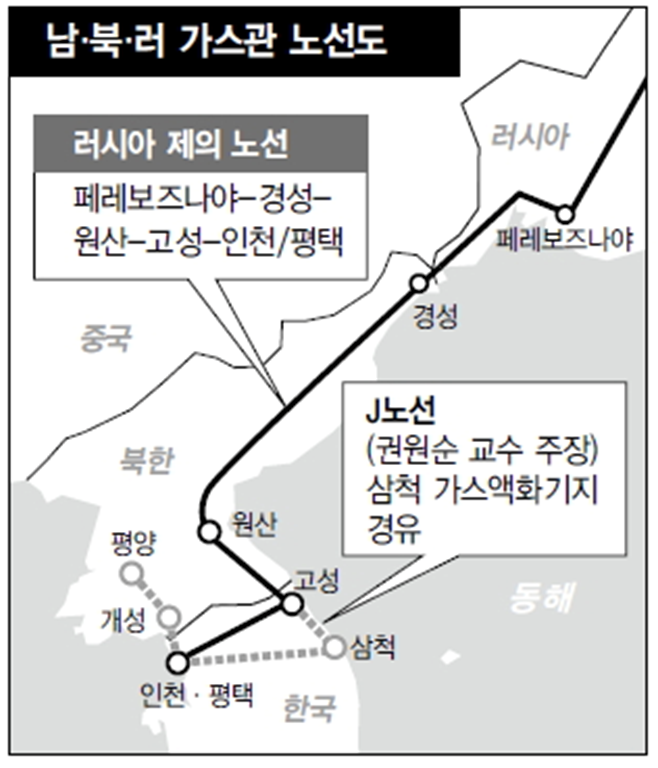
Russia-Korea gas pipeline compendium

Thursday, October 4th, 2012

UPDATE 43 (2015-6-17): Gazprom official claims pipeline not feasible. According to NK News:

The deputy CEO of Russia’s Gazprom told reporters that connecting South Korea to Russian gas supplies is economically attractive but politically infeasible on Tuesday.

The long-gestating pipeline project would extend through the DPRK and provide natural gas to energy-hungry South Korea.

But Alexander Medvedev, speaking from a press conference in Moscow yesterday, said the project was too difficult in the current climate.

“The level of communications, the level of cooperation is not that which would make it possible to speak of advancing to the feasibility study stage, let alone implementing a project to supply gas via North Korea.”

Despite the political hurdles, the project is still interesting from an economic standpoint.

“From the economic standpoint, this would probably be the most efficient option for supplying gas to Korea … There is demand for pipeline gas,” Medvedev added.

Despite the numerous roadblocks, the deputy CEO of the world’s largest gas producer remained hopeful that political changes could move the project forward.

“The opportunity remains all the same, but it depends on a resolution of the political issues between the DPRK and the Republic of Korea. There are certain positive signals, but there are negative signals too,” Medvedev said at the press conference.

Post 42 (2014-6-18): According to Leonid Petrov, “Russian GAZPROM postpones Trans-Korean gas pipeline construction project ‘due to unstable political situation in South Korea'”. Here is the source (in Russian).

Post 41 (2014-3-29): According to Yonhap, the Russians and the North Koreans held talks on a number of issues including the Kaesong Industrial Complex, Iron Silk Road, and the gas pipeline.  No information on the pipeline was made public.

Post 40 (2013-11-13): The Russians and South Koreans most recently discussed the Russia – South Korea gas pipeline at a presidential meeting in Seoul. No decisions were made. Read more here.

Post 39 (2012-10-4): The Choson Ilbo reports that the pipeline talks are delayed because DPRK is asking for transit rates above the international norm:

A South Korean government source said talks have dragged on because the North is demanding a transit fee that is two to three times more than international rates.

Based on a method of calculation used by Ukraine — about $2 per 1,000 cubic meters of natural gas for 1 km of pipeline — a reasonable fee would be about US$150 million a year given the estimated amount of gas South Korea would import from Russia and the 700-800 km of the gas pipeline running through the North. But the North reportedly demanded $300-500 million a year.

“It’s likely that the North asked for such a high price in the first place to gain the upper hand in future talks,” the source added. “There have been no full-fledged talks yet. At the moment, Pyongyang, Seoul and Moscow are just trying to read each other’s minds.”

Post 38 (2012-2-27): The Daily NK reports on details being discussed in the pipeline talks:

The Republic of Korea Ambassador to Russia, former chief nuclear negotiator Wi Sung Lac, says there has been progress on a gas pipeline connecting Russia, North Korea and South Korea.

“At the moment it is at the stage of enterprises discussing commercial conditions, and I am aware that there has been progress. North Korea and Russia are also discussing issues of transit and transit fees via working-level consultations,” he explained to reporters on a visit to Seoul today.

Wi would not be drawn on what kind of progress has been achieved, saying, “It’s about commercial details and so is hard to explain, but it appears there has been progress on supply quantities and supply conditions.”

Post 37 (2012-2-20): Gazprom reports “progress” in talks with North Korean government. According to Bloomberg:

OAO Gazprom, Russia’s natural gas exporter, said it made progress in talks to supply Korea Gas Corp. (036460) through a pipeline across North Korea, the Moscow-based company said today in an e-mailed statement.

Gazprom and Kogas, as the Korean company is called, plan to meet again in Moscow next month to continue talks, Gazprom said.

(more…)

Share

Some food, inflation, and trade data

Tuesday, October 2nd, 2012

These are all interesting data points. Do you think they offer reasonable journalistic evidence that the DPRK is practicing inflationary public finance?

First, Yonhap reports on DPRK food imports from China (2012-9-29):

North Korea’s grain imports from China slipped 16.3 percent on year in the first eight months of this year, in an apparent sign that the North may diversify its supply channels of grain, a Seoul researcher said Saturday.

North Korea imported 181,264 tons of rice, flour, corn and other grains from China in the eight-month period, compared with 216,535 tons for the same period last year, said Kwon Tae-jin of the state-run Korea Rural Economic Institute.

The decline in grain imports from China may be attributed to a rise in food aid from China and purchases from non-China markets such as Europe and South America, Kwon said.

“Including imports from non-China markets, North Korea’s total grain imports appeared to rise this year,” Kwon said in a report posted on his Web site, adding Pyongyang may “diversify its import channels.”

At the same time the Daily NK reports that food prices continue to rise (2012-10-2):

Internal sources informed Daily NK over the holiday that on September 29th the price of rice was 6,700 won/kg in Pyongyang, 7,000 won/kg in Onsung, North Hamkyung Province and 6,500 won/kg further west in Hyesan, Yangkang Province.

Not only do these prices far exceed those of Chuseok 2011, they even far exceed those of earlier this year.

The Hyesan source explained that on the day before the Chuseok holiday (Saturday) the atmosphere in the market was thus rather uncomfortable. “It was very slack,” she said. “People couldn’t buy anything easily, so most just seemed to be looking.”

Secondly, Yonhap reports that despite situations like those experienced by Xiyang or in Musan, mineral exports to China are up (2012-10-2):

North Korea’s exports of mineral resources recorded a 33-fold jump over the past decade with China remaining the biggest importer of the North’s iron ore and coal, a report showed Tuesday.

North Korea’s mineral exports stood at a meager US$50 million in 2001, accounting for 7.8 percent of its total exports, according to the report by Seoul’s Korea Trade and Investment Promotion Agency.

The mineral exports soared to $243 million in 2005 and $1.65 billion in 2011, accounting for 59.4 percent of the North’s total exports last year, the report said.

South Korea has estimated the total values of mineral deposits in North Korea at some $6.3 trillion.

Last year, North Korea exported $1.17 billion worth of anthracite coal and $405 million worth of iron ore, with China importing almost 100 percent of anthracite coal and iron ore, it said.

Share

DPRK investment seminars

Thursday, September 27th, 2012

Back in March 2011, KCNA posted this video clip to their web page:

Unfortunately for the North Koreans, actions speak louder than words.

The North Koreans appear to be worried that the unwanted attention brought about by the Xiyang story will have a negative effect on investment in the country’s special economic zones along the Chinese border. In order to combat these growing negative perceptions among Chinese investors, the North Koreans have begun holding a series of invitation-only seminars to tout the benefits of investing in Hwanggumphyong and Rason.

Here is coverage of the seminar in the Global Times (PRC) of the most recent seminar:

The officials told Chinese investors attending a seminar in Beijing that North Korea will allow the Chinese yuan to be used in business transactions, offer tax incentives to targeted industries and ease visa requirements.

North Korea is hoping to spur development of the Hwanggumpyong and the Wihwa Islands, two special economic zones on the Yalu River, which also runs through the Chinese border city of Dandong, Liaoning Province, reported the Beijing News. Favorable policies regarding the Rason Economic Trade Zone, which is closer to Jilin Province, were also discussed.

A North Korean official told the seminar that his country hopes to transform the economic zones into “world-class business districts.”

More than 200 Chinese companies, including State-owned enterprises and private corporations, participated in the seminar.

China’s Vice-Minister of Commerce Chen Jian said cooperation between China and North Korea on the development of the new economic zones is going smoothly.

Despite the enthusiasm from officials on both sides, entrepreneurs expressed concern over the veracity of the country’s legal framework needed to protect their investment.

“North Korea has significant iron ore and coal reserves, but I wouldn’t rush to invest unless I am sure it can be protected by their law,” a Chinese mining entrepreneur who requested anonymity told the Global Times.

The Daily NK provides additional details:

What the People’s Daily article did do was make clear how the two sides foresee the function of the SEZ areas. Rasun, it said, “will focus on the development of raw materials, equipment, high tech products, light industry, the service sector and modern agriculture.” Conversely, Hwanggeumpyong and Wihwa Island “will focus on the development of information industries, tourism, modern agriculture and garment manufacturing.”

The Chinese Ministry of Commerce has also moved to back efforts to stimulate interest in the SEZs.

The Hankyoreh offers some additional details on this and previous seminars:

Cars pulled up one after another on Sept. 26 in front of the Bridge Art Center in downtown Beijing, where a big blue sign read “Introduction to the Choson (North Korea) investment environment and counseling on investment areas.” The Chinese corporate executives who stepped out of the vehicles filed into the venue for a briefing on investment in North Korea.

The North Korean Committee for the Promotion of Economic Cooperation and China’s private GBD Public Diplomacy and Culture Exchange Center staged the event over two days in the hope of attracting investment by introducing “promising investment areas” for Chinese entrepreneurs.

The event was invite-only. Attendees walked around the venue, where they were asked not to take pictures. A screen at the front of the conference room displayed videos on the Rason and Hwanggumpyong special economic zones and the tax breaks available to investors. Around 100 Chinese businesspeople sat in their chairs to watch.

At the entrance was a list of around thirty participating North Korean businesses. Many were in areas such as natural resource development (iron and gold mining), seafood farming, and garments. Trade companies also stood out on the list, including the Daesong General Trading Corporation and the Jangsu Trading Company. Thirty-six officials from state-run North Korean businesses provided information about 43 investment projects. The afternoon saw one-on-one talks between North Korean officials and Chinese executives.

A senior official with GBD said hundreds of Chinese businesses would be participating on Sept. 26 and 27.

“There are quite a lot of Chinese businesses interested in investing in North Korea,” the official said.

On the invitations, the organizers touted the investment briefing as an “important opportunity for Chinese businesses to invest in North Korea.”

“Choson’s new leader Kim Jong-un declared that economic development and improving people’s livelihoods are important goals of the Workers’ Party of Korea,” they read.

This is just one of many such briefings that North Korea has organized all over China. On Sept. 7, a counseling session was held in Changchun, Jilin province, for “North Korea Day and China-Choson trade investment projects.” Another investment briefing on Sept. 9 was staged concurrently with the 16th China International Fair for Investment and Trade in Xiamen, Fujian province. A joint China-North Korea economic trade briefing on Oct. 14 in Dandong, Liaoning province, is scheduled to include counseling sessions for the three areas of trade, investment, and labor between 60 North Korean national trade company officials and 100 Chinese businesspeople.

Meanwhile, the Chosun Investment Office of Joint Venture and Investment Committee, North Korea’s body for attracting foreign investment, signed a contract in Beijing on Sept. 22 with China Overseas Investment to set up an exclusive North Korea investment fund of 3 billion RMB, or about US$476 million.

China’s private investors have shown much interest amid signs of change from Pyongyang, but sources said this had not yet led to actual investments.

“In staging investment briefings, North Korea is showing that it has decided on a course of change for the sake of the economy and the public welfare,” said a source in Beijing.

“In China, people have kept asking for Pyongyang to establish more laws and regulations to allay the fears of businesses investing there, so it’s going to take some time to see the kind of investment North Korean really needs for its own economic development beyond things like mining,” the source added.

Reuters also seems to have been invited:

But after listening to a presentation from Chinese and North Korean officials at one of Beijing’s most expensive hotels laying out the supposed allure of the two zones, the head of one company gave an emphatic “no” when asked if she was convinced.

“We’re not thinking about it at the moment,” said Li Guilian, chairwoman of Dalian-based clothing company Dayang Trands. “We might go and have a look at Hwanggumphyong, but I don’t think we’ll invest.”

She nodded her head vigorously when asked if she thought it was risky investing in such an isolated and backward country.

“Investors need first of all to consider the environment. If there’s a problem with the environment, then there’s no way people are going to commit money,” Li told Reuters.

Share