The Ministry of Unification’s recent monthly report on ‘Trends on Inter-Korean Exchanges” included an examination of the last five years of the Lee Myung-bak administration’s (January 2008 to November 2012) people-to-people exchanges and economic cooperation between North and South Korea.
Over the past five years, total inter-Korean trade reached 8.94 billion USD, a growth of 58 percent against the previous Roh Moo-hyun administration’s 5.62 billion USD. This increase can be attributed to the steady growth of the Kaesong Industrial Complex (KIC). The KIC recorded a total trade volume of 6.695 billion USD under the incumbent administration, which is nearly a seven-fold increase compared to the previous Roh administration’s record of 957 million USD. Considering its importance, the KIC was exempt from South Korea’s May 24 (2010) sanctions imposed against the North.
During the Lee government, 108 companies were authorized for inter-Korean cooperation projects (including the Kaesong Industrial Complex). This represents a drastic drop from the previous government’s 370 companies. Under Lee, the number of cultural exchanges and related businesses that were approved were a mere 5, compared to the former administration’s record of 121.
Combined government and private sector assistance to North Korea totaled 256.3 billion KRW, only one fifth of what was recorded during the Roh administration (i.e., 1.27 trillion KRW). While the current government had more private sector support, the previous government showed more government support.
Over the 5 years of the Lee Myung-bak administration, 664,000 people traveled across the North-South border, which is significantly higher than the number (i.e., 390,002 people) recorded during the Roh administration. However, the majority were government officials, mainly those involved with the KIC.
The number of North Korean defectors that entered South Korea during the Lee administration’s term in office was 724 people, a significant drop from the 4,571 people during the 5-year term of the previous administration. Last year, no defectors entered South Korea — the first “zero-entry” in 14 years (that is, since 1998.
In terms of cross-border vehicle traffic, vehicles traveled across the border 840,009 times, an increase from the previous administration’s 490,000 visits. However, the quantity of goods transported dropped 40 percent from the previous, at 1.39 million tons.
In particular, after the ROKS Cheonan incident on March 2010, people-to-people exchanges and economic cooperation were completely halted due to the May 24 (2010) measures. The amount of goods transported was also largely reduced.
As far as cross-border rail is concerned, the Gyeongui Line (connecting South Korea to the KIC) and the Donghae Line (connecting the South to Mount Kumgang) were actively utilized during the Roh administration; but under the incumbent administration, only the Gyeongui Line was utilized.
During the Roh administration, the air traffic recorded 589 trips (42,495 people), but during the Lee government reached only 77 (3,812 people).
The number of separated families members reunited during the last five years was 1,774 (888 people in 2009 and 886 people in 2010). This is only a tenth of the 14,600 family members reunited during the former Roh Moo-hyun government.
UPDATE 1: Hat tip to a reader in the commentsection…Mr. Park was given honorary citizenship to the city of Pyongyang, not to the DPRK. This is the DPRK equivalent of getting the “key to the city”.
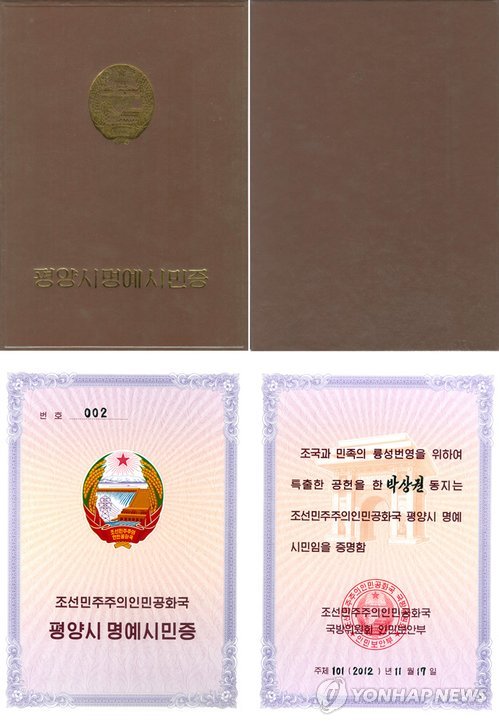
The head of inter-Korean automaker Pyeonghwa Motors said Tuesday that he was made an honorary citizen of Pyongyang late last year to reflect his contribution to North Korea’s development.
In an interview with Yonhap News Agency, Park Sang-kwon said he received the citizenship at the Mansudae Assembly Hall in the North Korean capital on Dec. 18.
Park has led the carmaker that started off as a joint venture between South Korea’s Tongil Group, run by the Unification Church, and North Korea. Production began in 2002, with the company producing about 2,000 vehicles every year.
He said his citizenship has a serial number of 002 and has an inscription saying that the honor is being bestowed because of his contribution to the fatherland and the Korean people. He is the first foreign national to have received the honor under the communist country’s new leader Kim Jong-un.
Kim Chin-kyung, the Korean-American president of Pyongyang University of Science and Technology was the first to receive an honorary citizenship in Aug. 2011 by late North Korean leader Kim Jong-il.
“The reason why they gave me the citizenship reflects recognition for the trust I have shown them and may be a sign that they want me to more freely engage in business activities,” he said. Park claimed that the citizenship can be seen as a sign that the North will allow him to start a new business in the country.
He then said that the reason why Tongil decided to turn over management of the carmaker last November was so it could focus on a wholly-owned business operation in the country. Last year, the business group created by late Rev. Moon Sun-myung also agreed to hand over control of the Pothonggang Hotel in Pyongyang.
The executive said he had asked the North to approve such a step.
“Pyeonghwa Motors has been generating profit for the past five years,” Park said. The businessman said that in the future, he wants to engage in the distribution of household necessities in North Korea, and in particular to Pyongyang.
He said there is a need to show that a wholly-owned (outside-invested) company that is not tied to a joint venture project with a North Korean partner can succeed in the country, which can act as an incentive for other foreign companies to invest.
He pointed out that Chinese companies that invested in the North are generally those that have not done well at home. He said that successful South Korean, Japanese and U.S. companies need to engage in business activities in the North.
“If 200 competitive South Korean companies operate in the North, there would be no reason for inter-Korean tensions, and it can actually help push forward the unification process,” he said.
Park, meanwhile, said the North is looking into the option of developing a ski resort near the 768 meter high Masik pass near the city of Wonsan on the east coast.
He said that United Front Department of the ruling Workers’ Party of Korea mentioned the development plan in December and claimed that North Korean leader Kim Jong-un gave the order personally. Kim has been running the country since the sudden death of his father Kim Jong-il in Dec. 2011.
“The North seems to want to develop a small ski resort first and build this up depending on demand,” he said.
The businessman added that Pyongyang wanted to transform Wonsan into a special tourist zone and is interested in using a military airfield near the city to accept civilian flights carrying tourists. Wonsan is famous for its beaches and if a ski resort is opened on Masik pass, it could attract tourists year round.
Park claimed Kim Jong-un has gained confidence in managing the country in the last year and may move to increase investments into the tourism sector.
China’s Ministry of Commerce reportedly sent about 70 specialists to North Korea to provide “joint consulting” services for Rajin and Hwanggumpyong and Wihwa Islands joint special economic zones (SEZs).
According to Yonhap News, about 70 specialists from the Department of Commerce of Jilin Province were dispatched to North Korea a few months ago to work on the China-DPRK joint venture projects. Their main focus is to discuss the management and legal systems of the SEZs, promotion of foreign investment, and share over 30 years of China’s experience on opening and reform.
The Department of Commerce of Jilin Province is directly under the Commerce Ministry. Chinese officials are going between Rajin, Sinuiju (near Hwanggumpyong and Wihwa Islands), and Pyongyang areas to negotiate on specific management measures concerning the SEZs.
Since Vice Chairman of the National Defense Commission (NDC) Jang Song Thaek visited China in August 2012, the two countries have reached an agreement and established joint management committee in Rason and Hwanggumpyong and Wihwa Islands. Since then, briefing sessions have been hosted in major Chinese cities to promote investment in North Korea.
Many speculated that joint management committees would be established in both zones.
A recent article in North Korea’s economic journal Kyongje Yongu (October 30, 2012), outlined general types of SEZ management: management-led, public enterprise management, cooperative management, joint venture, and contract-based management committees. Government-led management committee was referred to as the most common form.
Currently, the Kaesong Industrial Complex is jointly operated by North and South Korea by a management committee. However, one drawback to this system is that the high government involvement places enormous constraints on the activities of investing companies.
China, on the other hand, is trying to reduce North Korea’s intervention in the management process of the SEZs. China is also shying away from adopting a management committee-led form of management.
Meanwhile, the seventh meeting of the DPRK-China Intergovernmental Cooperation Committee on Economics, Trade, and Science and Technology was held in Pyongyang on January 9, where an agreement on economic and technology cooperation was signed. At a subsequent ceremony, the two sides also signed an agreement for the construction of administrative office buildings in the Rason and Hwanggumpyong SEZs.
The DPRK-China Intergovernmental Cooperation Committee on Economics, Trade, and Science and Technology began in March 2005 and has held one to two meetings each year to promote bilateral economic cooperation.
To shed light on the inner workings of policymaking in North Korea, this study examined the process behind economic policy change through an analysis of the official state economics journal (Journal of Economic Research 경제연구). Semantic networks are used to trace the introduction and evolution of policies during four distinct economic periods in North Korean history between 1986 and 2009. Although reform is catalyzed by political and economic crises, the emergence of new policy topics occurs incrementally prior to change. Specifically, new policy discourse tends to emerge in gradual and cautious ways but policy change occurs swiftly in periods of crisis. During periods of stability, the state retreats to the centralized socialist economic system, often through coercion and force. This view of the policy process suggests that foundations of economic reforms in North Korea are yet weak and instable, and policy reform will continue to be vulnerable to the political influence of conservatives.
Kim Jong-un ditched the new year “Joint Editorial” of the Kim Jong-il era and has personally taken on the role of reading a new year speech (appx .5 hrs)–as was done by his grandfather, Kim Il-sung. Here is a video of the speech (in Korean..no subtitles):
Having read it all, I can understand why Kim Jong-il did not want to give these speeches. If I had absolute power I would not want to either. Here is some analysis that others have provided:
The New York Times highlighted Kim jong-un’s softening tone towards South Korea:
“A key to ending the divide of the nation and achieving reunification is to end the situation of confrontation between the North and the South,” Mr. Kim said. “A basic precondition to improving North-South relations and advancing national reunification is to honor and implement North-South joint declarations.”
He was referring to two inter-Korean agreements, signed in 2000 and 2007, when two South Korean presidents, Kim Dae-jung and Roh Moo-hyun, were pursuing a “Sunshine Policy” of reconciliation and economic cooperation with North Korea and met Mr. Kim’s father in the North Korean capital, Pyongyang.
And on economics:
In his speech, Kim Jong-un, echoed themes of previous New Year’s messages, emphasizing that improving the living standards of North Koreans and rejuvenating the agricultural and light industries were among the country’s main priorities.
But he revealed no details of any planned economic policy changes. He mentioned only a need to “improve economic leadership and management” and “spread useful experiences created in various work units.”
According to the Ministry of Unification in Seoul, “Overall there was no new policy; they stuck to the existing line.”
In last year’s New Year’s Joint Editorial, the Kim Jong Il era equivalent of this morning’s address, a North Korean regime conscious of the risks of succession emphasized little more than the need to adhere closely to the last instructions of Kim Jong Il as a means of promoting social stability. Kim Jong Il’s name was mentioned a total of 34 times in that editorial.
This year, Kim Jong Eun focused on propagating the accomplishments of his first year, predominantly the December 12th rocket launch success, which he set up as an example for all sectors of the North Korean economy to promote growth. He even put forward a rocket-inspired slogan for 2013, calling for overall economic development based on the “spirit that conquered the universe.”
Cho Bong Hyun, a researcher with IBK’s economic research arm, told Daily NK today, “The core characteristic of this year’s New Year’s Address was emphasizing the Unha-3 launch and linking it to the economy. Kim Jong Eun seems to be planning to use the success of the rocket launch as a tool with which to vitalize the economy.”
However, the list of major achievements mentioned in the address included the military parade that marked the 100th anniversary of Kim Il Sung’s birth, the completion of Huichon Dam and its affiliated power plant, and the construction of athletic facilities around Pyongyang. It is hard not to regard such projects as indicators of North Korea’s fundamental economic weakness rather than strength.
Kim made references to reunification and improving relations with South Korea as well, but did not appear to offer a compromise position that could spur dialogue. Indeed, he appeared also to confirm that Kim Jong Il’s military-first political line is set to continue in 2013 and on into Kim Jong Eun’s rule.
Regarding the softer tone with South Korea, the Daily NK had this to say:
The message for South Korea in North Korea’s statement for the New Year was considerably more gracious than that of last year. Kim Jong Eun stated in his address, as per the subsequent official translation, “An important issue in putting an end to the division of the country and achieving its reunification is to remove confrontation between the north and the south.”
Despite the fact that the “unity of the Korean people” has been a constant theme of North Korean discourse over several decades now, the reaction to Kim’s words was abnormally enthusiastic. Some experts even believe that the speech revealed Kim Jong Eun’s ardent wish to restore inter-Korean relations, and say that North Korea is sure to put more weight on dialogue with South Korea going forward. The state-run Korea Institute for National Unification (KINU) concluded that North Korea has returned to a gentler South Korea policy.
Yet the reality is that North Korea has been going back and forth between dialogue and provocation over many years. This was even true under the left wing Kim Dae Jung and Roh Moo Hyun administrations. Lest we should forget, at the launch of the Lee Myung Bak administration in 2008, the first conservative administration for ten years, North Korea expressed great anticipation that progress in inter-Korean relations was impending.
At that time, North Korea called for the creation of “a new history of peaceful prosperity” and the promotion of legal and institutional mechanisms to prepare for unification. However, as inter-Korean relations went astray and Kim Jong Eun moved closer to the driving seat, North Korea embarked on a set of extreme provocations. Mind you, even then North and South were still discussing the possibility of a summit behind the scenes.
North Korea has chosen to limit its attacks on the new administration for one major reason; to test it. This happened in the 2003 and 2008 addresses (then known as the New Year’s Joint Editorial); indeed, it happens each time a new administration is launched down in Seoul.
The Daily NK also reports that the new year speech’s treatment of economic issues is nothing new:
[…] Promoting the development of light industry has been a key feature of a number of recent New Year’s Joint Editorials, the keynote editorial carried across North Korea’s three main publications; Rodong Shinmun (for the Chosun Workers’ Party), Chosun People’s Army (for the military) and Minju Chosun (for the Cabinet).
Evan Ramstad at the Wall Street Journal highlights a similar theme. In his article, “North Korea’s Message: New Style, Similar Script“, he very cleverly compares 2013, 2012, 2011 publications. They are very similar.
Stephan Haggard confesses to being worn down (as am I), but offers some thoughtful comments nonetheless:
The basic economic message seems to be “do everything,” which is really equivalent to not prioritizing anything at all. But it is possibly worse than that. The slogan for the year is “Let us bring about a radical turn in the building of an economic giant with the same spirit and mettle as were displayed in conquering space!” This approach suggests that the regime’s thinking is still locked into the idea of leapfrogging, “100 day battles,” and monumentalism; indeed, the first reference to economics in the speech is to “Juche-oriented and modern factories and enterprises and reconstructed major production bases in key industrial sectors on the basis of advanced science and technology…”
If there is any logic to the speech—a big assumption—it sounds like heavy industry comes first. (“By adopting decisive steps to shore up the vanguard sectors of the national economy and the sectors of basic industries, we should develop coal-mining, electric-power and metallurgical industries and rail transport on a preferential basis and provide a firm springboard for the building of an economic giant.”) This is disheartening to say the least, but who knows? In the next section, the speech says the country should concentrate on people’s livelihoods, agriculture and light industry “too,” and also with the increasing emphasis seen in recent speeches on “science and technology” as a panacea.
We see three things in the speech, editorials and posters that are discouraging. The first is the ongoing confusion between ends (being a strong and prosperous nation) and the strategy of getting there (heavy industry first, technological leap-frogging, vague injunctions to focus on people’s livelihoods). Second, the emphasis on technology as a form of economic deliverance is everywhere (“Today’s era is an era of science and technology, and we should open up an epoch-making phase in building an economically powerful state with the power of science and technology. The key to crushing the sanctions and blockades by the imperialists and leaping forward into an economically powerful state lies in science and technology.”) A single-minded focus on technology can put a missile in space, and the launch has to be seen as an achievement. But a single-minded focus on technology can’t produce economic growth in the absence of policies that promote ongoing innovation and provide incentives to using technology in an efficient way.In our humble opinion, it is a greater–if more mundane–achievement to grow at 3-4 percent a year than to waste hundreds of millions of dollars on a non-functioning satellite and military posturing.
Which brings us to the final problem: what we call the exhortatory approach to economic growth. The endless exhortation in important speeches is not coincidental. In the absence of meaningful incentives, the only way to squeeze more juice out of the workforce is hope that they respond to nationalist appeals by increasing effort. But a country’s workforce can work very hard and remain poor if what it is doing destroys value, as forced-march economic campaigns typically do. As we know from past socialist collapses, a surprising share of the capital stock in the former Soviet Union and Eastern Europe was essentially worthless when the final reckoning came. Effort cannot substitute for fundamentals, if anyone is even paying attention to these campaigns any more.
Evans Revere, writing for Brookings, made some interesting observations:
Kim Jong-un’s choice of venue for the New Year’s speech was important. He delivered his remarks at the Korean Workers’ Party (KWP) Central Committee building, a site selected to reinforce another theme of his year-old leadership: the primacy of the Party over other institutions and the role of the KWP as the main vehicle for his rule. It was no accident that the Party flag was displayed prominently next to Kim as he spoke.
Having sought to convey that he is a leader in his grandfather’s mold, and having reminded the nation (particularly the military) that the Party under his leadership is in the driver’s seat, Kim spent much of the speech holding forth on another central theme of his reign: economic growth. Looking through this section of the speech, one is hard pressed to find details about future economic plans or concrete new ideas aimed at boosting the DPRK’s anemic economy. In fact, its hortatory calls for making new “advances,” “building an economic giant,” and “breaking through the cutting edge” resemble the timeworn, empty exhortations of past New Year’s editorials. Thin gruel indeed.
Andray Abrahamian at Choson Exchange picks up on a similar theme:
For those of you with an interest in empirical measurements, Kim Jong Il’s “Songun” only got six mentions this year. Kim Il Sung’s “Juche” got 13. But as much as the content of Kim’s speech is important, the very fact that he made a speech at all demonstrates his continuing efforts to associate himself with the pre-Songun era of his grandfather. Implicit in Kim’s style is a return to the relative stability and prosperity that Kim Il Sung oversaw.
The Institute for Far Eastern Studies issued two reports on the new year speech:
In the New Year’s address delivered by Kim Jong Un, emphasis was placed on easing the hostile inter-Korean relations and implementation of the June 15 inter-Korean joint declaration.
An intriguing point of this year’s speech was its format, as Kim Jong Un’s delivery of the New Year’s Address was televised — a rare occurrence, considering the last one to be televised was that given by Kim Il Sung in 1994, some nineteen years ago. The Korean Central News Agency and Korean Central Television broadcasted this year’s speech.
The highlight of the speech was Kim Jong Un’s declaration, “To end the state of division of the country and achieve reunification, we must remove confrontations between North and South.” He added, “Respecting and thoroughly implementing the north-south joint declarations is a basic prerequisite to promoting the inter-Korean relations and hastening the country’s reunification.”
This can be interpreted as an effort by the North as a hopeful message to the newly elected South Korean president Park Geun-hye for improved relations and to urge her administration to depart from her predecessor’s North Korea policy and implement the June 15 and October 4 Joint Declarations.
In the 2008 New Year address, North Korea made a similar statement encouraging the then Lee Myong-bak administration to fulfill the joint declarations.
As for North Korea’s foreign relations, Kim stressed that it will expand and develop relations with those countries that are friendly and cooperative to North Korea and affirmed to “strive actively to realize independence in the world and safeguard peace and stability in the region.” However, there was no mention of North Korea’s position on the nuclear issue or US-DPRK relations.
As for the economy, Kim stressed that “the entire Party, the whole country and all the people should wage an all-out struggle this year to effect a turnaround in building an economic giant and improving the people’s standard of living.” The importance of economy and the improvement of the lives of its people were reiterated and agriculture and light industry was named as frontline industries.
Similarly, last year’s New Year joint editorial called for revolution in light industry and agriculture. This year’s message stressed that economic guidance and management must be improved to reflect the realities of development. It also stressed that the North “hold fast to the socialist economic system of our own style, steadily improve and perfect the methods of economic management on the principle of encouraging the working masses to fulfill their responsibility and role befitting the masters of production, and generalize on an extensive scale the good experiences gained at several units.”
In 2012, North Korea announced its ‘June 28 policy’. There is speculation that changes are taking place in various parts of the country to pilot changes in its economic system.
The New Year address also emphasizes the military. “The military might of a country represents its national strength; only when it builds up its military might in every way can it develop into a thriving country and defend the security and happiness of its people.” Kim Jong Un also emphasized that “The sector of defense industry should develop in larger numbers sophisticated military hardware of our own style that can contribute to implementing the Party’s military strategy.”
South Korean government showed a lukewarm response to North Korea’s New Year address. While the format of the address was relatively novel in that it was televised, most North Korea watchers see the content and format of the joint editorial as similar to past addresses. Kim Jong Un placed heavy emphasis on the economic sector, but the method of improvement revealed no major changes from the current policy. Likewise, no concrete measures were suggested for the improvement of inter-Korean relations except for a general suggestion to open the doors for dialogue.
and…
North Korea’s National Science and Technology Council calls the New Year’s Address, “A Shortcut Measure to Become an Economic Powerhouse”
2013-1-11
In the 2013 New Year speech by Kim Jong Un, plans to strengthen the National Science and Technology Council can be noticed to serve as a driving force for the future economic construction of North Korea.
According to the Chosun Shinbo, a pro-North Korean newspaper in Japan, the National Science and Technology Council assessed the New Year speech to substantiate, “The teachings of our leader Kim Jong Un, to stipulate the power of science and technology in order to provide a shortcut in constructing a strong economic nation.”
The news evaluated 2012 as a year of revolutionary achievement for succeeding in the satellite launch as it was the last year of the “Third Five-Year Plan” of scientific and technological development.
According to the newspaper, the National Science and Technology Council was acclaimed as an esteemed mechanism in conducting scientific research contributing to the nation’s economic development and in creating a new foundation for various scientific research sectors to carry out its projects.
As a result, the news claimed noteworthy achievements were made in state-of-the-art scientific research, with over hundreds of studies conducted in reconstruction and modernization projects in factories and enterprises across the country.
The 2013 marks the first year of the “Fourth Five-Year Plan of Scientific and Technological Development” and the National Science and Technology Council outlined its major goals and tasks of this year: “Our scientists and technicians will carry out the tasks put forth by the New Year speech to realize the modernization of our economy and build a strong nation from advancement in science and technology.”
The Presidium of the Supreme People’s Assembly decided last month to award the Medal of Kim Jong Il to the Korean Committee of Space Technology (KCST) for the successful launch of the Kwangmyongsong 3-2 satellite and commended it as the “paramount event and celebration in our national history of 5,000 years and of our people.”
The successful launch of the long-range rocket was lauded as a major national achievement to North Koreans, with the opportunity to embark on the building of a new satellite named “Kim Jong Un.”
In addition, Rodong Sinmun, the official newspaper of Workers’ Party of Korea, declared that the era of President Kim Il Sung and Kim Jong-il should be known as the “100 Years of Juche,” while the newspaper referred to Kim Jong Un’s era as the “new 100 Years of Juche.”
For Kim Jong Un, it is critical that his regime improve the North Korean economy in order for him to fully consolidate his power and win the hearts of the North Korean people. Kim is likely to continue to push forward with economic development efforts in 2013, through promoting political stability.
In this year’s New Year’s message, the year 2012 was named as the “year of the people” while agriculture and light industry were said to be major fronts for economic construction of a kangsong taeguk, or strong and prosperous nation. Food shortage and livelihood of the people were also named as major challenges to be resolved to realize kangsong taeguk.
From this year, “June 28 Policy” is likely to continue and already, pilot measures were implemented in selected rural areas to improve economic management and expand autonomy of factories and work sites. Depending on the outcomes of the pilot measure, changes in economic policy is likely to occur this year.
Some new measures likely to take place are as follows: in the agricultural sector, the expansion of farmers’ right to dispose of grain yield; in the industrial sector, the increase of incentives via increasing the autonomy of each company.
Production at the Kaesong Industrial Complex grew 17.5 percent last year from a year earlier as South Korean firms employed more North Korean workers, which raised output, Seoul’s Unification Ministry said Thursday.
The total output by the 123 South Korean firms operating in the inter-Korean economic project zone is estimated to have reached US$470 million during the one year period, according to data released by the ministry handling inter-Korean affairs.
The total number of North Korean workers employed at the industrial park in the North Korean border city of Kaesong, rose to 53,507 as of the end of 2012, up from 49,866 a year earlier, according to the data.
You can read the full story here:
Output from Kaesong complex jumps 17.5 pct on-year in 2012 Yonhap
2013-1-10
ORIGINAL POST (2012-12-3): According to Yonhap (via Korea Times):
The source said, “As far as I know, Pyeonghwa Motors is seeking to sell its factory in Nampo for about US$20 million in order to end its auto business.”
…
“The (South Korean) president of the auto firm appears to be eyeing the distribution sector” in North Korea, an official at the foundation said, adding the president may move to a new industry after liquidating the auto business. “But nothing has been determined so far,” the official said.
Pyeonghwa Motors president Park Sang-Kwon is widely expected to hold discussions with the North over the business shift during a North Korean visit scheduled for mid-December, to mark the first anniversary of the death of late North Korean leader Kim Jong-il, who died on Dec. 17.
The North Korean government is a 30% partner in the car manufacturer.
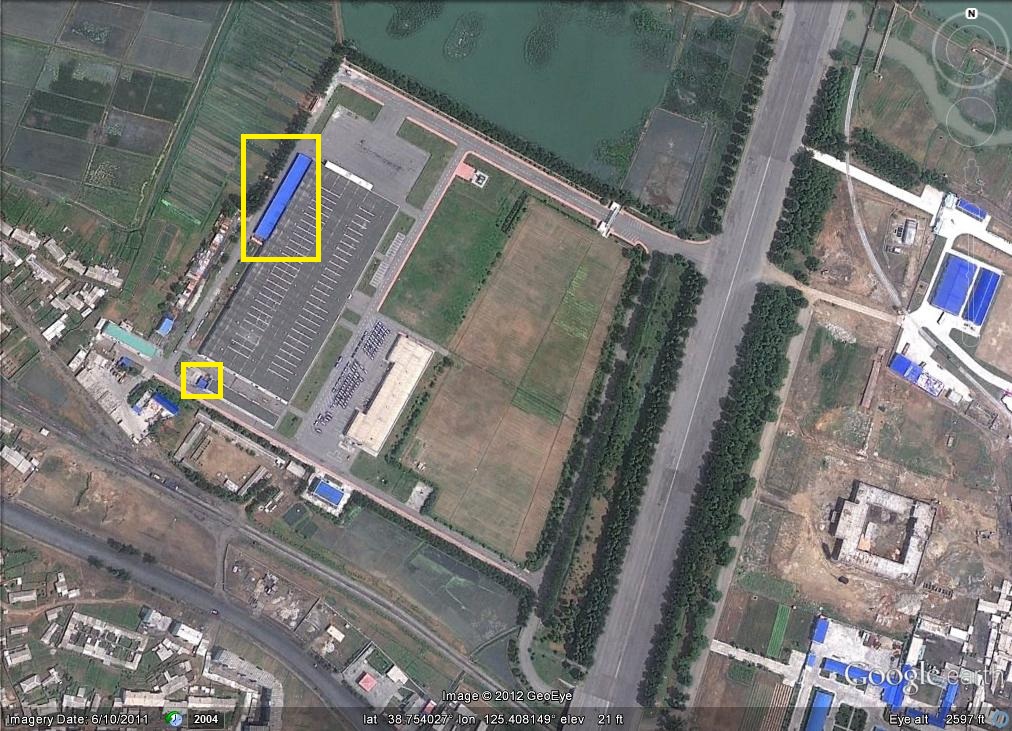
A unit from the church’s business arm spent about $55 million to build the Pyeonghwa factory in Nampo, a port city on North Korea’s west coast about an hour or so outside of the capital Pyongyang. After the factory was completed in 2002, workers there completed partially built cars, in a form called knockdown kits, that were imported from manufacturers in Italy and China.
But the company appears to have rarely been profitable. In 2009, the firm earned about $700,000 from the sale of 650 cars. About $500,000 of that was remitted to its parent operation in South Korea. The South Korean government noted then that it was the first time a South Korea-based company repatriated profits from North Korea.
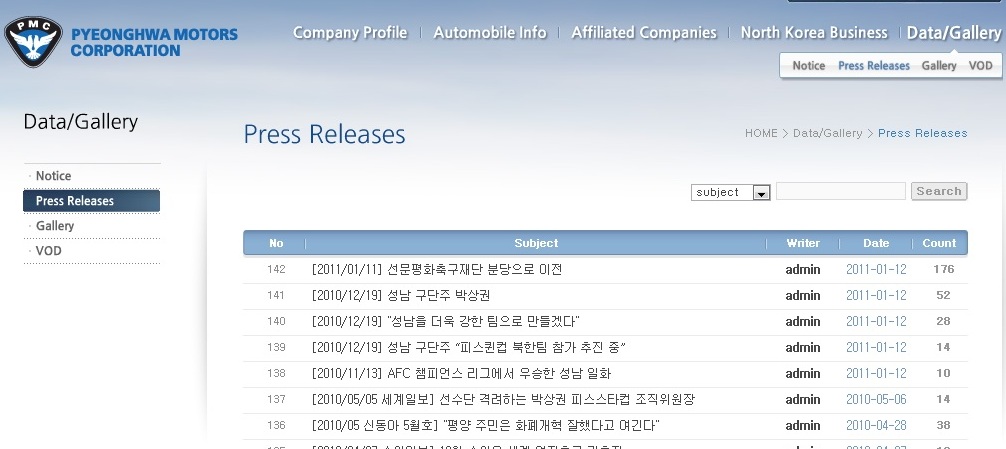
The Pyeonghwa Motors web page does not contain any information on this development. You can view the web page here (english). The last published press release was on 2011-1-11:
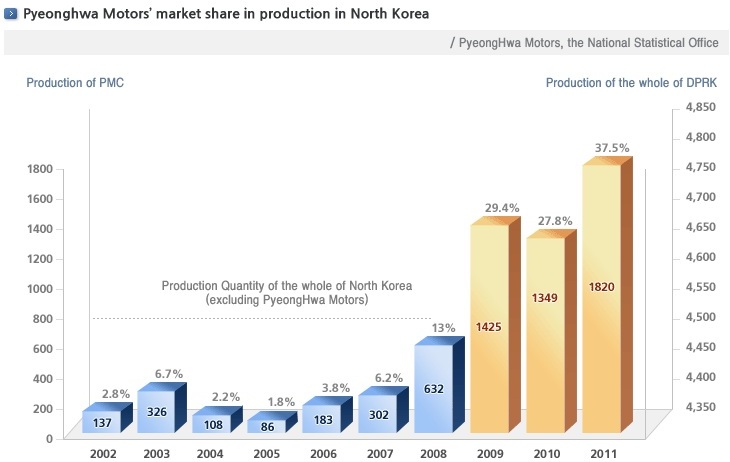
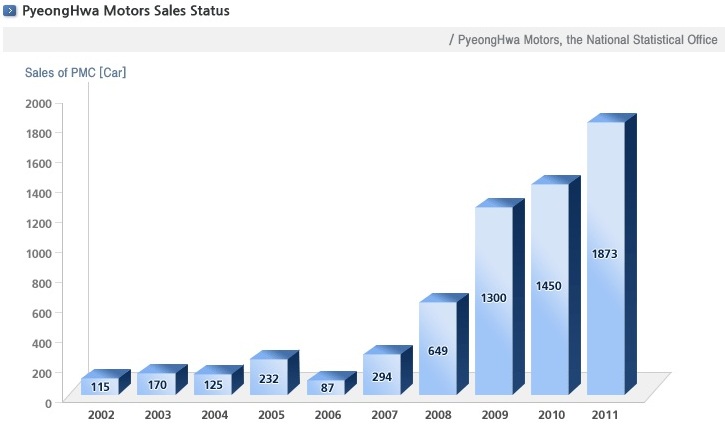
The web page does have production and sales data (if you choose to believe it):
No revenue or profit numbers are given on the web page, but it does mention that the factory’s capacity is 10,000 units per year. If these numbers are correct, in 2011 (the most productive year in terms of output) the factory was only running at approximately 19% capacity.
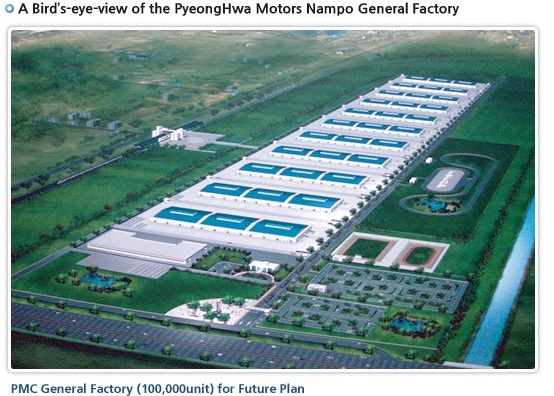
The Pyeonghwa Motors web page also offers a grand vision of the factory’s future (100,000 unit capacity):
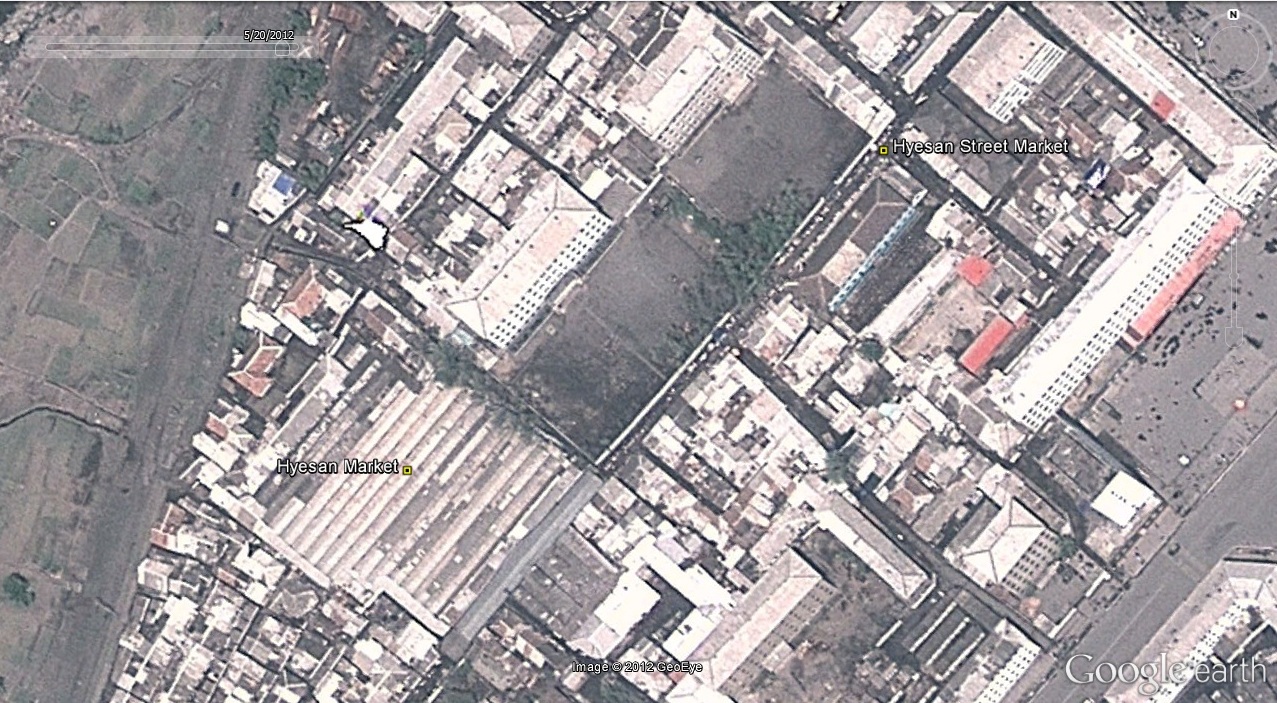
The authorities in Hyesan have embarked on an experiment that permits multiple traders to utilize each stall in the city jangmadang (market).
A source from the Yankang Province city told Daily NK on the 30th, “Hyesan Municipal People’s Committee has been struggling for a while to decide what to do with all these traders in the streets outside the market. So, they’ve decided to try and co-opt them by restarting stall-sharing arrangements. Any trader, even ones who used to trade in the streets, can now operate inside the market as long as they are ready to pay.”
“The traders rotate six days a week, and on Sundays the original stallholder gets to decide who trades there,” the source went on.
However, many of the original stallholders are reportedly angry at the move, according to the source, with many asking why they are being stopped from trading for almost half the week.
“But,” she said, “the Market Management Office is having none of it, so they have little choice but to oblige.”
The idea of stall-sharing has been tried before in Hyesan, but with little success. “Just last year they ordered the same thing to happen,” the source recalled, “but it wasn’t long before things went back to normal.”
That being said, she went on, “Now because the order has come from the Upper (Central Party), they are really trying to do it.”
Defectors from the city and others with experience of trading directly in the market say the measure has far more to do with controlling traders working illegally on the city streets than improving the efficiency of the market itself. In fact, they say the measure is likely to have a deleterious effect on market operations.
Seo Ok Ran, a 42-year old defector now living in the Dongdaemun area of Seoul pointed out, “Last year when they did this I had a hard time finding the right stallholders for the items I needed. At the end of the day, it just reduces trade.”
It is unclear whether the new rules are being applied nationwide, or are restricted to the area under the remit of Hyesan Municipal People’s Committee.
Read the full story here:
Stall-Sharing Returns to Hyesan Daily NK
Kang Mi Jin
2012-12-1
North Korea has focused on developing Rajin Port, located in the North Hamgyong Province, with the aim of attracting foreign investments.
China and Russia have already secured usage rights to these ports and Mongolia has expressed itsinterest in this endeavor. This indicates a rising popularity and competition to use these ports.
Mongolian parliamentary speaker, Zandaakhuu Enkhbold,met with the DPRK’s Supreme People’s Assembly Chairman and Korean Workers’ Party Secretary Choe Tae Bok on October 19 on his four-day visit to Ulan Bator, the capitol of Mongolia. The officials from both countries agreed on the future possibilities of bilateral trade and cooperation in the fields of information technology and human exchanges. Mongolia is landlocked and expressed interests in cooperating for port leaseswhile Chairman Choe expressed enthusiasm in cooperation in harbor, coal, and mining industries.
The day after the two leaders met, Choson Sinbo, Pyongyang’s mouthpiece in Japan, directly reported on the results of the talk, exposing North Korea’s positive reaction to leasing ports to Mongolians. According to the newspaper, “Rajin Port is the most convenient sea route for Mongolia.”
Mongolia’s and North Korea’s bilateral cooperation on Rajin Port has been received positively as it fits the economic interests of these two countries. For Mongolia, they are interested in exporting coal and other underground resources overseas, as the country is rich in underground resources such as coal, copper, gold, and uranium. However, these resources arecostly to export since Mongolia has to rely on Chinese and Russian railway systems.
Once it is able to obtain lease rights to the Rajin Port, Mongolia should be able to significantly reduce itsshipping costs. Thus far, Mongolia has exported coal mainly to China, but may intend to diversify exports to other countries once it is able to use the port at Rajin.
Furthermore, once freight trains between Hassan in the Far East region of Russia and Rajin begin to operate, it will make it possible for Mongolia to transport coal directly to Rajin Port.
North Korea is most likely to lease Pier No. 2 and Sonbong Port to Mongolia, which are currently not being usedby China or Russia.
More importantly, North Korea is turning to South Korean participation in the development of future Rajin Port development. Choson Sinbo reportedin an article on October 21 (under the title, “Hwanggumpyong and Rason”)that “We (North Korea) sincerely want North and South to cooperate for mutual prosperity through communication and join forces to advance economic cooperation larger than neighboring countries.”
Once inter-Korean relations improve and South Korea joins China, Russia, and Mongolia in the development of Rajin Port, other economic cooperation between these five countries is likely.
According to the MOU, the average monthly wage at KIC has reached $128.3 as of the first half of 2012. This marks a steady increase from $68.1 in 2006, $71.0 in 2007, $74.1 in 2008, $80.3 in 2009, $93.7 in 2010, $109.3 in 2011. One source of the increase is a built-in escalator clause on the minimum wage payment, which started at $50 and has increased 5% a year over the last six years. But that only gets you to about $67 for this year.
The remainder of the observed increase is apparently the result of additional payments for overtime, which has been rising dramatically. Average weekly working hours were already 55.2 hours in 2006 but now stand at 61.6 in 2012 (up to July). If we knew that these additional hours were the result of the free choices of hard-working, upwardly mobile workers we would still probably find it a little excessive. But of course, the advantages of working in Kaesong are such that North Korean authorities have absolute power to hire and fire at will. There is no way of knowing whether workers would choose this regimen if they were organized or not.
But the story is much worse, of course, because we don’t ultimately know what share of these wage payments actually end up in the hands of the workers in the complex. Wages are paid in U.S. dollars to the North Korean authorities by the South Korean companies operating in the complex. 45% of the wage bill–15% for “social security” and 30% for “socio-cultural policy entitlements”–flows into the regime’s coffer, while the remaining 55% is supposedly given to the workers in either DPRK won or coupons.
But not so fast. A crucial question is the exchange rate at which workers are paid and the value of the “coupons” they receive. We hardly need to state the obvious: North Korean workers are not getting paid the won equivalent of their dollar salaries at anything resembling the shadow-market exchange rate that reflects actual scarcities. At least in the Yonhap report, the MOU makes no mention of what the real dollar equivalent of won payments are using a realistic exchange rate. But given the country’s high inflation and rapid depreciation of the exchange rate—see my colleague Marc Noland on this—the dollar value of what North Korean workers actually receive could be only a small fraction—even a very small fraction—of the stated dollar wage .
Why has Kaesong stayed open? The answer lies in a pretty straightforward political economy calculus on both sides. For the South, Kaesong is industrial policy for labor-intensive firms. For North Korea, it is a cash cow that even hardliners have been loath to push the way of the Mt. Kumgang project. Since 2004, total wage payments for North Korean workers in the KIC has totaled $245.7 million, rising from $380,000 in 2004 (the first year of operation) to $61.76 million in 2011 and $45.93 million in the first half of 2012. For Pyongyang, even hardliners can see that this is a no-brainer.