Archive for the ‘State Offices’ Category

Rationing in Chongjin, Increased Control of the Civilians

Monday, September 17th, 2007

Daily NK
Moon Sung Hwui
9/17/2007

According to the inside source in North Korea, it was revealed on 13th that there has been partially a rationing in Chongjin, North Hamkyung since August.

This is the first time to have checked about nation rationing in Chongjin since the first Summit held on June 15, 2000.

This rationing has begun even before the flood occurred, which was prior to August. This is strong evidence that the North Korean food shortage was not in serious state. There has been acknowledgement that there has been food rationing even after the flood in the beginning of September.

There has been a case of rationing in Moosan, North Hamgyung and some other regions during the first Inter-Korea Summit in 2000. There is high probability that this rationing could have relation to the upcoming 2nd Summit in October.

The insiders spoke on the phone that, “All of a sudden the Chongjin distribution center opened and started supplying to the workers and their families, an old and feeble persons and wounded soldiers with a 15-days-worth of food since August.”

The special rationings that occurred on special occasions, like the birthdays of Kim Jong Il and Kim Il Sung was only given through the factories or People’s Units. The distribution center were often closed or usually used as the place for selling Chinese merchandises. The reason why the rationing has restarted through the distribution center is that the authorities are thinking of long-term rationings.

According to the inside source, the distributed food include corn, wheat and rice. It is hard to tell whether the rice was produced in the South or North because the rice was immediately packaged after it’s been produced from rice-polishing machines.

The inside source said that “Civilians are not in belief that there will be a continuance of rationing even in October, because there was just a 15-days-worth of rationing being distributed in September.” The rationing was only given to people who worked at particular factories which made profits.

Kim, who resides in Chongjin, staying in Hwoiryeong for his export business, claims that, “We have to get our attendance ballot stamped every day in our factory. For people who skip work for no particular reason, they are being ferreted out by the factory manager, and even the secretary of the Party. In the morning, there are so many meetings and conferences being held that it is difficult for us to think straight.”

Also, factories that had stopped functioning due to the electricity and resource loss, made workers show up at work and emphasized the importance of production culture and lifestyle culture, reinforcing the projects of fixing the buildings and cleaning the buildings.

“Our attendance is being reported on daily basis, so if we don’t go to work for several days, we are automatically taken to People’s Safety Agency immediately.”

For people who have made their livings through business are becoming increasingly dissatisfied by having to work in an inefficient factory. Some claim that, “Are we going back to how we used to be,” raising more concerns.

Kim states, “It’s not like they’re giving us abundant supply of food. We were able to breathe a little bit by doing our own business, but now it’s suffocating us to death.”

He added “We are now so strictly controlled with only a 15-days of rationing; can you imagine how much worse it can get if the rationing continues to supply fully in the future?”

The background of rationing has not been clear as of yet.

Kim Jong Il visited North Hamkyung for the onsite inspection in the beginning of August. This could be a temporary remedy taken by Kim Jong Il, to increase the effect of his visit. Furthermore, it could be his ways of increasing control on Hamkyung area, where the commute and trade with foreign countries is active.

The North Korean defector who came to South Korea in 2005, Park Jeong Chul (pseudonym) said, “The rationing can be a temporary remedy to appease the public anxiety with the upcoming Inter-Summit in October. It’s because North Korea has enough provisions for the army and there is pressure from the international society for North Korea to become more transparent, North Korea is pretending to oblige.”

Share

KFA Friday!

Friday, September 14th, 2007

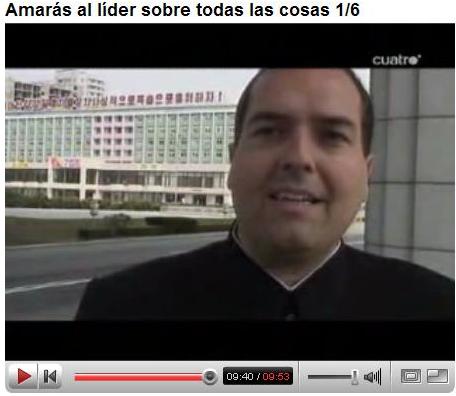
kfa.JPGDPRK watchers are generally familiar with the Korean Friendship Association (KFA) and its president, Alejandro Cao de Benos.  Alejandro has joined the rest of the DPRK blogging community and launched his own blog (in Spanish).  His blog is here.

He only has a few posts so far, but he has several pages typed up on an argument he is having with a journalist from the Spanish television station, Cuatro (4).  Apparently, Alejandro took some Spanish journalists on a recent KFA delegation, and like other journalists/film makers he has delt with (here and here), he did not like their final product.

The entire show “Love the Leader of all Things” can be seen on YouTube, but it is in Spanish: Part 1, Part 2, Part 3, Part 4, Part 5, Part 6.

Here are Alejandro’s comments about the show.

Share

Hundreds of firms plan to open in Kaesong

Wednesday, August 29th, 2007

Joong Ang Daily
Limb Jae-un
8/29/2007

Less than 10 percent of companies in Kaesong have stayed five years.

Hundreds of companies are lining up to operate in North Korea’s Kaesong Industrial Complex, but an economist said in a seminar yesterday that the current economic cooperation with South Korea won’t bring any significant changes to the communist country.

More than 200 companies have signed a contract with the Korea Land Corp. to join the 33 domestic companies currently operating in the industrial park, according to Kim Du-bok, an employee at the state-owned company.

Korea Land Corp. is responsible for assigning space in the industrial complex.

Among the new companies are a couple of firms with foreign connections that hope to open next year.

A Korean subsidiary of Tianjin JCI Cosmetic Corp., a Chinese producer of synthetic nail tips and other cosmetic goods, agreed Monday to lease space in the section allotted for foreign companies.

“Tianjin JCI Cosmetic Corp. and its Korean subsidiary, Dashing Diva, signed a contract to lease a piece of land,” Kim said yesterday.

To operate at the inter-Korean park, which uses North Korean labor and South Korean technology, a foreign company needs to have a South Korean subsidiary.

Yuhan-Kimberly, a joint venture between U.S.-based Kimberly-Clark and Korea-based Yuhan, has expressed a desire to set up a manufacturing base in Kaesong, but has not yet applied for space.

However, Cho Dong-ho, a professor at Ewha Womans University, said during a seminar in Seoul yesterday sponsored by the Korea Rural Economic Institute, that the government needs a more practical approach to stimulate reform and the opening of North Korea.

As an example of the failure, he said there are neither goods nor people to transport on the reconnected railroad between Seoul and Sinuiju.

He also said only 9.2 percent of the companies that tried to manufacture goods in Kaesong had done so for more than five years, as of January 2007. Many companies, he said, halted their operations after one or two years.

“The purpose of the economic policy toward North Korea is to support North Korea’s economic development and encourage reform and the opening of the North, but despite the fact that the cooperation is an economic issue, non-economic considerations were made a priority.”

Share

Chinese Firm to Open Plant in Gaesong

Tuesday, August 28th, 2007

Korea Times
Ryu Jin
8/28/2007

A Chinese company is going to be the first foreign enterprise to do business in the inter-Korean industrial park in the North Korean border city of Gaeseong, according to the Korea Land Corporation (KLC) Tuesday.

KLC officials said that Dashing Diva, the South Korean branch of Chinese artificial nail manufacturer Tianjin Jci Cosmetic, signed a contract to purchase a 6,000-square-meter lot in the Gaeseong Industrial Complex.

It marks the first time that a foreign company has bought a site in the inter-Korean joint venture, where about 15,000 North Korean workers commute to factories owned and operated by South Koreans.

While the first-phase pilot site has so far been occupied only by South Korean firms, the KLC designated a portion of land in Gaeseong for foreign businesses to boost the industrial complex’s international image and put the lots on sale in June.

Despite the South Korean government’s efforts to lure foreign investment there, no firms had come from outside the country until recently. Multinational sanitary goods maker Kimberly-Clark has also visited the complex to discuss investment there.

Located just north of the border, the Gaeseong Industrial Complex is a flagship project signifying reconciliation between the two Koreas, which remain still technically at war after a fratricidal conflict more than half a century ago.

Despite potential risks stemming from political uncertainty, the special zone has an inescapable economic logic: cheap labor and land of the North combined with the capital and technology of the South.

Gaeseong upbeat with foreign entrants
Korea Herald
Kim Yoon-mi
8/17/2007
 
The recent submissions of applications by two Chinese companies hoping to build factories in the Gaeseong industrial park in North Korea have further brightened the outlook on the joint economic project between the two Koreas, industry sources said yesterday.

South Korean government agency, The Korea Land Corp., said both a Chinese artificial fingernail manufacturer and a plywood producer submitted documents on July 30 in hopes of securing 6,000 square meters and 29,000 square meters of land, respectively, at the Gaeseong industrial park.

The Korea Land Corp. rents land in Gaeseong to individual South Korean or foreign companies under 50-year leases. The company had initially announced in late May that there were six applications available for foreign companies for 1,750,000 square meters of land in Gaeseong. No foreign applications were received until the two Chinese companies submitted their applications in July, according to an official at Korea Land Corp., who declined to be named.

“For foreign companies to build factories in Gaeseong, they should establish entities in South Korea. So, we are waiting for the two Chinese companies to finish that procedure first,” the official said.

The contract with the two companies is expected to be completed late this month, the official said.

Experts say Chinese manufacturers may have decided to move factories to North Korea because China’s rapid economic growth is raising wages and prices.

Currently, an average North Korean employed by any one of the 26 South Korean companies operating in the Gaeseong Industrial Complex earns $60.37 per month.

There have been unconfirmed news reports that the U.S. paper-based consumer product maker Kimberly-Clark Corp. may try to invest in the North Korean city.

Kimberly-Clark CEO Thomas Falk earlier hinted that the company would be interested in investing in Gaeseong, after he visited the North Korean city in late February.

“Gaeseong industrial part has the best environment (skilled labor) and facilities for South Korean SMEs to step forward…. Kimberly-Clark will be very interested in investment (in Gaeseong),” he was quoted as saying by the local daily, Maeil Business, on March 1.

The unnamed official from The Korea Land Corp. said he could not comment on the Kimberly-Clark proposition because he is not at liberty to discuss which foreign companies are in contact with his company.

However, the official said many foreign companies have contacted the Korea Land Corp., inquiring about going into North Korea.

The entry of foreign companies into Gaeseong will clearly be a boon for Hyundai Asan, the South Korean operator of major business projects in North Korea, the company’s officials said. This good news comes in light of a second summit between the two Koreas, another upbeat announcement for the park, Hyundai Asan officials said.

Hyundai Asan is in charge of the construction of factories in Gaeseong industrial park and operates South Korea’s tour business to Mount Geumgang resort in North Korea.

The Gaeseong industrial park, near the border with South Korea, was established in 2000 following the first landmark summit between South Korea’s then-President Kim Dae-jung and North Korean leader Kim Jong-il.

Chinese want some Kaesong action
Joong Ang Daily

8/13/2007

Two small Chinese light-industry companies have applied to build factories in an industrial complex in North Korea where South Korean companies are invested, a South Korean state land developer said on Saturday.

The Korea Land Corp. said a Chinese cosmetics manufacturer and a plywood firm submitted documents on June 30 requesting 6,000 and 2,000 square meters of land respectively in the Kaesong Industrial Complex near Kaesong, a North Korean city close to the border with South Korea.

It is the first time that foreign companies have applied to build plants at the complex where 26 South Korean labor-intensive companies are currently operating with a North Korean workforce of 15,000.

By 2012, it’s anticipated the complex will have several hundred South Korean plants employing as many as 500,000 North Koreans. South Korea is responsible for water, electricity and other infrastructure at the complex which opened three years ago.

The complex is a much-vaunted achievement of the first-ever inter-Korean summit of leaders in 2000 in the North Korean capital, Pyongyang. The second-ever summit of Korean leaders is scheduled to begin on Aug 28, also in Pyongyang.

Share

Orchestras may visit North, U.S.

Sunday, August 26th, 2007

Joong Ang Daily
Jin Se-keun
8/27/2007

A U.S. orchestra may visit North Korea while Pyongyang sends its own orchestra to the United States, an official of a Hong Kong-based company said yesterday.

Bae Kyeong-hwan, vice president of Daepung Investment Group, told the JoongAng Ilbo that his company has been authorized by the North’s Culture Minister, Kang Neung-su, to schedule and plan the events.

“We contacted the New York Philharmonic orchestra first, but if its schedule does not permit, the Boston Philharmonic or the Philadelphia Philharmonic could be an option,” Bae said.

The New York Philharmonic earlier confirmed that it has been invited to visit North Korea, but has not yet made an official decision.

After a performance in Pyongyang, the U.S. orchestra may return via South Korea, crossing the inter-Korean border at Panmunjeom Village, Bae said.

The North’s National Symphony Orchestra will then return the visit by going to the United States for a performance, according to Bae.

He claimed that negotiations for these reciprocal visits have been worked out by Christopher Hill, Washington’s chief negotiator to the six-party talks, and his North Korean counterpart Kim Gye-gwan.  

North invites the New York Philharmonic
Joong Ang Daily
Brian Lee
8/16/2007

It’s up to the New York Philharmonic orchestra to decide whether it will accept an invitation to perform in North Korea, a U.S. State Department spokesman said Tuesday.

“We’ll consider it,” Eric Latzky, the orchestra’s director of public relations, told Agence France Press. “We received an invitation to perform in Pyongyang through an independent representative on behalf of the ministry of culture of North Korea.”

Latzky said the request, which had just been received, was “unusual” and that the orchestra would consult with Washington before making any decision. Furthermore, Latzky said, any such visit would come as part of a tour in the region.

The Philharmonic is scheduled to play in China in February 2008.

When asked whether such a visit was feasible, U.S. State Department spokesman Sean McCormack said, “I think it’d be fully up to them whether or not they accept such an invitation. As for the details of being able to go there and whether there’s any compensation, that sort of thing, those are probably technical details.”

Financial sanctions and restrictions regarding arms, missile and nuclear technology are in place under a United Nations resolution adopted last year in the aftermath of a nuclear test by the North, but there are no restrictions on travel to the North by ordinary U.S. citizens.

But despite the symbolic meaning the orchestra’s visit could have, McCormack said he suspected it would only play for Pyongyang’s elite. “Whether or not your average North Korean gets an invitation if the New York Philharmonic’s in Pyongyang, I have my doubts about that.”

North Korea interested in inviting New York Philharmonic
Korea Herald

8/13/2007

North Korea has shown interest in inviting the New York Philharmonic to perform in its capital, Pyongyang, apparently as part of its efforts to improve ties with the United States, sources here said Sunday, according to Yonhap News Agency.

During a meeting of six-party nuclear disarmament talks in Beijing in July, U.S. envoy Christopher Hill met his North Korean counterpart, Kim Kye-gwan, and proposed that the two countries start civilian exchanges as part of confidence-building measures, said the sources who spoke on condition of anonymity.

Kim responded positively, saying that his government has already thought about such exchanges and would be interested in inviting the New York Philharmonic, according to the sources.

Eric Latzky, spokesman for the New York-based philharmonic, told Yonhap News Agency that he was unaware of any invitation by the North but said discussions were under way with South Korea for a performance tour there.

Share

N. Korea’s powerful commission in vanguard of flood recovery operations

Wednesday, August 22nd, 2007

Yonhap
Sohn suk-joo
8/22/2007

North Korea’s most powerful organization is leading efforts to clean up damage from heavy floods and restore the country’s infrastructure, the North’s state media reported Wednesday.

The National Defense Commission (NDC), the highest decision-making body under the communist country’s constitution that was revised in 1997 to reflect its “songun” or military first policy, supervises relief operations involving military forces and equipment.

“We’ve achieved recovery and restoration by appealing to party, government and labor officials to go out to damaged areas under the guidance of the National Defense Commission,” Kim Kyong-san, a senior official of the Pyongyang Railway bureau, said in an interview with Radio Pyongyang.

According to North Korea watchers, North Korea’s cabinet has usually spearheaded flood relief efforts in the communist country in the past. The NDC’s involvement signifies the extent of the damage and is also meant to speed up restoration ahead of the summit between President Roh Moo-hyun and North Korean leader Kim Jong-il, who leads the commission, they said.

Meanwhile, North Korea is in the final stages of restoring the railway line in Pyongyang.

“The Pyongyang railway line is fundamental in connecting the country to the east and west. All workers have labored hard and are urged to do more at the final stage,” Kim Kyong-san said.

Devastating floods are believed to have destroyed a revised 14 percent of the North’s farmland, South Korean officials said. South Korea, other countries and international agencies are extending a helping hand to the North.

The number of dead and missing is estimated at more than 300, with the homeless numbering about 300,000. An estimated 46,580 homes of 88,400 families were destroyed or damaged, according to the North’s media.

This year, South Korea is providing 400,000 tons of rice to the North, while it plans to send 7.1 billion won (US$7.5 million) worth of relief goods to North Korea.

On Tuesday, Pyongyang requested more help from the South, and South Korea is considering what to offer in response to the North’s plea for construction materials and heavy equipment.

The severe flood damage caused the two Koreas to postpone their second-ever summit, originally scheduled to be held late this month, until early October. Their leaders are to meet Oct. 2-4 in Pyongyang.

According to North Korean officials, the expressway linking Pyongyang and Kaesong has been damaged by heavy flooding, interfering with transportation. Roh plans to travel to Pyongyang via the overland route, and South Korean officials expressed hope that the expressway will be restored before the summit takes place.

Share

Kimberly-Clark considers opening factory in North Korean industrial park

Wednesday, August 22nd, 2007

Yonhap
8/22/2007

Kimberly-Clark Corp., one of the world’s biggest makers of health care and sanitary goods, is considering opening a factory in a South Korean-built industrial zone in North Korea, according to the company’s senior executive on Wednesday.

Moon Kook-hyun, chief executive officer of Yuhan-Kimberly Ltd., Kimberly-Clark’s South Korean unit in Seoul, recently told reporters that the company’s “sewing plant” in China may take part in slots of the industrial complex in the North Korean border city of Kaesong.

“First of all, I plan to sign a preliminary contract (to take part in the Kaesong industrial complex) and then will persuade our head office,” Moon said.

Moon and Thomas Falk, chairman of Kimberly-Clark, visited the Kaesong industrial park in February.

Currently, state-run Korea Land Corp. is receiving bids from foreign companies which want to set up factories in Kaesong, located just 70 kilometers north of Seoul.

“If Kimberly-Clark applies to receive land for the Kaesong industrial park, there will be no difficulty,” said an official at Korea Land.

South Korea began building the industrial park in 2003 on a trial basis with the hope of creating a model for eventual reunification of the Korean Peninsula.

Currently, 26 South Korean plants employ about 16,000 North Korean workers who produce garments, kitchenware and a number of other goods.

If the industrial zone becomes fully operational by 2012, more than 350,000 North Korean workers will work there, according to the South’s Unification Ministry.

In a free trade agreement signed last month, the U.S. government said it would recognize the Kaesong-made goods as originating in South Korea.

Moon’s remark also came as optimism has been building over progress in resolving the North’s nuclear standoff.

North Korea has shut down its key nuclear facilities at Yongbyon under a February agreement, which was also signed by South Korea, the U.S., Japan, China and Russia.

It now has to disable the Yongbyon facilities and declare all of its nuclear programs in exchange for 950,000 tons of heavy fuel oil or equivalent aid.

Share

Price of Rice and Inflation

Sunday, August 19th, 2007

Korea Times
Andrei Lankov
8/19/2007

Sometimes even Stalinist propaganda tells the truth. When the North Korean newspapers occasionally told grossly exaggerated horror stories about South Korean inflation, they stressed that nothing like that could possibly happen in North Korea. This was the case indeed. For nearly half a century, from the late 1950s to the late 1980s retail prices in North Korea remained essentially unchanged. One kilogram of rice cost 0.08 won in 1960. It was still the same price in 1990.

This was possible because almost nothing was actually “sold’’ in North Korea. Communist states often rationed goods distributed through retail trade, but in most cases it was only a handful of most prestigious goods that were subjected to rationing _ like, say, cars. North Korea went much further: by the early 1970s, retail trade in the North ceased to exist, being completely replaced by an elaborate public distribution system. Rations depended on a type of work performed, but also on one’s position within a complicated hierarchy of social groups, as well as one’s place of residence (inhabitants of major cities, and Pyongyang in particular, enjoyed much better rations than those in the countryside).

There were some markets, of course, barely tolerated by the government. But until the late 1980s markets were small, with their trade volume being almost negligible. It seems that most people were reasonably satisfied with what they could get from the state distribution system _ of course, it helped that they knew next to nothing about the situation in other countries, so they could not compare.

The situation began to change around 1990 when the old distribution system collapsed under the pressure of an economic crisis. From 1993-94 there were increasing problems with rations, and from around 1996 rations pretty much stopped altogether. Some food was still distributed in major urban centers, but even there the distributed amount was so meager that nobody could survive on rations alone. A large-scale famine ensued, with at least half to one million dead (the oft-cited figure of three million victims seems to be an exaggeration).

People turned to trade and handicrafts, and with this arrival of a market economy inflation became a North Korean phenomenon as well. Even in the 1980s market prices exceeded the official prices in the state shops. By the mid-1990s, the difference was much greater. In theory, rice still cost 0.08 a kilo, but by 2000 its price on the market reached 45-50 won. Official wages remained unchanged, however, so around 2001 the average salary was approximately 20 times less than the income necessary for physical survival. People had no choice but to augment their income.

The government understood that there was no way to restore the old system: a decade of economic crisis had undermined the basic machinery of distribution and obviously the system was beyond repair. Thus, in 2002 the much trumpeted “July 1 Reforms” were introduced.

It’s difficult to describe these measures as “reforms”–the government simply gave official recognition to the situation which had existed for quite a few years.

The distribution system (long defunct) was curtailed. There was a dramatic increase in the retail prices of basic goods and services _ obviously in an attempt to approximate the prices of the market. Thus, that one-kilo of rice which cost 0.08 won since July cost 44 won.

Wages increased as well. Obviously, the wage increase was not even, and some groups have gained _ or lost _ more than others. It was estimated that the average increase in wages has been approximately 2500 percent (that is, 25 times). At the same time, prices have increased 3000-4000 percent (that is, 30-40 times). This necessitated the issue of 1000 won bills _ the largest denomination in North Korean financial history since the 1959 currency reform. Later, 5000 won bills were issued as well.

But the measures had another effect. The increase in salaries meant that the market was instantly flooded with cash. Needless to say, the only outcome could be inflation. Some people speculated that this was the intention of the Pyongyang leaders who hoped to kick-start the economy in such a way. Perhaps. But I would not be surprised if in 15 or 20 years down the track we learn from interviews and talks with the planners of this reform that they did not really expect inflation. Pyongyang economic managers have not had much exposure to market theory, and are sometimes very naive in their understanding of these questions.

Indeed, by October 2002 the market price of rice had increased to 120 won per kilo. In 2003, the price doubled to 250-300 won, and now it is about 1000 won. Inflation has become a part of North Korean life.

What will happen next? Will the North Korean leaders manage to stabilize the situation, or will a new wave of economic crisis wipe out the entire North Korean system? We do not know yet. But it is clear that there is no return to old days when a kilo of rice could be had for 0.08 won _ that is, if you were lucky enough to live in an area where they distributed grain rations in rice, not in maize.

Share

Mass Games entered into Guiness Book of Records

Friday, August 17th, 2007

Click the picture to see it on YouTube.

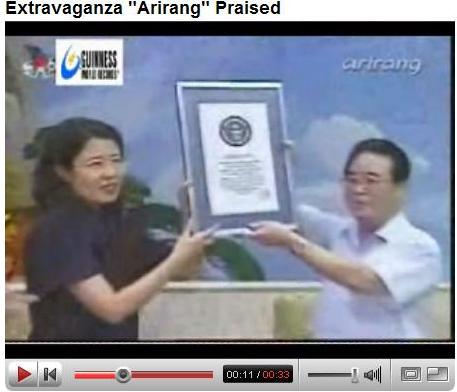
arirang.JPGGuinness Certificate Awarded to “Arirang”
KCNA

8/16/2007

A certificate of the Guinness World Records was awarded to the grand gymnastic and artistic performance “Arirang”.

It was handed to Song Sok Hwan, vice-minister of Culture, by Wu Xiaohong, representative of the Guinness World Records Ltd., on a visit to the DPRK at the May Day Stadium on August 15.

The record of largest gymnastic and artistic performance in the world was created in Pyongyang, the capital of the DPRK, the certificate says.

Conveying the certificate, the representative said the grand gymnastic and artistic performance “Arirang” could be successfully created thanks to the wise leadership of Kim Jong Il, and expressed deepest respect to him.

Warmly haling the registration of the performance in the Guinness World Records, the representative hoped that “Arirang” would successfully go on in the future.

More than 7 million Koreans in the north and the south and overseas and foreigners have watched the performance which has taken place over 180 times.

Extravaganza “Arirang” Praised
KCNA

8/16/2007

The grand gymnastic and artistic performance “Arirang” participated in by 100,000 persons is the most successful work both in its scale and ideological and artistic value.

Wu Xiaohong, representative of the Guinness World Records Ltd. on a visit to the DPRK, said this after appreciating the performance now going on in Pyongyang with great success.

I have never seen such peculiar work as the grand gymnastic and artistic performance “Arirang” in any other countries, she said, and went on:

What impressed me very much is that it is fantastic and conspicuous.

I marveled at the might of the unity of the Korean people while watching the performance.

It is my view that such extravaganza can be created only in the DPRK wisely led by Kim Jong Il.

It is something worth boasting before the world that such peculiar performance is going on in the DPRK.

The Guinness World Records Ltd. recognized the grand gymnastic and artistic performance “Arirang” going on at the May Day Stadium in Pyongyang, the capital of the DPRK, as the largest one in the world.

The Guinness Book of World Records published by the company is distributed to at least 100 countries.

I would like to express my sincere thanks to the Korean people for having created “Arirang” as a great masterpiece of the world.

It is my hope that the performance will prove successful in the future, too.

Share

Weekly Report on North Korea (July 30, 2007 – August 5, 2007)

Monday, August 13th, 2007

South Korean Ministry of Unification
Serial No.851 (July 30 to August 05, 2007)

Internal Affairs

  • According to the report by the Central Broadcasting Station on July 30, North Korea held the Election of Deputies to the Provincial (Municipality Directly under Central Authority), City (District) and County People’s Assemblies of the DPRK on July 29 and announced the result through the report by the Central Election Guidance Committee.
  • According to the reports by the Central Broadcasting Station from August 1 to 4, Chairman Kim Jongil inspected a sub-unit of KPA Unit 4318, the Unit 136, and the Unit 273.
  • The Central Broadcasting Station reported on August 2 that cooperative farms in Dahungdan-gun, Yanggang-do, are focusing on potato farming.

Inter-Korean Affairs

  • According to the reports by the Central Broadcasting Station and Pyongyang Broadcasting Services on August 3, the spokesperson of the Committee for the Peaceful Reunification of the Fatherland announced a statement on August 2 to criticize the U.S.-ROK joint military exercise Ulchi Focus Lens from August 20 to 31.
  • The Rodong Daily reported on August 4 that on the occasion of the 10th anniversary of Kim Jong-il’s work “Let Us Carry out the Great Leader Comrade Kim IL Sung’s Instructions for National Reunification,” North Korea held a Pyongyang city report session on August 3 and published a commemorative editorial on August 4 on the Rodong Daily.

Foreign Affairs

  • The standing committee chairman of the Supreme People’s Assembly Kim Young-nam made a formal visit to Algeria, Egypt, and Ethiopia from July 24 to 31.
  • North Korean delegates led by Minister of Foreign Affairs Pak Ui-chun visited the Philippines to attend the ASEAN Regional Forum from July 28 to August 2.
  • With the U.S. House’s adoption of the resolution on comfort women, North Korea is continuously criticizing Japan, maintaining Japan’s raising the abduction issue is causing trouble in the six party talks.
  • North Korean Minister of Foreign Affairs Pak Ui-chun met South Korean counterpart Song Min-soon during the ASEAN Regional Forum and reaffirmed that the abolition of the U.S. hostile policy against North Korea should be the precondition of the implementation of the second step of February 13 Agreement. 
Share