Archive for the ‘State Offices’ Category

Civilians along the North Korea-Chinese Border Prefer Small-Size TVs?

Tuesday, November 13th, 2007

Daily NK
Moon Sung Hwee
11/13/2007

Recent demand for small-sized TVs has been rapidly increasing in North Korea’s border regions, resulting in a huge price increases.

According to an inside North Korean source, the price of 12-inch (dubbed “chok” in North Korea) and 14-inch TVs, compared with prices this time last year, increased by 50 thousand to 100 thousand won (approx. USD15-30). Despite the increase, these small TVs are selling out, resulting in a supply shortage in stores located throughout the border regions.

Most 12-inch black and white TVs are Chinese-made. These TVs, which could have been purchased for a mere 150,000 won (approx. USD46) up until the end of last year, have recently sold for as much as 250,000 won.

The reason for the increase in the border region is that the state has strengthened inspections in these areas of those who watch Chinese TVs. The recent preference for small-size TVs comes from the fact that they are relatively easy to conceal.

A majority of border region civilians from North Pyongan to North Hamkyung Province can receive Chinese TV signals, thanks to the close distance. Among the channels able to be viewed is once broadcasted via Yanbian TV and South Korea’s China TV (www.openchina21.com). In accordance with a 2004 agreement between these two companies to promote broadcasting and cultural exchange, diverse South Korean dramas and movies as well as advertisements of South Korean products can be viewed.

The North Korean government collected remote controls to prevent the viewing of Chinese TV along the border region and implemented measures such as sealing the channels. Throughout the China-North Korea border region, inspections conducted by the No. 27 Bureau (under the Central Communications Office) are still very much underway.

The source said, “No. 27 Bureau agents come knocking at the door and turn on the TV at once to verify which channels have been viewed. Further, they inspect the state of sealed channels; if the seal has been damaged, the TV is confiscated.” When inspections take place, 30~50 sets are taken at a time, and in order to retrieve them, several thousand won in bribes is needed.”

However, in cases where these methods have failed to prevent the viewing of Chinese TV, technicians have entered homes and intercepted the circuits inside the TV, re-sealing the attached apparatus with high-strength adhesives. By doing so, the channels are forcibly fixed on Chosun Central TV broadcasting.

When the government carried out such invasive measures, the civilians put up a strong resistance, “Are they planning to just break TVs?” However, the government enforced the regulation of internal equipment, even when faced with civil rebellion.

The source said, “The apparatus inside televisions have been fixed so that people cannot watch Chinese TV channels, and inspections have been occurring randomly, so people have been watching and hiding small-size TVs in their homes.” This activity is reflected in the price increase.

One defector who has experience in selling used TVs in Rajin in North Hamkyung Province said, “Small-size TVs by which people could watch South Korean broadcasting were originally in high demand in South Pyongan, Kangwondo and South Hwanghae.” He said, “Since they cannot pass through customs, they are usually smuggled into and sold on the black market.”

The People’s Safety Agency handed down a decree stating that, “Those who pose a threat to the state and social system will be severely punished. Get rid of all kinds of places offering karaoke, movies, film subscriptions, PCs, and games.” It further emphasized the National Security Agency’s tightening of cell phone regulations along the border region.

Since last year, severe regulation of illegal films (foreign and South Korean DVDs and VCDs) has continually been enforced. Since this year, the North Korean government has gotten headaches from regulating the houses of civilians.

The North Korean government claims that the purpose of the regulations is “Destroying enemy maneuvers and directly impugn acts that pose a threat to society and the system.” North Korea’s opening and reform still seems far off.

Share

Google Earth North Korea (version 6)

Sunday, November 11th, 2007

The most authoritative map of North Korea on Google Earth
North Korea Uncovered: Version 6
Download it here

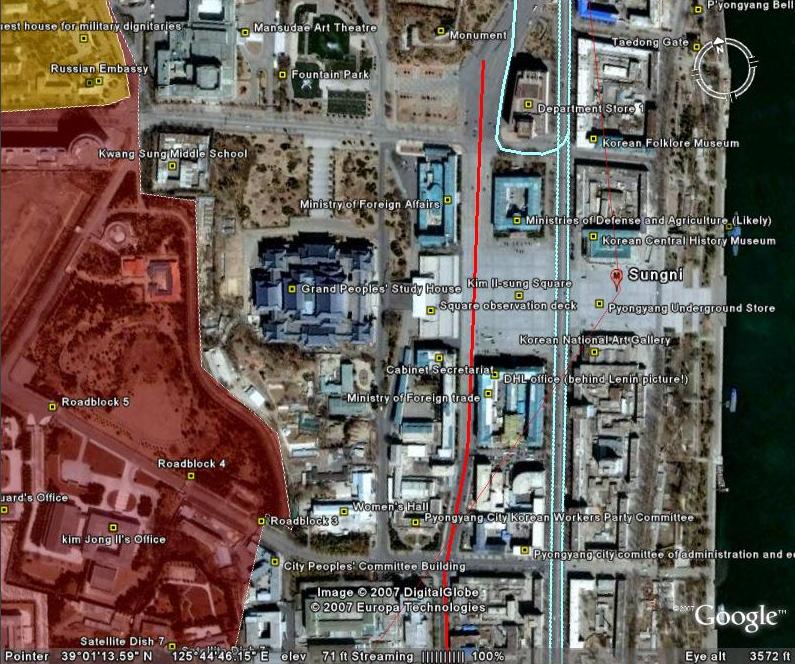
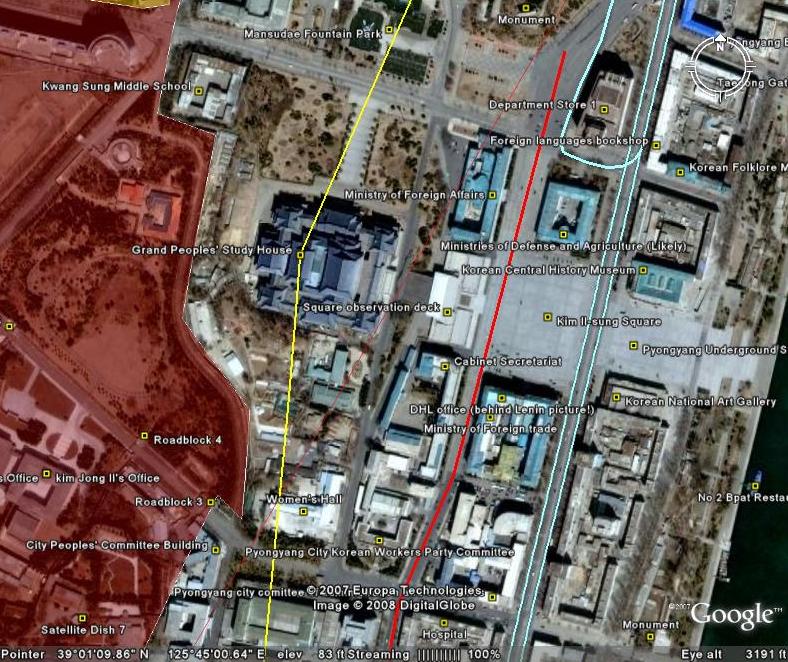
kissquare.JPGThis map covers North Korea’s agriculture, aviation, cultural locations, manufacturing facilities, railroad, energy infrastructure, politics, sports venues, military establishments, religious facilities, leisure destinations, and national parks. It is continually expanding and undergoing revisions. This is the sixth version.

Additions to the newest version of North Korea Uncovered include: Alleged Syrian nuclear site (before and after bombing), Majon beach resort, electricity grid expansion, Runga Island in Pyongyang, Mt. Ryongak, Yongbyon historical fort walls, Suyang Fort walls and waterfall in Haeju, Kaechon-Lake Taesong water project, Paekma-Cholsan waterway, Yachts (3), and Hyesan Youth Copper Mine.

Disclaimer: I cannot vouch for the authenticity of many locations since I have not seen or been to them, but great efforts have been made to check for authenticity. These efforts include pouring over books, maps, conducting interviews, and keeping up with other peoples’ discoveries. In many cases, I have posted sources, though not for all. This is a thorough compilation of lots of material, but I will leave it up to the reader to make up their own minds as to what they see. I cannot catch everything and I welcome contributions.

Share

Hyesan Mine, the Center of Copper Production Is Flooding!

Thursday, November 1st, 2007

Daily NK
Moon Sung Hwee
11/1/2007

A source familiar with issues inside North Korea said on the 30th, “Most of the underground tunnel of Hyesan Youth Mine in Yangkang Province is now under water.” The source added, “Ever since Samsoo Hydroelectric Power Station started filling up the dam last year, the mine began to flood, and now it can not operate properly.”

Hyesan mine produces 80 percent of the country’s copper. North Korea expects that the mine could produce copper for the next forty years. Hebeisheng-Luanhe Industry in China once attempted to buy 51 percent shares of the Hyesan Youth Mine. However, this was unsuccessful due to opposition from North Korea’s second Economic Commission, which manages the military economy.

North Korea began the construction of Samsoo Hydroelectric Power Station in February of 2004, mobilizing thirty thousand troops of the so-called “Shock Brigade for the Propaganda of the Party Ideology” every year. Unfortunately, Samsoo Power Plant became the major cause of the flooding of Hyesan Mine.

If this mine is inundated with water, North Korea has to import huge amounts of copper. It was the Propaganda and Agitation Department that led the construction of Samsoo Power Plant, which generates 50,000 kilowatts of power and is now causing the flooding. It is absurd that North Korea is about to lose its principal copper mine because of Samsoo Power Plant, a facility that was primarily constructed for political purposes.

Jung You Sim (37, pseudonym), a defector from Hyesan who came to South Korea in July of this year, stated that “Hyesan Mine is almost abandoned. It takes about three years to fill up the Samsoo Dam with water. Even now, there is difficulty in pumping out the water leaked from the power plant. Once the dam is completely filled, the total volume of water will be 1,300 million cubic meters. By then, the water pressure will have made it impossible to pump out the water that has infiltrated the mine. North Korea must choose either Samsoo Power Plant or Hyesan Mine.”

Samsoo Power Plant was constructed in Jangan-ri of Hyesan, Yangkang Province; Hyesan Mine is located nearby in Masan-dong.

The construction of Samsoo Power Plant which began in February 2004 evoked a great deal of controversy from the beginning. The Guidance Department of the Party and the Ministry of Extractive Industries opposed the construction citing the high risk of flooding in the Hyesan Mine.

However, Jeong Ha Cheol, then Secretary of Propaganda and Agitation Department and Choi Choon Hwang, then vice director of the Central Committee of the Party pushed hard for the construction with the aim of boosting their political standing and succeeded in obtaining Kim Jong Il’s approval. It is almost certain that both men have been purged.

At that time, the Propaganda and Agitation Department reported that the water leakage could be prevented if the bottom of the power plant dam is pressed hard and cemented with mud about three meters deep. However, experts from France who inspected the area opposed the construction because the land itself was calcareous and unstable. The water leakage was inevitable.

First explored in the 1960s, Hyesan Mine produces 10,000 tons of copper concentrates annually. When Gapsan Dongjum Mine, explored during the Japanese colonial period, was finally depleted and closed in 1990, Hyesan Mine became the lifeline of the nation’s copper production. It flooded before in the mid 1990s but was restored shortly thereafter.

At that time, the mine flooded because the pumping device stopped operating due to the lack of electricity across the country. Although the workers at the mine did their best to pump the water, they could not stop the water flowing into the mine at a speed of 480㎥/hour. In January, 1997, Hyesan Mine flooded again, as did other mines throughout the country, and lost all mining facilities.

The workers faced insurmountable obstacles in trying to save the mine. This was because some workers at Hyesan mine had removed the copper from pumping devices and had smuggled it to China before the flood hit the country.

When the officials from the Ministry of Extractive Industries visited Hyesan Mine in 1999, they informed the local cadres that the mine’s copper production had become insufficient for the manufacture of military supplies, and as a result, copper would have to be imported from Chile.

Defectors coming from Yangkang Province said that when Kim Jong Il paid a visit to the mine in October, 1998 and received the report on the difficulties in the mine’s operation, he said, “We must save the mine at any cost. I will supply the money.” At once, the chief secretary of Yangkang Province and the Ministry of Extractive Industries took charge of restoring the mine and organized the recovery workforce.

Kim Jong Il provided the so-called “Revolutionary Fund” for the mine’s recovery. He sent $ 3.8 million in 1998 and $2.6 million in 2001, paid all in cash. In 1998 when a great number of people were starving to death, corn was available in China for $ 137 per ton. The amount of money spent on the mine’s recovery could have been used to purchase approximately 28,000 tons of corn. In those days, the local residents in Yangkang Province were made to listen to lectures about the ‘General’s Revolutionary Fund’ over and over.

Upon the order for recovery, residents in Masan 1-dong and 2-dong in Hyesan city were mobilized every weekend to dig out the dirt in the mine. By May 1, 2003, the locals had dug to a depth of 710 m. Later that year, the mine produced 1,500 tons of copper concentrates, and in 2004 it produced 3000 tons.

The local people made huge sacrifices to recover Hyesan mine, and the recovery cost about $ 7 million. However, it was all in vain. The mine is now again flooded due to the construction of Samsoo Power Plant. Hyesan defector Jung Yoon Sim said that Kim Jong Il later changed his tone when he visited Yangkang Province and heard about the recent flooding, saying “it was anticipated.”

Samsoo Power Plant can produce up to 50,000 kilowatts of power. However, about 60,000 kilowatts of power are needed to supply electricity to the apartment complexes constructed in 2003 in Samjiyun county of Yangkang Province.

After all was said and done, Kim Jong Il had mobilized 30,000 people for three and a half years and had them work 14 hours per day while providing a mere 580 grams of grain daily in an attempt to build a power plant that generates only 50,000 kilowatts. In doing so, he destroyed the nation’s leading copper production center.

President Roh praised such an incompetent and irresponsible man as “a charismatic leader who has a deep understanding about the affairs of the country and has faith in the system.”

Share

Odd couple: The royal and the Red

Wednesday, October 31st, 2007

Asia Times
Bertil Lintner
10/31/2007

North Korean Premier Kim Yong-il is scheduled to pay a four-day visit to Cambodia in early November, underscoring the curious close relationship between one of the world’s last communist dictatorships and one of Asia’s most ancient monarchies.

Kim Yong-il, who should not be confused with the North Korean supremo, “Dear Leader” Kim Jong-il or any of his relatives, will hold talks with Cambodia’s retired king Norodom Sihanouk, the Cambodian Foreign Ministry said in a statement posted on its website.

The North Korean premier will also hold “official talks” with his Cambodian counterpart Hun Sen, and “pay courtesy calls” on Senate president Chea Sim, and the president of the National Assembly, Heng Samrin, according to the statement.

Cambodia has long served as a link between North Korea and Southeast Asia and beyond, so it is plausible to assume that trade and related issues will be on the agenda. For years the two countries ran a joint shipping company, and before the China-led six party talks, Cambodia had offered to mediate over Pyongyang’s contentious nuclear program.

Kim Yong-il’s visit to Cambodia is not the first by a North Korean dignitary in recent years. Kim Yong-nam, president of North Korea’s rubber-stamp parliament, the Supreme People’s Assembly, also visited the country in 2001 at the invitation of Sihanouk, who had then not yet abdicated in favor of his son, Norodom Sihamoni, the current serving monarch.

Kim Yong-nam now functions as de facto head of state, as Kim Jong-il’s father, “Great Leader” Kim Il-sung was elevated to the position of “eternal president” before his death in 1994, making North Korea not a monarchy, but rather the world’s only necrocracy.

As incongruous as it may seem, Cambodia is North Korea’s oldest ally in Southeast Asia. It all began when Sihanouk met Kim Il-sung in 1961 at a Non-Aligned Movement meeting in Belgrade and a personal friendship developed between the two leaders. When Sihanouk was ousted in a coup in 1970, Kim Il-sung not only offered him sanctuary in North Korea but also had a new home built for him about an hour’s drive north of Pyongyang.

A battalion of North Korean troops worked full-time on it for almost a year, and when it was finished, only specially selected guards were allowed anywhere near the 60-room palatial residence. Overlooking the scenic Chhang Sou On Lake and surrounded by mountains, the Korean-style building even had its own indoor movie theater. Like the Great Leader’s son, Kim Jong-il, Sihanouk loves movies.

Sihanouk has both directed and acted in his own romantic feature movies and a few more were made in North Korea, with Cambodian actors strutting their stuff against the backdrop of Korea’s snow-capped mountains.

French wines and gourmet food were flown in via China, and Sihanouk and his entourage were treated as royals would have been in any country that respects monarchy – as North Korea evidently does.

By contrast, North Korea has maintained less cordial relations with neighboring communist Vietnam, which still exerts behind-the-scenes pressure on Cambodia. Kim Yong-il will nonetheless also visit Hanoi during his diplomatic tour of Southeast Asia.

Throughout the Vietnamese occupation of Cambodia, North Korea refused to recognize the regime that Hanoi installed in Phnom Penh in January 1979 – and that despite immense pressure at the time put on Pyongyang from Moscow. During a meeting between Kim Il-sung and Sihanouk seven years later on April 10, 1986, in Pyongyang, the Great Leader reassured the then prince that North Korea would continue to regard him as Cambodia’s legitimate head of state.

When Sihanouk returned to Phnom Penh in September 1993, after United Nations-led mediation to end Cambodia’s civil conflict, he arrived with 35 North Korean bodyguards, commanded by a general from Kim Il-sung’s presidential guards. They are still there, now guarding Sihanouk as well as the new king, Sihanomi, who is not as close to North Korea as his father, but has paid at least one visit to Pyongyang.

Sailing buddies
Sihanouk and the Cambodian royals showed their gratitude to the North Koreans when in the late 1990s they set up a privately-owned shipping registry, the Cambodia Shipping Corporation (CSC). The flag of convenience was used by the North Koreans, and it enjoyed royal protection as it was headed by Khek Vandy, the husband of Sihanouk’s eldest daughter, Boupha Devi.

CSC was also partly owned by a Phnom Penh-based North Korean diplomat and for a few years aggressively marketed itself as a cheap and efficient “flag of convenience” service for international shippers. A series of embarrassing maritime incidents, including the interception in June 2002 of a Cambodian-registered – though not North Korean owned – ship by the French navy, in a joint operation with US, Greek and Spanish authorities, of a massive haul of cocaine off the West African coast prompted Hun Sen’s government to cancel CSC’s concession and reportedly give it to a South Korean company, the Cosmos Group.

At the time, International Transport Federation general secretary David Cockroft told the Cambodia-based fortnightly newspaper the Phnom Penh Post that “they’ll need to be able to walk on water, because nothing short of a miracle will clean up the name of Cambodian shipping”. Indeed, little appeared to change, including North Korea’s use of Cambodia’s flag of convenience for controversial shipments.

In December 2002, a Cambodian-registered, North Korean-owned ship named So San was intercepted by Spanish marines, working on a US tip, in the Arabian Sea. It was found to be carrying 15 Scud-type missiles, 15 conventional warheads, 23 tanks of nitric acid rocket propellant and 85 drums of unidentified chemicals under a cargo of cement bags.

The destination of the weaponry was said to be Yemen, and following protests from both Yemen and North Korea – and intervention by the US, which apparently did not want to antagonize Yemen, a supposed ally in Washington’s “war on terror” – the ship was allowed to continue to Yemen. Later revelations indicated that the cargo was ultimately delivered to Libya, which caused considerable embarrassment in Washington.

Premier Kim Yong-il is likely to be quite familiar with the CSC, as he served as minister for land and marine transport from 1994 until the Supreme People’s Assembly appointed him to the premiership in April this year. But since the scandal-ridden CSC was reorganized five years ago, Cambodia’s economic importance to Pyongyang would appear to have waned, and North Korea’s only known activity in the country today is in the restaurant business, including eateries in Phnom Penh and Siem Reap.

Yet as a diplomatic link to the wider region, Cambodia is still important to North Korea. In April 2003, the Cambodian government, at the urging of Sihanouk, had plans to send an envoy to Pyongyang in a bid to persuade the North Korean leadership to be more flexible about talks on its nuclear program, which at that time had stalled.

The mission never materialized, but North Korea no doubt remembers that its trusted ally Cambodia tried first to mediate – and that Phnom Penh in future could still serve as a gateway for improved contacts with the outside world. It remains to be seen what message Kim Yong-il will bring to Phnom Penh, but it is reasonable to assume that his visit will, despite the official announcements, be confined merely to “courtesy calls” and royal audiences.

Bertil Lintner is a former correspondent with the Far Eastern Economic Review and the author of Great Leader, Dear Leader: Demystifying North Korea under the Kim Clan. He is currently a writer with Asia-Pacific Media Services.

Share

Jangmadang Will Prevent “Second Food Crisis” from Developing

Friday, October 26th, 2007

Daily NK
Kim Min Se
10/26/2007

There is a prospect of the rise of “second food crisis” next year because of the flood disaster and the resulting food shortage.

A senior researcher at Korea Rural Economic Institute, Kwon Tae Jin said warningly, “Unless North Korea comes up with a special plan to secure food supply, there will come another food crisis next year, which is as severe as the one in the mid and late 1990s.”

Kwon anticipated that North Korea would need 5.2 million tons of grain for domestic consumption. Unfortunately, it is expected that North Korea would produce around 3.8 million tons of grain. This means there will be a shortage of 1.4 million tons of grain.

The statistics indicates there is a real possibility of a food crisis. North Korean authorities announced that the flood inundated about 2.2 billion ㎡ of farmland, which accounts for 14 percent of the country’s farmland. It is estimated that 2.2 billion ㎡ of farmland produces at least 500,000 tons of grain.

However, another prospect says that although food shortage is inevitable, it will not lead to mass starvation in North Korea as it did in the mid-1990s. Most of defectors from North Korea said, “Since the mid-2000s, things have changed. There won’t be any serious starvation.” They said that the current situation is different from that of those days under the central food distribution system. They added that the Jangmadang (markets) economy has changed a way for life among North Korea people.

◆ The amount of demand for food is overestimated

It should be double-checked whether North Korea really needs a minimum of 5.2 million tons of grain. There is criticism that the estimate of food demand which was calculated by some South Korean experts on North Korea and relief organizations is unrealistic. It is also pointed out that the estimate is calculated based on the nutrition standard of South Korea.

Defectors said that mass starvation would not have occurred if North Korea had at least a half of 5.2 million tons of grain in the mid 1990s.

Although the international standard for daily nutritional intake is between 2,000 and 2,500 kcal/day, North Korea sets the standard at 1,600 kcal/day, which amounts to 450 grams of grain.

It is easy to estimate the minimum amount of food demand needed in North Korea. Let us say every individual including children and the elderly needs 550 grams of grain per day, which is equal to the daily amount of food distributed to every adult by the state. With the population of 22 million in North Korea, the country then needs 12,100 tons of grain each day and 4.4 million tons of grain per year.

It is known that the North Korean government provides 550 grams of grain for adults and 300 grams for both children and the elderly. According to CIA’s World Fact Book 2004, the population aged between 15 and 64 in North Korea is around 15 million, which accounts for 67.8 percent of total population. This means the population of children and the elderly together reaches about 7 million. If we do the math, we come into conclusion that the amount of food needed in North Korea every year is 3,777,750 tons of grain.

Recall that North Korean people had received the aforementioned amount of food through the state food distribution until early 1990s. Of course, the country did not suffer from mass starvation back then.

The mass starvation during the mid-1990s resulted from huge decrease in food production between 1994 and 1998. In those years, North Korea produced about 2 million tons of grain, which fell far below the needed levels of food production. Hwang Jang Yop, former secretary of the Worker’s Party also testified that in the fall of 2006, while he was still in North Korea, he once heard the secretary of agriculture Seo Kwan Hee worrying about extremely low food production.

Therefore, it is correct to estimate the minimum amount of food needed in North Korea at 3,777,750 tons of grain. If the food production decreases below 3 million tons, then the food prices will skyrocket, and the possibility of mass starvation will be increased.

◆ A New way of life among North Korean people helps prevent them from falling victim to starvation.

North Koran people do not believe in the state authorities any more. The people know that they suffered from horrible starvation because they relied on the state and its food distribution system. During the crisis, many people had desperately waited for food to be distributed until they collapsed and died. Nowadays, North Korean people find a means of living by themselves at Jangmadang.

“There is no free ride” is the words on everybody’s lips in North Korea, which means that everyone must work hard in order to make a living. The lowest class became a day laborer.

The mass starvation of the mid-1990s has brought a significant change into North Korean society. Except a few, most of North Korean people do not rely on the state’s food distribution system. Instead, they have come up with a variety of survival techniques such as engaging in business, illegal trade with China or real estate transactions, receiving support from defected family members, and house sitting.

In that manner, North Korean people make money and use it to buy rice. An affiliate at the Bank of Korea who studies price trends of North Korea said, “Since the adoption of the July 1 Economic Improvement Measure, the price of rice and corn has increased the least.” If the prices go up, people would tighten their belts and decrease their spending on every item except rice. This means they are not that vulnerable to starvation as they used to.

◆ Businessmen are good at securing food.

Recently, a number of rich businessmen have emerged. Some have tens of thousands dollars, and others as many as several million dollars. Groups of Jangmadang businessmen have been organized with these rich businessmen as the leaders.

These businessmen come and go to China as they please and supply food and goods to Jangmadang in North Korea. If the rice price in North Korea is expensive than in China, they buy Chinese rice and sell it at Janmadang. In this way, they help balance supply and demand at the market.

Furthermore, Chinese residents in North Korea and Chinese businessmen also joined the North Korean businessmen as providers at the market. They too sell food produced in China at Jangmadang when food prices go up in North Korea. If possible, they even sell rice reserved for the People’s Army. There was an accusation that the state authorities supplied food aid from overseas for the People’s Army while collecting food produced in North Korea at the same time.

Of course, some businessmen could deliberately keep a hold on food supply anticipating an increase in food prices. However, that kind of unfair activity is temporary. Although it is too early to tell, the “invisible hand” of the market, however small it is, is operating in North Korea and acting as a preventive measure against starvation.

Share

DPRK Chamber of Commerce

Saturday, October 20th, 2007

The DPRK Chamber of Commerce was inaugurated on August 25, 2004 with the purpose of developing economic and trade relations with different countries over the world.

The Pyongyang Chamber of Commerce (PCC), the predecessor of the DPRK Chamber of Commerce, had been established on March 1, 2000 and granted an associate membership of the International Chamber of Commerce (ICC) at its 33rd World Congress held in Budapest, Hungary in May, 2000.

The PCC had conducted such service activities as trade, finance, arbitration and consultation helpful to the domestic and foreign trade and economic organizations in close relations with the ICC, national chambers of commerce and world trade and economic centres.

It was registered in the directory of addresses published by the ICC, the International Trade Centre and other international economic organizations.

With a view to expanding exchange and cooperation with foreign countries in all fields of the economy, the PCC was developed into the Chamber of Commerce of the Democratic People’s Republic of Korea.

At present, it is extensively carrying on its commercial business in closer ties with the ICC and national chambers of commerce around the world.

The DPRK Chamber of Commerce makes efforts to promote bilateral and multinational exchange and investment with Korean joint venture and individual enterprises in foreign countries as its full members and with foreign individual enterprises and entrepreneurs residing in Korea, overseas compatriots and foreign enterprises who hope to have business transactions with Korean partners as its associate members.

It has an organizational structure consisting of secretariat, trade information committee, trade arbitration committee and exhibition committee as well as non-permanent credentials committee for full members or associate members.

The trade information committee engages in such business as collection and distribution of information data on world economy and trade, international commodity and financial markets.

The trade arbitration committee handles correct examination and settlement of disputes relating to economy and trade.

The exhibition committee organizes the opening of national trade fairs at home and abroad and provides every convenience for the participation of its members in the fairs.

The DPRK Chamber of Commerce will make a positive contribution to the promotion of foreign trade, invitation of investment and economic exchange with other countries.

——

The DPRK Chamber is headed by Ri Hak Gwon.  I have been unnable to determine any other posts he might have held in the past.

——

The Chamber has two addresses on line:

DPRK Chamber of Commerce
c/o Ministry of Foreign Trade
Central District
Pyongyang
D.P.R. of Korea
E-Mail: [email protected]
(This address seems to indicate it is an office within the Ministry of Foreign Trade)

DPRK Chamber of Commerce
Jungsong-dong, Central District,
Pyongyang, DPR Korea
P.O.Box 89
Tel: 850-2-3815926
Fax: 850-2-3815827
E-mail: [email protected]

——–

Externally, the DPRK Chamber liases with numerous external business organizations to promote DPRK exports and foreign direct investment (FDI):

European Business Association

The EBA cooperates with the DPRK Chamber of Commerce and supports it as well as the Korea International Exhibition Corporation under the Ministry of Foreign Trade to help European companies participate [in the Pyongyang International Trade Fair].  European companies participating at the European booth [in the most recent fair] said they were very satisfied. European businesses that would like to participate at the European booth during the next trade fairs (11th PYONGYANG SPRING INTERNATIONAL TRADE FAIR, May 12 – 15, 2008 and the and the 4th PYONGYANG AUTUMN INTERNATIONAL TRADE FAIR, September 22 – 25, 2008) are welcome to contact EBA from now on. Details on these fairs will also be given shortly on the EBA-website under “Services”

Friedrich Nauman Foundation

“It is a great honour and a token of both appreciation and trust” , said Mr. Kim Myeong-ho, Deputy Director of the Department of International Relations of the Korean Workers’ Party welcoming two representatives of the Friedrich Naumann Foundation at the Headquarters of the Korean Workers’ Party (KWP) in Pyongyang. Since their meeting at the beginning of February this year the international political situation has changed dramatically: the February 13 Agreement on the Denuclearisation of the Korean peninsula was signed between the six parties DPR Korea, USA, China, Republic of Korea, Japan and Russia. Meanwhile, the parties have taken necessary steps to ease the tensions on the Korean Peninsula and to move towards denuclearization. Both the U.S. and the DPR Korea have started negotiations on the normalisation of bilateral relations within the framework of the Six-Party Talks. Finally, both Koreas agreed to hold a second summit on 2-4 October.

Mr. Kim Myeong-ho expressed his appreciation of the training activities of the Friedrich Naumann Foundation in the DPR Korea. Referring to the New Year’s editorial of the Rodong Shinmun, the KWP’s newspaper, he mentioned the priority of modernizing the economy in the sectors of agriculture, light industry, IT and banking. According to him, of particular interest are methods of farm management, renewable energy and food security but also city management.

The representatives of the KWP accepted FNF’s offer of having a study tour to Germany for party officials in 2008 presuming further progress in the Six-Party Talks. The members of the delegation would have “fresh ideas” after being back in the DPR Korea, FNF was told.

Walter Klitz, Resident Representative of the Friedrich Naumann Foundation in Korea, also had meetings with representatives of the Ministry of Foreign Affairs and the DPRK’s Chamber of Commerce. In cooperation with the European Union, FNF will hold the 3rd EU-DPRK Economic Workshop in October, its fourth seminar this year.

Here is the agenda for a training seminr held last April. Here is their summary of the event.

New Clients:

South-North Korean Economic Cooperation Forum

A major South Korean business organization said Thursday (Sept. 27) it plans to form a civilian body for economic cooperation with North Korea on the occasion of the 2007 South-North Korean Summit next week.

The envisioned body, tentatively named the South-North Korean Economic Cooperation Forum, is to be set up in October and have 50 members, including 35 entrepreneurs, the Korea Chamber of Commerce and Industry (KCCI) said.

It would be the first non-governmental channel for inter-Korean economic cooperation. Currently, the South’s Ministry of Unification and the North’s National Economic Cooperation Federation are the sole channels for inter-Korean economic cooperation.

“The establishment of the body is designed to further promote inter-Korean economic cooperation on a civilian level,” said Kim Sang-yeol, vice chairman of the KCCI.

The planned group will conduct economic cooperation projects with the North and help improve North Korea’s investment environment, the KCCI said.

To that end, the chamber will try to sign a deal with its counterpart, the DPRK Chamber of Commerce, and send an investment inspection team to the North after the end of the summit. DPRK is the acronym for the North’s official name, the Democratic People’s Republic of Korea.

Established in March 2000, the chamber of commerce, which includes members of 100 major companies, has carried out external economic exchanges and attracted foreign investment in the North, according to the KCCI.     

South Korean President Roh Moo-hyun is scheduled to meet North Korean leader Kim Jong-il from Oct. 2-4 in Pyongyang. Seoul has hinted that the promotion of economic cooperation will be high on the agenda of the 2007 South-North Korean summit, as it was in the first summit in 2000.

Alejandro Cao de Benos

In his own words: “[The KFA is] looking into development of new areas to expand into, especially those related to economy that are critical also for the development and life improvement of the DPRK. Since KFA has played an important role in building friendship, now we also can play our part in building business.

For accomplishing this goal, I announce the creation of the IKBC (International Korea Business Center).  As a sister organization of the KFA, the IKBC will strictly take care of business issues, facilitate business information to private investors and companies around the world.

In close collaboration with the DPRK Chamber of Commerce, IKBC will become the reference link between the DPRK and foreign businessmen. The spirit is to build a DPRK Chamber of Commerce outside the DPRK that will approach the countless possibilities in trading that will benefit all sides involved.

Alejandro’s involvement raises questions about the relationship between the DPRK’s cultural diplomatic efforts (since he is a client of the Committe for Cultural Relations with Foreign countries) and its business outreach efforts auspiciously under the Ministry of Foreign Trade.  I suspect that various DPRK agencies have been blurring the boundries between the two activities for fiscal reasons.  As access to hard currency comes to play a greater role in the DPRK system, I predict that we will see more of this kind of mission creep on the DPRK side.

They also undertake external activities:

A delegation of the DPRK Chamber of Commerce (KCC) took part in the 5th China International Equipment Manufacturing Exposition on Aug. 29, 2006 and the 2nd China Jilin Northeast Asia Investment & Trade Exposition on Sep. 2, 2006.

During its participation in the expositions, the delegation held an interview on investment and discussed matters of investment in the development of a vanadium mine, stone dressing, the production of agrochemicals and calcium carbonate, seafood breeding and processing and so on.

The KCC secretary-general made an introductory speech entitled “On the trade and investment policy of the DPR Korea”.

At the interview, a series of technical matters on joint ventures and processing trade as well as investment guaranty were discussed and agreed between traders.

A trade and investment seminar for European businessmen was held in Pyongyang under the sponsorship of the KCC on October 30, 2006.

There was the general explanation on the DPRK trade and investment policy and the investment environment.

Share

Market Prices Are Skyrocketing in North Korea

Friday, October 19th, 2007

Daily NK
Lee Sung Jin
10/19/2007

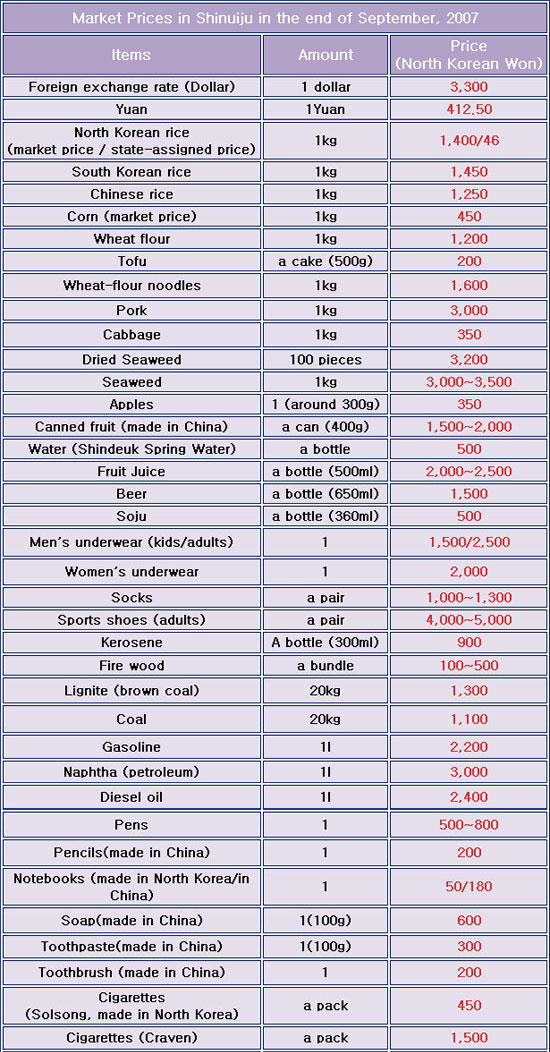
Prices.jpgA study reveals that market prices have skyrocketed in North Korea since the massive flood disaster in August.

According to the study conducted by DailyNK in late September this year, the rice price in the northern part of North Korea increased by 500 North Korean won on average between early July and September. In the market in Sinuiju of North Pyongan Province, the rice price rose from 980 Won/kg to 1,400 Won/kg.

The price of imported rice from China also went up to 1,250 won/kg. The rice from South Korea was sold at 1,450/kg. In Gwaksan of North Pyongan Province, the domestic rice was sold at 1,370/kg, the rice from China at 1,500/kg, the rice from South Korea at 1,300/kg.

In Hoiryeong of North Hamkyung Province, the price of domestic rice was 900 won/kg in July but rose to 1,250 won/kg. In Kilju of North Hamkyung Province, the domestic rice was sold at 1,200 won/kg. This shows that the rice price in North Hamkyung Province did not increase as highly as the price in Sinuiju of North Pyungan Province. In Hoiryeong, the price of rice has been rising steadily from 820 won/kg in March.

The rice in Hoiryeong is cheaper than in Sinuiju because demand for corn is relatively high and food distribution is partly being operated in Hoiryeong.

Between July and late September, the price of wheat also rose from 900 won to 1,200 won, and the price of noodles from 1,000 won to 1,600 won. However, the price of whole corn, the staple food for the low-income families remained stable for the same period.

It was believed that the surge in food prices resulted from the massive flood damage which stroke North Korea in early and middle August. When vast areas of land in South Pyongan and Hwanghae Province, the major granary of North Korea, were submerged during the flood, it was expected that domestic crop production would decrease.

After the food crisis in 1990s, the demand for rice increases in every fall during which rice price is low and people tend to purchase in advance one-year supply for food. In this fall, however, the price of rice greatly rose because the shortage of food was anticipated.

Meanwhile, the surge in rice price illustrates that overseas food aid was not distributed to the people of North Korean. The illicit sale of rice originally distributed to the party cadres or People’s Army has not been fully activated in the market. In addition, the rise in rice price was triggered by the fact that the number of wholesalers stocking up rice in advance increased with the news that there would be a shortage of food.

In early August, the price of rice once surged to a high of 1,950 won/kg in the market in Sinuiju. Thereupon, there was a rumor going around that the rise in rice price resulted from the state’s ban on rice sale and had nothing to do with the flood. Anyhow, the rice price has been on the decrease since then, and in September it had remained at around 1,500 won/kg.

As opposed to the rise in rice price, the price of corn, the main diet for the low-income families remained stable. This means the possibility of massive starvation in North Korea is low this year. Moreover, that the corn price remained moderate when rice price went up by 500 won reflects that the economic situation of middle class has been stabilized over the years.

Along with the rise in food prices, the prices of industrial products or others have been soaring sharply. The price of pork increased from 2,300 won/kg to 3,000 won/kg, and the price of frozen Pollack from 3,500/fish to 4,800/fish

The prices of brown seaweed or fruit juice went up to around 2,000 won each. The price of the popular imported cigarettes, Cat, rose by 200 won being sold at a cost of 1,500 won.

As winter is coming soon, the heating fuel price increased. Brown coal was sold at a cost of 1,300 won for 20 kg, gasoline at a cost of 3,000 won/liter

The exchange rate also increased from one dollar to 3,100 won to one dollar to 3,300 won.

Share

Roger Clinton’s Trip to North Korea

Sunday, October 14th, 2007

I was doing some research this weekend for a paper I am writing, when I stumbled on the following stories from KCNA.  It seems that although President Clinton never made it to the DPRK before his term in office ended, his brother Roger Clinton (aka “US pop singer”) did.

——————-

U.S. pop singer Roger Clinton and his party arrive
KCNA
12/2/1999

Pop singer Roger Clinton, brother of the U.S. president, and his party arrived here today to visit the DPRK on the invitation of the Korean Asia-Pacific Peace Committee. 

They were greeted at the airport by Ri Jong Hyok, vice chairman of the Korean Asia-Pacific Peace Committee, and Song Sok Hwan, vice-Minister of Culture.

U.S. pop singer Roger Clinton and his party enjoy concert
KCNA
12/4/2007

U.S. pop singer Roger Clinton and his party enjoyed a concert staged by the state symphony orchestra at the Moranbong Theatre Friday.

Among the audience were Ri Jong Hyok, vice-chairman of the Korean Asia-Pacific Peace Committee, Song Sok Hwan, vice-Minister of Culture, officials concerned and working people in the city.

The artistes of the state symphony orchestra staged the orchestral pieces “Arirang,” “Dear Home In My Native Place,” “Nostalgia,” “Bumper Harvest Has Visited Chongsan Field,” a piano concerto “Korea Is One,” and so on. 

U.S. pop singer Roger Clinton and his party visit Mangyongdae
KCNA
12/5/1999

U.S. pop singer Roger Clinton and his party visited Mangyongdae on December 3. 

They looked round historical relics with deep interest, hearing an explanation about how the President Kim Il Sung was born and spent his childhood there. 

They posed for a souvenir photo in front of the old home at Mangyongdae. 

They also visited the Tower of the Juche Idea, King Tangun’s Mausoleum and Pyongyang metro on the same day and the Mangyongdae Schoolchildren’s Palace on Saturday.

Kim Yong Sun meets pop singer Roger Clinton
KCNA
12/5/1999

Kim Yong Sun, chairman of the Korean Asia-Pacific Peace Committee, Saturday met and had a talk with U.S. pop singer Roger Clinton on a visit to the DPRK.

Present there was Ri Jong Hyok, vice-chairman of the Korean Asia-Pacific Peace Committee.

U.S. pop singer Roger Clinton performs in Pyongyang
KCNA
12/6/2007

A performance was given by U.S. pop singer Roger Clinton at the Ponghwa Art Theatre yesterday.

It was seen by Kim Yong Sun, chairman of the Korean Asia-Pacific Peace Committee, Ri Jong Hyok, vice-chairman of the committee, Mun Jae Chol, acting chairman of the Korean Society for Cultural Relations with Foreign Countries, Song Sok Hwan, vice-Minister of Culture, and artistes and Pyongyangites.

Roger Clinton and his party and Korean artistes took part in the performance.

Roger Clinton presented solo pieces and his party song, dance and male and female solos.

Korean artistes staged female concert, soprano, solo and dance and other pieces.

The performance ended with a chorus “Our Wish Is Reunification.”

Kim Yong Nam meets Roger Clinton
KCNA
12/7/1999

Kim Yong Nam, President of the presidium of the Supreme People’s Assembly of the DPRK, met and had a talk with U.S. pop singer Roger Clinton and his party at the Mansudae Assembly Hall today.

Present there was Ri Jong Hyok, vice-chairman of the Korean Asia-Pacific Peace Committee.

Roger Clinton said that it was an honor for him to visit Korea, expressing the belief that the visit would contribute to the improvement of the relations between the two countries.

Gift to Kim Jong Il from Roger Clinton
KCNA
12/7/2007

General Secretary Kim Jong Il received a gift from U.S. pop singer Roger Clinton on a visit to Korea. 

He handed it to Kim Yong Sun, chairman of the Korean Asia-Pacific Peace Committee.  

Roger Clinton and his party feted
KCNA
12/7/2007

The Korean Asia-Pacific Peace Committee (KAPPC) gave a reception for U.S. pop-singer Roger Clinton and his party on a visit to the DPRK at the Mokran House on Monday evening.

Present there were chairman Kim Yong Sun and vice-chairman Ri Jong Hyok of the KAPPC, vice-Minister of Culture Song Sok Hwan and other officials concerned.

Vice-chairman Ri Jong Hyok in his speech said Roger Clinton has staged music and conducted social activities, adding that he is well known among the pop-music circles for presenting many lively and optimistic songs in different countries and regions of the world.

Noting that Roger Clinton and his party gave a successful performance in Pyongyang, he hoped that they would find their stay in Korea pleasant and joyful.

Roger Clinton in his speech expressed thanks to General Secretary Kim Jong Il and the KAPPC and the Korean people for providing him with an opportunity to visit the DPRK and give a performance.

He said the performance tour this time offered an important occasion, adding that all of them should make positive efforts for peace in the future, too.

An art performance was given during the reception.

Roger Clinton interviewed by KCNA
KCNA
12/9/2007

American pop singer Roger Clinton was interviewed by KCNA at Pyongyang Airport before his departure from here Wednesday.

Giving his impressions of Pyongyang, he said it looked very positive and very much peaceful.

He continued:

From the artistic viewpoint, the talented Koreans that I saw here can perform any art of the world. They are as talented people as I have ever seen. But more specific is that children here are the most talented children that I have ever seen.

They performed music and dance, just general art work.

Really, the children are brilliant.

If there is something that I like to say to the Koreans freely, one must claim, I’ll be back.

I promise to convey all of my feelings, all of my lessons and all the information I have got from brave people to our people and to my brother.

At earlier press interviews he said that he was proud of having performed in Pyongyang, and this was great generosity that the Korean people and the government granted to him.

He thanked Marshal Kim Jong Il for the generosity.

He hoped that his visit would be helpful to the improvement of the U.S.-DPRK relations.

Roger Clinton and his party leave
KCNA
12/8/2007

U.S. pop singer Roger Clinton and his party left today after concluding their Korean visit at the invitation of the Korean Asia-Pacific Peace Committee (KAPPC).

They were seen off at the airport by Ri Jong Hyok, vice-chairman of the KAPPC, and Song Sok Hwan, vice-Minister of Culture.

Before their departure, they hosted a reception at Pyongyang Koryo Hotel Tuesday evening in connection with their Korea visit.

Share

Philharmonic to explore venues in Pyongyang

Monday, October 8th, 2007

Joong Ang Daily
10/8/2007

Representatives of the New York Philharmonic were set to arrive over the weekend in North Korea to discuss the possibility of a history-making performance in the communist nation.

Philharmonic President Zarin Mehta and public relations director Eric Latzky said they planned to explore venues and other arrangements for a potential February concert in Pyongyang.

“It’s a country that none of us have ever dreamed of going to. The next three or four days are going to be very eye-opening for us,” Mehta said by telephone Thursday from Beijing.

He and Latzky said they were embarking on the discussions with United States government support. A State Department official was accompanying the Philharmonic representatives on the trip.

“In as much as this is something that both sides are interested in exploring, we will do what we can to facilitate it,” said State Department spokesman Sean McCormack.

Relations between the United States and North Korea have been tense for years. President George W. Bush once branded the country part of an “axis of evil” along with Iran and Iraq under Saddam Hussein.

But after North Korea tested a nuclear bomb last October, the U.S. softened its policy to facilitate progress on the North’s disarmament.

This week, the North pledged arms talks with Washington and other regional powers to disable its main nuclear facilities and declare all its programs by the year’s end.

Latzky said orchestra representatives had spoken with U.S. Assistant Secretary of State Christopher Hill last month about the potential concert, and he was “very encouraging,” The New York Times reported Friday.

North Korea’s Ministry of Culture sent the renowned orchestra an invitation in August.

The Philharmonic has played in South Korea, as well as in other parts of Asia.

Share

Summit Reveals Fashionable Pyongyang

Friday, October 5th, 2007

Korea Times
Kim Tong-hyung
10/5/2007

It will be quite a long time before Pyongyang earns its stripes as a hip and happening city if it ever does. But, judging by the glimpses revealed during the three-day summit, it seems that not all is gray and grim in the North Korean capital.

First lady Kwon Yang-suk and other South Korean officials ran into a room full of headsets Wednesday at Pyongyang’s Grand People’s Study Hall as students managed to keep a straight face scribbling down English conversations played on tape.

“Repeating is the best,” said a North Korean student when asked what is the secret to learning English, providing no relief to his peers in the South who hear the same thing until their eardrums wear out.

Perhaps improving cooperation between the two Koreas will do little to better the foreign language skills of students from either side of the border who grab English books with the same enthusiasm as a kid force-fed vegetables.

However, it seems clear that Pyongyang’s youngsters of today are more concerned about internationalization than they appeared in the first inter-Korean summit seven years ago.

South Korean delegates went on to tour the Kim Chaek University of Technology where they found students, mostly studying English, searching for video files and text stored in computers.

The university’s library has 420 desktop computers, 2 million books and more than 10 million electronics books that can be accessed via a local area network (LAN) connection or from telephone modems at home.

North Korean officials were eager to show their elite students studying English to South Korean authorities, quiet a surprise from a country dominated by the “Juche,” or self-reliance, ideology.

And at least on the educational front, it seems that computers are becoming a part of everyday life for Pyongyang’s younger generation, although they are far behind their tech-savvy southern neighbors who have television on their cell phones.

Not every picture of change in Pyongyang was staged. South Korean correspondents have sent photos of young North Korean women gliding through the streets in clothes that seemed to be ripped from Vogue magazine. Some even had heavy mascara that would qualify them for a Johnny Depp pirate movie.

Bright colors of yellow and pink were easily seen among the women waving their hands to the limousine convoy of South Korean delegates upon their Pyongyang arrival.

Surely, North Korean fusionists have come a long way since their universally pale makeup and grayish attire seen by South Korean reporters during the 2000 summit.

Even North Korean government officials involved in the formal talks looked a little more contemporary than last remembered, with many of them suited up in tailor-cut, three-button suits.

The security officials looked better too. Gone were the bodyguards with big hats, khaki uniforms and oversized gun holsters who flocked around former South Korean President Kim Dae-jung back in the first talks.

Instead, North Korean bodyguards today were dressed in black suits and moved with a hand on their earpieces, making them hardly distinguishable them from their South Korean counterparts.

Share