Archive for the ‘State Offices’ Category

IFES Monthly report

Wednesday, August 1st, 2007

Institute for Far Eastern Studies (IFES)
8/1/2007

INTER-KOREAN RELATIONS

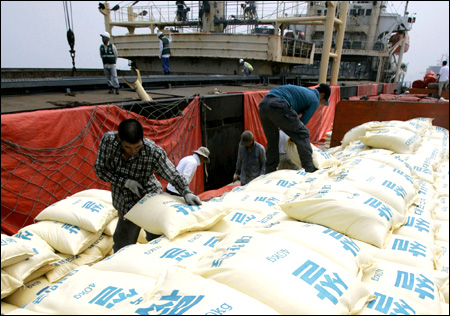
Following two days of talks between economic representatives of the two Koreas at the Kaesong Industrial Complex, South Korea announced on July 7 that it would begin shipping raw materials to the North in exchange for DPRK natural resources. South Korea shipped 800,000 USD of polyester fabric on July 25, and is set to send the rest of the materials by the end of November. North Korea accepted South Korean prices for the goods, and will pay transportation, cargo working, and demurrage costs, as well. South Korea will pay for shipping, insurance, and the use of port facilities. On 28 July, a South Korean delegation left for the North in order to conduct on-site surveys of three zinc and magnesite mines. The team will spend two weeks in North Korea.

It was reported on 17 July that North Korea proposed a joint fishing zone north of the ‘Northern Limit Line’ dividing North and South territorial waters to the west of the peninsula. Seoul turned down the offer.

Inter-Korean military talks broke down early on 26 July after only three days of negotiations as North Korea insisted on the redrawing of the Northern Limit Line.

North Korea demanded on 27 July that workers in the Kaesong Industrial Complex be given a 15 percent pay raise. The North Korean workers will not work overtime, weekends or holidays beginning in August unless the raise is granted.

It was reported by the Korea International Trade Association on 26 July that inter-Korean trade was up 28.6 percent in the first six months of 2007, totaling 720 million USD.

RUSSIA-DPRK INVESTMENT

It was reported on 19 July that Russia and North Korea have agreed to connect Khasan and Najin by rail, enlisting investment from Russian oil companies interested in an inactive refinery at Najin Port capable of processing up to 120,000 barrels per day. The project is estimated to cost over two billion USD.

MONGOLIA-DPRK RELATIONS

During a four-day visit to Mongolia by Kim Yong-nam beginning on 20 July, the two countries signed protocols on cooperation on health and science, trade and sea transport, and labor exchange issues. This follows on the heals of an agreement to allow South Korean trains to travel through North Korean territory on to Mongolia in route to Russia and Europe.

JAPAN-DPRK PROPAGANDA

Japan took one step further to recover abductees in North Korea this month when the government began broadcasting propaganda into the DPRK intended for Japanese citizens. The broadcasts are made in Korean and Japanese (30 minutes each) daily, and updated once per week.

U.S.-DPRK PEACE PROSPECTS

U.S. Ambassador to the ROK Alexander Vershbow stated that Washington was prepared to negotiate a permanent peace regime on the Korean Peninsula by the end of the year if North Korea were to completely abandon its nuclear ambitions.


EGYPT-DPRK INVESTMENT

The Egyptian company Orascom Construction Industries announced a 115 million USD deal with North Korea’s state-owned Pyongyang Myongdang Trading Corporation to purchase a 50 percent state in Sangwon Cement. To put this in perspective, the deal in worth more than four times the amount of frozen DPRK funds that had caused six-party talks to break down and delayed the implementation of the February 13 agreement.

NORTH KOREAN SOCIETY

The Economist reported on 7 July that, according to foreigners living in the North’s capital, concern for petty law appears to be weakening. Citizens are reportedly smoking in smoke-free zones, sitting on escalator rails, and even blocking traffic by selling wares on the streets.

It was reported on July 11 that a letter sent earlier in the year by the North Korean Red Cross indicated severe shortages of medical supplies. The letter stated that North Korea would accept any medicine, even if it was past expiration, and accept all consequences for any problems that arose from using outdated supplies. The (South) Korea Pharmaceutical Manufacturers Association had no choice but to reject the request.

Events were held on July 11 in North Korea in order to promote women’s health and well-being issues. Marking World Population Day, a North Korean official stated that the DPRK has cooperated with the UN Population Fund since 1986, and is now in the fourth phase of cooperation.

Seeing entertainment venues as a “threat to society”, North Korean security forces have been implementing a shutdown of karaoke bars and Internet cafes. These venues mainly cater to traders in the northern regions of the country.

It was reported on July 13 that construction of North Korea’s first all-English language university was nearing completion. The Pyongyang University of Science and Technology, funded largely by ROK and U.S. Christian evangelical groups, will hold 2600 students and offer undergraduate and post-graduate degrees in business administration, information technology, and agriculture.

Local elections were held on 29 July for DPRK provincial, city, and country People’s Assemblies. 100 percent of 27,390 candidates were approved with a 99.82 percent turnout reported.

Share

North Korea Wants End to Sanctions Before It Makes Nuclear Deal

Thursday, July 26th, 2007

Bloomberg
Bradley K. Martin
7/26/2007

To make painkillers and antibiotics in his factory in Pyongyang, Swiss businessman Felix Abt needs reagents, chemicals used to test for toxic impurities. Abt can’t get them now — because the world refuses to sell North Korea a product that is also used to manufacture biological weapons.

Such sanctions on trade with the regime of Kim Jong Il — some dating back to the Korean War — may be the next diplomatic battleground after North Korea bowed to pressure last week and shut down five nuclear facilities at Yongbyon.

North Korea said July 16 that ending sanctions, and its removal from a U.S. list of countries that sponsor terrorism, are prerequisites for further progress in the negotiations to end its nuclear weapons program. The U.S., meanwhile, says the next step is for North Korea to disclose all its nuclear capabilities, followed by a permanent dismantling of Yongbyon.

North Korea is playing a “tactical game,” said David Straub, a Korea specialist at Johns Hopkins University’s School of Advanced International Studies in Washington. After shutting down Yongbyon and receiving a pledge of 950,000 tons of oil, the reclusive nation will try to “force the U.S. and others to lift sanctions,” Straub said in an e-mail exchange.

While many of the post-Korean war sanctions were lifted between 1994 and 2000 by President Bill Clinton, Americans are prohibited from exporting “dual-use” products or technologies, a wide range of items that might have military as well as civilian applications — including reagents and even aluminum bicycle tubing, which might be used to make rockets.

UN Sanctions

Much of the world joined the sanctions regime after North Korea tested an atomic device last October. The United Nations called on member states to stop trade in weapons, “dual-use” items and luxury goods. Japan went further, stopping used-car exports and banning port calls by North Korean vessels.

Now that North Korea has shut its facilities at Yongbyon and allowed in international inspectors, the haggling will begin on the next steps. If its demands aren’t met, North Korea could kick out the inspectors and restart the plants, as it did in 2002.

“The Bush administration must choose between settling for a temporary closure of the nuclear sites and taking a strategic decision to coexist” with North Korea, said Kim Myong Chol, Tokyo-based president of the Center for Korean-American Peace, who for three decades has encouraged foreign reporters to consider him an informal North Korean spokesman. “Otherwise, the agreement will break up, leaving the U.S. with little to show.”

‘Contentious Issue’

Sanctions represent “a multiplicity of issues that could become contentious,” said economist Marcus Noland, North Korea specialist at the Peterson Institute for International Economics in Washington, in an e-mail exchange. China has already called for the lifting of the UN sanctions imposed Oct. 14.

North Korea agreed with the U.S., South Korea, Russia, China and Japan on Feb. 13 to close its Yongbyon reactor, which produced weapons-grade plutonium, and to eventually declare and disable all of its atomic programs. Working groups will meet in August before another round of talks in September.

If the U.S. insists on a list of all the country’s nuclear facilities without starting to negotiate on sanctions, North Korea might consider that “a spoiler” for the talks ahead, Kim Myong Chol said.

Swiss businessman Abt said that in the past he could get around U.S. sanctions for his North Korean pharmaceutical factory by buying supplies from other countries. The UN sanctions shut off those sources.

Using Old Stocks

“Luckily, we have enough stock of reagents, but when it runs out we would not be able to guarantee the safety of our pharmaceuticals any longer,” he said.

Abt, 52, is president of Pyongsu Pharma Joint Venture Co., an enterprise with ties to the Ministry of Public Health that makes painkillers and antibiotics for humanitarian organizations in North Korea. He is also president of Pyongyang’s European Business Association.

“The same is true in many other civilian industries,” said Abt, who moved to North Korea from Vietnam five years ago. Gold mines are affected too, he said: “If they cannot import cyanide, they can’t extract the gold.” Cyanide is another “dual-use” product, part of the process for making some chemical weapons, he said.

All this has “a highly negative impact” on the economy at a time when the regime has announced it wants to focus on development, Abt said. Foreigners are showing “more and more interest in doing business here,” Abt said, predicting that North Korea will eventually be regarded as a successor to Vietnam as “the newest emerging market.”

Share

North Korea Concentrates Energy on Regulating Citizens during Provincial Elections

Tuesday, July 24th, 2007

Daily NK
Kim Young Jin
7/24/2007

The North Korean government, with the approaching Provincial People’s Assembly delegate elections on the 29th of this month, stepped-up one level the management of citizens and regulation of cell phones.

Kang Ki Ok (pseudonym), a civilian of Hyesan in Yangkang Provicne, said in a phone conversation with the reporter on the 20th, “Nowadays, I am afraid to turn on my cell phone. The People Safety agents and the National Security agents inspect us with fury in their eyes. People who use cell phones during the election season are punished, so there are people who bury their phones by putting them into jars.”

The North Korean government, when the People’s Assembly election season comes around every four or five years, concentrates on regulating the society by observing the movement of citizens and examining the registration cards.

The members of the elections preparations committee, composed of National Security agents, chairmen of People’s Units, and head officials of each provincial unit, are ordered to strictly investigate illegal acts occurring in their regions and to control them. Illegal acts are punished at the end of the elections.

According to Mr. Kang, the outflow of information has been secured at the border region with the upcoming delegate elections, so concentrated cell phone regulation were carried out. Further, the control of the border has been toughened recently, so the escape fee has skyrocked to the North Korean currency of 1 million won (approx. US$1,075).

Another source relayed, “Safeguarding Kim Il Sung, Kim Jong Il statues and research offices have been toughened by inspection units composed of each organ and enterprise farming laborers. Further, they are making sure that historic places and vestiges of battle are not destroyed.”

This source said, “Youth Leagues have also organized inspection units and are regulating unemployed persons and are strictly making sure that juveniles do not watch South Korean dramas and listen to illegal CDs and South Korean songs.”

On one hand, related to election preparation, each city, district, and county candidates were posted at the election site and citizens over 17 have gone into preparations such as conducting voter registrations through the election committee.

The source also relayed that the People’s Safety Agency have actively stepped up inspections by summoning civilians who have gone out to foreign sites to catch clam and mine gold for survival.

When the movement of the North Korean authorities to strengthen the solidarity of the regime was presented through this election, the citizens, in fear of being punished as trial cases, have produced a cautious atmosphere.”

At the time of the Supreme People’s Assembly elections in 2003, when thefts or acts of violence occurred, perpetrators were stringently punished regardless of whether or not they were members of the Workers’ Party. Further, in the case that teenagers got into fist fights, the parents were disciplined and jointly held responsible.

Mr. Kim, who defected in 2006, said, “At the time of the 1991 provincial elections, in the province where we were living, teenagers got into a fist fight. One of the gangs who started the fight accused the opponent of “stirring a political event destroying elections” and went to the parents and got compensation for damages by threatening them.”

Share

DPRK Emphasizes Training International Financial Experts

Monday, July 23rd, 2007

Institute for Far Eastern Studies (IFES)
NK Brief No. 07-7-23-1
7/23/2007

North Korea is calling for training for financial specialists in order to protect against the pitfalls of credit transactions and currency exchanges. In a recently acquired copy of the latest issue of the North’s economic journal, “Economy Research”(2007, no.2), ‘bank risk’, the term applied to the hazard of potential losses, was explained in detail, stating, “In order to strengthen the improvements made in foreign currency trading, an important issue is that banks, such as the Trade Bank, dealing with overseas debts identify and thoroughly resolve potential threats.”

It is especially exceptional that the North Korean journal fully introduced the bank risk involved in financial transactions within a market-based economic system. This issue also reported on the events of May 20, when movement toward a resolution to the issue of frozen DPRK accounts in the Delta Banco Asia took place.

The journal divided ‘bank risk’ into three categories, ‘finance risk’, ‘credit risk’, and ‘management risk’. Finance risk was defined as, “the risk that a variety of changes within capitalist financial markets could carry with them adverse effects”. Further on, finance risk was divided into ‘foreign exchange risk’ caused by fluctuations in exchange rates, and ‘interest risk’ driven by changing interest rates.

In addition, “Economy Research” also carried pieces on rational management of the banking management system, subjective evaluation of bank risk, and establishing a strategy for preventing bank risk. “The outcome of [strategy for] prevention of bank risk rests entirely on the quality, skill, and roles of workers responsible for bank administration.”

The journal also stressed that even though quality information resources and materials on financial data are available, “if the quality and skill of workers in the banking sector cannot be raised,” then bank risk cannot be understood, analyzed, or evaluated, and an appropriate strategy cannot be implemented. “When workers constantly improve their quality and turn their attention to preventing bank risk…then an appropriate strategy can be set up.”

In one article, training in international financial transactions was called for, with the journal printing, “Even though today’s workers know how to use modern information resources and include financial experts with foreign language skills, they need to be well versed in the changing modern banking sector and international financial transactions.” From the 2002 “Foreign Investor Banking Law’ to last year’s ‘Commercial Banking Law’, established to stimulate private-sector financial transactions, North Korea continues to tweak its financial system. 

Share

North Korea ready to learn from the outside world

Friday, July 13th, 2007

New Zealand Herald (hat tip DPRK Studies)
David McNeill
7/13/2007

North Korea is set to take a potentially giant leap out of the intellectual cold with the construction of a new all-English language university staffed by academics from around the world and teaching the cream of the country’s graduate students.

Construction of the Pyongyang University of Science and Technology is nearing completion on a 100ha plot leased by the People’s Army in the North’s capital. The Army has loaned 800 solders to build the campus, which is largely funded by a network of Christian evangelicals.

North Korean leader Kim Jong Il is believed to have personally ordered the site cleared for use and granted the university the right to hire staff from anywhere in the world.

The university is expected to eventually have 2600 undergraduate and postgraduate students and to help train a new generation of elite business executives and technicians.

The project’s leaders in South Korea and the United States are playing down its potential impact for fear of spooking the North’s jittery authorities, but agree that it represents potentially a seismic shift in the reclusive state’s largely frozen relations with the rest of the planet.

“It will be the country’s first international university,” said Professor Chan Mo Park, co-chair of the university and a prominent Seoul scientist.

“The North has good universities but they don’t communicate with the rest of the world. This will let everyone know that the capacity of their scientists is very high.”

Despite crumbling facilities, Pyongyang’s standards of computer science, software and applied mathematics are world-class, say experts, and its youth are bursting with pent-up business energy. The university is expected to generate spin-off businesses and eventually a Silicon Valley-style business park.

The faculty of 45 will offer an MA in business administration as well as courses on information technology and agriculture to an initial cohort of about 150 students recruited from the country’s top research institutions.

Given the scale of foreign involvement and the money poured into the new campus so far, those involved say they are confident it will open its first research laboratories this autumn and its doors to students next spring.

But the legendary unpredictability of the Kim Jong-Il government could still throw a spanner in the university’s works.

Share

Famine: A Disaster Waiting to Happen

Sunday, July 8th, 2007

Korea Times
Andrei Lankov
7/8/2007

aid.jpgNowadays, the severity of famine appears to be a thing of the past _ at least outside Africa. Indeed, modern technology makes it possible to feed crowded cities almost effortlessly. Thus, any reports of famine nowadays can be argued to be the direct result of mismanagement and deliberate political decisions. The recent North Korean famine of 1996-2000 vividly demonstrates this and supports such a theory.

Stalinist agriculture has never been very efficient. The lack of incentive makes it sluggish and wasteful. However, in some cases, the heavy investments in machinery and fertilizers did, in fact, help to overcome some of the deficiencies created by the inept social system.

This was the case in North Korea. In the late 1950s all North Korean farmers were herded into the so-called “agricultural co-operatives.’’ While less restrictive than the “people’s communes’’ in Mao’s China, they imposed a harsher control than Stalin’s “kolkhozs.’’

The North Korean government invested heavily in agriculture. Its efforts produced a remarkably energy-intensive agricultural system. Electric pumps were running huge irrigation projects; chemical fertilizers and tractors were used on a grand scale. In attempts to reclaim arable land, steep hills were made into terrace fields. These fields, endorsed by Kim Il-sung himself, remained the poster image of North Korean agriculture until the mid-1990s.

Initially these efforts seemingly paid off. In the 1980s North Korea produced some 5-6 million tons of grain (largely, rice and maize) a year. Its population never enjoyed anything like the present-day South Korean abundance: meat or fruits were rare delicacies. Nonetheless, the 6 million tons of grain was sufficient to feed the country’s population. This was done through the rationing system. Depending on one’s position in the complicated hierarchy of social groups, daily rations varied from 500 to 900 grams per adult _ sufficient to provide enough calories.

But in 1991 the situation changed. The much trumpeted “self-reliance’’ of North Korea proved to be a complete fake. The Soviet decision to discontinue sales of oil and other goods at hugely discounted prices wrought havoc in the country’s economy. The agricultural sector was especially vulnerable, since without the heavy input of energy and resources it stood no chance of survival. Tractors required diesel oil, which was not forthcoming, and electric pumps could not operate when power stations were idle due to a shortage of spare parts.

In 1992-1993 the North Korean media began to argue the benefits of having only two meals a day as opposed to the traditional three, claiming the latter was unhealthy and excessive. By 1994, people in some remote areas could not get food for days at a time. They were issued the usual rationing coupons, but no foodstuffs were available in the shops. Rations were also cut. These were signs of things to come.

However, the North Korean government did not follow the example of China or Vietnam, where the return to private agriculture led to an instant revival in food production. In the early 1990s the Pyongyang leaders saw how the reformist Communist governments of East Europe had been wiped out, and they considered any reform potentially dangerous to their own survival. Thus, no reform was undertaken, and in the years 1992-1995 agricultural production continued its free fall.

And then the real catastrophe came. In July and August 1995 unusually heavy rains led to disastrous floods. The North Korean authorities blamed the floods for all subsequent developments. In the aftermath of the disaster, they even decided to break with the decades-old tradition of covering or playing down all the problems of their country. Pyongyang stated that some 5.4 million people had been displaced by the 1995 floods (the subsequent U.N. survey indicated that the actual figure was much smaller _ probably, by an order of ten). Politically, this was understandable: if the country was hit by a natural disaster of unprecedented proportions, the authorities were not to be held responsible!

There is, however, good reason to doubt these statements. After all, the Korean Peninsular is small, but impact of the very same floods on the South was negligible. However, the contribution of the flood to the disaster is undeniable. The already strained power grid was destroyed, and entire irrigation systems were wiped out. Most of the terrace fields, the pride of the “juche agriculture,’’ were simply washed away.

In 1996, the country harvested some 3 million tons of grain _ just above half the pre-crisis level. This meant famine. It was to last for four years and take between half million and one million lives.

Share

Kim Yun-kyu Resumes N. Korean Business

Tuesday, July 3rd, 2007

Korea Times
Yoon Won-sup
7/3/2007

Kim Yun-kyu, who stepped down as vice president of Hyundai Asan, South Korea’s operator of inter-Korean business and tourism, due to illegal use of corporate funds in October 2005, is resuming work with North Korea.

Kim set up his own company for North Korean business last year, dubbed Acheon Global Corp., which imported 531 kilograms of caviar from North Korea via the East Coast train on June 21, and entered the Gaeseong Industrial Complex, according to the Unification Ministry.

The importing of the caviar is Acheon’s first business transaction with North Korea, which was finalized by Kim’s aide Yuk Jae-hee, vice president of Acheon and former executive of Hyundai, during Yuk’s visit to Mt. Geumgang in North Korea June 18 to 20.

Kim will visit Mt. Geumgang Thursday, the first time since his resignation, to discuss additional imports with North Korean government officials. His North Korean counterpart is a business association in charge of fisheries.

Kim is reportedly seeking to bring North Korean sand to the South. Accordingly, he visited Gaeseong June 19, and Yuk plans to visit Gaeseong soon for further discussion on sand importing.

However, the two CEOs of Acheon are not likely to meet senior North Korean government officials, though they previously have met with and will, again, meet with working-level officials on inter-Korean affairs, in Gaeseong and Mt. Geumgang.

“Kim got approval from North Korea to visit the country for trade of agricultural and fishery projects, and the discussion has been conducted according to the purpose of his visit to North Korea,” a South Korean government official said on condition of anonymity.

Kim already discussed imports of North Korean fisheries and sand to the South and the establishment of an office in Gaeseong, with Choi Seung-chul, vice chairman of Asia Pacific Peace Committee of North Korea.

In line with Kim’s plan, Acheon signed a contract with the Korea Land Corp. to rent 1,400 square meters of land in the Gaeseong complex.

A building is to be set up there to accommodate restaurants, coffeehouses and other facilities for workers in Gaeseong, but it is not yet decided what kind of facilities will be built by Acheon. A permanent office of Acheon also is likely to be set up in Gaeseong.

Some observers say Kim’s resumed activity may lead to competition with Hyundai Asan regarding inter-Korean business, but the dominant opinion is that the chance is slim for the time being.

Kim led the inter-Korean business with Mt. Geumgang tourism and Gaeseong complex under the confidence of late Hyundai Group founder Chung Ju-yung and his late son Mong-hun, former president of Hyundai Asan. Now Hyun Jung-eun, widow of Chung Mong-hun, leads Hyundai Asan.

Share

Purchase Popular Jangmadang Goods at State-Operated Stores

Tuesday, July 3rd, 2007

Daily NK
Yang Jung A
7/3/2007

A North Korean insider source relayed on the 2nd that citizens’ complaints have been rising because the North Korean government recently gave guidelines to sell a portion of products which have been selling with popularity at the jangmadang (markets) only at state-operated stores.

This source, who resides in North Pyongan, revealed in a phone conversation with DailyNK, “Recently, plastic floors have been popular, so “plastic sales” is earning a lot of money. However, government authorities have mandated that the commerce office directly oversee plastic floors and that they be sold at state-operated stores.”

The insider relayed, “Families above middle-class have been showing a lot of interest in acquiring furniture. Besides floors, drawers on which TV can be placed and cabinets displaying wines and others are very popular.”

Previously, floors made of paper covered the floors of houses, but since North Korean civilians’ standard of living started rising recently, Chinese-made plastic floors decorated in flowers is drawing popularity.

He said, “Rumor has been leaking that pork (1,700 North Korean won per kg), the price for which has declined recently, is also directly managed by the commerce office, along with plastic floors.” “Besides this, the complaints of merchants have been rising since rumor starting circulating that the list of items to be overseen by the office will increase.”

He added, “Would they want to do any business given that individual sales are discouraged and turned over to national control when sales go even remotely well? There are grievances due to the fact that earning a livelihood through jangmadang sales is not even allowed, on top of the lack of provisions.”

Further, he said, “Regulations regarding people engaging in “Chapan-Jangsa (sales by trucks)” using privately-owned buses or trucks exceeding eight tons have begun. If one is caught, the vehicles become registered as national property and the vehicle owner receives a salary from the country instead.”

“Chapan Jangsa” refers to carrying out wholesale while ferrying the load on trucks. The “plastic floor” and “Chapan Jangsa,” along with what is popularly known as “ice (drug) sales” are counted are the top three business that brings in the most amount of money.

“The complaints of people are high, but the scope of regulation is wide-ranging, so there are people who think that the inspections will stop after several times.”

Even guideline to prevent wearing of wedding dresses

He also said, “Since October 2006, there were even guidelines to prevent wearing of wedding dresses at weddings. Not only wedding dresses, but wearing white gloves were also prohibited.”

In North Korea, wearing wedding dresses at weddings became a trend seven to eight years ago. Nowadays, many civilians are known to wear them. Even if they do not wear wedding dresses, North Korea’s general wedding culture is donning flowers on the chest part of dresses and on the head and putting on white gloves.

Additionally, the insider relayed, “The size of the flower of the groomsmen and the bridesmaids should not be bigger than the groom’s and the bride’s. The flower of the groom and the bride is fixed at 7cm and the flower of the groomsmen and bridesmaids fixed at 5cm. In the case with those who go against the orders and get their pictures taken after marriage, the photo volunteer in charge’s volunteer card (employment permit) can be revoked.”

Share

Elections for Supreme People’s Assembly Representatives Will Be Carried out in August

Tuesday, June 26th, 2007

Daily NK
Kwon Jeong Hyun
6/26/2007

A source from North Korea reported on the 23rd that the election of the 12nd representatives of the Supreme People’s Assembly will be carried out at the beginning of August.

The North Korean Supreme People’s Assembly officially announced on the 19th that it plans to execute the elections of provincial representatives of the city, village, and district People’s Assemblies on July 29th. In North Korea, elections for city, village, and district People’s Assembly representatives are carried out every four years and in August 2003, 26,650 provincial representatives were selected.

On one hand, the election for the Supreme People’s Assembly representatives, according to North Korean constitutional law, has been carried out every five years. Accordingly, the normal timetable should be August 2008 for the upcoming election. However, due to the Kim Il Sung’s death in ’94, the ’98 10th representative elections occurred in eight years and three months.

The current 11th representative elections were held at the same time as provincial representative elections in August 2003.

The source said, “The government, starting beginning of June, gathered civilians’ residential cards and entered into composing a roster for the Supreme People’s Assembly’s representative elections. The People’s Safety Agency is currently in the middle of a secret investigation into the deceased, missing people, and those who have not reported because they have moved.”

The making of the election roster is also carried out for provincial representative elections.

Detailed evidence for whether the Supreme People’s Assembly elections and the provincial representative elections will be carried out at the same time has not been discovered yet. The North Korean government, through the Chosun (North Korea) Central News Agency, formally announced, “The city, village, and district representative elections will be carried out on July 29th, but a reference has not been made regarding the Supreme People’s Assembly elections yet.”

However, it is difficult to completely exclude the possibility of the simultaneous execution of elections as long as one can expect change in North Korea’s foreign relations and the economic sacrifice problem.

If North Korea simultaneously carries out the provincial representative elections and the Supreme People’s Assembly representative elections at the same time, the possibility is high that it will terminate the process of searching for missing citizens’ whereabouts which has continued these last 10 years as well as the defector issue and will spur building the solidarity of the domestic system.

Kim Sung Hoon (pseudonym, Chongjin, North Hamkyung), who defected in December 2006, explained, “In North Korea, failure to participate in elections is considered as a ‘political reactionary activity’ and if one does not participate in elections without ‘report his or her death,’ the official documents of history are submitted to the National Security Agency and that person becomes, in essence, a ‘public criminal.'”

Share

N.Korea’s Kang Sok-ju Appointed to NDC

Monday, June 18th, 2007

Choson Ilbo (Hat Tip DPRK Studies)
6/18/2007

North Korea’s First Vice Foreign Minister Kang Sok-ju, who is in responsible for Pyongyang’s diplomatic affairs including the nuclear issue, was in May made a member of the ruling National Defense Commission (NDC) led by dictator Kim Jong-il, Russian sources said Sunday.

The sources said Kim appointed Kang to the leadership body to strengthen his power base, with the move seen as ensuring the NDC holds sway over the military as well as domestic and foreign affairs.

Kang has served as the First Vice Foreign Minister since 1986 and is known as the only foreign ministry official who can directly advise Kim. He was a signer of the 1994 Geneva Accords between the U.S. and North Korea and the leader of Pyongyang’s representatives in the six-nation talks. Kang recently visited Moscow for treatment of a cataract.

The sources also said that General Lee Myung-soo, who was the North Korean military’s director of operations, has been made an organizer in the NDC.

The NDC currently consists of the country’s nine most powerful leaders, including Kim who serves as the body’s head, Vice Marshal Cho Myong Rok, who is Kim’s special envoy, Vice Marshal Kim Young-choon, General Rhee Yong-mu, General Kim Il-cheol and Secretary Chun Byung-ho.

Share
