Archive for the ‘DPRK organizations’ Category

Tax free North Korea

Saturday, March 21st, 2009

By Benjamin Katzeff Silberstein

Archived article from KCNA in 2009, acknowledging North Korea’s turn to a formally tax-free economy system in 1974 (found through a cached page here):

March 21. 2009 Juche 98

DPRK, First Tax Free Country

Pyongyang, March 21 (KCNA) — The DPRK promulgated the historic law on liquidating the tax system, a legacy of the old society, once and for all on March 21, Juche 63 (1974), declaring the DPRK, the first tax free country in the world.

President Kim Il Sung saw to it that the Third Session of the Fifth Supreme People’s Assembly of the DPRK adopted and promulgated the law to the whole world.

He expounded the establishment of a fair tax system in his famous work “The Ten-Point Programme of the Association for the Restoration of the Fatherland” already in the period of the anti-Japanese revolutionary struggle. After the national liberation (August 15, 1945), he made every possible effort to do away with the predatory tax system of the Japanese imperialists, establish a popular and democratic one in the country and lessen the tax burden of the people in a systematic way.

The DPRK reduced the income tax of the factory and office workers by 30 percent, alleviated the tax burden of private traders and industrialists considerably and scaled down the agricultural tax in kind from 25 percent of grain output to 20.1 percent again in 1955 after the Korean war, and to 8.4 percent from 1959.

Along with the progress of the socialist construction, the growth of income of the state-owned economy and the heightening of the political and ideological awareness of the working people, the agricultural tax in kind, which had been introduced right after the liberation, was completely abolished by the year of 1966 in accordance with the publication of “Theses on the Socialist Rural Question in Our Country” by the President. The tax paid by the people accounted for some two percent of the state budget revenue.

He promulgated his famous work “On Abolishing the Tax System” as a law of the Supreme People’s Assembly and thus abolished the tax system for good and brilliantly realized the long-cherished desire of the people.

The promulgation of the law was a historic event which brought to reality the ardent desire of the Korean people to live in a tax-free country and made them as the proud masters of the country free from tax. This opened up a new tax-free era for the humankind and demonstrated the incomparable superiority of the Korean-style socialist system and the might of the independent national economy.

Share

European insurers and LinkedIn nervous about the Swiss

Friday, March 20th, 2009

Over the last few years, the European Union has pursued an engagement policy with North Korea.   MEP Glyn Ford makes regular trips to Pyongyang to facilitate diplomatic progress; the German Freidrich Naumann Foundation runs economic education courses; European donors founded the Pyongyang Business School; and a small group of European ex-pat businessmen formed a de facto chamber of commerce, the European Business Association in Pyongyang.  Although European companies have experienced mixed success in the DPRK they continue to look for new opportunities

This morning, however, Felix Abt, a Swiss director of the PyongSu Pharmaceutical Joint Venture Co. in Pyongyang informs me that his life insurance policy (purchased from a European company) has been cancelled. 

“A European life insurance company cancelled my life insurance because I am a dangerous person living in a dangerous country. Credit card organisations cancel credit cards for such persons in such countries, health insurance companies come up with other reservations and limitations and the latest organisation that has just expelled me is LinkedIn with a very curious explanation.”

I am unsure how the cancellation of life insurance policies could impact other Europen investments in the DPRK, but the marginal effect cannot be positive.  Mr. Abt has been a resident of Pyongyang for years where he manufactures Western-quality pharmaceuticals.  Needless to say, the DPRK is very much in need of his services, so it is a shame that after all this time he is now considered a liability by his insurer.

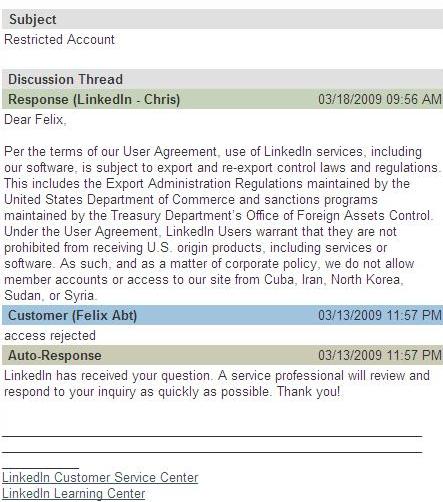
Mr. Abt also forwarded his rejection from the business networking site LinkedIn, which is posted below:
 

linkedin.JPG

Apparently LinkedIn‘s legal department considers logging into the server as “receiving goods of US origin” (the software I presume), and so it prohibits account holders, or even logging in, from Cuba, Iran, North Korea, Sudan and Syria—even if they are Swiss.

Share

North Korea Google Earth

Wednesday, March 11th, 2009

North Korea Uncovered v.16
Download it here

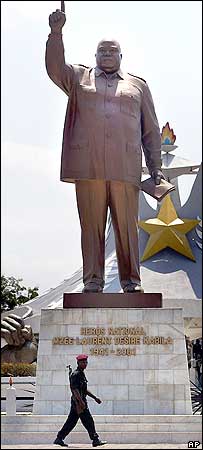
laurent-kabila.jpg

The most recent version of North Korea Uncovered (North Korea Google Earth) has been published.  Since being launched, this project has been continuously expanded and to date has been downloaded over 32,000 times.

Pictured to the left is a statue of Laurent Kabila of the Democratic Republic of Congo.  This statue, as well as many others identified in this version of the project, was built by the North Koreans. According to a visitor:

From the neck down, the Kabila monument looks strangely like Kim Jong Il: baggy uniform, creased pants, the raised arm, a little book in his left hand. From the neck up, the statue is the thick, grim bald mug of Laurent Kabila (his son Joseph is the current president). “The body was made in North Korea,” explains my driver Felix. In other words, the body is Kim Jong Il’s, but with a fat, scowling Kabila head simply welded on.

This is particularly interesting because there are no known pictures of a Kim Jong il statue.  The only KJI statue that is reported to exist is in front of the National Security Agency in Pyongyang.  If a Kim Jong il statue does in fact exist, it might look something like this.

Thanks again to the anonymous contributors, readers, and fans of this project for your helpful advice and location information. This project would not be successful without your contributions.

Version 16 contains the following additions: Rakwon Machine Complex, Sinuiju Cosmetics Factory, Manpo Restaurant, Worker’s Party No. 3 Building (including Central Committee and Guidance Dept.), Pukchang Aluminum Factory, Pusan-ri Aluminum Factory, Pukchung Machine Complex, Mirim Block Factory, Pyongyang General Textile Factory, Chonnae Cement Factory, Pyongsu Rx Joint Venture, Tongbong Cooperative Farm, Chusang Cooperative Farm, Hoeryong Essential Foodstuff Factory, Kim Ki-song Hoeryong First Middle School , Mirim War University, electricity grid expansion, Tonghae Satellite Launching Ground (TSLG)” is also known as the “Musudan-ri Launching Station,” rebuilt electricity grid, Kumchang-ri suspected underground nuclear site, Wangjaesan Grand Monument, Phothae Revolutionary Site, Naedong Revolutionary Site, Kunja Revolutionary Site, Junggang Revolutionary Site, Phophyong Revolutionary Site, Samdung Revolutionary Site, Phyongsan Granite Mine, Songjin Iron and Steel Complex (Kimchaek), Swedish, German and British embassy building, Taehongdan Potato Processing Factory, Pyongyang Muyseum of Film and Theatrical Arts, Overseas Monuments built by DPRK: Rice Museum (Muzium Padi) in Malaysia, Statue de Patrice Lumumba (Kinshasa, DR Congo), National Heroes Acre (Windhoek, Namibia), Derg Monument (Addis Ababa, Ethiopia), National Heroes Acre (Harare, Zimbabwe), New State House (Windhoek, Namibia), Three Dikgosi (Chiefs) Monument (Gaborone, Botswana), 1st of May Square Statue of Agostinho Neto (Luanda, Angola), Momunment Heroinas Angolas (Luanda, Angola), Monument to the Martyrs of Kifangondo Battle (Luanda, Angola), Place de l’étoile rouge, (Porto Novo, Benin), Statue of King Béhanzin (Abomey, Benin), Monument to the African Renaissance (Dakar, Senegal), Monument to Laurent Kabila [pictured above] (Kinshasa, DR Congo).
Share

2009 Supreme People’s Assembly (s)elections

Friday, March 6th, 2009

UPDTE 5: (h/t Werner) Here is a link to the full list of SPA members (in Korean).   Kim Jong il’s district, 333, is the only one not published.  Jang Song Taek (Kim’s borther in law) is representing district 31.

UPDATE 4: Michael Madden sends in more biographies of prominent North Koreans:

Kim Kyong Hui, biography here
Ju Sang Song, biography here
Ji Yong Chun, biography here
Choe Ryong Hae,  biography here
Kim Yong Ju, biography here

UPDATE 3: Daily NK coverage of the election results here. 

UPDATE 2: Yonhap reports that fewer lawmakers were replaced than in the 2003 election, when there was a 50% turnover.  Choe Sung-chol, vice chairman of the Asia-Pacific Peace Committee handling inter-Korean affairs, was removed from the Assembly, according to its new list. 

UPDATE 1: The AP is reporting that none of Kim Jong il’s sons were (s)elected to the SPA.  Who was (s)elected?  I am still waiting on the full list, but the AP reports the following:

Members of the new parliament announced Monday included Kim Yong Nam, the North’s No. 2 official and the ceremonial head of state; Jang Song Taek, head of the Workers’ Party’s administrative department and Kim Jong Il’s brother-in-law; and Kang Sok Ju, the first vice foreign minister.

Read the full story here

ORIGINAL POST: On Sunday, March 8, the DPRK will hold “our-style elections” for members of the Supreme People’s Assembly.  Organizaitonal charts of the North Korean government can be found here, although they are based on the a de jure reading of DPRK’s legal procedures not the de facto operation of the political system.  A list of top policymakers (in state offices) can be found here.  I will post relevant material as it becomes available.  In the meantime, here is some related information:

1. DPRK recent military personnel changes.

2. Kim Jong il nominated for SPA.

3. CIA publishes list of policymakers.

4. DPRK ministerial shakeup.

5. Election day pictures: 1, 2, 3.

6. KCNA coverage of the election: 1, 2, 3, 4, 5, 6, 7.

7. Biographies if prominent NK policy-makers by Michael Madden posted below.

The Associated Press provides some context for the (s)election:

North Korea holds elections Sunday for its legislature, the Supreme People’s Assembly. A look at key factors in the upcoming poll:

WHAT’S AT STAKE: Voters will elect the country’s 12th Supreme People’s Assembly for a five-year term. The assembly currently has 687 deputies but the number, which is linked to the country’s population, could change.

WHY IT’S IMPORTANT: Legislatively, the assembly is a rubber-stamp body. But since members double as key officials, the election provides a glimpse of the ruling elite in the secretive country.

WHO’S RUNNING: Only one candidate runs in each constituency. By law, individuals and organizations can recommend candidates, but the ruling Workers’ Party is widely believed to pick candidates. North Korean leader Kim Jong Il is running in constituency No. 333.

THE VOTE: Officially, it’s a secret vote. In reality, it’s not. To vote against a candidate, voters go to a special booth to cross out the name, making it obvious who is doing so. Defectors say opposing a candidate is unthinkable. Polls typically open from 9 a.m. to 6 p.m. and results are announced the following day.

TURNOUT: In the last election in 2003, turnout was 99.9 percent, state media said. All citizens aged 17 or older are eligible to vote.

The Donga Ilbo offers, “6 Rising Stars in the North Korean Elite”:

A report by the South Korean Unification Ministry presented to the National Assembly yesterday mentioned six politicians among the 20 most frequently mentioned by the North’s official daily Rodong Shinmun last year as rising stars in Pyongyang’s hierarchy.

The six were not mentioned in 2007.

One North Korea expert said, “North Korea’s leadership has been controlled by Kim Jong Il. Those frequently mentioned by media can be considered powerful politicians. After the elections Sunday, North Korea’s political elite will be replaced. In the process, we need to pay more attention to the rising stars.”

The most notable among the six is Ri Yong Chol, first secretary of the Central Committee of the Kim Il Sung Socialist Youth League. He ranks 15th for being mentioned 45 times last year.

Since being elected secretary in December 2007, Ri has often appeared on the political scene. He even had an interview with the state-run (North) Korean Central News Agency on the implementation of projects announced in a New Year’s joint editorial.

Kim Jong Il established the league, a fringe organization of the ruling Workers’ Party whose previous name was the Socialist Working Youth League, to strengthen the political foundation of his successor.

To lure the “third and fourth generations of revolution,” Kim renamed the body the Kim Il Sung Socialist Youth League after his late father.

In 2007, the list of the North’s top 20 politicians had nobody from the league. Ri’s rapid rise indicates Kim Jong Il’s strategy to strengthen the power of his successor.

Kim Thae Jong, vice director of the international department of the party’s Central Committee, ranks ninth for appearing 62 times in the media. He was a frequent player in diplomacy last year and even appeared in the royal box when North Korea held a national event to commemorate the 17th anniversary of Kim Jong Il’s taking office as supreme commander of the North’s military in December last year.

In 2007, Vice Marshal Kim Il Chol was the sole military officer among the top 20 elites but fell out of last year’s list.

Replacing him were marshals Hyon Chol Hae (11th) and Ri Myong Su (13th). Hyon accompanied Kim Jong Il most often last year and Ri ranked second in that category.

Among Cabinet members, Foreign Trade Minister Ri Ryong Nam, who was mentioned by media 43 times, ranked 17th. Kim Jong Il appointed nine new ministers including Ri last year.

Most of the six ministers appointed since October last year have been emerging technocrats.

Michael Madden submits these brief biographies of some DPRK notables:

Kim Ki-nam, biography (PDF), photo
Ri Yong-mu, biography (PDF)
Kim Il-chol, biography (PDF), photo
Jon Pyong-ho, biography (PDF)

Jang Brothers

Jang Sung-taek, PDF biography here, recent photo with Kim Jong il here.

Jang Sung-gil
Birth date: January 13, 1939
Last known position: Lieutenant General, KPA

Positions held:
1981: Colonel, and Vice-Commanding Officer, Second Corps, KPA
1982: Colonel, and Commanding Officer, 13th Division, Second Corps, KPA
Vice-Commanding Officer, Second Corps, KPA
1985: Major General, Commanding Officer, 32nd Division, Fifth Corps, KPA
1992: Vice-Commanding Officer, Fourth Corps, KPA
1992: Promoted to Lieutenant General, KPA (April)*
1996: Commanding Officer, 105th Division, Ryu Kyong-su Tank Command, KPA (December)

Presumed to be relieved of command of the 105th Tank Division, during JST’s p.n.g. status.

*General Jang is part of the same 1992 class that promoted Kim Yong Chun

Jang Sung-u
Born: 1935, Kangwon Province
Education
Kim il Sung Military Academy

Positions held:
1971: Vice Department Director, Organization and Guidance Department, CCKWP
1977: Promoted to Major General, KPA
1980: Member, CCKWP (October)
1982: Dlegate, 7th SPA (February)
Awarded Order of Kim il Sung (April)
1984: Promoted to Lieutenant General, KPA (May)
1986: Delegate, 8th SPA (November)
1988: Director-General, Reconnaissance Bureau, MPAF
1989: 1st Vice Director, Public Security Department (January)
1990: Delegate, 9th SPA, representing Saenal, South Hwanghae (April)
Promoted to Colonel-General, KPA (presumed April)
Member, Qualification Screening Committee, SPA (May)
1991: Director, General Political Bureau, State Security Department (December)
1992: Interim Position in the Central Command, KPA (April)
Director-General, General Political Bureau, State Security (May)
1994: Commanding Officer, Third Corps, KPA
Member, Kim il Sung Funeral Committee [#85]
1995: Dismissal, as Director-General, General Political Bureau, State Security Department (November)
1996: Commanding Officer, Third Corps, KPA (July)
1998: Delegate 10th SPA (July)

Jang’s inner circle

Cho Chun Hwang
Position: First Vice Department Director, Propaganda and Agitation Department, CCKWP
Education:
Baccalaureate, History, Kim il Sung University

Previous positions:
1972-1990: Mr. Cho worked as a staff member, division director, and department deputy director in the Propaganda and Agitation Department of the CCKWP.
1991: Vice Department Director, Propaganda and Agitation Department, CCKWP
1997: First Vice Department Director, Propaganda and Agitation Department, CCKWP (June)
2000: Vice Department Director Propaganda and Agitation Department, CCKWP (July)

Ri Yong Bok
Position(s): Chief Secretary, Nampho City People’s Committee
Member, 11th SPA
Member, Qualification Screening Committee, SPA

Positions held:
1972: Chairman, KIS League of Socialist Working Youth (December)
Presidium member and delegate, 5th SPA (December)
1982: Vice Department Director, Youth Guidance and Three Revolutions Department, CCKWP (June)
1998: Delegate (606 ED), 10th SPA (July)
Appointed Chief Secretary, Nampho City People’s Committee

Ri Kwang Gun
Position: unknown, possibly in Europe; former Minister of Foreign Trade
Born: 1935
Education:
Namsan Senior Middle School
Pyongyang Foreign Language Institute, German Department
Kim il Sung University

Positions held:
1965: Lecturer, German Department, Pyongyang Foreign Language Institute
1972: Professor, German Department, Kim il Sung University
1977-1978: Ministry of Foreign Trade
1979: State External Economic Affairs Commission
1987: 1st Secretary, Economic Affairs, DPRK Representative to Germany
1991: State External Economic Affairs Commission
1997 (presumed): Korea General Equipment Import and Export Corporation
2000: Appointed Minister of Foreign Trade, DPRK (December)

O Kuk Ryol
Born:  1931, Jilin, PRC
Education:
Mangyongdae Revolutionary School
Kim il Sung University
USSR Croatia Military University (1962)

Positions held:
1964: Promoted Major-General, KPA Air Force
Appointed, Dean, KPA Air Force Academy (November)
1967: Promoted Lieutenant-General and Commanding Officer, KPA Air Force (October)
Delegate, 4th SPA (November)
1970: Appointed Members, CCKWP (November)
1972: Delegate, 5th SPA (December)
1977: Appointed Vice Chief of Staff, KPA (October)
Delegate, 6th SPA (November)
1978: Appointed Alternate Member, Political Bureau, CCKWP
1979: appointed Chief of Staff, KPA (September)
[His command of the KPA Air Force was succeeded by Jo Myong Rok]
1980: Promoted to Colonel General, KPA (September)
Member, CCKWP; Member, Political Bureau (October)
Member, Central Military Committee
1982: Delegate, 7th SPA (February)
Member, Central People’s Committee
Awarded Order of Kim il Sung (April)
1985: Promoted General, KPA (April)
1986: Delegate, 8th SPA (November)
1988: Removed as KPA Chief of Staff (February)
Removed from the Political Bureau, CCKWP (April)
Removed from Central Military Committee (April)
Appointed Director of Civil Defense, CCKWP (November)
1989: Appointed Department Director, Strategy Department, CCKWP (July)
1992: Order of Kim il Sung (April)
1994: Member, Kim il Sung Funeral Committee (#45) (July)
1995: Member, O Jin-U Funeral Committee (#43) (February)
1998: Delegate (356 Electoral District), 10th SPA (July)
2003: Delegate, 11th SPA
2009: Appointed Vice Chair, NDC (February)

Ongoing: Member, CCKWP; State Funeral Committee

Jang rival

Ri Jah Gang
Postion held:  1st Vice Department Director, Organization and Guidance, CCKWP
Born: 1930
Education:
Kim il Sung University

Positions held:
1973: Cadre, Organization and Guidance Department, CCKWP
1975: Vice Director, Organization and Guidance Department, CCKWP
2001: 1st Vice Director, Organization and Guidance Department, CCKWP (July)

On the list of so-called reliable members of the KPA, General Jang Song-u is near the top.  General Jang’s last known position was in the Third Army Corps, whose primary mission is the military defense of Pyongyang.  The Third Army Corps is also responsible the maintenance and support of the Kamsusan Memorial Palace, where General Jang serves as a kind of military officer in residence.   General Jang has always had the support of his younger brother, Jang Song-taek, and the brothers’ careers have advanced on parallel paths in the KPA and the KWP.  Although, due most likely to his military affiliation and the advantage of age (he is eleven years older than Song-taek), General Jang was the first brother admitted to the CCKWP apparatus when he was assigned as a Vice Director of the Organization and Guidance Department CCKWP in 1973.  This was the same year that another Kim Jong il associate with KPA duties, Ri Ji Gang, was assigned to Organization and Guidance.  Based on the accounts of KPA and DPRK State events from the KCNA, General Jang was neither reassigned nor demoted when his brother was removed from the Organization and Guidance Department and confined to his chalet.  Among the capacities in which General Jang has served: he was the commanding military officer in the troop review and parade on the 50th Anniversary of the KWP Foundation in 1995 and; he has assumed interim operational command over the Escort/Bodyguard Units.  Jang Song-u occupies the intersection of the politico(politburo)-military structure and the intelligence agencies (including State Security and the Escort/Bodyguard Units).  The conjunction of General Jang’s political connections and military assignments give him a significant role in matters concerning succeeding governments to Kim Jong il.  In many ways, General Jang’s profile resembles that of those close Kim il Sung aides who eased Kim Jong il into his current job.

Share

“Let’s plant more trees!”

Friday, March 6th, 2009

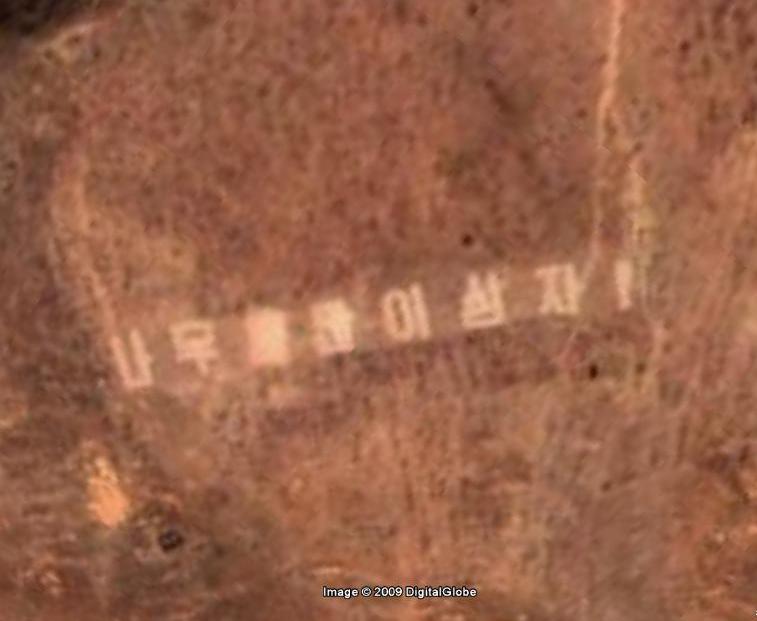
letsplantmoretrees.JPGAs regular Google Earth users are aware, the DPRK has experienced significant deforestation in recent decades from both private and state actors. The former have cleared land for fuel/heat and private food production. The latter have felled forests to export lumber. However, without private property rights over the lumber and corollary price signals, we have witnessed yet another “tragedy of the commons”–the over extraction of a common-pool resource. 

As can be seen in the image above, official reforestation campaigns have been launched several times.  According to Good Friends, the most recent was announced last September, shortly before the DPRK appointed a new forestry minister, Kim Kwang-yong.  According to the Yonhap article below, however, South Koreans and Europeans have been supporting reforestation projects in the DPRK for nearly ten years:

North Korean workers and students rolled up their sleeves Monday for Tree-planting Day, state-run media said, amid continuing aid from South Korea despite damaged political relations.

North Korea has a high deforestation rate, as residents have cut down trees for fuel. Deforestation is closely linked to the country’s chronic food shortages, as barren mountain slopes leave rice farms prone to severe flooding by summer monsoons, according to aid workers in Seoul.

The North Korean government has banned cutting trees and sought to make its country greener with aid from South Korea and some European governments.

“Covered with trees are mountains and fields of the country from the foot of Mount Paektu, the sacred mountain of the revolution, to the military demarcation line and from the eastern coast to the western coast,” the Korean Central News Agency said in an English-language report titled “Greening and Gardening Campaign Gets Brisk.”

“The tree-planting campaign is being briskly undertaken everywhere in the country … changing the appearance of the country beyond recognition day by day,” it said.

South Korean government and civic groups have been operating sapling fields in the North Korean cities of Kaesong and Pyongyang, as well as near the North’s scenic resort Mount Kumgang, providing seedlings, equipment and technology since 1999. The project has cost South Korea some 9 billion won (US$5.7 million), according to the Ministry of Unification.

Aid workers said the inter-Korean forestry project has continued even though Pyongyang cut off all government-level dialogue in response to Seoul’s hardline policy toward it that began last year.

Ahn Sun-kyong, an aid worker from Green One Korea, an umbrella group of over a dozen non-governmental organizations in Seoul, said it plans to build a seed preservation facility and an apple farm in Pyongyang as new projects this year.

“There may be certain limitations, but this non-governmental exchange project will continue,” Ahn said.

Hwang Jae-sung from the Korean Sharing Movement, which operates the Kaepung sapling field in Kaesong as a member of Green One Korea, said most trees are prematurely cut by residents, who also rake up fallen leaves for fuel.

“Deforestation is directly linked to the food problem,” Hwang, who last visited Kaesong in November, said. “We believe tree planting in North Korea is not only useful for preventing floods, but also can be another means of resolving the food shortages in the North.”

The aid groups say 16-18 percent of North Korean forests, or 1.5-1.6 million hectares out of the North’s 8.9 million hectares of forests, are believed to be deforested. About 80 percent of North Korea is covered by mountains.

Although the support offered by these groups is necessary to restore ecological health and productive power of the DPRK’s agricultural lands, an unfortunate consequence will likely be growing restrictions on private food production which will necessarily require the North Korean people to once again rely on the state for food distribution.

Read previous posts on forestry and environmental protection here.

Read the Yonhap story here:
N. Koreans work to make country green on Tree-planting Day: report
Yonhap
Kim Hyun
3/2/2009

Share

International Crane Foundation

Friday, February 27th, 2009

On my last visit to North Korea in 2005, fellow Atlanta native Ted Turner was also in Pyongyang (not at the Yangakdo unfortunatley, but the centrally-located Koryo Hotel) working to secure the DMZ as a crane reserve.  It turns out that this effort is fairly well organizaed and funded.  Below, I have attached some articles, names, and organizations involved in this movement:

The International Crane Foundation

Since 1974, ICF has been involved in conservation efforts for the Korean Demilitarized Zone (DMZ), the three mile wide strip of land between the divided neighbors that provides a home during migration or winter for half of the world’s White-naped Cranes and a quarter of the world’s Red-crowned Cranes.

Conservation in Korea

“For more than three decades, I have been coming to Korea to see the cranes that spend the winter along the DMZ. About one-third of the world’s 2,500 Red-crowned Cranes depend on the DMZ and the nearby Civilian Controlled Zone (CCZ) as their only remaining sanctuary on the peninsula. The Cheorwon Basin in the central highlands has the greatest numbers of cranes, while smaller flocks live in the Yuen Cheon valley, the lower reaches of the Imjin River, and the tidal flats around Kangwha Island.

The Red-crowned Crane is an auspicious symbol of good luck and long life throughout the Orient and cranes worldwide are a symbol of peace. Now perhaps the Red-crowned Crane can be a flagship for the conservation of the DMZ.

I have always tried to help my Korean colleagues in their efforts to save that priceless strip of land that’s carpeted by a grasslands, wetlands, and forests restored by the creative forces of nature over more that a half-century. Although it has been exciting to see modernization sweep it’s magic wand over Korea, it is alarming that humans now have such power to transform landscapes so quickly.

If the remaining natural landscapes of the DMZ and the CCZ are to be saved for nature, Korean conservationists from all walks of life must join together in a united front to negotiate with those more interested in development. This is now possible through a movement started in 1996 by two Korean Americans, Dr. Ke Chung Kim (a scholar) and Mr. Seung-ho Lee (a businessman).

To promote the conservation of the DMZ, they created a non-governmental organization called the DMZ Forum. I am honored to serve on the Board of Directors.

Under the leadership of Mr. Hall Healy (an environmental planner), the DMZ has created a Coalition for the Conservation of the DMZ. Although this Coalition had its birth in the USA, its operation will be “Koreanized” with leadership from an effective and prestigious Korean citizen and supported by a coalition of individuals and organizations primarily from Korea, but also from other nations. Only through the power of partnership, can these treasures of nature from “The Land of the Morning Calm” be saved.”

Recently, ICF held an event.  Here is the email they sent out (h/t Mike):

For years, hundreds of the magnificent Red-crowned Cranes wintered in lowland wetlands and organically-maintained agricultural fields in the DPRK.  With the rise of chemical fertilization after the Korean War through its alliance with the USSR, crops were plentiful in the DPRK, and the field gleanings provided sustenance for the cranes.  With the collapse of the USSR, the cheap source of fertilizer dried up, and after two decades of chemical dependence the organic farming methods had been lost.  Hungry humans foraged for food where the cranes had once wintered.  The cranes moved south, in and around the DMZ and the Civilian Controlled Zone (CCZ).  These two zones, however, have been targeted by developers as potential sites for future cities.  The plan for the re-introduction of wintering cranes in the DPRK addresses teaching the local people organic farming methods anew and relies on using captive cranes to attract wild cranes during their autumn migration.

Through collaboration among colleagues of the Korean University in Tokyo, the State Academy of Sciences in Pyongyan, Democratic People’s Republic of Korea (DPRK, or North Korea), BirdLife International, the International Crane Foundation, and Pisan Cooperative Farm of the DPRK, work is underway to restore the Red-crowned Cranes as winter visitors on the Anbyon Plain located in DPRK.  The project began in the spring and summer of 2008, and it is hoped that it will lead to communication between the DPRK and the Republic of Korea on the conservation of red-crowned Cranes in both nations.

From the event’s web page:

Through collaboration among colleagues of the Korean University in Tokyo, the State Academy of Sciences in Pyongyan, Democratic People’s Republic of Korea (DPRK, or North Korea), BirdLife International, the International Crane Foundation, and Pisan Cooperative Farm of the DPRK, work is underway to restore the Red-crowned Cranes as winter visitors on the Anbyon Plain located in DPRK.  The project began in the spring and summer of 2008, and it is hoped that it will lead to communication between the DPRK and the Republic of Korea on the conservation of red-crowned Cranes in both nations.

For years, hundreds of the magnificent Red-crowned Cranes wintered in lowland wetlands and organically-maintained agricultural fields in the DPRK.  With the rise of chemical fertilization after the Korean War through its alliance with the USSR, crops were plentiful in the DPRK, and the field gleanings provided sustenance for the cranes.  With the collapse of the USSR, the cheap source of fertilizer dried up, and after two decades of chemical dependence the organic farming methods had been lost.  Hungry humans foraged for food where the cranes had once wintered.  The cranes moved south, in and around the DMZ and the Civilian Controlled Zone (CCZ).  These two zones, however, have been targeted by developers as potential sites for future cities.  The plan for the re-introduction of wintering cranes in the DPRK addresses teaching the local people organic faming methods anew and relies on using captive cranes to attract wild cranes during their autumn migration.

More links:
The DMZ Forum web page

DMZ Coalition

Media hits

Share

No More Hoarding Grain

Thursday, February 26th, 2009

Daily NK
Jung Kwon Ho
2/26/2009

Hoarding grain, a major way for general farmers to substitute for the lack of public provisions, was barely possible during the latter-half of last year in Hwanghae Province, the breadbasket of North Korea, according to a source inside the country.

The source from South Hwanghae Province said, “It has become more difficult to hoard grains because the number of security guards on farms since late last year, and monthly house searches by the Province and counties, has made it much more difficult. The punishment for hoarding grain was strengthened; now hoarders are sent to long term reeducation camps.”

Hoarding grain has become a main tool for survival among general farmers since public provision has not been supplied consistently, if at all, in recent years.

Farmers steal grains right before harvest from the storage. From the perspective of the North Korean authorities it is stealing, but it is a lifeline for the people.

The average amount of hoarded grain was more than 20 kilograms in the past, but there were some households in Hwanghae Province that obtained one ton or more of grain. After that, the authorities’ countermoves became fiercer.

The source reported, “Now, farmers complain that it turns out that only guards can openly hoard grain.”

He explained that, “Farmers should receive a years wages according to their labor, but in reality the authorities exclude many parts of it for many reasons, so they can get merely 200,000 North Korean won, which is around three or four months living costs in North Korea.”

He added, “More than half the farmers eat porridge with floury corn and dried vegetables. In the situation where there are no provisions from the state, houses in which the whole family commits suicide can be found.”

Meanwhile, there is a rumor that 15-days’ rations will be distributed in regions of South Pyongan Province in February or March.

Share

Celebratory rations issued for Kim Jong il’s birthday

Thursday, February 26th, 2009

Institute for Far Eastern Studies (IFES)
NK Brief No. 09-2-26-1
2/26/2009

It has been reported that 2-3 day’s worth of special rations were issued to parts of North Pyongan and South Hwanghae provinces, including to those North Koreans working in the Kaesong Industrial Complex, to mark the February 16 birthday of Kim Jong Il.

For families with more than four members, 2 kilograms of rice and 2 kilograms of noodles, with corn making up the rest of the rations. Smaller families received a kilogram each of rice and noodles, in addition to corn. Recently, rations have been in very short supply, even on farms, so North Koreans have been very much looking forward to these special rations.

Since last year, the number of guards stationed at farms was increased sharply, along with increasingly more intrusive house searches, as the theft and consumption of food by those living on the farms was banned. Over the past few years, as the state failed to provide steady rations to the farmers and families on the agricultural plots, these farmers began stealing rice from the cooperative farms as a means to maintain their lifestyles.

However, in November and December of last year, inspections were carried out in cities and districts as grain management on farms was strengthened, leading to an increase in theft of foodstuffs. Those caught stealing would be dragged in front of labor authorities and often sentenced to confinement.

The districts receiving these special rations were all specifically chosen by North Korean authorities. Hweryong City, in North Hamgyong Province, is the hometown of Kim Jong Il’s mother, Kim Jong Sook, while the Samjiyon district, in Yanggang Province, is where Kim Jong Il claims to have been born. Kaesong was thought to have been chosen in order to propagandize the rations to the outside world.

One source reported that in 2006, an anti-socialist group emerged in the city of Hweryong, and that leaders of citizen groups were appealing, “It is difficult to live in our mother (Kim Jong Sook)’s hometown…Let’s all flee to China,” and since Kim Jong Il became aware of the uprising, special rations have been given on holidays and other special occasions. That said, currently, Kim Jong Il’s practice of gift giving continues to be aimed at the leading class in the North, with city and district Party secretaries also receiving gifts, along with central Party authorities. Gifts are also provided to state heroes and model laborers.

See previous posts on Kim’s birthday rations here.

See photos of Birthday rations from the Daily NK here.

Share

The DPRK food situation: Too early to break out the champagne

Wednesday, February 18th, 2009

Stephan Haggard and Marcus Noland
Asia Pacific Bulletin
No. 27, February 5, 2009

Abstract
North Korea has suffered chronic hunger problems for two decades. A famine in the 1990s killed up to one million people and shortages have remained endemic. Most observers believe that the recent harvest is the best in years, but even under optimistic scenarios, food-related distress is likely to continue. Stephan Haggard and Marcus Noland discuss North Korea’s current food situation and the prospects for the future.

Download the full paper in PDF here

Share

Rice prices plummet in North Korea

Wednesday, February 18th, 2009

Institute for Far Esatern Studies (IFES)
NK Brief No. 09-2-18-1
2/18/2009

The online newsletter Open News for North Korea has recently reported that the cost of rice in the DPRK has fallen drastically. The report stated, “The price of rice in a number of cities, including Pyongyang, Nampo, Sinuiju, Hyesan, and Chungjin, has fallen an average of 300-400 won since the middle of last month,” but noted, “however, this is the nominal price, and considering that North Korea’s exchange rate has risen 10-20 percent compared to the Chinese Yuan, the actual fall in price is even greater.”

The price of one kilogram of rice in Pyongyang at the end of last month was 1700-1800 won (earlier prices were from 2000-2100 won); In Pyongsong and Soonchun, 1700won (2100 won), in Sinuiju, 1660 won (2000 won), in Hyesan, 1800 won (2500 won at the end of November), and Chungjin, 1800-1900 won (2000-2500 won at the beginning of January).

The newsletter attributed the drop in prices to the fact that rations from last year’s harvest were distributed to farmers on collective farms in January, and those farmers are now selling those rations in markets. The article explained that prices drop in January and February every year for the same reason.

In addition, North Korea reported that last year’s harvest was the largest in recent years, and that the North had imported large quantities of foodstuffs from China over the past several months. The newsletter stated that this, along with U.S. food aid shipped to Nampo, further added to the drop in prices.

“The North Korean Cabinet handed down an internal order to exchange foreign currency gained through exports until the end of December last year to import as much food as possible,” and the North imported 500 tons of Chinese rice through Sinuiju by January 9. Authorities insisted that after this first import, “[the North] will continue to exchange foreign currency for rice.”

These rice imports are being handled by mining and trade offices, including coal mining companies, the Central Party Underground Special Offices (Reungra Office 88, etc.), Kangsung Trade Office No. 54, which is controlled by the North’s military, Ryongaksan Trade Office, Eunpasan Trade Office.

North Korea is setting aside some imported rice as emergency stores, explaining that they are “in case South-North tensions escalate.”

Share