Archive for the ‘DPRK organizations’ Category

Orascom attracting competition

Thursday, February 12th, 2009

According to Telegeography:

Vietnamese military-owned telco Viettel has announced plans to expand its network to North Korea, Cuba and Venezuela, according to reports in local paper Thanh Nien Daily. Tran Phuoc Minh, deputy director of Viettel, said the company is hoping to hold negotiations with the three countries in order to gain a foothold in their still relatively underdeveloped wireless markets. The cellco expanded its network to Cambodia last year, where it signed up 100,000 wireless subscribers after two months of pilot operations, as well as Laos, where it hopes to attract 50,000 subscribers this year. According to TeleGeography’s GlobalComms database, Viettel had a subscriber base of 28 million at end-2008.

Read the full story here:
Viettel plans network expansion to North Korea, Cuba, Venezuela
TeleGeography
2/6/2009

Share

DPRK announces military personnel changes

Thursday, February 12th, 2009

UPDATE 2: According to Yonhap:

North Korean leader Kim Jong-il appointed his loyal aide to the No. 2 post in the National Defense Commission on Friday, state media said, another sign of the aging leader consolidating his circle.

O Kuk-ryol was named the commission’s vice chairman, second only to Kim, said the North’s Korean Central News Agency.

North Korean media have said little about O, considered to be a combat-savvy veteran who served as the North’s air force commander and chief of the operational department of the ruling Workers’ Party.

Baek Seung-joo, a Seoul-based analyst, said O helped Kim Jong-il win support from the military in the early 1980s after he was tapped as successor of his father and North Korean founder Kim Il-sung.

“O is a senior military figure whom Kim Jong-il trusts,” Baek said.

O, 78, replaces Kim Yong-chun, who was recently promoted as minister of the People’s Armed Forces, the counterpart of South Korea’s Defense Ministry.

N. Korean leader promotes loyal aide in military shakeup
Yonhap
2/20/2009

UPDATE: A short biography of Kim Yong Chun (Big h/t again to Mike):

Born 1936, Kangwon Province

Education
Mangyongdae Revolutionary School
Kim Il Sung University

Positions Held
1960: Secretary, South Phyongan Provincial Committee
1980: Alternate Member, CCKWP (October)
1982: Lieutenant General, Korean People’s Army (year presumed)
1986: Director-General, Strategy Department, delegate to 8th SPA (November), and member of CCKWP (6th term, 12th plenary session, December)
1987: Order of Kim il Sung Award (April)
1990: Delegate, 9th SPA, representing Solbong, Kangwon (April)
1992: Appointed General, KPA (April)
1993: Director-General, General Munitions Mobilization Bureau, KPA (October)
1994: Commanding Officer, KPA Sixth Army Corps (March) and member of Kim il Sung Funeral Committee (July)
1995: Member of O Jin-u Funeral Committee (February), appointed Vice-Marshal and Chief of Staff, KPA (October)
1998: Delegate, 10th SPA (July), appointed to the NDC (September)
2007: Elected Vice Chairman of the NDC, at the ninth session of the 11th SPA (April)
2009: Appointed as Minister of People’s Armed Forces (February)

Ongoing: Member of the CCKWP and the State Funeral Committee

According to KCNA, Ri Young ho was last promoted in 2002:

Pyongyang, April 14 (KCNA) — Kim Jong Il, Supreme Commander of the Korean People’s Army, issued order no.00152 to raise the military ranks of KPA commanding officers on the occasion of the Day of the Sun. According to the order dated April 13, Kim Yun Sim, Kim Jong Gak and Ryo Cyun Sok were promoted to generals.

The military rank of colonel general was conferred on Paek Sang Ho, Kang Yong Ho, Ri Thae Il, Kim Yang Jom and Pak Sung Won and that of lieut. General on Ri Yong Ho, Ri Yong Gil, Hwang Hong Sik, Pak Su Chol and Pang Kuk Hwan. Ri Yong Rae and 39 others were promoted to major generals.

Coincidentally, on that same day  in 2002 KCNA announces that Jang Song Taek’s brother was given a military promotion:

Military rank of KPA vice marshal conferred on Jang Song U

Pyongyang, April 14 (KCNA) — The military rank of vice marshal of the Korean People’s Army was conferred on Jang Song U, according to the April 13 joint decision of the Central Military Commission of the Workers’ Party of Korea and the DPRK National Defence Commission.

ORIGINAL POST:
According to KCNA yesterday: 

Minister of People’s Armed Forces and Chief of General Staff Newly Appointed in DPRK

Pyongyang, February 11 (KCNA) — A decision of the DPRK National Defence Commission and the Central Military Commission of the Workers’ Party of Korea was released on February 11 in the name of Kim Jong Il, chairman of the DPRK National Defence Commission and chairman of the WPK Central Military Commission.

Vice Marshal of the Korean People’s Army Kim Yong Chun was appointed as minister of the People’s Armed Forces of the National Defence Commission of the DPRK and KPA General Ri Yong Ho as chief of the KPA General Staff, according to the decision.

Former Defense Minister, Kim il Chol, was 70 when he was appointed to the post in 1998.  According to the media at the time:

North Korean leader Kim Jong Il has picked Vice Marshal Kim Il Chol, a close confidant, as defense minister, virtually completing a reorganization of the military, the official Korean Central News Agency (KCNA) reported Tuesday.

The KCNA report monitored in Tokyo said Kim Il Chol, about 70 years old, was promoted from first vice minister to minister of the People’s Armed Forces.

The post of defense minister had been vacant since the death of Choe Kwang in February 1997.

Kim Jong Il issued the order Monday in his capacity as chairman of the National Defense Commission (NDC), a post which makes him North Korea’s head of state under the revised Constitution.

The Supreme People’s Assembly, the North’s parliament, revised the country’s 1972 Constitution on Saturday, abolishing the state presidency.

Kim Il Chol was a frequent companion of Kim Jong Il, the supreme commander of the North Korean army.

These changes come at the same time as other personnel changes are announced.  See related posts here and here.

Hat tip to Mike.

Share

Kim Jong il nominated to run for SPA

Friday, February 6th, 2009

UPDATE: From the Institute for Far Eastern Studies:

The 12th election of representatives for the North Korean Supreme People’s Assembly, scheduled for March 8, and the opening of the session of the 12th SPA, expected to occur in late March or early April, will mark the launch of the third government under Kim Jong Il

Kim Jong Il was elected to his current position of NDC chairman by 10th SPA in 1998, and was reelected in 2003 by the 12th SPA. In those cases, as well, the Constituency No. 333 announced his nomination. It is expected that all other election constituencies across the country will begin holding celebratory events for Kim soon in order to disseminate propaganda portraying Kim as the representative for all the North Korean people.

Over at One Free Korea, Joshua points out KCNA’s gushing coverage of Kim Jong il’s nomination as a candidate in the upcoming elections for the Supreme People’s Assembly :

Pyongyang, February 4 (KCNA) — Upon hearing the news that General Secretary Kim Jong Il was nominated as a candidate for deputy to the 12th Supreme People’s Assembly at Constituency No. 333, the entire army and people are full of great happiness and pride of having the peerlessly great man as the leader of the nation.

Anti-Japanese revolutionary fighter Hwang Sun Hui said that the anti-Japanese revolutionary fighters were very happy to hear the news. She went on:

A few days ago the officers and men of the People’s Army nominated Kim Jong Il as a candidate for deputy to the SPA with boundless reverence. This is the unanimous will and ardent desire of the entire people.

On receiving this happy news with the February 16, the greatest holiday of the nation, ahead, I can hardly repress the swelling emotion.

We anti-Japanese revolutionary fighters will uphold the leader’s plan of building a great, prosperous and powerful nation in the van of the people.

Vice-premier of the DPRK Cabinet Thae Jong Su, noting that having nominated Kim Jong Il as a candidate for deputy to the SPA this time again is the unanimous will of the entire army and people and a great auspicious event of the nation, said:

Kim Jong Il has been leading the Party and the revolution along one road of victory for scores of years, thus performing great feats which will remain immortal in the history of the country.

He is the peerlessly great man who has defended firmly and developed in depth President Kim Il Sung’s Juche-oriented idea and line on state building and demonstrated the dignity and might of the DPRK all over the world with his original Songun politics.

All the officers and men of the People’s Army and the people came to have as a firm faith through life that he is the destiny and future of our country and nation and the symbol of all the victories.

Needless to say, the coverage from Singapore is far more sober and satisfying:

NORTH Korean leader Kim Jong-Il was Sunday nominated to run in next month’s parliamentary elections, a requirement if he to stay on as supreme army commander, a South Korean official said.

Elections for the rubber-stamp Supreme People’s Assembly should have been held last year, but did not go ahead amid reports that the 66-year-old Mr Kim suffered a stroke in August. They are now set for March 8.

He is legally required to be a lawmaker in order to be eligible to serve as chairman of the powerful National Defence Commission, which runs North Korea’s 1.1-million-strong army. It is in this capacity that Kim rules the country.

South Korean unification ministry spokesman Kim Ho-Nyoun told AFP that the North’s state television reported that Kim had been nominated to run in the 333th district for the polls.

Candidates are picked by either the government or the ruling communist party, and it is common for only one candidate to run for each electoral seat.

In the last elections in 2003, the North Korean media boasted a 99.9-percent voter turnout and 100-percent support for every candidate.

A new assembly usually reaffirms his chairmanship of the National Defence Commission, and brings a reshuffle of the cabinet and military leadership, the officials say.

Some analysts in Seoul have forecast the elections also may bring changes to North Korea’s leadership, in preparation for a post-Kim era.

Read the full story here:
NKorea’s Kim to run in polls
AFP via Stratits Times
2/1/2009

Share

Korea Business Consultants Newsletter (1/09)

Wednesday, February 4th, 2009

Korea Business Consultants has published their January newsletter.

Here is a link to the PDF.

Topics covered:
New Year Joint Editorial
Year of DPRK-China friendship
UNDP to resume DPRK operations
Buddhist Leader to Head DPRK’s ROK Affairs
DPRK Railroad Engineers Study in Russia
Housing Construction Progresses Apace
Orascom Opens Bank in Pyongyang
DPRK Tackles Clothing Shortage
“DPRK Harvest Best in Years”
China to Invest in NK Coal
US$ 3.75 Million in Australian Aid for DPRK
The Principles of the DPRK’s Foreign Trade
ROK Farmers Send Rice to DPRK
New SNG Kaesong Plant Idle
“Inter-Korean Trade Slides Due to Weak ROK Won”
ROK to Build Nursery in Kaesong Complex
DPRK Opens Consulate in Dandong
DPRK, China Foreign Officials Meet
Seoul Forum Highlights DPRK Films
“NK Martial Arts Team Best in World”
PUST Opening Delayed
DPRK TV Takes Note of Park Ji-sung
The Korean War

Share

Kim Jong il birthday gifts 2009

Wednesday, February 4th, 2009

UPDATE 2/20/2009): According to the Daily NK:

“Special holiday provisions,” which have long been provided to all the people of North Korea on the three major holidays, Lunar New Year’s Day, Kim Il Sung’s and Kim Jong Il’s birthdays, and provided a rare moment of modest luxury in the year, are becoming scarce and discriminatory in their application by the authorities.

A source from Yangkang Province reported in a telephone interview with Daily NK on the 17th, “There were no holiday provisions in Hyesan provided to the citizens.”

The source explained some of the causes, “In the past, the authorities prepared holiday provisions and handed them over in one lump to each city, county and province. But now, factories, working places or collective farms prepare provisions for associated workers and farmers by themselves. In this situation, cadres cast their obligation to prepare and distribute provisions onto lower managers and take their own portions first. Accordingly, many other citizens cannot have been given any provisions.”

The source from Yangkang Province continued that, “The holiday provisions had continued, even though they were nominal, until now. It was unimaginable that there could be no holiday provisions because even on October 10, 2005, the 60th anniversary of the founding of the Party, and on September 9 last year, on the 60th anniversary of the nation’s’ founding, there were special provisions of some sort.”

Historically, there have generally been three kinds of special provisions on national holidays. The first one is holiday gifts for children consisting of candies, cookies or school supplies; the second is more substantial foodstuffs like pork or liquor for everybody; and lastly the General’s special gifts for cadres and some workers or farmers who achieve impressive results.

“Get holiday provisions for yourselves!”

Until right before Kim Il Sung’s death, on the three holidays, these gifts and provisions could be taken for granted.

However, as the economic situation turned ugly, the special provisions from Pyongyang were all suspended. Since 1998, the holiday provisions have been given only to citizens of Pyongyang, aside from one kilogram of candies and cookies supplied to elementary school students.

Since 2000, the authorities have ordered other work places, factories and collective farms to provide holiday provisions by themselves from their own funds.

The order created side effects. Factories and other work places started mobilizing workers and residents to collect beans, medical herbs and bracken under the pretext of making foreign currency. They allotted certain duties to the People’s Units, factories and farms. For cadres, it appeared to be a significant business.

Regarding the Lunar New Year’s Holiday provisions for 2009, the North Korean authorities issued an instruction on December 20th entitled, “With respect to preparations for 2009 Lunar New Year’s Holiday provisions distinctively under the responsibility of the committee of each level of the Party.” It came from the Guidance Department of the Central Committee of the Party.

The source criticized that, “The cadres have used this occasion to generate benefits for themselves. Households where holiday provisions were given on Lunar New Year’s Day were just those of the “marvelous” cadres’ of the National Security Agency, the People’s Safety Agency, the Ministry of Foreign Trade and the Party.”

“On the 16th, local cadres of the Party were taken rice, pork, liquor, bean oil, and cigarettes as holiday provisions. Besides gifts to the Party in the provinces by each department, cadres of the Guidance Department under the Party in local provinces were given socks and cosmetic products produced in China,” the source reported.

He released rumors of this custom circulating among the people, “Some say that the Party in Poongseo, Yangkang Province exported 300 square meters of timber in early January [nominally in order to prepare for holiday provisions]. And, others say that deer and wild boar were offered to officials of local committees of the Party, the NSA and the PSA of the provinces.”

“When holidays come, only the people without power suffer to make foreign currency to guarantee cadres’ special provisions. Otherwise, they have to offer bribes in order to avoid doing such activities.”

Kim Jong Il’s special gifts flow into seats of power

A source from North Hamkyung Province revealed on the 17th, “For the February 16 holiday, the state supplied the authorities of Pyongyang, Hoiryeong, Samjiyeon and Kaesong Special District with provisions. In Hoiryeong, they received a bottle of bean oil, 500 grams of candies and cookies, soap, toothbrush and toothpaste.”

He additionally reported that, “In some regions of South Hwanghwa and North Pyongan Province, two or three-days of food were provided around February 16.”

The regions where the special provisions were supplied were all selected by the authorities; Hoiryeong, because it is the hometown of Kim Jong Il’s mother, Samjiyeon is the county where Kim Jong Il insists he was born, and Kaesong is a place opened to South Korea so it may have been for propaganda towards foreign visitors.

The source explained, “In 2006, in evaluation meetings for anti-socialism group inspections in Hoiryeong, chairpersons of the People’s Units brought to the attention of the inspectors the fact that many citizens had left their hometown, the Hometown of the Mother (Kim Jong Sook), for China due to the grim reality of their lives. After a petition was reported to the General, on every holiday special supplies have not failed there.”

However, he said, “Although technically I live within the Hoiryeong administrative district, those who live in rural districts, including me, were excluded from the special provisions.”

Meanwhile, Kim Jong Il’s gifts to the official class have not ceased.

“On the General’s birthday, Chief Sectaries of cities, counties and provinces of the Party and other high level cadres in local provinces receive the General’s gifts. Additionally, persons who provided distinguished service to the state or exemplary workers also got gifts, but in Hoiryeong merely seven workers and farmers received special gifts of any sort.”

He criticized, “In the past it was a pleasure that even liquor was provided equally to all the residents, but now it is in the past. Now, it is a happy day only for cadres.”

He expressed the atmosphere of the holiday, “Some singing performances were held to commemorate the birthday by the Union of Democratic Women and Socialist Working Youth League, but there were not many people in the audience. There were not many people on the streets. It was a depressing holiday.”

Regarding this mood, an NGO activist who works for defectors in China analyzed hopefully, “This trend does not imply systematic change in North Korean society. There is one significant point; that in national business regarding Kim’s birthday, centralized authoritarian rule and control are crumbling down.”

UPDATE (2/19/2009): According to the Daily NK:

In commemoration of Kim Jong Il’s birthday on February 16th, 15-days of rations were provided to the citizens of Hyangsan and Woonsan in North Pyongan Province.

According to a source, the ration consisted of 2 kilograms of rice, 2 kilograms of noodles and the rest in corn for households with more than four family members. For small households, a kilogram of rice and noodles were given and the rest in corn. Recently, on the farms, provisions have not been sufficient and stealing has grown difficult, so the expectation of our citizens regarding the special rations have been high.

The source explained, “Since last year, with the increase in the number of guards on farms and the strengthening of house searches, the stealing of food from farms has been absolutely impossible.” For the last several years, as rations failed even for farmers themselves, stealing from collective farms as a means of survival had become commonplace.

The source continued, “Inspections have also been taking place at the county and provincial levels every November and December. With the strengthening of the regulations governing grain, stealing has become more difficult. If one is caught, he or she is taken to a labor detention facility.”

All the citizens of North Korea usually receive some form of commemorative product in honor of Kim Jong Il’s birthday, though it is not always in the form of food.


ORIGINAL POST: Although the practice has become inconsistent since the “Arduous March” of the late 1990’s, each year the DPRK distributes gifts or special provisions in celebration the two leaders’ official birthdays (Kim il Sung: 4/15 & Kim Jong il: 2/16). 

The value of one’s gift, however, allegedly depends on one’s rank in society.  A common farmer might receive a new pair of socks.  A senior Worker’s Party official probably receives a good deal more.  The distribution of alcohol is popular.  One estimate put the value of these special gifts at USD$20m

This year, Yonhap informs us that children in Pyongyang will receive domestically manufactured peanut candies:

Choson Sinbo, a Korean language newspaper in Japan that usually echoes Pyongyang’s policy, said peanut candies will be added to the gift list for children this year, following the completion of a production line in Pyongyang Vegetable-Processing Factory.

The foodstuff factory that produces noodle, bread and sweets was newly equipped with a peanut candy production facility at the end of last year as “a governmental measure to enhance the people’s diet,” the report said.

It said all of the ingredients are provided by the government.

Lee Seung-yong, a coordinator of Good Friends, a Seoul-based aid group for North Korea, said the cash-strapped North often has to collect ingredients from its citizens to make the gifts for them.

Only 20 percent of North Korean factories are currently operating due to the lack of electricity and raw materials, according to the Korea Institute for National Unification, a state-run think tank in Seoul.

Though some gifts are manufactured domestically by the peopleothers are donated by foreignersExpensive gifts are imported by the leadership

Last year (February 2008), the Daily NK reported that locals actually resented receiving the gifts to some degree because all of the items were available in the marketplaces. Rather than restricting market activity and providing limited goods via the Public Distribution System (PDS), the story reports that people would prefer the government to simply make it easier to conduct business in the markets.

The DPRK has been placing a lot of focus on building/repairing “foodstuff factories” recently.  Here is a link to KCNA stories about “foodstuff factories” via the very helpful Stalin Search Engine.

Read the more here:
N. Korean children to get peanut candies on leader’s birthday
Yonhap
2/3/2009

15-days of Food on the Leader’s Birthday
Daily NK
Jung Kwon Ho
2/19/2009

Un-Socialist Inequality
Daily NK
Lee Sung Jin
2/20/2009

Share

US might not have a DPRK envoy, but…

Sunday, February 1st, 2009

US slaps sanctions on DPRK companies
According to the Associated Press (Via CBS):

The United States is imposing sanctions on several Chinese, Iranian and North Korean companies for violating arms export regulations governing missile technology and other proliferation activities.

The sanctions are largely symbolic as they bar the companies from trade with the U.S. that they were not likely involved in. Although they were in the works for some time, the Obama team signed off on the sanctions on Jan. 21, a day after it took office, signaling a continuing tough stance from Washington on weapons technology transfers.

U.S. Slaps Sanctions On Overseas Companies
Associated Press (via CBS)
2/2/2009

Here is a link to the text from the US Federal Register
Below is a summary:

SUPPLEMENTARY INFORMATION: Pursuant to Section 73(a)(1) of the Arms Export Control Act (22 U.S.C. 2797b(a)(1)); Section 11B(b)(1) of the Export Administration Act of 1979 (50 U.S.C. app. 2410b(b)(1)), as carried out under Executive Order 13222 of August 17, 2001 (hereinafter cited as the “Export Administration Act of 1979”); and Executive Order 12851 of June 11, 1993; the U.S. Government determined on January 15, 2009 that the following foreign entities had engaged in missile technology proliferation activities that require the imposition of missile sanctions described in Section 73 of the AECA (22 U.S.C. 2797b)  and Section 11B of the EAA (50 U.S.C. Appx 24710b) on these entities:

Korea Mining and Development Corporation (KOMID) (North Korea) and  its sub-units and successors
–Mokong Trading Corporation (North Korea) and its sub-units and successors
–Sino-Ki (North Korea) and its sub-units and successors

And from the Donga Ilbo:

This is the eighth time for the mining company, which has been closely watched by Washington as an exporter of Pyongyang’s ballistic missiles and conventional weapons, to get U.S. sanctions.

The company was slapped with sanctions in 1992, 1998, 2000, 2003, January and August in 2007, and August last year.

Ex-IRA figure faces US counterfeiting charge
According to the Associated Press:

Irish police arrested former Workers Party leader Sean Garland, 74, outside the entrance of the fringe party’s Dublin headquarters — more than three years after he jumped bail in the neighboring British territory of Northern Ireland while facing a similar U.S. extradition warrant there.

Garland had been living openly in the Republic of Ireland — which typically refuses to extradite citizens to face criminal charges outside the European Union — since he left Belfast and abandoned a bail of 30,000 British pounds (about $53,000 at the time) following his October 2005 arrest.

U.S. authorities that year indicted Garland with receiving, smuggling and laundering millions in “superdollars” — so called because of their expert design — that the government of North Korea allegedly began distributing in the late 1980s to weaken the American currency. If extradited and convicted, Garland could face up to five years in prison and a $250,000 fine.

Only one of the past two-dozen extradition requests from the U.S. Justice Department has been approved by Irish judges, who generally oppose extradition, citing America’s harsher sentences and penal system.

Under [Garland’s] leadership, the Workers Party appealed in 1986 to the Communist Party of the Soviet Union for funds. According to the 2005 U.S. indictment, Russian officials encouraged Garland and other Official IRA activists to take counterfeit U.S. $100 bills produced by North Korea.

Read the full story here:
Ex-IRA figure faces US counterfeiting charge
Associated Press
Shawn Pogatchnik
1/30/2009

NK Defectors’ Groups to Get US Gov’t Aid
According to the Korea Times:

The U.S. Department of State will directly provide groups organized by North Korean defectors here with financial support for the first time, according to reports Sunday.

Thus far, Washington has funded local groups working for improvement of North Korean human rights via the National Endowment for Democracy (NED), a private organization supporting freedom around the world.

The move was construed as part of increased U.S. efforts to shed light on humanitarian issues in the Stalinist state.

The State Department posted a notice on the Human Rights Democracy Fund (HRDF) last September and about 50 organizations reportedly applied for the program.

Among the beneficiaries, Free North Korea Radio and the Coalition for North Korean Women’s Rights were granted $500,000 and $300,000, respectively.

The groups will receive a certain amount of money every month for two to three years in accordance with their performance.

Kang Su-jin, founder and representative of the coalition, said she thinks that the U.S. department aims at nurturing North Korean defectors as future leaders through the direct funding.

An official of the department was quoted as saying on condition of anonymity by Radio Free Asia (RFA) that a total of $3 million has been set aside for the program.

But the official refused to elaborate on grantees, saying the issue was “very sensitive.”

Read the full story here:
NK Defectors’ Groups to Get US Gov’t Aid
Korea Times
Kim Sue-young
2/1/2009

Share

DPRK relic in Ethiopia

Thursday, January 29th, 2009

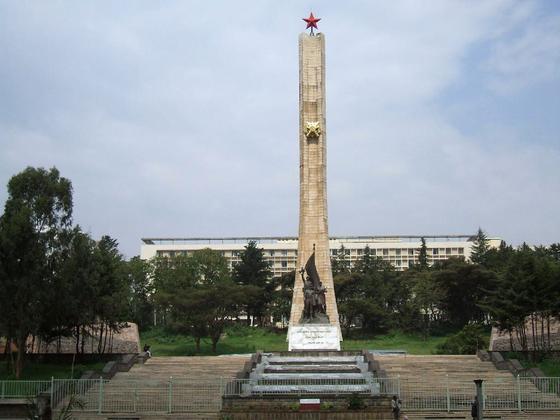
dergmonument.jpg

The Dialachin Monument (a.k.a. Victory Monument, Derg Monument) was a gift from Pyongyang to Addis Ababa’s Derg regime in the 1970s.

You can see the location of the monument in Wikimapia here.

You can learn more about the Derg here.

See more photos of the monument here.

*This location will be added to the next version of North Korea Uncovered (North Korea Google Earth).  If readers are aware of other construction projects the DPRK has supported, please let me know.  I am especially interested in locating the North Korean restaurants in China, Thailand, Cambodia, Vietnam, and Bangladesh.  Are there others?

Share

DPRK outlines region-specific economic growth plans

Saturday, January 24th, 2009

Institute for Far Eastern Studies (IFES)
Nk Brief No. 09-1-23-1
1/23/2009

Following the recent North Korean New Year’s Joint Editorial and its calls for economic measures, on January 5, more than 100,000 people attended a rally in Pyongyang at which customized economic tasks were presented for each of the North’s provinces, taking into account each region’s particular industrial concentration or specialty.

According to North Korean media reports on January 20, Pyongyang stressed reforms in steel, power, coal, railway, and other sectors it considers ‘Priority Sectors of the People’s Economy.” It also presented tasks for the promotion of housing construction, refurbishment of pig farms, and the increase in production of farms and light industries providing daily necessities to the people of the North.

South Pyongan Province was tasked with increasing the production of ‘Juche’ steel’ at the Chollima Steel Complex, which kicked off the “new revolutionary upsurge” late last year during an on-site inspection by Kim Jong Il, as well as full operation of the newly built ‘superpower electric furnace’, and called on all the people of the province to increase production of organic fertilizer in order to boost food production.

For North Pyongan Province, “mass reforms” for the metalworks sector and concentrated efforts to increase electrical production at the Supung and Taechon power plants were called for. In addition, increased production at the Kujang Earth Colliery Complex, Rakwon Machinery Complex, and the Sinuiju Cosmetics Factory were ordered, as was the institution of advanced agricultural management methods.

Efforts in South Hwanghae Province are to be focused on increasing iron ore mining and scrap iron collection at sites such as the Eunryool and Jaeryung mines, and agricultural production goals are to be met through the introduction of high-yield crops and double-cropping.

North Hwanghae Province was ordered to focus on increasing production at the Hwanghae Iron Complex, the Yesong River Youth Power Plant No. 1, the 2.8 Madong Cement Factory, the Sariwon Poultry Farm, and the Sariwon Pig Farm. In addition, high-yield crops are to be introduced and construction of irrigation systems is to begin, as land management efforts are to be implemented in order to expand agricultural land in Mirubol. North Hwanghae Province is also to build a new library, a new arts theater, and a new housing.

In South Hamgyung Province, efforts are focused on construction of the Keumya River and Keumjin River Guchang power plants, as well as improving mining capacity at the mines in the Danchun area while renovating production facilities at the Sudong Mines. Aggressive promotion of construction on the second stage of the 2.8 Vinylon Complex was also emphasized. Provincial authorities were also ordered to complete the initial stage of refurbishment in the Heungnam Pharmaceutical Plant, improve production at the Kwangpo Duck Farm and the Hamju Pig Farm, and accelerate home construction in Hamheung City.

North Hamgyung Province was tasked with perfecting ‘North Korean-style steel production methodology’ at the Kim Chaek Iron Complex and Sungjin Steel Complex, and modernizing exploration, mining and processing equipment at the Musan Mining Complex in order to boost output, along with bringing the Seodusu Power Plant and Chungjin Thermoelectric Power Plant fully on-line. Another important task prioritized was the completion of the second stage of the Urangchun Power Plant.

In Kangwon Province, construction of the Wonsan Army-People Power Plant, increased production at the Munchon River Ironworks, modernization of the Wonsan Shoe Factory and the Wonsan Textiles Factory, and the refurbishment of the Munchon Poultry Processing Plant were emphasized, along with the diversification of management in farming communities in order to resolve food shortage problems.

Ryanggan Province, in the northern Gosan region, was tasked with improving management of the Samsu Power Plant, which entered service in May 2007, and construction of the Baekdu Mountain Military-first Centennial Power Plant and other electrical facilities, and the establishment of a ‘hometown of potatoes’ for the quick increase in potato cropping.

The Jagang Province was tasked with modernizing its metalworks sector and increasing electrical production at the Gangye Youth Power Plant and Janga River Power Plant, construction of small and medium-sized power plants, and increasing its logging production. Jagang Province was also tasked with normalizing production in its pig, duck, and chicken factories, and software development for local organizations was emphasized as a priority task for the Electronic Business Research Institute in Ganggye City, which was visited by Kim Jong Il after its grand opening last year.

Share

DPRK bans South Korean, overseas goods from Markets

Thursday, January 22nd, 2009

Institute for Far Eastern Studies (IFES)
NK Brief No. 09-1-20-1
1/20/2009

It was revealed by Open Radio for North Korea on January 19 that DPRK authorities had handed down a decree to begin enforcing a ban the sale of imported goods in markets across the country on January 20. On January 3, North Korean authorities announced a measure to the Sinuiju Citizen Association and in the Chaeha Market banning the sale of imported goods, telling traders in the market to get rid of imported goods they had with them.

According to the report, the market management office in Sinuiju (operated under the control of the City People’s Committee) posted the decree at the entrance to the Chaeha Market, emphasizing that goods manufactured overseas were banned, while goods made domestically with imported materials were allowed to be sold. The report added that among goods banned from sale, those made in South Korea would be cracked down on especially hard.

Authorities are clamping down not only on markets in the city, but are also strengthening crackdowns on homeless vagrants, known as kotjebi, or literally, ‘flower swallows’. The report stated, “The Party, security office, trade association, youth association, and other organizations in Sinuiju are at the forefront of a coordinated crackdown on Kotjebi,” and, “As the crackdown is currently underway, between 20 and 30 vagrants, on average, are caught each day…those captured vagrants at the jail are sentenced to around 6 hours of forced labor in quarries or farms outside of the city, and must work hard before being given food.”

This same source reported that due to the Beijing Olympics last August, security on the border between North Korea and China had been tightened, and as winter rolled around and the river froze, this security was further strengthened, and, “recently, due to strengthened blockade of the border, the price of bribes to cross the river have more than doubled.”

In October 2008, the number of guards along the border near Hyesan was increased, and the distance between guardposts was halved from 200 to 100 meters. In addition, not only were military border patrols dispatched to the area, civilian patrols were also set up, increasing surveillance. This led to the cost (bribe) of a river crossing to jump from 1,000-2,000 Yuan (150-300 USD) in 2008 to as much as 4000-5000 Yuan (approx. 600-800 USD) this winter.

——–
Some immediate thoughts:

1. This is the kind of information that should be posted on the leaflets South Koreans are sending across the DMZ.

2. The Daily NK recently posted the “Top Nine” most popular goods list in the North Korean markets.  Many of these are imported.

3. Lets hope that these restrictions are as difficult to enforce as the previous directives.  As we all know, banning a product does not make it go away—even in North Korea.  It raises the price to the final consumer and enriches smugglers at the expense of the state and party organs (though individual party members and security personnel benefit as smugglers).

4. These trade restrictions, if enforceable, effectively amount to an import substitution policy….a policy that has pretty much been thoroughly discredited.

5. According to this IFES article, markets are controlled by a local “Market Management Office” which is in turn subordinate to each “City People’s Committee.”  According to the Worker’s Party organizational chart (view here), Each City People’s Committee is subordinate to a Provincial People’s Committee (PPC).  All PPCs are subordinate to the Central Committee of the Workers Party.  I am skeptical, however, that this is the only channel of authority.  Are the DPRK’s markets part of any ministry’s portfolio?

Share

CIA publishes 2008 “DPRK who’s who”

Wednesday, January 14th, 2009

UPDATE: The South Korean Ministry of Unifications offers a more comprehensive organization chart of North Korea’s various political organs. I should point out that this is a dejure (not defacto) organizational chart.

ORIGINAL POST:
(Hat tip to Mike Madden for the link)

After the ministerial shakeups in the DPRK were discovered last week, the US Central Intelligence Agency updated their list of DPRK VIPs.  It will come as no surprise that Kim Jong il managed to maintain control of his three titles: General Secretary Korean Workers’ Party, Supreme Commander of the Korean People’s Army, and Chairman of the National Defence Commission.

The full list can be viewed on the CIA’s web page here

Share