Archive for the ‘DPRK organizations’ Category

North Korea revises economic management laws

Tuesday, December 22nd, 2009

Institute for Far Eastern Studies (IFES)
NK Brief No.09-12-21-1
12/21/2009

The Korean Central Broadcasting Station (KCBS) announced on December 16 that the North Korean Supreme People’s Assembly Standing Committee has revised the North’s Real Estate Management Law, the Commodities Consumption Level Law, the General Equipment Import Law, and other laws related to economic management. This on the heels of the November 30th announcement, when authorities announced across-the-board currency reform measures, apparently in an attempt to regain control of the country’s market economy.

The KCBS reported that the Real Estate Management Law “regulates fundamental issues of real estate registration and inspection, use, and payment of user fees,” but offered no further details.

Since 2006, North Korean authorities established new offices in each city, county, and region throughout the country. These offices were responsible for surveying property, occupied and vacant, claimed by organizations and businesses, as well as recording the size of each structure on these lands.

In the mid-1990s, with the onset of serious food shortages, food rations to workers were halted and North Korean authorities from every branch and level (including the military, railway, business enterprises) were encouraged to distribute foodstuffs in ways more beneficial to themselves. These authorities planned to resolve food distribution issues through agricultural moves.

The new Real Estate Management Law appears to be aimed at labeling land used for private purposes as strategic nationalized land and strengthening the state’s ability to collect real estate taxes. However, the broadcaster failed to explain in detail how this restructuring would occur.

By enacting the Commodities Consumption Level Law, North Korean authorities can control the basis at which goods are injected into each production sector. This appears to be in preparation for taking cost-reduction measures for enterprises related to production in each region. The broadcaster explained that there were legal demands for the enactment and enforcement of regulations on the level of consumption.

The General Equipment Import Law newly regulates import plans, contracts, and the use of goods by factories, schools, hospitals, ships and broadcasters in an effort to control quality. In each sector, the measure prevents double-investment and controls consumption competition.

As these economic control measures are focused on factories and other bases of production along with importers, it appears that, in conjunction with the recent currency reform, North Korean authorities are attempting to control production quality on all levels. For example, as the North is suffering ongoing supply difficulties due to a lack of materials, the law on consumption levels is an attempt to restrict goods by forcefully managing demand. The law on imports appears to be in an effort to regulate general-use goods in light of the increased reliance on foreign equipment.

Share

Treaty of Friendship, Co-operation and Mutual Assistance Between the People’s Republic of China and the Democratic People’s Republic of Korea.

Tuesday, December 15th, 2009

Peking Review, Vol. 4, No. 28, p.5.
Transcribed/HTML: Max, B. and Mike B.
(h/t Northeast Asia Matters)

July 11, 1967

The Chairman of the People’s Republic of China and the Presidium of the Supreme People’s Assembly of the Democratic People’s Republic of Korea, determined, in accordance with Marxism-Leninism and the principle of proletarian internationalism and on the basis of mutual respect for state sovereignty and territorial integrity, mutual non-aggression, non-interference in each other’s internal affairs, equality and mutual benefit, and mutual assistance and support, to make every effort to further strengthen and develop the fraternal relations of friendship, co-operation and mutual assistance between the People’s Republic of China and the Democratic People’s Republic of Korea, to jointly guard the security of the two peoples, and to safeguard and consolidate the peace of Asia and the world, and deeply convinced that the development and strengthening of the relations of friendship, co-operation and mutual assistance between the two countries accord not only with the fundamental interests of the two peoples but also with the interests of the peoples all over the world, have decided for this purpose to conclude the present Treaty and appointed as their respective plenipotentiaries:

   The Chairman of the People’s Republic of China: Chou En-lai, Premier of the State Council of the People’s Republic of China.

   The Presidium of the Supreme People’s Assembly of the Democratic People’s Republic of Korea: Kim Il Sung, Premier of the Cabinet of the Democratic People’s Republic of Korea,

Who, having examined each other’s full powers and found them in good and due form, have agreed upon the the following:

Article I

The Contracting Parties will continue to make every effort to safeguard the peace of Asia and the world and the security of all peoples.

Article II

The Contracting Parties undertake jointly to adopt all measures to prevent aggression against either of the Contracting Parties by any state. In the event of one of the Contracting Parties being subjected to the armed attack by any state or several states jointly and thus being involved in a state of war, the other Contracting Party shall immediately render military and other assistance by all means at its disposal.

Article III

Neither Contracting Party shall conclude any alliance directed against the other Contracting Party or take part in any bloc or in any action or measure directed against the other Contracting Party .

Article IV

The Contracting Parties will continue to consult with each other on all important international questions of common interest to the two countries.

Article V

The Contracting Parties, on the principles of mutual respect for sovereignty, non-interference in each other’s internal affairs, equality and mutual benefit and in the spirit of friendly co-operation, will continue to render each other every possible economic and technical aid in the cause of socialist construction of the two countries and will continue to consolidate and develop economic, cultural, and scientific and technical co-operation between the two countries.

Article VI

The Contracting Parties hold that the unification of Korea must be realized along peaceful and democratic lines and that such a solution accords exactly with the national interests of the Korean people and the aim of preserving peace in the Far East.

Article VII

The present Treaty is subject to ratification and shall come into force on the day of exchange of instruments of ratification, which will take place in Pyongyang. The present Treaty will remain in force until the Contracting Parties agree on its amendment or termination. Done in duplicate in Peking on the eleventh day of July, nineteen sixty-one, in the Chinese and Korean languages, both texts being equally authentic.
(Signed)
CHOU EN-LAI
Plenipotentiary of the
People’s Republic of China

(Signed)
KIM IL SUNG
Plenipotentiary of the
Democratic People’s Republic of Korea

Share

Book review Tuesday: Lankov and Foster-Carter

Tuesday, December 15th, 2009

Book Review 1: The Cleanest Race: How North Koreans See Themselves-And Why It Matters
Author: B.R. Meyers
Reviewed by: Andrei Lankov
Review Publisher: Far Eastern Economic Review (the last issue)
Order this book on Amazon here

Most books on North Korea focus on the nuclear issue, that never-ending soap opera of the international diplomacy. In the rare cases when North Korean domestic dynamics are taken into account, the authors (most of whom do not speak or read Korean) concentrate on the official pronouncements of the regime.

Brian Myers takes a fresh approach. He largely ignores what the regime tells the outside world about itself, but concentrates instead on what North Koreans themselves are supposed to believe, paying special attention to the North Korean narratives and mass culture, including movies and television shows. North of the DMZ, mass culture is not about entertainment. Rather it is a lighter version of propaganda whose task is to deliver the same message, but in more palatable form.

As in the case in the Soviet Union, Pyongyang uses works of fiction to send signals which cannot be transmitted otherwise due to current political considerations. For example, when North Korean media found a few kind words for South Korean President Kim Dae Jung who visited North Korea in 2000 with impressive amounts of giveaway cash, North Korean novels still ridiculed him as a pathetic double-dealer.

Continue Reading here…

Bookr review 2: North Korean Posters
Editor: David Heather
Reviewed by: Aidan Foster-Carter and Kate Hext
Review Publisher: Print Quarterly, December 2009 issue (Vol XXVI no 4), pp 429-31.
Order this book on Amazon here

North Korean art is hardly well-known, but it has recently seen something of a surge. For this David Heather can claim some credit, and does. As he boasts in his brief (just one page) preface to this block of a book, “I held the largest exhibition of North Korean Contemporary Art in the West in June 2007 in the heart of London and managed to fly the North Korean Flag in Pall Mall for probably the first time ever” (p.7, capitals in original).

That militant tone, here tongue in cheek, is deadly serious in North Korean Posters. On page after gaudy page angry Korean heroes curse and smite the foe, mostly Americans with hook noses. Fists, tanks and sledgehammers crush; bayonets lunge and stab; rockets rain down – including on a shattered US Capitol (p. 138), in blithe disregard of post-9/11 sensitivities.

In a year when North Korea has been censured by the UN for testing a nuclear device and a long-range missile, such images can only reinforce stereotypes of what Koen De Ceuster in his introduction calls a country “often misrepresented and largely misunderstood” (p.9). Yet there is more to North Korean art than this, as anyone who attended David Heather’s shows at La Galleria can attest. (For those who missed out, images and comment can still be found by searching Philip Gowman’s London Korean Links website, an indispensable resource.)

Here one finds a commercial tie-in modestly unadvertised in North Korean Posters. The said posters, plus a range of other artworks – various genres of painting, tapestry and ceramics – may be purchased via www.northkoreanart.org, which proclaims that: “La Galleria Pall Mall has the privilege to be the only Gallery outside DPR Korea to be permitted to sell art and represent individual artists from North Korea. We can certify that all the works are original and authentic, made and signed by the artists themselves in Pyongyang.” These posters, here described as “Propaganda Popart” (sic), can be yours for £250 each (unframed) plus postage.

“Individual artists”? Not one is named in the book under review. Nor are the pieces dated; so one cannot trace the evolution of styles or themes, let alone particular artists. By contrast, the first volume in this series by Prestel – Soviet Posters, featuring Sergo Grigorian’s collection (2007) – is divided into six periods; each work is dated, with notes on artists and other detail. The absence of such basic data in North Korean Posters is a serious omission. De Ceuster’s useful Introduction gives the broad context, yet is oddly free-standing. With few exceptions the posters are left to shout for themselves, with no information except basic translations of the slogans – which, bizarrely and inconveniently, are printed sideways rather than below.

Furthermore, when is a North Korean poster “original and authentic”? De Ceuster notes that “hand-painted reproductions find ready buyers abroad.” Northkoreanart.org is silent on this key question for collectors: what exactly does your £250 buy, an original or a copy? (Also its comments on the actual art are trite, even illiterate: gouache and propaganda are misspelled.)

The ambiguities go on. Curiously, Northkoreanart does not say who exactly is its partner in Pyongyang, but its sister site LaGalleria.org reveals this as the Mansudae Art Studio. Yet a search swiftly brings up mansudaeartstudio.com, based in Italy and claiming to be “the only official web-site of the Mansudae Art Studio in the West,” which pipped Heather to the post with an exhibition in Genoa in May 2007. Will the real Mansudae reps please stand up? The Italian site is far more educative. Through it one can buy The Hermit Country, which despite a clichéd title (it must have miffed the comrades) is a much better, broader book on modern North Korean art, not limited to posters. The moving spirits here are a pair of Pier Luigis: Cecioni, a collector who owns 600 works; and Tazzi, an idiosyncratic but insightful critic.

For a serious academic survey, Jane Portal’s aptly titled Art Under Control in North Korea (Reaktion/British Museum, 2005), with its fully integrated text and illustrations, is essential. The current art scene in Pyongyang was recently described in an excellent piece by Adrian Dannatt in March’s Art Newspaper. This is big business, on an industrial scale. Mansudae has a thousand artists producing “at least 4,000 top level original works a year [and] a factory-style section producing copies for western hotels;” while abroad it claims to have held over 100 shows in some 70 countries.

Perhaps there are yet more ‘sole agents’ out there? North Korea lends itself to a Columbus complex. People who happen upon it often imagine they are the first ever to do so, and even when disabused they like to claim a special niche. Scepticism is in order, on many counts.

As Dannatt says: “it could not be easier to assemble a collection of contemporary DPRK art … but it could not be harder to source the originals.” He quotes Nicholas Bonner, the doyen of collectors in this area – he began in 1993, and is curating a major exhibition in Brisbane in December – on how many ‘original’ works are in fact copies, and how to tell the difference. Bonner’s website Pyongyangartstudio.com, showcasing his gallery in Beijing, makes no monopoly claims but focuses on the actual art. Interestingly Bonner eschews the propaganda genre, but has a fascinating selection of film posters: a far less aggressive variant, ignored by Heather. He is also scrupulous in specifying that what he offers are “hand painted copies.”

But back to the book. North Korean Posters is a sadly missed opportunity. It reiterates visual cliché, but gives almost no context – historical, political, artistic – for these specific works. It is just a picture book to flick through: no dates, no dimensions, no artists. For a publisher of Prestel’s stature these are shameful lapses. Is the image somehow meant to speak for itself?

Absent such essentials, this is just another twist on commie chic – like Che Guevara T-shirts. It is all very postmodern and cynical. Once upon a time North Korea was communist. Some of these posters are about ideals people believed in, as they strove to build a better society. In today’s DPRK, a half-starved neo-feudal tyranny, one of the few ways to earn hard cash is factories of well-trained draughtsmen flogging second-hand images – bilious or kitsch, take your pick – to gullible, exoticizing Westerners. (Here as in all else, the contrast with South Korea’s brilliant and original art scene is acutely painful.) The laugh is on us too, if we just gawp at these admittedly striking visuals. Have we lost our minds? Do we care to know what we are we looking at? Neither Heather nor Prestel seem bothered. Caveat lector – et emptor.

I used a copy of Soviet Posters and North Korean Posters to make this artistic discovery.

Share

DPRK acknowledges spread of swine flu

Wednesday, December 9th, 2009

UPDATE:  According to AFP:

South Korea is preparing to ship medical supplies worth more than 15 million dollars to help North Korea fight an outbreak of swine flu, officials said Monday.

The unification ministry, which handles cross-border ties, said the shipment would include antiviral drugs for 500,000 patients — Tamiflu for 400,000 and Relenza for 100,000 — and sanitation supplies.

The aid will cost an estimated 17.8 billion won (15.3 million dollars), which will be financed by a state fund for inter-Korean cooperation, it said.

Spokesman Chun Hae-Sung said Seoul would send the shipment as soon as possible, and definitely by the end of the year. But the North, which had accepted the offer, had not yet set a firm date.

The drugs shipment will be the first direct South Korean government aid since relations soured last year, although Seoul has funded assistance to Pyongyang through private groups.

North Korea Wednesday reported nine cases of (A)H1N1 in the capital Pyongyang and the city of Sinuiju bordering China. No death toll was given.

Observers say the virus could pose a particular threat to the North because of malnutrition amid persistent food shortages and a lack of drugs such as Tamiflu.

Good Friends, a Seoul-based welfare group with cross-border contacts, quoted an unidentified Sinuiju city official as saying more than 40 people had died of the swine flu in the border city alone.

The World Health Organization, however, told Yonhap news agency that all nine North Korean patients have recovered.

Yonhap quoted Suzanne Westman, coordinator of outbreak alert and response at the WHO’s New Delhi office, as saying no additional cases were reported in the isolated communist country.

The first of the patients, all children aged between 11 and 14, was discovered on November 25 and the last case on December 4, she said, adding that three of the infections were in Pyongyang with the other six in Sinuiju.

“All contacts have been identified, put in isolation and treated,” she told Yonhap, adding that North Korea had a solid surveillance system and a sufficient number of physicians is believed to be able to handle the outbreak.

ORIGINAL POST: According to KCNA:

Anti-A/H1N1 Flu Campaign Intensified

Pyongyang, December 9 (KCNA) — New Influenza A/H1N1 broke out in some areas of the DPRK amid the growing of its victims worldwide.

According to the Ministry of Public Health, nine cases were reported from Sinuiju and Pyongyang.

The relevant organ is further perfecting the quarantine system against the spread of this flu virus while properly carrying on the prevention and medical treatment.

The State Emergency Anti-epidemic Committee has taken steps to enhance the role of prevention and treatment centers at all levels and increased checkup stations across the country while directing efforts to the medical treatment of its cases.

According to Yonhap:

The World Health Organization (WHO) is working “closely” with the North Korean government to help stem the spread of an Influenza A outbreak there and assess the scope of flu infections among North Koreans, a WHO spokesperson said Wednesday.

North Korea said earlier in the day that it has confirmed nine domestic cases of H1N1 virus infections. The highly infectious disease may be particularly dangerous to the North Korean people, who are mostly undernourished and may have weakened immune systems.

“We are working closely with the (North Korean) government to see what is required and if they need any assistance from WHO,” Aphaluck Bhapiasevi, a WHO spokeswoman on the H1N1 pandemic, said over the telephone.

Bhapiasevi also said there are likely more cases of the H1N1 virus than announced, as people who have mild symptoms are not tested.

“In any country, there may be more cases than have been laboratory-confirmed,” she said. “They may not reflect actual number of the cases.”

In May, WHO provided 35,000 Tamiflu tablets each for North Korea and about 70 other underdeveloped countries to help fight possible outbreaks. Seoul officials say the North would need millions of tablets to safeguard its 24 million people.

Through its office in North Korea, the world health body has been making “preliminary assessments” of the scope of the outbreak, she said. “We have been discussing support that would be required.”

According to the AP, the DPRK will accept ROK assistance as well:

North Korea agreed Thursday to accept medicine from South Korea to fight an outbreak of swine flu, a Cabinet minister said, in a development that could improve relations between the nations after a deadly maritime clash.

“Today, the North expressed its intention to receive” the medical aid, Unification Minister Hyun In-taek told reporters.

North Korean state media reported Wednesday that there were nine confirmed swine flu cases in the country. South Korea plans to send the antiviral Tamiflu to the North, Health Ministry spokesman Lee Dong-uk said, without giving specifics.

South Korea’s Yonhap news agency said South Korea plans to send enough doses of Tamiflu for about 10,000 people. It cited a government official it did not identify.

The move came two days after South Korean President Lee Myung-bak offered unconditional aid to North Korea to help contain the virus — the government’s first offer of humanitarian aid since Lee took office in early 2008 with a hard-line policy toward the North.

(h/t NK Leadership Watch)

Share

Syria’s Tishreen War Panorama

Wednesday, December 2nd, 2009

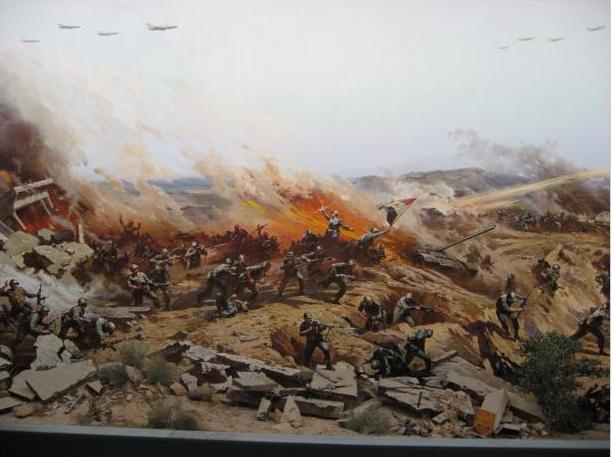
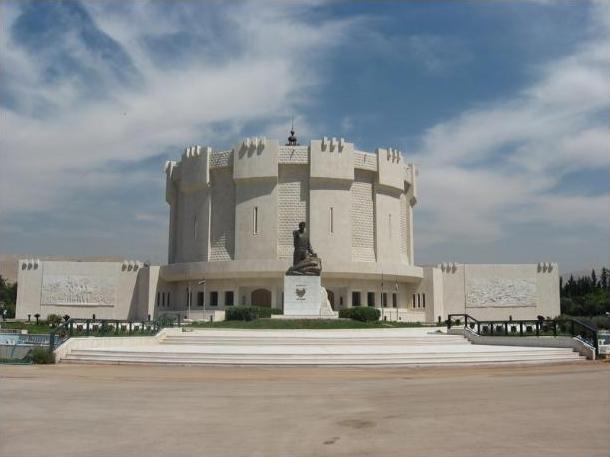
Visitors to Pyongyang’s Victorious Fatherland Liberation War Museum (Location here) will be interested to know that the DPRK has exported its museum technology to Syria’s Tishreen War Panorama (Location here).

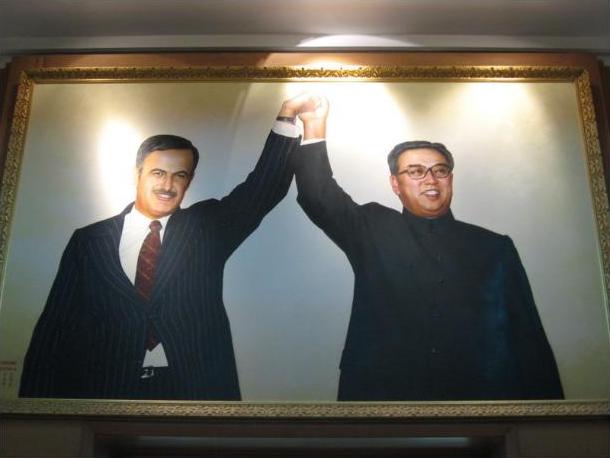
syria-museum.JPGsyria-museum2.JPGsyria-museum3.JPG

The images are from this web page.

According to an official web page (I think), the panorama dimensions are 129.5m x 7.8m.  It was painted by Kim Sing Chol, O Kwang Ho, Ri Jae Su, Ri Kap Il, Kim Chol Jin, Choe Song Sik, Ri Jong Gap, Kim Ki Dok, Cha Yo Sang, Ri Yon Nam, and it opened on 6th October 1999.  These artists are employees of the Mansudae Overseas Development Group (Art Studio).

I thank a reader for sending me this information.  I have been mapping North Korean projects in Africa, Asia, and the Middle East on Google Earth.  Here are some I have blogged about: Monument to African Renaissanace, Zimbabwe Hero’s Park, Ethiopia’s Derg Monument, Kinshasa Kabila Statue, and quite a few more.  If you are aware of any North Korea projects in your area please let me know.

UPDATE: Cairo’s October War Panorama is also built by the North Koreans.   It appears to have nearly identical architecture.  It is located here.

Share

DPRK joint venture releases e-learning software

Thursday, November 19th, 2009

eleROM, Sinji JV Group and Phoenix Commercial Ventures Ltd are proud to present learnwithelsi: an innovative new web-based e-learning platform.

learnwithelsi derives its name from the “el” of eleROM and “si” of Sinji. The system is jointly managed by eleROM and Sinji. Subscribers can use the system to manage and study educational courses. learnwithelsi combines the standard features of traditional e-learning platforms with additional features:

* Lectures can be presented real time, even when the lecturers and students are geographically disbursed
* The lecturer can interact with students via video link, whiteboard and instant messaging
* The lecture can be recorded and stored for future access (available from November)
* Every user has tools that enable him/her to create learning contents, manage training activities and interact with other users
* Additionally there are a host of other features; documents can be managed, online exercises created, learning paths created, group work coordinated, assignments produced, forums developed, agendas set, announcements can be made and statistics can be monitored.

Sinji ’s and eleROM ‘s experience in software and e-learning guarantee the quality and reliability of the product. Additionally, learnwithelsi comes with 24 hour support.

Unlike other e-learning platforms, learnwithelsi is offered directly to training institutes for them to create their own courses; thereby enabling them to concentrate on the content of their courses, without having to worry about the technology.

The product follows the philosophy of SAS (software as a service). You don’t need to install anything on your server. You need only an Internet connection to use the platform.

Further system and functional enhancements will be made, eg as from November the video lecture can be recorded and stored for future access.

You can try a sample course on the learnwithelsi platform by clicking here. (login: sample, password: course).

———–

Here is a PDF of the  press release.

Share

UN panel claims DPRK evading sanctions

Wednesday, November 18th, 2009

The UN panel responsible for implementing UNSC resolutions pertaining to the DPRK has written a report (which is not yet publicly available) claiming that the DPRK continues to evade UN sanctions. According to two different Bloomberg stories :

“The Democratic People’s Republic of Korea has established a highly sophisticated international network for the acquisition, marketing and sale of arms and military equipment,” said the report by a Security Council panel established in June to assess the effectiveness of UN sanctions.

The report said arms sales banned by the UN “have increasingly become one of the country’s principal sources for obtaining foreign exchange.” North Korea has used “reputable shipping entities, misdescription of goods and multiple transfers” to hide arms smuggling, according to the report, which has been circulated within the Security Council and not yet publicly released.

North Korean companies and banks that have been barred from foreign transactions are circumventing the prohibition through subsidiaries, according to “indications” from some member governments, the report said. The Korea Mining Development Trading Corp., cited in April for violations of UN sanctions, “continues to operate through its subsidiary companies,” according to the report.

The Kwangson Banking Corp. and Amroggang Development Bank substitute for or act on behalf of Tanchon Commercial Bank and the Korea Hyoksin Trading Corp., the UN panel said authorities in unspecified countries have determined. The U.S. earlier this year froze the assets of the Kwangson and Amroggang banks.

The UN panel said North Korea is believed to have exported arms to countries in Africa, Southeast Asia, the Middle East and Latin America. Only a “very small percentage” of North Korea’s illegal arms trade has been reported or discovered, the report said.

An example of attempted trade in contraband was reported in August by the United Arab Emirates, which seized a ship carrying North Korean-manufactured munitions, detonators, explosives and rocket-propelled grenades bound for Iran.

According to Reuters:

The Security Council imposed the sanctions, including arms embargoes, asset freezes and travel bans, in resolutions in 2006 and 2009, in response to North Korean nuclear tests and ballistic missile launches. This year for the first time, it listed eight entities and five people who were being targeted.

A report obtained by Reuters on Wednesday was the first to be written by an expert panel set up by the Security Council in May to vet implementation of the sanctions. It is due to be discussed in closed-door council consultations on Thursday.

The six experts said there were several different techniques employed by the isolated communist state to conceal its involvement.

“These include falsification of manifests, fallacious labeling and description of cargo, the use of multiple layers of intermediaries, ‘shell’ companies and financial institutions to hide the true originators and recipients,” the report said.

“In many cases overseas accounts maintained for or on behalf of the DPRK are likely being used for this purpose, making it difficult to trace such transactions, or to relate them to the precise cargo they are intended to cover.”

The experts said North Korea likely also used correspondent accounts in foreign banks, informal transfer mechanisms, cash couriers “and other well known techniques that can be used for money laundering or other surreptitious transactions.”

On illicit arms shipments, the report raised the case of the seizure of a “substantial cargo” of weapons from North Korea. It was apparently referring to arms seized in August by the United Arab Emirates from an Australian-owned ship.

The report also said the North continued to import luxury goods intended for its leadership, despite a U.N. ban. It noted that in July, Italy blocked the sale of two yachts that police said were destined for North Korean leader Kim Jong-il.

The panel, which began work just two months ago, said it would work on recommendations to the Security Council for further firms and individuals to be put on the sanctions list as well as goods whose import by North Korea should be banned.

It also promised more exact definitions of small arms — the only kind of arms Pyongyang can import under existing sanctions — as well as of luxury goods.

Marcus Noland has cleverly named the strategy of tracking down North Korean military financiers and arms dealers “Wac-a-mole“.

Read the full stories below:
North Korean Global Arms Smuggling Evades Ban, UN Panel Says
Bloomberg
Bill Varner
11/18/2009

North Korea Arms Trade Funds Nuclear-Bomb Work, UN Panel Says
Bloomberg
Bill Varner
11/19/2009

North Korea maneuvers to evade U.N. sanctions: experts
Reuters
11/18/2009

Share

In North Korea, the military now issues economic orders

Thursday, November 5th, 2009

Blane Harden wrote an excellent article for the Washington Post on the KPA takeover of state-owned trading companies and how these companies are increasing natural resource exports to China.  (As an aside, China has just recently ceased publishing North Korean trade data).  This is interesting because just a year-and-a-half ago we were discussing Jang Song-thaek’s anti-corruption campaign which was supposed to be closing down KPA companies and making them reapply for export licenses with the Ministry of Foreign Trade (meaning the WPK could start dipping into the revenue pools).

Quoting from Mr. Harden’s article:

The potential profits are eye-popping: China is one of the world’s most voracious consumers of raw materials, and North Korea’s mineral reserves are worth $5.94 trillion, according to an estimate by South Korea’s Ministry of Unification. China has been critical of North Korea’s nuclear program and missile tests, but it also has vastly increased its economic ties with Kim’s government.

Kim is increasingly creaming off a significant slice of Chinese mineral revenue to fund his nuclear program and to buy the loyalty of elites, according to “North Korea, Inc.,” a recent report by the United States Institute of Peace, a Washington-based group funded by the U.S. Congress.

The report echoes the views of North Korean analysts in South Korea, Japan and the United States, who say the military has elbowed out other ministries and the Korean Workers’ Party to take control of exports that earn hard currency. The military is also sending trucks to state farms to haul away as much as a quarter of the annual harvest for its soldiers, analysts say.

“The military is by far the largest, most capable and most efficient organization in North Korea, and Kim Jong Il is making maximum use of it,” said Lim Eul-chul of the Institute for Far Eastern Studies in Seoul.

North Korea is perhaps the world’s most secretive and repressive state, but it makes no attempt to hide the ubiquitous role the military plays in the daily lives of the country’s 23.5 million people. Soldiers dig clams and launch missiles, pick apples and build irrigation canals, market mushrooms and supervise the export of knockoff Nintendo games. They also guard the country’s 3,000 cooperative farms, and help themselves to scarce food in a hungry country.

Missile sales were for many years major earners of foreign currency, according to a report for the Strategic Studies Institute by Daniel A. Pinkston, who is now a Seoul-based analyst with the International Crisis Group. But the cost of the arms trade has gone up and sales have declined as a result of U.N. sanctions imposed after the North’s nuclear tests in 2006 and this year, South Korean analysts say.

The military has thus turned to its new Chinese cash cow. As the army has taken over management of mines in North Korea, mineral exports to China have soared, rising from $15 million in 2003 to $213 million last year. Led by those sales, the North’s total trade volume rose last year to its highest level since 1990, when a far more prosperous and less isolated North Korea was subsidized by the Soviet Union.

A unique advantage the Korean People’s Army brings to foreign trade is a well-disciplined workforce that has to be paid — nothing. Soldiers receive food, clothes and lodging, but virtually no cash. This competitive edge makes military-run trading companies especially attractive to the North’s leadership, according to the Institute of Peace report.

Based on confidential interviews with recent North Korean defectors, four of whom said they worked for trading companies run by the military, the paper concludes that a “designated percentage of all revenues generated from commercial activities . . . goes directly into Kim Jong Il’s personal accounts.” The rest of the revenue flows into the operating budget of the military.

The full article is worth reading here.

Additionally, the report by the Institute of Peace cited above, “North Korea, Inc.”, can be downloaded here. The paper is on my reading list this weekend, but here is the introduction and conclusion:

Introduction: Assessing regime stability in North Korea continues to be a major challenge for analysts. By examining how North Korea, Inc. — the web of state trading companies affiliated to the Korean Workers’ Party (KWP), the Korean People’s Army (KPA), and the Cabinet — operates, we can develop a new framework for gauging regime stability in North Korea. Insights into the Democratic People’s Republic of Korea (DPRK)1 regime can be gained by examining six core questions related to the DPRK state trading company system. First, what are DPRK state trading companies and how did they emerge? Second, how do DPRK state trading companies operate? Third, what roles do they play? Fourth, why are DPRK state trading companies important? Fifth, what major transformations are taking place in the DPRK state trading company system? Sixth, what are the implications of the manner in which this system is currently functioning?

Conclusion:  Despite lingering problems with the fragmented Public Distribution System, the challenges of chronic food shortages, and a deteriorating economic infrastructure system, the DPRK regime has proven to be remarkably resilient. By operating North Korea, Inc. — a network of state trading companies affiliated to the KWP, the KPA, and the Cabinet — the regime is able to derive funds to maintain the loyalty of the North Korean elites and to provide a mechanism through which different branches of the North Korean state can generate funds for operating budgets. During periods when the DPRK’s international isolation deepens as a result of its brinkmanship activities, North Korea, Inc. constitutes an effective coping mechanism for the Kim Jong Il regime.

While North Korea remains an opaque country, we now have greater access to unique defectors with the following characteristics — prior experience working in DPRK state trading companies and current business dealings with former colleagues in North Korea through channels in China. By closely examining DPRK commercial activities and capabilities, a new field of North Korea analysis can be structured to produce insights into the internal dynamics of the DPRK regime. This new line of inquiry would help to broaden our understanding of an evolving North Korea.

Share

North Korean food shortage to grow, crimes of necessity on the rise

Tuesday, November 3rd, 2009

Institute for Far Eastern Studies (IFES)
NK Brief No. 09-11-02-1
11/2/2009

The North Korean agricultural ministry has announced that the countries food shortages are expected to be even greater next year. Edition 302 of the newsletter “North Korea Today,” distributed by the group Good Friends, reports that the Ministry of Agriculture announced harvest predictions for farms in North and South Hwanghae and Pyongan provinces, North Korea’s ‘ricebowl region’. It stated that if the country was to avoid a food crisis next year, everyone would need to strictly manage this year’s crops. It was also reported that the central party authorities in North Korea, after receiving the report, called for the opening of all customs houses in the border region and for trading companies to seek new avenues for trade. An order was passed down to “relentlessly trade with the outside in order to bring in much food.”

With food shortages this year and last, and now news that there will be food problems next year as well, it is rumored that there is a growing number of angry people in the normally mild-mannered Hwanghae Province. In addition, this is driving a growing number of people to turn to crime in order to put food on the table. On October 26, Free North Korea Radio quoted a source as stating, “As rumors spread across North Korea that large-scale famine, the likes of which were seen in the mid-1990s, will again sweep through country next year, anxiety is shooting up among the people and crimes of necessity are on the rise.”

According to the source, “Crimes of necessity, like pillaging granaries on farms, are spreading like never before as people act quickly to ensure food supplies,” and, “Fighting has grown fierce between people trying to maintain their standard of living.” Furthermore, “The number of people in the Dancheon region of South Hamgyeong Province just ‘sitting down and starving to death’ is exploding,” and, “Not long ago, there was even one incident of and armed soldier guarding a threshing floor of one farm being attacked by a gang of thieves.”

The source explained, “People are well aware that this year yielded poor harvests, but that they cannot rely on aid from the international community because of the Kim Jong Il regime’s indiscriminant pursuit of nuclear development.” The source also added, “These days, people are rationalizing illegal activities in the belief that ‘you can rely on no one but yourself.’”

It was also reported that in Hyesan, Hyeryeong, Onseong and Musan, most food prices are at higher levels than what are usually seen in the spring, despite the fact that it is now fall harvest season. According to Free North Korea Radio, October 23rd prices of rice, flour and corn in Hyesan, Hyeryeong, Onseong, and Musan were as follows: Hyesan, rice = 2,550-2,750 won/1 kg, flour = 2,400-2,600 won/1 kg, corn = 850-900 won/1 kg; Hyeryeong, rice = 2,500-2,800 won/ 1 kg, flour = 2,400-2,700 won/ 1 kg, corn = 800-1,000 won/1 kg; Onseong, rice = 2,450-2,600 won/ 1 kg, flour = 2,500-2,700 won/1 kg, corn = 700-900 won/1 kg; Musan, rice = 2,500-2,700 won/1 kg, flour = 2,400-2,600 won/1 kg, corn = 850-1,000 won/1 kg

Share