Archive for the ‘DPRK organizations’ Category

NSA agents in Hyesan under greater scrutiny

Friday, June 17th, 2011

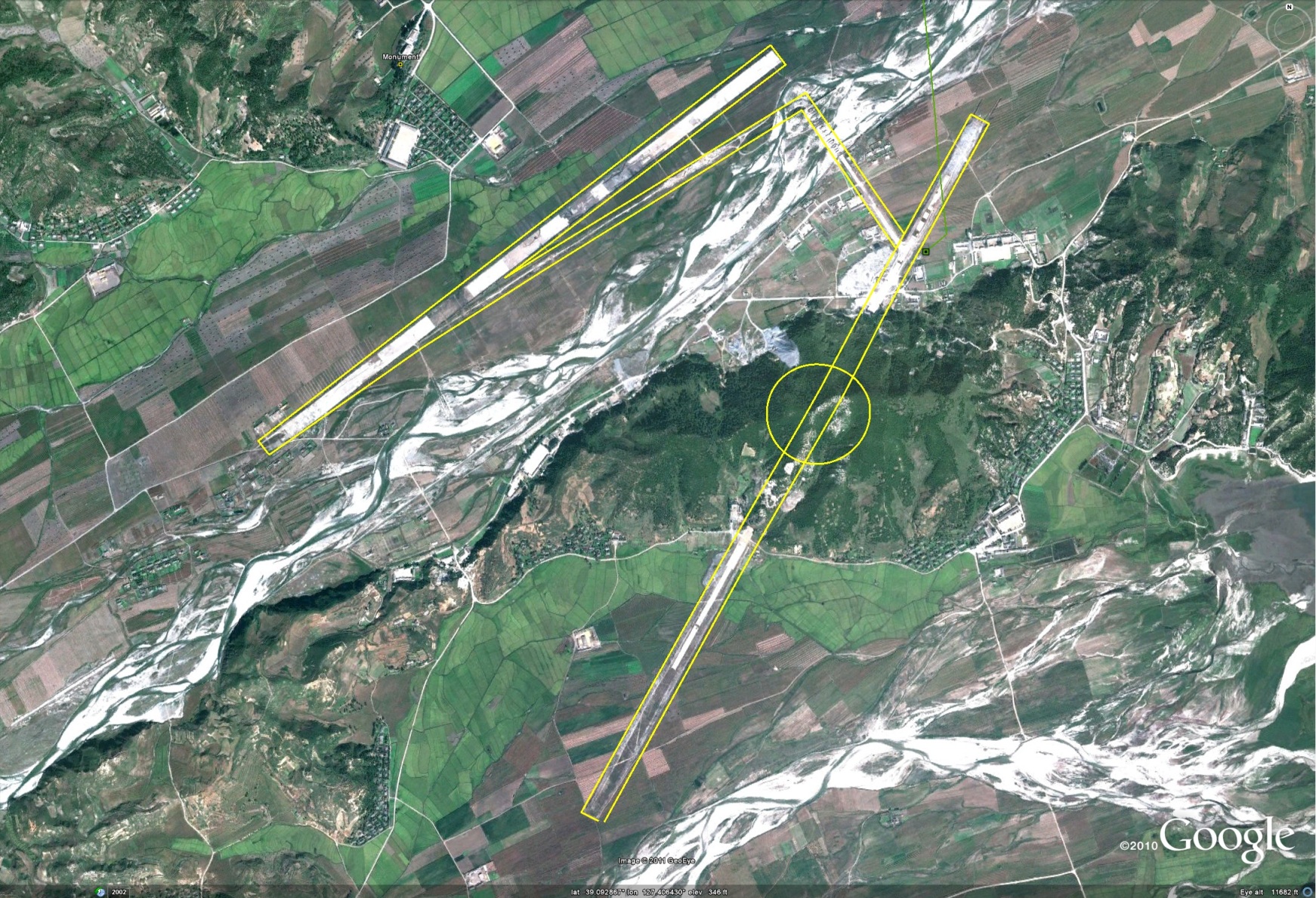
Pictured above (Google Earth): Hyesan City’s Kanggu-dong (강구동), Wiyon-dong (위연동), and Songpong-dong (송봉동) mentioned in the Daily NK story below.

According to Daily NK:

A source from Hyesan revealed the news yesterday, saying, “On the 11th, an NSA agent responsible for the Kanggu area of Hyesan committed suicide at his office. In one soldier’s testimony during the process of an investigation into the border guard unit, it came out that he had aided smuggling and defections, and had taken bribes. Out of fear of punishment, he killed himself.”

According to the source, there has recently been one other similar case in the city. In that instance, an NSA agent responsible for the Wuiyeon area killed himself at his house during April, apparently during an NSA investigation centering on the fact that an abnormally large number of defector families were there.

In another instance, NK Intellectuals Solidarity recently reported a case from February, where an NSA agent covering the Songbong area of the city killed himself at the time of his arrest by smashing his head into a wall. In that case, however, the NSA investigation was focused around the sale of 1kg of narcotics.

This is causing tension in the city, the source went on, explaining, “They are warning people not to gossip to others about issues related to the National Security Agency. The rumor now circulating is that there will be an in depth investigation by the central Party soon, so the feeling here is uneasy.”

In North Korea, a local NSA agent is responsible for roughly 1,000 households or less. Through roughly 40 or 50 people’s unit heads and Women’s Union cadres, the agent obtains information on the activities of local people and passes on instructions to them, thus playing a key role in the preservation of the system.

For smugglers and defectors, stepping outside this surveillance net is both important, and also hard. For that reason, smugglers commonly buy off NSA agents. Sources and defectors both agree that abetting defection is rarer, since it is punished more harshly, with whole extended families facing extreme consequences.

Ordinary city residents, meanwhile, are not sad to see the back of any agent who takes his own life, the source added, pointing out that they are one of the most hated groups in North Korea.

Hyesan is an ideal location from which to stage a defection.  Though it is the capital of Ryanggang Province (Yangang, 량강도) , it is both geographically and administratively remote—on the Chinese and DPRK sides of the border.  The border itself is a very shallow, sometimes dry, Yalu River basin which is lined in both directions with railway service.

Read the full story here:
Spate of NSA Agent Suicides in Hyesan
Daily NK
Lee Seok Young
2011-6-17

Share

Korea Unpung Joint Operating Company

Monday, June 6th, 2011

According to Yonhap:

A China-North Korea joint venture maker of food additives, have been operating smoothly in a display of close ties between the two countries, China’s state-run Xinhua News Agency said Monday.

China’s Liaoning Wellhope Agri-tech Co. and North Korea’s Unpasan General Trading Company set up a joint venture, (North) Korea Unpung Joint Operating Company, in 2006, in Pyongyang, the North Korean capital city.

Liaoning Wellhope Agri-tech holds a 55 percent stake in the joint venture, while the North Korean trading firm has a 45 percent stake.

In a dispatch from Pyongyang, Xinhua said the total assets of Unpung have now reached 21 million yuan (US$3.24 million). During the six-year operation, the firm made a total pre-tax profit of 15.21 million yuan, and its cumulative sales of food additives reached 18,720 tons.

“At present, Unpung aims to become a first-class brand in the (North) Korean food additive industry,” the new agency said in a Chinese-language report.

“Recently, demand for food additives are rapidly rising in North Korea, and many companies need their employees to work overtime to meet the demand.”

Quoting the Chinese head of the joint venture, Xie Jingming, the report said the firm’s more than 5 years of business development and expansion can not be separated from the deepening economic cooperation between China and North Korea.

China-N. Korea joint venture maker of food additives operates smoothly: Xinhua
Yonhap
Kim Young-gyo
2011-6-6

Share

Mansu Hill Kim Il-sung statue under wraps

Sunday, June 5th, 2011

UPDATE 4 (2011-9-9): The statue appears to no longer be under wraps.  It was covered up apparently to protect it from nearby construction debris. Read more here.

UPDATE 3 (2011-6-30): According to images on display at the 2011 Pyongyang Architecture Exhibition, the Mansudae Grand Monument appears to keep its basic structure after the renovations are completed.  So this raises the question of what exactly they are doing to the statue…

Pictured above are architectural  and satellite imagery of Pyongyang’s  Mansudae area, currently under renovation.

UPDATE 2 (2011-6-8): According to the Pyongyang Times, the North Koreans are building “a monumental structure in the area in central Pyongyang where the statue of President Kim Il Sung stands”.

UPDATE 1 (2011-6-5): We have some pictures of the monument renovation:

Pictured above we can see a recent photo of the Kim Il-sung statue at the Mansudae Grand Monument.  It is covered in a white sheet (or plaster?).  There is some scaffolding around the lower half of the statue and a crane overhead.

The surrounding neighborhood is also being renovated.

ORIGINAL POST (2011-6-1):

Pictured above (Google Earth): The Kim Il-sung statue on Mansu Hill, Pyongyang

A recent visitor to the DPRK emailed me to say that the Mansudae Grand Monument has been covered up and will be closed to visitors until next March.  It appears they are renovating the national icon for Kim Il-sung’s 100th birthday next year.

I am unsure if just the Kim Il-sung statue is covered or if the entire monument is under wraps.

An undertaking this prestigious would have to be approved at “the highest level”.

Construction of the Tower of the Juche Idea was similarly shrouded in secrecy until it was unveiled to Kim Il-sung in 1982 to commemorate his 70th birthday.

Projects like this are conducted by a special division of the Mansudae Art Studio located in Phyongchon District, Pyongyang.

The Pyongyang residential neighborhood to the south of the monument is also being renovated.

If you plan on visiting the DPRK in the near future, please try and get a picture!


Share

No. 91 Office

Wednesday, June 1st, 2011

Pictured above (Google Maps): No. 91 Office

According to the Daily NK:

No. 91 Office, as it is known, is allegedly run under the auspices of the General Bureau of Reconnaissance.

A defector with substantial experience of conditions there offered information on the situation as far back as 2006 at the NKnet-organized “2011 North Korean Cyber Terror Seminar.”

The defector was unable to attend the seminar in person due to fears for his safety, but via pre-produced materials he explained how No. 91 Office is located in a set of two two-storey buildings in the Dangsang-dong of Mankyungdae-district, and how he entered the buildings on a number of occasions thanks to his relations with traders and cadres affiliated to it.

Additionally, satellite images were used to show the location of the office, just 300m from Ansan Bridge across the Botong River.

The defector also detailed the staff of No. 91 Office; the head, in 2006 a PhD-holding colonel in his 40s, a Party secretary ranked lieutenant-colonel, a similarly-ranked National Security Agency agent and around 80 staff, all in their 20s and 30s.

The 80 staff, all excellent minds selected from Kim Il Sung University, Chosun Computer University, Kim Chaek University of Technology and other elite schools, often spoke of ‘business trips’ to Shenyang and Dandong in China, the source explained.

The No. 91 Office-affiliated trade arm had five workers at the time, and is known as the ‘May 18th Trading Company, he added. Through it, the No. 91 Office allegedly obtains the equipment to do its work and provides hackers and other staff with daily necessities.

The unit has a 35-seater bus and two cars with number plates starting with ‘33’ or ‘34’, officially denoting vehicles belonging to the Mining Industry Department of the Cabinet.

Here and here are previous post on the Reconnaissance Bureau.

Here is a post on similar cyber warfare units in the DPRK: Mirim College and Moranbong University

Read the full story here:
No. 91 ‘Hackers HQ’ Revealed
Daily NK
Kim So Yeol
2011-6-1

Share

KWP worried about deterioration of information controls…

Tuesday, May 24th, 2011

According to the Daily NK:

…Now, The Daily NK has confirmed the existence of this initiative to control information circulation in the form of an education document for Party cadres, ‘On thoroughly eliminating anti-socialist phenomena in every area of community life’.

The 15-page document appears to have been published by the Chosun Workers’ Party’s own publishing house in advance of the Party Delegates’ Conference in September last year for circulation by the Propaganda and Agitation Department of the Workers’ Party.

In it, the Party states three broad goals: “We must pull out the roots of individualism and selfishness, and firmly arm ourselves with group awareness”; “We must thoroughly eliminate the illusion of money and the illusion of foreign currency”: “We must battle fiercely against the invasion of imperialist ideology and culture.”

The document even outlines the schedule and approach which should be adopted for lectures on the subject, ordering that Party cadres receive a 90-minute and Party members and laborers a 60-minute lecture on these ‘anti-socialist phenomena’ occurring both in the community and in their specific work area, methods of discovering those phenomena and ways of eliminating them.

“You must find and explicate cases of the phenomenon of failing to concentrate on the revolutionary mission and trading for the purposes of earning money; the phenomenon of diverting state organ and enterprises’ materials and products or focusing solely on the organ, the phenomenon of working-age women who fail to attend work in order to trade etc.”

It states, “Now, cadres and laborers are getting caught up in the illusion of money and foreign currency, meaning that their economic activities, morals, and worse still their ideology, are lacking.”

This frank admission of the problems being caused by illicit capitalist trade and the need to stop it are clear evidence of the worries felt by the authorities.

It states, “We must absolutely not allow the selling in markets of items which encroach upon the state or public good, including those which spread undesirable trends, products produced by state factories and enterprises, products unhygienic or otherwise threatening to human health.”

“Transferring imported goods to private traders and earning money through their sale in the market on the part of trade and foreign currency earning enterprises, which also helps the market to develop, must be eliminated, and selling by the entire state sector must be reinvigorated.”

Again, later, it reaffirms, “The phenomena of promoting the transferring of products to private traders, thereby earning money secretly and promoting this secret trade, must be thoroughly eliminated.”

This, the documents claim, are serious issues because the outside world is striving to undermine the socialist system of the country, with the ‘imperialists’ ideological and cultural invasion capturing the people and leaving them “ugly beings knowing nothing but themselves and nothing but money, an animalistic existence.”

Elsewhere, the document also attacks the circulation of foreign information, asserting, “Here the important thing is to thoroughly eliminate the circulation of, watching of and listening to of these foul recordings. In particular, we must avert the eyes of housewives and young people.”

The circulation of such information, it alleges, must be stopped “so as not to become tangled in the enemies’ psychological scheming” and to cease the “circulation of capitalist ideology and culture.”

To which end, it concludes, “The role and responsibility of the Party and enterprise cadres must be enhanced, while community watch guards and security under people’s units must be strengthened.”

Read the full story here:
Party Reveals Worries over Foreign Wind
Daily NK
Choi Cheong Ho and Jeong Jae Sung
5/25/2011

Share

Is a generation change coming to the Supreme People’s Assembly?

Thursday, May 19th, 2011

The Choson Ilbo reports:

North Korea’s Workers Party has started a generational shakeup in the Supreme People’s Assembly by appointing large numbers of young delegates in their 20s and 30s. The rubber-stamp parliament consists of delegates with a five-year term from various organizations including the party and the military.

A North Korean source said the Workers Party recently ordered municipal, provincial, and county party committees to force elderly members to quit for health reasons and fill the vacancies with people under 40.

“The North Korean leadership is seeking to replace a larger number of elderly members with younger people next year,” which it has declared as the year when the country becomes a “powerful and prosperous” nation, the source said. The regime “also ordered officials to lower the educational level of the delegates, but raise the ratio of female delegates to more than 30 percent.”

The average age of the 687 SPA delegates is 57. Those with college or higher degrees account for 92.8 percent, and women for 19.3 percent, according to the source. The moves are believed to be part of the regime’s efforts to consolidate the succession of leader Kim Jong-il’s third son and heir Jong-un, who is in his late 20s.

Liberty Forward Party lawmaker Park Sun-young backed the story. “I was told by a North Korean source based in a Southeast Asian country that the regime has recently issued instructions for a generational change in the SPA,” she said. “The party is trying to strengthen Kim Jong-un’s control” at a time when the lower echelons of the party, which has a membership of 4.5 million nationwide, have become unreliable since a botched currency reform in late 2008.

“Once the SPA has more delegates in their 20s and 30s who are Kim Jong-un’s loyal cadres, the regime will probably get tough, including launching more provocations against the South,” Park added.

The 12th Supreme People’s Assembly just held their 4th session.

Read the full story here:
N.Korea Pushes Generational Change in Parliament
Choson Ilbo
2011-5-20

Share

Some current economic data points

Tuesday, May 17th, 2011

According to Daily NK:

Things are growing more difficult for many North Korean people as they pass through the spring lean season, according to a new interview with a citizen from the edge of Pyongyang, Kang Mi Soon. There has been little distribution this year, even in the capital, which has traditionally received preferential treatment, and while people are trading to try and improve matters, it’s not easy at the moment.

This is because, as a lingering after-effect of the currency redenomination, a lot of people have exhausted their reserves of cash, while prices have returned to levels commensurate with before the redenomination. In spite of relative commercial freedom in the jangmadang, the number of transactions has fallen and the class of small traders which lives day-to-day is struggling.

Kang, who hails from Gangdong County in Pyongyang, revealed this and more news from the city in an interview she gave to The Daily NK in Yanji, where she recently visited relatives,

The following is a transcript of the interview with Kang:

– What is the state of the distribution system?

In December last year and then January this year, there were eight days-worth of distribution. In February there were ten days, including the 16th (Kim Jong Il’s birthday), but in March there was no distribution. In April there were five days, including the Day of the Sun (Kim Il Sung’s birthday).

(One day of distribution ordinarily means 700g of rice or other grain for laborers, 900g for miners and workers in other strategic industries, 800g for members of state security, 400-500g for students (depending on grade) and 300g for housewives)

– Is the jangmadang operating well?

The jangmadang is working normally. However, the situation is that though the number of sellers is on the rise, people do not have money so products are not selling well.

– What things are selling the most?

Mostly, rice and corn are the mainstays of jangmadang sales. Since February of this year, there has been a drastic reduction in sales of other household items and industrial products. Though the supplies of rice and corn in the jangmadang are similar to last year, the number of buyers and the amounts being bought are both decreasing.

– What is the overall situation in terms of prices?

Overall, they have risen to a level similar to that of before the redenomination. In the case of Chinese products, prices have increased to more than before the redenomination. Socks made in China were 1,500won before, but now they are 2,000won.

– They say that the food situation during the spring lean season is hard. Can you tell us more?

Starting from last year, after the currency redenomination, the situation started getting worse, and this year it is really bad.

– Has anyone starved to death?

In Gangdong [Kangdong] County, since the beginning of February about twenty people, including two families which committed suicide, have died of hunger.

(Gangdong County had a population of 221,539 in 2008)

– What is the overall food supply situation?

60% of people in the county are living off three meals a day of corn porridge or corn flour noodles, 30% on corn rice and the remaining 10% are eating three meals of rice a day. In March and April of last year, the number of people eating three meals of rice was 30 or 40%, and less than 5% were living on corn porridge or noodles; the rest are corn rice.

– What about other regions?

With the exception of central Pyongyang and other big cities (Sinuiju, Pyongsung, Chongjin etc), it seems to me that other rural regions are in the same situation as Gangdong. The price of rice looks likely to stay the same or rise, and so, until around June 10th when the potatoes are gathered, the numbers of starving people is likely to rise.

Read the full story here:
Gangdong County Hit by Spring Shortages
Daily NK
Choi Cheong Ho
2011-5-17

Share

‘Pororo’ (뽀로로) a joint-Korean creation

Monday, May 16th, 2011

According to Reuters:

Pororo, who first debuted in 2003, is ubiquitous in South Korea, featured on everything from stick-on bandages to coffee mugs. Stamps with his image have sold more than those bearing the image of Olympic figure-skating champion Kim Yu-na, according to local media.

But few knew that North Korean cartoonists worked with their Southern counterparts to jointly produce part of the first two seasons of the television series that launched the bird to fame.

“This isn’t something that needs to be secret but by accident people found out that Pororo was partly produced in the North,” said Kim Jong-se, a senior official at Iconix Entertainment, the South Korean production company that developed Pororo.

“They gave us many responses, from very negative to very positive — we are a collaborator of the North or, it is great that both Koreas made the show together.”

After the leaders of North and South Korea signed a landmark peace pact in 2000 pledging new cooperative steps, Pororo was one of the inter-Korean businesses that developed, Kim said.

South Korean technicians went to the North to train their colleagues there. Production hit a snag when the North suddenly replaced its staff for the second season, forcing Kim’s company to repeat the teaching process, Kim said.

The North Korean participation took place between 2002 and 2005, ending when ties deteriorated between the two nations and the North could no longer join the project.

Pororo was probably developed at the Scientific and Educational Film Studio (SEK) or its affiliated April 26th Children’s Film Studio in Central District.  Guy Delisle worked there on an animation contract as well.  You can read about his experience here.

Read the full story here:
Iconic South Korean penguin character actually half-North Korean
Reuters
Ju-min Park
2011-5-6

Share

On the DPRK’s informal credit markets…

Monday, May 16th, 2011

According to the Daily NK:

Loan-sharking of both money and food is back to being widespread in North Korea these days, and sources say this is causing problems.

The activity is said to have waned for a time in the face of strict crackdowns during the currency redenomination in 2009; however, according to sources, a lot of those people who were expropriated by the currency redenomination have now started borrowing money from loan sharks in order to begin trading or get access to food, meaning it has spread widely once again.

A source from Hyesan, Yangkang Province explained on the 13th, “Those without funding for trade tend to borrow money at high interest. If they borrow money from an acquaintance, the interest rate is five percent, or they make an agreement with a loan-shark, who they don’t know well, to give ten percent.”

“Some loan-sharks get from 15 to 20 percent interest from smugglers for loans over a single night! Even though it is risky, depending on the regulations, they lend money to smugglers because they can earn large sums of money in just a few days.”

Loan sharks have been the target of crackdowns for years. In August 1997, the Ministry of Public Security (formerly the People’s Safety Ministry) released a decree stating that authorities could go so far as to execute those caught loaning food at high interest rates. Additionally, right before the currency redenomination in September of 2009, the National Security Agency cracked down on loan-sharking, releasing a decree calling on officials to “Map out measures to uproot usury.”

However, given that even agents of the People Safety Ministry use loan-sharking for the trading activities of their families, the crackdowns are doomed to fail.

According to sources from several provinces, the activity is also more common in rural areas than in cities, because in cities people have more survival mechanisms, but rural people do not have many alternative ways to get hold of money or food.

Loans are used in these agricultural areas in order to borrow grain from March to May, and are paid back double in the harvest season. In Yangkang Province, meanwhile, when people borrow one kilogram of rice or flour, they must pay it back in the form of 2.5 or 3 kg of potato starch, since the major product of the province is potatoes.

It is the kind of interest rate that was applied during the March of Tribulation, but people still apply it now.

This is a vicious circle of poverty, another defector pointed out. “Those who suffer loan-sharking each year face another worrying fall because their harvest must be paid to the loan sharks.”

The author of this Daily NK story unfortunately chooses to describe the DPRK’s “informal lenders” as “loan sharks,” making them morally equivalent to thieves and bullies, rather than describing them as lenders in a high-risk market.  This sort of pejorative name-calling is common among those who don’t understand how credit markets work, particularly in a high-risk business environment such as the DPRK.

The reality is that informal and black market lenders in the DPRK are making de jure illegal loans from their own savings.  This means that if the loan is officially discovered, the lender (and probably the borrower) will face criminal charges.  Even if the lender is not arrested, he must pay regular protection money to keep it that way.  Additionally, there is little property in the DPRK which can be credibly used as collateral in a loan, which means that even if the loan is not discovered by the authorities, if the borrower defaults or absconds with the funds there is little the lender can take possession of to recover his capital.  This level of risk requires borrowers to pay much higher interest rates to coax scarce lenders into the market.

In addition to the high interest rates that black market lenders usually charge, they also earn a bad reputation for their resort to “informal” mechanisms to insure and recover these loans.  Some insurance mechanisms, such as lending to family members and close acquaintances, might work well.  Other mechanisms, such as making threats of harm (and following through), are not as widely respected. But these are “technological” adaptations and responses to the DPRK business environment, not purely sadistic behavior.  In other words, these market practices are completely predictable given the institutional environment and not unique to the DPRK.  If the DPRK court system impartially enforced contracts, and collateral could be legally secured, these sorts of technologies would be unnecessary.

I am not claiming that black market lenders are angels, or even pleasant people (in fact some of them may be powerful individuals in the party and security infrastructure), but they are financing the development of the DPRK’s unofficial economy out of nothing more than financial self-interest.  Without their efforts a whole class of informal and black market entrepreneurs would be unable to access capital markets to start new businesses or finance operations.  The unpleasant side of black market lending should not be placed on the market participants themselves, but on the DPRK’s policymakers who have pursued economic policies that have made this sort of behavior necessary.

Read the full Daily NK story here:
Loans Creating Circle of Poverty
Daily NK
Kang Mi Jin
2011-5-16

Share

Mansu Studio statue in Zimbabwe to be replaced…

Thursday, May 12th, 2011


UPDATE 2 (2011-5-12): Zanu-PF has decided to re-erect the Nkomo statue.  According to the Zimdiaspora:

The controversial statue of the late vice president Joshua Mqabuko Nyongolo Nkomo will be re-erected in Bulawayo’s city centre after Zanu PF bigwigs agreed to put up the giant North Korean designed effigy.

Zanu PF officials said President Robert Mugabe appointed Environment Minister Francis Nhema who is Nkomo’s son-in-law to be in charge of the raising of statue along Main Street.

The statue was removed last year following widespread outcry by the Nkomo family but latest details show that the family has backtracked following Nhema’s persuasion. The soft-spoken Nhema is married to Louise Sehlule, one of the late nationalist’s daughters.

In the past two months, sources said Nhema, who chairs the Joshua Nkomo Foundation, has been making frequent visits to Bulawayo where he also met senior politicians to lobby for the re-erection of the statue, which drew anger from the Nkomo and Bulawayo community because it was made in North Korea—a country known for training the notorious 5th Brigade soldiers who killed over 20 000 civilians, raping 60,000 women.

Nhema met vice president John Nkomo, politburo members, Joshua Malinga, Eunice Sandi and Angeline Masuku as he drummed up support for the statue to be re-erected.

After the uprooting of the statue, it was later agreed that it would be put at the Joshua Mqabuko Nkomo airport on the outskirts of Bulawayo but there were reservations that the public would not be able to view it since it will be kilometers away.

“It’s a matter of time before the statue is put back along Main Street. Zanu PF doesn’t want to be seen as failures by conceding to pressure from the Nkomo family and the people of Matabeleland,” said a top Zanu PF official.

The latest revelation to re-erect the statue comes against a backdrop of efforts by former Zipra commanders to block the move, saying Mugabe, 87, should first return Zipra buildings to its rightful owners. Some of the buildings include Magnet House, which houses the dreaded CIOs in Bulawayo.

Although Nhema was not answering his mobile phone Thursday, a politburo meeting Wednesday vowed that the statue would be erected again.

UPDATE 1 (2011-1-23): The statue was mentioned in this New York Times article

ORIGINAL  POST (2010-9-17): According to MonstersandCritics.com:

Public anger over a decision to allow a North Korean firm to make a statue of a Zimbabwean freedom fighter resulted in government plans to take it down before its unveiling, according to reports Thursday.

The three-metre bronze statue of Joshua Nkomo had been under threat by the family of the deceased leader of the Ndebele ethnic group. They had vowed to tear it down, angered that the Zimbabwean subsidiary of a North Korean company had created it.

In the mid-1980s, North Korean military instructors, invited by President Robert Mugabe, trained a brigade that went on to kill thousands of Ndebele citizens during a low-intensity insurgency.

‘It was highly insensitive of the government to have hired the North Koreans to produce the statue without consulting Nkomo’s family or the people of Matabeleland,’ said political analyst Grace Mutandwa. ‘Let’s just say the North Koreans are not the Ndebele’s favourite people.’

After its completion, the statue remained covered by a black cloth on a plinth until Home Affairs Minister Kembo Mohadi removed the shroud Wednesday, announcing plans to dismantle it ‘with immediate effect.’

Originally, Mugabe had planned to participate in a public unveiling of the statue.

In the 1960s, Nkomo became the first national leader of the fight by blacks against the white minority government of Ian Smith. He led a rival faction to Mugabe’s in the 1970s before independence in 1980 and Mugabe’s election as prime minister.

Shortly after, Mugabe accused Nkomo and his ZAPU party of being behind an insurgency and launched a crackdown in western Zimbabwe, in which thousands of civilians were killed or disappeared. Nkomo died of prostate cancer in 1999, aged 82.

This is not the first time this year the Ndebele have protested over North Korea’s relations with Zimbabwe.

The North Korean national football team had been due to train in Bulawayo before the World Cup in neighbouring South Africa in June and July, but the visit was called off after Ndebele groups vowed to disrupt their training.

And according to Zimeye:

[A] statue of the late Vice President Joshua Nkomo was unveiled on Wednesday, but a minister said it would be immediately pulled down “following objections by his family and the Bulawayo community”.

A family spokesman said the statue, mounted at the intersection of Main Street and 8th Avenue was “small and pitiful”.

Home Affairs Minister Kembo Mohadi met Nkomo’s family for four hours on Tuesday as he unsuccessfully tried to reach an agreement on the three-metre-tall bronze statue which was erected over a month ago, and remained covered in a black cloth until Wednesday.

The meeting in Harare was also attended by Vice President John Nkomo, a relative of the late nationalist leader who died in July, 1999. Mohadi revealed John Nkomo was joined in the objections with the rest of the family.

Mohadi, who attended Wednesday’s unceremonious unveiling, said: “I have come here with bad news … to tell you that we will pull down and dismantle this statue with immediate effect.

“From the day when this statue was erected, the family objected and we have been receiving calls as to when the statue will be dismantled.

“We made extensive consultations and apparently Vice President John Nkomo shares the same sentiments with them, and as such we are complying with the wishes of the Nkomo family to remove the statue.”

Mohadi has refused to say where the statue was made and at what cost, although some reports say it was cast by a North Korean artist. It will be removed to the National Museum.

A senior government source revealed Mohadi had spoken to President Robert Mugabe after the tense meeting with Nkomo’s family.

“The President told Mohadi to ‘leave them (Nkomo’s family)’. He also said he was disappointed with John Nkomo for failing to take a principled stand,” the source said.

Mohadi, whose ministry commissioned two statues – the other designated for Harare – appeared to take the failure to get the statue to stand in Bulawayo personally.

He said: “It is unfair to myself and the ministry because we thought this was a government project that we initiated in honour of Dr Nkomo, but because the family objects to it we find it proper to concede to their plea and have no option but to abandon the project.

“With me, it is the end of the project indefinitely and I do not think we will do anything about it. The budget on it has been wasted.”

Mohadi disclosed contents of an August 31 letter he received from Nkomo’s daughter Thandiwe outlining 11 points of objection.
The family said there was no consultation on the final prototype, characteristics, and proposed locations of the statue.

“The statue itself is very small and pitiful, hardly a street statue at all nor the landmark and monument that it should be,” the family added.

The design of the statue said nothing about Nkomo and his historical legacy, the letter went on, and the size and colour of the 1,2 metre pedestal it was installed on “does not match the lofty stature of the late Father Zimbabwe.”

The family said it was not objecting to the principle of immortalising Nkomo with a statue, but wanted adequate consultations before work on a new one commenced. The family also wants the statue installed at the Joshua Mqabuko Nkomo International Airport in Bulawayo.

The planned erection of a second statue in Harare — already mired in legal troubles — now appears unlikely to go ahead. The owners of the Karigamombe Centre, the proposed site of the statue, have obtained a court order stopping the erection.

This story was eventually picked up by the Associated Press on September 29th:

The two North Korean-made statues were meant to honor a national hero but people were so offended because of Pyongyang’s links to a blood-soaked chapter of Zimbabwe’s history that one was taken down almost immediately and the other has not been erected.

Besides, at least one of them didn’t even resemble Joshua Nkomo, a former guerrilla leader known as “Father Zimbabwe” who died in 1999 at the age of 82.

That the statues were designed and made by North Koreans is an affront to Zimbabweans who blame North Korean-trained troops loyal to President Robert Mugabe for massacring thousands of civilians as the government tried to crush an uprising led by Nkomo in the 1980s. The uprising ended when Nkomo signed a unity pact in 1987 and became a vice president.

No offense was intended by the choice of North Korea to make the statues, Godfrey Mahachi, head of the state National Museums and Monuments, told The Associated Press. He said North Korea was chosen simply because it won the bid for the work, promising favorable prices.

One of the Nkomo statues was erected briefly last month in Bulawayo, Zimbabwe’s second-biggest city, on the site where a statue of British colonial era leader Cecil John Rhodes once stood. Nkomo’s family called his statue artistically “ineffectual.”

While there were no organized protests, criticisms were widespread before the unveiling. Nkomo’s relatives were quoted in newspapers complaining that they had not been consulted. Simon Dube, a Bulawayo businessman, said the Nkomo statue was shrouded under a black cloth under police guard. Dube, who glimpsed it, said the statue’s head was too small for Nkomo’s famously heavy and imposing build.

Organizers kept the police on hand during the unveiling ceremony and took the statue down within hours.

The other statue was to have been placed in the capital, Harare, outside an office tower known as Karigamombe, which in the local Shona language means “taking the bull by the horns and slaying it.” Some saw that as adding insult to injury: the symbol of Nkomo’s Zimbabwe African People’s Union party and his former guerrilla army was a rampaging bull.

Home Affairs Minister Kembo Mohadi said that despite the kerfuffle, the North Koreans have been paid their $600,000 for the two statues, state media reported.

Mahachi said officials are considering where else to put the two 3-meter (10 foot) statues.

“We still have to look at different options. They might go to museums, but that will be discussed to reach a final decision,” he said.

The Bulawayo statue is for the time being kept at the Bulawayo Natural History Museum, where the deposed statue of Rhodes is also kept.

Nkomo spent his adult life fighting colonialism and was also imprisoned for a decade for his political activism against white rule in Rhodesia, as Zimbabwe was previously called. “Father Zimbabwe” spearheaded black nationalist resistance to white rule well before Mugabe came on the scene. Nkomo’s image has appeared on postage stamps and the Bulawayo international airport has been named after him.

Share

An affiliate of 38 North