Archive for the ‘South Korea’ Category

S.Korean Networks to Pay Millions for N.Korean Footage

Thursday, August 30th, 2007

Choson Ilbo (Hat Tip DPRK Studies)
8/30/2007

Three South Korean terrestrial TV stations agreed in July to pay tens of millions to North Korea annually for footage from North Korea’s state-run Korean Central Broadcasting Station. An SBS executive said South Korean TV stations have used TV pictures aired by KCBS for free, but in July, the Korean Foundation for South-North Economic and Cultural Cooperation, as a proxy of the North Korean TV station, concluded negotiations with three TV stations whereby SBS will pay about W20 million every year to KCBS through the foundation. MBC will pay slightly more than that, and KBS will pay about W30 million.

The foundation, chaired by United New Democratic Party member Im Jong-seok, was established in 2004. It held talks with the three terrestrial networks for a year and a half. In the talks, the three argued it was unreasonable for South Korean TV stations to pay for North Korean footage in programs that aim at promoting mutual understanding, and they generally rejected the idea of unilaterally paying North Korea when the North does not pay South Korean broadcasters for footage.

Share

Hyundai Motor’s union to provide aid to North Korea despite looming strike

Wednesday, August 29th, 2007

Yonhap
8/29/2007

The labor union of Hyundai Motor Co. decided to provide aid to North Korea to help a South Korean humanitarian group expand a corn-noodle plant in North Korea, union officials said Wednesday, despite the union’s steps to stage a possible strike next week.

The workers at Hyundai, South Korea’s largest automaker, are scheduled to vote Thursday on whether to launch a walkout over higher wages and better working conditions, almost an annual ritual for the 44,000-strong union.

In a statement, the union said it will provide the aid worth 500 million won (US$530,786), including noodle-processing machines, a minibus, a truck and a power generator, to the corn-noodle plant in the North Korean capital of Pyongyang.

The aid will be provided via the Seoul-based humanitarian group Movement for One Korea, an official at Hyundai’s union said by telephone from Ulsan, a port city on the nation’s southeast coast where Hyundai’s main plant is located.

“We decided to provide the aid to help North Korea recover from its food shortage and to implement the union’s corporate social responsibility,” said the official, refusing to give his name.

The timing and other details have yet to be decided, he said.

It is the first time that a union of a private company has decided to give aid to North Korea.

The North has had to rely on international humanitarian aid for the past decade, due to floods, drought and economic mismanagement.

Earlier in the day, conservative newspapers questioned the Hyundai union’s rationale, criticizing it for deciding to give aid to the North as the strike looms.

“It’s an inappropriate time for Hyundai Motor’s union to do this as public criticism is mounting over its 13th consecutive annual strike,” Bae Son-geun, a professor at Korea University, was quoted as saying by the daily Dong-a Ilbo.

Hyundai and its union have had 10 sessions of formal negotiations. The union is demanding an 8.9 percent increase in monthly basic salary, after rejecting the company’s offer of a 5.4 percent rise.

The strike vote will be held on Friday and the outcome is to be announced later in the day or early Saturday, union officials said.

So far this year, Hyundai workers staged a 13-day partial strike over a bonus dispute and a proposed free trade agreement with the United States which they argued could hurt the livelihoods of farmers and factory workers.

Hyundai’s union has held walkouts every year except 1994 since its foundation in 1987. In the past 20 years, the union has gone on strike for 313 days, costing the company 8.94 trillion won (US$9.53 billion) in total lost sales, according to the automaker.

Share

S. Korea unable to recoup 2.2 trillion won in rice loan to N. Korea: lawmaker

Sunday, August 26th, 2007

Yonhap
8/26/2007

South Korea will likely lose 2.2 trillion won (US$ 2 billion) in its food loan to North Korea, because the price was set by international market standards, an opposition lawmaker said Sunday.

Since 2002, South Korea has loaned 2.1 million tons of rice worth 2.86 trillion won to North Korea to help alleviate chronic food shortages in the impoverished communist country.

The loan was offered at international prices at the time of the shipments, although 2.1 million tons of the shipment were homegrown products, whose domestic price is four times higher than international prices, said Rep. Hong Moon-pyo of the Grand National Party.

Citing data from unification and agriculture ministries, Hong said the total monetary value of the South Korean food loaned to North Korea during the period comes to 2.86 trillion won.

North Korea is required to pay back the loan at international market prices, which currently stand at US$380 on the average, the lawmaker said.

“According to the terms of the contract, South Korea will not be able to recover about 2.2 trillion won, so the difference should be offset by taxpayers’ money,” Hong said, adding that the government should unveil the exact amount of the loan and its conditions.

Share

S. Korea sends emergency aid to N. Korea for flood recovery

Friday, August 24th, 2007

Yonhap
Sohn Suk-joo
8/23/2007

South Korea made Thursday the first delivery of 7.1 billion won ($7.5 million) worth of emergency aid to North Korea to help the communist country recover from flood damage, officials said.

About 40 truckloads of instant noodles, blankets, emergency kits and mineral water were delivered to the border town of Kaesong via a reconnected road in the western section of the Korean Peninsula. The aid shipment will be completed by the end of this month.

On Tuesday, Pyongyang requested more help from the South, and the Seoul government is considering what to offer in response to the North’s plea for construction materials and heavy equipment, they said.

Devastating floods are believed to have destroyed a revised 14 percent of the North’s farmland, South Korean officials said. South Korea, other countries and international agencies are extending a helping hand to the North.

The number of dead and missing is estimated at more than 300, with the homeless numbering about 300,000. An estimated 46,580 homes of 88,400 families were destroyed or damaged, according to the North’s media.

“The total damage would be 10 times more than that of last summer in terms of money,” Cho Yong-nam, chief of North Korea’s flood damage control committee, said in an interview with the Choson Sinbo, a Japan-based pro-North Korean newspaper which usually reflects the views of the communist country.

The severe flood damage caused the two Koreas to postpone their second summit, originally scheduled for late this month, until early October. Their leaders are to meet Oct. 2-4 in Pyongyang.

According to North Korean officials, the expressway linking Pyongyang and Kaesong has been damaged by the heavy flooding, interfering with transportation. Roh plans to travel to Pyongyang via the overland route, and South Korean officials expressed hope that the expressway will be repaired before the summit takes place.

Share

N. Korea’s powerful commission in vanguard of flood recovery operations

Wednesday, August 22nd, 2007

Yonhap
Sohn suk-joo
8/22/2007

North Korea’s most powerful organization is leading efforts to clean up damage from heavy floods and restore the country’s infrastructure, the North’s state media reported Wednesday.

The National Defense Commission (NDC), the highest decision-making body under the communist country’s constitution that was revised in 1997 to reflect its “songun” or military first policy, supervises relief operations involving military forces and equipment.

“We’ve achieved recovery and restoration by appealing to party, government and labor officials to go out to damaged areas under the guidance of the National Defense Commission,” Kim Kyong-san, a senior official of the Pyongyang Railway bureau, said in an interview with Radio Pyongyang.

According to North Korea watchers, North Korea’s cabinet has usually spearheaded flood relief efforts in the communist country in the past. The NDC’s involvement signifies the extent of the damage and is also meant to speed up restoration ahead of the summit between President Roh Moo-hyun and North Korean leader Kim Jong-il, who leads the commission, they said.

Meanwhile, North Korea is in the final stages of restoring the railway line in Pyongyang.

“The Pyongyang railway line is fundamental in connecting the country to the east and west. All workers have labored hard and are urged to do more at the final stage,” Kim Kyong-san said.

Devastating floods are believed to have destroyed a revised 14 percent of the North’s farmland, South Korean officials said. South Korea, other countries and international agencies are extending a helping hand to the North.

The number of dead and missing is estimated at more than 300, with the homeless numbering about 300,000. An estimated 46,580 homes of 88,400 families were destroyed or damaged, according to the North’s media.

This year, South Korea is providing 400,000 tons of rice to the North, while it plans to send 7.1 billion won (US$7.5 million) worth of relief goods to North Korea.

On Tuesday, Pyongyang requested more help from the South, and South Korea is considering what to offer in response to the North’s plea for construction materials and heavy equipment.

The severe flood damage caused the two Koreas to postpone their second-ever summit, originally scheduled to be held late this month, until early October. Their leaders are to meet Oct. 2-4 in Pyongyang.

According to North Korean officials, the expressway linking Pyongyang and Kaesong has been damaged by heavy flooding, interfering with transportation. Roh plans to travel to Pyongyang via the overland route, and South Korean officials expressed hope that the expressway will be restored before the summit takes place.

Share

S. Korea to provide US$7.5 million worth of emergency aid to N. Korea

Friday, August 17th, 2007

Yonhap
8/17/2007

South Korea is to send 7.1 billion won ($7.5 million) worth of emergency aid to North Korea next week as part of efforts to help the communist country recover from the damage wreaked by recent heavy rains, the South’s point man on the North said Friday.

“We will prepare to send emergency aid to North Korea early next week,” Unification Minister Lee Jae-joung said in a press briefing, noting that the aid will consist of instant noodles, bottled water, powdered milk, blankets and medicine.

Lee said that South Korea will also discuss ways of sending equipment and additional aid needed to overcome the damage in the North after transporting the emergency aid via inter-Korean sea and land routes.

International aid agencies are also trying to help the North to cope with floods that have swept away a large part of its farmland, raising the specter of worsening food shortages.

North Korea allowed the United Nations World Food Program (WFP) to send four assessment teams Friday to areas struck by the flash floods.

On Thursday, the North’s state media said that about 46,580 homes had been flooded or destroyed, while more than 300,000 people were displaced. North Korean officials told international aid agencies that at least 200 people were dead or missing.

WFP officials will travel Friday to 10 hard-hit counties to assess the situation, hoping to start emergency food aid using supplies already in the country as part of ongoing hunger relief efforts.

South Korean President Roh Moo-hyun is to meet with North Korean leader Kim Jong-il on Aug. 28-30 in Pyongyang, the first summit in seven years. The floods are not likely to have an impact on the summit, South Korean officials said.

Share

Business leaders vying for chance to go North

Friday, August 17th, 2007

Joong Ang Daily
Lee Min-a
8/17/2007

Plenty of corporate leaders came along for the last inter-Korean summit, and the jockeying for which leaders will be selected this time has begun.

The Blue House said yesterday that it is looking for people who could play a substantial role in boosting North Korea’s economy.

“We don’t have any rule that says to exclude corporate leaders who went to Pyongyang last time, but we are hoping the new list will, if possible, first be filled with people who are already involved in North Korean businesses or who can play a substantial role in making investments there,” said Cheon Ho Seon, the Blue House spokesman.

About 200 people are expected to be in the entourage, up from 180 last time. The number of business leaders is expected to grow, too.

In 2000, corporate leaders going to Pyongyang included LG head Koo Bon-moo, then-SK head Son Kil-seung, late Hyundai chairman Chung Mong-hun, Samsung vice head Yun Jong-yong, then-Kohap head Chang Chi-hyeok and Rinnai Korea head Kang Sung-mo.

The Blue House is planning to invite corporate leaders to a financial seminar this week to discuss ways to help the North.

Share

Flooding news

Thursday, August 16th, 2007

Youtube video of the flooding 
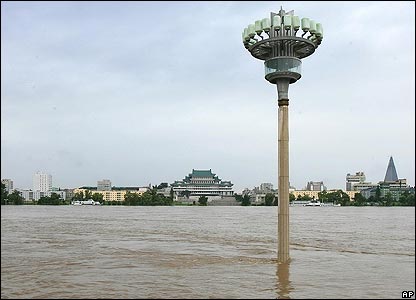
KIS square.jpg

North Korea: Deadly Rains Ruin Big Part Of Farmland
Washington Post

Burt Herman
Associated Press
Thursday, August 16, 2007; A11

North Korea on Wednesday detailed the devastation caused by some of the country’s heaviest-ever rains, saying more than one-tenth of the impoverished country’s farmland had been wiped out during peak growing season.

The North Korean government reported that hundreds of people were killed or missing in this month’s floods, with as many as 300,000 left homeless.

Footage from Associated Press Television News showed citizens working to rebuild roads, clear debris and shore up sandbags along rivers in flood-affected areas outside Pyongyang, the capital. Video images also showed a farmhouse that appeared to have been swept down a hillside by the rain.

If the government’s numbers on agricultural damage are confirmed, the destruction would be about one-quarter of that suffered in massive flooding in 1995. That disaster, coupled with outdated farming methods and the loss of the country’s Soviet Union benefactor, sparked a famine that is estimated to have killed as many as 2 million people.

The vivid portrait of damage, in reports from the North’s state-run media, appeared to be a cry for help from a desperate government that maintains strict secrecy of its internal affairs. But the North has previously exaggerated the extent of disasters to obtain aid and to cover up ineptitude in providing for its people in a centrally controlled economy.

The official Korean Central News Agency reported Wednesday that downpours along areas of the Taedong River were the “largest ever in the history” of measurements taken by the country’s weather agency.

An average of 20.6 inches of rain fell across the country from Aug. 7 through last Saturday, 2.1 inches more than downpours in August 1967, KCNA said.

The recent rains have submerged, buried or washed away more than 11 percent of rice and corn fields in the country, KCNA reported, citing Agriculture Ministry official Ri Jae Hyon. “It is hard to expect a high grain output owing to the uninterrupted rainstorms at the most important time for the growth of crops,” KCNA said.

The U.N. World Food Program estimated that the amount of damage the North Koreans reported to their fields would result in losses of about 450,000 tons of crops — adding to the 1 million ton annual shortage that the country already faces.

The amount is less than the 2 million tons that the North said was lost in the 1995 floods at the start of the famine, said Paul Risley, a spokesman for the U.N. agency. “Nonetheless, this would be an extremely serious reduction in the amount of the harvest,” he said.

The North is especially vulnerable to the annual heavy summer rains that soak the Korean Peninsula because of a vicious cycle in which people strip hillsides of natural vegetation to create more arable land to grow food, increasing flood risks.

U.S. Assistant Secretary of State Christopher R. Hill said the U.S. government was considering how it could help the North Koreans.

The disaster reports precede a planned summit this month between leaders of the two Koreas. South Korea’s government has been criticized by opponents at home and abroad for having given unconditional aid to the North during an international standoff over the communist state’s nuclear weapons program.

Aid was already expected to be a key topic at the summit. Marcus Noland, senior fellow at the Washington-based Peterson Institute for International Economics, said the latest disaster gives Seoul justification to expand assistance to its neighbor.

North Korea’s flooded ‘rice bowl’
BBC

8/16/2007

The UN World Food programme’s acting country director, Michael Dunford, has just returned from a visit to one of North Korea’s flood-affected areas, in the south of the country.

He told the BBC news website what he saw and how the floods are affecting a country already dependent on food aid.

“We went to Sogon, driving for about two hours to get there, and we saw extensive examples of flooding as we went down, with widespread inundation of arable lands which, of course, creates concerns as regards the long-term food implications.

We have been told by the government that the Kangwon province is one of the areas that is worst affected. The impression we are getting is that there is severe damage throughout the southern half of the country, across to the east.

The southern part of the country is the main food-producing area. As you go further north it is more mountainous and hence their ability to produce is limited.

The area that has been inundated is part of the ‘rice bowl’, hence this creates additional concerns as to what impact that may have.

We estimate that annually there is a food deficit of about a million tons of cereals – that’s maize and rice. So, in the past, North Korea has relied on bilateral, from China and South Korea predominantly, and also and multilateral support through the World Food Programme.

Collapsed houses

Last year, the amount of food that entered the county did not meet the food gap and hence we were concerned about the implications that was going to have for food security in the country and potentially the impact that may have on the most vulnerable.

Certainly for them to have the floods this year is only going to exacerbate the already food insecure situation in the country.

People are managing as best they can. We understand from the government that those who have lost their homes are now residing in either their place of work or some form of community shelter – either a schools or nursery, we expect.

We were dealing with local officials. They tell us that the waters have inundated houses, houses have collapsed, factories have been completely inundated and roads and bridges have been washed away. Certainly the impression we are getting is that this is very severe flooding.

We saw bridges that were knocked down, we saw roads that had been washed away. The infrastructure is typically old and anything that damages it further is going to have implications.

Wiped out

The landscape in the southern area is a combination of flatlands with quite dramatic mountains, there are fields with hills and mountains shooting up.

There are small villages and co-operative farms. These are very rudimentary houses – typically handmade.

People may have a small plot in the front of the house in which they try to grow their own vegetables – potatoes, beans, carrots, tomatoes – they are then surrounded by more extensive farmlands which have been damaged by flooding.

In one area, we were looking at what we thought was a river running through a field of maize but it was in fact the offshoot of a flooded river. Crops have just been wiped out.

We also saw a lot of areas that were completely underwater, knowing that the rice would not be able to recover.

This is the period of pollination and, hence, because the rice is underwater during this period, it won’t germinate and hence won’t produce for the harvest due in September-October.

N Korea floods devastate farmland
BBC

8/15/2007

Severe flooding in North Korea has destroyed more than one-tenth of the country’s farmland, according to the state news agency KCNA.

“As of 14 August, more than 11% of rice and maize fields were submerged, buried or washed away,” Ri Jae-Hyon, director of the Ministry of Agriculture, said.

Government officials also told aid workers in the region that 300,000 people may have been left homeless.

Aid teams visiting the area warned of a need for emergency shelter and food.

“Going forward, the crop damage is of major concern,” Michael Dunford, of the UN World Food Programme, told the BBC.

He added that he had been to see some of the damaged areas, and described the situation as “pretty grim”.

Food aid

“Areas of the capital, Pyongyang, have been inundated,” he said, “but certainly as you move out into the countryside there is widespread damage, and it is going to have a negative impact on DPRK [North Korea] most certainly.”

North Korea already suffered from severe food shortages, even before the floods.

About two million people are thought to have died from famine in the mid-1990s in North Korea, and the country remains dependent on foreign food aid.

United Nations Secretary General Ban Ki-moon has ordered a full evaluation of the needs of North Koreans and has promised assistance to the communist nation.

“I assured him that the United Nations will be prepared to render whatever possible humanitarian assistance and help to the DPRK (North Korean) government and people overcoming this difficulty,” he said after a meeting with North Korea’s UN envoy Pak Gil-yon.

The US and South Korea have both said that they would consider sending aid.

‘Huge damage’

North Korea made the rare plea for help after it announced late on Monday that storms since 7 August had led to “huge human and material damage”.

State news agency KCNA said hundreds of people were dead or missing.

Many areas were affected but worst hit were the three provinces of Kangwon, North Hwanghae and South Hamgyong, it said.

Television pictures from the capital Pyongyang showed people wading along streets through thigh-deep water after rivers burst their banks.

These floods are thought to be worse than the ones that hit last year. Hundreds of people are thought to have died in August 2006, but exact figures are not known.

Heavy rainfalls render 17,000 North Koreans homeless
Yonhap
8/15/2007

Hundreds of people were killed or missing in North Korea in heavy downpours that battered the impoverished communist country last week, a North Korean official said in a report on Wednesday.

The downpours, which flooded even the center of its capital, Pyongyang, and wide sections of the country’s western region, also left about 17,000 people homeless, said the official from Pyeongan Province in a report carried by Pyongyang Radio. 

South to Help North Recover From Floods
Korea Times
Jung Sung-ki
8/14/2007

South Korea is considering sending relief supplies to help the North recover from severe flooding, the Ministry of Unification said Tuesday.

Hundreds of people are dead or missing in North Korea following week-long torrential rain that has destroyed thousands of houses, and damaged roads and railway tracks, the North’s state media reported.

“North Korea seems to be suffering a greater loss of lives and property than it did during July’s flooding last year,” Seo Sung-woo at the ministry’s intelligence analysis bureau told reporters.

“I don’t think the inter-Korean summit will be affected by the floods. However, if the rains continue, it is hard to predict,” said Seo.

In 2006, monsoons rains hit much of the impoverished state, killing hundreds of people.

Floods in July that year left over 500 people dead and nearly 300 people missing, according to the Chonson Sinbo, a Japan-based pro-North Korean newspaper.

In the following month, Seoul sent $82 million worth of aid to Pyongyang. The South provided the North with 100,000 tons of rice and cement, five tons of iron, construction equipment, 80,000 blankets and 10,000 emergency kits, according to the ministry.

The North’s official Korean Central News Agency said this year’s heavy rain destroyed at least 30,000 homes of 63,300 families, and more than 540 bridges and sections of railway.

The agency said heavy downpours had caused “huge human and material damage.” Many parts of the country received between 30 and 67 centimeters of rain from Aug. 7 to 12, it said.

Gangwon Province was hit the hardest, with more than 20,000 homes damaged or destroyed.

Pyongyang and neighboring provinces including South Hwanghae and South Pyeongan were also badly affected, according to the report.

Experts blamed decades of reckless deforestation for North Korea’s flood problems, saying the country has been stripped of tree cover that provides natural protection.

The International Federation of the Red Cross (IFRC) emergency operations staff is on a 24-hour alert to monitor flood damage in North Korea and has distributed aid kits to some 500 families, its Web site said.

“People have been evacuated and brought to safety,” it said, and county governments are “appealing to cooperative farms to donate emergency food for homeless people.”

International Red Cross goes on alert in North Korea on flood damage
Yonhap

8/13/2007

The International Federation of Red Cross (IFRC) emergency operations staff is on a 24-hour alert to monitor flood damages in North Korea and has distributed aid kits to some 500 families, its Web site said Monday.

A bulletin dated Sunday said the torrential rain that started Aug. 5 has caused serious flooding in many parts of North Korea.
“People have been evacuated and brought to safety,” the IFRC Web site said, and county governments are “appealing to cooperative farms to donate emergency food for homeless people.”

“Warnings of high tides have been issued on national television. Indeed, weather forecasts predict continued heavy rains until Aug. 17.”

The Red Cross emergency operations room is on a 24-hour alert, it said, with its staff in the field assessing damage.

In a rare admission of a crisis, North Korea’s state run news agency said Monday the downpour so far has left hundreds of people dead or missing and destroyed more than 30,000 homes for 63,300 families.

The Korean Central News Agency said hundreds of public buildings, bridges and railway sections also were destroyed.


Share

Inter-Korea Cooperation Fund riddled with holes

Monday, August 13th, 2007

Korea Herald
Choi He-suk
8/13/2007

The Inter-Korea Cooperation Fund is riddled with problems, a team of civilian experts reported.

At present, the country’s support measures for North Korea are carried out using the Inter-Korea Cooperation Fund.

According to reviews evaluating public funds’ relevance and the efficiency of asset management carried out by civilian experts, the management of the Inter-Korea Cooperation Fund is inefficient and poorly planned. The panel also said that the Unification Minister-led committee in charge of the fund lacks the expertise required for asset management.

However, the team, comprised of 67 civilian experts including university professors, accountants and researchers, did not include the fund among those slated for abolition.

The reviews, carried out during the first half of the year, showed that the fund’s sources of revenue must be diversified. The review panel said that most of the fund’s revenues are generated from the government budget and that the proportion of resources raised from the private sector and through in-house projects remain insignificant.

The reports added that despite the fact that those responsible for managing the fund realize the need to find new sources of revenue and to draw up detailed expenditure plans, such changes have failed to materialize.

The reports also highlighted the need to draw up long-term plans for the fund’s management and said that the Ministry of Unification should take the lead in establishing long term plans and strategies for the management of the fund to reflect the changes in inter-Korea relations.

The review panel also suggested that the private sector’s participation in the fund needs to be increased.

The reports said that although the government should continue to provide support for private organizations in inter-Korea projects, local financial institutions should be at the core of related projects in the future when non-governmental exchanges become the mainstay of economic relations between the two Koreas.

The reports also showed that some of the projects operated through the fund overlap with those financed by other public funds and that such projects should be operated in collaboration with concerned bodies.

Share

Seoul to Unveil Investment Plan in NK Infrastructure

Thursday, August 9th, 2007

Korea Times
Ryu Jin
8/9/2007

South Korea is expected to propose a large-scale investment plan in social overhead capital (SOC) in North Korea in the inter-Korean summit late this month to help the impoverished state revive its economy, according to officials on Thursday.

Officials in Seoul said that the package proposal will likely include the provision of electricity, renovation of the Pyongyang-Gaeseong highway, improvement of facilities in Nampo port and establishment of a fertilizer factory.

President Roh Moo-hyun and North Korean leader Kim Jong-il are set to meet in Pyongyang Aug. 28-30, seven years after Roh’s predecessor, Kim Dae-jung, met with the reclusive North Korean leader.

While the Roh administration finds itself in a difficult position to give direct assistance to the North, such as provisions of rice and fertilizer — not to mention cash — it appears to have opted for “indirect’’ SOC investment, according to the sources.

Former President Kim Dae-jung won the Nobel Peace Prize for the first-ever summit in June 2000, but his achievement was partly tainted by later revelation that Seoul had secretly transferred $500 million to Pyongyang to foster the historic summit.

Roh, who has put more weight on transparency in North Korea affairs, often stressed the need to help North Korea repair its devastated economy with its own hand and get out of its economic slump.

In February, the Unification Ministry drew up a roadmap for a large-scale economic cooperation, focusing on “what the North really wants.’’ Seoul will likely make some offers to Pyongyang in the upcoming summit, according to government sources.

Dubbed “Roadmap to Hope,’’ the ministry plan includes as many as 16 items such as the provision of 2 million-kilowatt electricity, worth some $900 million every year, and renovation of the 170-kilometer Pyongyang-Gaeseong highway ($307.7 billion).

Other items include the improvement of facilities in Nampo port, the construction of a 330,000-ton fertilizer plant and installation of tree nurseries in Pyongyang, Gaeseong and Hamheung.

“We are sorting out items that could be offered,’’ a high-profile government official said on condition of anonymity. “I think our proposal for the SOC investment could be discussed in the working-level preparatory talks in Gaeseong next week.’’

Experts estimated that the aid package could reach 9 trillion won to 13 trillion won ($9.7 billion to $14 billion) in the coming several years, if major items such as the highway renovation are included on top of the ongoing supply of heavy fuel oil.

Seoul is expected to demand the establishment of liaison offices across the border and the regularization of military talks headed by the defense ministers from the two sides in return for the economic incentives, according to the sources.

But the large-scale economic assistance is expected to trigger fiery debate in the South, as conservatives, represented by the opposition Grand National Party (GNP), have often lashed out at the government’s “single-handed’’ assistance amid the nuclear standoff.

Deputy Prime Minister and Minister of Finance and Economy Kwon O-kyu, who is to accompany Roh to Pyongyang, stressed on Thursday that the aid package would be offered “transparently’’ in close coordination with the international community.

“South-North Cooperation Fund, operated under the endorsement of the National Assembly, could be used first,’’ he told reporters. “I think we should also try to create a favorable environment for the inter-Korean economic projects in close cooperation with the World Bank and the Asian Development Bank.’’

Share