Archive for the ‘South Korea’ Category

Leaders of 2 Koreas Will Meet in the North

Wednesday, August 8th, 2007

New York Times
Normitsu Onishi
8/8/2007

The two Koreas announced Wednesday morning that they would hold a summit meeting later this month, the first since a groundbreaking meeting in 2000 began an ongoing reconciliation process on the Korean peninsula.

President Roh Moo-hyun of South Korea will meet the North’s leader, Kim Jong-il, during a three-day meeting Aug. 28 to Aug. 30 in Pyongyang, North Korea’s capital, the two Korean governments said in coordinated announcements.

The North said the meeting will carry “weighty significance in opening a new phase of peace,” according to the government’s Korean Central News Agency. The South, using similar language, added that the meeting would “provide momentum to settle the North Korean nuclear problem.”

Neither side released details about the agenda, and it was not clear how much can realistically be accomplished because the deeply unpopular Mr. Roh has only a few months left in office.

The meeting, which had been rumored for months, was immediately criticized by South Korea’s political opposition as a ploy to influence the presidential election in December. The trip by Mr. Roh is widely expected to boost the popularity of liberal presidential candidates who share his engagement policy toward the North.

While the main opposition Grand National Party also favors engaging North Korea, its candidates call for tougher concessions from the North. Two Grand National Party candidates, Lee Myung-bak and Park Geun-hye, lead in polls for the election.

“This summit is about politics between North and South Korea,” Nam Sung-wook, a North Korea expert at Korea University, said in a telephone interview from Seoul. “It is unlikely to solve the nuclear problem because North Korea has consistently argued that it is a problem between North Korea and the United States.”

Still, South Korea said the North had agreed to the meeting because of the recent progress in negotiations over the North’s nuclear program. The North shut down its nuclear reactor at Yongbyon last month, and talks are continuing over its entire nuclear program.

In 2000, Kim Jong-il and the previous South Korean president, Kim Dae-jung, met in Pyongyang in sessions that inaugurated a policy of reconciliation between the two cold war enemies, which remain technically at war. That meeting led to a profound change in relations between the two countries.

Share

Northern exposure

Wednesday, August 8th, 2007

Joong Ang Daily
8/8/2007

football.jpg

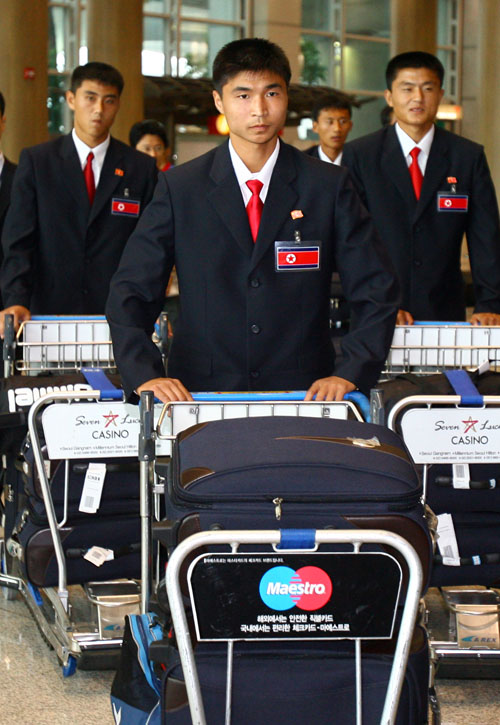
North Korean youth soccer players arrive yesterday at Incheon International Airport. The North Korean team will participate in the U-17 World Cup organized by FIFA in South Korea from Aug. 18 through Sept. 9.

Share

North Koreans Demand Cease to Scattering of Flyers: Provides Proof of Their Effectiveness

Thursday, August 2nd, 2007

Daily NK
Kim Song A
8/2/2007

“In order to transform North Korea, outside news has to enter.”

North Korea, through the North-South Korea Military working-level talks held on the 10th, proposed the cease of scattering of flyers by private organizations. This is the 16th time that North Korea has made such a request.

The North Korean authorities, through the North-South General Officers Talks held in 2004, protested that South Korean private organizations are scattering defamatory flyers, despite the fact that North and South Korea agreed to stop advertisement activities, broadcasting, or public announcements in the Military Demarcation Line region.

Related to this, Lee Min Bok, Christian Defectors Association’s representative, evaluated in a phone interview with DailyNK on the 26th, “The reason why North Korea is reacting sensitively is because many North Koreans are exposed to materials distributed by ‘leaflet balloons’ and are being influenced.”

Mr. Lee revealed his intention to continue to carry out this work, “All North Koreans, with the exception of Kim Jong Il, probably appreciate the information distribution even though they cannot outwardly express it. We will continue to carry out this work with the single-hearted purpose of relaying outside news.”

Lee, who entered South Korea in `95 via Russia and China after defecting from North Korea in `90 is well-known as “the first refugee from North Korea defined by UN.” Presently, he graduated from seminary in South Korea and is involved in spreading Christianity in North Korea.

Through the balloon, his strategy is to transform North Korea while disseminating outside news such as evangelism flyers to North Korea. The members of defector and missionary organizations sent 207 large-size balloons (as of July 18th) to North Korea this year alone.

A total of 597,816 leaflets were sent to North Korea through these balloons. Six radios and medicine such as aspirin were included as well. He who has been continuing this activity since 2002 emphasized that disseminating outside news was more important than any other work.

“In East Germany and the former Soviet Union, outside news caused the fall of Communism. East Germany’s last prime minister Lothar de Maiziere said at the time of Germany’s reunification, “West Germany tried to relay news of the outside world to East Germany. Russian-born North Korean expert, Professor Andrei Lankov said, “Soviet Union was toppled because of the radio.”

“As when Romanian citizens executed dictator Ceaucescu, the potential power of North Korean citizens will be great if North Korea collapses,” confirmed Lee of the enormous impact dissemination of flyers and radio broadcasting has had on North Korean citizens.

He said, “Failure to support or back such activity might actually ignore the latent energy of North Korean citizens. When I was in North Korea, I learned a lot from the flyers from South Korea. What I saw then is significantly helping me produce flyers to be distributed to North Korea now.”

He recalled his experience then and has produced flyers which are considerate of North Korean citizens by expressing terminology or inscriptions which may not be understood in a more North Korean way.

Regarding the content of the flyers, he explained, “It focuses on North Korean society’s devotion towards Kim Jong Il and helping them realize the areas of propagandistic lies about South Korea.”

He added, “I have lived in North Korean society, so I know what to capture to reveal the true nature of North Korea’s political power. From such intent, the defectors have to become owners of this work and must actively step forward.”

Sending one large-sized balloon to North Korea costs around 140 dollars. The cost adds up if the one counts the failed balloons due to the weak north wind. The support money from defector or missionary organizations and civilian organizations have been appropriated for this work.

Lee, who believes that a single flyer he sends can change the North Korean people, emphatically said, “There is no one who significantly recognizes our work, but in order to open and reform North Korea, I do not think there is any other way. Until North Korea democratizes and becomes reunified, I will continue this work.”

Share

Sunshine needs new directions

Wednesday, August 1st, 2007

Joong Ang Daily
Jo Dong-ho
8/1/2007

The environment for economic relations between South and North Korea has changed.

In 1998, when the Sunshine Policy was started, South Korea’s national per capita income was $7,355, while North Korea’s stood at $573. At the time, South Korea’s export volume was $132.3 billion, and North Korea’s was $600 million. In a nutshell, South Korea’s national per capita income was 13 times higher and its export volume was 220 times bigger than North Korea’s.

Since then, South Korea’s national per capita income has rapidly increased, to $18,372 as of 2006. Meanwhile, according to an estimate by the Bank of Korea, North Korea’s national per capita income hovers at around $900.

South Korea’s exports are worth $325.6 billion, nearly triple 1998 numbers, but North Korea’s export volume is merely $900 million.

Accordingly, the gap between the two Koreas’ economies has widened. Now, South Korea’s national per capita income is 20 times higher than North Korea’s. South Korea’s export volume is 325 times larger than North Korea’s.

In particular, South Korea’s economy has developed and matured a great deal in terms of quality because it opened its doors more widely after the financial crisis 10 years ago.

But North Korea still cries out for an independent, self-sufficient economy, leading to a wider discrepancy in the economies of the South and North.

In the meantime, economic cooperation between South and North Korea has developed a great deal. In 1998, trade volume between South and North Korea was worth around $200 million. In 2006, it was more than $1.3 billion. Today, large-scale projects by both the private and the public sectors are in progress, something that was unthinkable back in 1998.

Examples of these are a building project at the Kaesong Industrial Complex and the government’s project for social overhead capital, such as railways and highways between the two Koreas. A variety of agreements have already been prepared, such as one protecting investments.

As a result, South Korea is North Korea’s largest export market, its second-largest trade partner and largest investor. South Korea also provides support and more assistance to North Korea than other countries.

The number of visitors to North Korea has increased as well. In 1988, 3,317 people went to North Korea, but last year more than 100,000 people visited there.

The reason why I included these lengthy statistics is to underscore the change in South and North Korea’s economies as wellas their economic relations.

In the past, South Koreans wanted to buy products made in North Korea out of curiosity, but now an item from North Korea is simply commonplace.

A small project involving North Korea made headlines in the past, but now many go unnoticed.

However, the Sunshine Policy, which has been in place since the Kim Dae-jung administration, has not changed at all.

The Sunshine Policy was aimed at inducing North Korea to change and expanding contact and exchange with North Korea was a means to achieve that goal.

That is why we did our utmost to cooperate economically with North Korea and to increase assistance to the country. As seen in statistics, these efforts have produced significant achievements on the outside.

But in the process, we became preoccupied with the means and forgot about the original goal of the policy. We continued economic cooperation with North Korea even though it carried out a nuclear test. We wanted a summit meeting with North Korea even though it meant we had to put a tremendous amount of money under the table. The Donghae line is not of much use because the railway does not run northbound from Gangneung. We connected it because North Korea wanted us to.

Maintaining contacts and exchange with North Korea has become the ultimate goal of the policy. Because of the Sunshine Policy, in which the means have become the goal, North Korea receives assistance even though it sticks to its old-fashioned ideology.

Thus, now we need to straighten out the means and the goal. The environment for economic relations between South and North Korea has changed. We can’t define the Sunshine Policy as either a failure or a success.

We have long since passed the stage where we have to pour all our efforts into the means, but we have not changed our direction to focus our energy and attention on a new goal. It is meaningless that presidential hopefuls discuss whether they will embrace or abolish the Sunshine Policy in its entirety.

In the past, starting economic relations with North Korea was the top priority even though it meant “shoveling aid across the border.” The time has come to steer the policy in the right direction.

Share

Gaeseong output boosts inter-Korean trade

Monday, July 30th, 2007

Korea Herald
Ko Kyoung-tae
7/30/2007

Trade between South and North Korea expanded fast this year as South Korean manufacturers picked up investment and output at the Gaeseong Industrial Park, trade data showed yesterday.

The Korea International Trade Association said the inter-Korean trade rose to a record high $720 in the first half, up nearly 30 percent from a year earlier.

Imports from the North jumped over 60 percent to $390 million, while exports slightly declined to $330 million, according to the association.

The large leap in imports from North Korea largely resulted from the fast-growing manufacturing facilities in Gaeseong.

The two Koreas have traded around $190 million of products and machineries through the industrial complex in the first six months, up almost 80 percent from a year earlier.

The KITA officials expect the rising interests in the Gaeseong complex to further push up the cross-border investment and trade in the coming years.

South Korean conglomerate Hyundai Group built the manufacturing park in the North’s border city of Gaeseong in 2004 in a bid to attract South Korean manufacturers looking for cheap labor.

More than 20 South Korean companies currently employ around 11,000 North Korean workers.

Gaeseong’s output accounts for about one-third of the total inter-Korean commercial trade, the KITA noted.

Other regular trade also soared over 65 percent to $210 million as fishery and commodity imports grew in recent months.

In contrast, aid from South to North Korea remained stagnant.

Private cross-border aid dropped 15 percent to $140 million while government aid more than doubled to $20 million, the KITA noted.

The association estimated that 2007 inter-Korean trade would surpass $1.7 billion, four times that of 2000.

Share

S. Korea completes oil aid shipment to N. Korea under six-nation nuclear accord

Sunday, July 29th, 2007

Yonhap
7/29/2007

South Korea on Sunday sent 22,590 tons of heavy fuel oil to North Korea, its last oil shipment to the communist neighbor under the first stage of a landmark nuclear disarmament deal.

Under a Feb. 13 deal signed with five other regional powers, North Korea agreed to shut down its nuclear reactor in Yongbyon in return for 50,000 tons of heavy fuel oil aid from South Korea.

The oil shipment, the fifth of its kind, left this southeast port at 1 a.m. and is to arrive at Sonbong Port in northeastern North Korea at 7 a.m. on Monday, South Korean officials said.

North Korea shut down the Yongbyon reactor after South Korea sent the first shipment on July 12. The February deal also calls for North Korea to disclose and disable all its nuclear programs in return for an additional 950,000 tons of oil or equivalent aid.

The six nations — the two Koreas, the U.S., China, Russia and Japan — met in Beijing earlier this month but the talks ended without setting a date to meet again.

Share

Two Koreas to conduct on-site survey of three mines in the North

Friday, July 27th, 2007

Yonhap
7/27/2007

South and North Korea will start a joint on-site survey this week of three zinc and magnesite mines in the North’s mountainous northeastern region, the Unification Ministry said Friday.

“The zinc deposit in Komdok mine is about 200-300 million tons, the largest in East Asia, and magnesite deposits in Ryongyang and Taehung are about 4 billion tons, the world’s third largest,” a ministry official said.

Ahead of the 15-day joint survey of the mines starting from Saturday, the South started shipment of light industry materials worth US$80 million to the North on Wednesday. The first shipment was 5 million tons of polyester fabric worth $800,000.

Earlier this month, the two Koreas agreed on how to cooperate in natural resource exploration in the North in return for the South’s provision of light industry materials.

In 2005, South Korea agreed to offer industrial raw materials to the North to help it produce clothing, footwear and soap starting in 2006. In return, the North was to provide the South with minerals after mines were developed with South Korean investments guaranteed by Pyongyang.

But the accord was not implemented, as North Korea abruptly cancelled the scheduled test runs of inter-Korean cross-border trains in May last year, apparently under pressure from its powerful military. The two Koreas carried out the historic test run of trains across their heavily armed border in mid-May.

Share

Inter-Korean Trade Jumps 28.6%

Thursday, July 26th, 2007

Korea Times
Jane Han
7/26/2007

Inter-Korean trade rose 28.6 percent in the first half of 2007 from a year earlier, the country’s leading trade agency said Thursday, attributing the boost to the Gaeseong joint industrial complex and the eased tension between Seoul and Pyongyang.

Trade amounted to $720 million during the January-June period, the Korea International Trade Association (KITA) said.

While South’s exports to the North dropped 9.4 percent to $330 million, imports from the North jumped an impressive 63.3 percent to $390 million.

The trade group credited the big import leap to the expanded number of items produced in the industrial complex located at North Korea’s western border city.

But unlike the positive performance of the two-way trade, the Mt. Geumgang tour business has dropped 7.2 percent.

South Korean companies are currently employing about 15,000 North Korean workers in the Gaeseong complex and the number is expected to rise as the facility undergoes expansion.

Symbolic of the cooperation between the Cold War rivals, the industrial park began construction in June 2003 and its operation started the following year.

Share

North Korean Studies Unpopular

Tuesday, July 17th, 2007

Korea Times
Kang Shin-who
7/17/2007

More and more universities are removing departments of North Korean studies. Since Dongguk University was the first Korean university to establish a major in North Korean studies in 1994, five other universities followed: Kwandong University in 1996, Myongji University and Korea University in 1997, Chosun University in 1998 and Sun Moon University in 1998.

However, three of the five universities no longer offer the major. Chosun University abolished the department a year after its establishment because it could not guarantee jobs for graduates. Sun Moon University will change the department to North Asian studies from next year.

Also, Kwandong University, which is located in Gangwon Province, gave up the studies last year because the school has failed to meet the admission quota over the last few years.

Although students can major in North Korean studies at Dongguk University, the school will recruit only 20 new students for the next academic year, 20 less than the previous year.

Experts say that severe competition on landing jobs has caused many universities to give up North Korean studies. Many of the major hopefuls expect that they could easily get a job at the Ministry of Unification or research institutes for North Korea, but they have not taken advantage of their major. According to a survey by the Korea Research Institute for Vocational Education and Training, only 20 percent of students majoring in North Korean studies said that they are positive about their future, but 40 percent of them said their studies have no future.

While undergraduate schools have seen a decrease in the number of North Korean major students, more graduate schools have opened the studies. Sogang University set up the program at its graduate school in 1990, Kyungnam University in 1997 and Ewha Womans University last year.

Share

Oil Is Shipped to North Korea Under Nuclear Shutdown Pact

Friday, July 13th, 2007

NY Times
CHOE SANG-HUN
7/13/2007

A South Korean ship loaded with 6,200 tons of heavy fuel oil left for North Korea on Thursday under an agreement intended to end the North’s nuclear program.

The United Nations’ chief nuclear inspector said the North was expected to begin shutting down its main nuclear facilities early next week, after four and a half years of operation, during which time enough plutonium was thought to have been produced to make several atomic bombs.

The ship is expected to arrive at Sonbong, a port in northeastern North Korea, on Saturday, the same day a team of inspectors from the United Nations International Atomic Energy Agency is scheduled to arrive in the North to monitor and verify the shutdown.

Mohamed ElBaradei, the director general of the atomic agency, told reporters in Seoul that shutting down five nuclear facilities in Yongbyon, 62 miles north of Pyongyang, the capital, would not be difficult and should be completed “within maybe a month or so.” His agency and North Korea have already agreed on the procedures.

The shutdown would be significant because it would halt the North’s only declared program for producing fuel that can be used in nuclear weapons. The five facilities to be frozen in Yongbyon, including the country’s sole operating nuclear reactor and a radiochemical laboratory, can yield more than 13 pounds of plutonium a year, enough for one atomic bomb, according to experts.

But the steps to be taken after the initial freeze of the nuclear program remain “very much open questions,” Dr. ElBaradei said. Those include whether North Korea will provide the agency with a complete inventory of its nuclear materials, and when it might return to the Nuclear Nonproliferation Treaty.

“It’s going to be a very long process,” he said. “It’s going to be a complicated process. How smoothly the rest of the operation will go very much depends on how progress will be made in six-party talks.”

Chief envoys to the six-nation nuclear talks will meet in Beijing next Wednesday and Thursday, the Chinese Foreign Ministry said. The envoys, gathering for the first talks since March, were expected to discuss moves beyond the reactor shutdown.

North Korea agreed to shut down its Yongbyon facilities in a February agreement with the United States, South Korea, China, Russia and Japan. The deal called for shipping 50,000 tons of fuel oil to North Korea, and South Korea volunteered.

It plans to complete shipping the oil by early August, starting with the installment on Thursday.

North Korea indicated last week that it would undertake the long-delayed shutdown after the first shipment arrived.

When United Nations inspectors return to Yongbyon, they will face the same problems they had faced there before they were expelled in late 2002. They will put in seals, install cameras and leave monitors to ensure that the facilities remain shut. But they will not be allowed to collect samples or access North Korean data, much less travel around the country, to determine how much nuclear material North Korea has produced in Yongbyon or elsewhere.

The five-megawatt reactor in Yongbyon began operating in the mid-1980s. When suspicions about North Korea’s nuclear activities emerged in the early 1990s, a key dispute was how much plutonium had been produced at Yongbyon until then — 90 grams, about 3 ounces, as North Korea reported to the I.A.E.A., or up to 10 kilograms, about 22 pounds, as the agency suspected.

The dispute has never been resolved, although North Korea agreed to suspend operations at Yongbyon in an agreement with the United States in 1994. The accord collapsed in late 2002, when North Korea expelled the United Nations inspectors and restarted the Yongbyon operation.

North Korea has since claimed to have taken spent fuel unloaded from the reactor and reprocessed it into plutonium. Last October, it conducted its first nuclear test.

“It remains an unanswered question: how much plutonium has North Korea so far produced?” said Lee Un-chul, a nuclear scientist at Seoul National University. “North Korea won’t easily give up its operational data.”

Share
