Archive for the ‘International Governments’ Category

DPRK owes ROK appx $1billion

Wednesday, April 20th, 2011

According to the Choson Ilbo:

North Korea owes South Korea more than W1 trillion in terms of food and other loans, it emerged Tuesday (US$1=W1,092). The North has to start repaying the debt from June next year, but given its economic difficulties and strained inter-Korean relations it is unlikely that Seoul will see a penny.

According to the Unification Ministry, the Kim Dae-jung and Roh Moo-hyun administrations gave the North 2.4 million tons of rice and 200,000 tons of corn from 2000 to 2007 on condition of repayment over a period of 20 years with a 10-year grace period at a 1 percent annual interest. The loans amount to US$720.04 million, with the interest reaching $155.28 million.

The South Korean government also spent W585.2 billion from the Inter-Korean Cooperation Fund to re-link cross-border railways and roads from 2002 to 2008. Of the total, W149.4 billion worth of materials and equipment for construction on the North Korean side are also loans to be repaid on the same conditions.

Besides, Seoul lent the North $80 million worth of raw materials for production of textile, footwear, and soap in 2007 and 2008. At the time, the North paid back 3 percent of the loan with 1,005 tons of zinc ingots worth $2.4 million, leaving a $77.6 million balance.

All told, the principal on these loans amounts to W1.02 trillion and the total debt including interest to over W1.2 trillion.

The first repayment of $5.83 million for the food loans provided between October 2000 and March 2001 is due on June 7 next year.

A ministry official said, “The amount has already been included in next year’s revenue plan, on the assumption that it will be paid back. If the North fails to pay, it will be deemed outstanding balance.”

Aside from the food and economic loans, the South also lent the North W1.37 trillion through the Korean Peninsula Energy Development Organization from 1998 to 2006 for the construction of a light-water nuclear reactor. The money was raised by issuing government bonds. The total amount of all loans adds up to W2.25 trillion, if the accrued interest of W877.2 billion is counted.

But since the KEDO project was scrapped in 2006, there is no way for the South to get the money back. It seems likely that the total amount will be handled as “irredeemable government bonds” that have to be made up for with tax money.

Read the full story here:
Pyongyang Owes Seoul Huge Amounts of Money
Choson Ilbo
2011-4-20

Share

Strange UK-DPRK fraud case

Tuesday, April 19th, 2011

I still have not had time to pay much attention to this story, but here is the coverage by the major British media outlets:

The Economist:

SVEN GORAN ERIKSSON, a Swedish football manager of some repute, is a man known as much for his wide travels as he is for his colourful love life. After scoring great success in Italy, he managed the national teams of England, Mexico, and the Côte d’Ivoire. Even seasoned Sven-watchers however were surprised when he rocked up in North Korea in 2009.

This week it was reported that he had been there at the behest of one Russell King, a convicted conman, who had managed to convince a London financial institution, the government of North Korea, and Mr Eriksson himself that he was managing billions of dollars on behalf of the Bahraini royal family.

A report on the BBC’s investigative news programme “Panorama” (or, if you’re outside the viewing area) has it that Mr King, who is now believed to be on the lam in Bahrain, first convinced directors of small investment bank First London Plc to hand over 49% of the company to him, in return for his apparently colossal business. This done, he used First London to finance an investment in Notts County, a Midlands football club with a proud history, now plying its trade in the lower divisions.

Mr Eriksson, drawn in by the promise of shares in Swiss Commodity Holdings (SCH), a vehicle of Mr King’s, was duly installed as football director at County. He was joined there for a time by another fellow dupe, Sol Campbell, an ex-Arsenal and England star. Messrs King and Eriksson ventured to Pyongyang on SCH business, where they are reported to have made a deal with officials in the North Korean government to grant them exclusive rights to the impoverished nation’s gold mines. “I was in the palace and they were handing over to the North Korean government so-called shares”, Mr Eriksson told BBC’s investigative news programme “Panorama”. “They used my name”, he laments; there was even talk of him managing the North Korean football team.

Those who follow developments in North Korea tend to prefer casting Kim Jong Il as an evil genius—crazy like a fox—rather than as merely crazy. While there can be no doubting that he has it in him to run circles around America and China, the Dear Leader appears to be no match for a silver-tongued conman of Russell King’s stature.

The Guardian:

The Serious Fraud Office is looking into an elaborate scam that took in the former England football manager Sven Göran-Eriksson, former spymaster Sir John Walker and the North Korean government.

Investigators are also looking at how the same fraudster took control of almost half of a London investment bank without paying for the shares.

First London plc – the investment bank whose shares were listed on the Plus stock exchange and whose advisers included Tim Yeo MP and Air Marshal Sir John Walker, a former head of defence intelligence – subsequently went into administration with debts of £8.7m.

BBC Panorama has discovered that Russell King, a convicted fraudster, took control of 49% of First London by claiming he was managing billions of dollars for the Bahraini royal family. The case has been referred to the SFO – which only looks at the country’s highest value frauds – by the Financial Services Authority.

An FSA spokesman said: “In this case the acquisition of control occurred without the FSA having been given the prior notice which the law requires it to be given. Had it been given proper notice it would have been in a position to consider whether it should use its powers to object to and prohibit the change of control. The FSA subsequently identified a number of concerns and pursued a series of leads into what was an extremely complex corporate structure. It would be inappropriate for us to comment further at this time due to confidentiality issues.”

The Panorama programme will show how King then used the name of the bank and its high-profile advisers to give credibility to deals.

They included an attempt to obtain funding for a new company that claimed to have assets worth $2tn and the short-lived takeover of the Football League’s oldest club. In 2009, King was behind a controversial takeover of Notts County which promised to bring millions of pounds of investment from the Middle East. The investment, which appeared to have been guaranteed by First London, never materialised and the club was left £7m in the red – but not before Eriksson agreed to join County as director of football. Nottingham police are investigating.

The coach’s contract included a clause entitling him to €11m of shares in a little-known company called Swiss Commodity Holding, which had been set up a few months earlier and was claiming to have assets worth $2tn from the exclusive rights to North Korea’s gold, coal and iron ore.

King persuaded the former England manager to visit the rogue state as part of an SCH delegation and Eriksson was present at a meeting with the North Korean leadership. “I was in the palace and they were handing over to the North Korean government so-called shares,” he tells the programme. “I asked them how much and what they told me was not millions, it was billions of dollars. They used my name. Of course they did. At the end it became a big, big mistake.”

Panorama’s investigation shows that King was secretly running SCH, which was considering a public listing.

Documents detailing SCH’s claims were prepared by First London plc. The investment bank also sent Walker, who sat on the bank’s advisory board, to check out King and his associates. The air marshal tells the programme: “What do I think of Russell King? Not a lot. He was good at chat, but that was his business. He was a con man. I was taken the same way Sven was taken. They just wanted names.”

King had gained control over First London plc shares after convincing the bank that he was managing billions of dollars of Bahraini cash by introducing some of its executives to senior members of the royal family. But Fawaz Al Khalifa, president of the Bahraini Information Affairs Authority, says King was lying about his royal connections: “He might have met members of the family here or there, but we have no financial connection to him or his company.”

King, who was jailed for insurance fraud in 1991, denies running Notts County, SCH or First London plc.

However, the programme has obtained dozens of emails and testimonies showing he was secretly pulling the strings, including some where he refers to himself as Lord Voldemort, the character from the Harry Potter books who can never be named.

First London plc’s parent company, First London Group plc, is still in business. In a statement, its lawyers said the failure to notify the FSA about the change in ownership was a mistake: “This was simply an error and not done for any ulterior or questionable motive. As far as our client is aware the FSA were satisfied that the information provided was in compliance with all legal and regulatory requirements. Our client is unaware of any investigation by the FSA or SFO into its activities so far as they relate to or involve Russell King.”

BBC:

The Serious Fraud Office is examining a con that took in Sven-Goran Eriksson and the North Korean government, BBC Panorama has learned.

Investigators are also looking at how the same conman stole a football club and broke a bank.

Convicted fraudster Russell King persuaded the former England manager to join Notts County FC as director of football and to visit North Korea.

Mr King denies any fraud and said he was just a consultant on the deals.

Mr Eriksson was appointed at Notts County in 2009 following a takeover that promised to bring millions of pounds of Middle Eastern investment.

“For me as a football man it was fantastic, building a club from the bottom of League Two and having the funding to do it, to be a Premier League club. It’s like a dream, so I signed. Big mistake,” he said of the deal.

Milk bill
The promised money never arrived and the club was left £7m in debt. Mr Eriksson says there were early signs that all was not as it seemed.

“I started to have doubts when they came and told me the milk bill has not been paid,” he said.

Mr King claimed his Swiss-based mining company had assets worth almost $2 trillion because it had the rights to North Korea’s gold, coal and iron ore.

He told Mr Eriksson the Notts County cash would come from that mining deal. He then persuaded him to join a delegation visiting Pyongyang.

“I was in the palace and they were handing over to the North Korean government so-called shares,” Mr Eriksson told Panorama.

“I asked them how much that was and what they told me was not millions, it was billions of dollars. They used my name. Of course they did. At the end it became a big, big mistake.”

‘Con-man’
Russell King’s business deals had credibility because they appeared to have the backing of First London plc, an investment bank with advisers including Conservative MP Tim Yeo and Air Marshal Sir John Walker, a former British spymaster.

The bank sent Sir John, a former head of defence intelligence, to check out Mr King and the Korean deal, but he was also taken in.

Sir John said of the deal: “What do I think of Russell King? Not a lot. He was good at chat, but that was his business. He was a con man. I was taken the same way Sven was taken. They just wanted names.”

Mr King also managed to get control of almost half of First London plc without paying a penny for the shares, after he convinced its bankers he was managing billions of dollars for the Bahraini royal family.

But Fawaz Al Khalifa, President of the Bahraini Information Affairs Authority, says that Mr King was lying about his royal connections: “He might have met members of the family here or there, but we have no financial connection to him or his company.”

First London PLC went into administration last year with debts of £8.7m and the Financial Services Authority (FSA) has been examining the deal that gave King control of 49% of its shares. The FSA has now passed its finding to the Serious Fraud Office (SFO).

“In this case the acquisition of control occurred without the FSA having been given the prior notice which the law requires it to be given,” said an FSA spokesman.

First London plc’s parent company, First London Group plc, is still in business. In a statement, its lawyers said the failure to notify the FSA about the change in ownership was a mistake that had been rectified:

“This was simply an error and not done for any ulterior or questionable motive. As far as our client is aware the FSA were satisfied that the information provided was in compliance with all legal and regulatory requirements.

“Our client is unaware of any investigation by the FSA or SFO.”

Lord Voldemort
Mr King, who was jailed for insurance fraud in 1991, denies any involvement in the running of Notts County or First London plc.

But Panorama has obtained dozens of emails and numerous testimonies that show he was secretly pulling the strings at Notts County.

King even referred to himself as Lord Voldemort, the character from the Harry Potter books who can never be named.

The club had been owned by a supporters’ trust, but Mr King persuaded the fans to sell it for just £1 after they met one of his supposedly wealthy benefactors in Bahrain.

Abid Hyat Khan was introduced as a Middle Eastern prince, but Panorama has discovered he is actually on the run from British police.

He absconded from the UK in 2008, when he was due to stand trial for allegedly stealing almost £1m. Khan denies posing as a prince.

The BBC’s Panorama show can be found here.

Share

DPRK weapons imports

Tuesday, April 12th, 2011

According to the Choson Ilbo:

North Korea imported weapons and weapons components worth US$475 million from foreign countries between 1999 and 2008, Grand National Party lawmaker Lee Cheol-woo said Friday.

According to data Lee obtained from the government, the North bought helicopters and tank engines worth $90 million and aircraft parts and radars worth $110 million from China, Russia and Slovakia.

It also engaged in military exchanges with Cuba, Libya, Syria, Congo, Angola, Tanzania, and Uganda on a total of 101 occasions, Lee added.

Read the full story here:
N.Korea Imported $475 Million Worth of Arms Since 1999
Choson Ilbo
4/11/2011

Share

DPRK rescinds Hyundai’s Kumgang contract rights

Monday, April 11th, 2011

UPDATE 2 (2011-4-11): South Korea has declared the move illegal.  According to the AFP:

South Korea Monday criticised North Korea’s threat to strip a Seoul firm of its exclusive right to run tours to a mountain resort in the communist state, calling the move illegal and unacceptable.

The North said Saturday it may deprive Hyundai Asan of its monopoly over tours to scenic Mount Kumgang, where the firm has invested millions of dollars and has a 50-year agreement reached in 2000.

“The North’s claim… is in violation of agreements made at business and government levels as well as international customs,” said Chun Hae-Sung, a spokesman for the South’s unification ministry that handles cross-border affairs.

“The decision is absolutely illegal, illegitimate and unacceptable and should be withdrawn immediately,” Chun said.

UPDATE 1 (2011-4-11): The DPRK has formally ended Hyundai’s contract.  According to the Choson Ilbo:

North Korea has unilaterally ended a long-standing agreement that gave South Korea’s Hyundai Asan the sole rights to operate package tours to Mt. Kumgang. The tours have long been suspended, but Hyundai Asan has put a significant amount of money into accommodation and other infrastructure in the scenic resort.

In a statement on Friday night, the North’s Asia-Pacific Peace Committee said, “We’re invalidating the clause on the exclusive right given to Hyundai in the agreement on Mt. Kumgang tourism that we concluded with the company.” It said Hyundai Asan may continue to operate tours from the South Korean side, but the committee “will take care of the tours arranged through the North Korean side.”

A Hyundai Asan spokesman said the following day North Korea should withdraw the decision “since no terms of the agreement can be canceled or invalidated unilaterally by either side.”

Unilateral Decision

The two sides signed an agreement in October 1998 giving Hyundai Asan, a subsidiary of the Hyundai Corporation not to be confused with Hyundai Motor Group, the exclusive right to operate the tours.

In 2002, the regime granted Hyundai Asan the right to use of land in the Mt. Kumgang area until 2052, but it confiscated the property after South Korea suspended the tours following the shooting death of a tourist in July 2008.

According to Hyundai Asan, North Korean officials summoned staff to Mt. Kumgang on March 15 and 30 and told them the North would now promote tours on its own. On March 30, the North Korean also proffered a written document to a Hyundai Asan staffer, who refused to accept it saying it contravenes the original agreement.

The decision to cancel the deal nonetheless shows how desperate the North is to earn hard currency, since the apparent aim is to promote tours for Chinese visitors instead or indirectly pressure the South Korean government into resuming the tours.

Seoul says it will not resume the tours until the North allows an investigation of the shooting, gives firm safety guarantees, and promises to prevent similar incidents. There have been talks about their resumption, but the North’s sinking of the Navy corvette Cheonan in March last year and shelling of Yeonpyeong Island in November effectively strangled them at birth.

Chinese Tourists

It is unlikely that the North can plug the gap with revenues from Chinese tourists. Hyundai Asan says about 1.96 million tourists visited Mt. Kumgang over the past 10-odd years, but a mere 12,000 came from countries other than South Korea.

It remains to be seen whether the North will use the Hyundai-owned facilities to accommodate Chinese visitors.

Hyundai Asan has spent a total of W754.1 billion (US$1=W1,084) on developing nearby land and building facilities such as a power plant and a hotel. Other South Korean agencies and companies, including the Korea Tourism Organization and the National Agricultural Cooperative Federation, invested W133 billion. After tours were suspended, Hyundai Asan left 16 staffers behind at Mt. Kumgang to look after its properties.

ORIGINAL POST (2011-4-9): According to Yonhap:

Apparently growing impatient with South Korea’s lukewarm response to its dialogue offer, North Korea announced Friday that it could terminate an exclusive contract with a South Korean conglomerate for tourism at Mount Kumgang, a resort along its east coast.

In a statement carried by the official news agency KCNA, the Asia Pacific Peace Committee, a state organ in charge of inter-Korean relations, said, “There is no more prospect of resuming the tour of Mount Kumgang.”

“In this regard it informed the Hyundai side of its stand that it may terminate the validity of the provision of the agreement on tour of Mount Kumgang signed with the Hyundai side which calls for granting it monopoly over the tour,” it said, referring to Hyundai Asan, the South Korean operator of Mount Kumgang tourism program.

The statement also added Hyundai could continue conducting tours for South Koreans but that Pyongyang “may” take charge of tours to Mount Kumgang and elsewhere for North Koreans and also entrust an overseas business professional with such tours.

South Koreans’ tours to Mount Kumgang, once a cash cow for the impoverished North, have been suspended since the summer of 2008, when a female South Korean tourist was shot dead after straying into an off-limits military zone.

Pyongyang has been seeking to resume the joint venture, but Seoul has demanded a formal apology for the killing of the housewife, along with measures to prevent a recurrence of such an incident and a guarantee of tourists’ safety.

Friday’s announcement was viewed as aimed at putting pressure on the South to restart the tourism business.

Hyundai Asan said it was working to identify North Korea’s true intentions.

“The company is working to find out at the earliest possible date what the North’s true intentions are,” a Hyundai Asan official said, asking not to be identified.

North Korea froze Hyundai Asan’s assets at Mount Kumgang last year in an apparent attempt to pressure South Korea to resume tours to the mountain, a spiritual destination for Koreans on both sides of the border.

After years of threats and provocative acts, highlighted by two deadly attacks in 2010, Pyongyang has been appealing to Seoul for talks. Conservatives here say the North wants aid from the South and a dialogue with the United States.

Here you can see more of Seoul’s demands for resuming Kumgang tours.

Here and here you can find more information on Seoul’s demands for resuming Kumgang Tours.

Previous posts about the Kumgang Resort can be found here.


Share

DPRK donates to Chongryon in wake of Japanese tsunami

Sunday, April 10th, 2011

UPDATE 1 (2011-4-10): According to Yonhap:

North Korean leader Kim Jong-il donated more than 165 million yen (US$1.94 million) in educational funds to pro-North Korea residents in Japan on the occasion of his late father’s 99th birthday, the North’s state media said Sunday.

The educational aid was sent to the pro-Pyongyang General Association of Korean Residents in Japan, also known as “Chongryon,” to mark the 99th anniversary on April 15 of North Korea founder Kim Il-sung’s birth, the North’s official Korean Central News Agency (KCNA) said.

Here is the Original KCNA story:

General Secretary Kim Jong Il sent education aid fund and stipends amounting to 165,200,000 yen to the General Association of Korean Residents in Japan. It was sent for the democratic national education of children of compatriots in Japan on the occasion of the 99th birth anniversary of President Kim Il Sung.

The aid fund and stipends sent by Kim Il Sung and Kim Jong Il so far total 46 759 450 390 yen on 157 installments.

ORIGINAL POST (2011-3-24): According to Yonhap:

North Korean leader Kim Jong-il donated US$500,000 to pro-North Korean residents in Japan to help them recover from a killer quake and tsunami that left thousands dead and missing.

The aid from the cash-strapped country was announced Thursday in a brief dispatch from North Korea’s official Korean Central News Agency (KCNA).

Separately, North Korea’s Red Cross sent relief funds of $100,000 to its Japanese counterpart and expressed deep sympathy to the victims of the catastrophe, the KCNA said in a separate dispatch.

The KCNA did not give any further details on whether there were any casualties among pro-North Korean residents.

An official of the pro-North Korean association in Tokyo told Yonhap News Agency by phone that some of the residents could have been killed during the disaster. He did not elaborate and asked not to be identified as he was not authorized to speak to media.

Currently, hundreds of thousands of Koreans live in Japan, many of them descendants of Koreans forcibly brought to Japan as laborers during Tokyo’s 1910-45 colonial rule of the Korean Peninsula.

The ethnic Korean community, however, was later divided into two separate groups, with each supporting South and North Korea, respectively. The two Koreas remain technically at war since their 1950-53 Korean War that ended in a cease-fire.

North Korea and Japan have no diplomatic relations.

Despite Pyongyang’s vitriolic language towards the “Japanese colonialists,” the DPRK and Japan have historically enjoyed a uniquely close relationship.

Up until recent economic sanctions were imposed, Japan was the DPRK’s largest non-socialist trading partner.  This relationship was driven in large part by the Japan-based ethnic Korean association: Chongryon (Chosen Soren).  According to the Daily NK, at its peak, the Chongryon’s patriotic projects enabled the remittance of six to eight hundred million dollars every year.  With dividends like that, $500, 000 does not seem like much of a sacrifice.

Chongryon members are responsible for a number of investments in the country such as the Chosun Bank, Moranbong Company,   and Kim Man-yu Hospital in Pyongyang (39.031294°, 125.784566°).

Also worth noting, Ko Yong-hui,  Kim Jong-un’s mother, was from Osaka, Japan.  In fact here are the coordinates of her birthplace:  34.663147°, 135.531080°

Share

DPRK ships fishing illegally in Antarctica

Thursday, April 7th, 2011

UPDATE 1: Some additional information from the New Zealand media:

The government will be lodging a complaint with the North Korean government after two fishing vessels were caught fishing illegally in the Ross Sea.

Foreign Affairs Minister Murray McCully says the North Korean vessels were intercepted by an Air Force Orion plane carrying out surveillance against illegal fishing in the area.

The vessels, Xiong Nu Baru 33 and Sima Qian Baru 22, were caught fishing in an area managed by the Commission for the Conservation of Antarctic Marine Living Resources (CCAMLR). The Xiong Nu Baru 33 was using deep-sea gillnets, which are banned in the CCAMLR Convention Area.

“Deep-sea gill netting and associated ghost-fishing by lost and discarded nets have serious detrimental effects on the marine environment and many marine species”, said Fisheries Minister Phil Heatley.

“Illegal, unreported and unregulated fishing poses a severe threat to the sustainability of valuable toothfish stocks and has caused considerable environmental damage in the Southern Ocean.”

McCully said the detection of illegal, unreported and unregulated fishing vessels in the Southern Ocean was of grave concern to New Zealand.

He said New Zealand had reported its findings to the CCAMLR Commission and lodged its concerns with the North Korean government.

Noland reminds us of another similar case.

ORIGINAL POST (2011-4-7): According to the Dow Jones Newswire:

Two North Korean fishing vessels were recently caught illegally fishing in the Southern Ocean in Antarctica, New Zealand’s minister of foreign affairs said Thursday.

Minister Murray McCully said the Royal New Zealand Airforce in February detected two North Korean boats fishing to the east of the Ross Sea in an area managed by the Commission for the Conservation of Antarctic Marine Living Resources.

The boats weren’t supposed to be fishing in the area as they had been blacklisted under other names. One of the boats was also fishing using a banned deep-sea gill net.

“Illegal, unreported and unregulated fishing poses a severe threat to the sustainability of valuable toothfish stocks and has caused considerable environmental damage in the Southern Ocean,” McCully said.

New Zealand is concerned about unreported and unregulated fishing vessels in the Southern Ocean, the minister said, and would be lodging its concerns about these vessels with the Government of the Democratic People’s Republic of Korea.

New Zealand has reported these boats to the Commission and “this should ensure that the Commission’s 25 members (countries) do not allow these vessels to access their ports nor allow the import of any fish caught by them,” he said

You can read the full story here:
New Zealand Foreign Minister: North Korean Boats Caught Illegally Fishing In Southern Ocean
Dow Jones Newswire
Lucy Craymer
4/7/2011

Share

DPRK on high alert for radioactive damage from Japan

Wednesday, April 6th, 2011

UPDATE (4/6/2011): According to Yonahp:

North Korea’s official media reported on Tuesday that the country detected traces of radioactive materials in major cities following Japan’s nuclear crisis triggered by the March 11 earthquake and tsunami.

The North said in a report carried by the official Korean Central Broadcasting Station that traces of radioactive iodine and cesium were found in the cities of Pyongyang, Wonsan and Cheongjin, but the report did not disclose detection levels of such materials.

“Radioactivity monitoring stations in Pyongyang, Wonsan and Cheongjin have detected radioactive materials like iodine and cesium, which have not been seen in the past,” an official for North Korea’s meteorological research agency said in the TV report.

The traces were so small that they will not affect public health, the official said, adding that “close attention should be paid to monitoring and forecasting of weather changes.”

The news came as South Korea also reported air detection of radioactive materials after the massive earthquake and tsunami crippled nuclear reactors in Fukushima, sparking concerns of radioactive leaks.

ORIGINAL POST (2011-3-29): According to Yonhap:

North Korea is on high alert for any possible radioactive damage from an unfolding nuclear crisis in neighboring Japan, a senior North Korean scholar said Tuesday during talks with South Korea on a possible volcano in the communist state.

The comment was made by Yoo Yong-geun, head of a North Korean delegation who traveled earlier in the day to this South Korean border town of Munsan to discuss joint ways to respond if Mount Paekdu in the North is found to have an active volcanic core.

“We are actively watching, worrying that radioactive contamination may reach us” from Japan, where firefighters are struggling to contain radioactive leaks from a northeastern nuclear plant hit by a major earthquake and ensuing tsunami.

Yoon did not elaborate on what measures his government was taking to protect its population. Despite the direction of winds that normally blow from west to east, traces of radioactive material have been detected in South Korea, raising alarm here, according to a state nuclear safety agency on Tuesday.

“Due to the proximity, (events in Japan) seem to affect us,” Yoon told four South Korean scholars attending the first-ever inter-Korean volcano talks. Yoon, deputy head of a volcano research institute, added underground water fluctuated and mud seeped from spring water following the 9.0-magnitude earthquake off Japan’s east coast.

Read the full story here:
N. Korea on high alert for radioactive damage from Japan: scholar
Yonhap
Sam Kim
3/29/2011

Share

Japanese earthquake disrupts Chongryun web page

Tuesday, April 5th, 2011

UPDATE 3 (2011-4-9): After posting the news from April 1-6, the site appears to be out of service again. Here is the statement posted to the web page:

東日本大震災の影響により電波障害が発生しています。
そのため報道の配信を見合わせる場合があります。

According to Google Translate:

Interference has occurred due to the earthquake East.
You may postpone the delivery of the report for that.

UPDATE 1 (2011-4-6): The web page appears to be fixed today.  So it looks like the site was temporarily down from March 21-April 6.

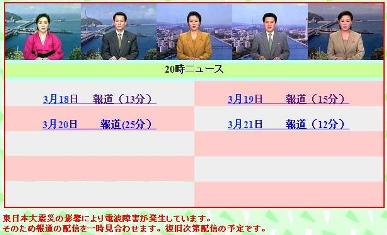
ORIGINAL POST (2011-4-5): Elufa.net is the premier web destination to watch North Korea’s evening news broadcasts.  It has not been updated for several days (appx. March 21).  Today I noticed a message on the screen:

The message at the bottom reads:

東日本大震災の影響により電波障害が発生しています。
そのため報道の配信を一時見合わせます。復旧次第配信の予定です。

Here is the translation via Google Translate:

Interference has occurred due to the earthquake East. Temporary 見合Wasemasu news delivered for that purpose. Delivery will recover soon.

North Korea’s Uriminzokkiri YouTube account is still being updated with other North Korean television footage, but they are not uploading evening news broadcasts.

Share

Is Russia looking for more loggers?

Thursday, March 31st, 2011

According to ITAR-TASS:

According to the head of the Russian delegation, “North Korea has a possibility to send workforce to Russia.” Last year about 32,000 citizens of North Korea worked on the territory of Russia. He noted that North Korea “hopes to increase the number of its citizens working in Russia”.

Of course there has been plenty of media attention given to the North Koreans who work as loggers in Russia (See here, here, here, here, here, here, here, here, here), but they must be a small minority of 32,000 people.

What else are North Koreans doing in Russia? Art showstrade and construction, paying off imports, etc.  There are 5,000 in Vladivostok alone. Leonid Petrov adds more details.

Share

CRS report on Kaesong Industrial Complex

Tuesday, March 29th, 2011

The Congressional Research Service has published an update to its paper on the Kaesong Industrial Complex.

You can download the paper here (PDF).

You can download other CRS reports on North Korea at my CRS Reports Page.

Below is the paper’s summary:

This purpose of this report is to provide an overview of the role, purposes, and results of the Kaesong Industrial Complex (KIC) and examine U.S. interests, policy issues, options, and legislation. The KIC is a six-year old industrial park located in the Democratic People’s Republic of Korea (DPRK or North Korea) just across the demilitarized zone from South Korea. As of the end of 2010, over 120 medium-sized South Korean companies were employing over 47,000 North Korean workers to manufacture products in Kaesong. The facility, which in 2010 produced $323 million in output, has the land and infrastructure to house two to three times as many firms and workers. Products vary widely, and include clothing and textiles (71 firms), kitchen utensils (4 firms), auto parts (4 firms), semiconductor parts (2 firms), and toner cartridges (1 firm).

Despite a rise in tensions between North and South Korea since early 2008, the complex has continued to operate and expand. The KIC was not shut down in 2010 despite two violent incidents between the two Koreas that year: the March sinking of a South Korean naval vessel, the Cheonan, which was found to be caused by a North Korean torpedo, and North Korea’s artillery attack on a South Korean island in November. Indeed, the complex has become virtually the last vestige of inter-Korean cooperation. After the Cheonan sinking, South Korea announced it would cut off all inter-Korean economic relations except the Kaesong complex. It also has reduced the number of South Korean workers—primarily government officials and business managers—at the complex because of worries about them being taken hostage by North Korea.

The KIC represents a dilemma for U.S. and South Korean policymakers. On the one hand, the project provides an ongoing revenue stream to the Kim Jong-il regime in Pyongyang, by virtue of the share the government takes from the salaries paid to North Korean workers. South Korean and U.S. officials estimate this revenue stream to be around $20 million per year. On the other hand, the KIC arguably helps maintain stability on the Peninsula and provides a possible beachhead for market reforms in the DPRK that could eventually spill over to areas outside the park and expose tens of thousands of North Koreans to outside influences, market-oriented businesses, and incentives.

The United States has limited direct involvement in the KIC, which the United States has officially supported since its conception. At present, no U.S. companies have invested in the Kaesong complex, though a number of South Korean officials have expressed a desire to attract U.S. investment. U.S. government approval is needed for South Korean firms to ship to the KIC certain U.S.-made equipment currently under U.S. export controls. The Korea-U.S. Free Trade Agreement (KORUS FTA), which has yet to be submitted to Congress for approval, provides for a Committee on Outward Processing Zones (OPZ) to be formed and to consider whether zones such as the KIC will receive preferential treatment under the FTA. Although the KORUS FTA says that the Executive branch will seek “legislative approval” for any changes to the agreement, Congress’s precise role in accepting or rejecting these changes is not clear.

Another issue raised by the KIC is whether components made in the complex can enter the United States if they are incorporated into products that are manufactured in South Korea and that qualify as originating in South Korea. This possibility is likely to be determined mainly by the KIC’s evolution; the more that is produced in the complex, the more products are likely to enter South Korea’s supply chain.

Share