Archive for the ‘International Governments’ Category

Hanawon

Monday, March 28th, 2011

USA Today published a story on the ROK’s transition program for DPRK defectors, Hanawon (하나원).  There is not much new information in the story, but I wanted to address some of the criticisms the program receives.

Here is the most salient part of the article:

North Koreans who’ve gone through the program say it is helpful but not enough to prepare one for a Western-oriented society after a life in a Stalinist dictatorship cut off from the outside world.

Gwang Il Jung, who attended the program six years ago and runs an advocacy group, Free NK Gulag, says the courses have good intentions but gloss over too many details.

“They will tell you the basics,” he says. “But what can you really learn in three months? How do you teach someone to use an ATM or ride the metro in a classroom setting? The classes need to be more hands-on.”

He says the requirement that North Koreans remain on the school grounds for three months is unhelpful.

“They just got here in pursuit of freedom. And they’re locked in again. It’s like prison for them. All they think about is getting out. Let them live. They’ll make their share of mistakes, but many are eager and able to learn,” Jung says.

The two Koreas share a common heritage and language, but much has changed since the two countries were divided in 1948 after the United States and the Soviet Union agreed to temporarily occupy the country as a trusteeship following the Allied victory in World War II.

The students must complete 130 hours of language courses to get a better grasp of the Southern dialect that has been infiltrated by English and other foreign vocabulary, such as the words “Internet” and “computer,” “chicken” and “phone.”

“They may find a job as a waitress, but if they can’t take orders or understand a command like ‘Go get that key from the cabinet,’ it’s just a matter of time before they’re fired,” Youn says.

Personal finance courses, ranging from basic money management skills to the concept of private property ownership, are also mandatory, as many North Koreans are ill-equipped to handle the sudden exposure to welfare and settlement payments the South Korean government provides.

Stories of defectors falling victim to financial scams or bouts of compulsive shopping are common.

Students take lessons on using computers, child-rearing skills and even hairdressing.

First of all, there is no program that is going to suitably address the individual needs of all the defectors that enter the ROK. Individual capacities, experiences, and needs are simply to heterogeneous for a single government program to address.  This diversity of needs, however, presents a market opportunity for non-profits and education entrepreneurs.   Indeed I can think of  a few organizations that offer “continuing education” to former North Koreans as they adjust to life in their new homes.   So Hanawon should not be criticized for failing to meet all needs of all defectors, it should be seen as simply the first step.

Hanawon also draws criticism in the article for keeping North Korean defectors isolated on campus for three months.  This criticism stems from the fact that Hanawon serves more than one mission.  The first mission is to facilitate the transition of North Korean defectors to their new lives in the south.  The second mission is to facilitate the gathering of information on the DPRK and to protect South Korea (and the North Korean defector community) from infiltration by North Korean agents.  There are now 20,000+ North Korean defectors in the South and some +% of them are active agents.  Given the potentially high and visible cost of failing to catch a North Korean agent, South Korean policymakers have a bias toward preventing type 1 errors (allowing DPRK agents to enter the country).  They try to reduce this cost by extending the amount of time defectors spend under scrutiny while confined at Hanawon.  However, this produces a type 2 error: the unnecessary “holding” of innocent DPRK defectors who just want to get on with their lives.  These particular individuals (the vast majority) have every right to feel “mistreated” by this system, but the only politically feasible way to minimize this cost is to improve the ability of the South Korean security services to detect North Korean agents–something few people are able to do anything about.

It is also worth pointing out that there are quite a few North Koreans that don’t go through Hanawon when they come to the South.  I wonder why that is?

Previous posts on Hanawon here.  Previous posts on North Korean defectors here.

You can read the full USA Today story here.

Share

DPRK economic delegation visits US

Sunday, March 27th, 2011

UPDATE 4 (4/13/2011): The Street adds some more information:

A delegation of 12 North Korean economic envoys flew back to Pyongyang on Sunday after spending two weeks touring companies that “represent main strands of the U.S. economy.”

The group visited Google (GOOG), Home Depot (HD), Bloomberg, Citigroup (C), Qualcomm(QCOM), Sempra Energy(SRE), Union Bank, and Universal Studios, as well as a mushroom farm, a seafood wholesaler, and the Port of Los Angeles, where they leaned about trade infrastructure.

Journalists were not permitted access to the visitors (they entered the Googleplex through a back entrance under tight security), and no mention of the trip appeared in the American media. I stumbled upon the story after striking up a conversation with a DPRK official at the North Korean embassy in Berlin, Germany.

Located on Glinkastraße, an avenue in what was once East Berlin, the North Koreans built an 87,788 square foot compound during the 1970s. After the Cold War ended, staff numbers were significantly reduced, and, according to the surprisingly friendly official I spoke with through the embassy’s rear gate, two of the DPRK’s three buildings were leased out to private companies.

In nearly-unaccented English, he pointed out the main tenant — a youth hostel which opened for business in 2008. Though the North Korean flag flies out front, the decision to become landlords was strictly capitalistic, as years of economic sanctions have taken a tremendous financial toll on the DPRK.

After learning I was an American, the embassy official told me that a group of North Koreans happened to be in the States at that very moment.

Before I could inquire further, he was gone.

One of the few sources providing any details regarding the affair, South Korean newspaper JoongAng Ilbo, managed to obtain a copy of the delegation’s itinerary.

According to the report, “Six director-level officials were in the group, including the delegation’s head, Yon Il, a director at North Korea’s trade ministry. The other directors work for the trade ministry, agriculture ministry, finance ministry and industry ministry.”

Other delegates included lower level North Korean directors and managers, two advisors, and a researcher from a North Korean trade bank.

While Russian news outlet ITAR-TASS maintained that “[T]he initiator of these meetings is unknown,” the North Koreans were in fact invited to the U.S. by Susan Shirk, director of the Institute on Global Conflict and Cooperation at the University of California, “to see firsthand what improved relations with the United States might mean in terms of economic cooperation.”

From 1997-2000, Shirk served as Deputy Assistant Secretary of State in the Bureau of East Asia and Pacific Affairs from 1997-2000, and is the head of the Northeast Asia Cooperation Dialogue, an organization engaged in “track-two” diplomacy.

As described by Tong Kim, a research professor with the Ilmin Institute of International Relations at Korea University and an adjunct professor at Johns Hopkins University’s School of Advanced International Studies, the track-two approach “refers to contact, exchange of views, and other conduit activities between civilian organizations or individuals of two countries that are in dispute with each other.”

An email to Shirk seeking further details of last week’s visit was met with a terse “Sorry, no comment.” But sources say the North Koreans attended lectures at Stanford University and NYU, where they learned about “the market economy, consumer protection, what a CEO does, corporate strategies in the U.S., and an overview of the western legal system.”

This is one of the pillars of the track-two strategy. In “North Korea Inside Out: The Case for Economic Engagement,” a December, 2009 policy paper from an independent task force chaired by Dr. Shirk and Charles Kartman, former director of the Korean Peninsula Energy Development Organization, the case is made that:

The United States should adopt a long-term strategy of economic engagement with North Korea. North Korea’s attitude toward the world is closely related to the underlying structure of its domestic political-economy: a closed, command economy that favors the military and heavy industry and is isolated from the sweeping economic and political changes that have transformed the Asian landscape in recent decades. Encouraging a more open and market-friendly economic growth strategy would benefit the North Korean people as a whole and would generate vested interests in continued reform and opening, and a less confrontational foreign policy. In other words, economic engagement could change North Korea’s perception of its own self-interest. China’s economic transformation stands as an important precedent, showing how a greater emphasis on reform and opening can have positive effects on foreign policy as well. Economic change has the potential to induce and reinforce the D.P.R.K.’s peaceful transition into a country that can better provide for its people’s welfare and engage with other countries in a non-hostile manner.

Some, more hawkish Korea-watchers brush aside track-two diplomacy as a rube’s game being played with a staunchly anti-American entity that already knows far more about the outside world than it lets on.

However, there aren’t many other options in this increasingly unstable era, as a North Korean power handoff from Kim Jong Il to his son, Kim Jong Eun, is said to be in the offing.

Professor John W. Lewis of the Center for International Security and Cooperation at Stanford, who has been involved in track-two negotiations with North Korea since 1986, told the Stanford News Service, “They would definitely prefer to have these talks and meetings with American officials. But since American officials won’t talk to them, we’re the only game in town. We have this weird access.”

A wholesale transformation of the North Korean political-economy would surely reap unprecedented benefits for the world at large. Of course, it would also benefit tremendously the foreign business concerns that manage to be first to market.

In this instance, Susan Shirk’s deep connections in Washington certainly bear mentioning. Shirk is a Senior Director at the Albright Stonebridge Group, a “global strategy firm that helps corporations, associations and non-profit organizations around the world meet their core objectives in a highly competitive, complex and ever-changing marketplace,” which happens to be led by former National Security Advisor Samuel R. Berger, former Senator Warren B. Rudman, and former Secretary of State Madeleine Albright — the first American official ever to visit North Korea.

The company “address[es] challenges for clients in any country, and work[s] with them to develop and implement winning strategies for long-term growth and success” — something that dovetails nicely with the goals of Albright Capital Management, an “emerging markets investment firm” of which Albright Stonebridge is “a significant shareholder” and “strategic partner”, “leveraging collective networks and skills to enhance each firm’s ability to serve as a trusted advisor in the emerging markets.”

The kind of access someone like Madeleine Albright provides cannot be understated.

“We see a lot of potential in emerging markets for economic growth,” Jelle Beenen, a portfolio manager at Dutch investment firm PGGM, told Bloomberg in 2007. “The reason that investing there is always a problem is there are issues like fraud and political instability, so that’s why there’s value in political-risk management and the involvement of Secretary Albright is a valuable one.”

Could the “DPRK 12” be sending a signal that the North “is finally getting serious about introducing more market-based economic reforms?” JoonAng Ilbo asks. “Has the reformist message that China, its closest ally, has been hammering home for years finally gotten across? Or is the envoys’ mission just a conciliatory gesture to try to woo food aid from the U.S. amid a deepening food crisis?”

The short answer is, no one knows.

David Straub, a former Senior Foreign Service Officer who spent 30 years focused on Northeast Asian affairs declined a request for comment, but in a recent paper, asserted that, “The fact of the matter is that no one, not even in Pyongyang, really knows what is going to happen there. I believe there could be dramatic change in the regime in North Korea even as you are reading this, but I also believe it is possible that the regime could last many decades more.”

Henry Rowen, Co-director of Stanford’s Program on Regions of Innovation and Entrepreneurship, Director emeritus of the Shorenstein Asia-Pacific Research Center, and a Senior Fellow at the Hoover Institution who gave a presentation to the North Koreans, said in an email that he knew “very little about the group and its mission,” though he added a caveat that, “My hunch is that it was less significant than you suggest.”

Most optimistic of all seems to be Dr. Siegfried Hecker, former director of Los Alamos National Laboratory (1986-97) and current co-director of Stanford’s Center for International Security and Cooperation.

Hecker, who has been granted access to North Korea’s Yongbyon nuclear complex, told an audience about an experience he had during a recent visit to Pyongyang.

As Hecker entered a subway station in the capital city, he encountered a young man “wearing a backwards baseball cap with a Nike(NKE_) swoosh.”

“When he gets to be 21 years old, they’re gonna have a hard time keeping him down on the farm,” Hecker said.

“Where there is ‘swoosh,’ there is hope.”

UPDATE 3 (4/2/2011): The Delegation spent the day in Silicon Valley touring Google headquarters and attending a talk at Stanford University.  According to Yonhap:

A delegation of North Korean economic officials toured Silicon Valley on Friday, as their rare two-week trip to the United States was heading to a close.

The 12-member delegation, comprising mid-level officials from the trade, agriculture and other ministries, has been in the U.S. since March 19 at the invitation of the Institute on Global Conflict and Cooperation at University of California, San Diego.

The group also had visited New York earlier this week.

On Friday, the North Koreans toured Silicon Valley which included a visit to the world’s largest Internet firm, Google, for about an hour and 40 minutes amid tight security. The delegation got into the building through a backdoor, and security guards restricted journalists from accessing the visitors.

Officials from the San Francisco-based Asia Foundation accompanied the North Koreans.

After the visit to Google, the delegation moved to Stanford University and attended a lunch seminar organized by the school’s Asia-Pacific Research Center.

The two-hour seminar was about industry-university cooperation and also drew well-known U.S. experts on North Korea, such as nuclear scientist Siegfried Hecker and former Defense Secretary William Perry, according to a participant who requested anonymity.

The North Koreans were scheduled to leave for home on Sunday.

It is rare for North Korean officials to visit the U.S. The North and the U.S. fought in the 1950-53 Korean War and have no diplomatic relations. The two sides have also been at odds over Pyongyang’s nuclear programs and a series of provocations.

The Choson Ilbo also covered the visit to Google and Stanford–including a rather funny photo.

UPDATE 2 (3/27/2011): (New York, NY) According to Yonhap:

A delegation of North Korean economic officials arrived in New York on Sunday, saying that they want to explore the possibility of economic cooperation with the United States

The 12-member delegation, comprising mid-level officials from the trade, agriculture and other ministries, flew from San Diego, where they had stayed after arriving in the U.S. on March 19 at the invitation of the Institute on Global Conflict and Cooperation at University of California, San Diego.

The delegation’s trip to New York was organized by the Asia Society.

It is rare for North Korean officials to visit the U.S. The North and the U.S. fought in the 1950-53 Korean War and have no diplomatic relations. The two sides have also been at odds over Pyongyang’s nuclear programs and a series of provocations.

But the trip came amid recent talk of the possibility of the U.S. resuming food aid to the impoverished nation and as former U.S. President Jimmy Carter is preparing to visit the communist nation to broker rapprochement between the two Cold War foes.

“We’re an economic delegation. We’re here to discuss and look for the possibility of economic cooperation between us and the United States,” one member of the delegation said, without giving his name.

Washington has downplayed the significance of the North’s delegation, stressing that their visit is a privately organized event in which the government has played no part.

“Our assessment is that they are not here for talks between the North and the U.S., considering the agencies they belong to and their ranks,” a source here said. “It’s difficult to fathom the real intentions of the North, but for the U.S., it might have seen no reason to reject the North’s delegation coming to learn about the capitalist economy.”

In New York, the North Korean officials are expected to attend an Asian Society seminar and visit media firms and Wall Street. The Asia Society has strictly barred reporters from access to the North Koreans, saying their trip is part of private-level exchanges.

UPDATE 1 (3/26/2011): (San Diego, California)  According to the Joong Ang Ilbo:

A tour bus with black tinted windows pulled up to a hotel in La Jolla, San Diego, at 5:30 p.m. on Monday and from it stepped out 12 strangers from a strange land.

The 12 were so-called “economic envoys” from North Korea who, according to their host, came to learn about American-style capitalism for one week.

Susan Shirk, director of the Institute on Global Conflict and Cooperation (IGCC) at the University of California, San Diego, invited the envoys, all North Korean officials in charge of economic affairs.

The IGCC is one of the United States’ influential, private diplomatic channels for dialogue with the communist country.

The U.S. government calls the envoys’ mission a private trip, but some North Korea watchers are trying to read more into it.

Could it be a signal that the North is finally getting serious about introducing more market-based economic reforms as leader Kim Jong-il searches for substantial achievement to smooth his relinquishment of power to his youngest son Jong-un? Has the reformist message that China, its closest ally, has been hammering home for years finally gotten across? Or is the envoys’ mission just a conciliatory gesture to try to woo food aid from the U.S. amid a deepening food crisis?

One of the 12 North Koreans admitted to JoongAng Ilbo reporters that they came to the U.S. to study the market economy. But none answered why they wanted to.

The attempt to interview them was cut short when the North Koreans got nervous. The reporters only could ask one additional question about whether the envoys knew about the democratic movements in the Middle East.

“We are not deaf,” one replied.

For the week, they will study capitalism at the IGCC building, 10 minutes away from the hotel.

ORIGINAL POST (3/4/2011): According ot the Korea Times:

A North Korean economic delegation will visit San Diego and New York City for two weeks from March 20.

Susan Shirk, director of the Institute on Global Conflict and Cooperation at the University of California, San Diego, invited the ten-member delegation who will learn about Western economic systems and theory during their stay, the Voice of America (VOA) reported.

Between 1997 and 2000, Shirk served as deputy assistant secretary of state in the East Asia and Pacific Affairs bureau, and went to North Korea last year as a director of the institute, to discuss North Korea-U.S. cooperation on a private level.

Read the full story here:
N. Korean delegation to visit NY
Korea Times
Kim Se-jeong
3/4/2011

Share

India and the DPRK: aid and financial safeguards

Sunday, March 27th, 2011

India is providing the DPRK with USD$1m in assiatance via the UN World Food Program.  According to the WFP web page:

The United Nations World Food Programme (WFP) today welcomed a generous donation of US$1 million from the Government of India for its operation to reach the most vulnerable children and their mothers in the Democratic People’s Republic of Korea (DPRK).

In an event organised at the Government of India’s Ministry of External Affairs, Honourable Minister of State for External Affairs Mr. E. Ahmed handed over an official pledge letter to WFP India representative Mihoko Tamamura.

“We are delighted to accept this donation from the government on behalf of the people of India,” said Ms. Tamamura. “As the people of DPRK are coming to the end of one of the bitterest winters in living memory – this act of generosity is extremely timely.”

The donation from India is to be used to buy pulses, rich in protein, which is a key missing ingredient in the daily DPRK diet.

Meanwhile the Reserve Bank of India (India’s Central Bank) has issued a warning to Indian banks regarding North Korean funds.  According to the Business Standard:

Fearing possible money laundering and terror-financing risks from Iran and North Korea, the Reserve Bank of India (RBI) has asked banks and other financial entities to be cautious in dealings with entities and funds from these countries.

The RBI warning follows a fresh global caution notice issued by the Financial Action Task Force (FATF) on Iran and Democratic People’s Republic of Korea.

The FATF is an inter-governmental body responsible for making policies at national and international levels to combat money laundering and terror-financing.

The RBI said the FATF has issued a fresh public statement on February 25, 2011, “calling its members and other jurisdictions to apply counter-measures to protect the international financial system from the ongoing and substantial money laundering and terrorist financing (ML/FT) risks emanating from Iran and the Democratic People’s Republic of Korea (DPRK).”

“All banks and all-India financial institutions are accordingly advised to take into account risks arising from the deficiencies in AML/CFT regime of these countries, while entering into business relationships and transactions with persons (including financial institutions) from or in these countries/jurisdictions,” the RBI said in a March 24 circular.

A similar circular could be issued soon by the market regulator Sebi to warn market entities against their dealings with funds and entities related to these two countries.

An FATF public statement in this regard is always followed up by various regulators in India and other member countries asking the entities regulated by them to exercise extra caution in dealings with countries where anti-money laundering and terror-financing regulations have deficiencies.

The RBI and Sebi had last issued such a warning in January about Iran, pursuant to a directive from the FATF.

India became a member of the FATF last year. Following the nation’s accession into the global body, it is required to follow the global standards prescribed by the FATF to check money laundering and terror-financing activities.

As per the FATF warning, all financial institutions have been advised to give special attention to business relationships and transactions with Iran and North Korea, as well as their companies and financial institutions.

The FATF has urged member countries to take into account the risk of money laundering and terror-financing when considering requests by Iranian and North Korean financial institutions to open branches and subsidiaries.

Iran and North Korea have been subjected to various sanctions by the US and some European countries to thwart the flow of funds allegedly used to finance their nuclear weapon ambitions and sponsor terror-related activities.

You can read the full story here:
RBI warns banks against dealings with Iran, N Korea funds
Business Standard
3/27/2011

Share

South Korean entertainment increasingly popular

Thursday, March 24th, 2011

According to the Daily NK:

The names Kang Ho Dong and Yoo Jae Seok are growing in popularity in urban North Korea now that variety shows hosted by the two South Korean entertainers, KBS show “One Night, Two Days” and MBC’s “Endless Challenge”, are becoming popular there.

One source who trades in Pyongyang said, “I rented ‘X-Men’ (a variety show on another big South Korean station, SBS), the show hosted by Kang Ho Dong and Yoo Jae Seok, from a CD store; it was really entertaining.”

“One of the popular things with Pyongyang elementary and middle school students is the games they can see in this show,” he added.

He noted, “Parents believe the games in X-Men can develop their children’s brains, so they also try to occasionally show it to them. Kang Ho Dong and Yoo Jae Seok are really popular here; we laughed until we cried.”

According to the source, people in Pyongyang do not generally purchase CDs of North Korean products, but rent them for around 500 won each, while illegally-produced South Korean dramas and variety shows are generally 2,000 won each, approximately the price of a kilogram of rice.

Another source from Shinuiju said, “The shows with Kang Ho Dong and Yoo Jae Seok, ‘One Night, Two Days’ and ‘Endless Challenge’ are so popular that they sell for 4,800 won.”

The reason why people like ‘One Night, Two Days’, in which a number of South Korean entertainers, led by Kang, take a trip to little-known South Korean places to camp out, mingle with locals and play a range of games, the source said, is “because people can see a lot of the scenery of South Chosun, as if they were sightseeing for real. It gives comfort to those who are in the situation of being unable to so much as dream of a trip to Chosun.”

There is another background reason for their growing popularity: they are also popular among Korean-Chinese people in the border provinces of China, leading to these illegally copied CDs flowing into North Korea.

In Yanji, Dandong, Shenyang and other Chinese cities with big Korean-Chinese populations, internet cafes have their own servers to download South Korean TV shows so that local people can see them easily at a decent speed.

North Korean or Korean-Chinese smugglers then take illegally copied DVDs or CDs containing the shows into North Korea. One smuggler generally carries between 1,000 and 3,000 recordable CDs or DVDs including such shows into North Korea at any one time.

Another defector, Kim Seong Cheol explained, “I can copy thousands of CDs cheaply and send them to North Korea all at once.”

When he crosses the river, Kim says he ends up giving away a few hundred discs in the form of bribes, and wholesales a few hundred to each North Korean trader.

Read the full story here:
South Korean Entertainers Gaining in Popularity
Daily NK
Park Jun Hyeong and Jeong Jae Sung
3/23/2011

Share

DPRK-EU trade grows in 2010

Tuesday, March 22nd, 2011

According to KBS:

The Voice of America says that North Korea’s exports to the European Union more than doubled year-on-year in 2010 as the communist country exported petroleum products worth 55 million euros to the Netherlands in the first half of last year.

Quoting data from Eurostat, the statistic agency of the EU, the broadcaster said that North Korea’s exports to the EU surged from 50 million euros in 2009 to over one hundred million euros last year.

However, the North’s imports from the EU inched up only about two million euros from 70 million euros in 2009 to 72 million euros in 2010.

I am pretty swamped at the moment.  I did a quick search for the original data source with no success. If you have any idea where to find it, please let me know.

Read the full story here:
NK’s Exports to EU Doubled in 2010
KBS
3-22-2011

Share

ROK Supreme Court rejects ownership claim for property in DPRK

Tuesday, March 22nd, 2011

According to Arirang News (3/22/2011):

The Supreme Court decided Tuesday that South Korean nationals are not eligible to claim ownership of property in North Korea.

A 56-year-old man surnamed Yoo filed a lawsuit, claiming ownership of six lots in the Yeoncheon district of Gyeonggi Province, which is in North Korea, and demanded the court change the land registration back to his name, based on a deed in his ancestor’s name from the early 1900s.

Two lower courts had previously acknowledged the deed and ruled partially in favor of the plaintiff.

But the Supreme Court annulled the decision, saying it is impossible to verify the ownership of the land, since the original land registration was destroyed in the Korean War, restored in 1980 and then discarded in 1991 because the land is north of the Demilitarized Zone.

I am no lawyer or expert in the field of property rights, but my understanding is that when reunification comes property reconciliation will be a nightmare for both Koreas.  Many South Koreans have already prepared the paperwork to reclaim lands confiscated by both the Japanese colonial government and the DPRK government and they are simply waiting to file them.  I imagine there are many North Koreans that have done the same.  No doubt there will be numerous types of claims and remedies—too voluminous to list here.

At a minimum, this case seems to establish the first of many tests for the validity of land reclamation cases: verification.  If a claim cannot be verified in evidence, it will not be honored by the court, and we also have a better idea of what kinds of evidence are not admissible.

Although possessing the right documentation will be important, I can also see all sorts of creative solutions emerging to help establish a claim even for those who lost their land titles long ago–DNA comparisons from family burial plots, to name just one example.

If anyone is aware of any good papers on this topic, please let me know.  There is probably a hefty German literature in this area, though I am not sure how comparable the legal systems are particularly when it comes to the disposition of land.

Some other recent South Korean cases:
1. A South Korean court gave North Korean defectors the right to divorce their spouses in the DPRK so they could remarry.

2. The North Korean children of a deceased, wealthy DPRK defector (who died in South Korea) are suing in a South Korean court for their share of his inheritance.

Share

Kim Jong-il pays respects to memory of Chung Ju-yung

Tuesday, March 22nd, 2011

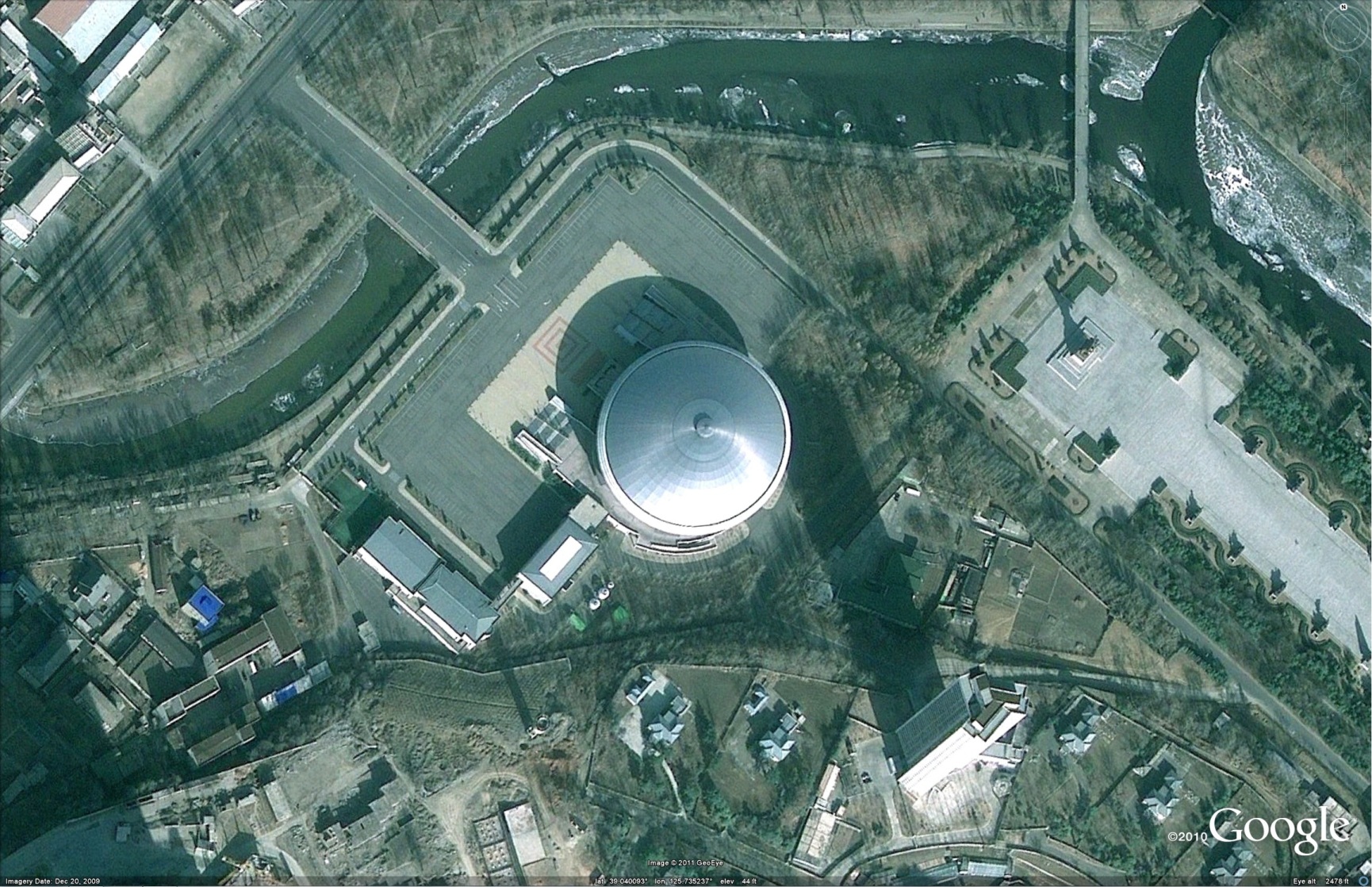
Pictured Above: Chung Ju-yung Stadium in Pyongyang
(Google Earth:  39.040093°, 125.735237°)

According to the Korea Herald:

North Korean leader Kim Jong-il has sent a verbal message to commemorate the 10th anniversary of the death of a noted South Korean industrialist who pioneered cross-border economic projects, the North’s media said Saturday.

Chung Ju-yung, the then chairman of Hyundai Group, initiated a series of major economic projects in North Korea starting in 1998, including a sightseeing tour to scenic Mount Geumgang on the North’s east coast. He died on March 21, 2001.

In the verbal message, the North Korean leader spoke highly of the South Korean industrialist, saying that he did the right thing to promote national reconciliation, the North’s Korean Central News Agency said in a report.

“Chung Ju-yung paved the way for national reconciliation and cooperation and did really a great job for the development of the inter-Korean relations and the sacred cause of national reunification,” the KCNA quoted the leader as saying in the message.

Kim also expressed hope that everything would go well for the Chung family and Hyundai, the KCNA report said.

The report did not say when and how the North Korean leader’s message was conveyed to the Chung family in Seoul. Chung’s eldest son, Chung Mong-koo, heads the nation’s largest automaker, Hyundai Motor Co.

According to the Choson Ilbo:

North Korea has sent a wreath to Hyundai Group to commemorate the 10th anniversary of the death of Hyundai founder Chung Ju-yung.

The wreath that read “In memory of Chung Ju-yung” was delivered from Pyongyang’s Asia-Pacific Peace Committee to Hyundai staffers at the joint-Korean industrial complex in Kaesong.

On Friday North Korean leader Kim Jong-il spoke highly of Chung for his role in paving the way for national reconciliation and cooperation.

Chung initiated various projects with the Stalinist state including the Mt. Kumgang package tours in the North and had sent more than one-thousand cows over the demilitarized zone to North Korea.

The Daily NK also offers some cultural background

Share

69 North Koreans in US military

Tuesday, March 15th, 2011

According to the Rumsfeld Papers there were 69  North Koreans serving active duty in the US armed services in April 2003.

Source here (PDF).

Much more discussion in the comments.

(h/t to a colleague)

Share

Kaesong Complex and ROK goods become harder to find in DPRK

Thursday, March 10th, 2011

According to the Daily NK:

This year, the North Korean authorities have been cracking down on the sale and distribution of products, tools and materials coming out of the Kaesong Industrial Complex. As a result, such Korean goods, formerly an expensive but popular choice in Hwanghae and South Pyongan Provinces, are now hard to find in markets.

A source from South Pyongan Province who spoke with The Daily NK in China explained, “Right up until last year, literally anything being made in the Kaesong Complex was available in the market, including clocks, metal, screws, clothes, underwear, toys and parts of electronics. However, the amounts have fallen dramatically since regulations were strengthened.”

The reason behind the regulations is unclear, however; the source suggested it could only be because of deteriorating inter-Korean relations.

Regardless, the source went on, “Nowadays, revealing the fact you sell those Kaesong Complex goods results in high fines and puts you in a bind” Therefore, he went on, “Only bread (Choco Pies), stainless steel or ceramic bowls and underwear are being sold.”

One consequence of the crackdown is that it makes the sale of other South Korean products smuggled in from China equally difficult. Albeit with some provincial differences, clothes and electronics cannot now be displayed on stalls, and must be sold in alley markets in secret.

A source from Shinuiju explained, “Market watch guards go around markets every day inspecting stalls with no notice; their investigation into South Korean products is really severe.” He explained, “If they find goods with Korean writing on, they confiscate them and give them back after two or three days later, after fines have been paid.”

“I hear there was a decree from above reinforcing crackdowns, but won’t this only lead to bribes?” the source pointed out.

Even when readily available, South Korean products are at the top of the price range, so most average families cannot afford them; one Choco Pie, a circular, individually wrapped chocolate cake made famous by the movie “JSA”, is between 180 and 200 won, a set of women’s underwear is 90,000 won, and a set of roughly ten plates, five or six small bowls and some coffee cups is around 250,000 won.

The source reported, “Due to the severe regulations, some traders sell them at home or in secret, hiding the goods behind the curtain.”

Interestingly, one South Korean official with the Kaesong Industrial Complex told the Daily NK that product leakage is not a problem at Kaesong, saying, “There have been almost no cases of complete products leaking out, but it is possible for stock, tools or things provided to workers like Choco Pies. However, the leaks are not enough to affect factory management.

And yet, one defector who used to be a worker in a shoe factory in charge of testing product quality explained that the siphoning off of materials, complete products, tools and other things is common among North Korean workers.

“The way they hide things and bring them out of the factory is really expert. I sometimes put up to 20 pairs of shoes on my body and came out of the factory. If you wear a long, thick winter coat then it is not so remarkable. Sometimes we did it in collusion with the factory manager.”

Read the full story here:
South Korean Products Disappear from Markets
Daily NK
Park Jun Hyeong and Mok Yong Jae
2010-3-10

Share

Choson Exchange Update

Sunday, March 6th, 2011

From the Choson Exchange web page:

We are looking to build our knowledge pool in the areas of contract negotiations, microfinance and bond markets as there have been requests for knowledge assistance in these areas from Pyongyang. We are told that North Korean firms need to negotiate more effectively with their Chinese counterparts, and require legal training to do so. The fundamentals of micro-finance and bond markets are also of interest to some financial organizations.  We expect initial programs for these areas to take place in April to May this year.

The executive director of Choson Exchange, Geoffrey See, also wrote the following article in the East Asia Forum:

Choson Exchange recently prepared a program for North Korean students to learn business, finance and economics overseas through university courses and internships.

They consulted a range of North Koreans on how it should structure such a program and ‘the Australia National University’ often came back as the model to follow. Up until 2006, ANU hosted North Korean trainees studying economics under programs supported by international and Australian aid agencies. The Australian exchange program was clearly well-regarded by outward-looking North Koreans.

But what would Australia gain from such programs?

A resolution to the constant series of crises on the Korean peninsula is obviously in Australia’s interest. Conflict on the Korean peninsula can destabilize the region and in a worst-case scenario draw China and the United States into a military conflict involving Australian troops. This would cause incalculable harm to the Asia-Pacific economy because of its impact on all the major Northeast Asian economies, not to mention the human cost of conflict. Australia also has long and particular historical interests in commerce with North Korea.

There are some things that Australia can facilitate for North Korea which is in their mutual interest, but which neither the United States nor South Korea can provide anytime soon. The opportunity for North Korean students to study economics, business or law in Australia in long-term university programs is one such crucial shared interest. Yet such programs are currently impossible because of autonomous sanctions in place since 2006 that deny visas to visiting North Koreans. This policy is counter-productive. It trades off the ability to shape longer-term outcomes on the Korean peninsula for short-term public displays of opprobrium. The only countries whose sanctions can hurt North Korea are the countries that actually trade with it. This policy is also unusually harsh of Australia. The United States takes a more nuanced stance by allowing visits by North Koreans for some purposes while publicly preventing political delegations to express its political support for US allies, chiefly South Korea. Similarly, Australia can publicly express its disapproval of current North Korean activities alongside efforts to develop exchanges that shape a future that goes beyond the present stalemate.

These educational exchanges provide Australia with an effective way to shape longer-term dynamics on the Korean peninsula. One way the Korean crisis will end peacefully is when North Korean elites calculate that benefits of economic integration with the rest of the world are great enough to make the costs of confrontation unsustainable. Overseas education can shift this cost-benefit calculus because it equips a new generation of North Korean leaders with the knowledge and the networks to benefit from international trade and integration.

Choson Exchange recently placed a North Korean student in an internship with an international consulting firm. Without such networks, the opportunity would not have materialized. The student also needed coaching on how to explain why his prospective-employer might find value in taking him on. He assumed that a good score on an international English test was the qualification he needed even though most selective employers see fluency as a minimum threshold, rather than a core selling point. This experience helped us see things from the North Korean perspective: there are hardly any commercial benefits to speak of when one lacks knowledge and networks to realize those benefits.

Now is the time to help build this knowledge and network base. North Korea has been active over the past year setting up institutions to promote economic development. This includes the State General Bureau of Economic Development, the Daepung Group, and the State Development Bank. Choson Exchange has led finance workshops with the State Development Bank, and Bank managers agree that training is needed and appreciated. By helping to educate the next generation of North Korean businessmen, economists, financiers or lawyers who will eventually fill these institutions, Australia can play a role in shaping these emerging institutions in North Korea, institutions that could have important ramifications for how North Korea interacts with the rest of the world in the future.

Australia has the opportunity to redefine how such exchanges are conducted. To maximize impact in developing institutions in Pyongyang, we need to think in terms of a “talent pipeline.” We need interlinked programs targeted at different age-groups: training workshops targeting senior or middle management at these institutions, overseas scholarships targeted at university students or recent graduates, and a way to bring both groups together to help maximize opportunities for scholarship recipients to move into the emerging institutions.

Australia has the base from which to take initiatives with North Korea. The North Korean institutions that are looking outwards explicitly seek to build on what has been done with Australia, and specifically through the Australian National University program for training in economics. A comprehensive settlement of the Korean problem is much more likely if we begin again to put this infrastructure in place and help with institutional development in North Korea.

Share