Archive for the ‘International Governments’ Category

Orchestras may visit North, U.S.

Sunday, August 26th, 2007

Joong Ang Daily
Jin Se-keun
8/27/2007

A U.S. orchestra may visit North Korea while Pyongyang sends its own orchestra to the United States, an official of a Hong Kong-based company said yesterday.

Bae Kyeong-hwan, vice president of Daepung Investment Group, told the JoongAng Ilbo that his company has been authorized by the North’s Culture Minister, Kang Neung-su, to schedule and plan the events.

“We contacted the New York Philharmonic orchestra first, but if its schedule does not permit, the Boston Philharmonic or the Philadelphia Philharmonic could be an option,” Bae said.

The New York Philharmonic earlier confirmed that it has been invited to visit North Korea, but has not yet made an official decision.

After a performance in Pyongyang, the U.S. orchestra may return via South Korea, crossing the inter-Korean border at Panmunjeom Village, Bae said.

The North’s National Symphony Orchestra will then return the visit by going to the United States for a performance, according to Bae.

He claimed that negotiations for these reciprocal visits have been worked out by Christopher Hill, Washington’s chief negotiator to the six-party talks, and his North Korean counterpart Kim Gye-gwan.  

North invites the New York Philharmonic
Joong Ang Daily
Brian Lee
8/16/2007

It’s up to the New York Philharmonic orchestra to decide whether it will accept an invitation to perform in North Korea, a U.S. State Department spokesman said Tuesday.

“We’ll consider it,” Eric Latzky, the orchestra’s director of public relations, told Agence France Press. “We received an invitation to perform in Pyongyang through an independent representative on behalf of the ministry of culture of North Korea.”

Latzky said the request, which had just been received, was “unusual” and that the orchestra would consult with Washington before making any decision. Furthermore, Latzky said, any such visit would come as part of a tour in the region.

The Philharmonic is scheduled to play in China in February 2008.

When asked whether such a visit was feasible, U.S. State Department spokesman Sean McCormack said, “I think it’d be fully up to them whether or not they accept such an invitation. As for the details of being able to go there and whether there’s any compensation, that sort of thing, those are probably technical details.”

Financial sanctions and restrictions regarding arms, missile and nuclear technology are in place under a United Nations resolution adopted last year in the aftermath of a nuclear test by the North, but there are no restrictions on travel to the North by ordinary U.S. citizens.

But despite the symbolic meaning the orchestra’s visit could have, McCormack said he suspected it would only play for Pyongyang’s elite. “Whether or not your average North Korean gets an invitation if the New York Philharmonic’s in Pyongyang, I have my doubts about that.”

North Korea interested in inviting New York Philharmonic
Korea Herald

8/13/2007

North Korea has shown interest in inviting the New York Philharmonic to perform in its capital, Pyongyang, apparently as part of its efforts to improve ties with the United States, sources here said Sunday, according to Yonhap News Agency.

During a meeting of six-party nuclear disarmament talks in Beijing in July, U.S. envoy Christopher Hill met his North Korean counterpart, Kim Kye-gwan, and proposed that the two countries start civilian exchanges as part of confidence-building measures, said the sources who spoke on condition of anonymity.

Kim responded positively, saying that his government has already thought about such exchanges and would be interested in inviting the New York Philharmonic, according to the sources.

Eric Latzky, spokesman for the New York-based philharmonic, told Yonhap News Agency that he was unaware of any invitation by the North but said discussions were under way with South Korea for a performance tour there.

Share

N. Korea building fences along border with China: sources

Saturday, August 25th, 2007

Yonhap
8/25/2007

North Korea has started building fences along its border with China in an apparent attempt to forestall defections of its hard-pressed citizens, local residents said Sunday.

The move comes amid growing international criticism of China which sends back home North Korean border trespassers under an agreement with Pyongyang.

Some human rights activists have been pressuring Beijing not to repatriate North Korean refugees, threatening to launch a campaign to boycott the Beijing Olympics in 2008.

About a month ago, North Korean workers were spotted erecting wire fences along a 10-kilometer area near a narrow tributary of the Yalu River, a major border-crossing point, local residents said.

China already built fences along its side of the border late last year.

“North Korea started building a dike early this year and building posts about a month ago,” one resident said.

An increasing number of North Koreans are fleeing their impoverished communist homeland, hoping to defect mostly to South Korea. Some of them travel as far as Vietnam and other Southeast Asian countries via China for safe passage to South Korea.

More than 10,000 North Korean defectors have so far arrived in South Korea amid reports that up to 300,000 North Korean refugees are roaming in China on their way to South Korea and other countries away from their impoverished homeland.

Share

S. Korea sends emergency aid to N. Korea for flood recovery

Friday, August 24th, 2007

Yonhap
Sohn Suk-joo
8/23/2007

South Korea made Thursday the first delivery of 7.1 billion won ($7.5 million) worth of emergency aid to North Korea to help the communist country recover from flood damage, officials said.

About 40 truckloads of instant noodles, blankets, emergency kits and mineral water were delivered to the border town of Kaesong via a reconnected road in the western section of the Korean Peninsula. The aid shipment will be completed by the end of this month.

On Tuesday, Pyongyang requested more help from the South, and the Seoul government is considering what to offer in response to the North’s plea for construction materials and heavy equipment, they said.

Devastating floods are believed to have destroyed a revised 14 percent of the North’s farmland, South Korean officials said. South Korea, other countries and international agencies are extending a helping hand to the North.

The number of dead and missing is estimated at more than 300, with the homeless numbering about 300,000. An estimated 46,580 homes of 88,400 families were destroyed or damaged, according to the North’s media.

“The total damage would be 10 times more than that of last summer in terms of money,” Cho Yong-nam, chief of North Korea’s flood damage control committee, said in an interview with the Choson Sinbo, a Japan-based pro-North Korean newspaper which usually reflects the views of the communist country.

The severe flood damage caused the two Koreas to postpone their second summit, originally scheduled for late this month, until early October. Their leaders are to meet Oct. 2-4 in Pyongyang.

According to North Korean officials, the expressway linking Pyongyang and Kaesong has been damaged by the heavy flooding, interfering with transportation. Roh plans to travel to Pyongyang via the overland route, and South Korean officials expressed hope that the expressway will be repaired before the summit takes place.

Share

N. Korea’s powerful commission in vanguard of flood recovery operations

Wednesday, August 22nd, 2007

Yonhap
Sohn suk-joo
8/22/2007

North Korea’s most powerful organization is leading efforts to clean up damage from heavy floods and restore the country’s infrastructure, the North’s state media reported Wednesday.

The National Defense Commission (NDC), the highest decision-making body under the communist country’s constitution that was revised in 1997 to reflect its “songun” or military first policy, supervises relief operations involving military forces and equipment.

“We’ve achieved recovery and restoration by appealing to party, government and labor officials to go out to damaged areas under the guidance of the National Defense Commission,” Kim Kyong-san, a senior official of the Pyongyang Railway bureau, said in an interview with Radio Pyongyang.

According to North Korea watchers, North Korea’s cabinet has usually spearheaded flood relief efforts in the communist country in the past. The NDC’s involvement signifies the extent of the damage and is also meant to speed up restoration ahead of the summit between President Roh Moo-hyun and North Korean leader Kim Jong-il, who leads the commission, they said.

Meanwhile, North Korea is in the final stages of restoring the railway line in Pyongyang.

“The Pyongyang railway line is fundamental in connecting the country to the east and west. All workers have labored hard and are urged to do more at the final stage,” Kim Kyong-san said.

Devastating floods are believed to have destroyed a revised 14 percent of the North’s farmland, South Korean officials said. South Korea, other countries and international agencies are extending a helping hand to the North.

The number of dead and missing is estimated at more than 300, with the homeless numbering about 300,000. An estimated 46,580 homes of 88,400 families were destroyed or damaged, according to the North’s media.

This year, South Korea is providing 400,000 tons of rice to the North, while it plans to send 7.1 billion won (US$7.5 million) worth of relief goods to North Korea.

On Tuesday, Pyongyang requested more help from the South, and South Korea is considering what to offer in response to the North’s plea for construction materials and heavy equipment.

The severe flood damage caused the two Koreas to postpone their second-ever summit, originally scheduled to be held late this month, until early October. Their leaders are to meet Oct. 2-4 in Pyongyang.

According to North Korean officials, the expressway linking Pyongyang and Kaesong has been damaged by heavy flooding, interfering with transportation. Roh plans to travel to Pyongyang via the overland route, and South Korean officials expressed hope that the expressway will be restored before the summit takes place.

Share

U.N. agency may have hit back at N.Korea whistleblower

Monday, August 20th, 2007

Reuters
Patrick Worsnip
8/20/2007

The U.N. ethics office found evidence that the United Nations Development Program retaliated against an employee who tried to expose its alleged wrongdoing in North Korea, a letter leaked on Monday said.

The letter sent on Friday by the office to UNDP chief Kemal Dervis is likely to lend fresh ammunition to the United States in a long-running dispute with UNDP over its North Korean operations, centering on claims of financial irregularities.

The agency has denied that it fired Artjon Shkurtaj, a native of Albania with Italian citizenship who was head of UNDP’s operations in North Korea from 2005-2006, because of his criticisms. It says his contract was not renewed.

The case came before the Ethics Office because Shkurtaj applied for U.N. whistleblower status under a two-year-old directive. But the office cannot launch a formal investigation without UNDP’s agreement because, as an agency with its own executive board, UNDP does not come under its jurisdiction.

In his letter, Ethics Office director Robert Benson told Dervis that the evidence it found would have supported a case against the UNDP if jurisdiction had applied.

UNDP has decided against waiving its right not to be investigated by the Ethics Office, but Benson urged the agency to do so, saying: “I believe this would be in the best interests of the United Nations and UNDP.”

His confidential letter first appeared on the Web site of Inner City Press, an independent blog on U.N. affairs.

The United States accuses UNDP of sloppy accounting, handing over cash to North Korean bodies without proper documentation and hiring staff hand-picked by the communist Pyongyang government.

OUTSIDE REVIEW

A U.N. audit published on June 1 said rule breaches had occurred but did not find systematic diversion of U.N. funding. UNDP quit North Korea in March after Pyongyang refused to accept changes ordered by its board of directors.

UNDP and U.S. officials have been unable to agree how much money Pyongyang, whose nuclear program has for years been the subject of international concern, received from UNDP.

Some of Washington’s information came from Shkurtaj, who has said publicly that UNDP violated “multiple rules and regulations” and engaged in “criminal conduct” in North Korea.

UNDP spokesman David Morrison told a news conference last month that Shkurtaj had been invited to submit evidence to back up his allegations but had so far not done so.

He admitted that UNDP barred Shkurtaj from entering the U.N. compound in New York after his contract expired in March, even though his U.N. pass was still valid.

Instead of agreeing to be investigated by the Ethics Office, UNDP has opted for an outside review — yet to be set up — that would look simultaneously at Shkurtaj’s allegations and other aspects of UNDP’s North Korea operations.

“UNDP believes that having multiple processes reviewing related or identical issues would not be the most effective way to achieve closure of this matter,” agency spokeswoman Christina LoNigro said.

U.N. spokeswoman Michele Montas said Secretary-General Ban Ki-moon was “very much concerned about this whole issue,” including the fact that Ethics Office jurisdiction did not cover UNDP, which has no such office of its own.

“There is no doubt that the Secretary-General is going to discuss ways of filling” the gap, she told a news briefing.

Share

US provides 100,000 dollar flood aid to North Korea

Friday, August 17th, 2007

AFP
8/17/2007

The United States is providing 100,000 dollars in humanitarian aid to flood-stricken North Korea, the State Department said Friday.

The US Agency for International Development (USAID) would provide 50,000 dollars each to two US non governmental organizations operating in North Korea — Mercy Corps and Samaritan’s Purse, department spokesman Sean McCormack said.

“The intention is that the money would be used to provide blankets, shelter materials, water containers and other supplies to those in need,” he told reporters.

Almost 300 people were dead or missing in the North Korean floods, according to an aid agency quoting official figures in the nuclear-armed hardline communist nation.

Official media in the reclusive state has painted a grim picture of inundated crops and homes, flooded factories and mines and washed-out roads.

UN agencies said on Friday that half of North Korea’s main health centres have been submerged by floods and warned that the situation in the country could deteriorate unless aid arrives rapidly.

The United States, together with China, Russia, Japan and South Korea, have promised to provide the North Koreans aid and security and diplomatic guarantees if it scraps its nuclear weapons program.

But any flood relief provided by the United States would not be linked to a planned gradual shipment of one million tonnes of fuel or its equivalent to North Korea if it completely dismantles its nuclear weapons program, McCormack had said.

North Korea has already got 50,000 tonnes of fuel aid for closure of its key nuclear reactor under the six-party nuclear talks.

Share

S. Korea to provide US$7.5 million worth of emergency aid to N. Korea

Friday, August 17th, 2007

Yonhap
8/17/2007

South Korea is to send 7.1 billion won ($7.5 million) worth of emergency aid to North Korea next week as part of efforts to help the communist country recover from the damage wreaked by recent heavy rains, the South’s point man on the North said Friday.

“We will prepare to send emergency aid to North Korea early next week,” Unification Minister Lee Jae-joung said in a press briefing, noting that the aid will consist of instant noodles, bottled water, powdered milk, blankets and medicine.

Lee said that South Korea will also discuss ways of sending equipment and additional aid needed to overcome the damage in the North after transporting the emergency aid via inter-Korean sea and land routes.

International aid agencies are also trying to help the North to cope with floods that have swept away a large part of its farmland, raising the specter of worsening food shortages.

North Korea allowed the United Nations World Food Program (WFP) to send four assessment teams Friday to areas struck by the flash floods.

On Thursday, the North’s state media said that about 46,580 homes had been flooded or destroyed, while more than 300,000 people were displaced. North Korean officials told international aid agencies that at least 200 people were dead or missing.

WFP officials will travel Friday to 10 hard-hit counties to assess the situation, hoping to start emergency food aid using supplies already in the country as part of ongoing hunger relief efforts.

South Korean President Roh Moo-hyun is to meet with North Korean leader Kim Jong-il on Aug. 28-30 in Pyongyang, the first summit in seven years. The floods are not likely to have an impact on the summit, South Korean officials said.

Share

Business leaders vying for chance to go North

Friday, August 17th, 2007

Joong Ang Daily
Lee Min-a
8/17/2007

Plenty of corporate leaders came along for the last inter-Korean summit, and the jockeying for which leaders will be selected this time has begun.

The Blue House said yesterday that it is looking for people who could play a substantial role in boosting North Korea’s economy.

“We don’t have any rule that says to exclude corporate leaders who went to Pyongyang last time, but we are hoping the new list will, if possible, first be filled with people who are already involved in North Korean businesses or who can play a substantial role in making investments there,” said Cheon Ho Seon, the Blue House spokesman.

About 200 people are expected to be in the entourage, up from 180 last time. The number of business leaders is expected to grow, too.

In 2000, corporate leaders going to Pyongyang included LG head Koo Bon-moo, then-SK head Son Kil-seung, late Hyundai chairman Chung Mong-hun, Samsung vice head Yun Jong-yong, then-Kohap head Chang Chi-hyeok and Rinnai Korea head Kang Sung-mo.

The Blue House is planning to invite corporate leaders to a financial seminar this week to discuss ways to help the North.

Share

Flooding news

Thursday, August 16th, 2007

Youtube video of the flooding 
KIS square.jpg

North Korea: Deadly Rains Ruin Big Part Of Farmland
Washington Post

Burt Herman
Associated Press
Thursday, August 16, 2007; A11

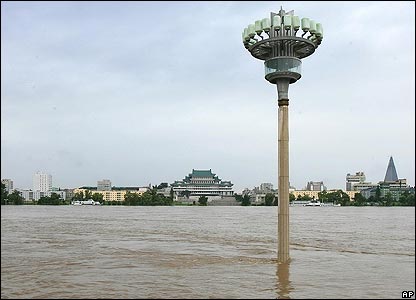
North Korea on Wednesday detailed the devastation caused by some of the country’s heaviest-ever rains, saying more than one-tenth of the impoverished country’s farmland had been wiped out during peak growing season.

The North Korean government reported that hundreds of people were killed or missing in this month’s floods, with as many as 300,000 left homeless.

Footage from Associated Press Television News showed citizens working to rebuild roads, clear debris and shore up sandbags along rivers in flood-affected areas outside Pyongyang, the capital. Video images also showed a farmhouse that appeared to have been swept down a hillside by the rain.

If the government’s numbers on agricultural damage are confirmed, the destruction would be about one-quarter of that suffered in massive flooding in 1995. That disaster, coupled with outdated farming methods and the loss of the country’s Soviet Union benefactor, sparked a famine that is estimated to have killed as many as 2 million people.

The vivid portrait of damage, in reports from the North’s state-run media, appeared to be a cry for help from a desperate government that maintains strict secrecy of its internal affairs. But the North has previously exaggerated the extent of disasters to obtain aid and to cover up ineptitude in providing for its people in a centrally controlled economy.

The official Korean Central News Agency reported Wednesday that downpours along areas of the Taedong River were the “largest ever in the history” of measurements taken by the country’s weather agency.

An average of 20.6 inches of rain fell across the country from Aug. 7 through last Saturday, 2.1 inches more than downpours in August 1967, KCNA said.

The recent rains have submerged, buried or washed away more than 11 percent of rice and corn fields in the country, KCNA reported, citing Agriculture Ministry official Ri Jae Hyon. “It is hard to expect a high grain output owing to the uninterrupted rainstorms at the most important time for the growth of crops,” KCNA said.

The U.N. World Food Program estimated that the amount of damage the North Koreans reported to their fields would result in losses of about 450,000 tons of crops — adding to the 1 million ton annual shortage that the country already faces.

The amount is less than the 2 million tons that the North said was lost in the 1995 floods at the start of the famine, said Paul Risley, a spokesman for the U.N. agency. “Nonetheless, this would be an extremely serious reduction in the amount of the harvest,” he said.

The North is especially vulnerable to the annual heavy summer rains that soak the Korean Peninsula because of a vicious cycle in which people strip hillsides of natural vegetation to create more arable land to grow food, increasing flood risks.

U.S. Assistant Secretary of State Christopher R. Hill said the U.S. government was considering how it could help the North Koreans.

The disaster reports precede a planned summit this month between leaders of the two Koreas. South Korea’s government has been criticized by opponents at home and abroad for having given unconditional aid to the North during an international standoff over the communist state’s nuclear weapons program.

Aid was already expected to be a key topic at the summit. Marcus Noland, senior fellow at the Washington-based Peterson Institute for International Economics, said the latest disaster gives Seoul justification to expand assistance to its neighbor.

North Korea’s flooded ‘rice bowl’
BBC

8/16/2007

The UN World Food programme’s acting country director, Michael Dunford, has just returned from a visit to one of North Korea’s flood-affected areas, in the south of the country.

He told the BBC news website what he saw and how the floods are affecting a country already dependent on food aid.

“We went to Sogon, driving for about two hours to get there, and we saw extensive examples of flooding as we went down, with widespread inundation of arable lands which, of course, creates concerns as regards the long-term food implications.

We have been told by the government that the Kangwon province is one of the areas that is worst affected. The impression we are getting is that there is severe damage throughout the southern half of the country, across to the east.

The southern part of the country is the main food-producing area. As you go further north it is more mountainous and hence their ability to produce is limited.

The area that has been inundated is part of the ‘rice bowl’, hence this creates additional concerns as to what impact that may have.

We estimate that annually there is a food deficit of about a million tons of cereals – that’s maize and rice. So, in the past, North Korea has relied on bilateral, from China and South Korea predominantly, and also and multilateral support through the World Food Programme.

Collapsed houses

Last year, the amount of food that entered the county did not meet the food gap and hence we were concerned about the implications that was going to have for food security in the country and potentially the impact that may have on the most vulnerable.

Certainly for them to have the floods this year is only going to exacerbate the already food insecure situation in the country.

People are managing as best they can. We understand from the government that those who have lost their homes are now residing in either their place of work or some form of community shelter – either a schools or nursery, we expect.

We were dealing with local officials. They tell us that the waters have inundated houses, houses have collapsed, factories have been completely inundated and roads and bridges have been washed away. Certainly the impression we are getting is that this is very severe flooding.

We saw bridges that were knocked down, we saw roads that had been washed away. The infrastructure is typically old and anything that damages it further is going to have implications.

Wiped out

The landscape in the southern area is a combination of flatlands with quite dramatic mountains, there are fields with hills and mountains shooting up.

There are small villages and co-operative farms. These are very rudimentary houses – typically handmade.

People may have a small plot in the front of the house in which they try to grow their own vegetables – potatoes, beans, carrots, tomatoes – they are then surrounded by more extensive farmlands which have been damaged by flooding.

In one area, we were looking at what we thought was a river running through a field of maize but it was in fact the offshoot of a flooded river. Crops have just been wiped out.

We also saw a lot of areas that were completely underwater, knowing that the rice would not be able to recover.

This is the period of pollination and, hence, because the rice is underwater during this period, it won’t germinate and hence won’t produce for the harvest due in September-October.

N Korea floods devastate farmland
BBC

8/15/2007

Severe flooding in North Korea has destroyed more than one-tenth of the country’s farmland, according to the state news agency KCNA.

“As of 14 August, more than 11% of rice and maize fields were submerged, buried or washed away,” Ri Jae-Hyon, director of the Ministry of Agriculture, said.

Government officials also told aid workers in the region that 300,000 people may have been left homeless.

Aid teams visiting the area warned of a need for emergency shelter and food.

“Going forward, the crop damage is of major concern,” Michael Dunford, of the UN World Food Programme, told the BBC.

He added that he had been to see some of the damaged areas, and described the situation as “pretty grim”.

Food aid

“Areas of the capital, Pyongyang, have been inundated,” he said, “but certainly as you move out into the countryside there is widespread damage, and it is going to have a negative impact on DPRK [North Korea] most certainly.”

North Korea already suffered from severe food shortages, even before the floods.

About two million people are thought to have died from famine in the mid-1990s in North Korea, and the country remains dependent on foreign food aid.

United Nations Secretary General Ban Ki-moon has ordered a full evaluation of the needs of North Koreans and has promised assistance to the communist nation.

“I assured him that the United Nations will be prepared to render whatever possible humanitarian assistance and help to the DPRK (North Korean) government and people overcoming this difficulty,” he said after a meeting with North Korea’s UN envoy Pak Gil-yon.

The US and South Korea have both said that they would consider sending aid.

‘Huge damage’

North Korea made the rare plea for help after it announced late on Monday that storms since 7 August had led to “huge human and material damage”.

State news agency KCNA said hundreds of people were dead or missing.

Many areas were affected but worst hit were the three provinces of Kangwon, North Hwanghae and South Hamgyong, it said.

Television pictures from the capital Pyongyang showed people wading along streets through thigh-deep water after rivers burst their banks.

These floods are thought to be worse than the ones that hit last year. Hundreds of people are thought to have died in August 2006, but exact figures are not known.

Heavy rainfalls render 17,000 North Koreans homeless
Yonhap
8/15/2007

Hundreds of people were killed or missing in North Korea in heavy downpours that battered the impoverished communist country last week, a North Korean official said in a report on Wednesday.

The downpours, which flooded even the center of its capital, Pyongyang, and wide sections of the country’s western region, also left about 17,000 people homeless, said the official from Pyeongan Province in a report carried by Pyongyang Radio. 

South to Help North Recover From Floods
Korea Times
Jung Sung-ki
8/14/2007

South Korea is considering sending relief supplies to help the North recover from severe flooding, the Ministry of Unification said Tuesday.

Hundreds of people are dead or missing in North Korea following week-long torrential rain that has destroyed thousands of houses, and damaged roads and railway tracks, the North’s state media reported.

“North Korea seems to be suffering a greater loss of lives and property than it did during July’s flooding last year,” Seo Sung-woo at the ministry’s intelligence analysis bureau told reporters.

“I don’t think the inter-Korean summit will be affected by the floods. However, if the rains continue, it is hard to predict,” said Seo.

In 2006, monsoons rains hit much of the impoverished state, killing hundreds of people.

Floods in July that year left over 500 people dead and nearly 300 people missing, according to the Chonson Sinbo, a Japan-based pro-North Korean newspaper.

In the following month, Seoul sent $82 million worth of aid to Pyongyang. The South provided the North with 100,000 tons of rice and cement, five tons of iron, construction equipment, 80,000 blankets and 10,000 emergency kits, according to the ministry.

The North’s official Korean Central News Agency said this year’s heavy rain destroyed at least 30,000 homes of 63,300 families, and more than 540 bridges and sections of railway.

The agency said heavy downpours had caused “huge human and material damage.” Many parts of the country received between 30 and 67 centimeters of rain from Aug. 7 to 12, it said.

Gangwon Province was hit the hardest, with more than 20,000 homes damaged or destroyed.

Pyongyang and neighboring provinces including South Hwanghae and South Pyeongan were also badly affected, according to the report.

Experts blamed decades of reckless deforestation for North Korea’s flood problems, saying the country has been stripped of tree cover that provides natural protection.

The International Federation of the Red Cross (IFRC) emergency operations staff is on a 24-hour alert to monitor flood damage in North Korea and has distributed aid kits to some 500 families, its Web site said.

“People have been evacuated and brought to safety,” it said, and county governments are “appealing to cooperative farms to donate emergency food for homeless people.”

International Red Cross goes on alert in North Korea on flood damage
Yonhap

8/13/2007

The International Federation of Red Cross (IFRC) emergency operations staff is on a 24-hour alert to monitor flood damages in North Korea and has distributed aid kits to some 500 families, its Web site said Monday.

A bulletin dated Sunday said the torrential rain that started Aug. 5 has caused serious flooding in many parts of North Korea.
“People have been evacuated and brought to safety,” the IFRC Web site said, and county governments are “appealing to cooperative farms to donate emergency food for homeless people.”

“Warnings of high tides have been issued on national television. Indeed, weather forecasts predict continued heavy rains until Aug. 17.”

The Red Cross emergency operations room is on a 24-hour alert, it said, with its staff in the field assessing damage.

In a rare admission of a crisis, North Korea’s state run news agency said Monday the downpour so far has left hundreds of people dead or missing and destroyed more than 30,000 homes for 63,300 families.

The Korean Central News Agency said hundreds of public buildings, bridges and railway sections also were destroyed.


Share

The gentle decline of the ‘Third Korea’

Thursday, August 16th, 2007

Asia Times
Andrei Lankov
8/16/2006

By Chinese standards, the city of Yanji is rather small, with a population of nearly 400,000. About a third of them are ethnic Koreans: Yanji is the capital of Yanbian autonomous prefecture in the northeastern province of Jilin.

From the first few minutes in Yanji it does not feel completely like China. The streets and shops have signs both in Korean and Chinese, the people (well, many of them) speak Korean among themselves, and restaurants advertise dog meat, a traditional Korean delicacy. But it also feels different from South and North Korea. Yanji is much too poor if compared with the South and much too rich if measured against meager North Korean standards.

The Korean migration began as a trickle in the 1880s, and by the early 1920s it had developed into a large flow. Some of those settlers fled the persecution of the Japanese colonial occupiers at home, but many more were attracted by lands easily available to migrant farmers in what then was known as Manchuria.

An overwhelming majority, some 80%, came from the areas that after 1945 became parts of North Korea. During the Chinese Civil War, most local Koreans sided with the communists, and this helped boost their standing after 1949. The local Koreans were officially recognized as a “minority group”, and in 1952 the entire area was made into an autonomous prefecture, with the Korean language co-official with Mandarin.

Yanbian is a large area, roughly half the size of South Korea, but its current population is merely 2.2 million. South Korea has 48 million people, so the density of population in Yanbian is remarkably low. Indeed, while traveling through the area one can drive for few kilometers without encountering any signs of human settlement – a picture that is unthinkable in most of South Korea or coastal China.

In 1945 about 1.7 million Koreans lived in China, overwhelmingly in its northeastern area. About 500,000 of those chose to move back to Korea in the late 1940s, but a million or so decided to stay. Nowadays, the Korean population has reached 2 million, of whom some 800,000 reside in Yanbian.

Economically, the area has not been very successful – perhaps because it is landlocked, so the import-oriented development strategy does not really work there. The breathtaking economic growth of the past two decades in the country as a whole has changed the looks of the local cities and towns, but Yanbian is still poor by contemporary Chinese standards. Sometimes in the villages around the city one can even see a derelict hut with a thatched roof – a sight that is almost impossible to see more prosperous areas of China. Still, changes are everywhere: the old gray buildings of the Mao Zedong era are being demolished and giving way to new, posh apartment complexes. Construction is everywhere, the number of hotels is astonishing, and good roads criss-cross the area, though motor traffic is still very thin.

Beijing’s policy toward ethnic Koreans has always been somewhat contradictory. On one hand, the Chinese central government follows the Leninist principles it learned from the Soviet Union. According to these principles, the ethnic minorities should be given manifold privileges, often at the expense of the majority group.

Indeed, this is frequently the case with the ethnic Koreans. But there were periods of unease and even open persecution, especially in the crazy decade of Mao’s Cultural Revolution beginning in 1966. A middle-aged ethnic-Korean businessman told me, “Back in the late 1960s, I seldom saw my parents. Because they were members of an ethnic minority, they had to go to ideological-struggle sessions every day and had to stay until very late.”

However, that period was an exception. The same person, who said he is not a fan of the current Chinese system, still admitted when asked about discrimination: “Discrimination? Well, almost none, to be frank. They appoint some Han Chinese officials to supervise the administration, but basically I don’t think Korean people here have problems with promotions or business because of their ethnicity. Sometimes being a minority even helps a bit – it’s easier to get to a university if you come from a minority group.”

It is clear that many Korean community cultural institutions rely on generous subsidies from the central government. The Chinese state sponsors a large network of the Korean-language schools, so until recently nearly all Korean children received secondary education in their ancestors’ tongue. If they wish, they can attend Yanbian University, where ethnic Koreans are given preferential treatment for the entrance exams.

The local television network broadcasts in Korean and the newsstands in the area sell a number of Korean-language periodicals. Some of these publications hardly need sponsorship, since they deal with the ever popular topics of sex, crime and violence, but many others, such as high-brow literary magazines or rather boring local dailies, would go out of business without their state subsidies.

A local law requires every street sign in the prefecture to be written in both Korean and Chinese, and it explicitly stipulates that Korean letters should not be smaller or placed below the Chinese characters. This even applies to advertisements.

The Korean heritage (or rather those parts of the heritage that are deemed politically safe) is much flaunted in the area because it is one of factors that make Yanji attractive to potential tourists. So Korean restaurants are everywhere and local advertisements frequently use images of beautiful girls clad in the Korean national dress or hanbok.

However, it would be a mistake to depict the Chinese policy in the area as an ideal to be emulated. The potential threat of irredentism has never been completely forgotten, and it is an open secret that radical Korean nationalists have dreamed about annexing this area since at least the early 1900s. They often say Yanbian is actually a “third Korea” (the other two being North and South), so it should be included into a Greater Korea that they believe will emerge one day.

Until recently such threats were not much pronounced, since the impoverished and grotesquely dictatorial North Korean regime could not inspire much longing for the lost homeland among the Chinese Koreans. Perhaps most local Koreans share the feelings of a middle-aged Korean with whom I had a long talk in the town of Tumen on the North Korean border. While pointing to the barren hills of North Korea, easily seen from a restaurant window, he said, “I am so lucky that my grandparents chose to get out of that place. I think we all would be dead had our grandfather stayed there. It is such an awful place. I do not understand how they manage to survive in North Korea.”

This seems to be the common feeling toward North Korea. There might be a lot of genuine sympathy, as demonstrated in the late 1990s at the height of North Korea’s great famine, when there was widespread grassroots support for the illegal migrants from that country. However, in most cases the North Korean regime is seen by local Koreans as an object of contempt and ridicule, and its unwillingness to emulate the Chinese example is often mentioned as the major reason for the disastrous situation of the country.

However, in 1992 China established formal diplomatic relations with prosperous South Korea, and soon the Yanbian area was flooded with South Korean business people, missionaries, students and tourists. These people were usually attracted by the opportunities to do business without dealing with a language barrier, but some of them began to preach the nationalist gospel as well. Their work was made much easier by the fact that South Korea came to be seen not as a land of destitution but one of prosperity and opportunity. South Korean nationalists love to stress that the lands of Yanbian once were part of the ancient Korean kingdom of Koguryo that lasted 700 years, from 57 BC to AD 668. Koguryo is presented by them – as well as many other Koreans outside of the area – as the most successful of the three ancient Korean kingdoms.
 
Therefore, Chinese authorities are on guard against this nationalist fervor and ensure that a Korean-language education does not mean an education in the spirit of Korean nationalism. At the Korean schools, children study exactly the same curriculum as their peers in the Chinese-language schools. Their textbooks are exact translations of the Chinese textbooks used at the same levels.

“We are a minority group of China, China is our country, so there is no need to study Korean history or literature,” one ethnic Korean told me. “When they teach national history at our schools, it means the history of China, and China only.”

As a result of this policy, the younger generations of Koreans are increasingly out of touch with their Korean heritage. Ko Kyong-su, a professor at Yanbian university, himself an ethnic Korean, remarked: “Nowadays, the Korean youngsters here do not learn about Ch’unhyang and Hong Kil-dong [characters from Korean classical novels] until they enter college, and only then if they chose to specialize in Korean studies.”

To what extent does this dualistic policy of support and restrictions work? This is a somewhat difficult question, but it seems that the overwhelming majority of the local Koreans indeed see themselves as “hyphenated Chinese”, not as proud overseas citizens of either Korean state. Their loyalties are, in most cases, firmly with Beijing.

Still, it is clear that the ongoing nationalist propaganda produces some response. A number of times my Korean conversation partners inquired whether I had seen the Koguryo remains, and once a woman in her early 30s, a fellow traveler on a train from Yanji to Shenyang, said nostalgically, “Two thousand years ago this used to be Korean land. We were so big then!”

This is not exactly a feeling that Chinese authorities would like to nurture, so it comes as no surprise that in official publications, Koguryo is mentioned as a “minority regime” that once existed as a part of multi-ethnic but unified Chinese nation. This nation, according to Beijing propagandists and court historians, existed since time immemorial.

In spite of all those problems and potential challenges, until recently Yanbian prefecture could be seen as a poster case for China’s “nationality politics”. Indeed, unlike the situation in Russia, Japan or the United States – three other major countries with sizable ethnic-Korean communities – the Korean-Chinese have remained fluent in their ancestors’ language, though they overwhelmingly belong to the third or even fourth generation of immigrants. They are also quite socially successful. If measured by such indicators as life-expectancy and infant-mortality rates, Koreans are the second-most-prosperous ethnic group in China. Their educational achievements are also well above average.

However, nowadays things are not that rosy – at least if judged from Korean nationalist perspectives. Beginning in the mid-1990s, the ethnic Korean population of Yanbian began to shrink, with its share dropping to 36.3% in 2000 (from 60.2% in 1953), and is still falling.

Local Korean schools are being closed for the lack of students, and Korean parents are increasingly unwilling to send their children to the ethnic schools. Until a decade ago, more or less every Korean family chose to educate their children at a Korean school, but this is not the case anymore. The number of children enrolled in Korean schools in 2000 was merely 45.2% of the 1996 level. In the 1990-2000 period, 4,200 Korean teachers, or some 53% of the total, left their jobs because of school closures. This does not mean Koreans are more poorly educated – on the contrary, the past two decades have witnessed a great education boom. But their education is increasingly conducted in Mandarin, not Korean.

Contrary to what many China-bashers want to believe, this process is not a result of some deliberate discrimination or the cunning policies of Beijing. No doubt some Chinese policy planners might feel a bit of relief when they see how a potentially “separatist” area is losing its explosive potential, but it seems they have done nothing to speed up such development. Rather, Koreans are becoming the victims of their own social success.

In the past, the aspirations of the average ethnic Korean was to graduate from a high school, settle down in his or her local village, and become a good farmer who could afford to have rice on the table for every meal. Now, success is increasingly associated with a university degree. However, the university education is in Mandarin, as are the entrance exams. Korean parents know that Chinese-language schooling gives their children better educational advantages.

This process is easy to see even without statistics. It is clear that a large proportion of younger people speak Korean, but it is also clear that many youngsters do not feel too comfortable when communicating in their parents’ tongue, and are happy to switch back to Mandarin at the first opportunity. It was instructive to see two Korean families who sat next to me on a train: the youngsters, in their 20s, spoke Korean to the parents but preferred Mandarin among themselves.

Another part of the crisis is the low fertility rate of the ethnic Koreans. The Koreans’ birth rate has always been lower than that of the Han Chinese, even though, as an ethnic minority, they are exempt from the “one-child policy”. In 2000, the average Korean woman in Yanbian had 1.01 births in her lifetime. This again reflects the higher education levels of the ethnic Koreans: better-educated groups tend to have less children.

Migration is also taking its toll. A large number of ethnic Koreans have moved away from their village communities. Some of them even went to South Korea – either for good, or just to make some money doing unskilled jobs. But for most of them the destinations of choice are the large Chinese cities, such as Shenyang or Beijing. While in the city, Korean settlers tend to maintain close relations with other Koreans, but they still live in a Chinese-language environment, and speak little Korean. The chances of marriage with a Han Chinese are high, and children from such marriages are usually monolingual – Mandarin.

So it seems that the days of the “Third Korea” are numbered. Even the infusion of South Korean money is not enough to reverse the unavoidable process of assimilation. Koreans are not subjected to forced Sinification; they are making a rational choice, even if it is one that Korean nationalists do not approve of. If things continue as such, in a few decades only hanbok-clad girls and the obligatory signs in Korean shops and restaurants will remind one of the Korean community that once thrived in Yanbian. But I hope it will always be a good place to feast on dog meat.

Share