Archive for the ‘International Governments’ Category

Lifting US Sanctions Key to NK’s Economic Revival

Wednesday, August 15th, 2007

Korea Times
8/15/2007

To understand what is at stake, we need to look back at key events in the past that led to North Korea’s isolation in the global economy.

U.S. economic sanctions against North Korea began on June 28, 1950, only three days after North Korea invaded South Korea, when the United States invoked a total embargo on exports to North Korea. Over the years, many more U.S. sanctions have been imposed against North Korea, and North Korean companies. Three of these sanctions have had a significant impact.

The first was the suspension of the Most Favored Nation (MFN) trade status, imposed on September 1, 1951. This sanction, which is still in effect, made it impossible for North Korea to even consider exporting its products to the United States.

The second is the placement of North Korea on the list of countries that support international terrorism. This sanction, imposed on January 20, 1988, followed North Korea’s blowing up of Korea Air Lines 858 on November 29, 1987, off the waters of Thailand.

This sanction has entailed many restrictions, including denial of North Korea’s ability to borrow money from international financial institutions.

The third measure is not a single action, but has taken the form of a tightening grip around the financial network used to fund North Korea’s illicit financial activities.

Although the ultimate target is North Korea, the threat of actual sanctions has been targeted against banks, including Banco Delta Asia, which deal with North Korea’s accounts. These financial sanctions involving Banco Delta Asia have been the focus of recent overt and covert negotiations between North Korea and the United States.

On September 17, 1999, President Clinton agreed to the first significant easing of economic sanctions against North Korea since the Korean War ended in 1953.

The U.S. easing of sanctions against North Korea, announced on June 19, 2000, may have been too little to persuade the leaders of North Korea to give up their prized long-range missile technology. North Korea carried out a nuclear test on October 9, 2006, and the United Nations passed Resolution 1718, further tightening North Korean economy.

There is no doubt that all these sanctions are having an impact on the North Korean economy. For instance, the North Korea’s annual trade deficit has averaged between $800 million and $1 billion in recent years, depending on whether deficits against South Korea are included.

The huge trade deficit is not sustainable, and it will eventually lead to a decrease in North Korea’s trade and gross domestic product. Studies indicate that the entire trade deficit appears to have been financed by weapons sales, illicit activities, and funds flowing from South Korea through joint projects. With the two UN resolutions adopted during 2006 and the tightening of North Korea’s financial transactions that began in 2005, North Korea should find it increasingly more difficult to pay for its trade deficit.

The key issue is not whether North Korea deserves the lifting of all the sanctions imposed against the country on the basis of its behavior since 1950, but how to bring about a peaceful resolution of pending security and humanitarian issues without military confrontation. This brings us to the importance of the upcoming summit between President Roh and North Korean leader Kim.

My assessment is that the collapse of the Soviet Union in 1989 led to an important change in the approach of North Korean leaders toward a better calculation of costs and benefits.

Share

Inter-Korea Cooperation Fund riddled with holes

Monday, August 13th, 2007

Korea Herald
Choi He-suk
8/13/2007

The Inter-Korea Cooperation Fund is riddled with problems, a team of civilian experts reported.

At present, the country’s support measures for North Korea are carried out using the Inter-Korea Cooperation Fund.

According to reviews evaluating public funds’ relevance and the efficiency of asset management carried out by civilian experts, the management of the Inter-Korea Cooperation Fund is inefficient and poorly planned. The panel also said that the Unification Minister-led committee in charge of the fund lacks the expertise required for asset management.

However, the team, comprised of 67 civilian experts including university professors, accountants and researchers, did not include the fund among those slated for abolition.

The reviews, carried out during the first half of the year, showed that the fund’s sources of revenue must be diversified. The review panel said that most of the fund’s revenues are generated from the government budget and that the proportion of resources raised from the private sector and through in-house projects remain insignificant.

The reports added that despite the fact that those responsible for managing the fund realize the need to find new sources of revenue and to draw up detailed expenditure plans, such changes have failed to materialize.

The reports also highlighted the need to draw up long-term plans for the fund’s management and said that the Ministry of Unification should take the lead in establishing long term plans and strategies for the management of the fund to reflect the changes in inter-Korea relations.

The review panel also suggested that the private sector’s participation in the fund needs to be increased.

The reports said that although the government should continue to provide support for private organizations in inter-Korea projects, local financial institutions should be at the core of related projects in the future when non-governmental exchanges become the mainstay of economic relations between the two Koreas.

The reports also showed that some of the projects operated through the fund overlap with those financed by other public funds and that such projects should be operated in collaboration with concerned bodies.

Share

N. Korea struggling to cope with flood damage, no deaths reported

Saturday, August 11th, 2007

Yonhap
8/11/2007

North Korea said Saturday that it is struggling to cope with flood damage across the country, but no deaths were reported.

Rice farms, residences and public buildings have been submerged or destroyed in dozens of regions due to heavy rain that started on Thursday, reported the Korean Central News Agency (KCNA), the North’s official news outlet monitored in Seoul.

The North Korean government “has mobilized all of its capacity,” dispatching recovery workers to several regions, and “is working on projects to place people’s lives in good condition by sending daily necessities like medicine to those in damaged regions,” the report stated. No deaths were mentioned.

Meanwhile, “showers and heavy rains … are continuing in many regions” of the country, it added.

Up to 367 mm of rain fell in Pyonggang County in the country’s eastern Kangwon Province, while the capital, Pyongyang, received over 257 mm of rain in just three days.

Due to heavy deforestation, North Korea frequently suffers from flooding during the summer monsoon season. Last year, the South Korean government provided food and supplies to the communist country to help repair damage amid increased tension following Pyongyang’s July test-firing of several ballistic missiles into the East Sea.

Share

More DPRK market (jangmadang) footage

Thursday, August 9th, 2007

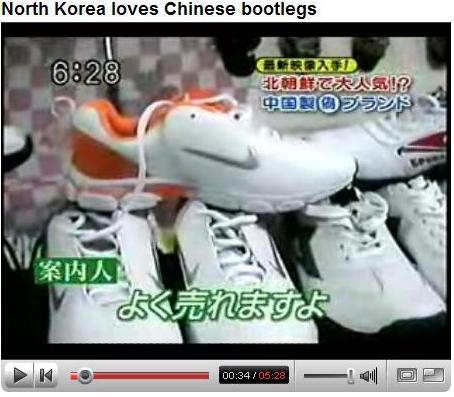
shoes.JPGAgain, while trapsing through the jungle of YouTube videos on North Korea, I stumbled on this clip shown on Japanese television which was secretly recorded in a North Korean market.  Since my Japanese ranges from rusty to nonexistent, I do not know where it is.

What does this clip teach us?  That some North Koreans are becomming more sophisticated shoppers/ consumers–looking to the outside world to get a sense of what’s fashionable.  Chinese entrepreneurs are hard at work building brand loyalty for western companies that are not yet aiming for the DPRK market.  Chinese knockoffs of Nike, the North Face (mislabeled “the Nice Face”), and fake designer apparel are all on display.  I imagine no North Korean citizen expects to ever see these goods in the local Public Distribution Office. 

Japanese narration highlights (thanks, Tony):

  • Are the North Koreans familiar with these western brands? Some are familiar and others are not so sophisticated.
  • These items sell really fast.  You can buy a Rolex Watch (knock off) for 800 Yen (appx. $8 or appx 2,400 North Korean Won).
  • The narrator contrasts lifestyles.  He compares shoppers that can afford these market goods with others in the same village who cannot.
Share

Seoul to Unveil Investment Plan in NK Infrastructure

Thursday, August 9th, 2007

Korea Times
Ryu Jin
8/9/2007

South Korea is expected to propose a large-scale investment plan in social overhead capital (SOC) in North Korea in the inter-Korean summit late this month to help the impoverished state revive its economy, according to officials on Thursday.

Officials in Seoul said that the package proposal will likely include the provision of electricity, renovation of the Pyongyang-Gaeseong highway, improvement of facilities in Nampo port and establishment of a fertilizer factory.

President Roh Moo-hyun and North Korean leader Kim Jong-il are set to meet in Pyongyang Aug. 28-30, seven years after Roh’s predecessor, Kim Dae-jung, met with the reclusive North Korean leader.

While the Roh administration finds itself in a difficult position to give direct assistance to the North, such as provisions of rice and fertilizer — not to mention cash — it appears to have opted for “indirect’’ SOC investment, according to the sources.

Former President Kim Dae-jung won the Nobel Peace Prize for the first-ever summit in June 2000, but his achievement was partly tainted by later revelation that Seoul had secretly transferred $500 million to Pyongyang to foster the historic summit.

Roh, who has put more weight on transparency in North Korea affairs, often stressed the need to help North Korea repair its devastated economy with its own hand and get out of its economic slump.

In February, the Unification Ministry drew up a roadmap for a large-scale economic cooperation, focusing on “what the North really wants.’’ Seoul will likely make some offers to Pyongyang in the upcoming summit, according to government sources.

Dubbed “Roadmap to Hope,’’ the ministry plan includes as many as 16 items such as the provision of 2 million-kilowatt electricity, worth some $900 million every year, and renovation of the 170-kilometer Pyongyang-Gaeseong highway ($307.7 billion).

Other items include the improvement of facilities in Nampo port, the construction of a 330,000-ton fertilizer plant and installation of tree nurseries in Pyongyang, Gaeseong and Hamheung.

“We are sorting out items that could be offered,’’ a high-profile government official said on condition of anonymity. “I think our proposal for the SOC investment could be discussed in the working-level preparatory talks in Gaeseong next week.’’

Experts estimated that the aid package could reach 9 trillion won to 13 trillion won ($9.7 billion to $14 billion) in the coming several years, if major items such as the highway renovation are included on top of the ongoing supply of heavy fuel oil.

Seoul is expected to demand the establishment of liaison offices across the border and the regularization of military talks headed by the defense ministers from the two sides in return for the economic incentives, according to the sources.

But the large-scale economic assistance is expected to trigger fiery debate in the South, as conservatives, represented by the opposition Grand National Party (GNP), have often lashed out at the government’s “single-handed’’ assistance amid the nuclear standoff.

Deputy Prime Minister and Minister of Finance and Economy Kwon O-kyu, who is to accompany Roh to Pyongyang, stressed on Thursday that the aid package would be offered “transparently’’ in close coordination with the international community.

“South-North Cooperation Fund, operated under the endorsement of the National Assembly, could be used first,’’ he told reporters. “I think we should also try to create a favorable environment for the inter-Korean economic projects in close cooperation with the World Bank and the Asian Development Bank.’’

Share

Director Daniel Gordon Returns to Seoul With “Crossing the Line”

Wednesday, August 8th, 2007

Korea Times
Lee Hwan-hee
8/8/2007

British film director Daniel Gordon will visit Korea Aug. 12-14 to promote the release of his documentary “Crossing the Line” (2006), a film about James Joseph Dresnok, one of the four American soldiers who defected to North Korea during 1960s and the only one who is still living there.

The other three are Charles Robert Jenkins, who made the news in 2004 by turning himself in to the U. S. Army in Japan to face desertion charges, and Larry Allan Abshier and Jerry Wayne Parrish, both deceased.

The film is Gordon’s third documentary on North Korea; the previous ones are “The Game Of Their Lives” (2002), about the North Korean national football team who defeated Italy to advance to the quarterfinals of the 1966 World Cup, and “A State Of Mind” (2004), about two North Korean child gymnasts participating in the “Pyongyang mass games.”

Dresnok and the filmmaker were interviewed by the CBS News Program “60 Minutes” last January and Dresnok told the program, “I really feel at home” in North Korea, and said “I wouldn’t trade it for nothing,” in contrast to Jenkins who likened his stay in North Korea as an extended prison sentence. Jenkins penned a memoir “To Tell the Truth” in Japan, the home country of his wife, in 2005 (translated into Korean the following year).

Four years after his defection in 1962, Dresnok, and the other Americans, sought asylum in the Soviet embassy, unable to endure the hardships of living in North Korea, but the Soviets handed them back to the North Koreans, and Dresnok eventually adjusted, relatively speaking, to North Korean life. He found fame by starring in several North Korean propaganda films, playing villainous Americans. He also translated some of Kim Il-Sung’s writings into English.

He has been married three times; twice in North Korea, to an Eastern European woman, and the daughter of a Korean woman and an African diplomat; and has three children. His eldest son, James, considers himself a Korean.

Gordon will attend a screening and have a question and answer session with audience members during his visit. The film was shown at the 2006 Pusan International Film Festival, as well as the 2007 Berlin International Film Festival and the Sundance Film Festival.

Share

Leaders of 2 Koreas Will Meet in the North

Wednesday, August 8th, 2007

New York Times
Normitsu Onishi
8/8/2007

The two Koreas announced Wednesday morning that they would hold a summit meeting later this month, the first since a groundbreaking meeting in 2000 began an ongoing reconciliation process on the Korean peninsula.

President Roh Moo-hyun of South Korea will meet the North’s leader, Kim Jong-il, during a three-day meeting Aug. 28 to Aug. 30 in Pyongyang, North Korea’s capital, the two Korean governments said in coordinated announcements.

The North said the meeting will carry “weighty significance in opening a new phase of peace,” according to the government’s Korean Central News Agency. The South, using similar language, added that the meeting would “provide momentum to settle the North Korean nuclear problem.”

Neither side released details about the agenda, and it was not clear how much can realistically be accomplished because the deeply unpopular Mr. Roh has only a few months left in office.

The meeting, which had been rumored for months, was immediately criticized by South Korea’s political opposition as a ploy to influence the presidential election in December. The trip by Mr. Roh is widely expected to boost the popularity of liberal presidential candidates who share his engagement policy toward the North.

While the main opposition Grand National Party also favors engaging North Korea, its candidates call for tougher concessions from the North. Two Grand National Party candidates, Lee Myung-bak and Park Geun-hye, lead in polls for the election.

“This summit is about politics between North and South Korea,” Nam Sung-wook, a North Korea expert at Korea University, said in a telephone interview from Seoul. “It is unlikely to solve the nuclear problem because North Korea has consistently argued that it is a problem between North Korea and the United States.”

Still, South Korea said the North had agreed to the meeting because of the recent progress in negotiations over the North’s nuclear program. The North shut down its nuclear reactor at Yongbyon last month, and talks are continuing over its entire nuclear program.

In 2000, Kim Jong-il and the previous South Korean president, Kim Dae-jung, met in Pyongyang in sessions that inaugurated a policy of reconciliation between the two cold war enemies, which remain technically at war. That meeting led to a profound change in relations between the two countries.

Share

Northern exposure

Wednesday, August 8th, 2007

Joong Ang Daily
8/8/2007

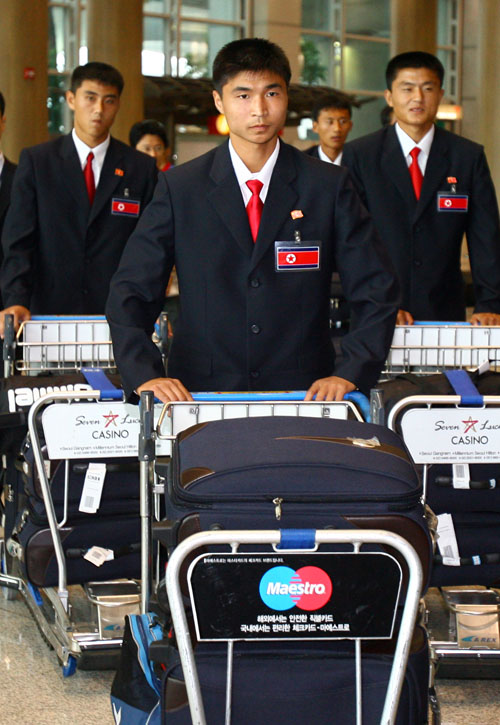
football.jpg

North Korean youth soccer players arrive yesterday at Incheon International Airport. The North Korean team will participate in the U-17 World Cup organized by FIFA in South Korea from Aug. 18 through Sept. 9.

Share

US tourists prepare to ‘invade’ N Korea

Wednesday, August 8th, 2007

Asia Times
Sunny Lee
8/8/2007

Hurry if you’re in the mood to travel to one of the least traveled countries on the planet. North Korea says it will admit foreign tourists this year only until October 10.

That’s the latest schedule Walter Keats received from Pyongyang. Keats heads Illinois-based Asia-Pacific Travel, the only travel company in the United States authorized by Pyongyang. The reclusive country opens itself to foreign tourists only for a limited period of the year. Restrictions on Americans are even stricter. In fact, Americans are allowed into North Korea only during the Arirang Festival, a birthday party for the late leader Kim Il-sung.

As a US citizen who is not part of a diplomatic or humanitarian aid mission on North Korea, Keats has had the rare experience of visiting the secretive country 10 times in the past 12 years, starting in 1995. During the period, Keats saw the country “definitely” changing.

“I don’t know if that’s the question of being closed or open. Things are still very restricted. But the people we deal with, at least, are more flexible, more friendly, and more open now,” Keats said in an interview in Beijing before he was to fly with Pyongyang-bound American tourists last weekend.

North Koreans’ flexible attitude is reflected, for example, in the tour scheduling. In the past, the North Koreans decided every itinerary. But Keats told them some places are not really interesting for Americans, while some are more interesting. Now they are more willing to listen.

Besides, the North Korean guides are more willing to accommodate impromptu requests from foreign tourists now such as visiting a local elementary school, even if that was not part of the original travel itinerary.

The changes are also noticeable in the North Korean tour guides themselves as well. They used to be rather solemn and less spontaneous, but these days they even crack jokes in English. Keats sees it as a “nice” change.

“One of the purposes of this tour is to break down the barriers to show that we are human beings and they are also human beings. We’re not both devils fighting each other. So it’s nice to see the humanity in both sides. Humor is a good medium,” Keats said.

North Korea and the US are still technically at war with each other as a legacy from the Korean War. However, today American tourists in North Korea are not subject to any of the anti-American sentiment and rhetoric that Keats experienced during some of his previous visits.

However, all foreign tourists to the Stalinist nation must go on guided tours and must have their tour guides with them at all times. Photography is strictly controlled, as is interaction with the local people. Besides, tourists holding US passports are not usually granted visas. But exceptions were made in 1995, 2002, 2005 and this year.

Some observers are inclined to view the timing of these exceptions as coinciding with a softening in US relations with North Korea. But that actually may not be the case, because North Korea gave the green light for US tourists in 2002 – just after President George W Bush lumped it in with a group known as the “axis of evil”.

On his part, Keats has to remind his fellow American tourists that visiting North Korea is “very different” from visiting any other country in the world and tells them to be mindful of following a few rules. These include refraining from attempting to strike an unauthorized conversation with local people.

In general, the North Korean people would not appreciate foreign tourists coming up to them because “frankly, it endangers them”, Keats said. Somebody could later ask them why they talked to the foreigners, what they said to the foreigners, what the tourists gave to them.

“So I advise our people to refrain from such approach. Of course, you’d like to talk to somebody there. But most of them don’t speak English anyway. So, if you do so, you’d be putting them at risk for no reason.”

Unfortunately, Keats observed, it’s not just the country that has changed over the years, but the tourists themselves have shown some changes as well. In the early days, tourists came with some research, reading about the society before they visited North Korea. The early tourists were more knowledgeable and inquisitive. But “today’s tourists are more interested in making sure that they’ve been to this place”, Keats said.

Keats believes the idea of going to North Korea as merely going on an “exotic tour” should be discouraged. “We get phone inquiries from people who say they don’t want to be in a group, want to go out and meet local people in North Korea. If you’re so ignorant about how the society there works, you’d think you can just go and talk to somebody on the street. That’s very dangerous.

“I don’t think you have a right to create a situation where somebody there might get into trouble because of your need to go back home and brag that you talked with North Korean people. I think it’s immoral for somebody, particularly from our [US] culture, to do so.”

Keats said no American on his tour so far has been rejected an entry visa to North Korea, but added that people with certain professions would have difficulty getting in. He took an example of journalists. He said he was specifically told by the North Koreans that he would be fined a minimum of US$1,000 per journalist, if found.

For him, however, that’s not the only business risk he has to bear in dealing with the North Koreans. Last year, he suffered a financial setback after the scheduled trip was abruptly canceled after more than 200 Americans had signed up for it.

Understandably, he was not very happy about it. “The problem is that they make changes all the time,” he said. In fact, the travel-permit dates for this year were already a third revision.

Keats said the North Koreans would simply change the dates for foreign visitors and say the foreigners needed to change their arrival dates. “They don’t seem to understand that in some peak travel seasons, changing dates on the air tickets could cost additional money. I don’t think people at the top [in North Korea] really understand how the market works.”

These days, a tour to North Korea usually comes as a four-day-three-night package. That may sound reasonable for a country that is roughly half the size of Minnesota. But the devil is in the details. The first day counts from the day the tourists’ airplane departs from Beijing to Pyongyang. (Foreign travelers usually arrive in Pyongyang via Beijing.) And on the last day, the foreigners have to leave the country at 8am. But that is still technically counted as “one day”.

So, to save time, once arrived, going to the hotel usually becomes the last itinerary of the first day. After stopping by a few places on the way from the airport, tourists go directly to see the Arirang performance, which starts at 7pm.

The Arirang Festival, the high point of any visit to North Korea, is a performance by 100,000 synchronized gymnasts inside the world’s largest stadium, occasioned for a celebration of the birth of the late “Great Leader” Kim Il-sung. It depicts two separated lovers, symbolizing the two Koreas, culminating with their reunion.

In North Korea, among the lists of “must-sees” is Mansu Hill, where a Korean War memorial and statue of Kim Il-sung is located. Others include the Arch of Triumph, Geumsu-san Memorial Palace and Kim Il-sung Mausoleum, a film studio in Pyongyang, and the Korean Central History Museum. Keats has found that these are the places American tourists find particularly interesting.

He said it’s also worth watching how the local people pay their respect to Kim Il-sung at his mausoleum, who is regarded as a deity there. “From a foreigner’s eye, that would be quite a cultural experience.”

Last year, the reclusive country accepted about 20,000 visitors from abroad. The majority were Chinese and South Koreans. Fewer than 2,000 Westerners visited North Korea last year.

So, at the end of having the rare opportunity to see the secretive country, “people are pretty amazed”, Keats said.

“North Korea is a unique system. I think most of the visitors leave with a positive view of the tour, which doesn’t necessarily mean that they get to have a positive view of the country. But they learn more about the country by being there. Seeing it first-hand gives them a much better sense of what is going on there.”

Share

Iran, North Korea to sign economic pact

Tuesday, August 7th, 2007

Islamic Republic News Agency
8/7/2007

Iran-North Korea economic relations will enter a new era once a bilateral cooperation document is signed by commerce ministers of the two country.

According to public department of Iran’s Ministry of Commerce, in the document which is to be inked on Wednesday, the two sides will announce their agreement to expand economic cooperation and boost mutual relations.

Mutual economic cooperation in such fields as construction and technology has been envisaged in the document.

Share