Archive for the ‘International Governments’ Category

ROK launches DPRK trade bribery case

Monday, October 25th, 2010

According to Yonhap:

The Unification Ministry said Monday it will ask law enforcement authorities to look into allegations that government officials took bribes in exchange for helping local traders bring in agricultural products from North Korea.

Rep. Choi Jae-sung of the main opposition Democratic Party claimed last week that the trading firms used the bribes after the ministry rejected their request to import shiitake mushrooms from North Korea for violating import conditions.

Choi claimed that multiple officials of a government agency, which he did not identify, exercised influence to help the traders win approval for the import, and received money in kickbacks. The lawmaker did not say how much money was given to them.

On Monday, Unification Ministry spokesman Chun Hae-sung said that the ministry will refer the case to investigation authorities but denied that the ministry was involved in the alleged bribery.

Read the full story here:
Unification ministry calls for investigation into bribery allegations over inter-Korean trade
Yonhap
10/25/2010

Share

3.6% of South-North cooperation fund spent in 2010

Monday, October 25th, 2010

Institute for Far Eastern Studies (IFES)
NK Brief No. 10-10-25-1
10/25/2010

There has been a sharp drop in inter-Korean exchanges resulting from the chill in relations on the peninsula. This has led to a mere 3.6 percent of the inter-Korean cooperation fund being tapped as of the end of September. In 2009, 8.6 percent of the allocated funds were spent, but this year, even at the end of the third quarter, not even half that much has been allocated.

The National Assembly’s Unification, Foreign Affairs and Trade Committee found in an audit of the Ministry of Unification’s public documents that almost 1.2 trillion Won had been allocated for inter-Korean cooperative projects, but a mere 41.7 billion Won had been spent. 1.4 billion Won was spent on socio-cultural exchanges, while 13.1 billion Won was spent on humanitarian aid, 10.7 billion Won supported economic cooperative projects, and 16.7 billion Won was advanced in support of those companies and groups planning additional projects. On the other hand, the Ministry of Unification is loaning 60 billion Won from the inter-Korean cooperation fund to South Korean companies invested in economic cooperative projects that are suffering losses due to the May 24 measures, which restrict exchanges due to the sinking of the Cheonan.

In 2008, the first year of Lee Myung-bak’s administration, only 18.1 percent of the inter-Korean cooperation fund was spent, and this percentage has fallen every year since. Now at an all-time low, it appears that the rate of spending will continue to fall in the future. With the May 24 measures, the Kaesong Industrial Complex was exempted from trade restrictions. In addition, other inter-Korean trade worth approximately 80 million USD (90 billion Won) has been permitted. This includes 639 different cases of imported goods manufactured from raw materials or parts sent to the North prior to the May 24 restrictions, amounting to 31.15 million USD, and 269 cases of pre-ordered exports amounting to just over 49 million USD.

On the other hand, losses due to the halt of tourism to Mount Keumgang and Kaesong have amounted to 628.5 billion Won over the last two years. According to a report submitted to the National Assembly by the Korea Tourism Association on the impact of halting these tourism projects, losses of 548.2 billion Won had been incurred by August, and that is expected to grow to 628.5 billion Won by the end of the year.

Mount Keumgang tours were halted in July 2008, while Kaesong tours were stopped in November of the same year. Since then, the Korea Tourism Association has lost 10.5 billion Won in profits, while private-sector companies including Hyundai-Asan and its partners have lost 465.2 billion Won. In addition, restaurants, rest stops, visitor centers and other businesses in the border town of Koseong, Kangwon Province have lost 72.5 billion won due to the lack of tourists travelling across the border to Mount Keumgang, pushing total losses by the government and private sector to over 500 billion Won.

Share

Food security and aid

Sunday, October 24th, 2010

According to the APF:

North Korea is heading for a “chronic” new food crisis with drought and floods in different parts of the country exacerbated by cuts in international aid, the United Nations said.

UN Secretary General Ban Ki-moon expressed concern “that the acute humanitarian needs” of at least 3.5 million women and children in North Korea would worsen because of food shortages.

Even though North Korea is considered by many to be the world’s most isolated state, Ban said in a report to be discussed Friday that “the global economic crisis is further increasing the levels of hardship” adding to the “chronic food insecurity”.

South Korea on Friday said it had no immediate plan to resume large-scale food aid to North Korea despite the UN warning on the food crisis.

“The government stance is that in order for the massive government food aid to be resumed, overall inter-Korean relations must be taken into account,” Unification Ministry spokeswoman Lee Jong-Joo told AFP.

She stressed, however, that Seoul allows smaller-scale “humanitarian aid” to the North, including 5,000 tonnes of rice and other aid supplies currently being shipped victims of floods that devastated northwestern North Korea in August.

There has been a shortage of rainfall in some parts of the country but in August torrential downpours caused floods in the north, near the Chinese border.

The UN predicted that the cereal yield would be nearly a fifth lower than in 2009.

It said the country needs 3.5 million tons of cereals a year to feed its population and would have to import 1.1 million tons. In addition, UN agencies had raised only 20 percent of the 492 million dollars they estimated in 2009 would be needed for the North.

Ban quoted the UN Children’s Fund (UNICEF) as saying that each year, some 40,000 children under five become “acutely malnourished” in North Korea, with 25,000 needing hospital treatment.

“The lack of maintenance of water and sanitation systems increases rates of diarrhoea and acute respiratory infections, which are leading causes of child death.

“In addition, one third of women of childbearing age suffer from anaemia, a nutrition deficiency that is also a major cause of maternal mortality.”

The poor diet across the country leads to widespread “infectious diseases, physical and mental development disorders, poor labour productivity and an increased risk of premature death,” said the grim report.

A survey carried out by the government with UN support showed that about one third of the population suffer from stunting — below normal body growth. In some regions the figure was 45 percent.

The report was intended to be on human rights in North Korea and the UN chief said there was an “urgent need” for Kim Jong-Il’s regime to take steps to provide the basic right to food, water, sanitation and health.

The UN reported little change in the “comprehensive restrictions” on freedom of speech, religion and opinion in the tightly policed state. “The government’s control over the flow of information is strict and pervasive.”

Ban highlighted the difficulty in getting reliable information on events in the North.

But he said: “There are a number of reports concerning public executions, the use of torture, forced labour and the ill-treatment of refugees or asylum-seekers repatriated from abroad.”

His report said North Korea’s UN delegation had acknowledged that public executions were carried out for “very brutal violent crimes.”

It added that the UN envoy on rights in North Korea had raised concerns with the North’s mission about conditions in six prisons and detention centers reportedly used for political prisoners.

With the North embroiled in a dispute with South Korea over the sinking of a warship and in a nuclear arms standoff with the international community, Ban said humanitarian aid should not be restricted “on the basis of political and security concerns.”

Though unrelated to the UN findings, South Korea is shipping 5,000 tons of rice to the DPRK today. According to Yonhap:

The Red Cross aid, which is aimed at helping the North cope with the aftermath of floods, marks South Korea’s first government-funded provision of rice to the North since President Lee Myung-bak took office in early 2008 on a pledge to link aid to progress in efforts to end Pyongyang’s nuclear programs.

Seoul also plans to send a shipment of 10,000 tons of cement to the North later this week.

A total of 13.9 billion won (US$12.3 million) came from the government coffers to finance the flood aid.

Also Monday, three Red Cross officials prepared to fly to the Chinese city to receive the rice and instant noodles there and transport the relief supplies by truck to the flood-hit North Korean border city of Sinuiju, according to officials from the Red Cross and the Unification Ministry.

The cargo ships are expected to arrive in Dandong around Wednesday.

Rice will be delivered in five-kilogram packages, and each package is marked with “Donation from the Republic of Korea,” South Korea’s official name.

In August, South Korea first offered to provide relief aid to the North after devastating floods hit the communist nation. North Korea later asked for rice, heavy construction equipment and materials.

Stories about South Korean aid in 2010 can be found here.

China has also pledged food assistance. According to KBS:

A Japanese daily says China pledged 500-thousand tons of rice aid to North Korea during Kim Jong-il’s visit to China in August.

The New York Times raises the concern that food aid may be diverted.  According to the article:

Rice, a staple of the diets in both Koreas, is also a highly symbolic item in terms of food aid throughout Asia. The 5,000 tons of rice in the shipment on Monday can feed about 325,000 people for a month, according to Red Cross estimates.

Some analysts and aid workers expressed concern that the rice would likely be diverted to political elites, loyal party members and the military rather than delivered to the neediest in the North. That has been the pattern, they said, of previous government aid deliveries.

“I’m not unhappy about food going up, but I fear that this kind of government-to-government distribution to Pyongyang will be carried out along loyalty lines,” said Tim Peters, founder of the civic group Helping Hands Korea. “Distribution through small NGOs that are more strategically placed and can get the food into the interior and places like remote mining towns, that is the more intelligent strategy.”

Mr. Peters said his group, which primarily assists North Korean refugees, has received numerous reports from defectors from what he called “the Siberia of North Korea” that residents in the hinterlands “never see any of this kind of food aid.”

Five weeks ago, a truck convoy delivered 203 tons of rice to North Korea, the first rice donations of any kind from the South in nearly three years. That nongovernmental assistance, which was donated by charity groups and opposition political parties, came one day after a shipment of 530 tons of flour was sent by a South Korean provincial government and civic groups.

Share

PUST scheduled to open doors this week

Sunday, October 24th, 2010

UPDATE: The New York Times also covers the opening.  According to the article:

In spite of all this, classes in technical English started Monday at the Pyongyang University of Science and Technology. A fuller curriculum in information technology, business management and agriculture is supposed to get under way in March.

“It’s amazing, and kind of a miracle,” said Park Chan-mo, one of the founders of the school, which was largely financed by contributions from evangelical Christian groups in the United States and South Korea. “Many people were skeptical, but we’re all Christians. We had faith.”

The driving force behind the school was Kim Chin-kyung, an American born in Seoul who founded a university in China in 1992. He made periodic trips from China into North Korea and in 1998 was arrested at his hotel in the capital and thrown into prison, accused of being an agent for the C.I.A.

The relentless interrogations went on for six weeks and almost broke him. “I was ready to die,” he said in a 2001 interview, even writing out a will and bequeathing his organs for transplants and medical study in Pyongyang.

He was finally released, he said, after convincing the authorities that “I was not the kind of person who would spy on them.”

In November 2000, a man appeared in his university office in China — oddly, the same man who had ordered his arrest for espionage in Pyongyang in 1998. But this time he had a proposal from the North Korean government: could he duplicate his Chinese technical university in Pyongyang?

“Doing business with North Korea is not for the faint of heart,” Mr. Kim said on the school’s Web site, “but the effort is ennobling and necessary.”

The first group of 160 undergraduate and master’s students has been chosen by the North Korean government, selected from its top colleges and from the political and military elite. Their tuition, room, board and books are all free, financed by foreign donors and individual sponsors. The plans call for an eventual student body of 2,600 and a faculty of 250, with classes in public health, architecture, engineering and construction.

Sixteen professors from the United States and Europe arrived in Pyongyang over the weekend. For now, no South Korean professors are allowed because of recent political tensions between the Koreas.

It seems an unlikely marriage — the hard-line Communist state and wealthy Christian capitalists — and it remains to be seen how well the match has been made.

North Korea, while reluctant to expose its citizens to the outside world, has been seeking foreign investment for its decrepit educational system. For their part, the evangelicals, who have antagonized the North by encouraging defections and assisting refugees after they cross over, are seeking a foothold inside the churchless state.

North Korea has made a similar bargain before. The Unification Church of the Rev. Sun Myung Moon, not only a Christian but staunchly anti-Communist, operates a car factory in Pyongyang, for instance. But the church is allowed to make only cars, not Christians or capitalist converts.

There is no campus chapel at the new university, Dr. Park said, and there is not one in the plans. But neither, for now, are there any official portraits of the North Korean leader, Kim Jong-il, or his father, the late Kim Il-sung, which hang in every school and public building in the North.

The $35 million, 240-acre campus includes a faculty guesthouse and world-class dormitories and classrooms, all of which are said to have running water, power and heat. The school has its own backup generators, but with so little diesel and gasoline available in the North, fuel has to be trucked in from neighboring China.

Classes will be taught in English, and Internet access has been promised to all students. The campus has sirens that go off before rolling electrical blackouts, so work on computers can be saved.

“The Internet will be censored, and we can’t imagine that it won’t be,” said Dr. Park, who has been involved in educational exchanges with the North since 2000. “Even in South Korea things are blocked. I’m sure North Korea has been looking at my e-mails. I keep them businesslike.”

Dr. Park, the former president of the prestigious Pohang University of Science and Technology in South Korea, said the university project could not have been completed without the approval of the United States government. Officials at the school, eager not to run afoul of international sanctions in place against the North, have even sent its curriculum to the State Department for vetting.

One request from Washington was that the name of the biotechnology course be changed for fear that it might be seen as useful in developing biological weapons, Dr. Park said. So the course title was changed to “Agriculture and Life Sciences.”

The United States government also was also “very sensitive,” Dr. Park said, about young North Korean scientists learning skills that could be used by the military or in developing nuclear weapons. “We can’t be fooled into teaching them those kinds of things.”

Several conservative lawmakers from South Korea called for Seoul, which gave $1 million to the school in 2006, to cut off all support. One legislator, Yoon Sang-hyun, was angered that the North insisted that future economics classes include lessons about juche, or Kim Il-sung’s founding philosophy of self-reliance.

Some critics also have suggested that there must have been heavy payoffs made to the North Korean government to move the project along, but Mr. Kim insisted that no deals had been made.

“Every brick we used, every bit of steel, every bit of equipment, we brought in from China,” Mr. Kim, who was in Pyongyang for the opening, said in an interview in Fortune last year. “I have never brought any cash into North Korea.”

“I have unlimited credit at the Bank of Heaven,” he added.

ORIGINAL POST: According to Yonhap:

The first university founded jointly by South and North Korea is scheduled to open next week in Pyongyang, a school official said Friday.

The project to build Pyongyang University of Science and Technology was launched in 2001 after the two countries’ governments approved a South Korean nonprofit organization to participate in it. The university’s stated aim is to promote reconciliation and prosperity among the Korean people, separated since the 1950-53 Korean war, and “help North Korea develop the necessary economic and intellectual infrastructure to function as a member of the international community,” according to its Web site.

“All the facilities and staff are ready, and we will officially open (next Monday),” said James Chin-kyung Kim, the school’s founding president and co-chairman. Kim, a U.S. citizen, also founded the Yanbian University of Science and Technology in the Chinese city of Yanji, a major Korean-Chinese population center.

“In time for the opening, 17 foreign professors will fly to Pyongyang from Shenyang (on Saturday). These professors come from the U.S. and Europe,” he said.

South Korean staff will also be able to teach, starting next semester, according to the school.

Instruction will be in English, and 160 students have been selected for the school’s undergraduate and master’s degree courses in agriculture, information and communication technology, and industry and management. Forty doctorate-level students began studying with four foreign academics in the summer.

The university plans to increase the number of students to 500 and open more departments to teach architecture, engineering, construction and public health care.

Here are previous posts about PUST including satellite imagery of the facility’s construction.

Read the full story here:
First university founded by two Koreas to open in Pyongyang next week
Yonhap
10/22/2010

Share

100th DPRK defector settles in US

Sunday, October 24th, 2010

According to Radio Free Asia:

He said he has already received a Social Security Card, and in August 2011 will likely receive his green card allowing him status as a permanent resident of the United States.

But while he is excited about the opportunities he sees in America, Jo said his new life is not without its challenges.

“If there’s one thing that’s inconvenient here, that is the language barrier. I feel that I can hardly get a grip on everything I’m doing, including studying English,” he said.

“Time just flies by, and time is so precious… However, I finally feel at home —- free.”

The North Korean Human Rights Act, which allows the U.S. government to receive North Korean refugees, was signed into U.S. law by former President George W. Bush on Oct. 18, 2004.

It also allows the U.S. government to provide humanitarian assistance to North Koreans inside North Korea and provide grants to non-profit organizations which seek to promote human rights, democracy, rule of law, and the development of a market economy in the country.

The act also allows efforts to increase information flow inside North Korea and to provide humanitarian or legal assistance to North Koreans who have fled their nuclear-armed country.

The U.S. accepted a group of six North Korean refugees for the first time since the act was signed into law on May 5, 2006.

Read all about the defector here.

Share

DPRK defectors in Japanese “adult entertainment” enterprise

Friday, October 22nd, 2010

According to the Yomiuri Shimbun:

North Korean defectors appear to be traveling to [Japan] from South Korea to earn an income in the adult entertainment industry, with a series of arrests having been made in connection with two adult businesses in Ueno, Tokyo.

A woman who defected from North Korean was deported from Japan to South Korea in mid-October after being convicted of illegally operating an adult salon in Ueno, according to Metropolitan Police Department sources.

The woman fled North Korea for South Korea in July 2004, but she came to Japan in April 2006 after experiencing financial difficulties in South Korea.

She opened the adult salon in January last year, and was arrested in May this year, the police said.

According to MPD sources, the woman sent part of her earnings from the shop to North Korea.

Nine other defectors from North Korea, all women, have also been arrested, the MPD said.

One, a massage parlor manager in her 40s, is an acquaintance of the deported woman. Investigative sources said she was arrested Oct. 4 on suspicion of violating the Adult Entertainment Businesses Law by operating the parlor in an area of Ueno where such businesses are prohibited.

The other eight women worked at the two Ueno businesses, and were arrested on suspicion of breaking the Immigration Control and Refugee Recognition Law by working in violation of their visa status.

After defecting from North Korea, all 10 women entered a facility in South Korea that helps defectors settle in that nation, and all obtained status as South Korean nationals, according to the police.

However, the women found it hard to find work in South Korea. One was quoted by the police as saying: “We defected from North Korea because our lives there were difficult, but our lives didn’t improve in South Korea. In Japan, we earned a lot, partly thanks to the strong yen.”

The deported woman made profits of about 35 million yen at her salon between its opening and April this year. The woman said she had sent part of the income to relatives in North Korea, according to the police.

The MPD believes word that good money can be made by starting an adult entertainment business in Japan has been spreading among North Korean defectors.

The arrested massage parlor manager, meanwhile, is rumored to have once been a member of North Korea’s secret police, the MPD said.

The MPD intends to thoroughly investigate the woman, who comes from a northern region of North Korea and visited Japan a few years ago, by exchanging information with South Korean police.

The majority of North Korean defectors seek asylum in South Korea after fleeing the country, often by crossing the Tumen River that runs along the North Korea-China border.

According to South Korea’s Unification Ministry, about 20,000 North Korean defectors currently live in South Korea.

However, many cannot assimilate to life in South Korea. Defectors’ employment rate is about 70 percent of that of the general public.

The Japanese government has accepted as North Korean defectors about 200 Korean-Japanese and their families who went to North Korea on its “return to the homeland” project, which began in 1959.

Most North Korean defectors were born and raised in North Korea, however.

Thought the exact number is not known, it is believed many North Korean defectors have visited Japan as South Koreans after obtaining South Korean nationality.

Also in the Korea Times:

Two pimps were arrested for trafficking female North Korean refugees in Japan and forcing them to engage in prostitution there, police said Friday. Police also arrested 13 female North Korean defectors for selling sex in red-light districts in Tokyo.

According to the Seoul Metropolitan Police Agency, the arrested female pimps, surnamed Tak and Lee, ran a massage parlor in Ueno since November 2008. The two are also North Korean defectors to the South.

The women defectors were forced to sell sex for 6,000 to 10,000 yen per hour, it said. The pimps racked up more than 1.1 billion won in illegal gains.

Investigators said they coaxed jobless female defectors here with the promise that they could make more than 15 million won a month in Japan.

Some of the trafficked women said during questioning they engaged in the illegal business to cover fees needed to take their family members still in the North out of the poverty-stricken state.

“This was the first case to catch a group of prostitutes and pimps, all of whom are North Korean,” a police officer said.

A growing number of female defectors leave for Japan voluntarily in recent years to enter into the sex industry there, a desperate move to escape from financial hardship in the South, the officer said.

Read the full stories here:
N. Korea defectors in vice busts / Arrested women drawn to Japan by earning potential in adult industry
Daily Yomuri
10/24/2010

North Korean defectors caught selling sex in Japan
Korea Times
Park Si-soo
10/22/2010

Share

Three South Koreans arrested for attempting to defect to DPRK

Friday, October 22nd, 2010

According to Yonhap:

Prosecutors said Friday they have arrested three people suspected of trying to defect to North Korea, allegedly disgruntled with South Korean society.

A medical doctor, identified only by his surname Shin, and two others are charged with attempting entry into the communist state via China last February, prosecutors said.

Seoul judges issued arrest warrants, citing that the suspects are feared to try to flee and destroy evidence.

The three returned to South Korea after failing to cross into the North, despite receiving help from an acquaintance in Sweden.

They met through an online pro-North Korea community and were quoted as having attempted defection because they were “sick of (South) Korean society,” prosecutors said.

Prosecutors have not found evidence of other parties’ involvement in the defection attempt, but are probing indications that the three had contact with the North during their stay in China.

Read the full story here:
Three suspected of attempting defection to N. Korea
Yonhap
10/22/2010

Share

More than 100 DPRK defectors in Japan

Thursday, October 21st, 2010

According to KBS:

Japan’s State Secretary for Foreign Affairs Takeaki Matsumoto says there are more than 100 North Korean escapees in Japan.

Matsumoto made the assessment on Thursday in response to a question posed by Democratic Party of Japan legislator Yosihu Arita during a meeting of a special House of Councillors committee on Japanese abductees.

Arita said a dozen North Korean escapees are under the protection of Japan’s diplomatic mission in China. He said there are reports that some of the escapees have been unable to leave China for nearly two years and urged the Japanese government to promptly address the matter.

In response, Foreign Minister Seiji Maehara said Tokyo will seek the early departure of the escapees in line with the interests of related countries.

Read the full story here:
‘More than 100 NK Escapees Have Entered Japan’
KBS
10/21/2010

Share

KWP reps visit Chinese counterparts

Thursday, October 21st, 2010

According to the Choson Ilbo:

The senior secretaries of all North Korea’s 11 metropolitan and provincial party committees paid a rare collective visit to a senior member of the Communist Party of China in Beijing on Tuesday.

The North Korean delegation led by Mun Kyong-dok, the senior secretary of the Pyongyang municipal party committee, met with Zhou Yongkang, a member of the Politburo Standing Committee who ranks ninth in the hierarchy, to discuss economic cooperation.

Zhou was quoted by the official Xinhua news agency as saying it was “the first time” in the history of bilateral relations that senior secretaries of the Workers Party’s metropolitan and provincial committees have visited China as a group. “I wish that you will expand exchange with various Chinese regions you’re visiting and achieve success from your tours.”

The North Koreans also met with their Chinese counterparts to discuss investment in development projects in the North. The Chinese officials were in Beijing to attend the fifth plenary session of the 17th Communist Party Central Committee.

A South Korean government official said, “The North Korean officials’ visit to Beijing is equivalent to all 16 South Korean metropolitan mayors and provincial governors flying to Washington as a group to discuss exchange and cooperation with ruling-party lawmakers and state governors in the U.S.” He said since Kim Jong-il’s son Jong-un was established as the official successor to the leadership, the North and China have increased the frequency of personnel exchanges “to discuss more substantive matters than before.”

The profiles of the Chinese delegation that attended the 65th anniversary celebrations of the North Korean Workers Party were also exceptional. It included senior officials of the three Chinese northeastern provinces — Sun Zhengcai, the secretary of the Jilin provincial party committee, Chen Xi, the deputy secretary of the Liaoning provincial party committee, and Du Yuxin, the deputy secretary of the Heilongjiang provincial party committee.

They were welcomed at Sunan Airport by Ju Yong-sik, the senior secretary of the party committee in Jagang Province, a border region. The senior secretaries of the party committees in all four North Korean provinces bordering China — Ju from Jagang Province, Ri Man-gon from North Pyongan Province, O Su-yong from North Hamgyong Province and Kim Hi-taek from Yanggang Province — attended a dinner that evening in honor of the Chinese delegation.

“There have recently been more signs of the North and China deepening and developing economic cooperation, including various development projects focusing on the border areas,” a Unification Ministry official said. “It seems that after the North’s Workers Party and the Chinese Communist Party finished talks at headquarters level, their provincial party committees have now begun concrete cooperation.”

Military exchanges are also increasing ahead of the 60th anniversary of the day the Chinese joined the Korean War on Oct. 25.

The official North Korean Central Broadcasting Station on Tuesday reported a delegation of Chinese People’s Volunteer Veterans led by Wang Hai, a former Air Force commander, and the People’s Liberation Army’s art troupe arrived in Pyongyang for the anniversary.

O Kuk-ryol, vice chairman of the National Defense Commission, and Pak Jae-kyong, vice minister of People’s Armed Forces, hosted a reception for them.

On Oct. 14, a North Korean Army delegation led by Pyon In-son, another vice minister of People’s Armed Forces, visited China, to tour PLA units. Quoting the North’s official Rodong Sinmun daily, Xinhua said, “Friendship bonded by blood in the previous generations is being handed down to the next generation.”

A South Korean security official said, “The North is apparently trying to counter the South Korea-U.S. military alliance, which has been strengthened since the sinking of the Navy corvette Cheonan in March, by intensifying military ties with China, as well as attempting to escape international economic isolation by leaning on China.”

Mike has more at NK Leadership Watch.

Read the full story here:
N.Korea, China Grow Ever Closer
Choson Ilbo
10/21/2010

Share

Report: DPRK-PRC tax-free market opens in Tumen

Wednesday, October 20th, 2010

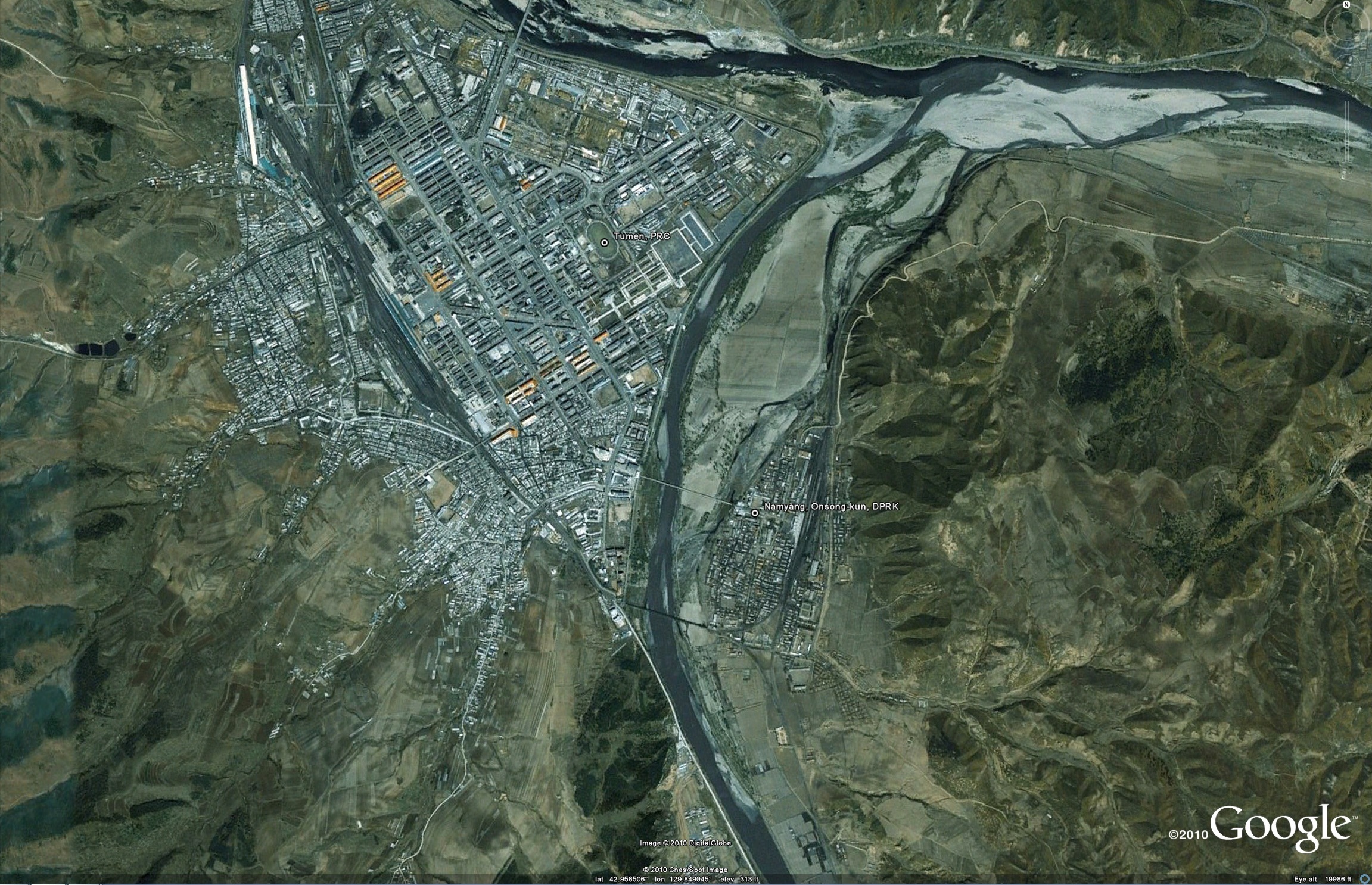
Low-resolution satellite image of the Tumen-Namyang border.

UPDATE: Here is the original story in Asahi:

Goods from North Korea are being traded freely in a thriving market that opened last week in a Chinese city near the border with the reclusive state, according to sources from the region.

Marine products–frozen squid is a specialty–are prominently displayed, the sources said.

The market in Tumen, Jilin province, opened on Oct. 13. It appears to be the latest development in growing economic exchanges between Beijing and Pyongyang following a visit to China by North Korean leader Kim Jong Il in August and moves to secure a smooth transition of power to his third son, Kim Jong Un, the sources said.

Earlier this month, it was learned that Tumen is preparing to accept an influx of cheap labor from North Korea.

The market, which has a total space of about 10,000 square meters, is located on the banks of the Tumenjiang (Tumengang in Korean) river, which serves as the common border between the two countries.

Currently, the market is open twice a week, but there are plans for it to become a daily feature in the near future, the sources said.

According to the sources, Chinese residents in Tumen, which is located inside the Yanbian Korean Autonomous Prefecture within Jilin province, can obtain travel permits to North Korea by presenting identification.

With entry permits in hand, the Chinese are able to cross the river to Namyang, where they are allowed to buy products at designated areas, provided they return to China the same day.

Purchases worth up to 8,000 yuan (about 96,000 yen, or $1180) are treated as duty-free and can be sold at the Tumen market.

The sources said about 150 people showed up at the market on Oct. 13, including merchants as well as ordinary citizens.

North Korean marine products, whose prices are considerably cheaper than Chinese products, dominated the goods on display.

A Tumen city official declined to provide details on the market, saying “it is still in the experimental stage.”

But sources suggest that the market is part of efforts to enhance commerce in northeastern China, which has trailed in economic development compared with coastal regions in the rest of the country.

The market also provides a crucial means for North Korea to earn hard currency by freely selling goods in China.

The idea of setting up such a market is not entirely new. In 2005, the Jilin provincial government authorized the opening of a market as a means to revitalize the border region. However, the project had to be shelved after an international uproar over an underground nuclear test conducted by North Korea.

The plan resurfaced after the region encompassing the Tumenjiang river district and the cities of Jilin and Changchun was designated in 2009 as a development and deregulation promotion zone, the first such national-level development project for a border region.

Jilin province has since taken strident measures to encourage exchanges with North Korea with which it shares a sprawling border.

Sun Zhengcai, a top Chinese Communist Party official from Jilin province, joined a delegation of party officials to North Korea this month on the occasion of the 65th anniversary of the founding of the Workers’ Party of Korea, and is believed to have engaged in talks with the North Korean side on boosting commerce.

The opening of the market follows reports that North Korean laborers may soon be able to work in Chinese factories in Tumen legally, and that Chinese businesses have acquired rights to use and develop wharf facilities at the ports of Rajin and Chongjin in northern North Korea.

Chinese businesses are also reportedly moving toward participating in the construction of infrastructure such as railways and roads to access the ports.

ORIGINAL POST: According to KBS:

A Japanese daily says a “free market” operated by North Korean and Chinese citizens has opened near the Tumen River, which flows between China and North Korea.

The Asahi Shimbun said Wednesday that the market was established in the city of Tumen in China’s Jilin Province a week ago.

The paper said the ten-thousand-square-meter market allows Chinese people to buy up to eight-thousand yuan worth of North Korean goods tax-free each day for resell in China.

The paper said that on the day the market opened last Wednesday, some 150 Chinese purchased tax-exempt frozen squid from North Koreans at the market for resell.

The Asahi said North Korea and China are apparently expanding bilateral economic exchanges following North Korean leader Kim Jong-il’s visit to China in August, citing Chinese firms’ recent move to employ North Korean workers.

Unfortunately high-resolution satellite imagery of the area is not yet available on Google Earth, but we do know that Namyang contains 1 of 4 railway links the DPRK maintains to China and 1 of 8 ground transportation crossings.  Besides Sinuiju, it is the only other DPRK border crossing with both rail and automobile bridges.

Read the full story here:
Market for North Korean goods opens in Chinese border city
Asahi
Daisuke Nishimura
10/21/2010

Asahi: NK-China Tax-Free Market Opens in Tumen City
KBS
10/20/2010

Share
