Archive for the ‘China’ Category

DPRK allegedly halts rations

Monday, June 14th, 2010

According to the AFP:

North Korea has completely cut off state food rations after China failed to supply the impoverished communist country with extra cereals, a welfare group said Monday.

The ruling communist party announced in a directive on May 26 that there would be no state rations for a while, said South Korea’s Good Friends group which has contacts in the North.

People were authorised to buy food supplies through private markets, it said, adding the directive was due to delayed shipments of food from China.

“The directive was unavoidable” because China failed to send the aid which had been anticipated after leader Kim Jong-Il’s trip to Beijing in early May, group president Pomnyun, who uses just one name, told reporters.

Private markets are now open around the clock across the North, he said.

The North suffered famine in the mid-1990s which killed hundreds of thousands and it still grapples with severe food shortages. The UN children’s fund estimates one third of children are stunted by malnutrition.

The state food distribution system collapsed during the famine. Free markets sprang up and were condoned for a time.

Since 2005 the regime has been reasserting its grip on the economy, with controls or outright bans on the private markets.

A currency revaluation last November, designed to flush out entrepreneurs’ savings, backfired disastrously, fuelling food shortages as market trading dried up and sparking rare outbreaks of unrest.

The North was forced to suspend its campaign to curb the private markets.

Read the full story here:
N.Korea completely cuts off state rations: aid group
AFP
6/14/2010

Share

DPRK border guard shoots 3 Chinese

Tuesday, June 8th, 2010

UPDATE 2: According to the Daily NK:

The recent shooting of four Chinese smugglers on the border between North Korea and China by a North Korean border guard was due to a quarrel between the Chinese smugglers and North Korean border guards about an antiques smuggling ring, according to a local trader.

The North Korean border guard shot the four smugglers on June 4th; three were killed and one was wounded. Afterwards, the North Korean authorities apparently issued an apology for the accident to the Dandong municipal government and paid compensation to the victims’ families.

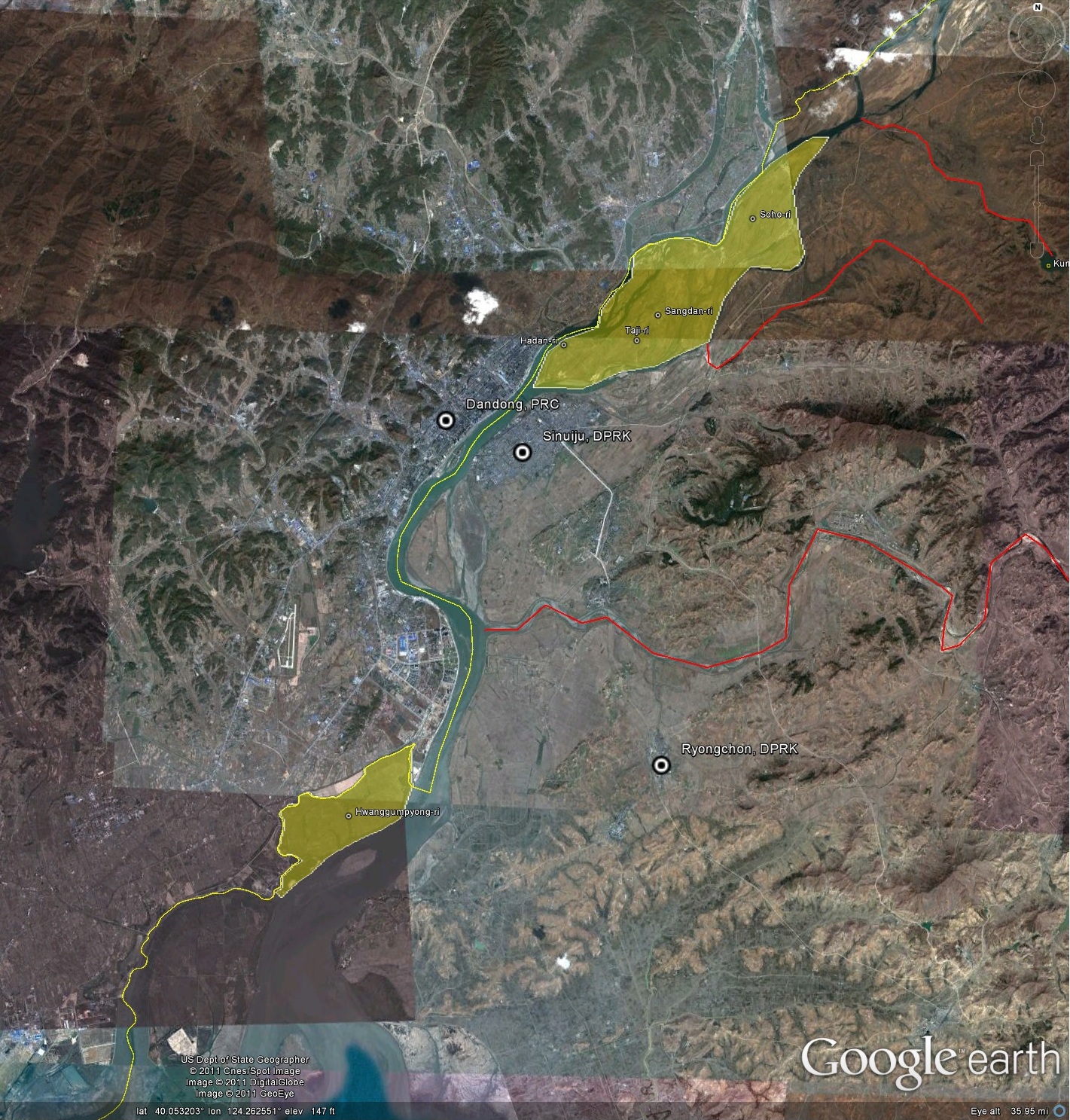
The trader, Kim, who lives in Dandong, reported the details of the shooting accident to The Daily NK earlier this week. The spot where the accident happened was on a boat around Hwanggeumpyeong on Shin Island at the mouth of the Yalu River, he explained, where the facilities of the Shinuiju Shoe Factory are located.

According to Kim, although it was reported in some quarters that the North Korean border guard did not know who was on the boat and fired at it in the dark, in fact, both sides already had close relations.

They were well acquainted with each other thanks to smuggling, Kim said; the North Korean guard had apparently passed several antiques which he had obtained in the North to the Chinese smugglers. However, the Chinese smugglers did not pay for them and severed contacts with him.

The antiques the North Korean guard had procured included rare pieces of white Chosun dynasty china, he said.

After the Chinese smugglers disappeared, the guard tried to find them for a while, but then encountered them by chance while on his patrols.

The guard chased and eventually caught them, then they argued, but the smugglers refused to pay money for the antiques, claiming they were all imitations.

After a while, the smugglers said they would give other goods of equivalent value instead of money and then tried to leave, at which point the guard apparently shot them.

Kim also reported the details of the North’s official response. After the Chinese Ministry of Foreign Affairs released a statement heavily critical of the shooting, the North sent a delegate to Dandong on the 15th to apologize, he explained.

In a meeting with Dandong governmental officials, the North’s delegate reportedly said it happened accidentally, and expressed the North’s sincere apologies for the accident.

The delegate apparently added that the North would restrict shooting towards the Chinese side and suggested that both sides should strengthen their mutual regulations on smuggling. He also paid $3,000 for each death as per the stipulations of a treaty between the two countries.

Kim said, “I thought the compensation was too low, so I asked once again, but their answer was that it is stipulated by the treaty.”

He added, “They promised the Chinese side that the border guard who shot the Chinese would be severely punished on suspicion of smuggling antiques and killing citizens of an allied country.”

UPDATE 1:  According to Reuters:

The isolated North made the effort to soothe China, its sole major economic and political supporter, after North Korean border guards last week shot at the Chinese nationals crossing the river border near the northeast Chinese city of Dandong.

Three were killed and a fourth was wounded.

Chinese Foreign Ministry spokesman Qin Gang said both countries were now “further investigating and handling the case”. He provided no other details.

On Tuesday, the Foreign Ministry made a rare public complaint about its neighbor and now North Korea appears to be seeking to placate Beijing.

North Korean border authorities said an initial investigation showed the incident was an “accident”, China’s official Xinhua news agency reported.

“The North Korean side expressed its grief over the Chinese deaths, and offered condolences to the families of the dead and to the injured, and will severely punish the perpetrators,” said the report.

“The North Korean border security authorities will further investigate this incident and prevent such incidents from recurring.”

ORIGINAL POST: According to the Associated Press:

A North Korean border guard shot and killed three Chinese citizens and wounded a fourth on the countries’ border last week, China said Tuesday after lodging a formal diplomatic protest.

The guard shot the four residents of the northeastern border town of Dandong last Friday, apparently on suspicion they were crossing the border for illegal trade, Foreign Ministry spokesman Qin Gang said.

“On the morning of June 4, some residents of Dandong, in Liaoning province, were shot by a DPRK border guard on suspicion of crossing the border for trade activities, leaving three dead and one injured,” he said at a regularly scheduled news conference. He used the acronym for North Korea’s formal name, the Democratic People’s Republic of Korea.

“China attaches great importance to that and has immediately raised a solemn representation with the DPRK. Now the case is under investigation,” he said.

Dandong is a major shipping point and rail link for goods going into and out of North Korea from China.

Qin did not give any further information. There have been some reports in South Korean media on the incident, though North Korea has not acknowledged the shootings.

And how did the South Koreans react?  According to the Los Angeles Times:

The irony of China’s protest over last week’s shooting was not lost on South Korea.

“This time it is their citizens who are killed, and they show they are not so naive after all about North Korea,” said Kim Tae Jin, a North Korean defector and human rights activist in Seoul. However, he applauded China’s protest of the shooting. China needs to show North Korean leader Kim Jong Il “that he can’t get away with whatever he wants,” Kim said.

China’s public protest is unusual in that relations between China and North Korea are normally shrouded in secrecy, to be discussed only in the politburos of the longtime communist allies.

“It is rare for China to publicly complain. Usually there is a private apology or money paid,” said Kim Heung Gwang, a former North Korean college professor and head of Seoul-based North Korea Intellectuals Solidarity.

The stretch of the Yalu just south of Dandong is frequently trafficked by smugglers, some of them bringing North Korean-made drugs into China or banned Chinese products, such as DVDs or cellphones, into North Korea.

The North Korean government is especially strict about the export of copper, which has been looted from factories, electrical and telecommunications facilities by Northerners desperate for money. But the North’s border guards do not normally shoot to kill — at least not when the smugglers are Chinese.

“Only their own people,” said Kim.

Read the full stories here:
China says NKorean border guard killed 3 Chinese
Associated Press
Tini Tran
6/8/2010

China makes rare public protest against North Korea over killing of 3
Los Angeles Times
Barbara Demick
6/9/2010

North Korea seeks to soothe China over border shootings
Reuters
6/10/2010

Share

PRC holds DPRK official on drug trafficking

Tuesday, June 8th, 2010

According to the Choson Ilbo:

South Korean activist Do Hee-yoon quoting a source in China on Monday said that a 33-year-old official surnamed Rim from the Sinuiju city government’s trade bureau was arrested by Chinese police on charges of drug trafficking in Dandong on the evening of March 2.

“North Korean agents targeting South Korea have been arrested before for their involvement in drug trafficking, but it’s unprecedented for a senior government trade official to be arrested for direct involvement,” Do said. “The Dandong Customs Office has mobilized customs officials from Dalian to probe all aspects of North Korea-China trade.”

The drug enforcement bureau of Anshan in Liaoning arrested four drug dealers based on a tip that Dandong drug dealers gained control of the trafficking network in Anshan, he added.

Under questioning, they revealed that a key figure in the drug ring in the Dandong area was a North Korean and that he was soon to arrive. Officers arrested Rim in Dandong on the evening of March 2 about after a month-long stakeout and took him to Anshan.

The bureau confiscated 2 kg of top-quality methamphetamine Rim had hidden in a kimchi container when he traveled from Sinuiju to Dandong, Do said. Rim was reportedly a very influential man in the North Korea-China trade. Despite the danger, he had traveled to China to buy goods necessary for his younger sister’s wedding scheduled for March 6 and take bribes.

“It seems Rim took a lot of bribes. There are rumors that he was going to take three large truckloads of goods back to the North,” Do said. “Rim’s arrest confirms that the North engages in international drug trafficking at the state level,” he added.

A South Korean official said the government has similar information but China has not officially confirmed it.

Read the full story here:
N.Korean Official Held in China for Drug Trafficking
Choson Ilbo
6/8/2010

Share

North Korean foreign trade down 10.5% in 2009

Monday, June 7th, 2010

Institute for Far Eastern Studies (IFES)
NK Brief No. 10-06-07-1
6/7/2010

In 2009, North Korea’s foreign trade (not including inter-Korean trade) amounted to 3.41 billion dollars, 10.5 percent less than 2008, which saw the largest amount of DPRK overseas commerce since 1991. Exports were down 5.97 percent (1.06 billion USD), while imports were down 12.45 percent (2.35 billion USD), recording a 1.29 billion USD trade deficit.

These figures come from a KOTRA analysis of the Korea Business Center (KBC)’s statistics of trade with North Korea by foreign countries. Because North Korea does not reveal trade statistics, this ‘mirror analysis’ method of analyzing the statistics of its trading partners is the only method available.

Looking at each country’s trade figures individually reveals that China is the North’s largest trade partner. DPRK-PRC trade amounted to 2.68 billion USD last year, 78.5 percent of all the North’s foreign trade. The North exported 790 million USD worth of goods to China, while its imports from China amounted to 1.89 billion USD. As North Korea’s trade with China continues to grow relative to that with other countries, so too, does its economic dependence on Beijing. In 2003, DPRK-PRC trade amounted to 42.8 percent of its overall foreign trade. This grew to 48.5 percent in 2004, accounted for more than half (52.6 percent) in2005, hit 56.7 percent in 2006, 67.1 percent in 2007, and 73 percent in 2008.

North Korea’s main imports from China were crude oil and petroleum (330 million USD, down 44.2 percent from 2008), boiler and machinery parts (160 million USD, up 10 percent), and electrical components (130 million USD, up 31 percent). Top exports to China included coal (260 million USD, up 26 percent), minerals (140 million USD, down 34.1 percent), and textiles (90 million USD, up 20.7 percent).

Germany, Russia, India, and Singapore were the North’s 2nd thru 5th largest trade partners. Trade with Germany was up 33.7 percent, amounting to 70 million USD, while trade with Russia, India, and Singapore dropped off. After these countries, Hong Kong, Brazil, Thailand, Bangladesh, and the Netherlands made up the rest of the top 10 trade partners, which account for 92 percent of all the North’s overseas trade.

In addition, with continuing sanctions against the North by the United States and Japan, there were no exports to these countries, and imports from these countries amounted to a mere 2.7 million USD and 900,000 USD, respectively.

Inter-Korean trade for 2009 amounted to 1.68 billion USD. This was down 7.8 percent from the previous year. North Korean imports from the South were down 16.1 percent, recording 740 million USD. This was largely impacted by the closing of the Keumgang Mountain tourism project.

Combined, North Korea’s total foreign trade was down 9.7 percent, to 5.09 billion USD. 53 percent of this was with China, while 33 percent was with South Korea.

Continued international sanctions against the North and the possibility of additional unilateral sanctions from several countries means DPRK foreign trade will likely shrink more in 2010. It is also expected that the North’s economic dependency on China will continue to grow.

Share

Some recent sanctions statistics

Tuesday, May 25th, 2010

According to Reuters:

The state-run Korea Trade-Investment Promotion Agency (KOTRA) said North Korea’s trade, including commerce with South Korea, fell 9.7 percent to $5.09 billion last year from 2008.

Excluding trade with the South, foreign commerce feel 10.5 percent to $3.41 billion last year, KOTRA said in a statement.

It said trade with China, the North’s sole supporter, amounted to about $2.7 billion.

The prospect of further sanctions as a result of the sinking of a South Korean naval vessel by a suspected North Korean torpedo in March would slow trade even more, KOTRA said.

“North Korea’s trade this year is seen shrinking further and depending more on China due to the U.N.’s continuous sanctions against the North and possibilities of further measures,” KOTRA said.

North Korea does not announce its own trade data and KOTRA said it compiled the data from the agency’s overseas offices.

Last week, Seoul released the findings of a report which concluded that a North Korean submarine had fired a torpedo that sank the Cheonan corvette, killing 46 sailors.

South Korea has repeatedly said it would not strike back at the North, aware that would frighten away investors already jittery about the escalating tension on the divided peninsula.

Washington has called for an international response, which could range from fresh U.N. Security Council sanctions on North Korea, although those might be opposed by China, to a statement of condemnation by the world body.

A range of international sanctions have been levied against North Korea in recent years for its missile and nuclear tests.

And according to Leon Sigal in 38 North:

… North Korean trade increased in the two years following the 2006 UN sanctions. Inter-Korean trade totaled $1.8 billion in 2007—about a 33 percent jump from 2006—then rose again to $1.9 billion in 2008. China trade also grew to roughly the same level in 2007, then shot up to $2.78 billion in 2008. North Korea’s total trade increased by more in 2008 than in any other year over the past decade and its economy grew by 3.7 percent according to the Bank of Korea.  

The most recent UN sanctions enacted in 2009 have had similar results. In response to the threat of sanctions, Pyongyang went ahead with a test-launch of a long-range rocket and a second, more successful, nuclear test. The UN Security Council, in response, enacted Resolution 1874 imposing sanctions on the DPRK. The prime target of the new sanctions was the bank accounts of North Korean entities involved in nuclear and missile trafficking. Given the many ways to circumvent the banking system, however, and the reluctance of governments to interpret Resolution 1874 as liberally as the United States did, it is still unclear how much of an impediment this will prove to be. As the Congressional Research Service concluded, “[F]inancial sanctions aimed solely at the DPRK’s prohibited activities are not likely to have a large monetary effect.”

Luxury goods were also a focus of the most recent U.N. sanctions—in the dubious belief that consumerism is as rampant among privileged North Koreans as it is in Georgetown or that Kim Jong Il’s hold on the elite can be loosened by denying them Rolexes or Mercedes imported from China. A Congressional Research Service analysis of Chinese trade statistics for 2008 indicates that Beijing’s exports of luxury consumer goods to North Korea was between $100 million and $160 million, mostly financed by Chinese credit. That trade is not likely to have dropped enough to make any appreciable difference on the loyalty of elites long accustomed to tight belts and even tighter social controls.

Again, the overall economic impact of the sanctions appears to have been limited. Overall, according to U.S. estimates, North Korea’s economy again grew at a 3.7 percent rate in 2009,[7] probably because of a more bountiful harvest. While North Korean exports to China are difficult to estimate because of the introduction of the new currency, imports from China in 2009 dropped sharply to below the 2007 level. Some of the drop was due to the global recession and price deflation.[8] Trade with South Korea fell 8.5 percent in 2009 but still totaled $1.7 billion—five times what it was a decade ago. Trade with Japan was cut to a pittance, though it is difficult to ascertain the extent to which cash remittances from Koreans in Japan still manage to circumvent sanctions. For instance, Tokyo discovered that the DPRK was exporting sanctioned food items such as mushrooms to China and they were then sold to Japan at higher prices. The only losers may have been Japanese consumers.

As for international cooperation to curb the North’s arms sales, the net effect is probably overstated. In 2005, even before sanctions were imposed, the global market for missiles—the big-ticket item—had dried up, as buyers like Iran and Pakistan opened their own production lines, although technological assistance still generated revenue for Pyongyang. Since the UN arms embargo, at least four shipments of arms have been interdicted. Their total value, never mind net profit, fell far short of the estimated $500 million a year North Korean arms sales are supposed to generate. How many of its exports evaded capture is not known.

Read the full stories here:
Sanctions hit North Korea’s crumbling economy: report
Reuters
Cheon Jong-woo
5/23/2010

Looking for Leverage in All the Wrong Places
38 North
Leon V. Sigal

Share

RoK to halt all trade with DPRK over sinking of Cheonan

Sunday, May 23rd, 2010

According to the Washington Post:

South Korean President Lee Myung-bak said Monday that his country is stopping all trade and most investment with North Korea and closing its sea lanes to North Korean ships after the nation’s deadly attack on a South Korean warship.

Lee also called for a change in Pyongyang’s Stalinist regime.

The tough measures, announced in an address to his nation, were bound to ratchet up pressure on the isolated Pyongyang government and add a new flash point in U.S. relations with China.

“Fellow citizens, we have always tolerated North Korea’s brutality, time and again. We did so because we have always had a genuine longing for peace on the Korean Peninsula,” he said. “But now things are different. North Korea will pay a price corresponding to its provocative acts.”

Lee then said that “no North Korean ship will be allowed to make passage through any of the shipping lanes in the waters under our control” and that “any inter-Korean trade or other cooperative activity is meaningless.”

A senior U.S. official, traveling with Secretary of State Hillary Rodham Clinton in China, said the United States will back “all the steps the South Koreans are going to announce.” In an indication of the seriousness with which the Obama administration views the drama between the North and South, home to nearly 29,000 U.S. troops, he added: “We have not faced something like this in decades.” Lee apparently has ruled out military action because he does not want to trigger an all-out war.

The official said that, based on talks over the past two days, Chinese officials have not accepted the results of a South Korean investigation — backed by experts from the United States, Australia, Britain and Sweden — that implicated North Korea in the attack on the 1,200-ton Cheonan that killed 46 sailors. As such, it is unclear whether Beijing will support Lee’s measures or his call, also made in the speech, to take the issue to the U.N. Security Council.

China’s reluctance to agree with the report underscores the challenges the United States faces as it seeks to forge closer ties to Beijing. The U.S. official also noted Sunday that China and the United States still do not see eye to eye on the details of planned economic sanctions on Iran for its failure to stop its nuclear enrichment program. Of specific concern, he said, are disagreements between Beijing and Washington about how investments in Iran’s oil and gas sector will be treated. China has committed to investing more than $80 billion in Iran’s energy sector; tightened sanctions against Tehran could threaten those investments.

Tough options for China

The attack and its aftermath also threaten China’s place in the region and could force it to make an unwanted choice between South Korea and North Korea — two countries that it has handled deftly since normalizing relations with Seoul in 1992. South Korea wants China, which is a permanent member of the Security Council, to back Seoul’s call to take the Cheonan issue to the council. So does the United States, the U.S. official said.

But that could risk hurting Pyongyang, and China appears committed to maintaining the North Korean regime above all.

“For China,” the U.S. official said, “they are in uncharted waters.”

China reacted slowly to the Cheonan’s sinking, waiting almost a month before offering South Korea condolences. Then it feted North Korea’s Kim in May, apparently offering him another large package of aid, Asian diplomats said. China’s attitude has enraged South Korea.

Michael Green, a national security official during George W. Bush’s administration, said the Cheonan crisis highlights just how differently China views its security needs than the rest of the players in Northeast Asia. For years, as China worked with the United States, Russia, South Korea and Japan to try to persuade North Korea to give up its nuclear weapons programs, these differences were obscured. But the Cheonan’s sinking has changed that.

According to Yonhap, the Kaesong Industrial Zone will be spared from the chopping block:

South Korean Unification Minister Hyun In-taek said Monday that Seoul will still maintain the joint economic project in Kaesong despite the attack, but will “respond with resolute measures” to any bid by the communist neighbor to undermine the safety of its workers.

“If North Korea ignores our careful consideration to preserve the complex even under current circumstances, and subsequently threatens the safety of our citizens there, we will never tolerate any harm to our citizens,” Hyun said.

Hyun was speaking at a joint press briefing with the foreign and defense ministers following President Lee Myung-bak’s nationally televised speech condemning the North for the ship sinking.

Hyun was apparently referring to the half-year long detention of a South Korean worker in Kaesong last year amid deteriorating political ties between the countries.

Also according to Yonhap, some aid projects will be maintained:

Lee announced his government will suspend all trade and exchange programs with the North except for the Kaesong project, while maintaining minimum levels of humanitarian aid for infants and children living in the impoverished communist country.

“Under these circumstances, any inter-Korean trade or other cooperative activity is meaningless,” the president said, adding that North Korean ships will no longer be allowed to use South Korean waterways as short-cuts.

Yonhap reports:

A suspension of inter-Korean trade would deal a “direct blow” to North Korea by blocking its major source of hard currency needed to govern the reclusive and impoverished country, a Seoul think tank said Monday.

The state-run Korea Development Institute (KDI), however, noted in a report that such a move could fail to achieve its intended goal if other global powers like China do not agree, highlighting the importance of securing international cooperation.

“North Korea’s trade with the South has accounted for up to 38 percent of its total trade volume and makes up 13 percent of its gross domestic product. With the dollars obtained through inter-Korean trade, the North has expanded its businesses with China. It (the trade with the South) also helped Pyongyang to cushion any negative external risks such as sanctions by Japan, while acquiring dollars needed to govern the country,” the report said.

“If we push for a measure to suspend the trade, it could translate into a decline in its trade with China and make it tough to find other business partners as a result, dealing a direct blow to its regime by blocking it from obtaining dollars,” it added.

The report noted that a trade ban by the Seoul government would have a maximum level of impact if China follows suit, which it expects could place Pyongyang under a situation where “it has to think about its life or death.”

Currently, the North depends on South Korea and China for up to 80 percent of its external trade and 35 percent of its GDP, according to the report. Especially, China provides many strategically important materials such as oil to the North.

The report said that if China decides to support the North, it would reduce the overall impact but it will still destabilize its regime in the long term by making it heavily dependent on its closet ally and fast-emerging global economic power.

“It would weaken the regime’s principle not to depend solely on a single country even for its trade based on the so-called juche (self-reliance) doctrine. Also China’s support would prompt opening of the reclusive nation to outside, making it more difficult for the regime to keep its tight grip on domestic market and those who want and push for market opening,” the report said.

“In summary, a political choice by China would have some impact but in the end, a trade suspension with the South would cause a significant amount of pain to the country. We need to have to push for such an action with self-confidence if there is a consensus, while taking diverse efforts to persuade China over such a measure, while establishing an international cooperative framework with the United States and Japan as well,” it added.

Business Week (Bloomberg) reports on the impact of UN sanctions last year:

UN sanctions imposed on North Korea after its second nuclear test in May 2009 caused the North’s international commerce to shrink 9.7 percent last year, according to the Seoul-based Korea Trade-Investment Promotion Agency. Stripping out South Korea’s one-third share, China accounted for 78.5 percent of North Korea’s commerce, the agency said. North Korea, whose leader Kim visited China earlier this month, doesn’t release trade data.

The New York Times also has good coverage

The full text of President Lee’s speech can be found here.

All previous posts on the Cheonan are here.

Read full article here:
South Korea to halt all trade with North Korea over sinking of Cheonan warship
Washington Post
John Pomfret
5/24/2010

Share

RoK asks China to ban Kumgangsan tours

Wednesday, May 19th, 2010

According to Yonhap:

Seoul has requested that Beijing exclude North Korea’s Mount Kumgang resort from its list of group tour destinations allowed for its people while it seeks understanding on a dispute over the North’s recent illegal freeze of South Korean assets there, the Ministry of Culture and Tourism here said Tuesday.

Late last month, the North froze most South Korean assets at the resort on the east coast, including five South Korean government-run facilities, citing Seoul’s refusal to resume cross-border tours.

The tours, once a cash cow for the poverty-ridden communist country, were suspended in 2008, when a South Korean tourist was shot dead by a North Korean soldier guarding a restricted area. Seoul has demanded a full investigation into the case and safety guarantees for South Korean tourists. The demands have yet to be met.

On May 11, South Korean Culture Minister Yoo In-chon sent China’s national travel agency a letter saying that the North’s asset freeze is a violation of an inter-Korean contract, and asked China’s help in making the North withdraw the unlawful step, the ministry said.

Read the full story here:
S. Korea asks China to ban Mount Kumgang tours
Yonhap
5/18/2010

Share

DPRK aid request rejected by China (rumor)

Monday, May 17th, 2010

According to Bloomberg:

China rejected North Korea’s request for aid at a meeting between Premier Wen Jiabao and Kim Jong Il, which may explain why Kim cut short his stay in Beijing, the Seoul-based JoongAng  Ilbo newspaper reported.

China can’t support North Korea beyond the framework of sanctions set by the United Nations Security Council, Wen told Kim at their meeting on May 6, the Korean-language daily said, citing an unnamed source in Beijing.

Kim made his first trip to China in four years amid speculation, denied by North Korea, that his regime may have been responsible for the March 26 sinking of a South Korean naval ship, which killed 46 sailors.

North Korea quit nuclear disarmament talks in April 2009 after UN condemnation of its test-firing of a ballistic missile. China is host of the six-party forum, also including Japan, Russia, South Korea and the U.S., which hasn’t convened since December 2008.

For a story like this the usual caveats apply.

Share

Chinese fertilizer god delivers

Friday, May 14th, 2010

Daily NK
Yoo Gwan Hee
5/14/2010

A source in North Korea has told The Daily NK that fertilizer shortages near the North Korean border have been alleviated by imports arriving from China.

“Chinese fertilizer has been imported through Hoiryeong. It was not done officially by the authorities, but by trade enterprises. They imported fertilizer in bulk and then sold it to the markets,” the source, who lives in the city, told The Daily NK yesterday.

Therefore, individuals and collective farm managers are still not able to get it through the national distribution system, but can obtain it on the open market.

“In Hoiryeong, a 50kg sack of fertilizer is being sold for 200 Yuan, which is approximately 22,000 North Korean Won,” said the source. Another source from Hyesan reported to The Daily NK the day before that, in the Hyesan jangmadang, the same quantity of fertilizer was being sold for 220 Yuan.

Until late last month, sources were reporting that fertilizer was “nowhere to be seen in the market.” Before that, one source said, “We could see it in the markets, but that was left over from last year.” Then, it was going for between 30,000 and 50,000 North Korean won per 50kg sack. Now enterprises are importing it from China, its price has dropped by around half.

In North Korea, May is the month when farmers are at their busiest, or to cite a proverb, it is the period during which “even the fire-pokers bustle with activity.” Therefore, individuals and farmers are all desperately seeking fertilizer.

Lee Min Bok, a former researcher with the Agriculture Institute of North Korea, explained why. “Growth of plants at the beginning of the planting period is really important because that decides the amount of grain it produces,” he said. “Therefore, applying fertilizer is decisive for the year’s farming. In times of fertilizer shortage, a maximum of 60% productivity can be achieved.”

It has been reported that many residents living near the border and who rely mainly on small farms believe China has relieved their worries.

However, it remains to be seen whether the importation of Chinese fertilizer will have an impact on the farming process in state-owned farms. It is not possible to say at this time whether the imported fertilizer has been or will be provided to those farms.

In North Korean farms, fertilizer ought to be applied three times a year: at the beginning, middle and end of the farming process. But with unfavorable circumstances negatively affecting the supply of fertilizer since the 1990s, use has been circumscribed, and it has only been added at the beginning and end of the

Share

DPRK-PRC summit and the outlook for bilateral economic cooperation

Wednesday, May 12th, 2010

Institute for Far Eastern Studies (IFES)
NK Brief No. 10-05-11-1
5-11-2010

As North Korean leader Kim Jong Il spent four nights and five days in China, meeting with President Hu Jintao, Premier Wen Jaibao, and other top Chinese leaders, it appears that the issue of bilateral economic cooperation was high on the agenda, and was discussed in depth.

‘Strengthening economic and trade cooperation’ was one of the five proposals for bolstering PRC-DPRK relations made by Hu Jintao during the May 5 summit meeting with Kim Jong Il, giving some indication of just how much emphasis he and Kim were putting on economic cooperation during the latest visit.

Hu stated that strengthening cooperation between Beijing and Pyongyang would help both countries build their socialist systems, and would be in their shared interests as it would further development and help to bring peace, stability and prosperity to the region. According to China Daily, the five suggestions made by Hu Jintao are as follows:

1) To maintain high-level contacts. The leaders of the two countries should keep in touch by exchanging visits, as well as sending special envoys and messages.
2) To reinforce strategic coordination. The two sides should exchange views in a timely manner and regularly on major domestic and diplomatic issues, international and regional situation, as well as on governance experience.
3) To deepen economic and trade cooperation. The relevant departments of the two governments should discuss and explore ways of expanding economic and trade cooperation.
4) To increase personnel exchanges. The two sides should expand exchanges in the cultural, sports, and educational fields, and the contacts between the youth in particular to inherit the traditional friendship from generation to generation.
5) To strengthen coordination in international and regional affairs to better serve regional peace and stability.

In response, Kim Jong Il expressed his appreciation for Hu Jintao’s heartfelt invitation and warm greeting, and agreed with Hu’s five suggestions for developing bilateral cooperation. He highlighted the construction of a new bridge over the Yalu River as the latest sign of friendly cooperation between China and North Korea, and added that he “welcomes investment in North Korea by Chinese companies and boosting bilateral working-level cooperation based on the principle of mutual prosperity.”

Economic issues were at the heart of Kim Jong Il’s meeting with Premier Wen Jiabao, as well. Following their meeting, Wen said, “PRC-DPRK economic cooperation has great potential,” and that he actively supports bilateral efforts. He stated that he had high hopes for infrastructure projects and other cooperative efforts in the border region.

He went on to say, “China actively supports North Korea’s economic development and improvements in the lives of its people,” and that he would like to introduce to North Korea “Chinese-style know-how” by sharing China’s experiences with reform and economic construction.

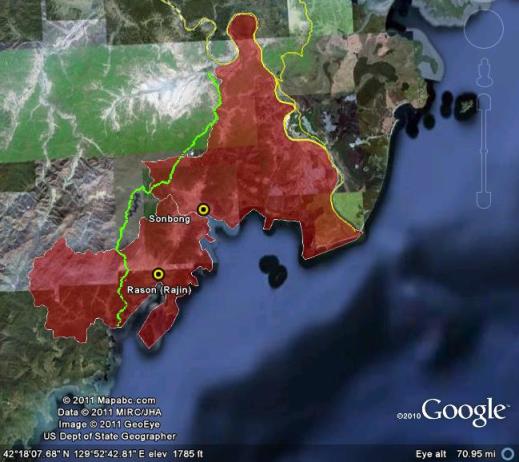
In October of last year, Premier Wen introduced the “Chang-Ji-Tu Development Plan” during his visit to North Korea, pushing hard for the North’s cooperation in developing the border region. That, along with North Korea’s extension of the contract giving Chinese companies access to Rajin Port and the latest talks during Kim’s visit to China give a clearer picture of the future direction of PRC-DPRK cooperative economic efforts.

The Chang-Ji-Tu plan to develop the Jilin and Tumen River regions calls for the establishment of an economic ‘beltway’ by 2020, and the revival of the antiquated industrial areas of China’s three northeastern provinces. To be successful, the plan requires North Korean cooperation on securing access to the East Sea. In 2008, North Korea granted China usage rights to Pier 1 in Rajin Port, and then signed an agreement with China last November on the joint development of the port into an ‘international distribution hub’ providing a link for China to the global market. China’s Jilin Province has already earmarked 3 billion yuan (500 billion won) for Rajin Port’s development.

This, along with the construction of a new border-crossing bridge on the Tumen River and other similar projects, reflects the infrastructure development plans for the border region. Construction on the new 33 meter-long bridge began last October, and China is bearing the burden of a 1.7 billion yuan (290 billion won) price tag. In March, China also began restoration of the bridge over the Tumen River linking Hunchun and North Korea, and is expected to move forward quickly with a road construction project linking the bridge to Rajin Port.

Another cooperative effort is focused on the development of the Hwangeum Industrial Complex, a free trade zone on Hwanggeum Island, in the Tumen River. Ryongaksan General Trading Company, which currently holds the development rights to Hwanggeumpyeong and Uihwa islands, is actively seeking to attract foreign investment. Kim Jong Il’s latest trip to China is seen by some as an opportunity to push for increased Chinese investment and assistance in developing the region.

Workers’ Party of Korea Unification Strategy Department Director Kim Yang Gong, as chairman of the Korea Taepung International Investment Group, traveled with Kim Jong Il in China, and it appears to have been in order to more strongly call for investment in North Korea, and the development of Rajin Port, in particular.

Beijing permitting North Korean sight-seeing tours and joint development in its three northeastern provinces indicates its support for the increasing pace of bilateral economic cooperation with Pyongyang.

Share

An affiliate of 38 North